In order to sign in, enter the email address you used to registered for the event. Once completed, you will receive an email with a verification link. Open this link to automatically sign into the site.
Register For Cube365 Events Platform
Please fill out the information below. You will recieve an email with a verification link confirming your registration. Click the link to automatically sign into the site.
I want my badge and interests to be visible to all attendees.
Checking this box will display your presense on the attendees list, view your profile and allow other attendees to contact you via 1-1 chat. Read the Privacy Policy. At any time, you can choose to disable this preference.
Raphaëlle d'Ornano of Decoding Discontinuity, founder and chief executive officer, joins theCUBE Research on AGNT Podcast episode 10 broadcasting from the New York Stock Exchange. d'Ornano analyzes recent developments in artificial intelligence and capital markets and they unpack SpaceX's Form S-1, X's AI ambitions and filings by Anthropic and OpenAI.The conversation examines practical enterprise AI adoption, including compute constraints, advantages of proprietary real-time data and product wedges such as Cursor that facilitate enterprise entry. d'Ornano contends that SpaceX comprises distinct business units and that the Form S-1 leaves the enterprise AI total addressable market unclear, describing it as a "black hole". They emphasize that conviction depends on scalable compute proprietary real-time data and product wedges to enter enterprises. The episode highlights likely market volatility, compute and supply bottlenecks and the importance of hedged investment strategies for investors.
This episode features Raphaëlle d'Ornano of Decoding Discontinuity, founder and chief executive officer. d'Ornano brings deep experience in agentic artificial intelligence, abbreviated AI, orchestration and enterprise strategy; they co-host the AGNT podcast with Gemma Allen of theCUBE at theCUBE Studio during NYSE Wired. The conversation examines Anthropic’s enterprise momentum, revenue dynamics, platform and orchestration architecture, managed agents and the evolving role of harness and application layers in enterprise deployments. theCUBE Research frames market, compute and adoption dynamics throughout the segment.d'Ornano and theCUBE Research highlight that harness-level orchestration serves as a durable moat while recent profitability and growth remain fragile. They emphasize compute constraints, tokenomics and potential shifts in enterprise software value. The discussion argues that systems of record must evolve to provide deterministic context and the operational glue that agentic systems require, informing enterprise AI strategy for vendors, investors and technology leaders evaluating valuation dynamics, revenue trajectories and deployment trade-offs.
Raphaelle d'Ornano of Decoding Discontinuity appears on AGNT Podcast Episode 8, broadcasting from the New York Stock Exchange with theCUBE Research. d'Ornano draws on their experience in artificial intelligence, referred to as AI, strategy and examines how intelligent systems reshape enterprise economics. Hosts Gemma Allen of theCUBE Research and theCUBE Research guide a focused conversation on hyperscaler capital expenditure concentration, the four-layer inference stack of chips models harness and applications, agentic pricing models and the evolving roles of AI labs cloud providers and SaaS vendors in the inference economy.Key takeaways include that hyperscalers command disproportionate capital expenditure and influence market structure, and that pricing shifts toward consumption-based agent models, d'Ornano states. They warn that compute scarcity could temporarily make compute costlier than human labor and highlight recent partnerships with Anthropic as signals that hardware and cloud arrangements are critical to scale inference affordably. The episode addresses strategic factors to consider for AI infrastructure pricing model design and deployment of large language models, referred to as LLMs, across enterprise applications.
In episode 7 of the AGNT Podcast, recorded at the New York Stock Exchange or NYSE, Raphaelle d'Ornano of Decoding Discontinuity joins host Gemma Allen of theCUBE Research for a focused discussion on agentic artificial intelligence or AI, market dynamics and enterprise orchestration.d'Ornano brings expertise in agentic systems, enterprise strategy and market positioning. They and the hosts analyze IPO narratives such as OpenAI and Anthropic, competition from open-source models including DeepSeek-R1, hardware dynamics centered on NVIDIA GPUs and CPUs and the implications for software-as-a-service or SaaS business models. The conversation examines orchestration and managed agent services and how these elements reshape product defensibility and go-to-market strategy.Key takeaways include that orchestration, rather than model scale, emerges as the primary moat. d'Ornano emphasizes the need for clear monetization narratives as compute spend rises and SaaS gross margins compress. Analysts flag geopolitical and hardware pressures from DeepSeek-R1 and NVIDIA as accelerants for higher-level application differentiation and secure managed agent deployments.
In this interview from the AGNT Podcast, recorded at the MCP Dev Summit in Times Square, Raphaelle d'Ornano joins theCUBE + NYSE Wired's Gemma Allen to break down the week's most market-moving developments in AI — from the accidental leak of Anthropic's 512,000-line Claude Code repository to the misread implications of Google's TurboQuant research. D'Ornano unpacks what the leaked codebase actually reveals: a sophisticated orchestration graph with Claude Code as the entry point for capturing user intent, and an indexing mechanism called the Pointer that solves context entropy by fetching information directly from external sources without inflating the context window.The conversation also explores the widening gap between Wall Street's interpretation of AI breakthroughs and their technical reality. D'Ornano explains how Google's TurboQuant research — an inference efficiency improvement rooted in papers from a year prior — triggered a sharp selloff in memory stocks despite HBM supply constraints remaining fully intact. She outlines her investment philosophy around "architectural resilience," evaluating how companies across the AI stack are positioned against rapid innovation cycles. The discussion turns to OpenAI's 35X revenue valuation and the unexpected difficulty of its latest funding round, raising sharper questions about retail investors gaining index-fund exposure to money-losing AI companies as Anthropic, OpenAI and xAI prepare for landmark IPOs. From the mismatch between market perception and technical nuance to the democratization risks of AI investing, d'Ornano provides a frank assessment of the industry's most consequential fault lines.
In this episode of the AGNT Podcast, Raphaelle d'Ornano, analyst and AGNT Podcast co-host, joins theCUBE + NYSE Wired's Gemma Allen to discuss how NVIDIA's GTC announcements are redrawing the battle lines for enterprise software in the agentic AI era. D'Ornano frames NVIDIA's debut of its agent toolkit as a deliberate echo of the original CUDA strategy — a move designed to make the company the foundational layer for agentic AI and the indispensable infrastructure beneath the entire ecosystem. She explains why Jensen Huang's approach is intentionally agnostic: whether LLMs or incumbent SaaS platforms win the fight to control the AI orchestration layer, NVIDIA sells more chips either way. The one scenario that threatens that dominance, d'Ornano notes, is full vertical integration by a hyperscaler supplying its own silicon.The conversation also explores the "SaaSpocalypse" — the argument that AI's disruption of traditional SaaS business models remains unfinished, regardless of macro distractions that have temporarily redirected investor attention. D'Ornano pushes back on executives drawing historical analogies to Blockbuster or the dot-com era, arguing the speed of AI progress makes those comparisons dangerously misleading, with change arriving 10 to 100 times faster than any prior technology cycle. She outlines two non-negotiable moats for software companies under pressure: proximity to human intent and unique, architecturally sound contextual data. Allen adds that what these companies urgently need is an "agentic through line" — a clear, offensive articulation of how they will create and defend value in the paradigm ahead. From the collapse of per-seat pricing to the rise of outcome-based consumption models, the episode provides a sharp framework for how enterprises and software providers can navigate the shift before the window closes.
In this episode of AGNT, recorded at the New York Stock Exchange, Raphaelle d'Ornano, analyst and co-host of the AGNT podcast, joins theCUBE + NYSE Wired's Gemma Allen to unpack how the rise of the inference economy is redrawing the competitive map for enterprise software. She revisits her earlier bearish stance on Figma, noting that after falling nearly 71% from its IPO highs, the company's Anthropic partnership represents a credible first-mover entry into the agentic orchestration layer. D'Ornano challenges the traditional vertical-versus-horizontal SaaS defensibility playbook, proposing that the more meaningful distinction is between systems of record evolving into systems of action and tools that must find their place in the emerging orchestration graph.The conversation also covers Salesforce's record quarter, where Agentforce combined with the Informatica acquisition delivered 169% growth — evidence that the system-of-record-to-system-of-action transition can produce real numbers. She frames Slack as Salesforce's most defensible agentic asset, citing "proximity to user intent" as a foundational principle of value in the agentic era. On Nvidia, d'Ornano details the inference economy thesis: as enterprise workloads turn agentic, compute demand for inference will dwarf historical training spend, even as market nervousness lingers around circular financing dependencies tied to OpenAI. She remains bullish on AMD as a strong inference-era alternative, pointing to its Meta partnership and the supply-chain complexity of deploying Blackwell at scale. From Anthropic's methodical product cadence — Claude Code to vertical plugins to security tooling — to the market's tendency to confuse narrative with product reality, d'Ornano offers a framework for separating signal from panic.
In this episode of the AGNT Podcast, recorded at the New York Stock Exchange, Raphaelle d'Ornano, co-host and enterprise technology analyst, joins theCUBE + NYSE Wired's Gemma Allen to examine who owns the orchestration layer — and the rent — in the agentic AI era. D'Ornano applies a framework built around intent, context and workflow moats to scrutinize Palantir's valuation of 71 times revenue, even after a 35% decline from late 2024 highs. She acknowledges the company's exceptional metrics — 10 consecutive quarters of growth, 70% year-over-year expansion and 138% net revenue retention — but argues the current price encodes a no-doubt scenario: that Palantir is already the orchestrator across all its domains, government and commercial alike, a claim she is not prepared to accept without debate.The conversation also explores the diverging strategies of OpenAI and Anthropic, pushing back on the tendency to treat frontier AI labs as interchangeable. D'Ornano argues Anthropic's enterprise-first approach and Claude Code's wedge into developer workflows represent a credible path to orchestration, while OpenAI's broader ambitions — from consumer advertising to the acquisition of OpenClaw — leave its durable competitive moat less defined. She underscores the fundamental risk embedded in both business models: a potentially catastrophic mismatch between spiraling compute costs and revenue, noting that Anthropic scaled from $1 billion to $14 billion in ARR in under two years. From speculating on IPO timelines for xAI, Anthropic and OpenAI to warning public investors of the single points of failure that no spreadsheet can capture, d'Ornano offers a candid framework for navigating the most consequential — and volatile — chapter in enterprise software history.
In this episode of AGNT, theCUBE + NYSE Wired's Gemma Allen and co-host Raphaëlle d'Ornano, broadcasting from the New York Stock Exchange, discuss the emergence of Moltbook, the rapid rise of agentic AI and what both mean for enterprise markets and public investors. D'Ornano frames Moltbook — a Reddit-like platform where AI agents interact autonomously via API calls — as a meaningful discontinuity, noting the platform reached 1.5 million agents almost immediately with growth unlike anything seen from human social networks. The discussion highlights how Moltbook signals the arrival of what d'Ornano terms the "inference economy," where agents drive massive compute demand at scale — a dynamic that briefly lifted stocks including Cloudflare and Apple's Mac mini sales even before most observers knew what Moltbook was.The conversation also explores the significant security and legal gaps exposed by the platform, including terms and conditions that place content responsibility on agents rather than humans — a crack the legal system has yet to address. Allen and d'Ornano turn to the broader market turbulence shaking tech stocks, examining how enterprise CFOs are allocating 80% of budgets to AI while expecting tangible returns and how announcements from Google, Meta and Oracle reveal the staggering CapEx reality behind the buildout. D'Ornano argues that legacy SaaS companies face an existential challenge, not from agents replacing software but from the urgent need to redefine their moat — shifting from per-seat models to consumption-based pricing and repositioning as orchestrators close to user intent. From Elon Musk's vision of inference in space through a potential SpaceX-xAI vertical integration to the earnings volatility ahead, the episode maps the forces reshaping enterprise tech in real time.
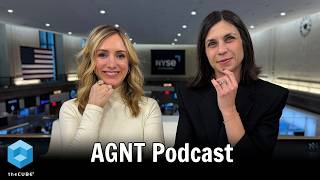
The AGNT Podcast, hosted by Gemma Allen and Raphaëlle d’Ornano, takes listeners inside the rise of AI agents and the new era of enterprise automation. Through conversations with technology leaders, founders and innovators, the podcast explores how agentic systems are reshaping workflows, decision-making and the future of business.