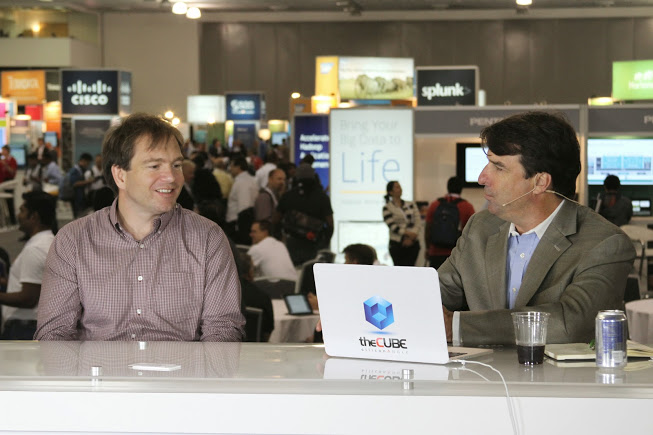
At this week's #HadoopSummit, Actian promised to make waves with their teaser hashtag campaign #CutHadoopLoose. It appears, with their Vector product, they have done just that. Professor Peter Boncz, Senior Research Scientist at the University of Amsterdam and adviser to Actian discussed how the columnar database he, along with his PhD student, designed is a revolutionary analytical database system that is leading the pack in the single server category.
"It is the fastest database engine on the market," Boncz proudly stated. "It pioneered a number of techniques that are becoming very popular."
Prior to developing what was originally known as Vectorwise, Boncz had experience in the design and build of analytical database systems. The design that led to his Vectorwise product was actually one of the earliest column storage databases.
"It started the wave of having a specialized analytical database engine in a relational domain," he stated. "After working on that for a few years, we had some new ideas. We saw new opportunities. These got realized in Vectorwise."
Vectorwise, originally created while Hadoop was still in its infancy, is, according to Boncz, a technology that really is native to the Hadoop infrastructure.
"I kind of look at it as we got lucky, in the sense that the design of how Vectorwise is really fits Hadoop and HDFS (Hadoop Distributed File System)," he stated. "HDFS is really difficult to port an existing database system to because it is only a file system. Typically it won't work to do a straight port."
The columnar storage employed by Vectorwise is not, he explains, a friend of data in place. "In a column store, you are looking for other ways of updating data. This is what is in the DNA of Vectorwise," he states. It is that DNA that made it really easy for his design to go native on the HDFS. "The second pillar to being native to Hadoop is YARN integration. You've got to play with the resource management of Hadoop to not be crashed by other jobs and also to not get in the way of the other users on the Hadoop cluster."
Boncz believes the enterprise should strongly consider Actian Vortex rather than relying on what he calls "wrapped legacy". Often times a SQL/Hadoop solution will be added, as a component, to a legacy database system that was never designed for analytical workloads. The caveat to this option is that it is not suited to perform fast query executions. "That's why [Vortex] is so much faster than those legacy systems," he explains. Additionally, Vortex betters the competition because it is able to perform trickle updates rather than having to shut down the HDFS for system updates.
"For SQL users and use cases that are considered mature, this is a big drawback," he states. "Vortex is going to change that." This is because Vortex performs differential updates that allow you to continue to write on the side. "This allows Vortex to support updates without running into HDFS troubles. I think with that it will be unique in the market."
The Vector Hadoop Edition, known as Vortex, will be an Actian commercial product that will launch an evaluation version at the end of this month. It will be available directly from the Actian website. Boncz also suggests that anyone wanting to go a little more in-depth on how Vortex works and how it can help their business should visit a recently written blog post here.
Forgot Password
Almost there!
We just sent you a verification email. Please verify your account to gain access to
Hadoop Summit 2014 | San Jose. If you don’t think you received an email check your
spam folder.
In order to sign in, enter the email address you used to registered for the event. Once completed, you will receive an email with a verification link. Open this link to automatically sign into the site.
Register For Hadoop Summit 2014 | San Jose
Please fill out the information below. You will recieve an email with a verification link confirming your registration. Click the link to automatically sign into the site.
You’re almost there!
We just sent you a verification email. Please click the verification button in the email. Once your email address is verified, you will have full access to all event content for Hadoop Summit 2014 | San Jose.
I want my badge and interests to be visible to all attendees.
Checking this box will display your presense on the attendees list, view your profile and allow other attendees to contact you via 1-1 chat. Read the Privacy Policy. At any time, you can choose to disable this preference.
Select your Interests!
add
Upload your photo
Uploading..
OR
Connect via Twitter
Connect via Linkedin
EDIT PASSWORD
Share
Forgot Password
Almost there!
We just sent you a verification email. Please verify your account to gain access to
Hadoop Summit 2014 | San Jose. If you don’t think you received an email check your
spam folder.
In order to sign in, enter the email address you used to registered for the event. Once completed, you will receive an email with a verification link. Open this link to automatically sign into the site.
Sign in to gain access to Hadoop Summit 2014 | San Jose
Please sign in with LinkedIn to continue to Hadoop Summit 2014 | San Jose. Signing in with LinkedIn ensures a professional environment.
Are you sure you want to remove access rights for this user?
Details
Manage Access
email address
Community Invitation
Peter Boncz | Hadoop Summit 2014
At this week's #HadoopSummit, Actian promised to make waves with their teaser hashtag campaign #CutHadoopLoose. It appears, with their Vector product, they have done just that. Professor Peter Boncz, Senior Research Scientist at the University of Amsterdam and adviser to Actian discussed how the columnar database he, along with his PhD student, designed is a revolutionary analytical database system that is leading the pack in the single server category.
"It is the fastest database engine on the market," Boncz proudly stated. "It pioneered a number of techniques that are becoming very popular."
Prior to developing what was originally known as Vectorwise, Boncz had experience in the design and build of analytical database systems. The design that led to his Vectorwise product was actually one of the earliest column storage databases.
"It started the wave of having a specialized analytical database engine in a relational domain," he stated. "After working on that for a few years, we had some new ideas. We saw new opportunities. These got realized in Vectorwise."
Vectorwise, originally created while Hadoop was still in its infancy, is, according to Boncz, a technology that really is native to the Hadoop infrastructure.
"I kind of look at it as we got lucky, in the sense that the design of how Vectorwise is really fits Hadoop and HDFS (Hadoop Distributed File System)," he stated. "HDFS is really difficult to port an existing database system to because it is only a file system. Typically it won't work to do a straight port."
The columnar storage employed by Vectorwise is not, he explains, a friend of data in place. "In a column store, you are looking for other ways of updating data. This is what is in the DNA of Vectorwise," he states. It is that DNA that made it really easy for his design to go native on the HDFS. "The second pillar to being native to Hadoop is YARN integration. You've got to play with the resource management of Hadoop to not be crashed by other jobs and also to not get in the way of the other users on the Hadoop cluster."
Boncz believes the enterprise should strongly consider Actian Vortex rather than relying on what he calls "wrapped legacy". Often times a SQL/Hadoop solution will be added, as a component, to a legacy database system that was never designed for analytical workloads. The caveat to this option is that it is not suited to perform fast query executions. "That's why [Vortex] is so much faster than those legacy systems," he explains. Additionally, Vortex betters the competition because it is able to perform trickle updates rather than having to shut down the HDFS for system updates.
"For SQL users and use cases that are considered mature, this is a big drawback," he states. "Vortex is going to change that." This is because Vortex performs differential updates that allow you to continue to write on the side. "This allows Vortex to support updates without running into HDFS troubles. I think with that it will be unique in the market."
The Vector Hadoop Edition, known as Vortex, will be an Actian commercial product that will launch an evaluation version at the end of this month. It will be available directly from the Actian website. Boncz also suggests that anyone wanting to go a little more in-depth on how Vortex works and how it can help their business should visit a recently written blog post here.