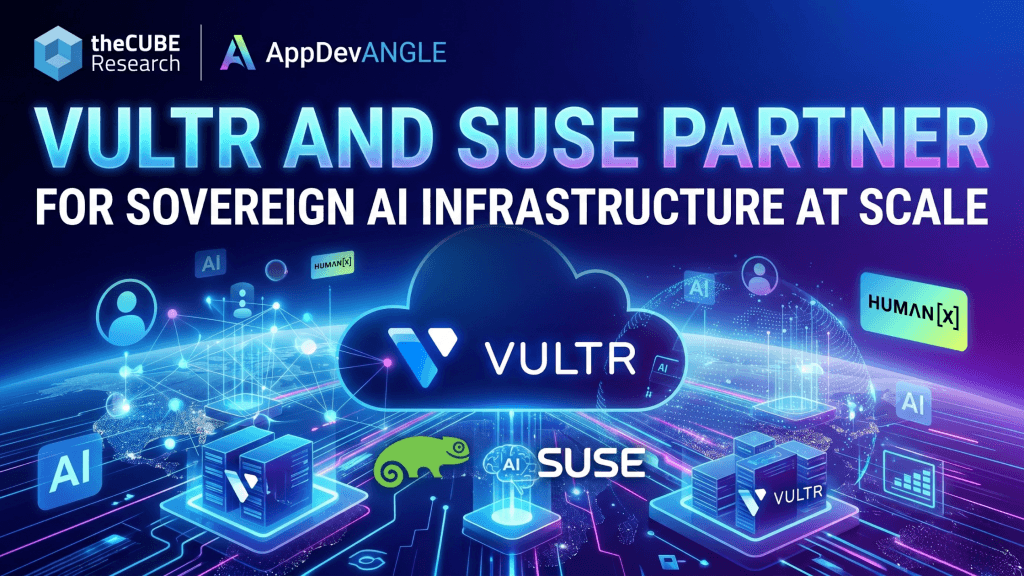
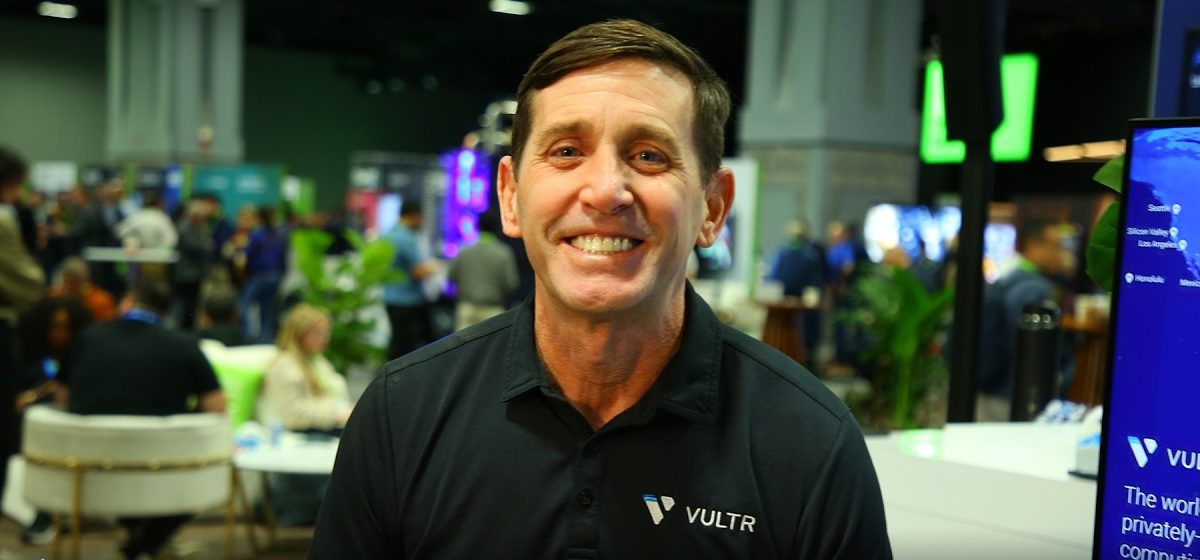
Kevin Cochrane of Vultr, chief marketing officer, brings 14 years of cloud operating experience to this SUSECON 2026 conversation. Paul Nashawaty of theCUBE Research hosts the discussion. The session examines the Vultr-SUSE partnership, Kubernetes, global GPU and cloud infrastructure, integration with SUSE Linux and Rancher, and the practical implications for enterprises adopting artificial intelligence. Abbreviated as AI in subsequent references, the term encompasses AI-native containerized applications, multi-region deployments and edge computing strategies.
Cochrane emphasizes openness, efficiency and governance as core principles. They explain enterprises move from AI experimentation to implementation, prioritizing openness for innovation, performance-per-dollar and predictable pricing for cost efficiency, and strict data residency to ensure cloud sovereignty. Nashawaty notes the Vultr-SUSE alliance aims to deliver scalable, compliant and cost-transparent platforms for enterprise AI deployments that support developer experience, multi-cloud strategies and accelerated model deployment on GPU-enabled infrastructure.
Forgot Password
Almost there!
We just sent you a verification email. Please verify your account to gain access to
SUSECON 2026. If you don’t think you received an email check your
spam folder.
In order to sign in, enter the email address you used to registered for the event. Once completed, you will receive an email with a verification link. Open the link to automatically sign into the site.
Register for Susecon 2026
Please fill out the information below. You will receive an email with a verification link confirming your registration. Click the link to automatically sign into the site.
You’re almost there!
We just sent you a verification email. Please click the verification button in the email. Once your email address is verified, you will have full access to all event content for Susecon 2026.
I want my badge and interests to be visible to all attendees.
Checking this box will display your presense on the attendees list, view your profile and allow other attendees to contact you via 1-1 chat. Read the Privacy Policy. At any time, you can choose to disable this preference.
Select your Interests!
add
Upload your photo
Uploading..
OR
Connect via Twitter
Connect via Linkedin
EDIT PASSWORD
Share
Forgot Password
Almost there!
We just sent you a verification email. Please verify your account to gain access to
SUSECON 2026. If you don’t think you received an email check your
spam folder.
In order to sign in, enter the email address you used to registered for the event. Once completed, you will receive an email with a verification link. Open the link to automatically sign into the site.
Sign in to gain access to SUSECON 2026
Please sign in with LinkedIn to continue to SUSECON 2026. Signing in with LinkedIn ensures a professional environment.
Are you sure you want to remove access rights for this user?
Details
Manage Access
email address
Community Invitation
Kevin Cochrane, VULTR
Kevin Cochrane of Vultr, chief marketing officer, brings 14 years of cloud operating experience to this SUSECON 2026 conversation. Paul Nashawaty of theCUBE Research hosts the discussion. The session examines the Vultr-SUSE partnership, Kubernetes, global GPU and cloud infrastructure, integration with SUSE Linux and Rancher, and the practical implications for enterprises adopting artificial intelligence. Abbreviated as AI in subsequent references, the term encompasses AI-native containerized applications, multi-region deployments and edge computing strategies.
Cochrane emphasizes openness, efficiency and governance as core principles. They explain enterprises move from AI experimentation to implementation, prioritizing openness for innovation, performance-per-dollar and predictable pricing for cost efficiency, and strict data residency to ensure cloud sovereignty. Nashawaty notes the Vultr-SUSE alliance aims to deliver scalable, compliant and cost-transparent platforms for enterprise AI deployments that support developer experience, multi-cloud strategies and accelerated model deployment on GPU-enabled infrastructure.
In this interview from SUSECON 2026 in Prague, Kevin Cochrane, chief marketing officer of Vultr, joins theCUBE Research's Paul Nashawaty to discuss how the Vultr and SUSE partnership is equipping enterprises to move from AI experimentation to full-scale implementation. Cochrane frames enterprise AI readiness around three pillars: openness, efficiency and governance. He explains why openness — rooted in SUSE's open-source leadership — is critical for teams building AI-native applications, while efficiency means delivering peak performance and resilience within...Read more
exploreKeep Exploring
What are the key priorities enterprises consider when moving from AI experimentation to large‑scale implementation of AI‑native applications?add
How does Vultr support customer deployments and modern applications?add
What are the benefits of your partnership with SUSE for enterprises and developers?add
What joint innovations or integrations should customers expect from SUSE and Vultr over the next 12–24 months, particularly around edge computing and developer experience?add
>> Welcome back to SUSECON 2026. I am Paul Nashawaty, practice lead and principal analyst for the AppDev practice at theCUBE Research. And I am excited for our next session here to talk with Kevin Cochrane from Vultr. Well, Kevin, welcome to our session today.
Kevin Cochrane
>> So great to see you again, Paul. Great to be back.
Paul Nashawaty
>> Yeah, it's awesome to have you here. We're here at SUSECON 2026. It stands as the key industry gathering of open source leaders, architects, enterprise IT decision makers, really looking to shape the future of cloud infrastructure through Linux, Kubernetes, and cloud-native innovation. There's over hundreds of sessions here spanning from AI, edge computing, digital sovereignty. And the event is really highlighting the shift towards resiliency, heterogeneous environments, and where organizations are prioritizing unified management, cost optimization, and control across multi-cloud or on-prem systems. But let's talk about the ecosystem. The partnership between Vultr and SUSE brings together that Kubernetes and AI platform with a global cloud and GPU infrastructure to deliver open, scalable, cost-efficient, cloud-native solutions while reducing vendor lock-in. Was I even closer? Is that on?
Kevin Cochrane
>> You absolutely nailed it there. `I think there's an important point here for the audience. You and I have been talking about this for quite some time now, which is, we're moving from the age of experimentation and AI to the age of implementation. This is the time when now enterprises are looking to roll out new AI-native applications, new AI and agentic AI services, and they're looking to do that globally. And enterprise leaders value three things. Number one, they value openness. Openness is the key to innovation. Openness is the key for them to be able to stay on the cutting edge of new technology. Openness is the key for them to get internal productivity for their teams because they're able to participate and collaborate with an entire community. Obviously, openness is key to our mission here at Vultr. And of course, the pioneer of open source, the pioneer of open communities is SUSE, and we couldn't be more honored to partner with SUSE in helping enterprises deliver on their goal of having open systems as they're building the future of AI-native applications. The other thing enterprises care about is they care about efficiency. Efficiency is a combination of performance and resiliency. You want incredible performance, and you want incredible resiliency, but it also has to be something that fits within a budget. Sometimes it's nice to operate like a little AI startup where you can get a whole bunch of capital from a venture capitalist, and you don't have to worry about profitable growth, but that's just not the nature of everyday enterprises. Everyday enterprises manage against a P&L. They have a budget. They need to innovate. They need to build open systems. But they need not only incredible performance and resilience, but it needs to fit a budget. So it's efficiency that truly matters for the enterprise. And again, this is the combination of Vultr working with SUSE to make sure you have the most efficient infrastructure, the performance, the resilience, and the cost-effectiveness that you need to deliver enterprise AI-native applications of scale. Of course, the last thing that enterprises care about is they care about governance and compliance. It's one thing to innovate. It's one thing to innovate with great efficiency, but you also need to do that with very little risk to the business. So governance, compliance truly matters. If there's one thing that we pride ourselves on in working with SUSE, it's making certain that we're focused on that enterprise risk reduction, the enterprise compliance, so that as new and emerging regulations around data residency and sovereignty emerge, that we have the right infrastructure in place for your CISO, for your CFO, for your CEO to run the business at scale safely.
Paul Nashawaty
>> Yeah, Kevin, I hear you. There's a lot there to talk about. One thing I do know at SUSECON and SUSE in general is, choice happens. That's their tagline from last year. They're carrying that same thing forward, and openness is definitely a big factor here. So let's talk about strategic alignment and customer impact.
Kevin Cochrane
>> Yeah.
Paul Nashawaty
>> When we look at that, what gap in the cloud or edge market does SUSE and Vultr partnership uniquely addressed, and why is now the right time to formalize this collaboration? And then on top of that, I want to add in the, how does combining SUSE's enterprise Linux and Kubernetes platforms with Vultr? Because you're already doing a lot of this, how does this combining it together in a global cloud footprint change the economics and operations that you were just talking about for customer deployments and modern applications?
Kevin Cochrane
>> Yeah. So just a little bit about Vultr, because that'll help answer the question, is we have a 14-year operating history. We're oftentimes termed a neocloud, but we're not a neocloud. We've been around the block for 14 years, helping platform engineers and cloud-native engineers build and scale some of the most ambitious workloads around the planet. We operate fully 32 global data center regions. We help you reach 90% of the world's population in two to 40 milliseconds. We're all about incredible performance delivered with the maximum cost efficiency, with the greatest security and compliance. And this is why we are the successful business profitable since day one that we've always been. As one of the first to markets with cloud GPUs in order to support the scaling of new AI-native applications, we've brought those same core operating personal maximum performance, cost efficiency, governance, compliance to the forefront. The benefit of the partnership with SUSE is that now, as enterprises are moving to implementation, they need rock-solid, resilient-performing, cost-efficient, compliant infrastructure at the operating system level, at the PaaS layer, the Kubernetes layer. And that is where we have 100% vision and execution alignment with SUSE. And that is what we are looking to arm developers all around the world with. We have over 600,000 developers on our platform across 185 different countries, and we want to make certain that we give them choice, freedom, and flexibility. SUSE likes to say choice happens. Let's make sure that they make the right choices and harness an entire open ecosystem, containerized applications, containerized services that they can build and deploy on SUSE Linux and on SUSE Rancher and SUSE AI.
Paul Nashawaty
>> Yeah, no, absolutely, Kevin. You talked about a couple of the things I want to double-click down on. One thing you mentioned, we're here in Prague, we're here talking about SUSECON and being in Europe. One of the competitive position pieces that you kind of touched on, I don't want to gloss over, I want to make sure we give this at the right time, is the market is dominated by these hyperscalers. We know that. This partnership you're talking about, how does it differentiate itself in terms of performance sovereignty? Sovereignty is a big one, and cost predictability. Those are the things that you touched on. We talked about this. I know we talked about it in Amsterdam at KubeCon. We talked about it at GTC. We talked about it HumanX. Let's talk about it and make sure that the audience understands it.
Kevin Cochrane
>> Yeah. Is a really good point, Paul, which is, at the end of the day, the market was heavily dominated by three traditional public cloud platforms. Whenever you have market concentration, unfortunately, you will have a lot of hidden costs. Some of those hidden costs comes in terms of open innovation, much of the hidden cost terms, what actually is reflected in your monthly bill. So we here at Vultr have always operated our own business with maximum cost efficiency, which means, just on the core cloud compute side, we deliver better performance at a dramatically lower cost, and we're between 50 and 90%, believe it or not, lower cost than traditional hyperscalers and traditional cloud compute. Overall, for our AI infrastructure stack, we're going to be delivering anywhere, on recent benchmarks, like an 82% performance per dollar advantage. It's a radically different cost structure that we're able to deliver same global scale, same security and compliance, just radically different cost structure, better performance per dollar, bar none. It gets to the other part to that, which is just the simplicity and the transparency of the cost structure as well. The most important thing that you need as an enterprise is you need predictability. You need predictability of performance, you need predictability of uptime, you need predictability in terms of your monthly bill for budgeting purposes. One of our other hallmarks is the simplicity and transparency and the predictability of our pricing, best performance, best uptime, lowest price, most predictable price kind of guarantee. The other part of it is when you're looking at an alternative hyperscaler, for the very first time, you have a provider like a Vultr that understands the requirements around data residency, understands where the market is headed to in terms of operational sovereignty in different geographic regions. We were architected from day one with data residency at the core of our infrastructure. We were architected from day one around the requirements of operational sovereignty in given regions. Every region has its own autonomous zone. Your data that you put in your region never leaves your region. There's no third-party service outside the region that touches or processors or manipulates or accesses your data. There's no Vultr process that does that. Your data is your data. It's controlled by you in a given region. Your applications run in your region and have no dependencies on any external service outside of our region other than a global control plane, which can be disconnected for any on-demand sovereign cloud deployment requirement that you may have. So it's a radically different architecture and it's a radically different approach, not only in terms of the performance per dollar, not only in terms of the predictability of the pricing, but also in terms of the way it's architected to support new and emerging requirements around sovereignty.
Paul Nashawaty
>> Yeah, Kevin, all incredibly valuable data points, all incredibly valuable points that you're making here. One thing I don't want to miss is, with AI and workload evolution, AI workloads increase, and SUSE and Vultr together are optimizing infrastructure and orchestration to support scalability too.
Kevin Cochrane
>> Yes, correct.
Paul Nashawaty
>> So scalability and distributed AI applications is important to talk about. I don't want to gloss over that point because distributed environments and scalability does come with this whole fact.
Kevin Cochrane
>> Yes, exactly. This still actually ties to notions of sovereignty as well, because if you're building and scaling a global agentic AI application, you're operating in multiple regions. The data that you're marshaling in India, the data that you're marshaling in Germany, the data that you're marshaling in France, the data that you're marshaling in Canada, guess what? It needs to only be provisioned to local GPU and CPU clusters and vector stores in region for serving the needs of your customers in that region. So when you're looking to scale globally, you need to make sure you're scaling in a legally compliant manner so that the data that you're leveraging as part of your agentic AI system, that entire agentic system is able to run in each isolated autonomous zone so that the data can be protected, so that the consumer experience can be protected. Of course, when you're operating in that distributed globally scalable environment, you want to make sure that you're doing at the lowest possible cost of greatest operational efficiency because you're scaling up infrastructure in so many different regions. So the industrial efficiency, the industrial scale of Vultr mapped with SUSE, I think, is the future of enterprise AI.
Paul Nashawaty
>> Okay. Well, speaking of future, we're sitting here at SUSECON 2027, a year out from now looking ahead, what joint innovations or integrations should customers expect from SUSE and Vultr over the next, say, 12 to 24 months, particularly around edge computing and developer experience? Because this is a big area.
Kevin Cochrane
>> Right. Right. Well, I think that's great. So we have this incredible commitment to open ecosystems, and I think the future is bright in terms of enabling a developer experience where developers have access to a marketplace of open composable stacks, where developers can share precomposed cloud stacks built and running on Vultr and on SUSE, so they can start sharing templates and best practices for different types of use cases that they're deploying within their enterprise. Building a new Agentic AI application, why should it have to reinvent the wheel? Can we crowdsource? Can we start sharing templates, start sharing best practices? I think the future of open community development is going to be bright and it's going to be brought to you by SUSE and Vultr.
Paul Nashawaty
>> Kevin, it's always a pleasure to talk to you. This is very insightful, super exciting. I'm really excited about your partnership between Vultr and SUSE. It's really, really good stuff. So thanks for being on today.
Kevin Cochrane
>> Thank you so much.
Paul Nashawaty
>> Of course. From theCUBE's research perspective, the Vultr and SUSE partnership underscores a broader market inflection point. Enterprises can no longer choose between flexibility and control. They're demanding both. From an alliance like this, we're seeing this defining the next era of cloud infrastructure by delivering open, sovereign, and AI-ready platforms at scale. So stay tuned into theCUBE for your leading source of tech news as we come back live for you from SUSECON 2026 in Prague.










 Paul Nashawaty