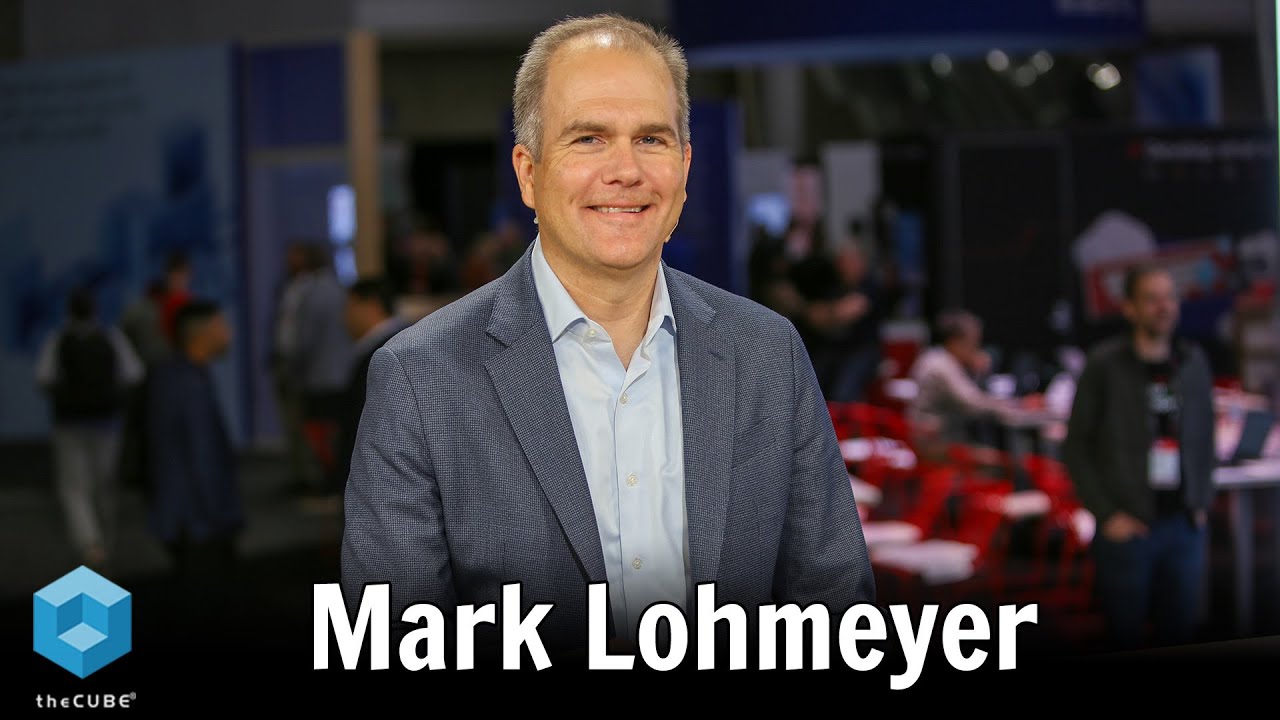
Mark Lohmeyer, Vice President and General Manager of Compute and Artificial Intelligence Infrastructure at Google Cloud, joins Rob Strechay of theCUBE Research and Rebecca Knight of SiliconANGLE Media during Red Hat Summit 2025 to discuss Google Cloud’s latest collaborations and advancements in artificial intelligence infrastructure.
In this segment, Lohmeyer explores Google Cloud's focus for 2025, which centers on inference workloads and the evolution of their infrastructure to support increasingly complex AI models. They emphasize Google’s strong presence in the open-source community, referencing technologies such as JAX and Kubernetes, and discuss the emerging synergies with Red Hat to address AI challenges, particularly in reasoning models.
Key points from the discussion include Google’s initiatives in low-cost high-performance AI solutions using tensor processing units and graphics processing units, as well as the open-source project LLMD, which offers flexibility across various computing needs. Lohmeyer states that Google’s strategic collaborations aim to enhance customer outcomes, focusing on a consistent platform that provides both choice and operational consistency across vendors and infrastructures.
Forgot Password
Almost there!
We just sent you a verification email. Please verify your account to gain access to
Red Hat Summit + AnsibleFest 2025. If you don’t think you received an email check your
spam folder.
In order to sign in, enter the email address you used to registered for the event. Once completed, you will receive an email with a verification link. Open this link to automatically sign into the site.
Register For Red Hat Summit + AnsibleFest 2025
Please fill out the information below. You will recieve an email with a verification link confirming your registration. Click the link to automatically sign into the site.
You’re almost there!
We just sent you a verification email. Please click the verification button in the email. Once your email address is verified, you will have full access to all event content for Red Hat Summit + AnsibleFest 2025.
I want my badge and interests to be visible to all attendees.
Checking this box will display your presense on the attendees list, view your profile and allow other attendees to contact you via 1-1 chat. Read the Privacy Policy. At any time, you can choose to disable this preference.
Select your Interests!
add
Upload your photo
Uploading..
OR
Connect via Twitter
Connect via Linkedin
EDIT PASSWORD
Share
Forgot Password
Almost there!
We just sent you a verification email. Please verify your account to gain access to
Red Hat Summit + AnsibleFest 2025. If you don’t think you received an email check your
spam folder.
In order to sign in, enter the email address you used to registered for the event. Once completed, you will receive an email with a verification link. Open this link to automatically sign into the site.
Sign in to gain access to Red Hat Summit + AnsibleFest 2025
Please sign in with LinkedIn to continue to Red Hat Summit + AnsibleFest 2025. Signing in with LinkedIn ensures a professional environment.
Are you sure you want to remove access rights for this user?
Details
Manage Access
email address
Community Invitation
Vikram Kanodia, Cohesity & Evong Chung, Red Hat
Mark Lohmeyer, Vice President and General Manager of Compute and Artificial Intelligence Infrastructure at Google Cloud, joins Rob Strechay of theCUBE Research and Rebecca Knight of SiliconANGLE Media during Red Hat Summit 2025 to discuss Google Cloud’s latest collaborations and advancements in artificial intelligence infrastructure.
In this segment, Lohmeyer explores Google Cloud's focus for 2025, which centers on inference workloads and the evolution of their infrastructure to support increasingly complex AI models. They emphasize Google’s strong presence in the open-source community, referencing technologies such as JAX and Kubernetes, and discuss the emerging synergies with Red Hat to address AI challenges, particularly in reasoning models.
Key points from the discussion include Google’s initiatives in low-cost high-performance AI solutions using tensor processing units and graphics processing units, as well as the open-source project LLMD, which offers flexibility across various computing needs. Lohmeyer states that Google’s strategic collaborations aim to enhance customer outcomes, focusing on a consistent platform that provides both choice and operational consistency across vendors and infrastructures.
Vikram Kanodia, vice president of global alliances at Cohesity Inc., and Evong Chung, senior director of solutions architecture at Red Hat Inc., join theCUBE’s Rebecca Knight and Rob Strechay during Red Hat Summit 2025 to explore the power of partnerships in modern data security. The conversation focuses on AI-driven protection, virtualization and how collaboration between Red Hat and Cohesity supports enterprise resilience.
Chung shares perspectives on ecosystem innovation and the role of OpenShift Virtualization in securing dynamic cloud environments...Read more
exploreKeep Exploring
What do organizations need to consider in the current cyber threat landscape?add
What are the benefits and aspects of the partnership between the companies Red Hat, Cohesity, and IBM in relation to protecting OpenShift containerized workloads and modernizing Spectrum Protect customers?add
What has the acquisition of Cohesity and Veritas resulted in for the market and for customers in terms of data security and innovation?add
What are some ways in which the company plans to meet customer needs in terms of protecting virtualization technologies and modernization efforts in the future?add
>> Good afternoon everyone, and welcome back to theCUBE's live coverage of Red Hat Summit AnsibleFest 2025. We are smack dab in the middle of day two of three days wall-to-wall coverage. I'm your host, Rebecca Knight, alongside my co-host and analyst, Rob Strechay. Rob, one of the buzzwords that we're hearing a lot is security here. We're talking a lot about data protection, resilience and business resilience too.
Rob Strechay
>> Yeah, I mean, I think when you talk about AI and you talk about AI is powered by data, and all of those things are just so key to how people are going to really get their ROI out of that data in a way that keeps them safe.
Rebecca Knight
>> Exactly, exactly. With that, I would like to introduce our next guest. We have Vikram Kanodia, vice president, technology and Cloud partnerships at Cohesity. Welcome, Vikram.
Vikram Kanodia
>> Thank you for having me here.
Rebecca Knight
>> And Evong Chung, senior director, ecosystems tech sales at Red Hat. Thank you so much for coming on theCUBE.
Evong Chung
>> Nice to be here. Thank you for being here with us at Summit.
Rebecca Knight
>> Yeah. So Vikram, I'm going to start with you because I want to hear about the Red Hat Cohesity partnership, but before we even get into the partnership and where it is today, talk a little bit about the cyber threat landscape right now that so many organizations are facing.
Vikram Kanodia
>> Absolutely. It's a menace. We liken it to pandemic, right? Everybody is going to get infected at some point. The question is how quickly can you recover from it? And it's the same with the enterprises. Especially right now, you have nation-state actors, you've got different companies trying to access the data, and all of us have to help our enterprise customers protect that data. So that's where Cohesity comes in. We are a leader in AI powered data security. We help customers recover from these cyber attacks in a fast way. We make the data secure, and that's where our partnership with Red Hat comes in as well. So we are very proud to have be protecting the world's data. As Sanjay Poonen, our CEO says, we've got hundreds of exabytes of data in the protection as well.
Rob Strechay
>> Evong, kind of help us put in place where Cohesity sits, how the partnership came about and where it stands today.
Evong Chung
>> Yeah, absolutely. Absolutely. So as you all know, there was significant disruption in the virtualization space last year. And so we have an offering on market called OpenShift Virtualization, which is the marriage between two really exciting technologies, Kubernetes and KBM, which Red Hat has been investing in the community for a combined 30 years. So mature, tried and true, KBM or kernel based virtualization is underpinning the cloud providers today. So tremendous scale that these technologies run at. And to take those two and marry them together, to take the power of KBM and the awesomeness of Kubernetes and unify them to a single platform for containers for now VMs, and to take it to an open hybrid cloud model has been a story that has really resonated with our customers. With the disruption of last year, we recognize, to your point, that data is the lifeblood of the enterprise. And for us to be a trusted virtualization vendor, we need a powerful cyber-realization story. So actually Cohesity was one of the first companies that we reached out to from a partnership perspective. We have a long-standing partnership, but around this new opportunity and really what our message, our joint message to our mutual customers that were in crisis would be. And so our CEOs connected, they've actually known each other for a very long time, Sanjay Poonen and Matt Hicks. And we talked about how we could approach customers together to take them on this journey to a modern hypervisor.
Rebecca Knight
>> So as you said, I mean it is a journey and as you also said, everyone's going to get infected. The question is, how quickly you're able to bounce back, recover and how really at the core is how resilient is your organization. So talk a little bit about how the CEOs came together and the teams came together and what your approach to customers is.
Vikram Kanodia
>> Maybe I can start and you can jump in. We've had a long-standing collaboration with Red Hat. Our platform runs on Red Hat Linux, but with the changes in the market, with customers looking to adjust their mix of virtualization technologies, protecting OpenShift workloads is a demand that we see from a lot of our large enterprise customers. And as Evong said, our CEO, Sanjay Poonen has a strong history in virtualization. He knows Matt Hicks. So with the changing dynamics of our customer and what they need, it made sense for us to work together. And that's how the partnership on protecting OpenShift containerized workloads came through. The third aspect of the partnership is we are also partnered with IBM, the payment company of Red Hat. IBM is an investor in Cohesity, and we are the only companies that they have OEM'd our product to take and modernize their Spectrum Protect customers using the Cohesity Data Protect as part of the defender portfolio. So there's a lot of goodness between the two companies from Red Hat Linux to us protecting OpenShift workloads to the IBM partnership as well.
Evong Chung
>> And to your question, we're connected at all levels of the organization, certainly our leadership as we discussed, but also our sales, our customer success organizations and engineering as well. So part of reaching out to Cohesity was also to get their feedback and advice on where we should take the roadmap and the future as it pertains to data protection and cyber resiliency. So as we're innovating upstream in the Kubernetes community, we're getting their feedback and benefiting from their many years of experience in the virtualization space to make sure that really resonates with our enterprise customers.
Rob Strechay
>> Cohesity made a small little acquisition.
Vikram Kanodia
>> Small.
Rob Strechay
>> Few billion, what's a few billion among friends, right? But help folks that are at home to understand how that's going and what it's kind of led to at this point. Because I think, again, as the changing threat landscape and cyber resilience has become a C-suite and sometimes unfortunately SEC-related type of event, help us understand how the things are going with Veritas and Cohesity now that you're one company.
Vikram Kanodia
>> Yeah, no, absolutely, happy to talk about that. But as you said, right, it's a C-level discussion. It's a board-level discussion. Every board is looking at how secure the data is. So we completed the acquisition in December, so it's kind of nearly six months in and it's going beyond our wildest dreams. The combination of Cohesity and Veritas has produced the market leader. We've got over 13,600 customers, 85% of the Fortune 100, 70% of the Fortune 500. We are protecting hundreds of exabytes of data. The world's data is protected by Cohesity and Veritas. The way we are looking at the merger is, it enables our customers, both the Veritas side of the house and the Cohesity side of the house, a more robust enterprise-grade black saw. We have twice the engineering capacity as our nearest competitor, which allows us to innovate and protect the customer's data in a way that's differentiated than a competition. It allows us to partner with thought leaders like Red Hat, like IBM, like other partners, to make sure we are taking an ecosystem approach to protecting our customers. So net-net, we are very happy with that acquisition. A lot of goodness coming in for our joint customers and looking forward to serving our joint customers even in a better way.
Rebecca Knight
>> So just to piggyback on that a little bit, Cohesity, rapidly grown, number one in data protection. 13,000 enterprise customers, more than $1.7 billion in revenue. There's of course the merger, but what else is driving this momentum, would you say?
Vikram Kanodia
>> I think, as Evong said, data is the lifeblood of organizations. I mean, the amount of data being generated day in, day out is increasing, and as the data increases, the paradigm to protect this data also increases. So really the growth driver here is how can we protect the world's data? And that's the mission that I wake up in the morning and think about all the large customers that have trusted their data to us. How can we live up to that responsibility and protect the data? So that's one. The second thing is with AI. Typically backup data used to be dark data. Enterprises did not know what's sitting in this backup data. OEC's unique architecture allows customers to peek inside this backup data and analyze it. We are the only company in our industry that NVIDIA has invested in because they love the technology. And the next frontier that we want to serve our customers on is enabling them to look at this backup data and do analytics on this data and generate meaningful business insights on the data. So that's what particularly excites me on where this industry is going and where we are going.
Rob Strechay
>> Well, did you want to add or you-
Evong Chung
>> Absolutely.
Rob Strechay
>> Yeah, go ahead.
Evong Chung
>> So the majority of my career at Red Hat has actually been in the public sector working with US federal agencies. So I can tell you how much of this resonates with the conversations that I've had with CIOs of agencies that the cyber threat is so much top of mind. And that's why I think our partnership is so exciting because we can take the cyber resiliency features that Cohesity brings to the table and through OpenShift and OpenShift Virtualization in a unified platform, take that from containerized workload to VMs to now AI. And I think that's a really powerful story that we can take our customers on that journey together.
Rob Strechay
>> So building off of that, one of the things I'm interested in is you're on the tech sales side of things, and so you're helping people from a solutioning perspective.
Evong Chung
>> Mm-hmm.
Rob Strechay
>> What are some of the solutions you see where Cohesity is really adding value to that whole overall solution?
Evong Chung
>> Well, I'll say with virtualization. So Red Hat is used to being a disruptor in the data center. We bring in these emerging technologies and sort of disrupt the paradigm that has existed inside of a data center. But this motion with virtualization is a little bit different because it's more of a displacement. And so we learned early on that we need to work with the trusted advisors that already exist in the data center if we're going to be successful. Customer doesn't want to have to retool their entire ecosystem to be able to work with OpenShift Virtualization. And that's why we were very intentional about reaching out to the market leaders. As we had talked about before, our CEO, Matt Hicks reached out personally to these market leaders to say, "Let's work together to have a single solution, an open ecosystem approach." You all know that Red Hat is all about open source, and the great thing about open source is it breeds open standards. And so these open standards, I think given the context of the situation that we're in, is really meaningful because they help lower vendor lock-in and give those customers freedom of choice. So I think that that message, the open ecosystem approach, working with the market leaders and the power of this platform has really resonated with our customer base.
Rebecca Knight
>> Describe, Evong, the mindset of the people that you work with from the customer standpoint. I mean, as you said, you worked with a lot of heads of federal agencies and obviously they're aware of the threat, but there's also a certain kind of throw-your-hands-up-in-the-air feeling about, I would imagine, just because if it is inevitable, why am I even working to keep it at bay? How do you talk to them about what the threats are and how do you describe their mindset and their awareness around them?
Evong Chung
>> Yeah, I mean, so definitely not throwing our hands up on national security. I mean, obviously, yeah. And actually in my new role, I have much more of a global purview, which has been great. And the themes are not, they're universal, right? so they're not unique to public sector at all. I mean, the cyber threat is real, right? We are under constant attack every moment of every day. And thinking about security at every layer of the technology stack is super, super important. But to the initial conversation, it all starts with the data. That is the lifeblood and that's why it is so important to have a strong story about how we're going to protect the data.
Rob Strechay
>> I mean, the whole landscape, just building off of that globally, and Cohesity has some numbers to this, so I'll let you comment on this, but I think from a perspective, I used to say when I was dabbling in this space before that if you think you haven't been hit, you've already been hit.
Evong Chung
>> Yeah.
Rob Strechay
>> I mean, I hate the saying of it's not if, it's when kind of thing, but it really is. In fact, it's when did it happen? Not is it going to happen, kind of thing. What are you seeing again from the industry and perspective? Because cyber resilience is more than just backup. Because there's RTO and RPO and how am I going to bring things back, and then how do I bring everything up in a state that it's now usable again?
Vikram Kanodia
>> Absolutely. What we see, and we do research on this all the time, and our customer kind of reviews indicate 90% of enterprises have been hit by an attack, and many of them have paid millions of dollars sometimes to recover their data back, which is kind of mind-boggling. It angers me that customers have to pay to get their data back. Where Cohesity fits in is, we think of the five Ss, right? Cohesity is number one, speed to recovery. We are one of the fastest recovery platform. So when your platform is down through cyber resilience, how soon can you bring back the system? So that's one of our key differentiators. The second is simplicity, how easy it is to bring back your system. We have a single pane of control. Customers can look at all the workloads, whether VMs or virtualization or data and coordinate all that recovery back. Third is scale, right? We've got large customers, we are bringing back hundreds of petabytes of data. It has to be orchestrated in the right way, to your point. And then the fourth is secure. How can we make sure we can detect early signs of data breaches before it happens and coordinate with other parties in the ecosystem? And finally, it's the smarts. How can we take a gen AI approach? So that's the five Ss that we look at how Cohesity works with customers' data.
Rebecca Knight
>> So final question, looking ahead, where do you both see the greatest need for continued innovation between Red Hat and Cohesity, especially around in the intersection of AI and cloud native infrastructure?
Vikram Kanodia
>> Well, maybe I can start and feel free to jump in. So I think we continue to kind of want to meet the customers where they are, right? As customers adopt newer virtualization technologies, we want to make sure we are their chosen partner to protect these virtualization technologies. So we will continue to partner with the Red Hat and making sure our solution to protect Red Hat workloads are the best in class, and we'll continue to co-innovate with them on how we can leverage gen AI, Red Hat Linux platform and all the innovation that Red Hat is doing to bring it to our customers.
Evong Chung
>> And I think, so right now, over the past year, the initial focus of our customers has really been addressing an immediate cost situation, but they're looking at this as an opportunity for long-term modernization, whether it be to an open hybrid cloud model, towards adopting containers or AI. And so I think our partnership conveys through all of those models, and we'll continue to work together to make sure that we give the customer the single solution that can carry them from the future. Address their current need, but carry them through to their future.
Rebecca Knight
>> Perfect note to end on. Thank you both, Vikram and Evong. Pleasure having you on the show.
Vikram Kanodia
>> Thank you for having us. Appreciate it.
Rebecca Knight
>> I'm Rebecca Knight for Rob Strechay. Stay tuned for more of theCUBE's live coverage of Red Hat Summit AnsibleFest. You're watching theCUBE, the leader in enterprise tech news and analysis.















 Rebecca Knight
 Rob Strechay