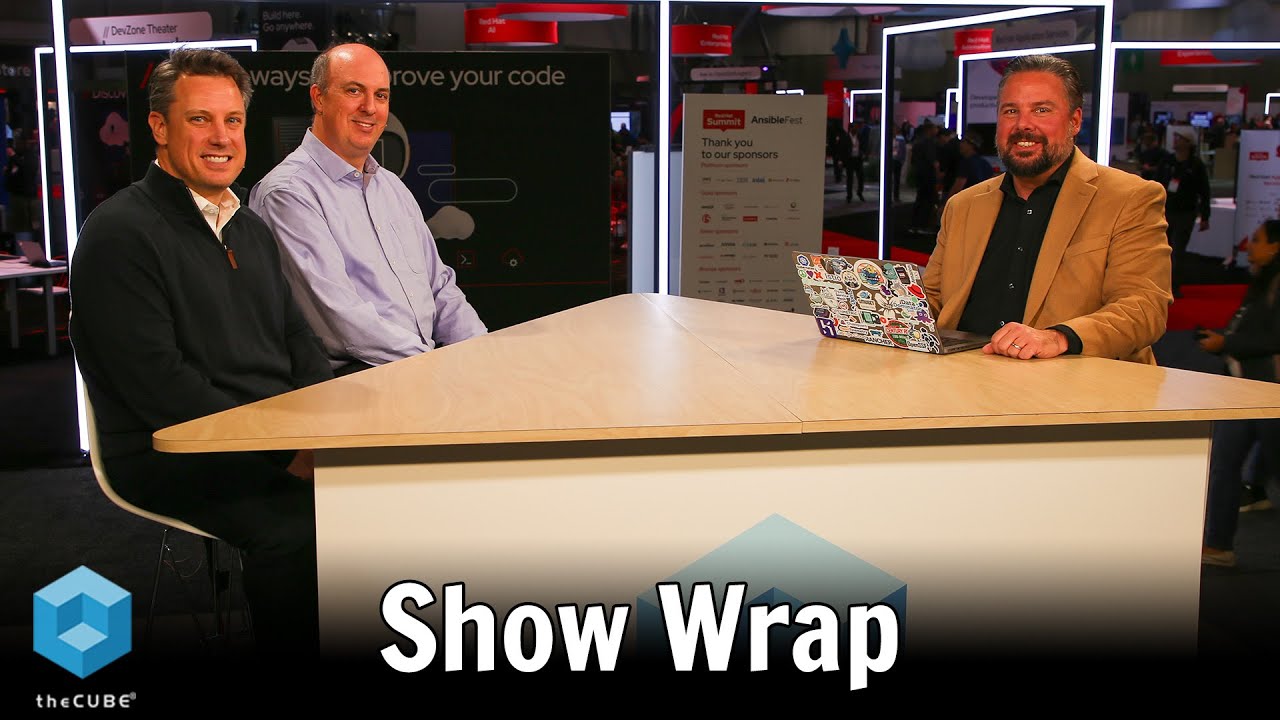
Join us for an insightful discussion featuring Ed Keen of Red Hat, director of global services OpenShift; Venkat Ramakrishnan of Portworx by Pure Storage, vice president and general manager of the cloud native business unit; and Nate Mason of SiriusXM, associate director of the Unix systems group. This segment examines their recent experiences and challenges encountered at the Red Hat Summit 2025.
In this video, Rob Strechay, director and principal analyst at theCUBE Research, hosts an engaging dialogue. Ed Keen discusses how OpenShift supports SiriusXM’s cloud-native journey through virtualization and containerization. Nate Mason shares insights into SiriusXM’s strategic shift towards more efficient cloud infrastructure, leveraging Red Hat products.
Discover key takeaways such as the importance of simplification in hybrid cloud environments. Exciting developments are shared by Venkat Ramakrishnan regarding their affordable virtualization solutions designed to reduce total cost of ownership. Insights are provided on streamlining operations and the vital role of Kubernetes in modernizing enterprise IT strategy.
Forgot Password
Almost there!
We just sent you a verification email. Please verify your account to gain access to
Red Hat Summit + AnsibleFest 2025. If you don’t think you received an email check your
spam folder.
In order to sign in, enter the email address you used to registered for the event. Once completed, you will receive an email with a verification link. Open this link to automatically sign into the site.
Register For Red Hat Summit + AnsibleFest 2025
Please fill out the information below. You will recieve an email with a verification link confirming your registration. Click the link to automatically sign into the site.
You’re almost there!
We just sent you a verification email. Please click the verification button in the email. Once your email address is verified, you will have full access to all event content for Red Hat Summit + AnsibleFest 2025.
I want my badge and interests to be visible to all attendees.
Checking this box will display your presense on the attendees list, view your profile and allow other attendees to contact you via 1-1 chat. Read the Privacy Policy. At any time, you can choose to disable this preference.
Select your Interests!
add
Upload your photo
Uploading..
OR
Connect via Twitter
Connect via Linkedin
EDIT PASSWORD
Share
Forgot Password
Almost there!
We just sent you a verification email. Please verify your account to gain access to
Red Hat Summit + AnsibleFest 2025. If you don’t think you received an email check your
spam folder.
In order to sign in, enter the email address you used to registered for the event. Once completed, you will receive an email with a verification link. Open this link to automatically sign into the site.
Sign in to gain access to Red Hat Summit + AnsibleFest 2025
Please sign in with LinkedIn to continue to Red Hat Summit + AnsibleFest 2025. Signing in with LinkedIn ensures a professional environment.
Are you sure you want to remove access rights for this user?
Details
Manage Access
email address
Community Invitation
Venkat Ramakrishnan, Portworx by Pure Storage & Nate Mason, SiriusXM
Join us for an insightful discussion featuring Ed Keen of Red Hat, director of global services OpenShift; Venkat Ramakrishnan of Portworx by Pure Storage, vice president and general manager of the cloud native business unit; and Nate Mason of SiriusXM, associate director of the Unix systems group. This segment examines their recent experiences and challenges encountered at the Red Hat Summit 2025.
In this video, Rob Strechay, director and principal analyst at theCUBE Research, hosts an engaging dialogue. Ed Keen discusses how OpenShift supports SiriusXM’s cloud-native journey through virtualization and containerization. Nate Mason shares insights into SiriusXM’s strategic shift towards more efficient cloud infrastructure, leveraging Red Hat products.
Discover key takeaways such as the importance of simplification in hybrid cloud environments. Exciting developments are shared by Venkat Ramakrishnan regarding their affordable virtualization solutions designed to reduce total cost of ownership. Insights are provided on streamlining operations and the vital role of Kubernetes in modernizing enterprise IT strategy.
Venkat Ramakrishnan, Portworx by Pure Storage & Nate Mason, SiriusXM
Venkat Ramakrishnan
President and COONeuBird AI
Nate Mason
Associate Director, Unix Systems GroupSiriusXM
Ed Keen
Director, Global Cloud ServicesRed Hat
Venkat Ramakrishnan, vice president and general manager of Portworx at Pure Storage Inc., Nate Mason, associate director of the Unix Systems Group at SiriusXM, and Ed Keen, director of OpenShift global cloud services at Red Hat Inc., join theCUBE’s Rob Strechay during Red Hat Summit 2025 to discuss real-world hybrid cloud strategy. The conversation centers on virtualization, containerization and the role of Kubernetes in modernizing infrastructure.
Mason shares how SiriusXM is simplifying its cloud operations through Red Hat solutions, while Keen outli...Read more
exploreKeep Exploring
What factors helped SiriusXM get started with virtualization and maintain peace of mind with their production workloads?add
What was announced today regarding Portworx for Kubernetes virtualization?add
What infrastructure components does SiriusXM use to create a global storage cloud with Kubernetes native declarative way of deploying and managing resources, integrated tightly with OpenShift and delivering storage as a service per VM or eventually per container?add
What was the approach taken to scale infrastructure and migrate applications to OpenShift Virtualization?add
What are some new alternatives for legacy virtualization platforms that people have the opportunity to look at, particularly in terms of hybrid cloud readiness?add
Venkat Ramakrishnan, Portworx by Pure Storage & Nate Mason, SiriusXM
search
Rob Strechay
>> Hello, and welcome back to Red Hat Summit and AnsibleFest live from Boston here in 2025. We're closing up today and really bringing it to crescendo. Again, what I love is when we bring together partners and customers that are really using the technology in a unique way to really further and gain ROI. And to do that and to help me do that, one of the things that I love is I got Ed Keen, who is the director of OpenShift Global Services for Red Hat. Welcome on board, Ed.
Rob Strechay
>> Thanks for having me.
Rob Strechay
>> Nate Mason, who's the director of platform operations for SiriusXM, welcome on board. A big fan of your company. I listen to it all the time out of the car and on the app on my phone. Love that too.
Rob Strechay
>> Thank you.
Rob Strechay
>> Great service too. And then we have Venkat... I knew I was going to screw this up because I practiced it so much, but Venkat Ramakrishnan.
Rob Strechay
>> You nailed it.
Rob Strechay
>> I tried. VP at GM from Portworx by Pure Storage. Welcome back on. You've been on a couple of times, but I think the last actually Red Hat Summit, KubeCon EU and Salt Lake City. Many times here. So you know how this goes. Let's start off with Nate, what's brought you here? I saw you in Salt Lake on the main stage, this is a lot easier. I'm a lot nicer than the 6,000 people there that were staring at you, but Nate, what brought you here with these two folks, and how are things going with SiriusXM and your cloud native journey?
Nate Mason
>> It's going very well. We started with virtualization. We needed to diversify our hypervisor platforms. That brings in the question, we were a Rev shop as well, another Red Hat product, but we wanted to move into OpenShift both for virtualization and containerization. Having a common platform that we can maneuver microservices and VMs that power a lot of our workloads. So that was a good start.
Rob Strechay
>> Ed, from your perspective, how did Red Hat really help in this journey? Because virtualization, it started out with KubeVirt, which Red Hat, that's the upstream from OpenShift Virt, and how did you help SiriusXM on this journey?
Rob Strechay
>> Yeah, it's funny. SiriusXM were ahead of the curve really at this point. When we first got started, you think about it almost, almost a couple of years ago now. Now, two years later, we're having these conversations with every customer. Every single customer wants to know how can we move off quickly but safely, our existing incumbent virtualization provider, you guys were ahead of the curve and I think if I think about what was it that helped you get started and the critical nature of the production workloads that you're running on your existing virtualization provider, what gave you peace of mind and helped you accelerate that start?
Nate Mason
>> Well, know we right Red Hat's our partner, so we leveraged Red Hat to help us out and say, "Hey, this is what we're trying to do." We had a clear idea of where we wanted to go. We just needed to get the bits and pieces working and a clean migration, things like that. We have critical workloads running. So it's not something you want to do extremely quickly. You want to build it right, get it done the first time correctly. And then from there, what you learn in the journey, you can move forward to do more of containerization and things like that. So virtualization was the kickoff.
Rob Strechay
>> And this is where the critical nature of these workloads, right, we're talking about six nines of availability, production, manufacturing plants that are making this cut over how important I'm with Red Hat services, the services expertise, along with our trusted partners and the validated patterns that we built together?
Rob Strechay
>> Yeah, absolutely.
Rob Strechay
>> And Venkat, you guys are announcing some really cool stuff here to really support customers like SiriusXM. What are you guys announcing here at Summit?
Venkat Ramakrishnan
>> Yeah. So today we announced Portworx for Kubernetes virtualization. It's a discounted SKU matching Red Hat's OpenShift Virtualization engine in pricing. So in order to help drive the total cost of ownership down in the virtualization market, look the rest of the virtualization market, the TCO is going way up. Red Hat and Pure Storage, we're driving it down further. So we're making it a lot more affordable for customers to migrate their VMs off of the legacy platform to a more modern Kubernetes-based virtualization plus containerization. To make it affordable for customers at scale. So I love listening to Ed and Nate about how we started off, proved out a few workloads and now we're scaling to more mission-critical workloads and that's essentially the journey we're taking our customers through. It's still early days, but definitely a lot of critical deployments are coming to OpenShift Virtualization and Portworx. And Nate, as SiriusXM, by the way, I love the company too. It's on all my devices and all my vehicles. And SiriusXM is not just a Portworx customer. They actually run Portworx on top of pure FlashArrays and they use pure FlashBlades to back up all of their Kubernetes infrastructure, including all their VMs and VM data. So it's a complete turnkey solution combined with OpenShift Virtualization. I mean that's like, deploy it, start operating it and simply plug it about. That's how we're scaling it.
Ed Keen
>> Yeah. That was really important for Portworx to do that as a partner, come down to the correct virtualization because we're not afraid to have multiple hypervisors in an organization, multiple storage. We diversify for you never know when a ripple is coming through the industry. What's been happening over? What's licensing changes of some sort? Buyouts, you never know. But yeah, it was very important that they responded and it was a good place.
Rob Strechay
>> So how far are you into this journey now? Because again, it is a journey and some would've thought it was a sprint. Some think it's a marathon depending on which type of organization. Where is SiriusXM these days?
Ed Keen
>> It's a little of each. You need to really be comfortable with it. The engineers have to own it. On as good as the partners are, I mean you own it. It's coming out of your data center in some cases. When they're comfortable with it, then you know can move to the next step and then keep pushing. When they're screaming to say, "We need to migrate tomorrow," that's when it's time. So you got to keep a clear ear out.
Rob Strechay
>> So you said you had experience with Rev, which was a previous product, no longer around, but it went down that it was the virtualization on top of Red Hat Linux at one point in time. And I think where it makes more sense is in OpenShift and what has been done has also your experience been that because you own ops. So to me, I'm thinking there to Venkat's point about TCO, the cost to manage and the simplification. Was that factoring into your decision to go this direction?
Ed Keen
>> Absolutely. I mean, it was most of it. Again, industry changes. New players show up and you have to be able to move quickly to another platform at times. So depending on what that is, at the time, but it hits all those marks. It's low cost of ownership, it's on-prem, you can use it wherever you want. You can push it out to any one of your cloud providers. So it's an integrated ecosystem as far as you want to take it. As far out to the edge or if you want to keep it inside the data center as well. And we utilize all portions of it to be honest. And again, even from the storage point of view, I mean it's one of those things that fits.
Rob Strechay
>> So I think to jump in on it, when you mention about the migrating quickly, it makes me think about how our customers, these are the critical workloads that are powering their digital business, but they also have timeframes that they want to be able to execute on. So how with our customers, we're migrating like hundreds of VMs every day. But again, that's almost like the step one of the journey. They're migrating to Oakley Shift because it's the platform of the future where they can modernize, which is some of the work that you guys are now starting to undertake as well.
Ed Keen
>> Absolutely. I mean, there's nothing worse from an operations point of view of having to get downtime moving out. You want everything to be completely disconnected from the underlying infrastructure as much as possible. They should leverage it as much as possible. But who wants to patch servers? Hey, can I get an outage on Tuesday night? Now, we're doing billing. All right. Let me try Sunday. You know what I mean? And you end up in this weird round the clock situation. So the last time you do that is migrating them to a new platform or containerization, that's it. You're free and clear after that.
Nate Mason
>> And then when you start to get into containerization, that's when you get some of the real benefits, the real TCO benefits from the platform.
Ed Keen
>> Absolutely. Now, you're getting into very hyperconverged. You're maxing your processors out. That has the concept of millicore, not a whole core. So you're starting to really make your hardware work for you.
Rob Strechay
>> And like you said though, and I would assume that this is where Portworx by Pure Storage... My brain is... It's the lights. But when you look at Portworx by Pure Storage and what it helps you do, it must give you that confidence. Again, giving you like that cyber resilience as well as that underlying storage layer that gives you that flexibility where you, again, just having been on the IT side, it's been a long time and I own DR for a financial services company. For me, I had to know that I could recover at any point in time and we couldn't be down because that was millions and millions of dollars per second kind of thing. I mean, again, you're live on air all the time across all these platforms. That had to be a big factor for you.
Ed Keen
>> It was. You're going to look for a really good CSI in Kubernetes or OpenShift. You really want a solid CSI, especially when it's backed by the hardware that's already in the data side. I mean that's huge. Being able to live, migrate things, come up with many different tiers of storage, you can shoot stuff out to the X90s, high performance, low latency. Then we got some C70s for general purpose, FlashBlade for just dumping tons of data. So if that's your storage subsystem, it doesn't really make sense to put on top of a FlashArray, that's too expensive. Seth shines, we have massive Seth deployment, but JBoss. So when it comes to high performance, we need it to be real close to the storage. So one IT rated is great.
Venkat Ramakrishnan
>> Absolutely right. So what we have done in this case, SiriusXM uses portable enterprise, which is know of course the upstream interface, CSI interface to the Kubernetes driver to the platform. But what portable enterprise does is that it takes their FlashArray estate and creates a global storage cloud, for lack of a better word. I mean, we call it an enterprise data cloud, where Portworx blankets on top of the multiple deployments. They have FlashArrays and FlashBlades and gives them a Kubernetes native declarative way of deploying and managing resources. I mean that OpenShift works tightly integrated with OpenShift, manages all the underlying storage infrastructure and delivers essentially storage as a service per VM. And eventually when they bring in containers, it'd be per container. So now that's literally how the infrastructure is being built. It becomes a lot easier as we scale the infrastructure to essentially go like Lego blocks. You can build out an entire private cloud, a VM data cloud with OpenShift Virtualization of OpenShift, portable enterprise and FlashArray and FlashBlade that meets Sirius as a workload needs, SLA needs, and of course DR and recovery. Yeah.
Rob Strechay
>> Yeah. It makes sense mean, and again, like Ed was talking about hundreds of VMs in a day, a night, a weekend, how did you approach it? Did you say, "Hey, we're going to start with this application that's on this cluster over here, we're going to bring it over and we're going to get our methodologies down?" Because I'm thinking of patterns that others who are watching this could think about, "Hey, you know what? We have OpenShift, let's go do that because we can simplify our operations." What was your pattern that got you to where you are today?Well, OpenShift Kuber under the hood is KVM. It's essentially a launcher wrapper for a KVM version instance. So we're familiar with that from our Linux side of the house and it was an easy transition for us over to Kuber, OpenShift virtualization specifically know for the most part, start with lower environments dev, let's get the devs out of the way, make sure nothing breaks. Now, let's get staging up there, say QA, and before you know it, the last thing is left is prod. So as soon as you got to the production instances is pretty much as fast as... At that point you're extremely comfortable with. So you're like, "Okay. We're good. We got our monitoring the belts of suspenders."
Now, Portworx is really good about calling us out and with some of the telemetry that we activate saying, "Hey, you may want to take a look at this. And we've been in situations where it wasn't necessarily the right size, but we were able to back out of that decision, and on the fly in the middle of a maintenance window, we got three 400 VMs coming in, we need more storage." Click a button, not click a button, that's a few commands in there, hit enter and there it goes. So it starts resizing itself. So that's another really good aspect.
Venkat Ramakrishnan
>> That automatically looks at your workload and resizes the available storage. So they don't have to do it manually for their hypervisor node. And to talk about simplifying operations, what Nate and I were talking about it too is to how Portworx and pure support will call them based on the telemetry data and which things are running suboptimally and where they need to quickly tune it so they don't have a downtime. So we dialed it in and we were talking about how we're extending it a little bit more into visibility into Kubernetes and OpenShift as well. So our customers jointly get a lot of visibility into their infrastructure.
Rob Strechay
>> When customers are looking to get started, they can depend upon the years of experience that Red Hat has. Now, having done this with 50, 100 plus customers like Red Hat and Portworx as well, our teaming model, how we help the customers see how long are these migrations going to take? Is it something that's going to take six months? Is it going to take 36 months? What's the risk level and the complexity? And also, once they start getting into their day two operations, how do they plan for making the use of their best use of their existing hardware investment as well as their investment they've made in their people as well too?
Rob Strechay
>> Yeah. I mean I was blown away last year when I got to talk to one of the financial services customers. I won't mention which one because I can't remember if I can name them or not, but was talking about the first workload that they went and moved, which was their traders VDI workstations, which to me was like, okay, having been in financial services, I'm like, "That's insane. The fire pretty..." Exactly. How did you bring your organization along with this too? Because I mean you still have to get buy-in. I'm sure the cost of it had to help but there was a good ROI At the end of the day.
Ed Keen
>> that's really it. I mean, we did want to diversify our platform from another large hypervisor. So that's how Rev got in the door. So if that's where going to OpenShift is going to pick up that slack, that's exactly what we made it do. And it's not difficult. When you're coming in pretty much under the bar as far as costs and TCO and assuming you have good data center deals and you're not just spinning up instances out in the cloud for no reason at all, I mean, it speaks for itself. And I'm not going to say there's no more options, but it's as far as the good options, I mean it's there and now we're starting to integrate with again, just pure containerization, not just virtualization as well.
Rob Strechay
>> And you're doing that transformation as well now?
Ed Keen
>> Yeah. The virtualization we got pretty much locked down. We're like, "Okay. Now, it's time to move." Remember, we're talking about virtualization, but thousands of these VMs run tens of thousands of containers. The end goal is just get those containers off of the VMs. That's really where we're trying to get to. So that was the, from day one, my goal and get everybody else on board with just cost, "Hey, this is going to help us out."
Venkat Ramakrishnan
>> See, that's the vision of modern enterprises. I mean it's something that I tell all our customers is that if you look at the modern data centers or even on the cloud, people are running VMs in a one control plane. Today, there's a legacy architecture and then the containers in another control plane and another like Kubernetes. But now you have these islands of infrastructure with different software orchestrators that proliferate and it makes an IT environment that is very complex, it makes it even more complex. Generally, great enterprise IT organizations try to continue to simplify their architecture is a journey, the transformational journey. So standardizing on OpenShift, which is Kubernetes based and standardizing on that virtualization to get off of legacy VM platforms, makes absolute sense because that's your journey to continue to simplify, to go to containers.
Rob Strechay
>> And think about it, you've got your hybrid cloud with OpenShift running your hybrid workloads, whether they're VMs or containers with your Portworx, so there's running the layer over whatever underlying stories there might be pure or other. And then you're setting yourself up for the future of modernization where you're modernizing your storage, you're also modernizing, you're getting a real return on investment once you start going to cloud native development and containers where now, hey, instead of taking a week to deploy an application, you need to deploy it in five minutes. Instead of taking a week to scale scale application or a VM, maybe again, you can do it in like five minutes or it can happen automatically. That's where you start getting the real TCO and ROI benefits.
Venkat Ramakrishnan
>> Yeah. I mean, ed, you nailed it. So then take it to hybrid cloud. Then now you have the same control plane for not just your data center on-prem assets, but hey, your cloud infrastructure too. That is the real power of Kubernetes. So when people have this opportunity to look at new alternatives for legacy virtualization platforms, I think Kubernetes and OpenShift Virtualization is a no-brainer. Added that with Portworx, now we are hybrid cloud ready to run in the data center, and we can, of course we run on top of Pure, we have best in class integrations, but we can also run on top of other vendors too. And you can essentially replicate that architecture in the cloud and then be hybrid cloud ready within a matter of a day essentially. Yeah.
Rob Strechay
>> Nate, I'm going to give you the last word. What do you hope to be able to say next year when you're on with us talking about where you've gotten to?
Ed Keen
>> I'd love to get rid of virtualization, just go all containerization, but that's not going to happen. We all have appliances and things like that that need to be powered, but I want to get some more critical workloads containerized. Again, they're already containerized is running in VMs. I want to get them really orchestrated pure out there.>> Metal of containers.
Ed Keen
>> Where application teams don't have to think, where do I want this green, blue canary? They click a few buttons from either a CM or whatever orchestration system and say, "If you want your workload out in this cloud provider, push it out there for a while. If the prices come down, somebody has a good deal, move it over here and it should not be that difficult." Now, it's really getting the application teams and developers fully engaged into leveraging it the way it should be. I can only do so much for them. I can create the infrastructure and operate it, but it needs to click up here so they can start moving things around and really get there.
Rob Strechay
>> I love that. Yeah. Fantastic. Thanks for coming on, Nate, Ed, Venkat. As always, really appreciate it. Thanks for coming on guys.
Rob Strechay
>> Thanks for having us.
Rob Strechay
>> Thanks for having us, Rob. As always, fantastic interview.
Rob Strechay
>> Always fun. Thank you. And thank you for watching this episode, our closing episode for today at Red Hat Summit and AnsibleFest 2025 live from Boston. We'll be back with much more a full day tomorrow and Wednesday. Stay tuned and see you soon.















 Rob Strechay