In order to sign in, enter the email address you used to registered for the event. Once completed, you will receive an email with a verification link. Open this link to automatically sign into the site.
Register For Cube365 Events Platform
Please fill out the information below. You will recieve an email with a verification link confirming your registration. Click the link to automatically sign into the site.
I want my badge and interests to be visible to all attendees.
Checking this box will display your presense on the attendees list, view your profile and allow other attendees to contact you via 1-1 chat. Read the Privacy Policy. At any time, you can choose to disable this preference.
Lars Maaløe of Corti, co-founder, joins Paul Nashawaty of theCUBE Research, practice lead and principal analyst for the AppDev practice, to examine governance of deterministic artificial intelligence and clinical trust in healthcare. Maaløe draws on their research in deep generative models to explore deterministic orchestration, agent memory and validation, recursive fact extraction and practical applications such as nurse triage, clinician communication and revenue cycle automation.The discussion addresses applying machine learning, speech recognition and natural language processing to clinical and administrative workflows. Topics include model validation, sub-millisecond data retrieval, graph-based fact grounding to prevent hallucinations, integration with electronic health record systems and modular agent-to-agent interoperability.Key takeaways emphasize traceability, auditable guardrails and open standards as prerequisites for moving agents from pilot to production. Nashawaty reports that only 11% of agents reach production in 2025. Maaløe recommends deterministic validation, sub-millisecond retrieval, graph-based fact grounding and modular A2A interoperability as concrete measures for safe, scalable deployments.Subscribe for more AppDevANGLE discussions on governance, deterministic AI, clinical trust and interoperability in healthcare.
This conversation explores agentic AI governance and operationalizing enterprise AI within ServiceNow environments. Harsha Kumar of NewRocket, chief executive officer, joins Paul Nashawaty of theCUBE Research, practice lead and principal analyst for the AppDev practice, and the AppDevANGLE hosts for a discussion recorded in the context of ServiceNow Knowledge. They examine agentic AI applied to ServiceNow, the differences between agentic AI and traditional automation, and approaches for data preparation, agent fabrics and enterprise-ready AI architectures.Kumar highlights that governance and data readiness rather than investment present the primary barriers to enterprise AI. They emphasize that clean semantically consistent data fuels AI and highlight Maestro for governance and value realization and Origin to realign ServiceNow implementations. Nashawaty observes that leaders combine clear business cases, user-friendly interfaces and strong controls to move from pilots to scaled agentic AI.This discussion provides practical guidance for CIOs, IT leaders and platform teams seeking to operationalize agentic AI on ServiceNow, covering governance, data readiness and architectural patterns for enterprise-scale deployments. It addresses data governance, operationalizing autonomous workflows and strategies for achieving enterprise AI value.
This episode examines observability and automated remediation in middleware platforms enabled by artificial intelligence, AI. Laduram Vishnoi of Middleware, founder and chief executive officer, discusses a purpose-built observability platform with an AI layer that detects incidents, correlates telemetry and actively remediates faults. Paul Nashawaty of theCUBE Research, practice lead and principal analyst, hosts the conversation. Vishnoi explains the platform's approach and they describe telemetry unification, false-positive reduction and integrations with continuous integration and continuous deployment, CI/CD and developer workflows, and how AI transforms incident response across modern stacks.Key takeaways include AI shifting observability from reactive dashboards to proactive remediation and reducing mean time to repair, MTTR, by up to 70–80% according to Vishnoi. Nashawaty highlights the importance of a unified telemetry view and feeding insights into developer tools to increase actionability. The discussion emphasizes keeping humans in the loop today while preparing for broader automation across microservices, Kubernetes and AI workloads.
This AppDev ANGLE conversation at Google Cloud Next 2026 explores how Google Kubernetes Engine is becoming the operating system for agentic artificial intelligence and enterprise AI infrastructure. Bobby Allen of Google Cloud, product manager, and Paul Nashawaty of theCUBE Research, practice lead and principal analyst, discuss GKE’s evolving role and the developer experience and operational controls required for agentic workloads.Allen explains how Kubernetes adapts to agentic workloads through features such as agent sandboxes, pod snapshots, Autopilot, Kubernetes Config Connector, custom compute classes and Gemini Cloud Assist. They draw on product experience with GKE to illustrate how these capabilities improve isolation, enable faster recovery, increase cost and scaling efficiency and translate intent into infrastructure. The conversation includes real-world demos and practical guidance for migration and modernization.Allen positions GKE as the control plane or operating system for large-scale AI workloads. Nashawaty emphasizes that migration and modernization require honest trade-offs between aspiration and willingness to change. This discussion provides technical insights for platform engineers, developers and technology leaders focused on AI infrastructure, Kubernetes operations and cloud migration strategy.
This AppDevANGLE episode examines how artificial intelligence, AI-powered autonomous workspaces transform enterprise IT operations and modernize application lifecycles. The discussion covers autonomous workspace architecture, open APIs, application lifecycle automation, hybrid cloud and cloud native deployment strategies, digital employee experience and automated remediation, and AI for IT operations, AIOps, as means to improve operational efficiency and reduce skill gaps.Jon Holloway of Omnissa, director of product management, brings deep experience in virtual applications and desktops including a long tenure at VMware and leadership of the Horizon portfolio. Holloway discusses Omnissa's autonomous workspace vision, open APIs, application lifecycle automation and strategies for hybrid cloud and cloud native deployment, and they emphasize AI-driven digital employee experience and automated remediation to reduce complexity and address skills gaps. Paul Nashawaty of theCUBE Research, practice lead and principal analyst, hosts the conversation and highlights accelerated product focus and faster roadmap execution after platform divestitures as strategic benefits for enterprises.Key takeaways include prioritizing operational simplicity through consolidated platform capabilities and an open ecosystem to avoid vendor lock-in, accelerating product focus and roadmap execution and leveraging AI-driven automation to improve digital employee experience and operational resilience. Watch the full episode for detailed strategies and technical considerations for implementing autonomous workspaces in enterprise IT.
Bryan Sacks of Myriad360, field chief information security officer CISO, joins host Paul Nashawaty of theCUBE Research, practice lead and principal analyst, to examine the intersection of artificial intelligence AI-driven automation and cybersecurity. Sacks draws on more than 15 years of experience in consulting, enterprise security and public sector leadership to explain how non-human identities, shift-left development, agentic workflows, tool sprawl and limited observability expand attack surface and operational risk. They note that non-human identities often outnumber human accounts and create stealthy attack vectors. They recommend centralized data lakes for richer behavioral context, stronger machine identity governance and translating cyber risk into business terms to support board readiness and executive accountability. Nashawaty observes that increased automation shifts hiring toward generalists.
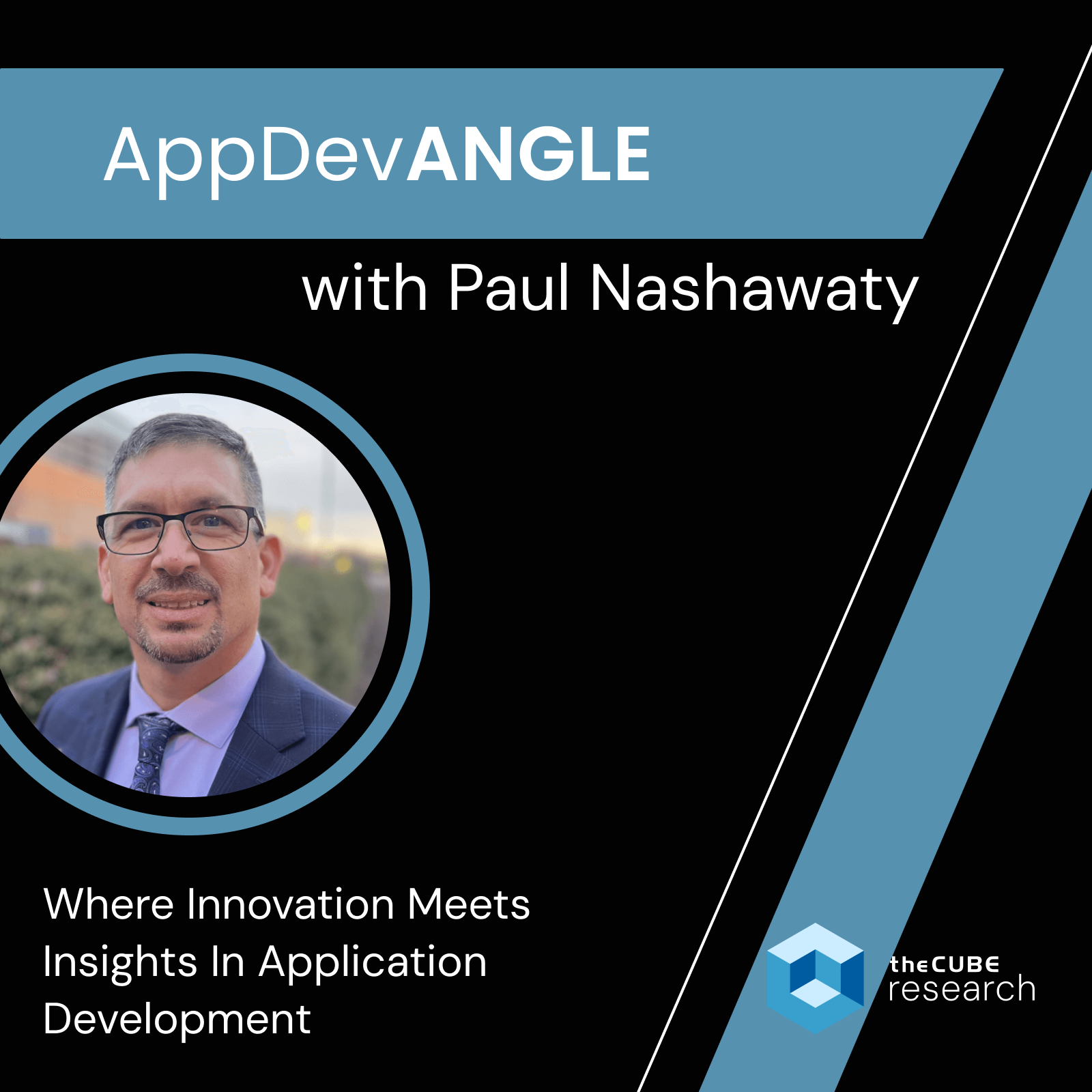
AppDevANGLE, hosted by Paul Nashawaty, explores the full application and software development lifecycle—Day 0 (Build), Day 1 (Release), and Day 2 (Operations)—while spotlighting the critical role of DevSecOps in embedding security and automation at every step.
Join us as we dive into innovative strategies and best practices that drive secure, efficient, and scalable application development.