SiliconANGLE Media Inc. Co-Founder and Co-CEO Dave Vellante hosts Duncan Angove, CEO at Blue Yonder as part of theCUBE + NYSE Wired presentation of NRF Media Week - AI Retail Leaders from the New York Stock Exchange.
Duncan Angove, CEO of Blue Yonder, explains the impact of technology on reducing waste in the supply chain. Technology has led to abundance but also increased waste, creating a demand for ethical consumption. Consumer expectations include reducing waste, sustainability, and addressing carbon emissions. Waste in food and fashion industries is substantial, with a billion meals wasted daily and truckloads of fashion ending up in landfills every few seconds. Technology helps reduce waste through returns management, AI forecasting, markdown pricing, and perishable goods management.
Real-time visibility in supply chains is challenging due to legacy systems and data volume. Speed is crucial, with visibility and AI crucial for responding to disruptions. Blue Yonder's acquisition of One Network aims to enhance speed and visibility in supply chains. AI plays a significant role in predictive analytics but has limitations. Integration of systems and harmonizing data are essential for efficient operations. Blue Yonder focuses on unifying applications, enhancing data analysis, and addressing returns management challenges. Despite global uncertainties, the company's focus on customer outcomes and trust drives its success.
Forgot Password
Almost there!
We just sent you a verification email. Please verify your account to gain access to
theCUBE + NYSE Wired: AI & Retail Trailblazers. If you don’t think you received an email check your
spam folder.
Sign in to theCUBE + NYSE Wired: AI & Retail Trailblazers.
In order to sign in, enter the email address you used to registered for the event. Once completed, you will receive an email with a verification link. Open this link to automatically sign into the site.
Register For theCUBE + NYSE Wired: AI & Retail Trailblazers
Please fill out the information below. You will recieve an email with a verification link confirming your registration. Click the link to automatically sign into the site.
You’re almost there!
We just sent you a verification email. Please click the verification button in the email. Once your email address is verified, you will have full access to all event content for theCUBE + NYSE Wired: AI & Retail Trailblazers.
I want my badge and interests to be visible to all attendees.
Checking this box will display your presense on the attendees list, view your profile and allow other attendees to contact you via 1-1 chat. Read the Privacy Policy. At any time, you can choose to disable this preference.
Select your Interests!
add
Upload your photo
Uploading..
OR
Connect via Twitter
Connect via Linkedin
EDIT PASSWORD
Share
Forgot Password
Almost there!
We just sent you a verification email. Please verify your account to gain access to
theCUBE + NYSE Wired: AI & Retail Trailblazers. If you don’t think you received an email check your
spam folder.
Sign in to theCUBE + NYSE Wired: AI & Retail Trailblazers.
In order to sign in, enter the email address you used to registered for the event. Once completed, you will receive an email with a verification link. Open this link to automatically sign into the site.
Sign in to gain access to theCUBE + NYSE Wired: AI & Retail Trailblazers
Please sign in with LinkedIn to continue to theCUBE + NYSE Wired: AI & Retail Trailblazers. Signing in with LinkedIn ensures a professional environment.
Are you sure you want to remove access rights for this user?
Details
Manage Access
email address
Community Invitation
Duncan Angove, Blue Yonder
NRF Media Week brought together key voices in the retail and technology industries, with Duncan Angove, CEO of Blue Yonder, headlining the AI Retail Leaders Forum. In his conversation with theCUBE’s Dave Vellante, Angove discusses how AI and technology can reduce supply chain waste and drive greater efficiency in retail.
The discussion looks at the challenges of waste in industries such as fashion and food, with Angove highlighting the role of AI in forecasting demand, managing returns and improving inventory management. He emphasizes the importance of speed and real-time visibility in supply chains to help businesses better respond to disruptions.
Angove also reflects on the growing role of AI in supply chain decision-making, as well as Blue Yonder's technological advancements, such as its integration with Snowflake. The conversation concludes with a look at Blue Yonder's commitment to innovation and customer outcomes, marking a pivotal moment for the company’s AI-driven supply chain solutions.
>> Hi, everybody. Welcome back to our NRF Media Week, theCUBE and NYSC Wired communities coming together here in New York. Duncan Angove is here, CUBE alum, CEO of Blue Yonder. Great to see you, my friend. Thanks for coming in.
Duncan Angove
>> Thanks, Dave. Great to see you again.
Dave Vellante
>> It's always nice to be here in this-
Duncan Angove
>> It sure is, yeah....
Dave Vellante
>> iconic location. NRF Week, it's kind of crazy up in Midtown, so I'm glad to be down here, kind of away from all the action. But let's start with you and I, we did a breaking analysis mid last year, it was awesome. You had some interesting thoughts and takes on the opportunities that we have to really take out some of the waste in the supply chain, and one of the points that you made was that infinite resources, i.e. cloud, helps a lot because you can do a lot with that, but it feels like we have even further to go. So, where are we in that sort of journey of taking out waste? And if you could quantify that, especially in a retail context, it would be awesome.
Duncan Angove
>> Yep. It's a great question. One of the things I've always talked about is technology turns scarcity into abundance. And a lot of that technology is powered supply chains, which has made cheap clothing available, cheap electronics, medicines, all of those types of things. The downside of it though is that it's created a lot of waste. And if you look at consumer expectations, there's sort of a rising need for what they consider ethical consumption, which means reducing waste, and actually caring about sustainability and carbon emissions, and supply chains produce 60% of those. If you look at some of the stats around waste, let's just take food and fashion as an example, the numbers are staggering. There's about a billion meals that we waste every day.
Dave Vellante
>> A billion?
Duncan Angove
>> A billion. And 780 million people go hungry, so there's a lot of waste. Second thing from a fashion perspective, and it's hard to believe, but every few seconds, an entire truckload of fashion is going into a landfill.
Dave Vellante
>> Wait, wait, you said seconds?
Duncan Angove
>> Every few seconds, yes, exactly. Around the world, something is going into a landfill. So, there's a lot of waste. So, it's sort of the dark side of what technology and supply chains enabled and it's raised the standard of living, but it's something that consumers and businesses are looking to address now and technology is a huge part of that, whether it's returns management, it's using AI to better forecast where demand is and what inventory you put there, whether it's using AI to drive markdown pricing, to remove perishable goods, to reduce waste. There are all these roles that technology can play in basically reducing the impact of abundance.
Dave Vellante
>> It's a huge issue, especially in the United States. We're what, 5% of the world's population, 25% of its consumption. Do you see any sort of deltas around the world? I know Far East, certainly Europe seems to be more tuned in. US, we're this consumption society. Are we coming together and are you seeing a better awareness of this problem or is it still-
Duncan Angove
>> I think so, and it ebbs and flows, particularly in a world that's been driven by a populist agenda. I would think Europe is probably more conscious of it, but I think certainly people are looking for choices to make more sustainable decisions or things that actually reduce waste. We'll talk about returns management later, but that's something where we've definitely seen consumer demand for looking for more sustainable return options.
Dave Vellante
>> The other thing we talked about in our session last summer was really real-time visibility. The whole theme was around intelligent data apps and real-time ability to respond. Give us some color there. What's the state of real-timeness in supply chain applications today?
Duncan Angove
>> Not great, quite frankly. It's still plagued by legacy architectures because it's a super difficult problem to solve, because the volumes of data are massive, the need for real-time speed is there. So, you've got point solutions, batch-based architectures, arcane languages like EDI, all of those things make real-time very, very difficult. But when you step back and you think about what's the fundamental attribute that drives everything else we're looking for in a supply chain? Whether it's efficient profitability, efficient fulfillment, it's the ability to respond to disruption, risk and opportunity or being more agile. Speed is the thing. It's speed. And you look at the metrics we use to describe supply chains, it always has a speed or time dimension to it, like on-time, in-full, just-in-time, quick-response. How fast are my inventory turns? It's all about speed. So, if you're able to inject speed into a technical architecture that supports supply chain apps or you're able to inject speed into how a retailer operates, it gives them all of that. And a key part of that is visibility, right? The sooner you can see something or the better you can use AI to anticipate something, the quicker you can resolve it. So, visibility is absolutely critical, and that was really at the core of our acquisition of One Network last year, right? Bring a multi-enterprise, multi-tier network of trading partners that's doing a trillion dollars in transactions, connect that to our apps and processes and inject speed into how retailers operate.
Dave Vellante
>> So, what's the relationship between speed and visibility? We could talk about that acquisition and what kind of visibility that gives you. I'm interested in what role AI can really play, versus the AI washing that we see in the news every day. But explain that acquisition in a little bit more detail, visibility and how it relates to speed and supply chain disruptions.
Duncan Angove
>> Yeah, so if you think about today, on average it takes four and a half days for a retailer to learn of a supply disruption. Four and a half days before they know about it.
Dave Vellante
>> Oh, really? Okay.
Duncan Angove
>> Yeah. And on average, it takes 40 to 45 days to resolve it, and it takes that long to resolve it because you're not behaving as one organization because you've got functional silos. Logistics aren't talking to warehousing, aren't talking to stores, aren't talking to merchandising, let alone stakeholders across a value chain with your carriers and suppliers acting as one. Very hard to respond to risk or opportunity if you're not doing it in a coordinated way. So, that's where visibility comes in. Visibility within inside your enterprise, but then visibility across your stakeholders, the four and a half days. I think I talked to you about this book I read, it was The History of Counterintelligence written by a guy that came from GCHQ, the original Bletchley Park in World War II, Enigma code-breaking, all of that. And they talked about the Victorian internet in 1860, and it was copper cables, telegraph, Morse code. And what happened was all of these cables basically followed shipping routes, whether it was from America or India, they went back to London. And the traders there, because they had this Victorian internet, knew about things well before anyone else did that was waiting for ships or carrier pigeons, and it gave them an edge, an advantage. It changed trading and commerce and it changed warfare. That's the speed of visibility and information flow, not to mention they could actually send signals back down it. So, it's very, very similar today, the premise of bringing visibility to inject speed in knowing what's happening, speed into knowing what's going on, speed by using AI to diagnose outcomes and then to actually decide and execute, right? That's really what it brings. It's the cognitive capability to inject speed powered by a network.
Dave Vellante
>> The Victorian internet? What a concept of basically this rudimentary network system gave a significant advantage to the Allies. And what you described was essentially all these data silos, that's why it takes 45 days to even reconcile these issues. So, your approach to that has been partner with guys like Snowflake, put everything into a single data construct, but still you've got to figure out how to harmonize all that data. There's different formats and there's different meanings of that. I know knowledge graphs play in here. Let's talk a little bit about the tech behind solving that problem.
Duncan Angove
>> Yeah, so you're absolutely right. If you look at traditional legacy supply chain software, it's siloed. Different databases, different front-end architectures, really diverse complex application topology, and that means you have a lot of latency as you're moving data between silos. Not to mention, those decisioning systems are not connected to the systems that execute, let alone your trading partners across the network. So, with Snowflake, we were the first company to build applications natively on the data cloud. Every week we ingest about a terabyte of data that feeds our cognitive core, our AI engines. Every day we process 20 billion machine learning predictions on the data cloud, every day, and that doubled in three months. So, the pace of this at scale is really quite astounding.
Dave Vellante
>> Let's talk about AI and agents. And we see a lot of single agents see a lot of digital assistants, a lot of agent-washing, there's AI-washing. What should we expect with regard to what agents can actually do for us? It seems like a very complicated situation to get all these agents acting like humans. It's not like they can pick up the phone and start doing whiteboarding. So, how are you thinking about agentic, as the new buzzword?
Duncan Angove
>> Yeah, and you're right. There was a lot of AI-washing just at the NREF shows. You saw everyone's an agent, they have an avatar. I mean, we've been at the AI game for over a decade now. We have 913 patents, a lot of those are in the AI, machine learning, optimization space. Supply chain is where linear programming originally came from, which was the forerunner to ML, and now we have gen AI. And apparently, it's not gen AI, it's not sexy anymore, but predictive AI, deep learning, machine learning, all of that has a huge role to play in supply chains, and that's what our 20 billion predictions are based on is that technology. Gen AI though also has a role. If you think about in most organizations, the human being is the reasoning layer in a company, right?
Dave Vellante
>> Yes.
Duncan Angove
>> And we're going to start seeing that replaced with both predictive ML and also generative AI as a thing that can actually orchestrate it, but it has to be connected to the systems that actually execute. You need a bridge from the digital world to the physical that actually makes something move.
Dave Vellante
>> So, let's talk about those backend systems because it seems to me... I look at what Salesforce and Benioff are doing with agents that say, "Okay, that's good within their world." They have access to the business logic, they have their version of a data cloud, and so it's relatively rudimentary compared to the mathematical challenges that you're dealing with, but it seems to be potentially working. Same thing with ServiceNow. I think it's pretty well-known what they're trying to accomplish. Your world is a lot more unpredictable. So. you mentioned reasoning. So, are we at a point where or when will we be at a point where those agents can actually interpret the reasoning traces of humans and then learn from that and then apply that in workflows going forward? Are we at all close to that? You're going to tell me we can do it today?
Duncan Angove
>> Yeah. No, I think this is moving at an exponential pace and there's a notion here of combinatorial innovation where we're building on other things, and they're all driving at a really impressive pace. This time Last year everyone was saying generative AI language models weren't good at math, now they are. You know what I mean? So, certainly, it's moving at a very, very rapid pace. And there will be agents. I think there'll be agents for every role within a supply chain. To your point, supply chain's a little bit trickier than when you look at like a CRM or an IT service management use case. Those are very call center, QSR-driven, knowledge-based lookups, those types of things. It's not predicting and orchestrating thousands of things. If you look at Black Friday, we had to orchestrate, in just one day, 218 billion customer orchestrations. That's a very expensive model. Computationally be running that through something that's token driven, but it's going to have a huge role. And I talk to you all the time about how in technology, we've always seen the user interface, the UI get updated, but it's always been the I. It went from a DOS prompt, to GUI, to mobile. This time it's the U being upgraded. The U is getting a cognitive upgrade. And in some places, it will be a copilot that helps them. In other places, it will actually be able to replace it with an agent.
Dave Vellante
>> Are you GPU-constrained? I mean, you just mentioned it's very expensive to run these computations. Is it cost-effective for firms like yours to actually inject whether it's GPUs or other systems into the equation? I mean I know you're cloud-based, the cloud guys have access. I guess they're not constrained, but are the economics attractive?
Duncan Angove
>> Well, obviously, there's an explosion in data centers. It's consuming a lot of, lot of energy. Energy's another big component of this, but even in the energy space, which is shifting from a commodity to a technology, technology has this magical attribute where it makes things faster, cheaper, and better over time at a dramatic rate. Just look at solar, the same thing's going to happen in the large language model layer. But again, you have to think about the use case you're applying it to, so that it's economically efficient for a retailer or for us as a software vendor.
Dave Vellante
>> Your point is the technology is deflationary, so it will a-
Duncan Angove
>> 100%....
Dave Vellante
>> you're confident that it'll sort of address it itself over time?
Duncan Angove
>> Yeah.
Dave Vellante
>> I want to come back to this notion of these backend systems because you're touching a lot of different backend systems and you have to harmonize that data in a way that agents can actually understand it and act on it confidently. It's got to be governed. How do you deal with all that? I mean, it's a combination of your IP and your partner IP, but I wonder if you could sort of lay that out and paint a picture of it?
Duncan Angove
>> So in December, we just shipped a release we called 24.4. We need to come up with a catchier name. But really, it's a two-year culmination of over half a billion dollars of investment in R&D. It's arguably the largest supply chain software release in the history of the industry. And a big part of that was a suite of applications that were built to be AI native, connected to a network. A big part of that was unifying all of these applications and their data into the data cloud, Snowflake's data cloud and having one unified set. So, when you're thinking about forecasting replenishment allocation, merchandise, financial planning, assortment, pricing, you're not moving data in batch between these different things. You have one common data model and you have a knowledge graph on top of it that brings semantic meaning to it, which makes it much faster to extend, to do feature engineering, modeling for ML, all of those things. Not to mention that is a translator for a large language model, to understand the semantics and the context of the data. So, that's what we just released last month, and it is truly revolutionary moment in terms of what we're able to do with supply chains on top of the modern data architecture.
Dave Vellante
>> That's awesome. Now, of course, retail, generally low-margin business. So, you guys are taking cost out of the business. So, it's a great value proposition. It's that time of year where people are doing returns from the holiday season. How are retailers dealing with the whole return and margin impact? Has AI affected that at all? How are you helping?
Duncan Angove
>> So, we have a full set of capabilities around the entire life cycle of returns management. So, when you think about e-commerce and returns, well, supply chains were never originally designed to ship in the last mile. We've sort of solved that, but they certainly weren't built to process a trillion dollars of returns going the other direction. And if you look at fashion, 25%, 30% return weights, and it drives, where we started the conversation, a ton of waste and all of that. So, we built and developed an entire suite that manages the entire returns life cycle from returns initiation for a consumer or in a stop or a store, all the way to returns, orchestration, where do you actually put it? Processing returns in a warehouse. And then, even we have a whole network for a drop-off kiosks that did 50 million returns last year. So, an entire suite that allows you to do all of that efficiently.
Dave Vellante
>> So, a little personal stuff. You've got a deep tech background, you've worked at a number of large companies, a number of public companies. You're owned by obviously a very well-funded, established firm. You probably don't need the money, but how important is it to you from a just public perception standpoint, customer perception to be a public company?
Duncan Angove
>> In all honesty, today, we don't worry about that so much, right? I mean, we have a phrase which is we want our company to be powered by customer happiness and enabled by trust. And trust means you have people that have aligned incentive with customers, aligned to drive customer outcomes. And if we do that, everything else will sort of take care of itself. There's no pressure for us to go public. We have huge strategic advantages in market by being owned by a long-term thinking sponsor in Panasonic.
Dave Vellante
>> Interesting. So, we had Alex Bouzari whose somebody who's going to come on I think tomorrow remotely. We were at SuperCompute. And he runs a company, you probably even haven't heard of them, called DDN. They're sort of not a well-known company. They participate in the high-performance computing markets, privately-held company, never taken any outside capital. But there's this startup called VAST Data coming in, and they're getting all the action and they're talking IPO, so he's now talking IPO. So, there's this sort of like a marketing angle. You've seen both sides of it.
Duncan Angove
>> Yeah, absolutely.
Dave Vellante
>> I see Databricks now a $60 billion valuation. I saw Anthropic with a $60 billion valuations. I said, "Gee, why go public?" But you're basically saying you have enough presence in the market, you don't need the money, so you don't need to go public. So, is an IPO not in your future?
Duncan Angove
>> Well, we're the largest company in the category that we play in, right? We're growing double-digit and we've got 3,000 of the largest brands in the world. So, we don't really have a marketing or a brand issue. Anyone that wants to do supply chain or omnichannel is going to be looking at Blue Yonder. Now, I'll never say never, but again, it's not what drives us. We're focused on customer outcomes and everything else will take care of-
Dave Vellante
>> So, just let me ask you to step back and put on your analytical hat. You got a new administration coming in. I saw Gary Gensler this morning doing his exit interview on CNBC. I saw Lina Kahn. Hope maybe M&A will start picking up again. Maybe crypto mean... It seems to be unstoppable. I had Peter McKay on, he's the CEO of a company called Snyk. Clearly, they want to do IPO, but they don't need the money. They got about $400 million on the balance sheet. But he said, "I think that those companies in the first half that need the money are going to go out IPO. Those of us that don't..." Veeam is another one that we talked to here recently, "we're going to wait and see."
What's your take on the macro, the market, the climate, the IPO climate? Any observations?
Duncan Angove
>> Listen, we're entering a kind of new era here, where you're seeing the global order change. People are challenging just-in-time. There's the rise of industrial policy, which I don't think is necessarily a bad thing, but it creates a lot of uncertainty. And uncertainty's not a bad thing for us because that's what our software looks to resolve, back to visibility and speed and all of those things. But yeah, I would say the IPO markets are going to reopen at some point. And we're in a very fortunate position because most of the competitors we're up against, they're being forced to basically do capital raises, which can be very distracting. And we've got a sponsor that believes in investing in product and building a long-term enduring company.
Dave Vellante
>> So, you're open-minded to it, but it's not an urgent need?
Duncan Angove
>> Correct. That's right.
Dave Vellante
>> Hey, Duncan. Congratulations on what you and the team have done. You obviously have a lot of experience. You've taken some historical assets and put them together and to building a modern supply chain system, it's quite remarkable to watch. So, congratulations.
Duncan Angove
>> Thank you, Dave.
Dave Vellante
>> All right. You're welcome.
Duncan Angove
>> Thank you. Thank you.
Dave Vellante
>> All right. Keep it right there. Dave Vellante for John Furrier, he was also in the house. This is NRF Media Week with theCUBE and the NYSE Wired community. We'll be right back right after this break.
>> Hi, everybody. Welcome back to our NRF Media Week, theCUBE and NYSC Wired communities coming together here in New York. Duncan Angove is here, CUBE alum, CEO of Blue Yonder. Great to see you, my friend. Thanks for coming in.
Duncan Angove
>> Thanks, Dave. Great to see you again.
Dave Vellante
>> It's always nice to be here in this-
Duncan Angove
>> It sure is, yeah....
Dave Vellante
>> iconic location. NRF Week, it's kind of crazy up in Midtown, so I'm glad to be down here, kind of away from all the action. But let's start with you and I, we did a breaking analysis mid last year, it was awesome. You had some interesting thoughts and takes on the opportunities that we have to really take out some of the waste in the supply chain, and one of the points that you made was that infinite resources, i.e. cloud, helps a lot because you can do a lot with that, but it feels like we have even further to go. So, where are we in that sort of journey of taking out waste? And if you could quantify that, especially in a retail context, it would be awesome.
Duncan Angove
>> Yep. It's a great question. One of the things I've always talked about is technology turns scarcity into abundance. And a lot of that technology is powered supply chains, which has made cheap clothing available, cheap electronics, medicines, all of those types of things. The downside of it though is that it's created a lot of waste. And if you look at consumer expectations, there's sort of a rising need for what they consider ethical consumption, which means reducing waste, and actually caring about sustainability and carbon emissions, and supply chains produce 60% of those. If you look at some of the stats around waste, let's just take food and fashion as an example, the numbers are staggering. There's about a billion meals that we waste every day.
Dave Vellante
>> A billion?
Duncan Angove
>> A billion. And 780 million people go hungry, so there's a lot of waste. Second thing from a fashion perspective, and it's hard to believe, but every few seconds, an entire truckload of fashion is going into a landfill.
Dave Vellante
>> Wait, wait, you said seconds?
Duncan Angove
>> Every few seconds, yes, exactly. Around the world, something is going into a landfill. So, there's a lot of waste. So, it's sort of the dark side of what technology and supply chains enabled and it's raised the standard of living, but it's something that consumers and businesses are looking to address now and technology is a huge part of that, whether it's returns management, it's using AI to better forecast where demand is and what inventory you put there, whether it's using AI to drive markdown pricing, to remove perishable goods, to reduce waste. There are all these roles that technology can play in basically reducing the impact of abundance.
Dave Vellante
>> It's a huge issue, especially in the United States. We're what, 5% of the world's population, 25% of its consumption. Do you see any sort of deltas around the world? I know Far East, certainly Europe seems to be more tuned in. US, we're this consumption society. Are we coming together and are you seeing a better awareness of this problem or is it still-
Duncan Angove
>> I think so, and it ebbs and flows, particularly in a world that's been driven by a populist agenda. I would think Europe is probably more conscious of it, but I think certainly people are looking for choices to make more sustainable decisions or things that actually reduce waste. We'll talk about returns management later, but that's something where we've definitely seen consumer demand for looking for more sustainable return options.
Dave Vellante
>> The other thing we talked about in our session last summer was really real-time visibility. The whole theme was around intelligent data apps and real-time ability to respond. Give us some color there. What's the state of real-timeness in supply chain applications today?
Duncan Angove
>> Not great, quite frankly. It's still plagued by legacy architectures because it's a super difficult problem to solve, because the volumes of data are massive, the need for real-time speed is there. So, you've got point solutions, batch-based architectures, arcane languages like EDI, all of those things make real-time very, very difficult. But when you step back and you think about what's the fundamental attribute that drives everything else we're looking for in a supply chain? Whether it's efficient profitability, efficient fulfillment, it's the ability to respond to disruption, risk and opportunity or being more agile. Speed is the thing. It's speed. And you look at the metrics we use to describe supply chains, it always has a speed or time dimension to it, like on-time, in-full, just-in-time, quick-response. How fast are my inventory turns? It's all about speed. So, if you're able to inject speed into a technical architecture that supports supply chain apps or you're able to inject speed into how a retailer operates, it gives them all of that. And a key part of that is visibility, right? The sooner you can see something or the better you can use AI to anticipate something, the quicker you can resolve it. So, visibility is absolutely critical, and that was really at the core of our acquisition of One Network last year, right? Bring a multi-enterprise, multi-tier network of trading partners that's doing a trillion dollars in transactions, connect that to our apps and processes and inject speed into how retailers operate.
Dave Vellante
>> So, what's the relationship between speed and visibility? We could talk about that acquisition and what kind of visibility that gives you. I'm interested in what role AI can really play, versus the AI washing that we see in the news every day. But explain that acquisition in a little bit more detail, visibility and how it relates to speed and supply chain disruptions.
Duncan Angove
>> Yeah, so if you think about today, on average it takes four and a half days for a retailer to learn of a supply disruption. Four and a half days before they know about it.
Dave Vellante
>> Oh, really? Okay.
Duncan Angove
>> Yeah. And on average, it takes 40 to 45 days to resolve it, and it takes that long to resolve it because you're not behaving as one organization because you've got functional silos. Logistics aren't talking to warehousing, aren't talking to stores, aren't talking to merchandising, let alone stakeholders across a value chain with your carriers and suppliers acting as one. Very hard to respond to risk or opportunity if you're not doing it in a coordinated way. So, that's where visibility comes in. Visibility within inside your enterprise, but then visibility across your stakeholders, the four and a half days. I think I talked to you about this book I read, it was The History of Counterintelligence written by a guy that came from GCHQ, the original Bletchley Park in World War II, Enigma code-breaking, all of that. And they talked about the Victorian internet in 1860, and it was copper cables, telegraph, Morse code. And what happened was all of these cables basically followed shipping routes, whether it was from America or India, they went back to London. And the traders there, because they had this Victorian internet, knew about things well before anyone else did that was waiting for ships or carrier pigeons, and it gave them an edge, an advantage. It changed trading and commerce and it changed warfare. That's the speed of visibility and information flow, not to mention they could actually send signals back down it. So, it's very, very similar today, the premise of bringing visibility to inject speed in knowing what's happening, speed into knowing what's going on, speed by using AI to diagnose outcomes and then to actually decide and execute, right? That's really what it brings. It's the cognitive capability to inject speed powered by a network.
Dave Vellante
>> The Victorian internet? What a concept of basically this rudimentary network system gave a significant advantage to the Allies. And what you described was essentially all these data silos, that's why it takes 45 days to even reconcile these issues. So, your approach to that has been partner with guys like Snowflake, put everything into a single data construct, but still you've got to figure out how to harmonize all that data. There's different formats and there's different meanings of that. I know knowledge graphs play in here. Let's talk a little bit about the tech behind solving that problem.
Duncan Angove
>> Yeah, so you're absolutely right. If you look at traditional legacy supply chain software, it's siloed. Different databases, different front-end architectures, really diverse complex application topology, and that means you have a lot of latency as you're moving data between silos. Not to mention, those decisioning systems are not connected to the systems that execute, let alone your trading partners across the network. So, with Snowflake, we were the first company to build applications natively on the data cloud. Every week we ingest about a terabyte of data that feeds our cognitive core, our AI engines. Every day we process 20 billion machine learning predictions on the data cloud, every day, and that doubled in three months. So, the pace of this at scale is really quite astounding.
Dave Vellante
>> Let's talk about AI and agents. And we see a lot of single agents see a lot of digital assistants, a lot of agent-washing, there's AI-washing. What should we expect with regard to what agents can actually do for us? It seems like a very complicated situation to get all these agents acting like humans. It's not like they can pick up the phone and start doing whiteboarding. So, how are you thinking about agentic, as the new buzzword?
Duncan Angove
>> Yeah, and you're right. There was a lot of AI-washing just at the NREF shows. You saw everyone's an agent, they have an avatar. I mean, we've been at the AI game for over a decade now. We have 913 patents, a lot of those are in the AI, machine learning, optimization space. Supply chain is where linear programming originally came from, which was the forerunner to ML, and now we have gen AI. And apparently, it's not gen AI, it's not sexy anymore, but predictive AI, deep learning, machine learning, all of that has a huge role to play in supply chains, and that's what our 20 billion predictions are based on is that technology. Gen AI though also has a role. If you think about in most organizations, the human being is the reasoning layer in a company, right?
Dave Vellante
>> Yes.
Duncan Angove
>> And we're going to start seeing that replaced with both predictive ML and also generative AI as a thing that can actually orchestrate it, but it has to be connected to the systems that actually execute. You need a bridge from the digital world to the physical that actually makes something move.
Dave Vellante
>> So, let's talk about those backend systems because it seems to me... I look at what Salesforce and Benioff are doing with agents that say, "Okay, that's good within their world." They have access to the business logic, they have their version of a data cloud, and so it's relatively rudimentary compared to the mathematical challenges that you're dealing with, but it seems to be potentially working. Same thing with ServiceNow. I think it's pretty well-known what they're trying to accomplish. Your world is a lot more unpredictable. So. you mentioned reasoning. So, are we at a point where or when will we be at a point where those agents can actually interpret the reasoning traces of humans and then learn from that and then apply that in workflows going forward? Are we at all close to that? You're going to tell me we can do it today?
Duncan Angove
>> Yeah. No, I think this is moving at an exponential pace and there's a notion here of combinatorial innovation where we're building on other things, and they're all driving at a really impressive pace. This time Last year everyone was saying generative AI language models weren't good at math, now they are. You know what I mean? So, certainly, it's moving at a very, very rapid pace. And there will be agents. I think there'll be agents for every role within a supply chain. To your point, supply chain's a little bit trickier than when you look at like a CRM or an IT service management use case. Those are very call center, QSR-driven, knowledge-based lookups, those types of things. It's not predicting and orchestrating thousands of things. If you look at Black Friday, we had to orchestrate, in just one day, 218 billion customer orchestrations. That's a very expensive model. Computationally be running that through something that's token driven, but it's going to have a huge role. And I talk to you all the time about how in technology, we've always seen the user interface, the UI get updated, but it's always been the I. It went from a DOS prompt, to GUI, to mobile. This time it's the U being upgraded. The U is getting a cognitive upgrade. And in some places, it will be a copilot that helps them. In other places, it will actually be able to replace it with an agent.
Dave Vellante
>> Are you GPU-constrained? I mean, you just mentioned it's very expensive to run these computations. Is it cost-effective for firms like yours to actually inject whether it's GPUs or other systems into the equation? I mean I know you're cloud-based, the cloud guys have access. I guess they're not constrained, but are the economics attractive?
Duncan Angove
>> Well, obviously, there's an explosion in data centers. It's consuming a lot of, lot of energy. Energy's another big component of this, but even in the energy space, which is shifting from a commodity to a technology, technology has this magical attribute where it makes things faster, cheaper, and better over time at a dramatic rate. Just look at solar, the same thing's going to happen in the large language model layer. But again, you have to think about the use case you're applying it to, so that it's economically efficient for a retailer or for us as a software vendor.
Dave Vellante
>> Your point is the technology is deflationary, so it will a-
Duncan Angove
>> 100%....
Dave Vellante
>> you're confident that it'll sort of address it itself over time?
Duncan Angove
>> Yeah.
Dave Vellante
>> I want to come back to this notion of these backend systems because you're touching a lot of different backend systems and you have to harmonize that data in a way that agents can actually understand it and act on it confidently. It's got to be governed. How do you deal with all that? I mean, it's a combination of your IP and your partner IP, but I wonder if you could sort of lay that out and paint a picture of it?
Duncan Angove
>> So in December, we just shipped a release we called 24.4. We need to come up with a catchier name. But really, it's a two-year culmination of over half a billion dollars of investment in R&D. It's arguably the largest supply chain software release in the history of the industry. And a big part of that was a suite of applications that were built to be AI native, connected to a network. A big part of that was unifying all of these applications and their data into the data cloud, Snowflake's data cloud and having one unified set. So, when you're thinking about forecasting replenishment allocation, merchandise, financial planning, assortment, pricing, you're not moving data in batch between these different things. You have one common data model and you have a knowledge graph on top of it that brings semantic meaning to it, which makes it much faster to extend, to do feature engineering, modeling for ML, all of those things. Not to mention that is a translator for a large language model, to understand the semantics and the context of the data. So, that's what we just released last month, and it is truly revolutionary moment in terms of what we're able to do with supply chains on top of the modern data architecture.
Dave Vellante
>> That's awesome. Now, of course, retail, generally low-margin business. So, you guys are taking cost out of the business. So, it's a great value proposition. It's that time of year where people are doing returns from the holiday season. How are retailers dealing with the whole return and margin impact? Has AI affected that at all? How are you helping?
Duncan Angove
>> So, we have a full set of capabilities around the entire life cycle of returns management. So, when you think about e-commerce and returns, well, supply chains were never originally designed to ship in the last mile. We've sort of solved that, but they certainly weren't built to process a trillion dollars of returns going the other direction. And if you look at fashion, 25%, 30% return weights, and it drives, where we started the conversation, a ton of waste and all of that. So, we built and developed an entire suite that manages the entire returns life cycle from returns initiation for a consumer or in a stop or a store, all the way to returns, orchestration, where do you actually put it? Processing returns in a warehouse. And then, even we have a whole network for a drop-off kiosks that did 50 million returns last year. So, an entire suite that allows you to do all of that efficiently.
Dave Vellante
>> So, a little personal stuff. You've got a deep tech background, you've worked at a number of large companies, a number of public companies. You're owned by obviously a very well-funded, established firm. You probably don't need the money, but how important is it to you from a just public perception standpoint, customer perception to be a public company?
Duncan Angove
>> In all honesty, today, we don't worry about that so much, right? I mean, we have a phrase which is we want our company to be powered by customer happiness and enabled by trust. And trust means you have people that have aligned incentive with customers, aligned to drive customer outcomes. And if we do that, everything else will sort of take care of itself. There's no pressure for us to go public. We have huge strategic advantages in market by being owned by a long-term thinking sponsor in Panasonic.
Dave Vellante
>> Interesting. So, we had Alex Bouzari whose somebody who's going to come on I think tomorrow remotely. We were at SuperCompute. And he runs a company, you probably even haven't heard of them, called DDN. They're sort of not a well-known company. They participate in the high-performance computing markets, privately-held company, never taken any outside capital. But there's this startup called VAST Data coming in, and they're getting all the action and they're talking IPO, so he's now talking IPO. So, there's this sort of like a marketing angle. You've seen both sides of it.
Duncan Angove
>> Yeah, absolutely.
Dave Vellante
>> I see Databricks now a $60 billion valuation. I saw Anthropic with a $60 billion valuations. I said, "Gee, why go public?" But you're basically saying you have enough presence in the market, you don't need the money, so you don't need to go public. So, is an IPO not in your future?
Duncan Angove
>> Well, we're the largest company in the category that we play in, right? We're growing double-digit and we've got 3,000 of the largest brands in the world. So, we don't really have a marketing or a brand issue. Anyone that wants to do supply chain or omnichannel is going to be looking at Blue Yonder. Now, I'll never say never, but again, it's not what drives us. We're focused on customer outcomes and everything else will take care of-
Dave Vellante
>> So, just let me ask you to step back and put on your analytical hat. You got a new administration coming in. I saw Gary Gensler this morning doing his exit interview on CNBC. I saw Lina Kahn. Hope maybe M&A will start picking up again. Maybe crypto mean... It seems to be unstoppable. I had Peter McKay on, he's the CEO of a company called Snyk. Clearly, they want to do IPO, but they don't need the money. They got about $400 million on the balance sheet. But he said, "I think that those companies in the first half that need the money are going to go out IPO. Those of us that don't..." Veeam is another one that we talked to here recently, "we're going to wait and see."
What's your take on the macro, the market, the climate, the IPO climate? Any observations?
Duncan Angove
>> Listen, we're entering a kind of new era here, where you're seeing the global order change. People are challenging just-in-time. There's the rise of industrial policy, which I don't think is necessarily a bad thing, but it creates a lot of uncertainty. And uncertainty's not a bad thing for us because that's what our software looks to resolve, back to visibility and speed and all of those things. But yeah, I would say the IPO markets are going to reopen at some point. And we're in a very fortunate position because most of the competitors we're up against, they're being forced to basically do capital raises, which can be very distracting. And we've got a sponsor that believes in investing in product and building a long-term enduring company.
Dave Vellante
>> So, you're open-minded to it, but it's not an urgent need?
Duncan Angove
>> Correct. That's right.
Dave Vellante
>> Hey, Duncan. Congratulations on what you and the team have done. You obviously have a lot of experience. You've taken some historical assets and put them together and to building a modern supply chain system, it's quite remarkable to watch. So, congratulations.
Duncan Angove
>> Thank you, Dave.
Dave Vellante
>> All right. You're welcome.
Duncan Angove
>> Thank you. Thank you.
Dave Vellante
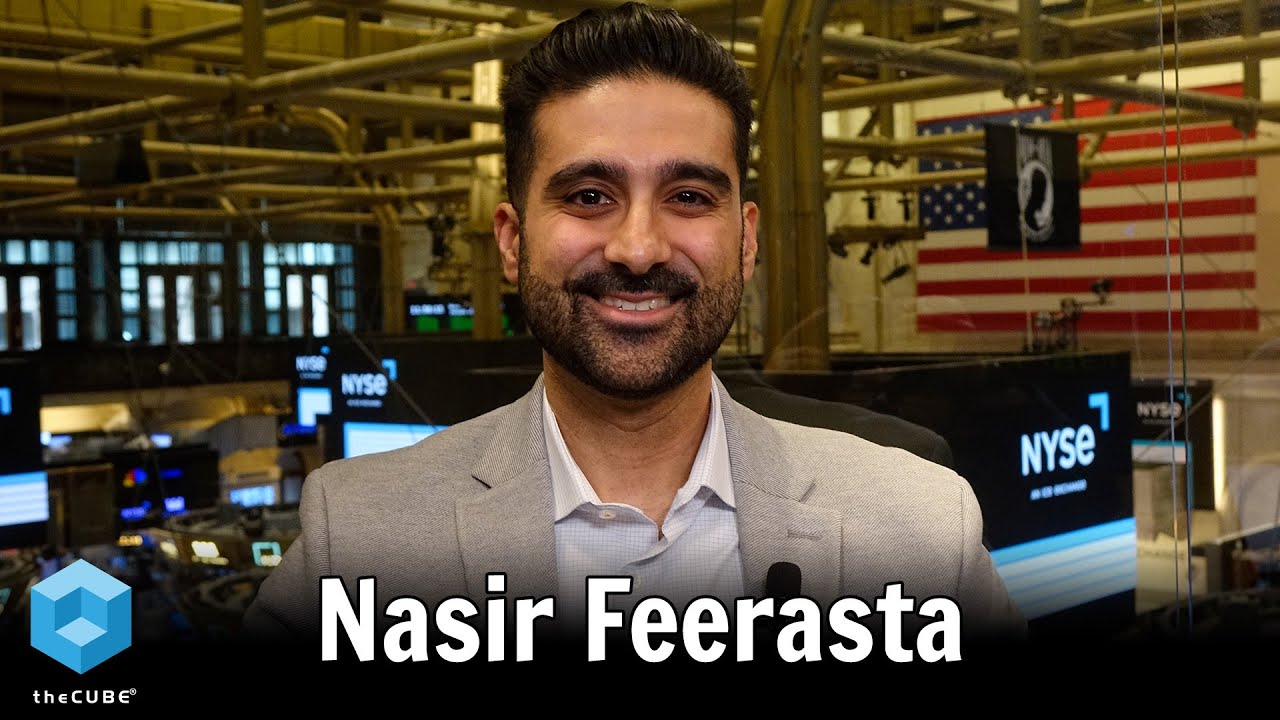
>> All right. Keep it right there. Dave Vellante for John Furrier, he was also in the house. This is NRF Media Week with theCUBE and the NYSE Wired community. We'll be right back right after this break.














 Dave Vellante