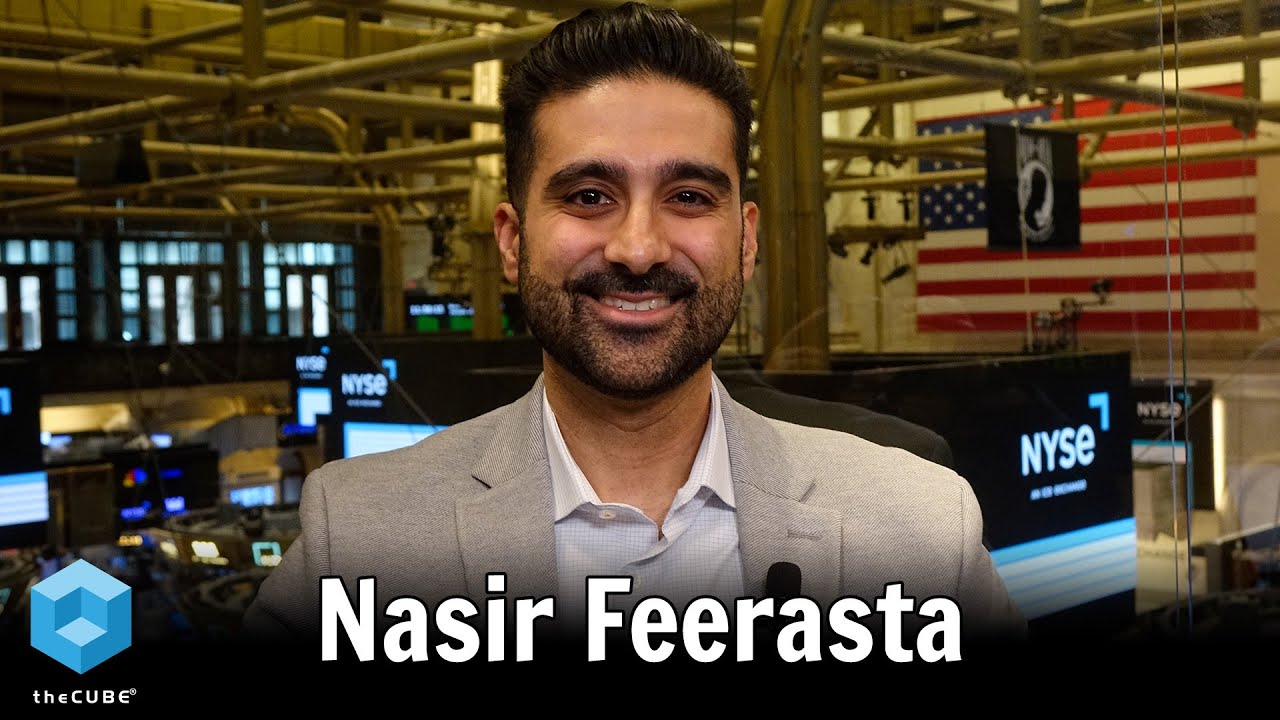
The CTO of Zebra Technologies explains the company's role in providing mobile computers and devices across various industries. Zebra Technologies focuses on asset visibility, mobile computing, and intelligent automation to enhance productivity. The company has been around for 50 years and has adapted to new technologies like AI and computer vision. The CTO discusses the challenges of the labor shortage and the need for automation to improve efficiency. Zebra works with Google Cloud Platform to provide software solutions for frontline workers, emphasizing the importance of collaboration and transformation in technology development. The CTO highlights the excitement of working with a great team and being close to customers to co-innovate and deliver value.
A top 10 retailer recently joined forces with Zebra to showcase how they are reinventing retail through technology, people, and customer experience. Zebra introduced the Zebra Companion offering, which includes four key agents designed to assist frontline workers in retail. These agents focus on knowledge, sales, merchandising, and devices, providing assistance with various tasks and workflows. The data for these agents typically comes from the retailer's own data lake, with some collaboration with Google for the knowledge assistant. Zebra envisions a future where stores are fully connected and personalized, with increased automation and digital twinning to optimize the retail experience for both customers and businesses. The implementation of these technologies will not only transform the retail store but also have a ripple effect on the entire supply chain and consumer economy.
Forgot Password
Almost there!
We just sent you a verification email. Please verify your account to gain access to
theCUBE + NYSE Wired: AI & Retail Trailblazers. If you don’t think you received an email check your
spam folder.
Sign in to theCUBE + NYSE Wired: AI & Retail Trailblazers.
In order to sign in, enter the email address you used to registered for the event. Once completed, you will receive an email with a verification link. Open this link to automatically sign into the site.
Register For theCUBE + NYSE Wired: AI & Retail Trailblazers
Please fill out the information below. You will recieve an email with a verification link confirming your registration. Click the link to automatically sign into the site.
You’re almost there!
We just sent you a verification email. Please click the verification button in the email. Once your email address is verified, you will have full access to all event content for theCUBE + NYSE Wired: AI & Retail Trailblazers.
I want my badge and interests to be visible to all attendees.
Checking this box will display your presense on the attendees list, view your profile and allow other attendees to contact you via 1-1 chat. Read the Privacy Policy. At any time, you can choose to disable this preference.
Select your Interests!
add
Upload your photo
Uploading..
OR
Connect via Twitter
Connect via Linkedin
EDIT PASSWORD
Share
Forgot Password
Almost there!
We just sent you a verification email. Please verify your account to gain access to
theCUBE + NYSE Wired: AI & Retail Trailblazers. If you don’t think you received an email check your
spam folder.
Sign in to theCUBE + NYSE Wired: AI & Retail Trailblazers.
In order to sign in, enter the email address you used to registered for the event. Once completed, you will receive an email with a verification link. Open this link to automatically sign into the site.
Sign in to gain access to theCUBE + NYSE Wired: AI & Retail Trailblazers
Please sign in with LinkedIn to continue to theCUBE + NYSE Wired: AI & Retail Trailblazers. Signing in with LinkedIn ensures a professional environment.
Are you sure you want to remove access rights for this user?
Details
Manage Access
email address
Community Invitation
Tom Bianculli, Zebra Technologies
The CTO of Zebra Technologies explains the company's role in providing mobile computers and devices across various industries. Zebra Technologies focuses on asset visibility, mobile computing, and intelligent automation to enhance productivity. The company has been around for 50 years and has adapted to new technologies like AI and computer vision. The CTO discusses the challenges of the labor shortage and the need for automation to improve efficiency. Zebra works with Google Cloud Platform to provide software solutions for frontline workers, emphasizing the importance of collaboration and transformation in technology development. The CTO highlights the excitement of working with a great team and being close to customers to co-innovate and deliver value.
A top 10 retailer recently joined forces with Zebra to showcase how they are reinventing retail through technology, people, and customer experience. Zebra introduced the Zebra Companion offering, which includes four key agents designed to assist frontline workers in retail. These agents focus on knowledge, sales, merchandising, and devices, providing assistance with various tasks and workflows. The data for these agents typically comes from the retailer's own data lake, with some collaboration with Google for the knowledge assistant. Zebra envisions a future where stores are fully connected and personalized, with increased automation and digital twinning to optimize the retail experience for both customers and businesses. The implementation of these technologies will not only transform the retail store but also have a ripple effect on the entire supply chain and consumer economy.
The CTO of Zebra Technologies explains the company's role in providing mobile computers and devices across various industries. Zebra Technologies focuses on asset visibility, mobile computing, and intelligent automation to enhance productivity. The company has been around for 50 years and has adapted to new technologies like AI and computer vision. The CTO discusses the challenges of the labor shortage and the need for automation to improve efficiency. Zebra works with Google Cloud Platform to provide software solutions for frontline workers, emphasizing the ...Read more
exploreKeep Exploring
What does Zebra Technologies do and what is happening at NRF this year?add
What are the core areas of focus for asset management and workforce optimization in today's environment?add
What are some technologies and strategies being used to improve inventory visibility and prevent stockouts in retail settings?add
What is Zebra's relationship with Google, particularly in regards to their use of Google's Android operating system and Google Cloud platform?add
What are the key highlights of the Zebra Companion offering announced at the show?add
What are the potential benefits of having fully digital-twinned retail stores in the future, specifically for CPG companies like Unilever?add
>> Hello. Welcome back to theCUBE. We are here in the New York City at the NYSE Studios with theCUBE East. This is our East Coast super node, super pointed president. We've got the Silicon Valley studio in Palo Alto here at the Wall Street, part of the NYSE Wired CUBE partnership. I'm John Furrier, your host of theCUBE. Tom Bianculli is here. CTO of Zebra Technologies, is here in town for NRF. Made the trek over to the stock exchange. Thanks for coming on.
Tom Bianculli
>> It's great to be here, John. Thanks for having me.>> So really appreciate you taking time out of your super busy schedule to come into the NYSE. Not a bad little location here.
Tom Bianculli
>> It's a great spot.>> This will be our East Coast point of presence this week, where the community's going to dial up into the world and connect people with content. And NRF's the hot show.
Tom Bianculli
>> It absolutely is.>> So we love talking AI as it applies to retail.
Tom Bianculli
>> Yeah.>> So you're in the middle of it with Zebra Technologies. I know you got some news. But I want to get your take on... Just explain what Zebra does for the folks watching, who might not know the extent of what you guys do and then what's happening at NRF this year.
Tom Bianculli
>> Yeah, sure. Yeah, so Zebra Technologies, we like to say we're hidden in plain sight. If you've been at a checkout lane or you've been in any retail store, you've had a package delivered to your front door, you've seen our devices. You may not have noticed the logo, but it's been there. So we have market share leading positions in all the mobile computers that are deployed across 80% of Fortune 500 companies. That includes retailers, transportation companies, manufacturing companies, warehouses, hospital wristbands, and patient side medication administration that's using our devices to really digitize and automate workflows. So if you think about capturing information. That could be information about inventory on a shelf floor->> Like scanners....
Tom Bianculli
>> scanning technology that reads barcodes, that prints those barcodes, that captures that data on mobile computers for applications to be able to consume them for doing things like inventory optimization. And then we have a whole suite of software capabilities that help optimize those frontline workers. And really the way we like to think about it is much of what we provide is aimed at enabling productivity At the point of activity. People that went to school to become healthcare providers didn't do that so they could document patient care, they did it so they could provide the care to a patient. So we want to use the technology to remove all that extraneous activity, allow them to get their job done, and we do that through asset visibility, mobile computing, and intelligent automation.>> So you guys have a lot of products, both software and hardware that powers the edge. Super edge, like, "Hey, I'm scanning the brace that I'm at a hospital or I'm buying something, checking inventory." We've all seen scanners. I think UPS comes and Amazon comes, they scan the package, take a picture, things like that. That's kind of like what the main-
Tom Bianculli
>> Exactly. And one of the terms that's been coming up more and more over the last year is the far edge. So if you think about the edges being on-prem and the cloud, of course everybody knows, and the far edge is literally write down what's either worn by or in the hand of a person getting a job done.>> And like healthcare, retail has a lot of IOT devices.
Tom Bianculli
>> Yes.>> You guys are in that device business, have the back office, I mean all business operations are going to have this end-to-end kind of workflow.
Tom Bianculli
>> Absolutely.>> But you're living it. This market in retail, I think, like healthcare lives in the state-of-the-art super edge, multiple devices, small form factor, highly intelligent-
Tom Bianculli
>> Exactly.... >> hitting a database. So you've been living this.
Tom Bianculli
>> Oh, yeah. We actually pioneered the wearable technology in the enterprise with some of the largest transportation carriers. The first wearable computers that mounted on wrists, we have scanners that read barcodes that are literally the size of a ring that you can wear on your finger. And so if you think about a large carrier like a FedEx or UPS, when they're loading the back of those vehicles, they're scanning every package going in using that kind of technology. And we pioneered that and now we're seeing a whole new generation of it with generative AI and computer vision and AI that we're really excited about.>> And the company is not a start-up. You've been around for a while.
Tom Bianculli
>> We've been around for over 50 years.>> 50 years, yeah. So this has been an e-commerce physical world situation. We've all seen how retail's evolved and now with AI... So first of all, retail, the conversation we've been having here, for your perspective, has been twofold. One is the digital side obviously of the internet. The pandemic changed the brick and mortar relationship to digital. So everyone had to go online.
Tom Bianculli
>> Absolutely.>> Stores were shut down.
Tom Bianculli
>> Yeah.>> And then the whole post-pandemic. That was a forcing function to change behavior. A lot of things were happening differently.
Tom Bianculli
>> Absolutely, yeah.>> And then now the pre-agentic. Now generative AI has changed another forcing function 'cause now you've got computer vision.
Tom Bianculli
>> Yes.>> I mean, there's things happening now that were not gettable technically-
Tom Bianculli
>> Absolutely.... >> if you go back five to 10 years. Even five.
Tom Bianculli
>> Yeah. Absolutely.>> So what are some of those things that's happening at NRF now that as you guys have been in the, I call, poll position, if you're going to be in the market, you're seeing everything. What's gettable now? Is it the computer vision? Is it the self-autonomous retail tracking system? I'm just making this up, but I'm sure there's a lot of true things.
Tom Bianculli
>> Yeah, no, absolutely. All great points. And even just to flesh it out a little bit further and go back to our heritage as well. We like to say we were initiated well before IoT, this idea of converting atoms to bits. So the mission of our company actually early on was very much around connecting the physical to digital. And now as you said, there's been the pandemic, ushered a lot of change in behavior. And I think one of the other dynamics on the demand side we're seeing from our customer, and this showcased in a major way at NRF over the last couple of days, is the labor shortage and labor attrition wage inflation. And so Korn Ferry is actually estimating that by the end of the decade, there'll be a shortage of 85 million workers, which is like the population of Germany. And they're anticipating that's going to result in $8 trillion of unrealized economic output. So everything you just said, which is the technology is now possible. What's possible is that we advanced massively. And what's valuable is being able to augment workers to be able to deal with the fact that there is this labor shortage and we're asking frontline workers to do more and more. So if you think about what's on the floor at NRF, what are we hearing from our customers, think about a store now. It's not just a physical store to go shopping in, it's also a fulfillment center. So the store is being used to pick items and ship those to your home. And so now we're asking those workers in the store not only to do their regular job of stocking shelves, but they're also picking those items to be able to ship as well. So in terms of the technology, what's realizable now and possible, absolutely, computer vision is at an inflection point in terms of what can be run on that far edge. So we demoed in the booth with Qualcomm, with Google, and with a major North American retailer, the ability to literally snap a picture of a shelf and within a second be able to identify all 70 products on that shelf, identify what the products are, are they the right products, is anything in the wrong location, is anything out of stock? And then to the agentic point of what you mentioned earlier, the system then ingests all of that captured data, and using generative AI decides what are the right next things to do? Should I kick off a task to have someone replenish an item? But don't do that if it's not in the back stock, otherwise you're just wasting somebody's time. Or should I say, "Hey, there is no back stock, but there's a product missing. Here's a substitute, you should go put in there and do that." So basically it's all made in->> Next best action.
Tom Bianculli
>> Next best action. Orchestrating workflows and doing that in a very automated fashion and removing steps from the workflow.>> Yeah, it's interesting, a lot of your customers, I'm sure, have this problem because we're seeing this consistently across all industries and all verticals, whether it's at the infrastructure for the big banks or whatever vertical in industry, is that data and AI growth is growing so much faster than budgets. So the money has to come from something.
Tom Bianculli
>> Absolutely.>> We predict in our research, a trillion dollar shift is going to happen over the next 24 months around data center and edge deployments. And when I say shift, it's not shifting from the cloud yet, some repatriation, but it's cloud connected. So we're distributing computing hybrid architecture. That's happening. So cloud guys are going to... Everyone wins, but the money has to come from somewhere. So we're saying it's got to come from the old stuff, so stuff will be killed to feed the new stuff.
Tom Bianculli
>> Which I think this is really->> Where is that coming from? Where's the dollars going to come from?
Tom Bianculli
>> Yeah. Well I think every one of our customers, and I, over the course of two days, met with a few dozen customers, are thinking about how do they reinvent their operations? And in fact, one of our customers mentioned to us that, "Hey, if we keep piling on to our frontline workers, the things we need them to do," let's say, over the next two years, 'cause they can see what is coming for the store environment and Omni fulfillment and endless island and so on, "the labor bill will actually outpace the sales bill." So where it's got to come from, a big chunk of it has to come from just raw efficiency. So can I get the work of five people using three people, because I can automate 40% of the workflow using some of this generative AI and technology? So that's a big way that >> Robotics is going to be a big part of it.
Tom Bianculli
>> Physical automation is a big->> At CBS we saw a ton of robotic around labor tracking, scanning inventory.
Tom Bianculli
>> Absolutely. So in the logistics space, we're definitely seeing more and more of the physical robotics capability. And we actually acquired a company several years back called Fetch Robotics out of San Jose that is focused on autonomous mobile robots that does collaborative fulfillment in e-commerce fulfillment centers. So this is orchestrating robots with people in an environment and we're taking the... If you think about the time or the amount of mileage that a picker in a warehouse environment walks per day without this robotics, they might walk 12 or 15 miles a day and with this robotics capability that's down to one or two miles and they're focused on the actual picking and fulfillment.>> Well, I want to get my steps in. Maybe I should look at that career.
Tom Bianculli
>> Yeah, exactly. Maybe both of us should think about that.>> Just to kind of put things in perspective with Zebra technology, you guys have product categories, mobile computers, tablets, barcodes, scanners and printers, RFID readers, smart label technologies, autonomous mobile robots, machine vision systems, enterprise software solutions, and you're operating in multiple industries, retail, e-commerce, which we're talking about this week, manufacturing, transportation, logistics, banking, healthcare, government, public sector, hospitality, utilities. You guys are accelerating workflows end to end across all markets.
Tom Bianculli
>> We are.>> You guys have a unique perspective.
Tom Bianculli
>> Yes.>> What's the one thing, if you zoom out and get away from the bark of the tree, to the tree to the forest, what's going on? How are the trees blowing? What are you seeing as CTO? What is the common thread? Is it horizontally scalable data? Is it domain specific application intelligence? What's the core thing that you guys overseeing that you see happening?
Tom Bianculli
>> So what I would say is a common thread across all those areas is this need to have perpetual asset visibility. So wanting to understand, and a lot of the omniverse capability, digital twin, some of these concepts have been around for a while, but now it's really hitting a point where it's able to drive a return on investment. And so the asset visibility is really around where are all my people, my inventory, my capital assets, but not just understanding that from a planning perspective, but understanding in real time in motion, where are those assets? That's one key piece. The other piece is what we are calling the augmented connected workforce. And it's not just us. Gartner actually is calling it the augmented connected workforce. And it's expected that over the next several years that's going to be deployed to reduce what Gartner calls the time to competency by 50% for onboarding new employees. And these are the kinds of trends, the asset visibility and making that more perpetual and continuous, the everyone connected workforce that has the right information and the next best action at their fingertips, and then the ability to have human-centered automation. I think there's so much in the headlines around wholesale automation and it's going to completely >> going to be critical.
Tom Bianculli
>> Exactly.>> Robots will fill the gap on some labor issues. Yeah, my coffee might be filled by a robot, but a latte's a latte, whatever, but the human's the next product.
Tom Bianculli
>> Yeah, exactly. And so being able to do that in a collaborative fashion with automation. So I would say those three elements of that perpetual visibility, the connected frontline worker with this information, and then the collaborative engagement with robotics. You could pick any vertical from what's happening in healthcare to what's happening in retail. That's certainly what's happening in warehouse and transportation.>> You know, you mentioned digital twins. One of the trends that we're seeing in here, certainly in retail that's more acute because it's got a consumer aspect to it, is listening to the customer. Now in classic retail, we just without the internet say, "Hey, they looked at the price tag, they squint their eyes and they stop away. Oh, they don't like the price." You can read that gesture listening to the data. So you guys actually track and analyze and accelerate data, essentially what you do. That's basically . I get that right. Simplify a little bit, oversimplified it.
Tom Bianculli
>> Visible, connected and optimized.>> That's what you guys are doing. Okay, so how do I listen to the data? You mentioned digital twins, because digital twins, we use that term when we do all of our digital events and people, "That's not a digital twin." I mean, okay, you want to get specific. Manufacturers use digital twin because they're the first industry that gets value out of that. Now my thesis is, "Okay, I do a digital twin. Why? Because I want to get no defects." So I'll use a digital twin simulation to drive what the outcome of manufacturing is. Highest quality product, no defects, oversimplifying that among other things. Roll the line.
Tom Bianculli
>> Machine uptime and all these sorts of things.>> So that definition of using digital technology to simulate efficiency for something. So that could be applied to everything. So in media, digital twin could be a cube, not on the show floor at NRF right now.
Tom Bianculli
>> Right, right.>> We're here.
Tom Bianculli
>> Yes.>> I mean, we're digitally twinning NRF, technically. So now the data comes into our cloud. So I mean, I'm kind of connecting the dots here because I think digital twin is probably the biggest opportunity I've ever seen in the world we're in now, because every industry could have that outcome.
Tom Bianculli
>> Absolutely.>> If you don't know the outcome. You can't leverage the data.
Tom Bianculli
>> That's right. Yeah.>> What's your thoughts on this? I mean, I kind of loosely described there.
Tom Bianculli
>> Yeah, no, no, I think that they're great insights around that. And we're both saying the concept's been around for a little while, we're seeing a little bit of an inflection point. But what's really critical I think in this digital twin and the asset visibility space is driving back from the use cases back. And so the challenge I see->> Like what?
Tom Bianculli
>> Well, so if we think about on-shelf inventory availability or inventory accuracy for fulfillment from store, one way to look at a, say digital twin to say, I want to have a digital representation of the entire store at every second of every day. That could be energy management, it could be inventory. If you take it from a digital twin perspective, it's the people. It's where vehicles are coming in the back to make deliveries. Or you could say, "Hey, the use case is that 50% of when shoppers leave a store without buying something, more than 50% of the time, it's because they couldn't find what they wanted on the shelf." Like a really basic thing. Or when you're made a promise to deliver something to your house tomorrow, and I sent a picker in the store to go pick that item and they can't find it on the shelf, you're a disappointed customer. So if we said, "Hey, what if we digitally twin the shelf, and we used camera technology, both fixed mobile RFID?" Tremendous boom in RFID over the last couple of years and another big area of technology innovation at NRF this year. Another big topic with customers. So those items that can be tagged with RFID, we have customers doing this today. They're getting that perpetual visibility of the inventory and they have basically a digital twin of all the inventory that's then solving for, "Hey, I'm never out of stock. I never make a disappointed customer because I always can find what I'm looking for when I do the pick." And so it's a digital twin with a purpose. It's a digital twin to go now >> To optimize why the thing exists in the first place.
Tom Bianculli
>> Exactly right. Exactly. And then what we're seeing, John, really is once you stitch together multiple of these use cases, you get to the whole store becomes digital twinned because it's an amalgamation of a number of these use cases. And I think that's the way to do it in an economically realistic way as opposed to just digital twin for digital twin sakes.>> And I think I bring it up because I think a lot of people get dogmatic around old definitions. In August, we wrote the section on the Economist on the digital twin feature, and we use the Uber example because it's people, places and things. As things going on, a lot of things are happening and they're different databases, so you have to get it right and you can run simulations to figure out the classic, at the cashier, "Did you get everything you need?" "Actually, I didn't. Can you go get me? Find?" No, they're not going to do that. I never say that with the cashier, "Hey, yeah, I had a hard time getting X." They're like, "Oh, well see you next time." What? Are they going to stop What they're doing? Are they going to call loudspeakers? So I think having... That's a really good real world example.
Tom Bianculli
>> Absolutely. Getting that insight and exactly using cameras to be able to determine, "Hey, is someone dwelling?" I mean, dwelling is another one? Are you dwelling in front of a large purchase item and you're probably trying to make a decision? Is that the right time to send someone over to maybe do some assistance stuff?>> I think the computer vision kiosk kind of like, "Hey, how can I help you?", can be on the app. It could be sensing where I'm in the store. So much is going on.
Tom Bianculli
>> Yeah, it really is.>> I mean, we could go for an hour. I got to ask about the relationship with Google first because I know you mentioned them earlier. You did a thing with Google and Qualcomm. Thanks to Google for giving us your contact information, bringing me... Love this conversation. I mean, what are you doing working with Google on their cloud for? Google Cloud has been a big partner.
Tom Bianculli
>> Sure.>> I mean obviously Gemini Pro has got great reviews. They've got a lot of big queries, a great product. They've got a lot of great big iron capability.
Tom Bianculli
>> Absolutely. Yeah. So the exciting thing about the Google relationship and really unique with Zebra and Qualcomm as well, but with Google specifically, we use Google's Android operating system, which is obviously independent of the Google Cloud platform on all our mobile computers. And we have market share leading position, the number one position in enterprise mobile computers across all the verticals you mentioned. But then in addition to that relationship with Google Cloud platform and GCP, we've been on a journey with them for the last six or seven years. And we essentially had no SaaS offerings if I go back six or seven years ago as a company, and now we're enabling with a whole suite of what we call work cloud offerings. It's a whole suite of communication, collaboration, employee self-service for doing things like swapping shifts and seeing your schedule, forums, being able to do a... Like if a manager wants to leave a note of the day for the beginning of the shift, task management is all built into this as well. So we have a whole suite of software that engages that frontline worker that helps them get their job done. Again, removes the extraneous noise and helps them focus on what's the most important thing in the moment. And all of that, as we bought that in through organic development, acquisitions, and it's been multiple acquisitions to get to where we are, we went on that journey with Google Cloud to migrate and basically shift and harmonize all of that into a cloud instance that allows us to minimize duplicity and have a common data lake and do that in a really effective and efficient way possible. All the metering, we're partnered with them on Apigee for API integration. So we can do metering and observability.>> Got security challenges too?
Tom Bianculli
>> Absolutely. And leveraging Google in terms of being able to get that from a security wrapper perspective is tremendous as well. So all of that on the tech side. But the other thing I really enjoyed about the Google relationship is the transformation element. So when we started on the journey, we were doing a lot of this as infrastructure, as a service, and we realized, "Hey, we can get a lot more done. We can spend our cycles and our capital developing a lot more value if we focus above the platform layer and bring Google in as a platform, as a service." And so going on that change journey is not simple either. You've got people that have been developing certain ways for a long time and to bring Google in and go on, that transformation with them was just as valuable as all the technology. And as I always like to say, people do business with people at the end of the day and they're just tremendously great culture and people to work with.>> And that's a great business call too, because what we're seeing right now with AI, you're at scale and you have end-to-end workflows and data. That's the new asset, right?
Tom Bianculli
>> Absolutely.>> So IP, the initial properties, is what you got going on if you can get to scale faster in your core.
Tom Bianculli
>> Exactly. And that's exactly right.>> And they're underpinning. They've got the marketplace and other stuff, but the core scale-
Tom Bianculli
>> It's core versus context is exactly right. The contextual foundational elements will build on top of and use Google for that. So let's >> So, CTO, Zebra Technologies, I mean, you've got so much going on. You're in the thick of everything. You're literally on the wave. I mean, it's got to be thrilling.
Tom Bianculli
>> It absolutely is.>> It must be fun. What's it like? What's it to be CTO of Zebra?
Tom Bianculli
>> Well, first of all, I have to mention the team at Zebra. That's the most exciting thing about it is all of the people that make up Zebra. I think our culture is one of our biggest, if not the biggest differentiator, our people are our greatest asset. So working with an awesome team, always like surrounding myself with people that are smarter than I am. And I'm able to do that at Zebra in many, many ways in just different disciplines. So great team. That's awesome at Zebra. One of the most exciting things beyond our own team and people is just working with customers and being really close to the customer. We pride ourselves in that. We understand the workflows. We have, fortunate enough to say, just amazing relationships with customers and we co-innovate, we co-develop with those customers. And we did that exactly. We had two of our customers in the booth today. One is a top 10 retailer and today and over the last few days, and they were shoulder-to-shoulder with us with their branded logos on, presenting our combined stories to how we're reinventing retail. It's the technology, it's the people and it's our customers.>> You're reinventing their operations and ultimately revenue, where right now follow the money. We've been looking at this edge waiting for that to go mainstream ,industrial edge, intelligent edge. I mean it's everything. Now you're running businesses end-to-end and your devices and your technology is right there. Let's get into some of the news. You guys have so much. I got the release. It's almost, we could have done an hour just on going through the press release.
Tom Bianculli
>> It was a lot of the release, yeah.>> So I got knowledge, agent sales. Take us through the highlights of the key news because, I mean, a comprehensive agent suites out there. You got some key, what's the key highlights from the news?
Tom Bianculli
>> Yeah, so a couple of key takeaways. One is the Zebra Companion offering that we announced at the show and we showcased in the booth with some of the players that I just mentioned. And there's four key agents under that. So keep in mind these are Zebra Companion using agentic AI for the frontline worker in retail. And so the four agents that we discovered would be the most valuable to those frontline workers is what is a knowledge agent. So you can think about this as everything policy and procedure oriented if you're in the store. You're returning an item, you have the credit card you bought it with, but you don't have the receipt, what do you do? Can I give you store credit? Do I give you just a full return? So you can quickly ask that through voice, through text, it's multimodal and get that response back really quick. This plays into the labor shortage and onboarding more quickly. The second one is a sales agent. So this we integrate to the PIM, or the product information management system, of our retailers and that brings in all of that product information. So of course you can do simple things like, "Hey, what's the price of this? What's the inventory on that?" You can scan a barcode and then ask questions about the barcode, which represents that product. Everything from health information to allergies to calorie inference. So anything that's in the product information base. "Does this go with that?," kinds of questions as well? So that's the sales agent. And then we have something we call merchandising agent, which allows us to enable the fastest way for that associate to deliver the perfect shelf. So if you think about Facings on the shelf, you may have 60 or 70 facings on a four-foot section of the shelf. You'll literally snap a picture of the shelf. In less than a second, it analyzes all that and then tells the worker what steps they need to take and automates entire portions of the workflow. So that's the merchandising->> This is the acceleration .
Tom Bianculli
>> And then we have a device agent as well. Sorry, just real quick.>> What's the device agent?
Tom Bianculli
>> Yeah. Device agent is understanding all the details of our products. And so if you want to ask a question around, "How do I make this product work with that one? How do I change the media or the supplies and this printer?," it'll walk you through that step-by-step for troubleshooting and so on. So those are the four agents. They all fit under Zebra Companion and you don't have to know anything about those agents if you're the Frontline worker. You just ask your question or take your picture and then it tells you what it can do with that and routes automatically in an agentic fashion to the right agent.>> Does the retailer have to create a data lake with you guys or they use their data lake or both or how does the data work?
Tom Bianculli
>> It varies by agent, but for the most part they use their data lake. And in the case of knowledge assistant, we work closely with Google on this. It's a lot about documentation ingestion, and Google has a whole knowledge document capability that's able to parse those documents. So things like videos and links to PowerPoints and charts and graphs as well as all the text. It's able to ingest all that and then augment the LLM. So your prompts can be used to pull that information back. But one of the cool things we're doing with it in an enterprise context is ensuring that the answer we give back to that frontline worker can be clearly attributed back to a policy and procedure documentation. Because we don't want to be in a situation where it's making up an answer or it's hallucinating or something. So the attribution of the answer it provides in a closed loop fashion, actually back to the document that was created is something that we worked on with Google that basically grounds the model to ensure we're giving all the right information to the worker.>> And that's critical. We get the context windows increasing, so cost per tokens are dropping.
Tom Bianculli
>> Absolutely.>> A lot more action.
Tom Bianculli
>> Faster than we could figure out. I mean as we look at some of these >> Well, appreciate your time. Final question, what's the impact going to look like? Because you guys are bringing so much capability to the market, you got all this change happening, budgets are shifting. There's a trillion dollars in IT, generally speaking, but retail's going to have their portion. It's going to come from somewhere. What's your vision over the next five years? What's the steady state look like in retail if we're here five years from NRF? What's it going to look like in your mind?
Tom Bianculli
>> Right. Yeah. Well, everything's going to be connected to everything for one thing. So the store is going to be Omni in every sense of the word. I think you pulled up some things earlier in our conversation where you were saying an understanding of the customer. So curated and personalized experiences, that's already happening, but that's going to get to another level. We're seeing retail media networks take off in a major way within stores. So I think there'll be more screens and ability to interact, but do that in a personalized fashion->> With agents....
Tom Bianculli
>> as you walk... Absolutely with agents, as you walk up to those elements. We'll have much more automated, the digital twin, which won't just be a use case in five years from now, it'll be the whole store is instrumented. And then these things have massive network effects. So if the whole store becomes instrumented, think about a CPG company like a Unilever, that right now has no visibility into the exact on-shelf position in a given store other than maybe what the store reports on some manual-based basis. Well, once the store is fully digital-twinned, in five years from now, that information is brokerable right to that CPG company. They can see exactly what's there. So now think about that. They're not sending somebody to the store to replenish something that doesn't need replenishing. They're able to see things you talked about like dwell time. Did people pick something up and put something else down, from a merchandising perspective and optimizing that. So I think the more exciting thing is not just what's in the four walls of the retail store, but what's the rippling effect of all these technologies that are deployed in the retail store to the whole rest of the supply chain. And that changes the economy and it changes our experiences as consumers. It's exciting.>> It's wild because when I was in business school in the 90s, we had a whole book and class on consumer behavior. It was just so pedestrian. What you're getting at is next level. It's stuff.
Tom Bianculli
>> Really going to interesting.>> It's well-timed, computer vision. They stared at the product for 10 seconds and walked away.
Tom Bianculli
>> Right.>> Or would look confused.
Tom Bianculli
>> Sure.>> I mean, this is the kind of gestures we're going to get.
Tom Bianculli
>> Absolutely. And what do you do with that to make your operations better and your customers happier is what it's going to be all about.>> Tom, thanks for coming in. I know you're super busy.
Tom Bianculli
>> John, thank you.>> I appreciate you coming in.
Tom Bianculli
>> Yeah, absolutely. Thank you.>> For our NYSE location, I'm John Furrier, host of theCUBE, getting all the action from the AI leaders in retail and of course e-commerce. End-to-end data, end-to-end workflows will drive the AI data advantage, AI infrastructure, powering this new agentic system. Thanks for watching.