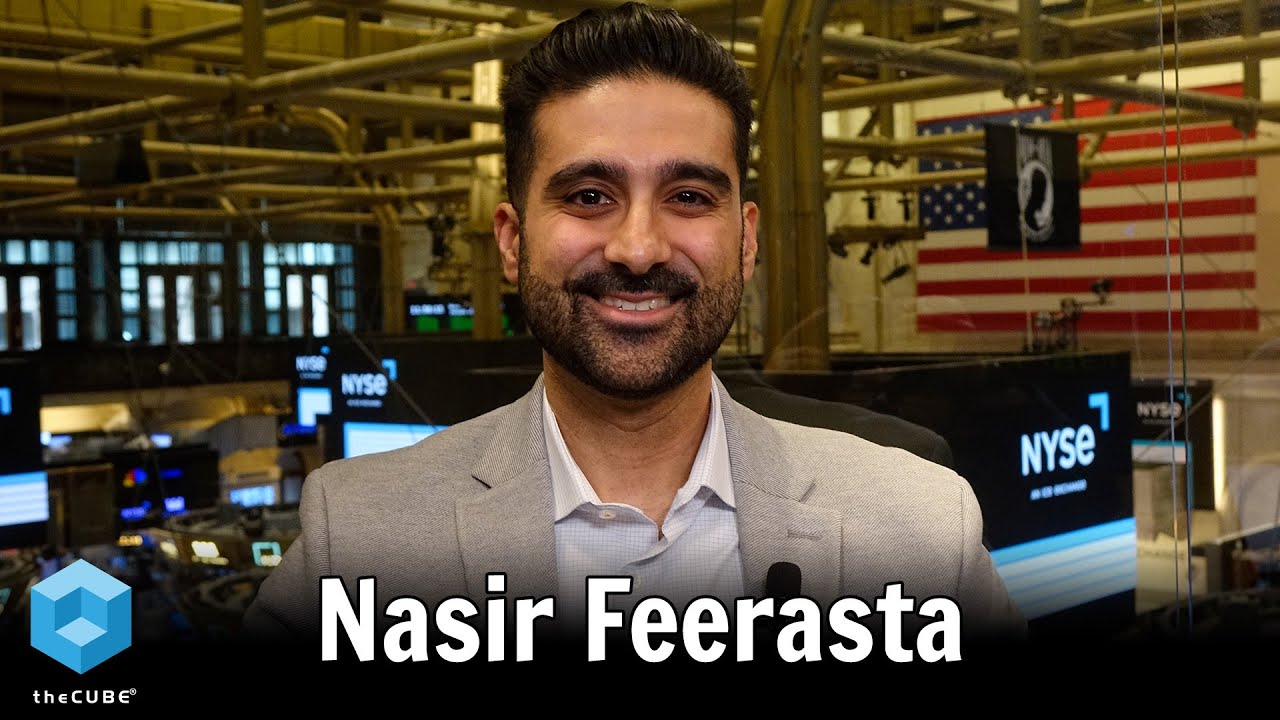
During NRF's Media Week, John Furrier interviews Remington Tonar, co-founder of Cart.com. Cart.com provides unified commerce solutions, focusing on efficiency and optimization by connecting supply chain with commerce demand gen capabilities. The company has experienced growth through acquisitions and now serves middle market and enterprise brands. They differentiate themselves by bringing together functions that typically don't collaborate. Cart.com emphasizes the importance of AI and domain expertise for success in entrepreneurship, particularly in digitalizing traditional businesses. The company has a track record of taking over operations and implementing their technology for greater efficiency. While facing objections about in-house solutions, Cart.com provides evidence through client references. Ultimately, having a strong backbone and infrastructure is crucial for delivering value in the market.
Forgot Password
Almost there!
We just sent you a verification email. Please verify your account to gain access to
theCUBE + NYSE Wired: AI & Retail Trailblazers. If you don’t think you received an email check your
spam folder.
Sign in to theCUBE + NYSE Wired: AI & Retail Trailblazers.
In order to sign in, enter the email address you used to registered for the event. Once completed, you will receive an email with a verification link. Open this link to automatically sign into the site.
Register For theCUBE + NYSE Wired: AI & Retail Trailblazers
Please fill out the information below. You will recieve an email with a verification link confirming your registration. Click the link to automatically sign into the site.
You’re almost there!
We just sent you a verification email. Please click the verification button in the email. Once your email address is verified, you will have full access to all event content for theCUBE + NYSE Wired: AI & Retail Trailblazers.
I want my badge and interests to be visible to all attendees.
Checking this box will display your presense on the attendees list, view your profile and allow other attendees to contact you via 1-1 chat. Read the Privacy Policy. At any time, you can choose to disable this preference.
Select your Interests!
add
Upload your photo
Uploading..
OR
Connect via Twitter
Connect via Linkedin
EDIT PASSWORD
Share
Forgot Password
Almost there!
We just sent you a verification email. Please verify your account to gain access to
theCUBE + NYSE Wired: AI & Retail Trailblazers. If you don’t think you received an email check your
spam folder.
Sign in to theCUBE + NYSE Wired: AI & Retail Trailblazers.
In order to sign in, enter the email address you used to registered for the event. Once completed, you will receive an email with a verification link. Open this link to automatically sign into the site.
Sign in to gain access to theCUBE + NYSE Wired: AI & Retail Trailblazers
Please sign in with LinkedIn to continue to theCUBE + NYSE Wired: AI & Retail Trailblazers. Signing in with LinkedIn ensures a professional environment.
Are you sure you want to remove access rights for this user?
Details
Manage Access
email address
Community Invitation
Remington Tonar, Cart.com
During NRF's Media Week, John Furrier interviews Remington Tonar, co-founder of Cart.com. Cart.com provides unified commerce solutions, focusing on efficiency and optimization by connecting supply chain with commerce demand gen capabilities. The company has experienced growth through acquisitions and now serves middle market and enterprise brands. They differentiate themselves by bringing together functions that typically don't collaborate. Cart.com emphasizes the importance of AI and domain expertise for success in entrepreneurship, particularly in digitalizing traditional businesses. The company has a track record of taking over operations and implementing their technology for greater efficiency. While facing objections about in-house solutions, Cart.com provides evidence through client references. Ultimately, having a strong backbone and infrastructure is crucial for delivering value in the market.
During NRF's Media Week, John Furrier interviews Remington Tonar, co-founder of Cart.com. Cart.com provides unified commerce solutions, focusing on efficiency and optimization by connecting supply chain with commerce demand gen capabilities. The company has experienced growth through acquisitions and now serves middle market and enterprise brands. They differentiate themselves by bringing together functions that typically don't collaborate. Cart.com emphasizes the importance of AI and domain expertise for success in entrepreneurship, particularly in digitaliz...Read more
exploreKeep Exploring
What led to the success and growth of Cart.com as a relatively young company?add
What combination of software capabilities and enhancements allowed the company to target larger companies and omnichannel brands?add
What advantages can be gained by relying on Cart.com for e-commerce services?add
>> Hello, welcome to theCUBE. We are here for Media Week for NRF, National Retail Foundation. It's a big retail show. I'm John Furrier, host of theCUBE. This is our NYSC Wall Street CUBE East location. We've got Palo Alto, California and Wall Street connecting tech and money. All the action's happening here. Our next guest is Remington Tonar, who's the co-founder of Cart.com. Great to have you back on. Not back on, first time on.
Remington Tonar
>> Yeah, first time. Thanks for having me, John.>> Yeah, I felt like we've been on. We were just talking before you came on camera about your awesome story and background. But what's compelling is you got a very diverse background, very entrepreneurial. First of all, congratulations. Company started in 2020 around the pandemic timeframe.
Remington Tonar
>> Yes. Yep. Right in the pandemic.>> Bring us through what you guys do real quick, the origins.
Remington Tonar
>> Cart.com is a unified commerce solutions provider. We basically connect and unify supply chain capabilities, both software and services, with commerce demand gen capabilities, both software and services. By combining those two aspects of the value chain, we're able to provide greater efficiency, agility, optimization, and automation for our clients who are world-class beloved retailers in some cases, all the way to the US federal government, which is also a customer of ours.>> What I find fascinating when I was preparing for chatting with you was is that you guys offer a service that is very cloud-like in the sense of the value proposition. You do a lot of the heavy lifting, abstract away the complexities for your customers around e-commerce, and providing all that process. Classic SaaS play. But now with the AI wave, we're seeing all those things come back with more acceleration around it, like more automation in the areas that were harder.
Remington Tonar
>> Yeah, exactly.>> That makes your job easier, and ultimately the product to the end customer. Take us through that journey of how you guys innovated, because you had rapid growth. You've had to come in and you had a variety of different roles in the company. Take us through that growth curve, and then what you're seeing now with the AI wave and what that's going to do for you guys.
Remington Tonar
>> The first thing I'll say, John, is you're absolutely right. The influx of new technologies, AI, big data, all of these things really provided the opportunity for Cart.com to come in and do what we do. We do operate facilities in addition to offering our customers software, but it's the software that allows us to transform the physical operations in a way to extract greater margin, greater efficiency out of those facilities. We started the company, as you mentioned, in the pandemic, November 2020. We just turned four recently, so relatively young company for our size.>> Good timing.
Remington Tonar
>> Excellent timing. But it wasn't an accident. We moved quickly to take advantage of the trends, the crises.November of 2020?>> Yeah, November of 2020.March '21 was really when it kind of blew up, right?
Remington Tonar
>> Yes, exactly.>> So you had that November to April. What was it like? I mean, were you sitting in the war room going, "Hey, this is not a pivot. Just throw the sails up and get that tail wind."
Remington Tonar
>> Yeah, yeah. Well, we realized that the market was moving fast and accelerating, and that in order for us to keep up with the market and even get ahead of it, we'd have to be very creative in how we built the company. And so initially, rather than build our capabilities from scratch, we used our initial funding to make a series of acquisitions. This kind of consolidator model, this consolidator approach that we took is actually what allowed us to get a jump start into 2021 so that we were really well positioned when, as you said, things started kind of heating up and cresting.>> What was the key move that you made that really kind of moved the needle?
Remington Tonar
>> I think it was initially we acquired some front-end software, front-end commerce software, but it was only after we acquired some of the back end software, warehouse management software, inventory management software, order management software, and started building AI and data capabilities into that software that we really started to see a lift. That's really when we were able to target larger companies, more blue chip companies, the omnichannel brands you might see in the mall that we all know and love and wear and use in our daily lives. It's the combination of those things that allowed us to target those customers. I think that's when we really saw the growth take off.>> It's interesting, I want to get your thoughts on the market because I think there's a real need there. We saw that a lot in the IT market where you had the big companies, they had full departments. You had other people were under-invested in key areas, but they were businesses. They weren't like mom and pops. But this mom and pops shop out there that hit a lucky strike at a killer product. They come to you. That's good, obviously. But these are brands. Take us though the market.
Remington Tonar
>> These are established companies, in some cases doing hundreds if not billions in revenue. So they're quite sophisticated in these areas. What's really interesting is these are companies that ultimately want to focus on their customers, their products, delivering a great experience to their consumers. What they don't want to do is have to worry about advancing and evolving and maintaining all of this technology that they have on the back end, all these operational components they have on the back end, which for a long time, John, were static. If you had these capabilities, you were solid. You didn't need to innovate on them. But now the market's moving so quickly with the introduction of new tools, AI, automation, that if you are a brand or a retailer and you're not Walmart or Target or Home Depot investing in the ability to keep up with that pace, that market, it's intractable.>> We were talking before we came on camera that you teach an entrepreneurship course at Rice University.
Remington Tonar
>> Rice University.>> Rice University once a semester. Thanks for doing that by the way. It's great way to pay it forward.
Remington Tonar
>> Appreciate that.>> It's hard for entrepreneurs to get back into that.
Remington Tonar
>> It's very hard.>> It's very busy. You've got a busy schedule. But I want to talk about the entrepreneurship side this, because when you have lightning in a bottle, you had it because we're seeing... That was the beginning that I look at the market and say, "Okay, cloud was kind of up and running with SaaS." SaaS is just a mobile device, in my opinion, mobile software in the cloud. But when you start getting into domain expertise, you saw a market develop and now it's kind of well-known. But if you can just have better domain experience, the buy-build decision is huge. Because what happens is when you have scale, black boxes are dangerous. People quit. "I built the inventory system." Well, who's the guy who wrote that? He doesn't work here anymore.
Remington Tonar
>> Yeah, he's gone.>> He's gone. So talk about this is huge. Talk about that dynamic because that's happening everywhere.
Remington Tonar
>> It is. We're seeing something really interesting happening right now across the commerce and supply chain space. It's really, a lot of people talk about the growing consolidation in that space, which is true. We see that. But a lot of it is because of a deconsolidation that is happening. During the pandemic, a lot of companies tried to verticalize. They wanted to control their own infrastructure so that they could move faster, and it makes total sense. In the current environment where rates are high, access to capital is lower than it was previously, the attention to margin and profitability is paramount. A lot of these companies are now looking to shed some of these capabilities that they built out during the pandemic, and we've been a beneficiary of that. We have a couple of household name brands, $1 billion plus in revenue, who have essentially handed over large parts of their operation to us because they want out of those businesses. And so there's this deconsolidation happening. We see ourselves as kind of being a reconsolidator where we can come in, absorb that capacity while also obtaining scale, while at the same time allowing our customers or freeing our customers to focus on what they do best.>> And you have the domain expertise. You just keep reinforcing that.
Remington Tonar
>> Exactly.>> The pandemic and AI, I brought this up earlier. Dave on our podcast have been riffing on this concept around the similarity between the two. We sometimes say forcing function. The pandemic was an unforecasted forcing function.
Remington Tonar
>> Absolutely.>> .
Remington Tonar
>> Yes.>> Ship me stuff. Okay, good for you. Check. AI now is a forcing function.
Remington Tonar
>> Yes.>> What do you guys see with AI? Because this reinforces this deconsolidation. It reinforces the value that you're saying, "Hey, you have a choice. You can go hire a bunch of guys." Well, I can build, it's a database. It's easy.
Remington Tonar
>> Good luck. Good luck. Good luck.>> When you have scale and data, it's not that easy. It's a complex system.
Remington Tonar
>> Yes, it's complex. Talk about that forcing function now with AI that the pandemic got you started, but now you got the AI wave.AI is becoming increasingly important in our space, obviously, but I think this is what's going to unlock the next wave of supply chain and retail and commerce efficiency. When you're able to incorporate real-time data sources, for example, we're using pre-purchase data, ad click data, web traffic data. Eventually we even want to use social media and sentiment data from real-time live sources to do demand planning and inventory forecasting. If I know more people are talking about this laptop, then I can calculate a higher or growing intent to purchase, and we can look at forecasting maybe months ahead of time, "Hey, we're going to need more of these in inventory. We might out of stock on them. I need more of them on the West Coast because that's where the interest is. We are out of them on the West Coast. We need to pull them from an East Coast facility over to the West Coast so we can get ahead of demand," and actually start to do what I like to call kind of tongue-in-cheek pre-commerce, where you're starting to make moves on behalf of the customer before they even make a purchase decision.>> 25 years ago or so, IBM had this slogan, e-business. Remember those days? And that was essentially internet. But that actually is what's happening now. I mean, you have that expertise, it's digital, everything's connected. So now you can integrate into systems that were frankly un-gettable that you had hire a server provider.
Remington Tonar
>> They're unobtainable. You had to build heavy, cumbersome middleware to go and get that data. Nothing was API-enabled. Now you are seeing in many industries an easier ability to obtain that data, which is obviously essential for teaching, informing, and empowering AI. It's all about the data. Garbage in, garbage out. In some cases though, John, there are industries that we work in like healthcare and pharmaceuticals that are not as modernized yet. And so obtaining that data can be very difficult. But once we are able to get our hands on that data, I think that provides a differentiator, but also provides greater clarity and visibility for our customers.>> As you guys build your business out and get that domain reinvested with innovation around doing the things that customers don't have to do, that's the main competitive advantage, what do you guys see as an advantage? Because at some point you hit what I call scaled app level. I made the term up because there was no other term for it, but when you hit a certain level of scale, you're in a rarefied air. You see things that other people don't.
Remington Tonar
>> Correct.>> You're scaled up. You're a scaled app or scaled platform. What do you see at that level that customers might not even be gettable? Because at some level you're working at scale. I'll say digital is a great example, which being in demand, demand forecast, that ties right into inventory, that checks the box. You see returns, all kinds of things you see. When you hit this scale, what's the data you see?
Remington Tonar
>> I was going to say, sticking with the theme of data, at that scale you're able to get data from multiple industries, customers of different sizes, customers in different geographies, customers with different consumer types, and without using, and we're not doing this today, but one can imagine a world where you're able to anonymize all that data of course, but use that to draw correlations on larger macroeconomic market trends. Like the pattern of purchasing in a certain industry in certain geographies, you can start to see those patterns once you have that amount of data. And then, you can start to make predictions based on those patterns as well. That's something that we're excited about down the road.>> As a co-founder, one of the things that's great to chat with you about is, one, you have that entrepreneurial skill of opportunity and recognition. And then going after it, you guys capture it and are doing great. As you look out at the next 20-mile stair in the marketplace, you've got AI, all this stuff we talked about. You're at scale. What is the vision? What is your competitive strategy? Because now your competitors can move faster.
Remington Tonar
>> Yes.>> Maybe someone's arguing in a boardroom right now, "Well, let's build it internally."
Remington Tonar
>> Yeah, let's build it internally.>> As you now are competing on the value you have, what's the 20-mile stair look like?
Remington Tonar
>> It's a great question. I think part of it is just what we talked about, having the scale, having the breadth and depth of data makes it very hard to replicate, particularly if you're trying to build it internally. Because you're only going to have access to your first party data. Sure, you can buy third party data, but ultimately it's going to be very hard at some point to obtain a data advantage over what we're able to access. I think that's one big thing. Another one is, as we're seeing with some of the trade risk that is emerging and the political risk that's emerging with the new incoming administration, which can offer challenges but also opportunities, at scale, our ability to offer our customers an international supply chain network is going to be hugely valuable.>> That's what I'm saying, that's supply chain risk basically.
Remington Tonar
>> Absolutely. 100%.>> You never know what the geopolitical landscape looks like.
Remington Tonar
>> You never know. So how do you build an infrastructure that allows, and this is how we think about it, allows our customers to be agile, to be flexible, to adapt to any number of different scenarios? So that regardless of what policy comes down the pipeline, we have a solution for them. And that's not something that they're going to be able to do easily on their own.>> I mean, geopolitical is one. Force majeure is like, look at the wildfires in LA. Look at the impact. That's basically their 9/11.
Remington Tonar
>> Absolutely.>> Not as many deaths like here in New York, but from a disruption standpoint, LA is offline. There is nothing going on.
Remington Tonar
>> It's shut down.>> It's shut down completely. It's a disaster. How do I reroute what's going on there?
Remington Tonar
>> And what's really interesting in the supply chain space is for a long time now, there has been this dominance of just-in-time inventory, where I don't want it until I absolutely need it, because that helps me lower costs. But what a lot of companies are seeing now is with an increasing amount of risk and uncertainty, black swan crises, you have to balance that with some just-in-case mentalities as well. Because these crises net-net can cost you more than you'd lose if you were operating on a more just-in-case model versus the current just-in-time model. So I think there's starting to be a rethinking of how we approach supply chain and inventory management and data technology AI so that we can predict demand, monitor inventory levels, adjust and balance in real time is going to be critical to making that a reality.>> What would you say the secret sauce is for Cart.com in terms of when someone says, "Hey, we're so solid, we're growing our core asset, our core secret sauce"? What's the secret sauce?
Remington Tonar
>> I think it's unification of things, functions and capabilities that have historically not talked to each other. I have marketers in the same room as my supply chain guys, and they're working on solving the same problems. That's not something you see even in a lot of companies. Their marketing team is over here, their logistics team is over here, and they're not collaborating. By bringing it all together, both on the software and service side, we're actually able to bring that expertise together as well. I think that unlocks a lot of value.>> I think the horizontal scalability, but yet the domain expertise you bring to the table is killer. Talk about the customer mix. You're a platform. I build a product. I might need to ship it. I might not need supply chain management. Where do you guys see your customer base starting and ending? What's the range of customer size, scope?
Remington Tonar
>> I'll give you a little history here, because when we started, especially during the pandemic, there were a lot of small businesses, new entrants that were trying to take advantage of the tremendous demand influx that we saw during the pandemic. And so that's where we started, working with these small, relatively new businesses that were growing very quickly. Unfortunately, after the pandemic subsided and things started to normalize, a lot of those businesses, as you know, weren't able to make it. A lot of them weren't able to survive. The level of demand just wasn't able to support that number of firms. And so we pivoted very quickly along with, as I was mentioning before, the incorporation of more sophisticated technologies. We moved upmarket to middle market and lower enterprise, enterprise brands, retailers. So now if you look at the customer base, it's about a third B2C companies, companies that are selling to consumers. It's about a third B2B companies, companies that are selling components or products to other businesses. And then it's about a third public sector revenue, so we do a lot of work with both state and federal government agencies, and that's been a huge unlock for us as well.>> Yeah, it's fascinating. As I get a little older, I've become kind of a historian at some level, joking about my history being around in many cycles. The interesting thing about outsourcing back in the old days, oh, you outsource your non-core confidence and you focus on your core. Some would say, "Okay, I'm shipping stuff. That's core to my business." But when you get into the platforms like Cart, you can actually be a core competency service provider-
Remington Tonar
>> Exactly right.>> ... versus outsourcing. Talk about that dynamic, because again, back to the black box, we've seen technical debt conversations move to, "Okay, technical debt's a concept we all talk about," but now we're talking about black boxes. What I mean by that is that you build it internally and you got to maintain it. You got to have R&D.
Remington Tonar
>> No one else knows it, but your internal people doesn't connect to anything.>> If someone leaves, the team just says, "Hey, Google may be a bigger offer."
Remington Tonar
>> Yes, a.>> "I'm gone."
Remington Tonar
>> And inside those black boxes over years, decades of development, there is a lot of spaghetti.>> .
Remington Tonar
>> Yeah, exactly. There's a lot going on in those black boxes. And the black box contains it and it protects it for a while, but at some point it explodes out of the box and then you have a real problem. And so to your point->> And the core business at that point is dead in the water.
Remington Tonar
>> ... you're relying on this thing that becomes very fragile. By relying on a Cart.com, you're able to obtain some level of anti-fragility where we're always getting better. We're learning in bad times, we're learning in good times. We're always making improvements to our offering. And why not take advantage of that? And so that's who we want to be for our customers. You mentioned a lot of them do see shipping, logistics, supply chain, all these things as part of their core competency. But I think ultimately these companies, many of them, at the end of the day, their core competency is creating great products for people who will love and enjoy those products. That's what they do best. I see a lot more of them today wanting to focus on that, and we're here to support them.>> Two more questions. One's going to be about Cart, one's more entrepreneurship. But the last question around your business is, talk about the objection when you get, "Hey, why should we go with you versus building it in-house?" Number one. And then two, if they go, "Okay, we're going to go with you guys," what happens next? Is it a migration and you guys just click on some code, co-pilot it in there? Take us through the objection handling and then, "We got you." What evidence do you give for that, and then how does the migration go?
Remington Tonar
>> We're fortunate enough now to have a wonderful set of references. So when people propose that objection to us, when they come to us with that objection or that skepticism, the best thing I can do is connect them with one of our clients that went through that same journey and is now having a great experience where their SLAs are up, their efficiency's up, they're saving money. And so I say, "Talk to these folks." So that's a big boon that we have now having dozens and dozens, hundreds of clients that have gone through that process with us that are very similar to any company that would be interested in taking .>> So you give evidence. "Look, someone like you did it. Here's the evidence."
Remington Tonar
>> Yes. And here's the outcomes. And what does that look like? It varies from company to company. In some cases, we've even taken over their whole facility, dropped in our technology. Because they're like, "Hey, this is a loss leader for us. We're not able to achieve break even margin in this facility. It's really weighing our business down. We need to unload the entire operation. But we have employees here that know what they're doing. We have a setup here that is optimized for our business, so we don't want to just leave that." Well, Cart.com can come in, take that over, drop in our technology to extract greater efficiency. In that case, they're saving money. We're making money. Everybody's happy.>> Got it. All right, final question for you. As an entrepreneur, you've been very successful. You teach a class. What's the opportunity for entrepreneurs these days when you look at the landscape? Everybody wants to be an entrepreneur. I personally believe you're born with it, but that's my opinion.
Remington Tonar
>> It is a hard thing to teach.>> It's a hard thing to teach, but people have natural skill. But good entrepreneurs see opportunities and then have to capture it.
Remington Tonar
>> Yeah.>> Right now, if you're an entrepreneur right now in this market, what's the dynamic that you could share that would help someone get orientation and/or look at?
Remington Tonar
>> Needless to say, in this right environment, as we all know, venture capital, private capital in general is not as available and accessible as it was in years past. So there's that constraint on entrepreneurship today. But I think a big horizon for entrepreneurship is looking in a few areas; one, traditional legacy businesses that can be digitalized and then transformed through that digitalization. For a long time, everyone wanted to build the next killer app. But sometimes you just have to optimize something that already exists, something that we all use.>> .
Remington Tonar
>> Absolutely. And so I think that's a big horizon because it's sometimes less capital-intensive. In an environment where capital is less accessible, look to less capital-intensive things where you can still get great multiples, get great growth.>> And you get customers and get the profit faster.
Remington Tonar
>> Absolutely.>> Every industry is going to be disrupted by digitalization, so that's a great point. And we're seeing it here in New York. I talked to these young under-thirty entrepreneurs that worked at Facebook, Airbnb, you name it. These young guns, basically I call them, they're all working with the financial services. I'm like, "Why?" "Because I want customers." And they know the problem.
Remington Tonar
>> In insurance, some of these industries that have not been as disrupted as others, I would encourage entrepreneurs to look to those industries.>> Bottom line, be disruptive. Disrupt something. .
Remington Tonar
>> Be disruptive. Entrepreneurs naturally will look for opportunities in as much as they're looking for new ideas. But an opportunity can also present itself as a whole industry. So there are industries of opportunity that entrepreneurs should look at and maybe focus on a little more in their ideation.>> I would just add to that just by saying that's my observation, is that with AI, domain expertise pays dividends.
Remington Tonar
>> Yes, absolutely.>> Because that's where AI shines. That's where the data shines. The rest is platform stuff, which is cool too.
Remington Tonar
>> Which is cool too, but ultimately you have to have that backbone, that infrastructure behind all of the applications in order for them to deliver value.>> Remington, thank you so much. We're getting the boot here. Appreciate you coming on theCUBE.
Remington Tonar
>> John, thanks for having me. Appreciate you.>> Not too shabby here, right? Getting a little city glows along the bay.
Remington Tonar
>> This is great, yeah. Fantastic.>> Thanks for coming on.
Remington Tonar
>> Hey, thanks.>> This is theCUBE. We're here breaking it all down here at the NYSE, our CUBE studio. I'm John Furrier, your host of theCUBE. Thanks for watching.