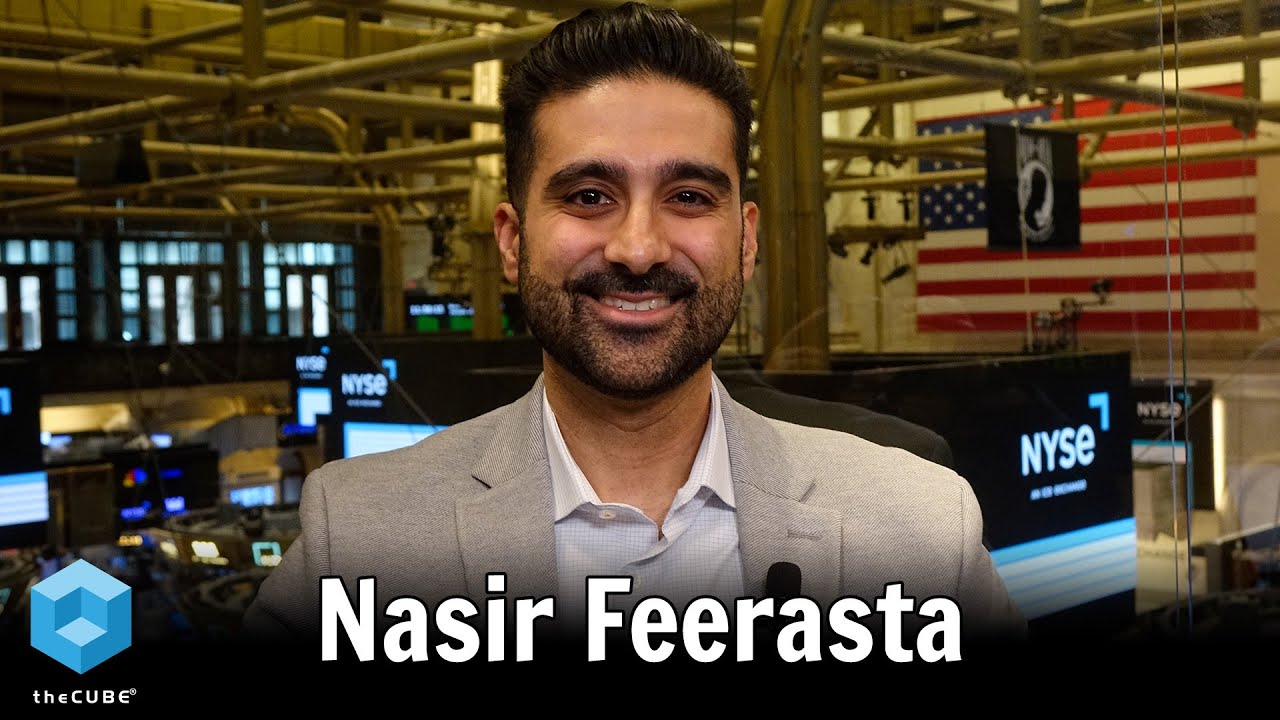
D-Wave, a quantum computing company founded 20 years ago, was the first to develop a quantum computer utilizing principles like superposition and entanglement. Known for its focus on annealing for business optimization, D-Wave's flagship product, the Advantage Quantum computer, is used across industries for tasks such as resource optimization and workforce scheduling. The company's cloud service, Leap, offers reliable business applications, boasting over 99.9% uptime. With impressive gross margins, D-Wave's capital-efficient model allows them to generate millions in revenue annually. The future balance between cloud and on-premises solutions will depend on customer needs. D-Wave's emphasis on execution and product development positions them well for success in the quantum computing market.
Forgot Password
Almost there!
We just sent you a verification email. Please verify your account to gain access to
theCUBE + NYSE Wired: AI & Retail Trailblazers. If you don’t think you received an email check your
spam folder.
Sign in to theCUBE + NYSE Wired: AI & Retail Trailblazers.
In order to sign in, enter the email address you used to registered for the event. Once completed, you will receive an email with a verification link. Open this link to automatically sign into the site.
Register For theCUBE + NYSE Wired: AI & Retail Trailblazers
Please fill out the information below. You will recieve an email with a verification link confirming your registration. Click the link to automatically sign into the site.
You’re almost there!
We just sent you a verification email. Please click the verification button in the email. Once your email address is verified, you will have full access to all event content for theCUBE + NYSE Wired: AI & Retail Trailblazers.
I want my badge and interests to be visible to all attendees.
Checking this box will display your presense on the attendees list, view your profile and allow other attendees to contact you via 1-1 chat. Read the Privacy Policy. At any time, you can choose to disable this preference.
Select your Interests!
add
Upload your photo
Uploading..
OR
Connect via Twitter
Connect via Linkedin
EDIT PASSWORD
Share
Forgot Password
Almost there!
We just sent you a verification email. Please verify your account to gain access to
theCUBE + NYSE Wired: AI & Retail Trailblazers. If you don’t think you received an email check your
spam folder.
Sign in to theCUBE + NYSE Wired: AI & Retail Trailblazers.
In order to sign in, enter the email address you used to registered for the event. Once completed, you will receive an email with a verification link. Open this link to automatically sign into the site.
Sign in to gain access to theCUBE + NYSE Wired: AI & Retail Trailblazers
Please sign in with LinkedIn to continue to theCUBE + NYSE Wired: AI & Retail Trailblazers. Signing in with LinkedIn ensures a professional environment.
Are you sure you want to remove access rights for this user?
Details
Manage Access
email address
Community Invitation
Alan Baratz, D-Wave
D-Wave, a quantum computing company founded 20 years ago, was the first to develop a quantum computer utilizing principles like superposition and entanglement. Known for its focus on annealing for business optimization, D-Wave's flagship product, the Advantage Quantum computer, is used across industries for tasks such as resource optimization and workforce scheduling. The company's cloud service, Leap, offers reliable business applications, boasting over 99.9% uptime. With impressive gross margins, D-Wave's capital-efficient model allows them to generate millions in revenue annually. The future balance between cloud and on-premises solutions will depend on customer needs. D-Wave's emphasis on execution and product development positions them well for success in the quantum computing market.
D-Wave, a quantum computing company founded 20 years ago, was the first to develop a quantum computer utilizing principles like superposition and entanglement. Known for its focus on annealing for business optimization, D-Wave's flagship product, the Advantage Quantum computer, is used across industries for tasks such as resource optimization and workforce scheduling. The company's cloud service, Leap, offers reliable business applications, boasting over 99.9% uptime. With impressive gross margins, D-Wave's capital-efficient model allows them to generate mill...Read more
exploreKeep Exploring
What is the premise of D-Wave's approach to building a quantum computer?add
What advantage does quantum computers have in terms of energy efficiency compared to traditional computing systems?add
What are the main focuses of the product roadmap for the company, including the current flagship product and upcoming products?add
What is the name of the quantum cloud service that the company developed and runs on AWS servers?add
What is the quantum cloud service called and how does it differ from other quantum companies' services?add
What are the advantages of using a cloud-based quantum computing service for customers who just want to run their applications?add
>> Hi, everyone. Welcome back to day three of our Media Week NYSE and theCUBE community, NYSE Wired and theCUBE. We've been going wall-to-wall coverage. We came down here to really focus on the NRF week, and we love to have innovators come in and talk about what they're doing in the marketplace. I'm really excited. Quantum computing, one of the hottest topics going, other than AI. We're always talking about AI. Of course, there is an intersection between quantum and AI. Alan Baratz is here. He's the president and CEO of D-Wave, one of the hotter companies. Alan, thanks for coming in. It's good to see you.
Alan Baratz
>> Pleasure to be here, Dave. Thanks for the opportunity.>> So D-Wave, I want to get into it and what your focus is, but let me understand why the company was formed originally. What was the premise?
Alan Baratz
>> Oh, that's a really interesting story. So the company was formed about 20 years ago, originally to collect up intellectual property for quantum computing in hopes of monetizing it as it later became possible to actually build quantum computers. But a few years into it, the company decided that they were just going to go for it and build a quantum computer. So D-Wave is actually the first company to start building a quantum computer.>> Oh, that's very interesting. Can we have a basic explanation? I think most people at least understand the ones and zeros and simultaneous ones and zeros and entanglement, although sometimes it's hard for me to get my brain around entanglement. But can you give us your quantum 101 explanation for the audience?
Alan Baratz
>> Sure. So quantum computing, and you almost said it, is nothing more than using quantum mechanical effects to solve hard computational problems faster than they can be solved classically. And those quantum mechanical effects are in fact things like superposition or entanglement or tunneling. But at the core, when you think about how classical computers work, at any point in time, they can see one potential solution to a problem, because bits are zero or one. So at any point in time, you're seeing one possible solution, and then you're trying to evaluate that and iterate to get a better and better solution, until you get the best possible solution to the problem. With quantum computers, superposition allows you to evaluate multiple potential solutions at the same time, because qubits can be in the state zero and one at the same time, and that allows us to move faster in solving hard problems.>> Okay, so it's not this serial operation like a Von Neumann computer would operate. And help us understand entanglement. I mean, it's a really interesting concept. It's almost like these systems, even though they're separate, have the same brain, but explain in your words what entanglement is and why it's so important to quantum computing.
Alan Baratz
>> Sure. So when qubits are entangled, they're basically acting in concert. And that's all part of the ability to evaluate multiple possible solutions at the same time.>> And I know there are many prevailing and competing approaches and architectures to quantum. You guys are focused on annealing. My understanding is it's really good at some really hard problems like logistics and others. It's maybe not as general purpose as some of the others, although you may disagree with that. I'd love to get your thoughts on that, because that's the narrative on annealing, so if you could explain annealing, and then let's get into the trade-offs.
Alan Baratz
>> Yeah, and I very much disagree with your comment that it's not as general purpose. So there are two primary approaches to quantum computing, annealing and gate. At D-Wave, we did decide to start with annealing. Now, annealing is very good at solving a class of problems known as business optimization problems. These are things like workforce scheduling, or autonomous vehicle routing, or cargo loading, or last-mile routing. Frankly, most of the important hard problems that businesses need to solve are in fact optimization problems. Until recently, it was believed that the other approach to quantum, gate, could solve all problems. But a few years ago, it was proven by researchers in the US and Europe that gate model systems actually are not very good at solving optimization problems, the thing that annealing is good at. So we're in a situation now where there will always be problems that will require annealing, think optimization, and there are always problems that will require gate. These are differential-equations-oriented problems, things like quantum chemistry or computational fluid dynamics. So neither of them is truly general purpose and universal. They each are required for different types of problems.>> I see. Okay. So translate that into your market opportunity. And maybe it's a hard thing to do. How do you think about your TAM and sizing? Is it all computing, or do you think about it in a more narrow, practical use case scenario?
Alan Baratz
>> So IDC recently estimated that worldwide customer spend on quantum will be in the $8 to $9 billion range, three to four years from now. So it's a fairly significant market opportunity even in the near term. Earlier work that was actually done by Boston Consulting Group ended up dividing the market across several different problem classes. Optimization was one of them, linear algebra for AI was another, factorization for crypto was a third, and differential equations for quantum chemistry was a fourth. And they roughly put a quarter of the market into each of those four application areas. Now, what that means for D-Wave is that roughly a quarter of the TAM requires annealing, because it's optimization. And we're the only company in the world that provides annealing quantum computers. So roughly a quarter of the TAM is D-Wave's exclusively. Now, D-Wave can solve other application areas as well, like linear algebra for AI and factorization for crypto, so we can address about three quarters of the TAM. Gate, they can go after differential equations for quantum chemistry, but they can't go after optimization.>> Interesting. And the BCG TAM was similar to the IDC TAM?
Alan Baratz
>> The BCG TAM went out a bit further, so they looked 20 to 30 years out, and they said the TAM in that timeframe would be on the order of 450 to 850 billion. But that was for not just the quantum providers, but also the customers and the value that would be created by using the products. So they estimated that in the order of 20% was available to the hardware, software and services providers in the quantum industry. So think that in that timeframe, 20 to 30 years, we're talking between 100 and 200 billion.>> Interesting. And I've spent a lot of time thinking about TAM. I used to work at IDC, so I like the fact that they only went out a few years, because they're not really great at doing 20-year forecasts, whereas BCG thinks about it in different use cases. But the reason I want to come back to this is when you think about what's happening now in data centers, there's a transition from general-purpose computing to what Jensen calls accelerating computing. We call it extreme parallel computing, whatever term you want to use. But we know what we're talking about AI. And the data center market is probably 300 billion today, and it used to be growing at single digits, and now it's growing at 15%. There's this super cycle going on in data centers. And if you look out, I mean, that's going to be a $1.5 to $2 trillion market mid next decade, we think, when you do these long-term forecasts. But the point is you see a massive gain share by AI, and you see general-purpose computing getting crushed and just disappearing essentially. It's going from 90% of the market to maybe low single digits in that long-term timeframe. Is quantum a similar dynamic in that it's basically taking away share from general-purpose computing, or is it more incremental? I know your answer is going to be both, but I'm trying to get a general sense of the impact. How much of it is incremental versus, "Hey, quantum ultimately is going to be cheaper and better at doing things that general purpose computers do today."
Alan Baratz
>> So quantum computers are much like GPUs in the sense that they're good at the hard computational core of the problem. So they will offload classical computers from that portion of the workload. And that's very similar to what GPUs are doing.>> Yes, absolutely.
Alan Baratz
>> They're offloading classical computers->> Storage, networking, yep, for sure.
Alan Baratz
>> And the quantum computers are very similar to that. Now, I actually think that the TAM for quantum that we talked about a few minutes ago may well be underestimated. And the reason why I say that is, at the point in time at which BCG put that data together, there is something very important that I don't think they were focused on, and that is the massive energy consumption required by GPUs to support the AI workloads. And that's why we see all this craziness around buying nuclear plants and various energy sources to power these data centers. Well, what I think everybody is not currently focused on is the fact that quantum computers are very energy efficient. So for example, our quantum computers consume about 10 kilowatts to run. Very low power consumption.>> Wow. Okay.
Alan Baratz
>> And we've shown that we can solve important, useful problems on that quantum computer today in the area of material simulation, that it would take well over global annual energy consumption to solve on parallel GPU systems. Now, think about applying that to AI workloads, which is something that we're working on. We're not yet at the point where we have products in this area, but to the extent that our quantum computers, with their low energy consumption, can be used in model training and inference to reduce the time and reduce the energy consumption, that's a game changer. And I don't think that got factored into any of the thinking on the market for quantum.>> That's an order of magnitude, at least. I would think If you were going to put in into a data center, I don't know, six or eight Dell AI servers, a bunch of storage, some networking, and top-of-rack switches, you're probably talking about 200 kilowatts to basically do anything, right?
Alan Baratz
>> You may be talking megawatts when you start adding in all the GPUs.>> Well, yeah, that's true. But I mean, I'm talking about even a small configuration, if you have the power for it. Okay. So it's going to basically eat into the general-purpose market and well, what is becoming the AI market. Well, I guess I have another thought. The way that people are thinking about solving for the energy issue with AI is to produce more energy, which doesn't really seem like... If there's a way to reduce the energy consumption, that would seem to be a more logical path if the stuff works and it can be stable.
Alan Baratz
>> Exactly right. That's exactly right. And so for example, we just recently announced the first sale of one of our Advantage Quantum computers. This is our current flagship product that's in production use. Up until now, we've been selling access to them through our Quantum Cloud service. We just announced the sale of our first Advantage system. It's actually going to go into a supercomputing center, where it will be located right next to a massively parallel exascale supercomputer, essentially looking at how to improve the AI workloads as you bring these two together.>> Okay, so I said up at the top, my gut tells me that AI and Quantum are going to come together. We tend to have this either or. I mean, Jensen last year at GTC in a private analyst meeting said there's nothing that Quantum... He said a couple things that I'd love to get your thoughts on. He said, "We're probably the biggest quantum computing company in the planet." He also said there's nothing that Quantum can do that AI can't do except cryptography. And we were like, "Huh." That was to us a signal that there's some tension there. And then of course, recently at CES, he said, "Well, it's 20 years away." You compare that to what Arvind told us in a private meeting, Arvind Krishna said, "Yeah, I think in three to five years, we're going to have some practical applications." He talks about hybrid, et cetera. Love to get your thoughts on all this, because Microsoft today announced a lot nearer term scenario around quantum. What's your take, Alan?
Alan Baratz
>> Yeah, so my take is, Quantum is useful today. Now, I'm probably the only person in the world that can say that, as the CEO of D-Wave Quantum, because D-Wave is the only company in the world that has quantum computers that are being used today by customers to run their business operations. So I'm not talking 30 years from now, I'm not talking 20 years from now, I'm not talking 15 years from now, I'm not talking five years from now. I'm talking right now, today. We have a broad array of companies. We have companies like NTT Docomo in Japan that's using our quantum computers today in production to optimize resources at cell towers.>> Through your cloud, correct?
Alan Baratz
>> Correct. Through our cloud today. We have customers like Pattison Food Group that is using our quantum computers today for workforce scheduling and last-mile routing for delivery. We have customers that are getting close to production, like Ford Otosan, for scheduling the assembly of automotive bodies, or MasterCard, looking at using the quantum computer to optimize loyalty rewards program. This is all going on today. So when Jensen says you won't see quantum computers doing anything useful for 15 to 30 years, he's missing the fact that we're doing it today. And we have customers that are actually paying us to use our quantum systems today, and we're delivering an ROI for them. I think the issue is that for Jensen, along with pretty much everybody else in the industry, they think only gate model.>> So go back to energy for a moment. I've taken the tour of the Thomas J. Watson facility and I've seen the Quantum, I've seen the chillers and the like. How are you cooling these systems, and does D-Wave have a different approach?
Alan Baratz
>> So first of all, I invite you to come to our research facility and we'll give you a tour. Would love to have you there.>> Would love to. Great. We'll take you up on that.
Alan Baratz
>> So we are superconducting, which means that we also live in dilution refrigerators. Our quantum computer is about a 10 foot by 10 foot by 10 foot cube. Most of the spaces taken up by the dilution refrigerator. The chip obviously is the size of a thumbnail, and it lives in the dilution refrigerator. When I talk about the power consumption as 10 kilowatts, that's really just to run the refrigerator. The chip itself draws no power, it's superconducting. The other interesting and important point about that is today, we put one chip in a dilution refrigerator. We could put multiple chips in a dilution refrigerator, which means on that same 10 kilowatts of power, we can run 2, 4, 10, 20, quite a few processing chips. And then when we start interconnecting those chips to have even much larger quantum computers, that's going to allow us to scale pretty nicely.>> And that chip is your design?
Alan Baratz
>> Yes.>> Is that right?
Alan Baratz
>> Yeah. So we design the chip, the chip is fabricated by a partner SkyWater in Minnesota, but they fabricate that chip using our process and our materials on their machines, and we own all the intellectual property, not just for the design of the chips, but also for the fabrication of the chips.>> So you don't have to go to Taiwan to get the latest-
Alan Baratz
>> No, we do it all in the U.S.>> Interesting. From a process standpoint, I mean it's got to be complicated. All chip fab is complicated, but the fact that you could do that on shore is actually enticing, I think, for a lot of folks. Is it substantially easier to manufacture quantum chips than it is two-nanometer AI chips?
Alan Baratz
>> Well, it's certainly not substantially easier, but the issues are different. So for us, it's not so much about density. We're not using state-of-the-art lithography. We can have wider wire widths. The issue for us is the purity of the materials, because remember, we need long coherence times. That means the time that the qubit remains in the quantum state.>> And that's the big challenge.
Alan Baratz
>> That's the big challenge. And as soon as the external environment interferes with the qubits, we lose coherence. We lose the quantum effects. And so the challenge is to fabricate these chips with very pure conducting materials and very pure insulating materials, so that there's no interaction with the external environment. So it's different.>> Interesting. Okay. Yeah. Like you said, it's not a real estate problem, you've got a situation with even Blackwell where you've got these big SRAMs, and the SRAM is taking up a greater percentage of the wafer, and that's clearly running out of gas. You've got a different issue. Fascinating. I want to talk about the stock price, because potentially, when I think about D-Wave, like I hear on whatever, news channels and business channels, "Well, if you put $10,000 into Nvidia in 1999 at their IPO, you'd be worth $30 million today." It's like, "Okay, great. Where were you in 1999?" But you could be one of those companies, right? You got a billion-plus dollar valuation, who knows stock price, but it's speculative, but now you've got a revenue model. You're actually shipping product through your cloud and I guess on premises. And so the future, again, how do you think about the future of D-Wave in this, what you said is potentially a conservative $500 to $800, $900 billion, trillion dollar market?
Alan Baratz
>> So first of all, we are very focused, day in and day out, on executing and delivering against our product roadmap. Our current flagship product is a 5,000-cubic system called Advantage. Our next generation product is Advantage2. We have small early versions of that in our cloud service that customers can experiment with. We expect to launch that in full production for customers later this year. And then we've already started working on Advantage3. For each generation, it's always about larger processors to solve larger problems, longer coherence time to solve those problems faster, and greater precision to provide better answers to the problem. So with each generation, we're executing on improving in all three of those areas. At the same time, we are very focused on growing the business. Because we are commercial today and we do have a cloud service revenue model, and now a system sale revenue model, our focus is on growing bookings and growing revenue, and doing it with strong, high gross margins. Now, at this point in time, we just announced that FY24, the year just ended, bookings will be over 23 million, which is 120% increase over FY23. So over 2x increase in bookings. We also announced that we now have over $175 million of cash in the bank, so we're also well-funded to be able to execute, and we're building very strong pipeline. We've got customers in production, we've got customers that we're working with to get into production, and we've got a very strong pipeline.>> So you've got an operating plan that, you've got visibility anyway at some point on positive free cash flow, positive operating margins and et cetera?
Alan Baratz
>> Absolutely, yes.>> Interesting. And the analyst community, again, I don't follow quantum that closely, but I started to pay more attention because it's becoming real. It's been real for longer than I realized, but the analyst community is, how do you feel about the analyst community? You've got a number of analysts following you guys. I know there's a lot of market analysts, like when I go to these meetings, these analyst meetings, I see a lot of really smart quantum people. People are starting to get it, aren't they? And this is becoming much more real. Obviously, you see the stock prices, a lot of that speculative, but you're talking about real revenue here.
Alan Baratz
>> No, absolutely. We have, I think, six analysts that cover us now. They're all very smart, they all dig into the details, they understand the technology, they've developed very solid business models. Almost all of them have recently raised our price target significantly. So we've got excellent coverage. We feel quite good about that, and we've got a good dialogue with them.>> Well, you have a challenge of educating people, obviously, this is a complicated topic. I just want to make sure I understand, you have your own cloud, so I can rent quantum from you.
Alan Baratz
>> Yes, we do.>> And that's your cloud? It's in a colo, it's in a hyperscaler, what-
Alan Baratz
>> So our quantum cloud service is called Leap. We developed that cloud service ourselves. We run the front end software on AWS servers. So it's like colocate. I mean, we basically buy CPU and GPU access from AWS, and then we run the front end of our cloud service there. We are fiber connected from there to each of the four Quantum computers that we have in production in our cloud service today. We have two up in Vancouver, we have one in Southern California, and we have one in Germany. And I will also tell you that that cloud service was designed to support business applications in production. Very high reliability, very high availability, in fact, we have over 99.9% availability. We offer service-level agreements for customers that want to put applications in production. We're the only quantum company that offers service-level agreements. We're the only ones that can. Because you hear horror stories from some of the other quantum companies like, "The system was down for a month," or, "It was 100 hours waiting in the queue before the job ran." But we have basically real-time access to our quantum service, very high availability.>> And you've got control over your cost of goods sold.
Alan Baratz
>> Yes, we do.>> And is this long-term, tell me what you can, is this long-term? I mean, you think about Amazon's operating profits, it's AWS, it's mid-twenties on a bad quarter. Is this a similar profitability model? Is it more like the conventional hardware business, Dell, with single-digit operating margins? It's not, obviously. Oh, maybe it is, more like a software, marginal economics of software.
Alan Baratz
>> We've announced our gross margins. Our gross margins on the cloud service business are north of 80%. We have a professional services business there, north of 50% on the professional services business. And now, we've just done our first system sale, on-premise system sale. We have not announced the margin on that, but it's quite high.>> But if you have 80% gross margin, that's as good as any SaaS company. Now, you don't have the marginal economics of software, but you're talking about potentially north to 30% operating profits on long term. Do you have a long-term model?
Alan Baratz
>> We're very capital-efficient. Let me give you some data to support that. It costs us about $2 million to build, install, calibrate a quantum computer, 2 million. Each one of those quantum computers can support 25 to 30 million of revenue per year. So it's a very capital-efficient business.>> Yeah, in your balance sheet, you got 175 million, which is nice. But if you were an AI company developing LLMs, that would be a drop in the... You'd be in trouble.
Alan Baratz
>> Yeah. No, that's not our model.>> Okay. And the last question I have, this has been fascinating, I really appreciate your time, do you see the long-term businesses... How do you see the mix between cloud and on-prem?
Alan Baratz
>> So for customers that really just want to run their applications, cloud is the best model. They don't have to lay out all the cash to buy a quantum computer, they don't have to worry about how to maintain it, they don't have to worry about backup. I mean, they just access our quantum cloud service, they can get in at a very reasonable price, and then they can grow as their needs grow. We always provide backup systems, we always update the cloud systems to the latest technology. But for customers that really need to have more flexibility over the operating parameters of the quantum process and more flexibility for interconnect, for example, interconnecting with massively parallel GPU systems for AI workloads, you probably need an on-premise system.>> D-Wave. By the way, you got the best stock symbol too, QBTS, you've got that first.
Alan Baratz
>> We do.>> Alan, thanks so much for coming on theCUBE.
Alan Baratz
>> Thank you.>> Really, really appreciate your time.
Alan Baratz
>> Thank you.>> All right, keep it right there, John Furrier, and I'll be back with our next guest. This is Media Week with the NYSE Wired community and theCUBE. Be right back.