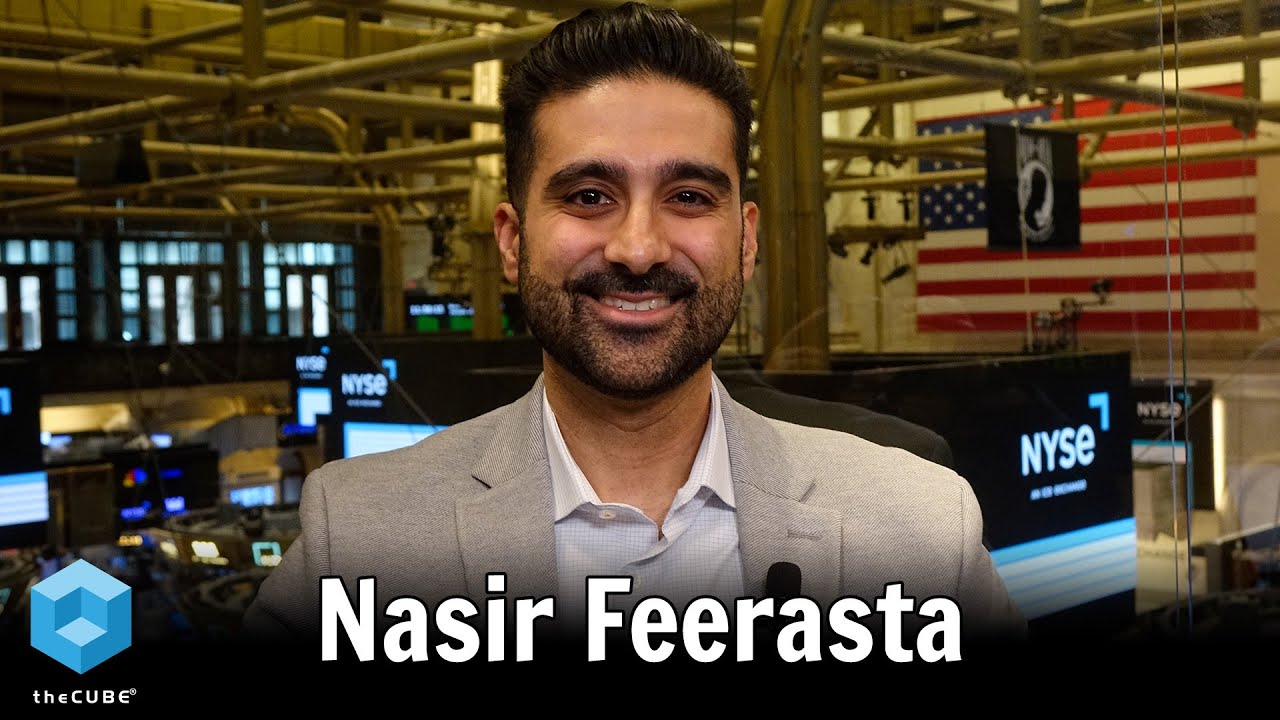
Diaz Nesamoney, founder of DaVinci Commerce and former founder of Informatica, participates in theCUBE's NYSE Wired series to discuss the transformative impact of artificial intelligence on the retail industry. In this insightful conversation, co-hosted by John Furrier, co-founder and co-CEO of SiliconANGLE Media, they explore how technology redefines the commerce value chain from data utilization to consumer engagement.
Throughout the video, Nesamoney explores how brands can harness the potential of AI to revolutionize consumer interactions and behind-the-scenes operations. They discuss DaVinci Commerce's journey since inception, emphasizing its successful adaptation to changing industry demands and recent product launch revenue milestones. The conversation with theCUBE Research analysts highlights the importance of evolving user experiences in the AI-integrated commercial landscape.
The discussion also illuminates key insights for brands striving to excel in the AI-powered retail future. Nesamoney elaborates on the importance of creating conversational commerce channels and integrating brand-specific data streams with public data to enhance consumer recommendations. Their perspective underscores the necessity of a seamless user experience while maximizing technological frameworks to position brands advantageously in the AI ecosystem.
Forgot Password
Almost there!
We just sent you a verification email. Please verify your account to gain access to
theCUBE + NYSE Wired: AI & Retail Trailblazers. If you don’t think you received an email check your
spam folder.
Sign in to theCUBE + NYSE Wired: AI & Retail Trailblazers.
In order to sign in, enter the email address you used to registered for the event. Once completed, you will receive an email with a verification link. Open this link to automatically sign into the site.
Register For theCUBE + NYSE Wired: AI & Retail Trailblazers
Please fill out the information below. You will recieve an email with a verification link confirming your registration. Click the link to automatically sign into the site.
You’re almost there!
We just sent you a verification email. Please click the verification button in the email. Once your email address is verified, you will have full access to all event content for theCUBE + NYSE Wired: AI & Retail Trailblazers.
I want my badge and interests to be visible to all attendees.
Checking this box will display your presense on the attendees list, view your profile and allow other attendees to contact you via 1-1 chat. Read the Privacy Policy. At any time, you can choose to disable this preference.
Select your Interests!
add
Upload your photo
Uploading..
OR
Connect via Twitter
Connect via Linkedin
EDIT PASSWORD
Share
Forgot Password
Almost there!
We just sent you a verification email. Please verify your account to gain access to
theCUBE + NYSE Wired: AI & Retail Trailblazers. If you don’t think you received an email check your
spam folder.
Sign in to theCUBE + NYSE Wired: AI & Retail Trailblazers.
In order to sign in, enter the email address you used to registered for the event. Once completed, you will receive an email with a verification link. Open this link to automatically sign into the site.
Sign in to gain access to theCUBE + NYSE Wired: AI & Retail Trailblazers
Please sign in with LinkedIn to continue to theCUBE + NYSE Wired: AI & Retail Trailblazers. Signing in with LinkedIn ensures a professional environment.
In this segment from the NYSE studio, DaVinci Commerce founder Diaz Nesamoney joins theCUBE’s John Furrier to map how AI is rewiring the consumer journey from discovery to purchase. Nesamoney argues that commerce’s next battleground is data: the same retail intelligence that helped Amazon turn advertising into a multibillion-dollar engine is now colliding with surging AI-driven shopping behavior and reshaping how brands earn attention and margin.
The conversation drills into what comes after the chatbot: agentic workflows that turn recommendations into...Read more
exploreKeep Exploring
What is the background and current focus of Diaz Nesamoney in the context of AI and retail?add
What is the vision for the new venture in retail and commerce?add
What is the difference between traditional shopping experiences and the typical online shopping process?add
What changes have occurred in the approach to advertising and data usage among retailers and brands over time?add
What recent advancements have been made in AI platforms related to sales transactions and shopping infrastructure?add
What factors contributed to Amazon's success as an advertising and commerce business?add
>> Welcome back, everyone, to theCUBE. I'm John Furrier, your host here at our New York Stock Exchange CUBE Studios. Of course, we have our Palo Alto studio connecting Wall Street and Silicon Valley tech and the capital markets coming together. Technology is the market, and this is part of our AI Retail Leaders series and trailblazers. Diaz Nesamoney is here. He is the former founder of Informatica back in the day and now founder of DaVinci Commerce. Really taking a unique approach, looking at the data of commerce and the value it can create for brands and for the platforms. As the user experiences change, how people source and discover information to transact or navigate or get value will be done via AI. Diaz, thanks for coming in to theCUBE special Retail Trailblazer series we just kicked off. Obviously, AI trailblazers with retail. Thanks for coming in.
Diaz Nesamoney
>> Great. Well, thanks for having me.
John Furrier
>> It's an honor to have you on theCUBE, obviously being the co-founder of Informatica. Back in the '90s, now Informatica, went private equity and then Salesforce recently bought them. Obviously, state of the art in the catalog, but what they were doing in the enterprise was significant. So major, major OG, as they say, in the business.
Diaz Nesamoney
>> Thank you.
John Furrier
>> Now, you're back. You got a new startup you've been working on, DaVinci Commerce. I like your perspective. We were talking before we came on. Share the vision of the new venture.
Diaz Nesamoney
>> Starting with Informatica, I always follow data, and I think it's ultimately all about data. And so I saw two things happening in the retail and commerce industry. One was, of course, Amazon with their enormous amount of data, monetizing it through advertising. And that's a $56 billion business, and actually it's contributing to mostly to Amazon's growth and margin. So that was one big thing. The second big thing is AI. And I was just reading last week, I think the holiday shopping season had 39% of consumers using AI to research, get recommendations. So when you put those together, commerce starting with consumer journeys all the way to purchase, it's completely changing. And we started working on DaVinci Commerce three years ago to capitalize on that.
John Furrier
>> One of the things I've observed, and it's anecdotal on my side, but everyone has the same story. I want to fix something. My MacBook has got a reboot. I can go to apple.com. I go to OpenAI. I want to find a washing machine or whatever's happening. It's just easier to go to the models because they basically crawl the web. They also have reasoning. So it's not a first token out one-shot query. It's got a multi-step process. You're seeing the advances in all the models on reasoning, starting to get to the road of super intelligence, but you can start to see the improvements. It's getting smarter. There's more memory. The context windows are increasing. That's a huge opportunity, but they can't do it all. So they lock the user experience. The numbers are off the charts. The genie's out of the bottle. The horse is out of the barn. It's a done deal. There's no debate. People want that interface.
Diaz Nesamoney
>> Absolutely. And if you think of shopping, it used to be a two-step. I see an ad or a friend tells me about something and I'm supposed to go straight and just buy. Well, that's not how we shop. If you're going to a store, you browse the aisles, you talk to the associate, you ask a lot of questions. You want to know what color it's available, what styles are available. That has not been available in online commerce. It assumes a straight transaction, whereas that's not how consumers buy. And I think that's why consumers are all flocking to AI because, to your point, AI does all the research for you, it searches all the data and content and images of products and advice. It's a game changer.
John Furrier
>> What is the current status of the venture? You said you've been working on it for three years. What's that status?
Diaz Nesamoney
>> Yes. So we started building this product about three years ago when we saw this change with Amazon essentially using retail data. And then at that time, AI was just beginning to get a lot of traction. So we released the first version of the product in '23. And '24 and early '25 was getting our first customers, figuring out the product market fit and all of that. And then we saw just the demand pickup significantly. So we just closed a round of financing actually a couple of weeks ago, which gets us the capital to grow the business and take advantage .
John Furrier
>> You sharing the amount publicly, or?
Diaz Nesamoney
>> No, no. Our investors didn't want us to.
John Furrier
>> Preferred stock, so it's venture.
Diaz Nesamoney
>> It was a venture fund, yeah. And actually we're excited to partner with two lead firms. Actually, one of them was the head of search at Google, search engineering. So he said-
John Furrier
>> I get it....
Diaz Nesamoney
>> yeah, this is a new model.
John Furrier
>> He threw the holy water on it, as they say in the venture business.
Diaz Nesamoney
>> Exactly.
John Furrier
>> What is the product market fit equation? How would you describe your visibility on that? Do you feel good about it, is it evolving?
Diaz Nesamoney
>> Yeah.
John Furrier
>> How would you describe that?
Diaz Nesamoney
>> It evolved a little bit. So first, we went to retailers to try to replicate the Amazon experience for them, and we got some great traction. And then we realized more recently that the retailers are building out the infrastructure, they're trying to do what Amazon's doing. But the brands seeing the power of that retail data, want to run their ads across retailers, but it's extraordinarily difficult, complex. Everything from producing the creative and the content to delivering it, using the data and so on. So now we're seeing a lot more demand from brands. And then if you throw in the shopping on AI part, the brands want to be in AI, and they want to use AI tools to automate the process and they want to be an AI platform. So we feel like-
John Furrier
>> I love your earlier slogan of follow the data, as you've always done in your career. I have a similar kind of thinking as well. But let me just throw this out at you, and I want you to react to it because I think this is something that I'm seeing. So this year at NRF, we covered pretty much like a blanket this year. Everyone's realizing that they have to have their own models, whether it's cataloging or whatever the shopping, they have data.
Diaz Nesamoney
>> Right.
John Furrier
>> Okay. Now it could be in the cloud, it could be everywhere, whatever. They have their own data, but the models have data too. So I think there's going to be not an API call, but a fusion of models. So I could see OpenAI and Claude and others saying, "Hey, interface in, I'll ingest your model." In the old school days it was called a data dump. Here's your data and they would ingest it in. It's not a data dump because it's more of a stream. It's more of a connection. A neural network or whatever you want to call it. How do you see that? What's your reaction to that? And if you believe that to be true, that means that the integration for a brand or a platform that's going to replicate scale and the benefits, you have to go through the model. The brands have to be involved. They're the winner. The consumers are the ultimate winner because they want to have least steps to discovery.
Diaz Nesamoney
>> Exactly.
John Furrier
>> Take me through that.
Diaz Nesamoney
>> That's a great question because if you think about AI platforms in their current form, most of the data is coming from publicly available sources, right? They're scouring the web, they're scanning everything that's out there, but what they don't have is the private data or the enterprise data. So if you're a big brand and you've got all kinds of data, your CRM data, this, that, and the other, how do you meld that with that public data to provide the best advice to a consumer, recommendations to a consumer and so on? So the early version of that was RAG, which is the context that you can-
John Furrier
>> A nice search.
Diaz Nesamoney
>> Yeah. It adds-
John Furrier
>> It's a search....
Diaz Nesamoney
>> a little bit of context, allows you to restrict the answers, make it brand safe and so on. But I think there's probably a bigger iteration of that that needs to happen that allows a brand or an enterprise to say, "Hey, here's my data. You can't use it for everything else, but you can use it to provide better answers." And we're seeing that. And I think the foundation models are also realizing that opportunity because when you combine that is when you get the best outcomes.
John Furrier
>> Distillation has been a big discussion in terms of, I think DeepSeek was the first one to come out and shake the world and, hey, if you think differently, you could actually distill down. You don't need to have every written paper from every college on whatever topic if you're going to do something specific. And I don't need to have all that overhead in training and reasoning. If you know we can scope the query or whatever, the prompts-
Diaz Nesamoney
>> The prompt, exactly.
John Furrier
>> The prompt. I call it a query, but a prompt, whatever, then you don't need to have all that overhead. So you're starting to see different computation models. So you're seeing that conversation mostly on the infrastructure side. But when you roll it to the front end, you say, "Okay, that's a user experience opportunity. It changes the costs. It changes the output of the value." This is where the model interactions, to me, is very interesting.
Diaz Nesamoney
>> Exactly. And the other part, which I think is really important to brands and enterprises is the workflow. Because if you're launching a marketing campaign or you're trying to get a commerce transaction available to consumer, there's a lot of workflows involved. And that's where agents come in. So we're super excited about it. In fact, in our platform, we've implemented agents every step of the way because you can have great data, you can have great answers, but a consumer isn't just looking for answers. They also want to do stuff like, "How do I buy this?" The vision is you can just tell your agent, they'll go buy it for you. That's a little out there. We'll see when that comes true. But for a brand, if someone's going to buy something, there are many different things that have to happen. Is it available in the inventory? How much do we have in each store? So the user says, "Oh, what's the nearest store I can buy this at?" Well, what if that product's not available there? So I think that's where agents play a key role in turning all that amazing data and answers into something actionable.
John Furrier
>> All right. So what's the to-do item for you? You got customers, what are you optimizing for right now?
Diaz Nesamoney
>> So we're optimizing for really working with brands to help them create a presence and not just a "here's my products, good luck" presence, but more like a store-like presence within the AI platforms, because I think that's what consumers want.
John Furrier
>> What's the mechanism for that? A deal with OpenAI and Claude, or?
Diaz Nesamoney
>> So the nice thing is OpenAI has announced ACP for transactions, for sales transactions. They've also launched their app store, which is quite exciting. It's sort of like the iPhone app store, which now allows brands to use the infrastructure they need to establish a presence. Actually, it's fascinating. Just the last two weeks, we've had Microsoft announce Copilot Checkout. And actually at NRF, Google announced UCP. So you can see where all this is going. All the big AI platforms are saying-
John Furrier
>> Where's it going? Explain it.
Diaz Nesamoney
>> Well, shopping. And so shopping infrastructure, because what comes after discovery or recommendations?
John Furrier
>> Yeah, you progress to a non-linear decision and you take an action.
Diaz Nesamoney
>> Or buy. Exactly.
John Furrier
>> You buy.
Diaz Nesamoney
>> But the buy right now is still the old way, which is, I've done my research, I've got excited, oh yes, this is the product I want. Now what happens?
John Furrier
>> Go to the website, go to the app, whatever.
Diaz Nesamoney
>> And by the way-
John Furrier
>> Cut and paste.
Diaz Nesamoney
>> And then my favorite is you land on the PDP page, out of stock.
John Furrier
>> I mean, I have used cut and paste more in the past two years than at the past 10 combined because I'm constantly cut and pasting from the models into the app, into the app, into this, in my two-factor authentication.
Diaz Nesamoney
>> It's a disconnected flow.
John Furrier
>> So many steps. It's not easy. It takes time. I mean, I remember in the internet there was a rule of thumb, reduce the steps it takes to do something, make it intuitive and easy to use. If you did those three things, you were successful.
Diaz Nesamoney
>> Well, that's the secret to Amazon. How long does it take for you to buy a product on Amazon?
John Furrier
>> They make it really easy and the ads are up top. First page is ads. Now, are their products.
Diaz Nesamoney
>> So that's how Amazon became a $56 billion ad business and a massive commerce business.
John Furrier
>> They have the distribution.
Diaz Nesamoney
>> They made it really easy.
John Furrier
>> And they had distribution.
Diaz Nesamoney
>> They have distribution.
John Furrier
>> So distribution becomes a topic in all these ad games and all these brand games, distribution. You have to get in front of the eyeballs. What's the strategy for that?
Diaz Nesamoney
>> So the eyeballs, so the numbers are phenomenal from the holidays of people wanting to do research and so on. So the eyeballs are going to AI, which is great. The question is what happens when you have the eyeballs? How do you monetize it? So I don't think the AI platforms have the answer yet, but they figure, much like Google did in the early days, focus on the eyeballs, make it a great experience for them. And then eventually you should be able to monetize whether it's through ads or it's through transactions. Nobody knows yet. But I think ultimately it's about user experience, right? I think there's too much focus on how do we get the user to buy? Well, the answer is make the user experience really good. Give them all the information. Consumers are empowered with a lot of information right now, so you can't just shoehorn them into a purchase. "Oh, I'll give you this. I'll give you that." "Buy now, click here." That's not working very well because they're much better informed. So I think the focus on user experience, that's really what we're working towards is how do we make it really easy for a brand to communicate with the consumer? And the platforms are focusing on how do we make the transaction straightforward and easy.
John Furrier
>> So you have some nice investors. One of them, you mentioned head of search, technology, engineering. Obviously, Google. I was very close to them with their AdWords, so I knew how that rolled out. AdSense became the side thing. Now you have search engine optimization. Industry emerged from the fact that organic search that they had and the paid links became so big that brands were motivated to organize their operations for search engine optimization. Okay, check. That's kind of a little rundown history lane there, memory lane. Now the big buzzword our analysts on our team are following is AI optimization, AEO, AI engine optimization. So question for you is, do you see, is it a two-pronged strategy, a bulk connection with the engines for constant updates for data? And then how does a brand organically create optimization?
Diaz Nesamoney
>> Yes.
John Furrier
>> I mean, engines have to create a mechanism for this.
Diaz Nesamoney
>> So the tendency is for people to try to follow the same rule book that Google had, which is optimize your sites, optimize your content so it's easy to find. And that's not a bad thing. Everybody's doing it and that's GEO or whatever. But I think the real opportunity is to build a presence within the AI platforms. That takes a little bit more work because you have to publish not just your data, but your content and create a real presence and-
John Furrier
>> Where do you publish that information? On your site, or?
Diaz Nesamoney
>> No, inside the AI platform. I mean, because the thing is-
John Furrier
>> How do you do that?
Diaz Nesamoney
>> Well, through technology. And that's one of the things that we're working on. How does a brand-
John Furrier
>> So you're an on ramp for brands-
Diaz Nesamoney
>> For brands to-...
John Furrier
>> into the engines....
Diaz Nesamoney
>> to create a presence in the engines.
John Furrier
>> So it's like a bulk upload, but a bulk connection.
Diaz Nesamoney
>> Publishing.
John Furrier
>> And always on.
Diaz Nesamoney
>> Always on. Exactly.
John Furrier
>> Always on connection.
Diaz Nesamoney
>> Always on.
John Furrier
>> With some tightly coupled integration.
Diaz Nesamoney
>> Exactly. Right.
John Furrier
>> And some other tech you guys have.
Diaz Nesamoney
>> Right. Exactly. So because I think if it's just about making your site visible, which is what SEO was all about, I don't think you're fully utilizing the power of AI. The power of AI is to allow consumers to have a conversation with you as a brand, not just for you to be visible. I mean, that's not a bad thing as a first step.
John Furrier
>> And they're crawling. They're doing scraping, so like-
Diaz Nesamoney
>> Yeah, so that's good. That's all good. That's like these.
John Furrier
>> But you're relying on their mechanism.
Diaz Nesamoney
>> Right. But the problem is then after that, what happens? You go back to the old e-commerce model, the site with 10,000 products, search through, find the PDP page. One of the customers I was talking to yesterday talked about an agentic shelf, which was an interesting word because the digital shelf was in commerce sites, PDP page and all of that. Great, but no conversation happening there.
John Furrier
>> I mean, it's interesting. The web or the internet, call it the web, has become critical infrastructure, not a transactional piece. So you can almost look at your site and say, "Hey, SiliconANGLE," we have all this content. We actually made the bet 16 years ago that people wouldn't come to our site, they would share it everywhere, so it's wide open. OpenAI crawls it nicely, so does everyone else. But it's an infrastructure node on the network. So if you design your sites not to be a navigation hub, like the front door of Yahoo, whether people used to think like that, but more as critical metadata infrastructure, basically data, you don't care if you got the catalogs of everything in there, but then you got to connect them. And is that something that you see as well? I mean, brands should think about their website as a critical node, not so much as a hub.
Diaz Nesamoney
>> Exactly. So one of the terms I heard at NRF, which I really like, is conversational commerce. So we're going from search-driven commerce or transaction-driven commerce to conversational commerce. And I think it's going to happen both within the LLM platforms, but even on websites. So you saw Walmart implement Sparky and Amazon's Rufus. That's great because you don't go there and search for something and end up with 10,000 products that you can't find what you're looking for. You start a conversation with Rufus, with Sparky. So I think on both ends, on the e-comm site, as well as within the LLMs, if conversations can be enabled, I think that's the game changer here. And that's what's new.
John Furrier
>> Well, Diaz, I'm super excited for you. And the last minute we have here, put a plug in. You're an early stage company. A lot of people love to jump on startups. They're either a rocket ship and they blow up or they make it out of escape velocity. Not saying you're going to blow up. I'm just saying that's just the way startups are. But people like to join startups or customers and brands might want to engage. Put a plug in for where you're at, what you're looking to do, going to hire, looking to reach out, any particular objectives you have. Take a minute to share your goals.
Diaz Nesamoney
>> Sure. Yeah. So over the next five years, what we see is AI transforming commerce entirely, the entire journey for consumers. We're building the infrastructure to do that. And so it's an exciting time ahead. Great investors coming on board. We want to build a team. We want great smart people to come and be a part of it.
John Furrier
>> How big is the team now? So you're in team building mode right now?
Diaz Nesamoney
>> We're about 140 people.
John Furrier
>> That's a big number. Yeah. So you've been around for a couple of years.
Diaz Nesamoney
>> Yes. Yeah, exactly.
John Furrier
>> Key areas you're looking for us, engineering, hiring?
Diaz Nesamoney
>> Engineering. I would say FDs. It's a new term for AI engineers who work with customers closely.
John Furrier
>> What's the term?
Diaz Nesamoney
>> FD, forward-deployed engineer.
John Furrier
>> FD.
Diaz Nesamoney
>> And that is because AI has to connect into their systems, get their content, get their data. So it's kind of like a solutions architect, but an AI aware-
John Furrier
>> Basically integration's a huge, critical piece of your business.
Diaz Nesamoney
>> Exactly. Exactly.
John Furrier
>> Not just here's the API.
Diaz Nesamoney
>> Yeah. It's not like a SaaS product here, log in and run stuff. It's infrastructure that connects into content and data. So that's something that we're looking for.
John Furrier
>> By the way, NVIDIA has a term called Extreme Co-Design. That's their guiding principle, which has worked well for them. A similar vein for you, right? Hey, co-designing, making sure we are locked and loaded.
Diaz Nesamoney
>> Right. And that's what customers are looking for. When I talk to them, they say, "Hey, we don't want just a piece of software. We want your team to help us transform the way we're doing commerce." So we need people that can take our tech and deploy it successfully.
John Furrier
>> In terms of brand on the front end, you're looking for folks there too?
Diaz Nesamoney
>> Yes. I mean, building our brand, we're a small company. We just rebranded two days ago.
John Furrier
>> DaVinci Commerce. Nice.
Diaz Nesamoney
>> So we're-
John Furrier
>> We got the scoop here on theCUBE. Thank you.
Diaz Nesamoney
>> Yeah. That was the name of our product. And that product was getting so much traction, let's just name the company after that. And so far, so good. Everyone's told me it's a great name.
John Furrier
>> Yeah. No one's coming after you yet. We'll see. Hit a little TM next to it.
Diaz Nesamoney
>> Exactly.
John Furrier
>> You got DaVinci, but you got Commerce. It's a modifier.
Diaz Nesamoney
>> Well, we got the domain. And we got the domain.
John Furrier
>> Davincicommerce.ai.
Diaz Nesamoney
>> Yes.
John Furrier
>> All right. Check it out. You're looking for folks to call on the brands too?
Diaz Nesamoney
>> Yeah, we do.
John Furrier
>> -
Diaz Nesamoney
>> But we've become an AI company too, so we're trying to transform our own sales marketing and a lot of functions using AI. Because, again, the old ways of doing selling and marketing -
John Furrier
>> So forward deployed engineers is kind of a new concept.
Diaz Nesamoney
>> It's a new concept.
John Furrier
>> It's like an agile engineering team.
Diaz Nesamoney
>> Right. So building the product-
John Furrier
>> OpenAI says, "Jump." "How high do you want me to jump?" They're iterating features like super fast. It's not like the old days where, "Hey, we're going to have a launch next two quarters." "No, no, it's next week."
Diaz Nesamoney
>> It's next week. And you get it up and running next week. Exactly.
John Furrier
>> That's what forward deployed means.
Diaz Nesamoney
>> Exactly.
John Furrier
>> That kind of thing.
Diaz Nesamoney
>> Absolutely, yes.
John Furrier
>> And that's the new normal, isn't it?
Diaz Nesamoney
>> Absolutely. It's a new way of deploying software that ties closely to their infrastructure, but gets them up and running quickly because we're using AI to do all of that.
John Furrier
>> I have to ask since you're here. Since you're an experienced entrepreneur, you've seen many cycles. From a startup standpoint now, you got to think differently. "Never fight fashion", as we say in theCUBE. The fashion is speed, velocity, scale. What are some of the things you've learned? What remains the same and what's different?
Diaz Nesamoney
>> I was telling my team that, back in the day, writing software was your competitive advantage. It took a lot of time to build software and develop it. That's no longer a competitive advantage. You can build a prototype with Lovable in a few minutes. You can write code with AI. So I think more important than the ability to write software is the understanding of a domain really well. How does commerce happen? What needs to happen? What are the different steps? What are the bottlenecks that today are costing brands a lot of money and solving for that? So I think the new era of software company is going to be deeper in domain expertise and knowledge and the ability to use and deploy AI effectively.
John Furrier
>> That's why NRF, one observation we have here, I'm sure you saw her too, love your comment on it, but is that they're realizing that all the data work that they did for analytics, the dashboards and the KPIs and all the stats that they were interested in actually is a setup for the new data modeling and that they have the data. They got the domain data and the domain experts, the people. So bringing people and data together for them, that seems to be an awakening this year at NRF.
Diaz Nesamoney
>> Exactly. It's kind of like Mark Bayoff said, "No code." Do you remember that?
John Furrier
>> Yeah.
Diaz Nesamoney
>> Or no software.
John Furrier
>> Yeah, no software. Yeah. With software-
Diaz Nesamoney
>> And now it's like-
John Furrier
>> Software with the -
Diaz Nesamoney
>> Now it's like no code. So data is becoming the application ultimately. There's some software, for sure, but you've got the infrastructure of the AI platforms. Whatever code you're writing, you're doing it with AI. So it's really the data and the domain expertise.
John Furrier
>> I was talking with an entrepreneur yesterday. What you're basically getting at, and I think that, and correct me if I'm wrong, but there was a vibe coding buzz, "Hey, vibe coding." And then it kind of hit this, "Well, I connected all to the systems. Oh, shit that's hard."
Diaz Nesamoney
>> That's the hard part.
John Furrier
>> And people would abandon it, so it became kind of passe.
Diaz Nesamoney
>> Right.
John Furrier
>> But what I was talking to an entrepreneur yesterday who's actually building agents to pick up the heavy lifting, connecting to APIs, doing some delegation, some identity stuff that you got to do in the enterprise that takes a little bit more thought. So I think vibe coding is back, it never left, but it's going to have a new agentic-
Diaz Nesamoney
>> Agentic backend.
John Furrier
>> It fits together.
Diaz Nesamoney
>> Yes.
John Furrier
>> Wire it up. There's some things you got to state, stateless data, state, all these things that are technical. That's where the user would have to do research or be a coder. Do you agree with that, that vibe coding will be really prototype-
Diaz Nesamoney
>> It coming back to it was just a cool way to build UIs, but then to get the UI to do real useful work became the problem.
John Furrier
>> Like pre-production.
Diaz Nesamoney
>> Right. -
John Furrier
>> Let's review that before we press production.
Diaz Nesamoney
>> Exactly. But now I think with agents connecting into these vibe coding platforms, I think you're able to plug into enterprise data, enterprise content and so on. So I'm hopeful that the combination of vibe coding for UI and UX with agents in the backend.
John Furrier
>> It's almost like the old stack. Infrastructure, middleware apps. I mean-
Diaz Nesamoney
>> It is, in a funny way.
John Furrier
>> Basically, it's the middleware kind of thing.
Diaz Nesamoney
>> Those of us that have a few great gray hairs remember that stack.
John Furrier
>> Three layers. This is middleware kind of work.
Diaz Nesamoney
>> Middleware, yeah.
John Furrier
>> Vibe coding is great, but then-
Diaz Nesamoney
>> Agents are middleware. So it's like a better, faster, cheaper stack.
John Furrier
>> Full circle.
Diaz Nesamoney
>> Exactly.
John Furrier
>> Yes. Thank you for coming in and sharing. Again, you certainly are a seasoned veteran, entrepreneur, OG, but trailblazing in retail. Love the vision that commerce was going to be completely reimagined, end-to-end experience, journey, technology, everything. Consumers are voting with their mind share and activity, which is that models.
Diaz Nesamoney
>> Great. Well, thanks for having me.
John Furrier
>> All right.
Diaz Nesamoney
>> All right.
John Furrier
>> I'm John Furrier with theCUBE. We are here at theCUBE's NYSC studio on the East Coast. Of course, we've got our Palo Alto. This is our NYSC Wired program and a CUBE Original, a new program. We feature capital markets and technology coming together with the NYSC and the community at large between NYSE and theCUBE. Thanks for watching.















 John Furrier