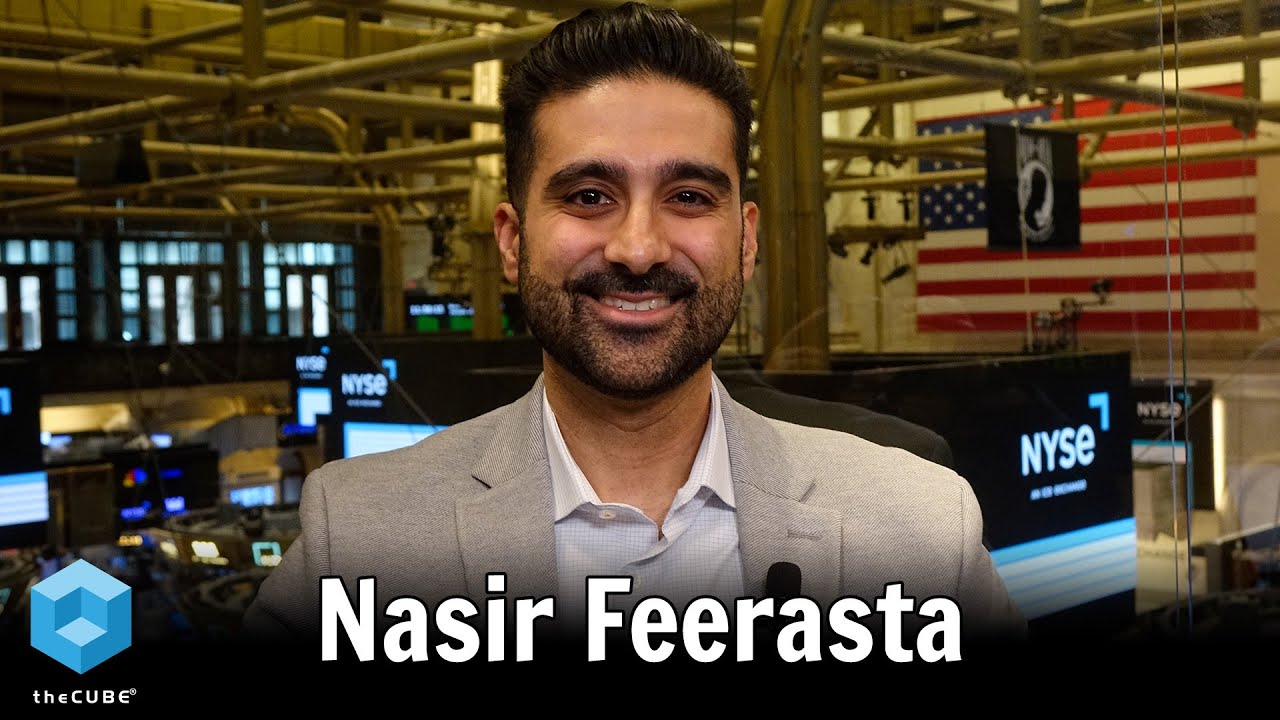
The NYSE Cube Studios in New York City are hosting theCUBE East, a significant location for theCUBE and the NYSE Wired community. Key topics at the NRF show include the impact of COVID on e-commerce, the rise of GenAI and IoT, and the need for businesses to adapt to new technologies for cost reduction and improved customer engagement. Bharat, Chief Product Officer of Algolia, discusses how their AI search company serves over 5,000 online retailers, enabling them to enhance customer experiences through generative AI. He highlights the challenges of scaling AI applications and the importance of balancing latency, quality, and costs. The future of AI models involves networking between different agents, increasing productivity for businesses. Architectural shifts are needed to support the growing data and AI demands. The speaker predicts significant innovation in the application layer, transitioning to smaller language models like RAG. Voice applications, such as Apple Intelligence, are expected to grow. Retail Week in NYC is discussing AI disruptions and enhancements in retail and technology, aiming to provide valuable insights for audiences.
Forgot Password
Almost there!
We just sent you a verification email. Please verify your account to gain access to
theCUBE + NYSE Wired: AI & Retail Trailblazers. If you don’t think you received an email check your
spam folder.
Sign in to theCUBE + NYSE Wired: AI & Retail Trailblazers.
In order to sign in, enter the email address you used to registered for the event. Once completed, you will receive an email with a verification link. Open this link to automatically sign into the site.
Register For theCUBE + NYSE Wired: AI & Retail Trailblazers
Please fill out the information below. You will recieve an email with a verification link confirming your registration. Click the link to automatically sign into the site.
You’re almost there!
We just sent you a verification email. Please click the verification button in the email. Once your email address is verified, you will have full access to all event content for theCUBE + NYSE Wired: AI & Retail Trailblazers.
I want my badge and interests to be visible to all attendees.
Checking this box will display your presense on the attendees list, view your profile and allow other attendees to contact you via 1-1 chat. Read the Privacy Policy. At any time, you can choose to disable this preference.
Select your Interests!
add
Upload your photo
Uploading..
OR
Connect via Twitter
Connect via Linkedin
EDIT PASSWORD
Share
Forgot Password
Almost there!
We just sent you a verification email. Please verify your account to gain access to
theCUBE + NYSE Wired: AI & Retail Trailblazers. If you don’t think you received an email check your
spam folder.
Sign in to theCUBE + NYSE Wired: AI & Retail Trailblazers.
In order to sign in, enter the email address you used to registered for the event. Once completed, you will receive an email with a verification link. Open this link to automatically sign into the site.
Sign in to gain access to theCUBE + NYSE Wired: AI & Retail Trailblazers
Please sign in with LinkedIn to continue to theCUBE + NYSE Wired: AI & Retail Trailblazers. Signing in with LinkedIn ensures a professional environment.
Are you sure you want to remove access rights for this user?
Details
Manage Access
email address
Community Invitation
Bharat Guruprakash, Algolia
The NYSE Cube Studios in New York City are hosting theCUBE East, a significant location for theCUBE and the NYSE Wired community. Key topics at the NRF show include the impact of COVID on e-commerce, the rise of GenAI and IoT, and the need for businesses to adapt to new technologies for cost reduction and improved customer engagement. Bharat, Chief Product Officer of Algolia, discusses how their AI search company serves over 5,000 online retailers, enabling them to enhance customer experiences through generative AI. He highlights the challenges of scaling AI applications and the importance of balancing latency, quality, and costs. The future of AI models involves networking between different agents, increasing productivity for businesses. Architectural shifts are needed to support the growing data and AI demands. The speaker predicts significant innovation in the application layer, transitioning to smaller language models like RAG. Voice applications, such as Apple Intelligence, are expected to grow. Retail Week in NYC is discussing AI disruptions and enhancements in retail and technology, aiming to provide valuable insights for audiences.
The NYSE Cube Studios in New York City are hosting theCUBE East, a significant location for theCUBE and the NYSE Wired community. Key topics at the NRF show include the impact of COVID on e-commerce, the rise of GenAI and IoT, and the need for businesses to adapt to new technologies for cost reduction and improved customer engagement. Bharat, Chief Product Officer of Algolia, discusses how their AI search company serves over 5,000 online retailers, enabling them to enhance customer experiences through generative AI. He highlights the challenges of scaling AI ...Read more
exploreKeep Exploring
What are some key trends in the retail industry, particularly in relation to technology and consumer behavior?add
What techniques do retailers use to clean up dirty data in their vast product catalogs?add
What are tools enabling in terms of utilizing vast stores of ERP data to auto-configure customer experiences and move towards hyper-personalization?add
What is the future direction of personalized online shopping experiences and how are retailers utilizing advanced technologies to create hyper-personalization for customers?add
What are some considerations when working with multiple language models in order to bring in verifiable and safer AI that can unleash tremendous productivity?add
What architectural shift do you see happening in terms of data center and edge spending, and how do you think it will impact the way applications are developed in the future?add
>> Hello, everyone. Welcome back to theCUBE. We are here in New York City for theCUBE East. This is the NYSE Cube Studios, part of our super node, our super pointed presence, super pop. It's where all the action is on the East Coast for theCUBE and the NYSE Wired community that Brian Baumann and Kevin Hawkins are putting together with the team. This is where all the action is. And of course, Silicon Valley or Palo Alto is our other super node and super pop, bringing Wall Street and Silicon Valley together through theCUBE and the network. We've got a great lineup this week as part of our media week NRF coverage. Bharat's here, the Chief Product Officer of Algolia, doing some really good search work, but also, it's under the cover's a lot of tech. Bharat, great to have you on theCUBE. Thanks for coming in.
Bharat Guruprakash
>> Very excited to be here. Thank you for having me.>> We were shooting the breeze before you came on around your experience at Twilio and then the role of NRF. This is the show, the National Retail Foundation, or Federation, whatever the F stands for, but it's actually Retail Week. I call it Retail Week.
Bharat Guruprakash
>> It is Retail Week.>> Is it? Retail. The show has always been about, hey, how to put end caps up and how to merchandise on analytics, omnichannel marketing, blah, blah, blah. Now MarTech has been, gone technical. But kind of stalls. Now AI comes in. Retail is a internet problem, opportunity, because stores, brick-and-mortars are back, online ordering is up. It's a first-party nexus between hybrid, digital and physical. We're seeing that post-pandemic clearly. And then, too, it's an IoT opportunity, Internet of Things, because when people walk in, there's computer vision, there's language models working on behalf of customers, mobile devices, getting notifications. This is a developer market now.
Bharat Guruprakash
>> It is, yeah. >> What's your take on this? Because you see this, too. What is your perspective of NRF?
Bharat Guruprakash
>> Yeah, absolutely. I'm sure your audience knows Algolia. It's an AI search company. We are an API-driven company and we serve over 5,000 retailers right now, online retailers. It's been interesting the last two years. I would say that with COVID, they had this natural boom of e-commerce, and so everyone was sort of happy. Once COVID ended, I think we went back to the mean. And what we're seeing now, especially with the rise of GenAI and especially with the rise of agentic AI, especially with the rise of IoT, there's this opportunity to both reduce costs, improve customer engagement for the shoppers, and to increase efficiencies all around. I was on the floor at NRF yesterday and the day before, and this is the theme everywhere. So I think that we're in the midst of this revolution that is happening, and e-commerce is->> You mentioned the pandemic, COVID hit. I think obviously everyone, we saw that as a forcing function, and that just was a black swan event. So that happens, but that forces everyone either to work at home, so IT was under pressure for just forecasting demand of remote dialing in or remote access. That's a whole 'nother discussion. But what it did was everyone had to go electronic. Events were digital, commerce boomed, and that forcing function caused a lot of change, in a positive way accelerated, but then you hit the AI, the Generative AI, and now pre-agentic-
Bharat Guruprakash
>> Pre-agentic, yeah. ... >> wave, software wave. We are predicting on our research side, that's about a trillion dollars of spend in flight right now on-premise. And when I say on-premise, I mean data center and edge, retail would factor in as an edge because people want to have a physical relationship with a brand or store or outlet or whatever, but yet have first-party-like capabilities online. It used to be you go to the store and online was competitive or alternative channel, not one thing.
Bharat Guruprakash
>> Absolutely.>> This is what's happening. Now if you think about that's happening, then you ask the next question: how do you technically make that work? Because now packets are one thing, footsteps are another. Now you have the physical traversal visiting a store-
Bharat Guruprakash
>> Yeah, absolutely.... >> and now you've got digital. First of all, it's a good opportunity for technical people to solve a hard problem, but it's not that easy. Scope this for us and explain... It sounds easy, oh, yeah, I know who you are, but the database is a silo. There's so many problems. Scope the opportunity and challenge.
Bharat Guruprakash
>> I'll give you an example of a customer who was actually on stage with us at NRF yesterday, the keynote, Breville. They're a customer of ours. I was having a conversation with their CTO, Tal, and he was mentioning that many of their customers go to the stores to feel their Breville machines and to look at it, and they don't buy it there. They then go back home and they order it online, and they either order it through Amazon or they order it directly from the Breville website, which we power. He said that this is a really interesting phenomenon. So how do they capture that person who walked in, showed interest, and then didn't purchase it there but went back? So we are seeing retailers innovate on the in-store personalization experience, apps, so that they can capture that data, the intent, connect it back to the databases so that when that customer goes back in and if they happen to log in to Breville, Breville knows, okay, yeah, we see that you had come in. We started seeing this first in the luxury fashion industry. If you think of the big fashion brands->> Louis Vuittons of the world.
Bharat Guruprakash
>> Louis Vuittons of the world, we started seeing it with them over the last two, three years. They've invested heavily in the in-store experience to connect it back to the digital experience, and it's not an easy trivial problem to solve. So they are making a lot of advancements in mobile technology, in-store recognition of the demographics and connecting it back to their database.>> Talk about some of the things you're doing. Obviously, as the chief product officer at Algolia, you guys have to look at a lot. Enterprise search always has been a hard nut to crack because of the database silos, schemas, different formats of the data. Enter neural networks, you can abstract away some of those stovepipes or silos and build on a control plane layer with vector embeds, and then use multimodal, whether it's computer vision, camera in-store to a database. So there's a lot of technical innovations. Could you take us through some of the thinking around this new paradigm? Because this is game-changing because it'll enable an agentic software development practices. It will also provide hyper-personalization capabilities, if you do it right. Take us through that kind of direction and unpack that.
Bharat Guruprakash
>> Yeah, absolutely. Look, I think generative AI and LLMs have unlocked a world where information can now be brought together from different silos, which they were not able to. Previously you had to be very deterministic and understand every piece of data to connect it. We don't need to do that anymore. Today at Algolia, we have over 30 billion unique pieces of data in our data store. What we do is we embed all of them. We can run it through an LLM, and when we query it, we're able to find relationships and generate a lot of different summaries and whatnot. That is useful when it comes to productivity, it's useful when it comes to knowledge. In retail, there's a little bit of a difference. If I'm looking for a Breville toaster, I don't want you to show me a fridge or some other appliance. They want you to be specific. I think this is where the balance between search as what it traditionally used to be known and generative AI, how you marry that together, everyone is experimenting right now.>> You bring up deterministic as a concept. In machine learning, you have supervised and unsupervised machine learning, deterministic versus undeterministic things. When you look at all the heavy lifting that has to get done in some of these multi-formatted datasets, there's a lot of grunt work, a lot of grinding you got to do. There's a lot of toil, there's a lot of muck, whatever... every company has their own word for it, but it's a lot of crap work. Nobody wants to tag every webpage. So analytics, reporting, some of the key connective tissue is evolving. What are some of the key innovation areas that companies now can do with AI? Because just riffing off what you just said, I can almost imagine just traversing a product catalog in real time to understand when to tag something smartly to track. So if I do walk in the store and then buy from Amazon, I automatically append maybe a code, "Buy through us, get a discount."
Bharat Guruprakash
>> Absolutely.>> You can still go through Amazon, but if you tag somehow have some sort of metadata... I'm just riffing on the fly here-
Bharat Guruprakash
>> Yeah, no, absolutely, yeah.... >> but this is where it's going. What is some of the innovation?
Bharat Guruprakash
>> If you think about what retailers are going through today, they have vast product catalogs and they're not able to actually tag them properly in their databases. It's dirty data. If you have dirty data, garbage in, garbage out. So if they have bad data, you're going to get bad results out. We use a ton of AI generative techniques to actually clean up that data. We give it a quote and we say, "Tell us what should we put in the description and metadata of this code." And it picks up, this is an autumn quote, it has this sort of a color, et cetera, which you would never be able to do manually. So we are seeing innovation there. The second thing that we're seeing is, how do you match intent? How do you truly understand, when someone's searching for something, what are they really looking for? When they're looking for a coffee-colored floor tile, what is it that they're actually trying to get to? There's a lot of work that we can do with semantic understanding over there. I would say the third piece is, and this is the theme that I've seen over NRF and what our hypothesis is: business outcomes. It was great for customer experience and that wow factor of generative AI. Now every business is trying to understand, okay, how do I marry that with my business goals? For a retailer, they have many commercial priorities, inventory optimization, revenue, margin, net revenue. It's a multivariate equation, and humans, how many spreadsheets can you have open to manage it? >> Exactly.
Bharat Guruprakash
>> So this is where I think agentic AI is going to come in to manage that entire workflow for them.>> Manual work has good and bad and ugly sides of it. You mentioned priorities, and it's kind of the ROI equation. One of the things that's coming out of this I call super computing cycle we're in... We had the computer revolution, the personal computer revolution, which I lived through. That was fun. That was Wintel. Now we have the Nvidia, which Dave and I were riffing on the pod, that's the new Wintel. They're both Win and Tel, or they're proprietary of the Mac. We don't know yet. Super computing clearly means you have a lot of horsepower, network and compute all integrated in these AI factories, but the conversation is about outcomes, and what we're seeing is, we went from IT transformation back... 20 years ago, the conversation was consumerization of IT or IT transformation. Then it moved to digital transformation, which was, hey, digitize your business. And we're still in that phase, but quickly right now, because of the AI wave, it's business transformation. You guys are in the sweet spot of this business transformation mode because you're enabling capabilities that were untenable, ungettable. You could not attain this. We're seeing stuff with AI on top of Nvidia that was ungettable because we now have democratized super computing. Retail's shifting the same way. What are some of the things that people could do that you're enabling it with your product and other products in general in AI? Because those conversations don't even get talked about at the table because they've been shot down before, but now they're gettable.
Bharat Guruprakash
>> Now they're gettable, yeah. >> The guy who had the idea 10 years ago, he's now, "Where's that product roadmap?"
Bharat Guruprakash
>> Exactly. >> This is a real phenomenon. Do you agree?
Bharat Guruprakash
>> 100% agree, and what we're seeing is, what is search and discovery for an e-commerce website? That's their bread and butter. How do I find something? How do I buy it? How do I check out? That is what they care about. What these tools today are enabling is we're able to take vast stores of their ERP data, not just their product catalog, but all of their ERP data, and actually then say, "Hey, listen. If this is your business priorities for the year, the CFO is driving the business priority, hey, we need to hit these goals." How do you manage that with the business complexities that they have with what their customer experience wants to look like? So we're able to take all of that data and then auto-configure what their browse and their discovery and their search experience looks like. I think where we're going to go is hyper-personalization. You actually spoke about that earlier. Imagine a world where every time you walk into that digital store, it has a look and a feel that is very hyper-personalized to you in a very dynamic way. And it's different for you, it's different for me, it's different for others. We're going to start seeing that very soon. In fact, in some ways we're seeing that with retail media inside the store. I was talking to a customer in the Middle East. Think of them like a large Walmart in the Middle East. What they were saying is that they're building these TV screens inside their stores where, as you walk by, it has sensors and cameras that detects, okay, this is a male, this is roughly their age, and if we have them in their database, could we identify, match them with other personalities that we have and start to infer, what is it that will make them buy something? So we're getting to this world of hyper-personalization, and these technologies, the compute power that is being unleashed, the amount of data that we can suck in now, and these language models allow us to do that.>> I was talking with a company that has robots on the floor. They're a grocery. They're not stocking shelves, but they're scanning inventory. So inventory management, old school. You mentioned cameras and TVs, that's computer vision. Think about the multimodal processing required for that device-
Bharat Guruprakash
>> Very high.... >> and then how low-latency you need to go back to a dataset and find the record, the data. Again, old school would've been get a database query into the ERP.
Bharat Guruprakash
>> We'll wait 24 hours.>> Who's the customer? Five seconds later, a non-starter.
Bharat Guruprakash
>> Yeah, it is.>> Now it's edge.
Bharat Guruprakash
>> It's at the edge.>> Low latency, real time. And this is the key. As a product person, okay... I was joking keys to the kingdom because you got to think about the requirements for your customers, but also, you got to build it. I want to ask you a question around search. I think search is a good tell sign for where we're going because I think search has always been the killer app. People want to find what they're looking for, they're on some sort of discovery progression, whatever you want to call it. And then you have these actionable insights. Action is in search of the killer app. So search, and then some transaction. Those are the two things. RAG, retrieval augmentation generation, has got everyone buzzed because you can use AI today to get something going and go have an aha moment, but the minute you try to move it into production with any scale-
Bharat Guruprakash
>> Yep, you break.... >> shit happens, as they say, and then it doesn't really work. I'm over the top on that because I've seen use cases where, let's green-light that project, but as you scale up the datasets, there's a whole 'nother level of consideration. Could you share your thoughts and perspective on this progression? Cool. Prototype it, whip it up. It's not even an MVP, but it's MVP-like. The old world was, "That's an MVP. Let's scale and iterate." Not so much the same playbook now because of the scale breakage.
Bharat Guruprakash
>> It is.>> I call it scale breakage. But what's your thoughts on that?
Bharat Guruprakash
>> I think it's a great term, scale breakage. I'm going to use that.>> Yeah, sure, absolutely.
Bharat Guruprakash
>> It's a good one. You are 100% right and I would say... We were the first in the world to come out with hybrid search, neural search. We were the first in 2023 to come out with that. We skinned our knees because we started to go through all of these scabs and->> Scar tissue....
Bharat Guruprakash
>> the scar tissue of, okay, what does it mean to scale? I think scale and operations is one part of it, but also, the unintended results that come out and the customer experience that people were not expecting. You can't really predict these as you go bigger and bigger. In search, especially, there is a triangle that we need to optimize, which is latency, quality of the results, and cost. Can you do it at the scale that we do? We serve two trillion requests a year. To give you some perspective, that's second->> You're horizontally scalable across multiple touchpoints?
Bharat Guruprakash
>> We're second only to Google in that regard, in the terms of query. So how do we scale a vector database? How do we scale generative AI applications with speed, cost and quality at the same time? We've had to learn it the hard way. The way I think about it is, 25 years ago, everyone was thinking about distributed systems engineering, and they had to learn, so you created DevOps. That term didn't exist before. And then DevOps was created. I think we're going through a similar thing right now.>> Yeah. It's like the old school days when you've had pre-modular, you had to build everything monolithically, and now you componentize it and you have DevOps, you have platform engineering, data engineering. All right, so scale's huge. Now the flip side of that is that... First of all, great insight there. Now the flip side to that is you guys have scale. So now the benefit of skinning your knees and getting the scar tissue is you've plowed through the work, you've done the work, now you're in rarified territory, air we call it, where you're now seeing stuff at scale that only scalable apps can see, or scalable platforms. Amazon's one. We all know this, hyperscalers. When you're at that level, you're seeing things that only you see. It's not like a startup's going to come out and do that tomorrow because there's diseconomies of scale, they don't have the trajectory, they don't have the experience. That's this classic concept, mental model. But you now have an advantage. What are some of the things that people see when they get, your customers, you guys get that scale point where you're now seeing data points that feed into product requirements, feed into utility, feed into value proposition, you get triangle, all good, good constructs, trade-offs, all that good stuff, but now you have a competitive advantage. What are some of those things?
Bharat Guruprakash
>> No, we do, and I think there are a few things. I think one is the fact that we can consume even more data as a result of that. Because in this world, data is king, and the more knowledge that you can gather in to your systems, the smarter it is going to be. That only gets, I think, exponentially harder. It's very cute to build that prototype and be super excited like, look what I'd created, but gosh, you put it into production, it breaks. I think data and the ability to just keep taking that in is only going to reinforce the moat, and I would say that we have learned where the sweet spot is when it comes to actually optimizing a lot of these models, and we're learning rapidly on that. >> Yeah. I used the term when I interviewed Matt Garman at AWS before re:Invent, I had exclusive preview because I had the same conversation with him, I called it scalable apps. I couldn't think of a word because there's no category yet for these unique apps that are at scale. They're SaaS apps that grew to be massive and they had to do things horizontally, learn about what's going on, how to do machine learning pipeline at scale. Just a lot of knee-scraping, to use your term, that get you there. And once you're in that place, it's a much different place than where you were.
Bharat Guruprakash
>> It is, yeah. >> I think we are at this time where scalable apps as a managed service can be a core competency for a company, because what's their alternative? Build a black box? This is a huge managed service, categorical change in the industry that will change the landscape of this new connected ecosystem, because I would love to rather go with you guys if I have my choice to be there, fund it, build it, go through all those learnings, and that's what you guys do for work, and that's full-time? I'll just lean on you.
Bharat Guruprakash
>> That's what . 100%. If you followed re:Invent two months ago, a big announcement that they had was something called model distillation. The whole idea was, that triangle that I just mentioned, how do you get it to a place where it's small enough so it's cost-effective and can scale? I think that is the name of the game right now, and most companies haven't reached that level. I think there is advantages in leaning on what we're doing, and leaning on what companies like OpenAI are doing. I think Sam Altman keeps saying, "Why build something to compete with OpenAI? Just build on top of us and build these apps on top.">> You guys are doing extremely well. Congratulations for all your success. You guys got a great opportunity over there.
Bharat Guruprakash
>> Thank you.>> My final question for you is more on the model side. I think we were the first ones to put out the power law of AI models three years ago and we said... It's controversial at the time, but now everyone, it makes sense and everyone sees it. You have the power law, the head of the tail, head, long tail, you got the big guys, and then you have the thin neck that's growing up in the torso, and then the long tail of models, specialty models. So small language models are happening. Models are going to talk to each other. LLM routing is a hot topic in the paper academic area right now. A whole 'nother level of networking and discussions with models are happening. What is your perspective on this? Because this is one of the most cutting-edge areas that's top of mind in computer science.
Bharat Guruprakash
>> Yep. It is advancing faster than I think any one of us can keep pace with. We're already doing that at Algolia at scale because we have to be able to talk to multiple language models at the same time to actually solve different problems. I think what we are learning as we go through this is, how do you bring in verifiable AI, safer AI? What are the networking constructs and contracts between these different agents? But the amount of productivity that it can unleash is just tremendous. Again, I go back to that Google spreadsheet, which all business managers are trying to deal with->> Yeah, there's too much data....
Bharat Guruprakash
>> lead it to a machine. They can figure out a lot of these things. I think we're going to see contracts, different types of APIs, different types of networking that is going to happen between these different agents.>> One quick follow-up, last question on that is just, because I think it's... We'll come back and do a deeper dive on you guys later, but if there was one architectural shift that you see happening, and Dave and I have been riffing on this this morning, there's the old way we did things and the new way now. Old is two years ago, and go back 10, 15 years, you're selling a server, rack and stack on top of rack switch, the infrastructure, the AI infrastructure, and now that software layer is changing. Is there an architecture that you guys see that's going to be different if there's a new way? Because there is a shift happening. Budget-wise, we're seeing over a trillion dollars in spend shifting to data center and edge, and data and AI growth rates are much faster than budget increases. That money's going to come from somewhere. It's not going to not just fall out of the sky, it's going to come from shifting-
Bharat Guruprakash
>> It is going to shift.... >> from, hey, how we did it before, that's killed, move it over here. What's that architecture that will be the new thing, if you could lay that out or at least give some directional insight around? Is it clustered systems? Is it a new software layer paradigm? Is it more full stack, back to full stack or is it going to be half-stack, some cloud? As a product and an engineering team, how should they think about whether you're a large enterprise or just a startup?
Bharat Guruprakash
>> Yeah. I think that we are going to see a ton of innovation on the application layer, and basically that stack is going to evolve dramatically. If I just think about what even my kid does today to build an app, they go to Replit or they go to some other code generator, and that's how they build it. So what we're going to see is all that cruft of managing the service. That's not going away. Someone still has to manage all of that, but the folks who are developing that are going to be developing different things now, and I think that's where the shift is going to be, and it is going to be a new stack absolutely. I think it is going to be based on a lot of these smaller language models, these agentic frameworks that are coming out, RAG that you mentioned, retrieval-augmented generation. I think these are the tools that we're going to be seeing in the future.>> It's a perfect storm because you have this year's the year AI infrastructure, and then there's just a developer frenzy right now from young to old, all ages are coding, and you're going to see that just pushed down, this meat in the middle. That's a collision of epic proportion of innovation.
Bharat Guruprakash
>> You think about Apple Intelligence, we're going to start seeing more and more voice applications as well. You're going to be talking, and your agent will go do something for you.>> Bharat, great to have you on. Appreciate you coming in to theCUBE Studios-
Bharat Guruprakash
>> It was great. Thank you so much. ... >> here on the East Coast. It's our super note. We're getting all the actions. Retail Week, I'm calling it Retail Week. It's NRF. It's happening here in New York City. Of course, we're talking to all the AI leaders in retail and in technology as we understand these industries being disrupted and enabling with more value coming in. The new architecture's coming in. Of course, it's AI, it's data, and of course we're bringing that to you. I'm John Furrier, your host of theCUBE. Thanks for watching.