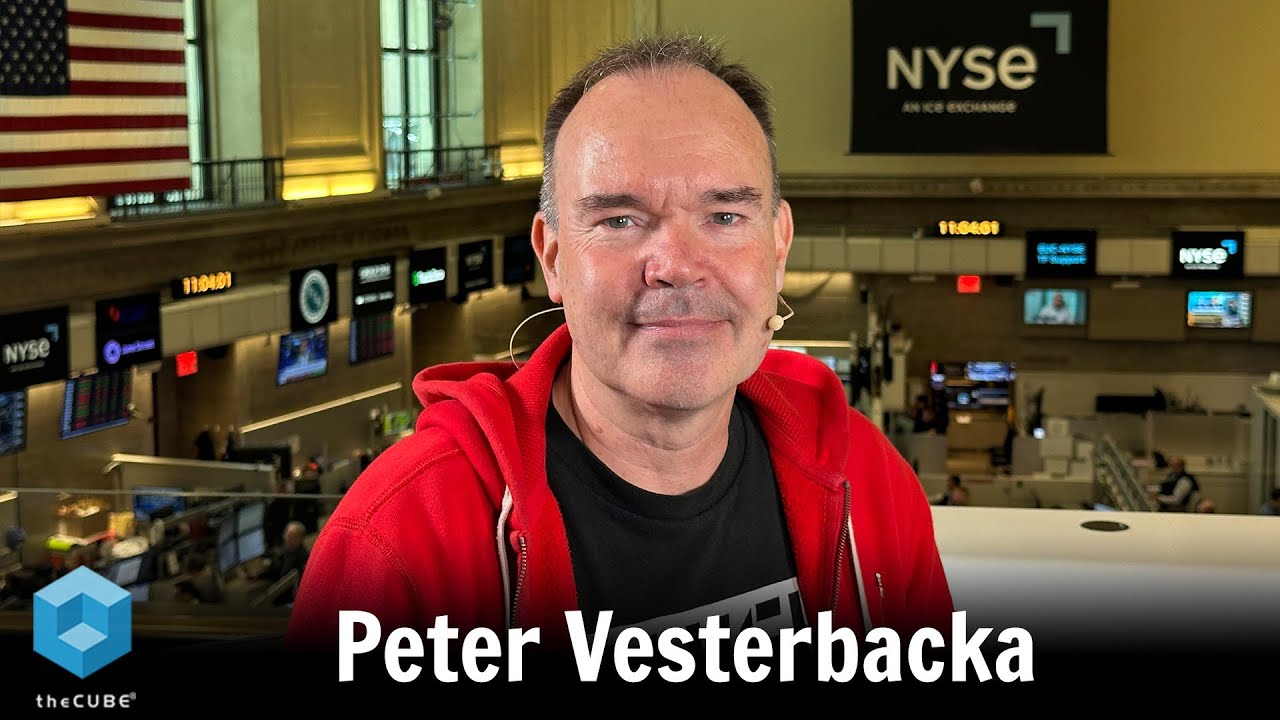
Arvind Jain, the Chief Executive Officer of Glean, joins us in our NYSE studio to delve into the transformative power of artificial intelligence in enterprise applications. In this segment of theCUBE + NYSE Wired's "Mixture of Experts" series, Jain shares insights alongside the Co-Founder and Co-Chief Executive Officer of SiliconANGLE Media, John Furrier.
Jain, with an extensive background in AI and enterprise solutions, discusses the vital role of search and data integration for businesses. They explain how Glean's enterprise brain taps into diverse systems such as Slack and Snowflake, building a foundation for AI-driven insights. The conversation spotlights Glean's journey and the industry trends reshaping enterprise technology.
The discussion further explores how Glean empowers enterprises to construct their own AI agents by integrating disparate databases into a cohesive system. Jain emphasizes that a strong focus on secure data access and innovative agent-building blocks positions Glean at the forefront of enterprise AI advancements, highlighting key partnerships that bolster their strategic vision.
Forgot Password
Almost there!
We just sent you a verification email. Please verify your account to gain access to
theCUBE + NYSE Wired: Mixture of Experts Series. If you don’t think you received an email check your
spam folder.
Sign in to theCUBE + NYSE Wired: Mixture of Experts Series.
In order to sign in, enter the email address you used to registered for the event. Once completed, you will receive an email with a verification link. Open this link to automatically sign into the site.
Register For theCUBE + NYSE Wired: Mixture of Experts Series
Please fill out the information below. You will recieve an email with a verification link confirming your registration. Click the link to automatically sign into the site.
You’re almost there!
We just sent you a verification email. Please click the verification button in the email. Once your email address is verified, you will have full access to all event content for theCUBE + NYSE Wired: Mixture of Experts Series.
I want my badge and interests to be visible to all attendees.
Checking this box will display your presense on the attendees list, view your profile and allow other attendees to contact you via 1-1 chat. Read the Privacy Policy. At any time, you can choose to disable this preference.
Select your Interests!
add
Upload your photo
Uploading..
OR
Connect via Twitter
Connect via Linkedin
EDIT PASSWORD
Share
Forgot Password
Almost there!
We just sent you a verification email. Please verify your account to gain access to
theCUBE + NYSE Wired: Mixture of Experts Series. If you don’t think you received an email check your
spam folder.
Sign in to theCUBE + NYSE Wired: Mixture of Experts Series.
In order to sign in, enter the email address you used to registered for the event. Once completed, you will receive an email with a verification link. Open this link to automatically sign into the site.
Sign in to gain access to theCUBE + NYSE Wired: Mixture of Experts Series
Please sign in with LinkedIn to continue to theCUBE + NYSE Wired: Mixture of Experts Series. Signing in with LinkedIn ensures a professional environment.
Are you sure you want to remove access rights for this user?
Details
Manage Access
email address
Community Invitation
Arvind Jain, Glean
Arvind Jain, the Chief Executive Officer of Glean, joins us in our NYSE studio to delve into the transformative power of artificial intelligence in enterprise applications. In this segment of theCUBE + NYSE Wired's "Mixture of Experts" series, Jain shares insights alongside the Co-Founder and Co-Chief Executive Officer of SiliconANGLE Media, John Furrier.
Jain, with an extensive background in AI and enterprise solutions, discusses the vital role of search and data integration for businesses. They explain how Glean's enterprise brain taps into diverse systems such as Slack and Snowflake, building a foundation for AI-driven insights. The conversation spotlights Glean's journey and the industry trends reshaping enterprise technology.
The discussion further explores how Glean empowers enterprises to construct their own AI agents by integrating disparate databases into a cohesive system. Jain emphasizes that a strong focus on secure data access and innovative agent-building blocks positions Glean at the forefront of enterprise AI advancements, highlighting key partnerships that bolster their strategic vision.
In this episode of theCUBE + NYSE Wired: Mixture of Experts, Arvind Jain, founder and CEO of Glean, joins John Furrier to unpack the evolving role of enterprise search, AI agents and what it really takes to operationalize generative AI at scale. Jain shares how Glean's foundational bet on AI-powered enterprise search has evolved into a broader platform he calls the “enterprise brain” – an intelligence layer that connects structured and unstructured systems across the business.
The conversation digs into how companies are using Glean to enable secure,...Read more
exploreKeep Exploring
What role does search play in the development of AI and assistants within enterprises?add
What is the core technology behind Glean and how does it connect with various enterprise systems?add
What is Glean and how does it function as a horizontal system?add
What are the key objectives and strategies for the company's growth in the AI sector?add
What partnerships and collaborations does the company engage in to enhance their product offerings?add
What is the cultural approach and leadership style of Glean?add
>> Welcome back, everyone, to theCUBE here at our NYSC studio. A lot of activity trades going on behind us. Part of our mixture of expert series, Arvind Jain, the founder and CEO of Glean is back in now our permanent studio. Arvind, great to see you. Thanks for coming in.
Arvind Jain
>> Thank you for having me.>> Always a pleasure. I had a smile and a spring in my step when I saw your recent financing. Congratulations. Big one. What was the amount? How much did you-
Arvind Jain
>> It is about 150 million.>> 150 million, big valuation of course. Why I'm excited was because when we originally talked and continued to talk, the search was the killer app we talked about in the enterprise. You guys did such a great job nailing that use case. It's an entry playbook for the enterprise. They have all that data, but the continuing hype of agents. But people are still just trying to get their data story together. So we'll get to the agents in a second, but give us an update on where you guys are at, obviously successes you've had. What's changed in the past, say four months for you guys, obviously besides the financing?
Arvind Jain
>> Yeah. Well, I mean I think first, as you said, search remains the core for Glean, and it's the foundation on which you build all these different agents inside the company because the models themselves, they don't know anything about enterprise knowledge, data, information, and you have to bring your enterprise context to these models. And so search actually continues to play a big role in making that happen for businesses. For us, I mean, I would say a lot of things are changing in the industry. Number one, we started the company six and a half years back using AI and transformers to build a really good search and an AI assistant product. And we were alone for many years and now there are so many more players. The space has become hot. Everybody's realizing that search is a core for making AI working in the enterprise, so->> I mean, rising tide floats all boats for you there, but what's that mean for you guys? Because now you're starting to see, okay, search is a use case. You guys don't look at it that way. Our last conversation you talked about... And we were riffing on this operating system concept. At Snowflake and then at Databricks this past month, we saw a lot of conversations around this thinking around systems and evaluations. So a lot more intelligence is going into some of the back end services. How does that relate to what you guys are doing? How do you talk to customers when they say, "Okay, what's next beyond search? I like what you have." They're starting to think holistically, not just about one database, but many databases. Every application has a database.
Arvind Jain
>> That's right. That's right. So search is a end user concept. As a user, I'm looking for some things, I'm familiar with how to use Google, and Glean works the same way in your work life. But behind the scenes, what is the core technology for Glean is what we call the enterprise brain. What we are doing is going inside the enterprise, we are connecting with all the different systems that you have within your enterprise, and this includes your unstructured systems like Slack and Google Drive and OneDrive, SharePoint. It also includes your structured systems like Snowflake, Databricks. And the idea is that we go in, we understand all the data that's out there, we understand the governance of that data, we understand your business, we are understanding who the different people are, what they do, and we're trying to actually also understand how work happens inside your business. And this is the core foundation. It's all based on observation. We are observing what people have been doing in this company for the last however many years since the company started. And those observations now feed into making AI work in your enterprise. Think about any agent. You're trying to build an agent to do some work. How's the agent going to figure out how to do this work? It needs to learn from humans who have done that work before. And these observations now that we make accessible through our enterprise brain becomes the core foundation for our->> You're building an intelligence layer, this enterprise plane, you call it?
Arvind Jain
>> Enterprise brain.>> Brain? Brain.
Arvind Jain
>> Yeah.>> Okay, brain. Okay. So the intelligence coming from the observations that you're seeing, usage on data interactions-
Arvind Jain
>> The actual data, the usage, how people actually do work, you have to understand that. You have to actually really go and build that knowledge graph. You have to look at a business. You have to look at their goals. You have to look at any piece of work. First you have to figure out what work even is. Work could be, for example, resolving a customer ticket. It could be taking a feature request and then writing some code for it and launching that feature. So first you to understand what different pieces of work are, then you have to actually see who are the people who worked on it. You have to understand what they actually did during that time period of when that work happened and you'll distill all of that information. And so I think the good thing with AI is that you can go much farther than what you could go with traditional search before. With these observations combined with the power of AI and intelligence, you can now start to understand how work happens inside a company.>> Yeah. And I think the big macro trend that we're seeing just in the industry and what customers are aligning with is I have data. It's valuable. You're hearing it here in the capital markets. I just did an interview this morning where the fact that you can have neo-banking, a trend I've never heard of until I came here, which is people can compete with the banks and control the data with decentralized infrastructure. So companies are seeing power and value from their data. So the next question is, okay, I got a brain. I can see the graph concepts there and maybe graph of graphs, but there's horizontal data. So data availability, you need to see everything. That's one key thing. But then you start getting into the application logic, the business logic. How do you guys think about that? How are you thinking about that at Glean? Because now you're going to have to take specific domain application data. Maybe that's a database tied to an application. We MongoDB here, Postgres over there. Doesn't matter. Okay. But how does that connect in to the brain? How do you make that happen? Is it a reset? Take me through the thoughts on this piece because it seems to be the big part.
Arvind Jain
>> Yeah. So Glean is actually a horizontal system in the sense that when we initially started, we were search and the search product was available to every employee in your company regardless of their role and what they do because everybody has this common need of, well, sometimes I'm going to need some information to do my work. So similarly after search, we build this AI assistant that you can think of that as a superset of ChatGPT. Again, it's an AI assistant. I go and talk to it, I ask some questions, it answers those questions for me. Or I give it some tasks, it's going to do it for me. But it's very broad, very horizontal. We're not talking about specific business processes yet.>> Yeah.
Arvind Jain
>> And then the third thing in our product evolution is this agent platform and even that is in horizontal agent platform. So what we are doing is we are not thinking of the use cases first. First, we are actually thinking about data and your business and how things happen in your company. So we'll connect with all the systems. We'll build this massive horizontal graph. And now we are creating building blocks that we're giving to our customers and they will actually not take... They will say that, "Okay. Well, I have this business process." Maybe it's a legal person, somebody in the legal team, and they say that, "I don't want to actually redline these contracts anymore manually. I want AI to do it." And so they want to build an agent for that. Maybe there's a person in sales and they're tired of filling these RFPs with 500 questions in there and they say that, "I want AI to do it for me."
So different teams, they will go and they have a specific business process and they want to automate that with AI. And our job is to not build all of those things for them, but actually give them the building blocks so that they can actually go and build these particular solutions.>> You're enabling them. You're enabling them.
Arvind Jain
>> Exactly.>> So if I get this right, you're connecting the data first.
Arvind Jain
>> Yeah.>> So get the data access nailed down in that brain connective tissue, whatever you want to call it.
Arvind Jain
>> That's right. Yeah.>> Have a backbone.
Arvind Jain
>> And do it in a secure way so that->> Secure way with governance knowledge so you understand the data.
Arvind Jain
>> Yeah.>> You speak data first.
Arvind Jain
>> Right.>> So then the app layer then is just an extension of SaaS or enterprise apps where they turn into agent builders as an evolutionary trend. So if I'm the HR department, I know my data, I bring that to Glean. So I connect into the agent layer if you want to call it that.
Arvind Jain
>> That's right. Yeah. And then you build agents yourself. So part of it is like what's happening now is that businesses are feeling more capable of building some applications or services themselves because it's so easy with AI. I'll give you one quick example since we're talking about HR. One of the most painful processes in HR is performance reviews and management. And nobody->> Yes, no one likes it.
Arvind Jain
>> And nobody likes to do this, right?>> Yeah. Yeah.
Arvind Jain
>> But you have to do it. It's necessary part of->> Being a manager....
Arvind Jain
>> being a manager. And so people are now building agents in Glean that can actually write your self-assessment or that can actually help a manager write the manager assessment based on all the data, all of the observations from before. And this is something that now HR teams, they're actually building these agents themselves. They're not actually going and buying a dedicated product for that.>> They're rolling their own. I mean, because the tools are so good. I was playing around this weekend, just vibe coding, testing out Augment versus Replit and different tools. And I wrote three apps just by prompting and-
Arvind Jain
>> That's a new programming language.>> So building agents, I'm seeing as... Not to trivialize agents, but back in the day, building a PowerPoint, you have to go in and put a graph in there. You have to go in-
Arvind Jain
>> Yeah. Yes, varying level of complexity. Sometimes building an agent is like talking to a chief of staff and just telling them that, "Hey, do this for me." That's the most simple way of doing it. And it goes from all the way from there to where you actually are also writing some code. But there's a lot of steps in between. It could be like building a PowerPoint.>> There's no doubt that you're definitely on the right trajectory. Not that you need my approval of that, but I think that's clearly the case. The question I have for you is what are customers doing now? Because the number one question I get is I want to build my own agents. I don't want to have to call the IT department or hire developers. You mentioned some of the standards of the code. Okay, so I buy that. That's clear. That's happening. That will happen. Now what do I do? Now I'm an enterprise. I'm like, "Okay, I have a lot of databases." So is it a data mesh or what it means to Glean? What do I have to do to build a data brain?
Arvind Jain
>> Yeah. First, see different teams. Each one of them don't necessarily have to think about that I want to build this massive data brain. For example, if you're in the HR team and you want automation on some specific thing, you just need to work with that selective amount of data, not everything. So for business owners, they don't have to think brand and->> It should be abstract in a way.
Arvind Jain
>> Yeah. But I think if everybody were to build everything from scratch, then you'll end up with this very siloed agent infrastructure. And so therefore, the technology team in a business, the CIO and their organization, they should make sure that they're actually bringing the right horizontal platforms and LLM models and giving the right frameworks to their business teams to then actually go and develop these agents. So the way it works with Glean, for example, is that the CIO goes and buys Glean, puts it in the company, connects it with all the data, and now they tell the HR team and the sales team and the marketing team that, "Go-">> Go use it.
Arvind Jain
>> "... Go pick whatever agents." Yeah.>> Yeah, go use it.
Arvind Jain
>> "Go build agents on this platform." Now, every agent that they're going to build is going to be secured centrally through the Glean platform. All the data that those agents get to use, we will ensure that the agent has the right identity to be able to actually access that data because everything is funneled through us.>> Got it.
Arvind Jain
>> So that's the strategy. So there's some work that the technology team do once. And then every individual department is free to then go and add->> So your strategy is to continue to stay with what you know, nail the infrastructure side of it on the data piece to make that as seamless as possible, easy as possible-
Arvind Jain
>> That's right.... >> to construct agents?
Arvind Jain
>> Yes.>> Okay. So you just got the funding. You're doing well.
Arvind Jain
>> Yeah.>> I know you won't share the numbers, so I won't ask, but I know you're doing well. Got a hundred plus million dollars more in the bank. What's the focus? Is it to continue to engineer? Is it a go to market? What's the expansion strategy look like to build on the current base?
Arvind Jain
>> It won't be surprising to you that every enterprise today are very eager to build agents. They're eager to bring AI into their business processes. And so we have a big opportunity. The product that we have, the technology that we have, it's ahead of everybody else. We started on this journey before anybody else out there. And so we need to make sure that we are reaching to all the major enterprises, all the companies in the world, and so we have to expand fast. This is the key objective for us.>> So all fronts?
Arvind Jain
>> Yeah, on all fronts. So basically we are using capital to both grow our R&D team. We want to double that in size this year. We are growing business. We're doing a lot of international expansion. And they're also actually doing a lot of investment in partnerships. Quite a few of those that we announced recently at our first user conference. But making sure that Glean is also serving as the AI data platform and foundation for vertical SaaS applications that want to build very nice AI capabilities with their own products. We want to be the data provider to them.>> What are some of the partnerships that are attractive to Glean? Can you share either names or their profiles at more cloud players, operators, agents, software, ISVs? I mean, is there a characteristics of who aligns well with you?
Arvind Jain
>> Yeah. Yeah. So I mean, there's some partnerships which are on the backend. So we of course partner with all the model providers. We partner with the cloud hyperscalers. We make use of a lot of technology that they build to build our product. But then on where we are providing the technology to other companies, there are a lot of partnerships that we announced last week. So first data companies like Snowflake and Databricks. So we actually now have tightly coupled integrations with them as people come in and ask questions where the answers are in their databases. We're able to actually now make those work. We announced a partnership with Workday, like in building agents together. Then also with companies like Zoom. Zoom is building a really awesome AI companion inside their product and Glean powers some of the core capabilities in that AI companion in the back end.>> Well, there's two questions on this next segment. One is, I think we talked about this two interviews ago, metadata, you were sharing your thoughts on how metadata was super important. If you look at S-three tables, Databricks, Snowflake, the iceberg phenomenon's been helping a lot. The rise of MCP this year has been a quite surprise. So you have these organic surprises. What's surprising you right now in terms of enablement that's going to speed the mission? Because you have two things going on, these organic trends, de facto kind of capabilities, people are rallying around. And then two, the role of this metadata layer. I mean, Databricks's at one point. So we want to own it all. I mean, everyone I think wants to own the data layer. We've talked about that before and I always say, "Hey, it's got to be open." But you're also horizontal, so you have a lot of horizontal people going for this. But metadata and iceberg changes the game a little bit. Now you've got MCPs enabling agents. So with all that going on, what surprised you this past year in terms of what's coming out of the market organically around the developers? And two, does the metadata this new layer help you?
Arvind Jain
>> Yeah. Yeah. So I think one of the really interesting things for last one year has been interoperability. When we started out model providers were very siloed, like they're not really working with each other. AI companies are all, again, very much doing independent things. And I think in the last six months, the whole narrative has changed to everybody's realizing that they cannot do it all. And therefore interoperating with other players has become a big thing. A to A and MCPs. These are very simple frameworks, but there's something appealing about it that it allows my agents to work with your agents or it allows me to actually expose my functionality and my application in a way that any AI application can make use of that. So I think that has been actually really incredible. The uptake of these open standards has been phenomenal. And it's actually very good for us as a business. We want to make sure that we can interconnect with as many systems and applications, has always been the story of Glean is to connect with all the different systems. In terms of the metadata itself and whether that helps us or not, absolutely. One of the big challenges with making LLMs answer questions precisely and correctly, especially with structured data, is that you often... There is this task of taking a natural language question and you need to convert that from a text to SQL, which is the database query language. And then you issue those requests, you get the data back and you serve it back to the users. And it's so hard to actually make that happen because you're missing the context. When you look at a database, you can't figure out, okay, what is this table about? What is in this one specific column? What are the constraints, the caveats, the unspoken or unwritten->> Meaning. Yeah....
Arvind Jain
>> meaning of it? And so with these metadata layers that are being put in front, it is going to really enable AI to actually create higher accuracy responses.>> And speed too, right? I mean, latency too on finding data.
Arvind Jain
>> Yeah.>> What's your vision on agents? Because you're going to have a lot of agents and the models integration's happening. I think we talked about the last time we had said that needs to happen. And by the way, standards are great. Look at ethernet. That is the most trivial protocol on the planet. Yeah, now it's still alive and thriving. So it's good to have de facto standards. I think people can rally around that and that's good for the industry. But now you have the agent world coming, so now you have the connective tissue, you have the Glean layer brain out there. What's going to happen with agents? Because now you're going to have delegation, you have different agents doing different things. Maybe one hits a small language model, agents watching agents, human feedback that's being automated. You're seeing a lot more probabilistic evaluations of agents' efficacy and you're starting to see more of that. So reinforced learning starts to come into the scene. What's your vision on how agents will progress? Slowly, quickly? What's some of the data coming from the customers that you see from an agent perspective? Thousands and zillions of agents? Or is it going to be targeted?
Arvind Jain
>> Well, ultimately a large enterprise, they probably have a thousand SaaS applications today. And at that scale, when you're at a thousand of applications, you can imagine they'll have at least 10,000 agents in the future. It's going to get injected in every business process that you have in your enterprise. So there's going to be a lot. But where are we today? Agents, despite all these advances, despite all the talk, I think it's still a slog. It's not that easy to actually build these agents and make them perform with the right level accuracy, and customers need help. Most enterprise, most customers we talk to, they don't even know what they can do. And so showing them the heart of the possible, hand-holding them, building roadmaps together with them. And then once you know that, hey, this is what I'm going to now do, after that the journey becomes easy because the actual core capability is there.>> So you're saying is that they got to know what they have?
Arvind Jain
>> Yeah, exactly.>> What do I got?
Arvind Jain
>> Yeah.>> What can we do?
Arvind Jain
>> And it is hard because it changes every day or every week.>> Yeah. Yeah. The other thing I've be hearing too is that, one, figure out what we know, then we can figure out all the possible. We had some sales and marketing and some coding, good use cases there, got that. And then they move to, okay, great, we got some prototype basically democratized agents that have been built by users or departments. Then it's like, how do I get into production?
Arvind Jain
>> Mm-hmm (affirmative).>> What are some of the concerns there that are requirements, hurdles that you're seeing in enterprise? Because yeah, thanks for showing me this great capability. How do I bring that across into production? Thoughts on production, workloads being embedded, shipped and connected?
Arvind Jain
>> Yeah. Well, I mean, first of all, I think that's the only real thing. Like any POCs or experimentation that you're doing. Well, that's basically the pre-work, but ultimately you have to roll things in production. So there are two things I would say on that. Number one, people talk about this world of autonomous agents and agents talking to other agents, invoking them when they need to, agents reviewing other people's work. And I think we're a little bit like, "That's a big step. That's the right direction. That's where we're going to go." But I think today, that's not the way to think. Today you build agents with human supervision. You take any business process that takes 10 hours and you should be very happy if you can shave nine hours from that process and let the human spend one hour on it. And that's a big win. And I think most of the successes that we're seeing in agents today is of that nature where you are... And in this one, you feel very comfortable because now you don't have to worry about the accuracy because ultimately you have the safeguard of the human in the end. And it also simplifies sometimes issues around regulation and compliance because if the human used AI as a technology as a component, but ultimately the human made the decision on the actual final body of work, then you're able to handle compliance and regulations also much in a much easier way.>> Yeah. And productivity's a great win. That's certainly is not in the payback or valuation. I have to ask you, you've shared with me many times your experience in startups. You had a great track record, obviously from the early days of Google and multiple startups and exits after. As a leader at Glean at this point in time, it's hard not to read the press clippings and see all the great news. But you're a seasoned veteran. You're in probably a historic cycle right now. Dave and I call it Super Cycle on the podcast many times. It's unique and a lot of the younger generations have never seen it either. I mean, it's just like, "Oh my God, this is great." It's a super great time. How do you feel right now about this cycle personally and from a business standpoint? And what are you doing to calm and stay focused? I know you're doing a lot of traveling and you've got a lot of product work to do. I mean, you can't rest on your laurels in this market product-wise. You got to have the technology. You got to watch not just the trends, but you got to keep the product leadership going. How do you feel personally, and how do you see this market and what are you doing to manage it?
Arvind Jain
>> Well, I mean I think first this is a trend that in my 30-year career, I've seen many trends like mobile, internet, SaaS, mobile, and this is the biggest of them all. This is the first time where I actually felt surprised with what technology can do because everything else was... It was a slow buildup and->> That's cool. Yeah, incremental improvement. Yeah.
Arvind Jain
>> Yeah. And so it felt natural and within the realm. And here you get things which are sudden and so big, and so things that you don't expect machines to be able to do. So this is the biggest trend. The interesting thing is that the young workforce, for them, they don't feel it. I think maybe they feel this is all normal. But from a perspective of what that does for us, it's exciting. On one side, there's no boredom in this space. Every day you have something really cool to actually work with, to actually incorporate in your product. So that's the most exciting part as a product builder. But also this is a market where we feel very unsettled. It never feels like, yes, we have a business->> We won, not... Yeah....
Arvind Jain
>> that we have a business that's going to last because we feel like if we don't act, if we don't innovate, we'll be irrelevant within three months and things move so fast here. So it's a->> I mean, Andy Grove had the best line, only the paranoid survive. I interviewed Diane Bryant who came on theCUBE last week during our robotics AI leaders. And she's retired now. She's on the Broadcom board. And she was also talking about the Intel miscues. But she said that missing Moore's law for Paul Otellini... Not Paul Otellini, the guy he came after. They lost the edge. They had such religion on not staying still, and they were constantly on their mission. And what is that mission for you? Because you have the same kind of vibe, which is it engineering, product? What is that mission? What is that cultural trait in your company that makes Glean different? Because it's good to be paranoid right now because the game's just starting. What is that cultural cadence for Glean?
Arvind Jain
>> Yeah. I mean, for us, we are a very much technology-driven organization and the way we build our company is... And maybe I'll be transparent and say that most of us didn't learn how to be leaders. Most of us grew in the Google way of building companies, which is that you just hire the best people and then let them be. They'll figure out the right things. You just have to get out of the way. And so we follow the same approach at Glean. And I think it helps because everybody in the company feels the agency. They feel like they can do big things. And you don't have to go and get four rounds of approval to actually build something cool. And so I think that's the culture that we are trying to follow. And as we grow, now we're closing in on being a thousand people in the company and maintaining that culture is going to be super critical.>> Yeah. It's a growth story. It's a great one. I congratulate you. It's quite fun to follow the journey. It's great to have you back on theCUBE. And we're happy for you. And again, directionally, it's coming at us, this wave. So Arvind, thank you for coming on. I appreciate it.
Arvind Jain
>> Thank you so much.>> Okay. Got a mixture of expert in the studio here. It's our series. A play on the AI mixture of experts. Of course, we're doing our best to bring you the knowledge again as agents are coming, connecting the data, understanding what you have, and then understanding the art of the possible. That really is about the innovation trend we're on. And again, it's wide open. New brands are emerging, new capabilities. The future is unwritten. Thanks for watching.