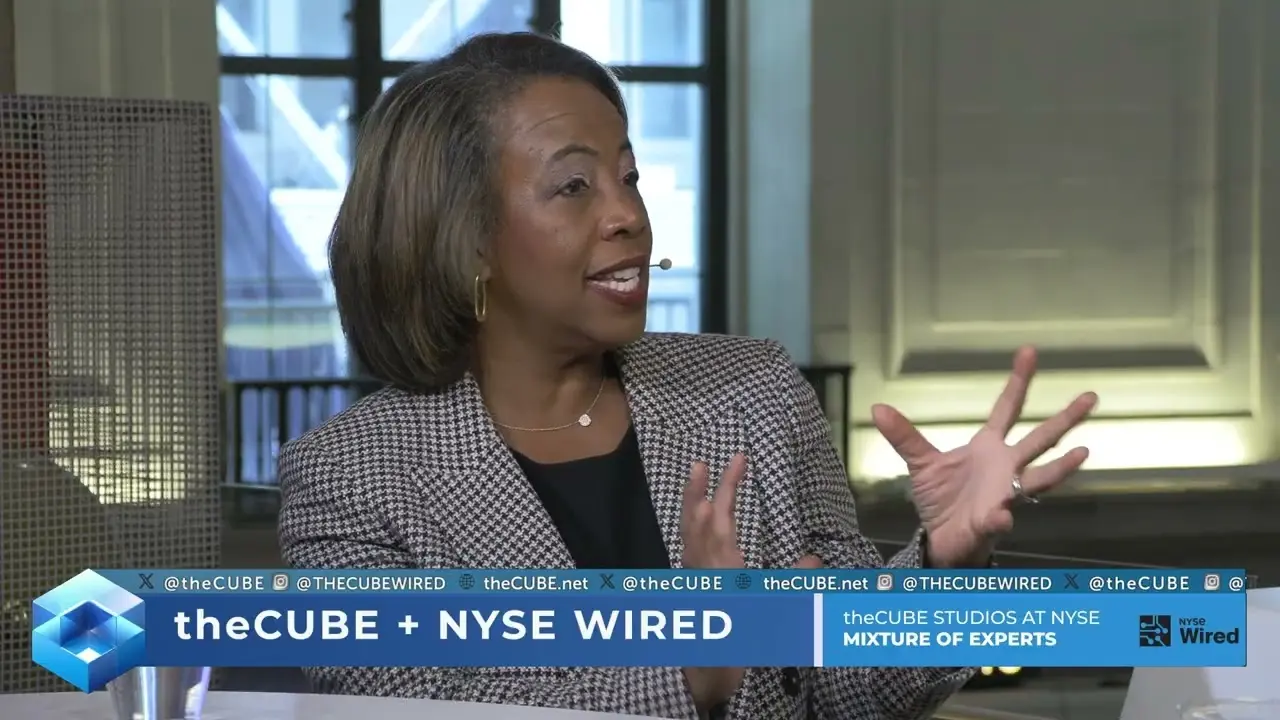
This conversation explores how artificial intelligence infrastructure and agentic workflows transform healthcare operations. Ganesh Padmanabhan of Autonomize AI joins NYSE Wired Mixture of Experts to discuss how AI serves as an enterprise infrastructure layer for healthcare and to outline Autonomize AI's platform—context graphs, specialist models and agentic workflows—and to examine use cases such as prior authorization, care management, pharmacy benefits, revenue cycle and claims while emphasizing deployment on existing information technology systems. Padmanabhan highlights measurable operational impact and governance needs, and they note Autonomize reclaims roughly 66,000 clinical hours through automation while scaling to assist millions of members.
Padmanabhan emphasizes operating leverage from agent-enabled workflows, the importance of governed shadow AI controls and capturing tacit institutional knowledge via context graphs. theCUBE Research hosts observe these trends indicate substantial productivity and transformation opportunities for providers, payers and life sciences.
Forgot Password
Almost there!
We just sent you a verification email. Please verify your account to gain access to
theCUBE + NYSE Wired: Mixture of Experts Series. If you don’t think you received an email check your
spam folder.
Sign in to theCUBE + NYSE Wired: Mixture of Experts Series.
In order to sign in, enter the email address you used to registered for the event. Once completed, you will receive an email with a verification link. Open this link to automatically sign into the site.
Register For theCUBE + NYSE Wired: Mixture of Experts Series
Please fill out the information below. You will recieve an email with a verification link confirming your registration. Click the link to automatically sign into the site.
You’re almost there!
We just sent you a verification email. Please click the verification button in the email. Once your email address is verified, you will have full access to all event content for theCUBE + NYSE Wired: Mixture of Experts Series.
I want my badge and interests to be visible to all attendees.
Checking this box will display your presense on the attendees list, view your profile and allow other attendees to contact you via 1-1 chat. Read the Privacy Policy. At any time, you can choose to disable this preference.
Select your Interests!
add
Upload your photo
Uploading..
OR
Connect via Twitter
Connect via Linkedin
EDIT PASSWORD
Share
Forgot Password
Almost there!
We just sent you a verification email. Please verify your account to gain access to
theCUBE + NYSE Wired: Mixture of Experts Series. If you don’t think you received an email check your
spam folder.
Sign in to theCUBE + NYSE Wired: Mixture of Experts Series.
In order to sign in, enter the email address you used to registered for the event. Once completed, you will receive an email with a verification link. Open this link to automatically sign into the site.
Sign in to gain access to theCUBE + NYSE Wired: Mixture of Experts Series
Please sign in with LinkedIn to continue to theCUBE + NYSE Wired: Mixture of Experts Series. Signing in with LinkedIn ensures a professional environment.
Are you sure you want to remove access rights for this user?
Details
Manage Access
email address
Community Invitation
Ganesh Padmanabhan, Autonomize AI
This conversation explores how artificial intelligence infrastructure and agentic workflows transform healthcare operations. Ganesh Padmanabhan of Autonomize AI joins NYSE Wired Mixture of Experts to discuss how AI serves as an enterprise infrastructure layer for healthcare and to outline Autonomize AI's platform—context graphs, specialist models and agentic workflows—and to examine use cases such as prior authorization, care management, pharmacy benefits, revenue cycle and claims while emphasizing deployment on existing information technology systems. Padmanabhan highlights measurable operational impact and governance needs, and they note Autonomize reclaims roughly 66,000 clinical hours through automation while scaling to assist millions of members.
Padmanabhan emphasizes operating leverage from agent-enabled workflows, the importance of governed shadow AI controls and capturing tacit institutional knowledge via context graphs. theCUBE Research hosts observe these trends indicate substantial productivity and transformation opportunities for providers, payers and life sciences.
>> Palo Alto Studio Connection, Silicon Valley and Wall Street. I'm John Furrier, the host of theCUBE here with Dave Vellante, my co-host. Hello, welcome to theCUBE here at our NYSE studio as part of the NYSE Wired original theCUBE programming. Of course, we have our Palo Alto Studio connecting Silicon Valley and Wall Street. This is our mixture of experts series. We talk to leaders, who are making it happen, changing the world. Obviously, AI is hot, physical AI, and just overall AI infrastructure is powering new applications. Ganesh Padmanabhan is here, founder and CEO of Autonomize AI, friend of theCUBE going back to the Dell days. Great to see you.
Ganesh Padmanabhan
>> Great to be here.
John Furrier
>> Thanks for coming on. What do you think of the studio? We're in Wall Street.
Ganesh Padmanabhan
>> It's amazing. It is amazing. My memory of theCUBE from the time that we actually interacted was you would come in and deploy theCUBE in an event. From that to this is just amazing.
John Furrier
>> Well, now we still got the events. Now we got the studios in Palo Alto and Wall Street. We connect that, but also the events give us real-time information and just the cycle of content creates a great community. That's our new NYSE Wired brand. That's independent, but we collaborate with NYSE deeply and it's digital. So what happens is we learn a lot and we can connect with experts. That's why we like our Mixture of Experts series.
Ganesh Padmanabhan
>> That's amazing.
John Furrier
>> And not to be confused with mixture of experts in the AI model, but we have our own AI experts. Ganesh, you're doing some pretty cool things. I want to get into the company you founded a couple of years ago, 4 years ago. It's in healthcare. It's AI. You've probably known this for more years than we've been covering it over the past 2 years, but healthcare is really booming with AI at many levels.
Ganesh Padmanabhan
>> Yeah. No.
John Furrier
>> So, tell us about what you're working on.
Ganesh Padmanabhan
>> So, first off, thank you for having me. It's a delight to be back and good to be chatting with you. So, look, healthcare is one of the industries I believe that is going to fundamentally be an early adopter of large-scale AI in action, right? And the reason is this. We have a workforce shortage— we have 330 million people in the United States. There's less than a million MDs. We have a 300,000 shortage of nurses. So, the only way you can scale expertise and access to care is by adopting technology that can scale the expertise of people. What we've been up to at Autonomize AI is, so we believe that the last 10, 20 years of digital health innovation has been in narrow silos. And while investors did well, you ask the average patient, has healthcare gotten better? They'll say no, not at all. So we're trying to change that. But the way you do that is not by solving more siloed problems, but treat AI as an infrastructure layer to change the way operations are run. So what we do is we work with large and medium-sized health enterprises, help them reimagine their workflows across care management prior authorizations, revenue cycle management, claims, anything that touches where you're actually deploying high quality high expertise to do mundane administrative work, that's the sweet spot. We do the boring stuff by taking that off their plate and applying agents to automate that, autonomize these processes so they can actually deliver care at the top of their license.
John Furrier
>> I do. I love the operational aspect of this because it reminds me of the IT wave. You go back in the '90s. Yeah. After PBXs got digital, you have now networks. Networks had PCs, they have LANs, then you got cloud came in, virtualization. So that was a really big growth area in IT. It was slower, obviously, but now we got a compressed AI operations going on. But it's not literally an IT problem. It's really a business model, but it's also sitting on top of all that preexisting IT work, the database, what's available, the regulation, existing systems. By layering that on top, you now have an opportunity to do things differently, but it's also compressed. Share your reaction to that and observations around this dynamic, because healthcare is in a good position. They got the data, they got the workflows, but those workflows were statically defined sometimes years, maybe a decade earlier.
Ganesh Padmanabhan
>> No, no, you're right. First off, I think I love the parallels you're drawing to the IT evolution back in the day, because my background at Dell and understanding infrastructure, I was there for the virtualization boom, the hyperconvergence, the converged infrastructure. There's a lot of parallels we can learn there. And the truth in any industry today is that nobody gets a fresh start. So you have to start from the systems you have, the data that you have, and that's the advantage as well, right? Now, in healthcare, one of the good things is, like you said, we have heavy regulations. There's a lot of regimented processes. There are systems that have been built over time, but there's still two different problems, which is the opportunity for AI. One, the knowledge of these workflows is not exactly what a job aid or an SOP says. It's actually in people's heads. So if you can capture that, the tacit reasoning, all of that stuff, and then blend it with the data processing capabilities we have with AI, unstructured data, then you can unlock the true potential. Second, I think since healthcare is one of those things where you have like it's always going to be a scale problem because it's a fundamental— if you can argue it's a fundamental right versus a thing for humanity, you have to— there is no other way than to figure this out. So, that demand and then the lack of expertise, the lack of ability to scale expertise to do it. I was recently in China for the World Economic Forum. We won a Technology Pioneer Award from the World Economic Forum. And you could see their healthcare is in different places in different parts of the world. But everybody has a fundamental problem, access, right? You cannot produce enough doctors on time. You can't produce enough nurses to support the population growth around the world. So I think it's a— it's
John Furrier
>> the—talk about that operating leverage that AI gives, because that's a— there's two problems. There's one, this process and just the workflow and the operations, but that's— AI clearly can go after that. But you're getting at the labor problem, which has got leverage with the AI. How does the person become more productive What are some of the things that you see that jump out at you? What's the down-the-road upside? Is it more operating leverage for the person? Is it recruiting more people? Does it change the scope of jobs? What does it do to the impact?
Ganesh Padmanabhan
>> Yeah, no, I think so. This is the— it's not just limited to healthcare, but we stand in this profound place in history where productivity is going to just completely explode, right? And it's true for healthcare. So healthcare, what happens if you look at an average healthcare organization, A nurse or a doctor spend about 50% to 60% of their time doing administrative processing, looking at information, logging into all the different layers of systems that we put in. They look through every different things, summarizing information, moving information from one to another. So individual productivity, we're already seeing the gains by, hey, when the doctor comes in and sees the patient, let them spend the time face-to-face with the patient instead of looking at a computer. And so to do that, you have agent workflows that are automating the summarizing, the data gathering and stuff like that. So, that's the individual productivity uplift. Organizations today, the cost model for running a healthcare organization, average healthcare enterprise runs at a 1% to 2% profit margins because a lot of that is labor. And that labor is not so much that you don't need to have labor at the right places like taking care of people, talking to people, reaching out. healthcare is more human, but then overall, 60% to 70% of those people do administrative process. So that's the operating leverage. If you can imagine a world where you have a healthcare enterprise and you want to support an employer's health benefit plan, you should be able to do it as a healthcare enterprise with 1 doctor, 10 nurses, and a completely automated autonomous system, an operating system like from say, Autonomize AI, that'll actually completely automate and autonomize the mundane manual processes, right? And that's the future we're trying to build for.
John Furrier
>> Yeah, I love it. I love the macro. Let's get into your business. Talk about your company obviously you got the award, you mentioned the Cigna callout. How many employees? Where are you on the progress on the product? How much money did you raise? Where are you on the trajectory?
Ganesh Padmanabhan
>> Yeah, so we started about 4 years ago, the company, and we're headquartered in Austin, Texas. We're 130 employees right now. We have people in the United States, mainly in Austin, but also distributed, also a team in Bangalore, India, more of the product development team. And we've raised about $32 million to date in funding. We raised our Series A late last year, and it was backed by Valtruis, which is part of the Welsh Carson portfolio, and also Cigna Group Ventures. So, we commercially engage, we now power 4 of the 5 largest health enterprises in the United States. We work with several value-based care organizations, payers, providers.
John Furrier
>> Can you share the names of them?
Ganesh Padmanabhan
>> We can share, we work with Cigna. They also invested in the company. Some of the others are more sensitive in who we're actually allowed to share. We work with the companies.
John Furrier
>> What's the scope of how big are they?
Ganesh Padmanabhan
>> So, we work with on average, if we execute this well in this year, we would probably be assisting with close to 150 million people in the United States through this organization.
John Furrier
>> Patient impact.
Ganesh Padmanabhan
>> Patient impact.
John Furrier
>> Okay. And the amount of organizations you sell into and service, and deploy? Size roughly?
Ganesh Padmanabhan
>> Yeah, so we usually go to organizations that are at least managing about 500,000 people or more. So they have either 500,000 patients or members as a health insurance company. Usually they are large complex enterprises and they want more transformation than just a new agent to automate a workflow, right? They want hey, I want to reimagine my care management process because I have 200,000 members who need to be are in their long-term care. But for that, I need to have specialists. I need to have doctors. I need to have nurses. I need to have care managers. How do I redesign this in a way that it's not just an assembly line of people?
John Furrier
>> Yeah. And by the way, they now have an opportunity to do something they never could do before.
Ganesh Padmanabhan
>> Exactly.
John Furrier
>> the whole part of AI that we're seeing is that, yeah, it's not an IT scope, this department or this kind of project. Do a pilot, bring it in, test it. You can actually inject intelligence in the organization and kind of move faster to solve problems people have been bitching about for years and probably in the coffee room. that's the way it is. people always talk.
Ganesh Padmanabhan
>> I'll tell you, you asked the question earlier on, practical, what's the thing? So we were able to, using AI in these processes, say, prior authorization for a company like Altais is a customer of ours. What we have been able to do is, we were able to recoup, thousands of hours of clinical time that can be repurposed to taking care of patients, right? Instead of doing this thing. In one large organization, we were able to recoup about 66,000 hours of clinical FTE time in a year, which is just ridiculous. Just do the math on that, right? So those are the short to medium-term problems. Efficiency, save costs, decrease cycle time and stuff. The real opportunity, as you said, is the unknown unknowns with AI, right? Let's say, for example, you're a pharmacy benefit manager or a health plan and there is a new— FDA approves a new drug. It takes 100 people 8 months to go across designing your benefit plans, updating your formularies patient engagement material, all of that stuff. And it's not just about the work that happens, but it requires collaborative intelligence and collaborative experts to do it. That to me is an opportunity for things like AI swarms. we're launching a capability around how do you have a group of agents, AI agents that have access to specialized knowledge, but then let them collaborate instead of just telling them how to do the workflow, go creatively solve that problem and come back with a recommendation, right? To me, those kind of— we're seeing that in biology right now, right? So I think that's the big opportunity with AI.
John Furrier
>> I want to get into the physical AI at the end because I think there's a real upside with physical robotics and healthcare. We're seeing some examples of that in NVIDIA's showing a lot of them the ER, automated ER. But let's get into the products that you guys are deploying, the platform. It's an infrastructure AI layer. Love that position because you can almost throw it on top of, abstract away the complexities with software and AI. What are people using? You guys had an announcement yesterday with, is it GenAI
Ganesh Padmanabhan
>> GenAI, yeah.
John Furrier
>> Talk about the product and platform.
Ganesh Padmanabhan
>> So we have an infrastructure layer. So that includes a couple of products. One is around how do I normalize data from multiple sources, unstructured, to a normalized healthcare-native interface. We have a context layer, which is basically an ontology of sorts that actually combines all the different healthcare knowledge publicly available and allows our customers to extend it to their own context layer. So, we're separating the model layer from the actual context layer for enterprises. And then we have a family of models, some specialist models, some SLMs, some large language models, and we also work with all the different vendors. So that's the infra layer. And then on top of that, we have actually enabled a set of tooling and then a set of these applications that are AI-native workflows. So we have AI-native workflows for utilization management, which is helping health plans and providers manage the whole process of how do you get approvals for expensive care options. We have a pharmacy benefit capability that allows you to design benefits for pharmacy and new drugs like GLP-1. We have a care management application that allows you to manage care across the continuum of how do I do transitions of care and so forth for organizations. We have a revenue cycle management capability. We have a claims capability. So we have a series of applications. Our customers usually engage with us on, depending on the complexity, they would usually come in and say, I want to solve a problem. So we'll go reimagine an appeals problem or a prior auth problem or a care management problem. But once we do that, we enable a self-service layer, which is the announcement that we made yesterday, GenAI. And Genie is an AI agent that can act as your solutions architect, but work very closely with the people on the ground who are closest to the problems, the doctors, the nurses, the care managers, and then being able to give them a JARVIS suit, if you will, to turn them into Iron Man.
John Furrier
>> It's like a forward-deployed engineer, to use industry terminology, for the worker. It's like having an assistant copilot. whatever you want to call it?
Ganesh Padmanabhan
>> Yeah,
John Furrier
>> but these forward deployed engineers, a term people use in the industry, like bring an engineer and sit next to the user. That's what agents are turning into.
Ganesh Padmanabhan
>> exactly right. I think, except it doesn't start with a $20 million price tag for a forward deployed engineer. But that said, I think there is value
John Furrier
>> in—Well, a SpaceX employee or Uber or OpenAI. But getting a forward deployed engineer in the tech companies is a high paying job. Agents are replicating that. Claude, I just interviewed Genspark AI. they're doing deep research with prompts that would usually cost a lot of money, researchers and coders to do. Now that's at the fingertips of users.
Ganesh Padmanabhan
>> I think, look too long we've actually associated work to be done with effort and knowledge. Both of those are going to get democratized with AI, right? So the big differentiator is going to be taste. Being able to, for example, the biggest problem in healthcare specifically, the reason we built GenAI is because of all the vibe coding activity, these doctors, nurses, and folks are actually going and building their own stuff, which introduces vulnerabilities. They're taking random libraries from GitHub and so forth. And then IT is facing, you remember, they used to face shadow IT problems. Now it's shadow AI problems, right? And so what this allows them to do is when they design and you're co-creating it, you're limiting the aperture of where they pick the components from that particular—
John Furrier
>> Ganesh, talk about the shadow AI, because this is super important for the folks that are following the AI boom. There's a term called shadow AI, which comes from shadow IT. Yeah, shadow IT. You lived through those days. We're talking about when cloud came around around 2013, maybe 2012.
Ganesh Padmanabhan
>> Yep.
John Furrier
>> I'd say 2011 to 2014 was the hype cycle and deployment. Shadow IT meant you were in the shadows. You go around the process, put your credit card down on AWS, test some stuff under the covers. No one knows you're doing it. Skunk Works, whatever you want to call it. Come back with a working prototype. Show everyone on the team.
Ganesh Padmanabhan
>> Go through the
John Furrier
>> process.Oh, you did that? How fast? Maybe we should do that. Of course, they got their hands slapped and they end up running the project. So that became cloud. That spawned cloud
Ganesh Padmanabhan
>> computing.
John Furrier
>> Yep.In my
Ganesh Padmanabhan
>> opinion.Yeah, fair
John Furrier
>> enough.But that was only IT. So those were IT projects, IT transformation. Hey, roll out new desktops. Let's put some software out there, let's put some new hyperconverged servers in, let's put virtual machines. So a lot of those projects were done only from a back office IT standpoint.
Ganesh Padmanabhan
>> Yep.
John Furrier
>> Okay. Why am I saying that? Because shadow AI isn't a back office. It's happening in every department. It's happening in finance, general knowledge workers. They're just going, wow, this is doable. They get the value of what IT used to do.
Ganesh Padmanabhan
>> Yep.
John Furrier
>> And they could feel the success. And it makes them more tech savvy, but also more business savvy on why we invest in tech.
Ganesh Padmanabhan
>> And actually, it is more challenging than what shadow IT was. And the reason is this, right? On the one hand, yes, you're actually opening up the World Wide Web or the Wild West of actually picking up the components for building AI because these are LLMs that are necessarily trained on everything from tweets to journals to everything else, right? So one is you're exposing your attack surface area when you enable users to go and build random stuff out of them. The second most important thing is what all the foundation model, the frontier model folks want you to do is contribute knowledge into the thing. If you're an enterprise that has actually been doing this for, I think Satya Nadella wrote about this a couple of weeks ago. And if you're an enterprise and your core information, the knowledge, the way you do work, the way you perform work, the way you manage your patients is your moat. And you're just enabling a competitor to go build that. So, you can't do that. But you also have to unlock the productivity of the people on all the front lines. So, the way you have to do that is enable them, give them the tools, but then constrain the backend in which they're only working out of a governed layer. They're working off components that are IT-approved. They have the security boundaries in place. They're not putting personally identifiable information and PHI on ChatGPT and on Claude.
John Furrier
>> It's like giving an IT sandbox to every worker.
Ganesh Padmanabhan
>> Yeah, and it's more than that.
John Furrier
>> Put some guardrails around it, get the governance right, watch the databases, identity.
Ganesh Padmanabhan
>> And then in addition to that, you get another benefit of this, which is just like the frontier models are looking to extract the knowledge out, you now have the opportunity to capture that tacit knowledge in the organization into an intelligence layer for your enterprise, right? Which is one of the things we enable with the context graph, right? What it does is, for example, we work with our customers and we hear this all the time. Hey, how do I actually go and deal with this particular request for durable medical equipment or wheelchairs or something? Well, I don't know. Ask Sally. Sally has done it for 30 years. She knows it. It's not documented anywhere. It's not written in a job aid. How do you capture that knowledge? Well, you empower Sally to turn that into an agent workflow that can enable everybody else, train the new hires, all of that stuff. I think that is the big opportunity while you control and contain the CVEs, the exposure of security.
John Furrier
>> That's why knowledge graphs are huge right now. If you look at data lakes, that's Gen 1. Knowledge graphs are coming out of the data lakes. That's the neural network, if you will, the brains.
Ganesh Padmanabhan
>> Exactly.
John Furrier
>> And then you have the arms and legs, which is like the body.
Ganesh Padmanabhan
>> So it's likethe agents.
John Furrier
>> Yeah, agents. Yeah, doing the work. Well, great, great stuff on your roadmap. What's on your to-do list? Obviously, you're getting off the runway, getting some cruising altitude. Healthcare booming market. Again, congratulations. And by the way, there's a whole healthcare side that's on the research side that's booming too.
Ganesh Padmanabhan
>> Yes.
John Furrier
>> A little bit different. You're running ops, but they're going to contribute more innovation too.
Ganesh Padmanabhan
>> we actually have a division. We actually work with the research folks. So we used to work exclusively on the clinical research side. So from the time a drug has to be approved and you need to take it through human trials, helping people recruit the right people for the trials. Analyzing their medical records. All of that is a lot of work, right? And so we have solutions there. We're also working with several life sciences companies on the market access side. How do I remove the patient burden for getting access to a GLP-1 medication or a CGM? How do you help understand how do I competitively price my particular drug so that I'm getting the best price and passing on the most benefit to the customer? How do I place my drugs in the market so that they can get the most adoption and I can forecast where the need is going to be and so forth. So, we believe one of the challenges in healthcare has been everybody siloed their thinking, right? Oh, you're a provider AI, you are a payer AI, you are a life sciences or a biology AI. Well, we are healthcare AI. So, we want to go, in our roadmap is a very strong ambition to go and enable a living intelligence layer across providers, payers, life sciences, and even patients so that healthcare can be as seamless as it can be for patients, joyful for providers, and efficient for enterprise.
John Furrier
>> All right, what's on your focus list? What are you guys optimizing for? Put a plug in for hiring.
Ganesh Padmanabhan
>> Yes.
John Furrier
>> People, customers might be watching. Put the pitch out there and give a plug.
Ganesh Padmanabhan
>> Yeah, so thank you. I think we're building the best team in the universe to tackle the hardest problems in AI. So, we are definitely hiring across all roles, across engineering, product, go-to-market. We've been actually building out our growth engine so far. For customers, if you're a healthcare enterprise that is looking to optimize your administrative spend, you're looking to reimagine some of the workflows that are being like traditional processes, you're just going to do another RFP to get the same old shit that you had before. So, if you want to reimagine it and if you want to really treat AI as a transformative experience, we're here to serve you, right? So we want to actually— we want to talk to you, reach out to me, check out autonomize.ai. We have a variety of new products that we are launching because what we have built with our platform is an agentic factory to produce these apps, which is healthcare native, secure, but also really fast to get in hand.
John Furrier
>> And I was talking, just not to belabor the point on productivity, but I was just having a conversation about the word leadership and management. Management is managing something. Leadership is taking action. That's a superset of management. You manage, but leaders make change. And I think what you're doing is an example of successful AI companies because there's an empowerment and creativity where anyone in the organization, nurse, someone in revenue management, could have an idea and make a sizable dent in the universe for their company because it just takes one little spark, but people usually don't go for it because the hurdles to do something are ah, I know it's too complicated. I got to stand in line, go to IT, get approval, fill out forms. Now with Shadow AI, you're starting to see an empowerment mindset. That's leadership. That's not just managing. Managing is like moving paper around.
Ganesh Padmanabhan
>> Yeah, it is.
John Furrier
>> People are doing their tasks.
Ganesh Padmanabhan
>> And AI at this point requires true leadership from everybody, all the innovators, all the enterprises, everybody here. By the way, I just realized that today is the AI Appreciation Day, so I want to appreciate all of the healthcare knowledge workers and folks who are putting the community in front of themselves, in front of their family, working long hours and stuff. We want to give them the, I call it the JARVIS suit, so they can all turn from Tony Stark to Iron Man, right? So that's where we want to go.
John Furrier
>> Well, you've seen the IT wave, the cloud wave, now you're in the AI wave. It's great to see you. Thanks for coming on our Mixture of Experts series.
Ganesh Padmanabhan
>> Thank you.Thank you, John.
John Furrier
>> I'm John Furrier, the host of the NYSE Wired: theCUBE program. Thanks for watching.
>> Palo Alto Studio Connection, Silicon Valley and Wall Street. I'm John Furrier, the host of theCUBE here with Dave Vellante, my co-host. Hello, welcome to theCUBE here at our NYSE studio as part of the NYSE Wired original theCUBE programming. Of course, we have our Palo Alto Studio connecting Silicon Valley and Wall Street. This is our mixture of experts series. We talk to leaders, who are making it happen, changing the world. Obviously, AI is hot, physical AI, and just overall AI infrastructure is powering new applications. Ganesh Padmanabhan is here, founder and CEO of Autonomize AI, friend of theCUBE going back to the Dell days. Great to see you.
Ganesh Padmanabhan
>> Great to be here.
John Furrier
>> Thanks for coming on. What do you think of the studio? We're in Wall Street.
Ganesh Padmanabhan
>> It's amazing. It is amazing. My memory of theCUBE from the time that we actually interacted was you would come in and deploy theCUBE in an event. From that to this is just amazing.
John Furrier
>> Well, now we still got the events. Now we got the studios in Palo Alto and Wall Street. We connect that, but also the events give us real-time information and just the cycle of content creates a great community. That's our new NYSE Wired brand. That's independent, but we collaborate with NYSE deeply and it's digital. So what happens is we learn a lot and we can connect with experts. That's why we like our Mixture of Experts series.
Ganesh Padmanabhan
>> That's amazing.
John Furrier
>> And not to be confused with mixture of experts in the AI model, but we have our own AI experts. Ganesh, you're doing some pretty cool things. I want to get into the company you founded a couple of years ago, 4 years ago. It's in healthcare. It's AI. You've probably known this for more years than we've been covering it over the past 2 years, but healthcare is really booming with AI at many levels.
Ganesh Padmanabhan
>> Yeah. No.
John Furrier
>> So, tell us about what you're working on.
Ganesh Padmanabhan
>> So, first off, thank you for having me. It's a delight to be back and good to be chatting with you. So, look, healthcare is one of the industries I believe that is going to fundamentally be an early adopter of large-scale AI in action, right? And the reason is this. We have a workforce shortage— we have 330 million people in the United States. There's less than a million MDs. We have a 300,000 shortage of nurses. So, the only way you can scale expertise and access to care is by adopting technology that can scale the expertise of people. What we've been up to at Autonomize AI is, so we believe that the last 10, 20 years of digital health innovation has been in narrow silos. And while investors did well, you ask the average patient, has healthcare gotten better? They'll say no, not at all. So we're trying to change that. But the way you do that is not by solving more siloed problems, but treat AI as an infrastructure layer to change the way operations are run. So what we do is we work with large and medium-sized health enterprises, help them reimagine their workflows across care management prior authorizations, revenue cycle management, claims, anything that touches where you're actually deploying high quality high expertise to do mundane administrative work, that's the sweet spot. We do the boring stuff by taking that off their plate and applying agents to automate that, autonomize these processes so they can actually deliver care at the top of their license.
John Furrier
>> I do. I love the operational aspect of this because it reminds me of the IT wave. You go back in the '90s. Yeah. After PBXs got digital, you have now networks. Networks had PCs, they have LANs, then you got cloud came in, virtualization. So that was a really big growth area in IT. It was slower, obviously, but now we got a compressed AI operations going on. But it's not literally an IT problem. It's really a business model, but it's also sitting on top of all that preexisting IT work, the database, what's available, the regulation, existing systems. By layering that on top, you now have an opportunity to do things differently, but it's also compressed. Share your reaction to that and observations around this dynamic, because healthcare is in a good position. They got the data, they got the workflows, but those workflows were statically defined sometimes years, maybe a decade earlier.
Ganesh Padmanabhan
>> No, no, you're right. First off, I think I love the parallels you're drawing to the IT evolution back in the day, because my background at Dell and understanding infrastructure, I was there for the virtualization boom, the hyperconvergence, the converged infrastructure. There's a lot of parallels we can learn there. And the truth in any industry today is that nobody gets a fresh start. So you have to start from the systems you have, the data that you have, and that's the advantage as well, right? Now, in healthcare, one of the good things is, like you said, we have heavy regulations. There's a lot of regimented processes. There are systems that have been built over time, but there's still two different problems, which is the opportunity for AI. One, the knowledge of these workflows is not exactly what a job aid or an SOP says. It's actually in people's heads. So if you can capture that, the tacit reasoning, all of that stuff, and then blend it with the data processing capabilities we have with AI, unstructured data, then you can unlock the true potential. Second, I think since healthcare is one of those things where you have like it's always going to be a scale problem because it's a fundamental— if you can argue it's a fundamental right versus a thing for humanity, you have to— there is no other way than to figure this out. So, that demand and then the lack of expertise, the lack of ability to scale expertise to do it. I was recently in China for the World Economic Forum. We won a Technology Pioneer Award from the World Economic Forum. And you could see their healthcare is in different places in different parts of the world. But everybody has a fundamental problem, access, right? You cannot produce enough doctors on time. You can't produce enough nurses to support the population growth around the world. So I think it's a— it's
John Furrier
>> the—talk about that operating leverage that AI gives, because that's a— there's two problems. There's one, this process and just the workflow and the operations, but that's— AI clearly can go after that. But you're getting at the labor problem, which has got leverage with the AI. How does the person become more productive What are some of the things that you see that jump out at you? What's the down-the-road upside? Is it more operating leverage for the person? Is it recruiting more people? Does it change the scope of jobs? What does it do to the impact?
Ganesh Padmanabhan
>> Yeah, no, I think so. This is the— it's not just limited to healthcare, but we stand in this profound place in history where productivity is going to just completely explode, right? And it's true for healthcare. So healthcare, what happens if you look at an average healthcare organization, A nurse or a doctor spend about 50% to 60% of their time doing administrative processing, looking at information, logging into all the different layers of systems that we put in. They look through every different things, summarizing information, moving information from one to another. So individual productivity, we're already seeing the gains by, hey, when the doctor comes in and sees the patient, let them spend the time face-to-face with the patient instead of looking at a computer. And so to do that, you have agent workflows that are automating the summarizing, the data gathering and stuff like that. So, that's the individual productivity uplift. Organizations today, the cost model for running a healthcare organization, average healthcare enterprise runs at a 1% to 2% profit margins because a lot of that is labor. And that labor is not so much that you don't need to have labor at the right places like taking care of people, talking to people, reaching out. healthcare is more human, but then overall, 60% to 70% of those people do administrative process. So that's the operating leverage. If you can imagine a world where you have a healthcare enterprise and you want to support an employer's health benefit plan, you should be able to do it as a healthcare enterprise with 1 doctor, 10 nurses, and a completely automated autonomous system, an operating system like from say, Autonomize AI, that'll actually completely automate and autonomize the mundane manual processes, right? And that's the future we're trying to build for.
John Furrier
>> Yeah, I love it. I love the macro. Let's get into your business. Talk about your company obviously you got the award, you mentioned the Cigna callout. How many employees? Where are you on the progress on the product? How much money did you raise? Where are you on the trajectory?
Ganesh Padmanabhan
>> Yeah, so we started about 4 years ago, the company, and we're headquartered in Austin, Texas. We're 130 employees right now. We have people in the United States, mainly in Austin, but also distributed, also a team in Bangalore, India, more of the product development team. And we've raised about $32 million to date in funding. We raised our Series A late last year, and it was backed by Valtruis, which is part of the Welsh Carson portfolio, and also Cigna Group Ventures. So, we commercially engage, we now power 4 of the 5 largest health enterprises in the United States. We work with several value-based care organizations, payers, providers.
John Furrier
>> Can you share the names of them?
Ganesh Padmanabhan
>> We can share, we work with Cigna. They also invested in the company. Some of the others are more sensitive in who we're actually allowed to share. We work with the companies.
John Furrier
>> What's the scope of how big are they?
Ganesh Padmanabhan
>> So, we work with on average, if we execute this well in this year, we would probably be assisting with close to 150 million people in the United States through this organization.
John Furrier
>> Patient impact.
Ganesh Padmanabhan
>> Patient impact.
John Furrier
>> Okay. And the amount of organizations you sell into and service, and deploy? Size roughly?
Ganesh Padmanabhan
>> Yeah, so we usually go to organizations that are at least managing about 500,000 people or more. So they have either 500,000 patients or members as a health insurance company. Usually they are large complex enterprises and they want more transformation than just a new agent to automate a workflow, right? They want hey, I want to reimagine my care management process because I have 200,000 members who need to be are in their long-term care. But for that, I need to have specialists. I need to have doctors. I need to have nurses. I need to have care managers. How do I redesign this in a way that it's not just an assembly line of people?
John Furrier
>> Yeah. And by the way, they now have an opportunity to do something they never could do before.
Ganesh Padmanabhan
>> Exactly.
John Furrier
>> the whole part of AI that we're seeing is that, yeah, it's not an IT scope, this department or this kind of project. Do a pilot, bring it in, test it. You can actually inject intelligence in the organization and kind of move faster to solve problems people have been bitching about for years and probably in the coffee room. that's the way it is. people always talk.
Ganesh Padmanabhan
>> I'll tell you, you asked the question earlier on, practical, what's the thing? So we were able to, using AI in these processes, say, prior authorization for a company like Altais is a customer of ours. What we have been able to do is, we were able to recoup, thousands of hours of clinical time that can be repurposed to taking care of patients, right? Instead of doing this thing. In one large organization, we were able to recoup about 66,000 hours of clinical FTE time in a year, which is just ridiculous. Just do the math on that, right? So those are the short to medium-term problems. Efficiency, save costs, decrease cycle time and stuff. The real opportunity, as you said, is the unknown unknowns with AI, right? Let's say, for example, you're a pharmacy benefit manager or a health plan and there is a new— FDA approves a new drug. It takes 100 people 8 months to go across designing your benefit plans, updating your formularies patient engagement material, all of that stuff. And it's not just about the work that happens, but it requires collaborative intelligence and collaborative experts to do it. That to me is an opportunity for things like AI swarms. we're launching a capability around how do you have a group of agents, AI agents that have access to specialized knowledge, but then let them collaborate instead of just telling them how to do the workflow, go creatively solve that problem and come back with a recommendation, right? To me, those kind of— we're seeing that in biology right now, right? So I think that's the big opportunity with AI.
John Furrier
>> I want to get into the physical AI at the end because I think there's a real upside with physical robotics and healthcare. We're seeing some examples of that in NVIDIA's showing a lot of them the ER, automated ER. But let's get into the products that you guys are deploying, the platform. It's an infrastructure AI layer. Love that position because you can almost throw it on top of, abstract away the complexities with software and AI. What are people using? You guys had an announcement yesterday with, is it GenAI
Ganesh Padmanabhan
>> GenAI, yeah.
John Furrier
>> Talk about the product and platform.
Ganesh Padmanabhan
>> So we have an infrastructure layer. So that includes a couple of products. One is around how do I normalize data from multiple sources, unstructured, to a normalized healthcare-native interface. We have a context layer, which is basically an ontology of sorts that actually combines all the different healthcare knowledge publicly available and allows our customers to extend it to their own context layer. So, we're separating the model layer from the actual context layer for enterprises. And then we have a family of models, some specialist models, some SLMs, some large language models, and we also work with all the different vendors. So that's the infra layer. And then on top of that, we have actually enabled a set of tooling and then a set of these applications that are AI-native workflows. So we have AI-native workflows for utilization management, which is helping health plans and providers manage the whole process of how do you get approvals for expensive care options. We have a pharmacy benefit capability that allows you to design benefits for pharmacy and new drugs like GLP-1. We have a care management application that allows you to manage care across the continuum of how do I do transitions of care and so forth for organizations. We have a revenue cycle management capability. We have a claims capability. So we have a series of applications. Our customers usually engage with us on, depending on the complexity, they would usually come in and say, I want to solve a problem. So we'll go reimagine an appeals problem or a prior auth problem or a care management problem. But once we do that, we enable a self-service layer, which is the announcement that we made yesterday, GenAI. And Genie is an AI agent that can act as your solutions architect, but work very closely with the people on the ground who are closest to the problems, the doctors, the nurses, the care managers, and then being able to give them a JARVIS suit, if you will, to turn them into Iron Man.
John Furrier
>> It's like a forward-deployed engineer, to use industry terminology, for the worker. It's like having an assistant copilot. whatever you want to call it?
Ganesh Padmanabhan
>> Yeah,
John Furrier
>> but these forward deployed engineers, a term people use in the industry, like bring an engineer and sit next to the user. That's what agents are turning into.
Ganesh Padmanabhan
>> exactly right. I think, except it doesn't start with a $20 million price tag for a forward deployed engineer. But that said, I think there is value
John Furrier
>> in—Well, a SpaceX employee or Uber or OpenAI. But getting a forward deployed engineer in the tech companies is a high paying job. Agents are replicating that. Claude, I just interviewed Genspark AI. they're doing deep research with prompts that would usually cost a lot of money, researchers and coders to do. Now that's at the fingertips of users.
Ganesh Padmanabhan
>> I think, look too long we've actually associated work to be done with effort and knowledge. Both of those are going to get democratized with AI, right? So the big differentiator is going to be taste. Being able to, for example, the biggest problem in healthcare specifically, the reason we built GenAI is because of all the vibe coding activity, these doctors, nurses, and folks are actually going and building their own stuff, which introduces vulnerabilities. They're taking random libraries from GitHub and so forth. And then IT is facing, you remember, they used to face shadow IT problems. Now it's shadow AI problems, right? And so what this allows them to do is when they design and you're co-creating it, you're limiting the aperture of where they pick the components from that particular—
John Furrier
>> Ganesh, talk about the shadow AI, because this is super important for the folks that are following the AI boom. There's a term called shadow AI, which comes from shadow IT. Yeah, shadow IT. You lived through those days. We're talking about when cloud came around around 2013, maybe 2012.
Ganesh Padmanabhan
>> Yep.
John Furrier
>> I'd say 2011 to 2014 was the hype cycle and deployment. Shadow IT meant you were in the shadows. You go around the process, put your credit card down on AWS, test some stuff under the covers. No one knows you're doing it. Skunk Works, whatever you want to call it. Come back with a working prototype. Show everyone on the team.
Ganesh Padmanabhan
>> Go through the
John Furrier
>> process.Oh, you did that? How fast? Maybe we should do that. Of course, they got their hands slapped and they end up running the project. So that became cloud. That spawned cloud
Ganesh Padmanabhan
>> computing.
John Furrier
>> Yep.In my
Ganesh Padmanabhan
>> opinion.Yeah, fair
John Furrier
>> enough.But that was only IT. So those were IT projects, IT transformation. Hey, roll out new desktops. Let's put some software out there, let's put some new hyperconverged servers in, let's put virtual machines. So a lot of those projects were done only from a back office IT standpoint.
Ganesh Padmanabhan
>> Yep.
John Furrier
>> Okay. Why am I saying that? Because shadow AI isn't a back office. It's happening in every department. It's happening in finance, general knowledge workers. They're just going, wow, this is doable. They get the value of what IT used to do.
Ganesh Padmanabhan
>> Yep.
John Furrier
>> And they could feel the success. And it makes them more tech savvy, but also more business savvy on why we invest in tech.
Ganesh Padmanabhan
>> And actually, it is more challenging than what shadow IT was. And the reason is this, right? On the one hand, yes, you're actually opening up the World Wide Web or the Wild West of actually picking up the components for building AI because these are LLMs that are necessarily trained on everything from tweets to journals to everything else, right? So one is you're exposing your attack surface area when you enable users to go and build random stuff out of them. The second most important thing is what all the foundation model, the frontier model folks want you to do is contribute knowledge into the thing. If you're an enterprise that has actually been doing this for, I think Satya Nadella wrote about this a couple of weeks ago. And if you're an enterprise and your core information, the knowledge, the way you do work, the way you perform work, the way you manage your patients is your moat. And you're just enabling a competitor to go build that. So, you can't do that. But you also have to unlock the productivity of the people on all the front lines. So, the way you have to do that is enable them, give them the tools, but then constrain the backend in which they're only working out of a governed layer. They're working off components that are IT-approved. They have the security boundaries in place. They're not putting personally identifiable information and PHI on ChatGPT and on Claude.
John Furrier
>> It's like giving an IT sandbox to every worker.
Ganesh Padmanabhan
>> Yeah, and it's more than that.
John Furrier
>> Put some guardrails around it, get the governance right, watch the databases, identity.
Ganesh Padmanabhan
>> And then in addition to that, you get another benefit of this, which is just like the frontier models are looking to extract the knowledge out, you now have the opportunity to capture that tacit knowledge in the organization into an intelligence layer for your enterprise, right? Which is one of the things we enable with the context graph, right? What it does is, for example, we work with our customers and we hear this all the time. Hey, how do I actually go and deal with this particular request for durable medical equipment or wheelchairs or something? Well, I don't know. Ask Sally. Sally has done it for 30 years. She knows it. It's not documented anywhere. It's not written in a job aid. How do you capture that knowledge? Well, you empower Sally to turn that into an agent workflow that can enable everybody else, train the new hires, all of that stuff. I think that is the big opportunity while you control and contain the CVEs, the exposure of security.
John Furrier
>> That's why knowledge graphs are huge right now. If you look at data lakes, that's Gen 1. Knowledge graphs are coming out of the data lakes. That's the neural network, if you will, the brains.
Ganesh Padmanabhan
>> Exactly.
John Furrier
>> And then you have the arms and legs, which is like the body.
Ganesh Padmanabhan
>> So it's likethe agents.
John Furrier
>> Yeah, agents. Yeah, doing the work. Well, great, great stuff on your roadmap. What's on your to-do list? Obviously, you're getting off the runway, getting some cruising altitude. Healthcare booming market. Again, congratulations. And by the way, there's a whole healthcare side that's on the research side that's booming too.
Ganesh Padmanabhan
>> Yes.
John Furrier
>> A little bit different. You're running ops, but they're going to contribute more innovation too.
Ganesh Padmanabhan
>> we actually have a division. We actually work with the research folks. So we used to work exclusively on the clinical research side. So from the time a drug has to be approved and you need to take it through human trials, helping people recruit the right people for the trials. Analyzing their medical records. All of that is a lot of work, right? And so we have solutions there. We're also working with several life sciences companies on the market access side. How do I remove the patient burden for getting access to a GLP-1 medication or a CGM? How do you help understand how do I competitively price my particular drug so that I'm getting the best price and passing on the most benefit to the customer? How do I place my drugs in the market so that they can get the most adoption and I can forecast where the need is going to be and so forth. So, we believe one of the challenges in healthcare has been everybody siloed their thinking, right? Oh, you're a provider AI, you are a payer AI, you are a life sciences or a biology AI. Well, we are healthcare AI. So, we want to go, in our roadmap is a very strong ambition to go and enable a living intelligence layer across providers, payers, life sciences, and even patients so that healthcare can be as seamless as it can be for patients, joyful for providers, and efficient for enterprise.
John Furrier
>> All right, what's on your focus list? What are you guys optimizing for? Put a plug in for hiring.
Ganesh Padmanabhan
>> Yes.
John Furrier
>> People, customers might be watching. Put the pitch out there and give a plug.
Ganesh Padmanabhan
>> Yeah, so thank you. I think we're building the best team in the universe to tackle the hardest problems in AI. So, we are definitely hiring across all roles, across engineering, product, go-to-market. We've been actually building out our growth engine so far. For customers, if you're a healthcare enterprise that is looking to optimize your administrative spend, you're looking to reimagine some of the workflows that are being like traditional processes, you're just going to do another RFP to get the same old shit that you had before. So, if you want to reimagine it and if you want to really treat AI as a transformative experience, we're here to serve you, right? So we want to actually— we want to talk to you, reach out to me, check out autonomize.ai. We have a variety of new products that we are launching because what we have built with our platform is an agentic factory to produce these apps, which is healthcare native, secure, but also really fast to get in hand.
John Furrier
>> And I was talking, just not to belabor the point on productivity, but I was just having a conversation about the word leadership and management. Management is managing something. Leadership is taking action. That's a superset of management. You manage, but leaders make change. And I think what you're doing is an example of successful AI companies because there's an empowerment and creativity where anyone in the organization, nurse, someone in revenue management, could have an idea and make a sizable dent in the universe for their company because it just takes one little spark, but people usually don't go for it because the hurdles to do something are ah, I know it's too complicated. I got to stand in line, go to IT, get approval, fill out forms. Now with Shadow AI, you're starting to see an empowerment mindset. That's leadership. That's not just managing. Managing is like moving paper around.
Ganesh Padmanabhan
>> Yeah, it is.
John Furrier
>> People are doing their tasks.
Ganesh Padmanabhan
>> And AI at this point requires true leadership from everybody, all the innovators, all the enterprises, everybody here. By the way, I just realized that today is the AI Appreciation Day, so I want to appreciate all of the healthcare knowledge workers and folks who are putting the community in front of themselves, in front of their family, working long hours and stuff. We want to give them the, I call it the JARVIS suit, so they can all turn from Tony Stark to Iron Man, right? So that's where we want to go.
John Furrier
>> Well, you've seen the IT wave, the cloud wave, now you're in the AI wave. It's great to see you. Thanks for coming on our Mixture of Experts series.
Ganesh Padmanabhan
>> Thank you.Thank you, John.
John Furrier
>> I'm John Furrier, the host of the NYSE Wired: theCUBE program. Thanks for watching.