In this theCUBE + NYSE Wired: Mixture of Experts segment from the New York Stock Exchange, theCUBE’s John Furrier sits down with Raj Verma, CEO of SingleStore, to unpack how the intersection of technology and finance is shaping enterprise strategy. Verma shares why SingleStore is “on course” for the public markets, reflects on brand-building through the company’s partnership with golf Hall of Famer Padraig Harrington and connects that ethos to how SingleStore helps organizations fix struggling data “swings.” The discussion zeroes in on what’s next as Wall Street watches the AI infrastructure buildout: after chips and systems, the software and data layers set the pace for value creation.
Verma outlines why enterprises must modernize “brown” data estates into “green” ones to safely bring corporate context, governance and compliance into LLM workflows via RAG – and why commoditized data-at-rest puts the advantage at the query layer that unifies data in motion with data at rest. He predicts agentic AI will gain reasoning capabilities in roughly 18 months, cites industry indicators like Google reporting ~25% of its software now built by AI and argues that high switching costs will give way to disruption as buyers reassess legacy vendors. The conversation closes with concrete momentum: ~33% YoY growth, ARR in the ~$135M range, gross dollar retention ~98%, cloud NDR ~130, ~50% of business now in the cloud, landing ~3 new customers per day, a path to cash-flow breakeven in the next two quarters and a teaser for AI-related announcements in the next two months. Listeners will find notable stats, real-world use cases and forward-looking views on how databases power reliable AI at enterprise scale.
Forgot Password
Almost there!
We just sent you a verification email. Please verify your account to gain access to
theCUBE + NYSE Wired: Mixture of Experts Series. If you don’t think you received an email check your
spam folder.
Sign in to theCUBE + NYSE Wired: Mixture of Experts Series.
In order to sign in, enter the email address you used to registered for the event. Once completed, you will receive an email with a verification link. Open this link to automatically sign into the site.
Register For theCUBE + NYSE Wired: Mixture of Experts Series
Please fill out the information below. You will recieve an email with a verification link confirming your registration. Click the link to automatically sign into the site.
You’re almost there!
We just sent you a verification email. Please click the verification button in the email. Once your email address is verified, you will have full access to all event content for theCUBE + NYSE Wired: Mixture of Experts Series.
I want my badge and interests to be visible to all attendees.
Checking this box will display your presense on the attendees list, view your profile and allow other attendees to contact you via 1-1 chat. Read the Privacy Policy. At any time, you can choose to disable this preference.
Select your Interests!
add
Upload your photo
Uploading..
OR
Connect via Twitter
Connect via Linkedin
EDIT PASSWORD
Share
Forgot Password
Almost there!
We just sent you a verification email. Please verify your account to gain access to
theCUBE + NYSE Wired: Mixture of Experts Series. If you don’t think you received an email check your
spam folder.
Sign in to theCUBE + NYSE Wired: Mixture of Experts Series.
In order to sign in, enter the email address you used to registered for the event. Once completed, you will receive an email with a verification link. Open this link to automatically sign into the site.
Sign in to gain access to theCUBE + NYSE Wired: Mixture of Experts Series
Please sign in with LinkedIn to continue to theCUBE + NYSE Wired: Mixture of Experts Series. Signing in with LinkedIn ensures a professional environment.
Are you sure you want to remove access rights for this user?
Details
Manage Access
email address
Community Invitation
Shelley Copsey, FYLD
In this theCUBE + NYSE Wired: Mixture of Experts segment from the New York Stock Exchange, theCUBE’s John Furrier sits down with Raj Verma, CEO of SingleStore, to unpack how the intersection of technology and finance is shaping enterprise strategy. Verma shares why SingleStore is “on course” for the public markets, reflects on brand-building through the company’s partnership with golf Hall of Famer Padraig Harrington and connects that ethos to how SingleStore helps organizations fix struggling data “swings.” The discussion zeroes in on what’s next as Wall Street watches the AI infrastructure buildout: after chips and systems, the software and data layers set the pace for value creation.
Verma outlines why enterprises must modernize “brown” data estates into “green” ones to safely bring corporate context, governance and compliance into LLM workflows via RAG – and why commoditized data-at-rest puts the advantage at the query layer that unifies data in motion with data at rest. He predicts agentic AI will gain reasoning capabilities in roughly 18 months, cites industry indicators like Google reporting ~25% of its software now built by AI and argues that high switching costs will give way to disruption as buyers reassess legacy vendors. The conversation closes with concrete momentum: ~33% YoY growth, ARR in the ~$135M range, gross dollar retention ~98%, cloud NDR ~130, ~50% of business now in the cloud, landing ~3 new customers per day, a path to cash-flow breakeven in the next two quarters and a teaser for AI-related announcements in the next two months. Listeners will find notable stats, real-world use cases and forward-looking views on how databases power reliable AI at enterprise scale.
play_circle_outlineFYLD founded in 2020 to digitize infrastructure field operations.
replyShare Clip
play_circle_outlineUnified AI Field Platform: Video-Enabled Apps and Remote Command Centers Streamline Paperwork, Safety, Scheduling, and Predictive Ops
In this interview from the Mixture of Experts series, Shelley Copsey, chief executive officer and co-founder of FYLD, joins theCUBE + NYSE Wired's Gemma Allen to discuss how AI is transforming field operations across the infrastructure sector. Copsey traces FYLD's journey from a 2020 startup idea conceived during COVID to a platform now deployed across 12 of the UK's 18 water companies. She explains how the company reimagined technology from the ground up for field workers — moving beyond digital forms to a mobile-first app that processes short on-site videos...Read more
exploreKeep Exploring
How did your product/company (FYLD) get started, how did COVID affect its early launch, and how did you eventually gain early adopters and traction?add
How does FYLD's solution support field personnel and the managers who oversee them remotely?add
What is your personal journey to becoming a founder and CEO in a male‑dominated industry—especially around raising capital—and how did you learn to become more assertive and vocal about your achievements when humility felt like a hindrance?add
What are your plans and priorities for the next 12 months now that you've raised this funding (March 2026)?add
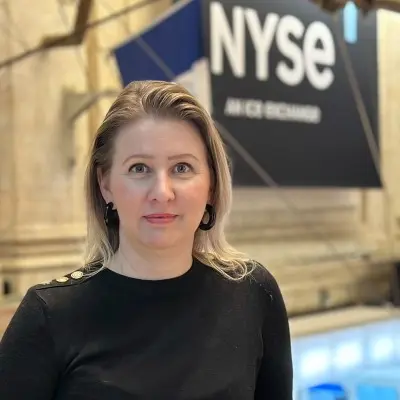
>> Welcome back to theCUBE Studio here at the New York Stock Exchange. This is Mixture of Experts, part of our NYSE Wired programming. And joining me now is a woman fresh off the plane from London and off a 41 million Series B, Shelley Copsey, CEO and co-founder of FYLD. Welcome, Shelley.
Shelley Copsey
>> Thank you. Thank you for having me.
Gemma Allen
>> So you have been on quite the journey since 2020. The world was falling apart and you got an exceptional idea, I would say, to found a company, FYLD, which has gone on to do very, very well in quite a short space of time. Take me on that journey.
Shelley Copsey
>> Yeah. So 2020, we just did a small project and we were looking at technological changes. We were looking at FYLD working in the infrastructure sector and thinking there had to be a better way than pen and paper. But as you say, it was COVID. So we had this really cool little product idea, but really hard to get off the ground in those early days. People in our industry were out. The water pipes had to run, the roads had to work. They didn't really have time to look at what we were doing. But fast-forward two, three years, we got those early adopters. We got the case studies. We all know what happened when ChatGPT hit the enterprise and the business has just boomed across the last two years.
Gemma Allen
>> Wow. And what is your own background, Shelley? Have you always been working in the field yourself? Are you in the energy space? Utilities? Where have you grown up per se?
Shelley Copsey
>> Yeah, I spent most of my career consulting into the infrastructure sector, but actually more at the back office end. So I was doing mergers, acquisitions. I was seeing these infrastructure companies talk about all the problems they had, liabilities, balance sheet, struggles, insurance, because things didn't go right in the field. I then just did a bit of a stint working in data digital at Australia's National Science Agency because I began to see the opportunity of technology in my home of infrastructure, put the two together and that's where my career has gone.
Gemma Allen
>> And it's extraordinary really when you think about how mundane and administrative some of these processes are for field workers, right? For construction workers, energy workers, utility workers. A lot of it was, up until very recently, a lot of paperwork at the end of a day in a week, right?
Shelley Copsey
>> Yeah.
Gemma Allen
>> So the, I guess, opportunity to automate that, you would imagine could have happened 10 years ago, but didn't. Talk to me a little bit about how it's fascinating to listen to folks like you come on and really explain how AI has suddenly become this magic wand for so many industries. What fundamentally shifted? Is it visualization? Is it data analytics? Is it prediction? Is it cleaner data? What's really changing under the hood?
Shelley Copsey
>> To my mind, a couple of things. Firstly, I think there's just been the transformation of how we build technology. So we're no longer building for the back office and pushing it to the field. There's been this transformation of who is our user. And so I think the first thing is a lot of us technologists, we got out the office and we got in the field and we understood the field worker's day better. That lets you reimagine how you build technology for them. I think the next thing is like video, photos, unstructured data. If you go back 10, 15 years when we first tried to digitize the field, we're still asking them to fill out forms, not pen and paper, but digital forms. Whereas now, the ability to take things like videos, pictures, gain insight and make their lives simpler, those technologies have really changed the game for our industry.
Gemma Allen
>> So talk me to, I am a FYLD customer and I am using your technology right now. What does my day look like? Is it an app? Is it something that people ... You see forum and all the time, but iPads? Talk me through it. Make it real for me.
Shelley Copsey
>> Simple. So let's like look at two things, the person in the field, but then the remote manager, right? The person in the field, app deployed, they take 60 to 90 second videos. They might do this three, four, five times a day. Very simply, they tell us about what's going on, the environment they're working in, the work they're going to conduct and safety hazards. We use that information in real time, coupled with a very large proprietary data set of what it takes to get a job done in the field to make their life simple. Recommendations, filling out paperwork for them automatically, helping them secure sites. If their day might have some heavy lifting operations and we know there's going to be wins coming through in the afternoon, we might suggest do your heavy lifting operations now. We just make their life dead simple. If I now though go to the remote command center, people in those command centers, each person might be running 10, 15, 20 crews in the field. When you go there before FYLD, their phone's running hot, they're WhatsApping, they're using technology, but not enterprise fit technology and therefore they don't really know who to prioritize. All of a sudden with FYLD, we're using AI over all of this data coming in. And remember, these organizations might send out 10,000, 20,000 crews. We help them understand which jobs should I focus on? How do I proactively manage my day's operations instead of sampling jobs, instead of driving site to site to site? We've just given them the insight that those of us that have been in banking, marketing, et cetera, have had for years.
Gemma Allen
>> So it's a mix of, I guess, intervention from the perspective of safety and even cost perspective.
Shelley Copsey
>> Yep, schedule.
Gemma Allen
>> And predictive analytics and predictive visualization around what's possible, right?
Shelley Copsey
>> Yes.
Gemma Allen
>> So I read that your customers say they save an average of about $1 million a year. Is that correct?
Shelley Copsey
>> Some of them get way more than that. So if you just think, going back to what you said, like how long does the paperwork take? Lots of these field workers will spend an hour to two hours of their day doing paperwork. If you can get that capacity back into your field operations, millions and millions begin to get saved. If you sometimes think about a big cement pool when they're building a road, that can be half a million dollars worth of cement, do it incorrectly and the cost is huge. So the customer's ROI is significant.
Gemma Allen
>> So in terms of the tech stack, like the integration, this is the plug and play technology. Is it SaaS? Is it licensed? Is it seat based? Talk me through the, I guess, specifics of this.
Shelley Copsey
>> Yeah. So the landscape in our industry is complex, right? A lot of very legacy systems. It's really important to us that plug and play just works. So customers can either integrate into their scheduling system and assets systems or they can on day one just use it standalone because often the technology teams have got a lot of a backlog to work with. That's really important. And then it's a kind of SaaS style model. We're really focused on return to the customer. And when we're looking at pricing, we're always making sure that they're getting 7x, 8x ROI instantly, and 12x, 15x as they begin to be a longer term and larger customer.
Gemma Allen
>> I'm very interested in your point around unstructured data because it's been such a challenge for such a long time. And there is suddenly epiphany that this is all solvable, right? But there are still a lot of challenges in the space, and I don't think that we have that magic wand just yet.
Shelley Copsey
>> No.
Gemma Allen
>> I'd love to know what you're seeing in terms of computer visualization, how these two things are mapping together, where you think there's still opportunity for improvements. Talk to me a little bit on the technical side of this for a second.
Shelley Copsey
>> So when people say that AI solves problems in industrial environments, these are really complex environments. We had a customer recently when they turned on field mining environment, right? The visualization, put aside AI, they're like, "I can see everything going on." And then they said to us, "If you could tell us the sites that are messy, I would know where to intervene because people get hurt, they don't finish production for the day, they have cost blowouts."
And if you just think about this, anybody that's not trained in industrial environments would think virtually every work site in our industry is messy, but they're not. They're just complex machinery, the spillage and piling. And so for us, when you think about computer vision, what we need to keep doing is training these models in complex environments to understand when is there a problem, when is there not. You need large data sets to do this. And again, one of the struggles in this industry, you can't go to the normal providers of data and buy it, right? So there's actually, I think, are going to be a three to five year period where we're beginning to collect enough data across the industry as a whole, figure out how we make it available to each other, because people are prizing and keeping this data to themselves, right? But that's when I think we're going to begin to see even further leaps and balance in this industry and what's possible.
Gemma Allen
>> And from the context model perspective, is that context coming organically to every feed you receive? Are these models training themselves from the perspective of context? Or do you have humans who are looking at these videos and are training these models? How does that side of it work?
Shelley Copsey
>> Yeah, so there's a little bit of both actually. These environments can be incredibly dangerous and these are humans that we're putting into the environments. So human in the loop and verifying what goes on with our algorithms is incredibly important and we do spend time doing that. I think that, that is going to be something that will sustain for a number of years. You just have to be careful when you're putting humans to work in dangerous environments. But at the same time, one of the things that you can do as well is if people are filming and they're telling you about the environment, you can begin to step away from a world of paying people to tag your data, et cetera, and you can get real time tagging going on using technology. So again, I think that at the moment, we're at a point in time where you can think very differently about how you get value from data very quickly. But the other thing we talk to our customers about is if they capture more data now, there are problems that we don't know how to solve today, but go on the two, three year journey, begin to capture the data, and then you're at a head start as technology continues to advance.
Gemma Allen
>> Wow, it's so interesting. So Shelley, one thing I love about your story, this is a very male dominated field. You're a female founder, based in the UK, have raised money somewhat globally, Australian. So you really are like a bit of a quagmire in a great way, right?
Shelley Copsey
>> Yes.
Gemma Allen
>> Talk to me a little bit about your own personal journey from the perspective of becoming a founder and CEO in a male dominated industry, and especially raising money. I'd love to understand a little bit more about that.
Shelley Copsey
>> Yeah. The industry is really male dominated. You can't get away from it. But what I do think is you're working with engineers and problem solvers, right? Like every time you go out in the field, they're using ingenuity to solve hard problems, right? It's not a script. You can't just rinse, repeat all the time. And therefore, I think a lot of the people in the industry are very open to new perspectives. So as long as you're coming into a room, you've got a perspective and you're willing to share it and it's grounded in like knowledge, they're willing to listen to you. So even though I often find myself in rooms that are full of men, I don't tend to find I'm at a disadvantage in that way. And actually, I bring something different to the room because in our industry it's not highly ... It hasn't had a lot of technological change in terms of software yet, right? So I bring something different. And I think it's always important to like acknowledge what is your special source or what have you in the room and be loud and proud about it, but then also just acknowledge what their special superpower is and how do you bring the two together. And that's always been my approach. I think I've been incredibly fortunate with the investors that I've found, but again, there's a reason that they've chosen to back me and that's they've seen my pedigree. I've had to learn, perhaps it didn't always come naturally to me to be as loud and proud about it as I am today, but I've learnt that, that if I'm going to compete for money, which is what you're doing as a founder, if I'm going to compete to get the best money from the brightest people that will help me let this company explode, I have to be willing to back myself and talk about my achievements.
Gemma Allen
>> And so I have to ask you, as a female journalist as well, myself, I write a lot about females in tech. What did you learn about switching that button on that might not necessarily be on all the time? The more bullish, proud, I guess I think women carry a lot of humility naturally sometimes and it can be somewhat of a hindrance.
Shelley Copsey
>> Yes.
Gemma Allen
>> How did you overcome that?
Shelley Copsey
>> Yeah. I really think back to my late 20s, early 30s, I was in consulting, I was passed over for a promotion. I was told that you don't have the gravitas, which you usually meant that you're not allowed.
Gemma Allen
>> .
Shelley Copsey
>> Yeah, right.
Gemma Allen
>> I've gotten that exactly. Right.
Shelley Copsey
>> Yeah. And so I never wanted to emulate the male gravitas that they were referring to, but what I did recognize was I needed to find my voice in the room. So I very deliberately went through a five-year period of over-preparing for every meeting. I would have five talking points and I knew in the first week, if I could get one of them in, it was a step forward if I could get two. And I think if you practice, it's like a muscle, isn't it?
Gemma Allen
>> Yeah.
Shelley Copsey
>> You get better and now I don't have to think about it, but I very consciously went on a journey of saying, "I've got to find my voice." Like being smart in the work I do isn't enough if I can't convey a message effectively.
Gemma Allen
>> So I love that. I love how tactical it is too, and there's a humility in admitting that, right? Because some people don't want to admit that they need to over-prepare or that they feel they should, right? Because there's almost like, "No, I'm already worthy of this, but it is a reality for so many men and women."
Shelley Copsey
>> It is.
Gemma Allen
>> Right? It's something you have to train yourself to do.
Shelley Copsey
>> Oh, definitely. No sports person says they're elite in their field and I don't have to practice. If we want to be elite in our roles, practice.
Gemma Allen
>> Love that. Okay. Talk to me about the raising. So your first cap table had some very interesting and impressive investors, you had BCG on there.
Shelley Copsey
>> Yep.
Gemma Allen
>> Second round, talk me through that process a little bit. So you raised one round in 2023.
Shelley Copsey
>> Yes.
Gemma Allen
>> And then another round just recently that closed very fast, right?
Shelley Copsey
>> I did. Yeah. So the prior round led by Ontario Teachers Pension Plan, one of the world's biggest infrastructure investors, amazing. They know the areas we work in and the problems. Boston Consulting Group, again, it's a dream investor. Most people could only hope to have that. But we also got one of the UK's biggest gas networks in Scotia Gas Networks, six and a half million customers. We had subject matter expertise during the Series A journey that could help us grow and understand the problems at debt, but patient capital. First half of last year, the inbounding into our company by investors, off the tables. I couldn't believe how much we were getting. We did decide in October to test the waters about how serious that interest was. We saw immense interest. We hit go, I don't know, early November or so into exclusivity by mid-December with the energy impact partners who have backed us and we closed in early January. So amazingly short period. And then second close when we brought in Partech, one of Europe's biggest growth funds. So we feel, again, fortunate, but well-earned to have such amazing investors.
Gemma Allen
>> Okay. So it's March 2026. It's almost April. You've just raised this money. What's ahead for you and your team for the next 12 months?
Shelley Copsey
>> The US is a massive focus, being why I'm here at the moment. The UK market, like we deployed to 12 of the 18 water companies. We're a known name over there. The US market, we've actually got a good five, eight customers over here already, probably a few more actually, but I feel like we're still a little nascent, right? In this size of market, that's not huge.
Gemma Allen
>> Yeah, it's such a huge market for you. My gosh.
Shelley Copsey
>> Exactly. And you look at the lead line replacements going on, you look at the story of the crumbling infrastructure, et cetera, not enough public funds to keep it up urbanization. This market will be massive for us, so it's a huge focus for me this year.
Gemma Allen
>> Are you going after data center builds?
Shelley Copsey
>> Yeah, data center builds, you can't stay away from what we do, particularly like some of them are building their own utilities to get power, water, because there's so much problem getting it from the grid. I think also for us, the environment it causes, there's even more drive for field workers and everybody's already talking about the labor scarcity of field workers, right? So again, the pull for our type of product, which lets more work get done with the resources that are limited, we think the world is our oyster over here.
Gemma Allen
>> Well, so, let's end on that. The world is your oyster. I certainly hope so. Wish you guys all the best in this US growth. Thanks so much for coming on theCUBE.
Shelley Copsey
>> Thanks for having me.
Gemma Allen
>> I'm Gemma Allen here at theCUBE Studio at the New York Stock Exchange. This is Mixture of Experts, part of our NYSE Wired programming. Thanks so much for watching.











































 Gemma Allen