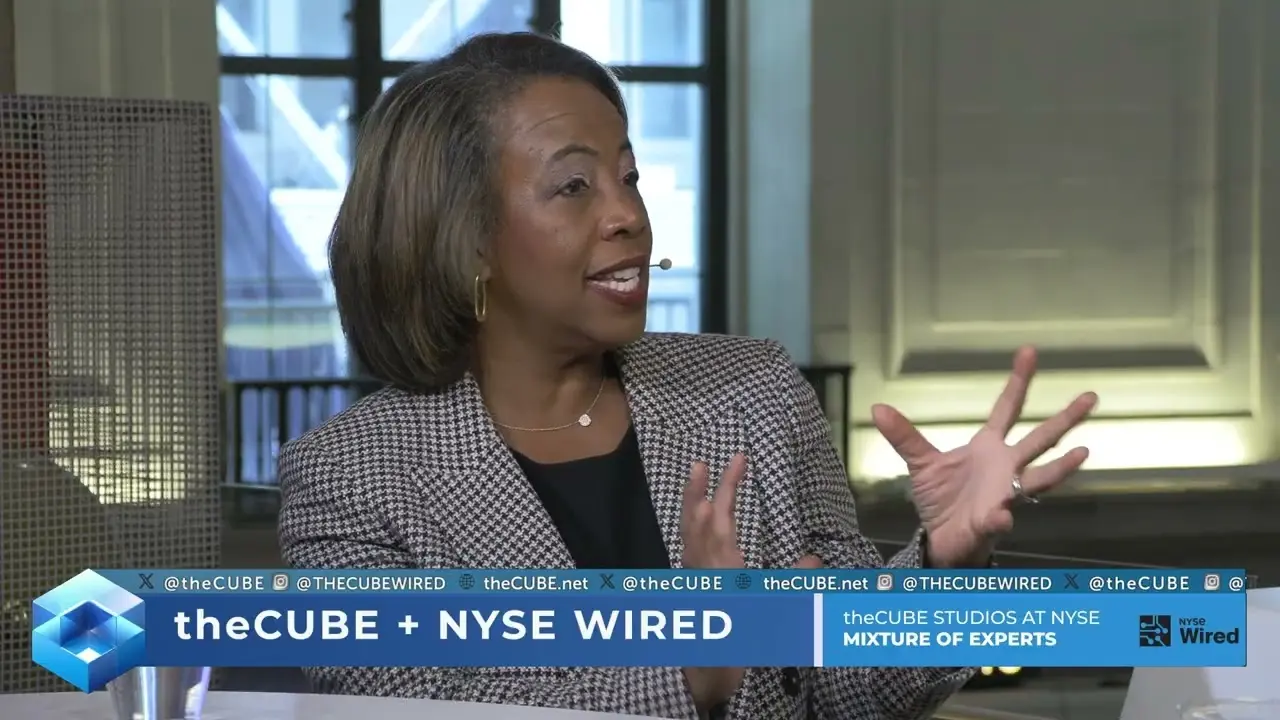
In this interview from theCUBE + NYSE Wired: Mixture of Experts, Chantel Jeffries, DJ and founder of Vizn Ventures, joins Alicia Quinn, content creator, to talk with theCUBE + NYSE Wired's Gemma Allen about how creators are navigating AI's promise and risks while building businesses beyond the attention economy. Jeffries frames AI as a productivity multiplier for creators — streamlining video editing, business planning, and day-to-day logistics — while drawing a direct parallel to how the internet once transformed the nature of work. She raises urgent concerns about deepfakes and unauthorized image use, noting that she has dealt with impersonators and image theft for over a decade. Both guests argue that existing public and private figure laws have failed to keep pace with an era in which anyone can become a public figure by simply downloading an app.
The conversation also explores the attention economy in depth, with Jeffries reflecting on the deliberate trade-off between visibility and privacy after years of navigating stalkers and impersonators. Quinn highlights the importance of community depth over audience size, particularly when evaluating brand partnerships. The discussion then pivots to Jeffries' evolution into venture investing through Vizn Ventures, where she applies product intuition — built through years of evaluating consumer goods as a creator — to back passionate founders in markets she knows well. She details early investments in Poppi, which sold to PepsiCo for approximately $2 billion, and Cymbiotika, describing a hands-on approach that includes advising, making connections, and DJing portfolio company events. For aspiring female investors held back by unfamiliarity with term sheets, she points to AI as a practical equalizer and advocates for asking questions without hesitation. From dismantling generational skepticism around influencer expertise to hinting at her own founding ambitions, Jeffries outlines a model where creative credibility and investment acumen reinforce each other.
Forgot Password
Almost there!
We just sent you a verification email. Please verify your account to gain access to
theCUBE + NYSE Wired: Mixture of Experts Series. If you don’t think you received an email check your
spam folder.
Sign in to theCUBE + NYSE Wired: Mixture of Experts Series.
In order to sign in, enter the email address you used to registered for the event. Once completed, you will receive an email with a verification link. Open this link to automatically sign into the site.
Register For theCUBE + NYSE Wired: Mixture of Experts Series
Please fill out the information below. You will recieve an email with a verification link confirming your registration. Click the link to automatically sign into the site.
You’re almost there!
We just sent you a verification email. Please click the verification button in the email. Once your email address is verified, you will have full access to all event content for theCUBE + NYSE Wired: Mixture of Experts Series.
I want my badge and interests to be visible to all attendees.
Checking this box will display your presense on the attendees list, view your profile and allow other attendees to contact you via 1-1 chat. Read the Privacy Policy. At any time, you can choose to disable this preference.
Select your Interests!
add
Upload your photo
Uploading..
OR
Connect via Twitter
Connect via Linkedin
EDIT PASSWORD
Share
Forgot Password
Almost there!
We just sent you a verification email. Please verify your account to gain access to
theCUBE + NYSE Wired: Mixture of Experts Series. If you don’t think you received an email check your
spam folder.
Sign in to theCUBE + NYSE Wired: Mixture of Experts Series.
In order to sign in, enter the email address you used to registered for the event. Once completed, you will receive an email with a verification link. Open this link to automatically sign into the site.
Sign in to gain access to theCUBE + NYSE Wired: Mixture of Experts Series
Please sign in with LinkedIn to continue to theCUBE + NYSE Wired: Mixture of Experts Series. Signing in with LinkedIn ensures a professional environment.
Are you sure you want to remove access rights for this user?
Details
Manage Access
email address
Community Invitation
Chantel Jeffries, Vizn Ventures
In this theCUBE + NYSE Wired: Mixture of Experts segment from the New York Stock Exchange, theCUBE’s John Furrier sits down with Raj Verma, CEO of SingleStore, to unpack how the intersection of technology and finance is shaping enterprise strategy. Verma shares why SingleStore is “on course” for the public markets, reflects on brand-building through the company’s partnership with golf Hall of Famer Padraig Harrington and connects that ethos to how SingleStore helps organizations fix struggling data “swings.” The discussion zeroes in on what’s next as Wall Street watches the AI infrastructure buildout: after chips and systems, the software and data layers set the pace for value creation.
Verma outlines why enterprises must modernize “brown” data estates into “green” ones to safely bring corporate context, governance and compliance into LLM workflows via RAG – and why commoditized data-at-rest puts the advantage at the query layer that unifies data in motion with data at rest. He predicts agentic AI will gain reasoning capabilities in roughly 18 months, cites industry indicators like Google reporting ~25% of its software now built by AI and argues that high switching costs will give way to disruption as buyers reassess legacy vendors. The conversation closes with concrete momentum: ~33% YoY growth, ARR in the ~$135M range, gross dollar retention ~98%, cloud NDR ~130, ~50% of business now in the cloud, landing ~3 new customers per day, a path to cash-flow breakeven in the next two quarters and a teaser for AI-related announcements in the next two months. Listeners will find notable stats, real-world use cases and forward-looking views on how databases power reliable AI at enterprise scale.
Producer; Operations and Sales SupportSiliconANGLE & theCUBE
In this interview from theCUBE + NYSE Wired: Mixture of Experts, Chantel Jeffries, DJ and founder of Vizn Ventures, joins Alicia Quinn, content creator, to talk with theCUBE + NYSE Wired's Gemma Allen about how creators are navigating AI's promise and risks while building businesses beyond the attention economy. Jeffries frames AI as a productivity multiplier for creators — streamlining video editing, business planning, and day-to-day logistics — while drawing a direct parallel to how the internet once transformed the nature of work. She raises urgent concern...Read more
exploreKeep Exploring
How can AI help with daily administrative tasks for content creators, and what risks or precautions should they consider when sharing content online?add
How is the rise of AI affecting creators' ability to control and protect their image, and what legal reforms are needed to prevent misuse?add
Did you set out to be an influencer, and how did your online following lead you to start a makeup company and get involved in investing?add
Yes. Neutral-form question:
"When evaluating investment opportunities, what qualities or factors do you look for in founders, products, and potential investments?"add
In what ways do you participate in or support the companies you invest in beyond providing capital?add
>> Welcome back to theCUBE Studio here at the New York Stock Exchange. This is Mixture of Experts, part of our programming with NYSE Wired, and joining me now are two women who are a master class in the attention economy, Chantel Jeffries, DJ and founder of Vizn Ventures, and Alicia Quinn, content creator. Welcome, ladies.
Alicia Vellante
>> Thank you, Gemma.
Chantel Jeffries
>> Yeah.
Gemma Allen
>> I think this is the first time we've had three women on this-
Alicia Vellante
>> This is the first.
Gemma Allen
>> Yeah, which is, I'm just so excited to share with you two. Right?
Chantel Jeffries
>> I love that. I'm glad to be a part of the first three ladies.
Alicia Vellante
>> Yeah. What a moment.
Gemma Allen
>> So, Chantel, we're going to start with you. This is a very interesting time to be a woman, a time to be a creator, time to be an investor. There is a lot of excitement, a lot of anxiety, and a lot of noise. Right? So AI, what are your thoughts? There's so much uncertainty, excitement, noise, not really a huge amount of signal just yet. Right? What are your thoughts?
Chantel Jeffries
>> I think AI is a very powerful thing. And so, with a lot of power comes a lot of responsibility. I think there's great ways to use AI. And even for me as a creator, I see so many opportunities to help exponentially increase my workflow in the space of, whether that's editing videos, creating content, and things like that, helping just with making business plans and being creative, and all the menial admin tasks that I get done on a day-to-day basis, whether that's scheduling and planning out my events, my outfits, booking glam, and doing all these things. So it's like having something that can help make that workload easier is great. But at the same time, we have to be weary of the fact that anything can happen with AI. When you're a content creator or you're somebody in the public eye putting your image onto the internet, you're feeding the AI with things that can then create deepfakes or whether that's use your image to promote products. I've seen it so much on TikTok and some of these other platforms where there's a video that has all of these celebrities or people. They're endorsing a product, but it's actually not them, because it's just taken their voice and changed what they're saying and things like that to where I think we do need to be cautious. Security issues is another thing we need to be cautious about. So I think just having that frame of mind when going into using it is really important. I try to think, when I'm putting something on the internet, this could be used in a different way and things like that, and more than I have in the past. So that's just something that I'm wary of, but I do think it's a really exciting time in the AI space.
Alicia Vellante
>> Definitely. Sorry. And I think that especially being in this creative space, it's really important, and I hear so much discourse surrounding how do we use AI to make our jobs and our lives easier, as you were describing, versus not replicating or actually replacing individuals in those creative spaces.
Chantel Jeffries
>> Yeah. I think everyone is scared of saying, "Oh, AI is going to replace..." But I think that you have to kind of look at it in the same way as the internet. When the internet came, it's like, there were so many jobs where you're writing by hand. You're filling out things. It's like, it just takes so much more time. But then when the internet came, and now it was like, "Okay. It's so much easier to send an email than wait to write a letter and wait for it to come." Things like that to where it's looking at it as a tool. And at the end of the day, we are the humans. We're creative, and the creation that we have and the creative energy that we have, that comes from our personal experiences that happen with us being human. So I think that that's something that's not going to change.
Alicia Vellante
>> Yeah.
Gemma Allen
>> When we think about the evolution of the internet, especially as it relates to women, and some of the ways in which the internet was obviously fantastic for women, but also a little scary, if we think about the beauty industry, for example, or some of these apps that were made without really any female input. Uber is a perfect example. Right? If a female product engineer had been involved in Uber 10 years ago, maybe there would have been an alert button or an SOS function much, much sooner.
Alicia Vellante
>> Right.
Gemma Allen
>> And when we think about AI right now, there's certainly reason to believe that the speed is really leading everything, and some of the ways in which it could impact young women, like deepfakes, we see a lot of horror stories around what that could entail, isn't really accounted for, at least not yet. What are your thoughts on that as creators? Does that concern you guys? Even the idea that people could rob your images, which is part of your bread and butter.
Chantel Jeffries
>> Well, I think what's exciting about the AI space is there are a lot of women involved, and that's something that I've noticed because of the time that we're in. It's kind of like a turning point where I've seen that people have exponentially grown a business in the AI space to billion-dollar businesses so fast. And so, I think that's exciting. But when it comes to saying, "This is my image, and how am I going to protect that as a creator or as somebody in the public eye?" That's something I've had to deal with for over a decade. I've had people using my image for clicks and make a story up so that they can make money and it's monetized, and with no regard to the truth in a lot of cases. So that's something that I've just dealt with, but to see that your image can be used to sell products without your knowledge or make different types of photos and video content without your knowledge. I think that we're going to really have to make some big changes in the laws in the space. We haven't seen changes in these laws. Everyone's kind of a public figure now versus 10 to 12 years ago. That wasn't the case. You were not a public figure just because of anything. You had to make an effort to be a public figure, and that was kind of just celebrities. There's celebrities and politics. There wasn't really that middle ground of people that's like, "Are you a public figure? Are you a private figure?"
And now, people are treated like they're all public figures, but there's different laws for public and private figures. So I think that's something that we need reform in that space, especially with the growing of AI. Yeah. It's just something that I try to keep in the back of my mind and I'm wary of, but I also try to get ahead of. If I see people using my image, I keep on top of that, but that's something that an average, everyday person, how are they going to be doing that? So it's something that we need to be aware of moving forward.
Alicia Vellante
>> Definitely. Yeah. When you said getting ahead of it, because that is something that scares me too, but there are AI tools out now that will actually scan, find other accounts using your likeness, and they give you the option to take it down. So that's been really useful in that space as well.
Gemma Allen
>> Wow. So in terms of the creative industry broadly, and you say something really interesting there. Right? Everyone is kind of a public figure now, or can be. You can become a public figure by downloading TikTok or whatever it is to your phone. Right? But the attention economy is a very interesting phenomenon. It's happened, in some respects, quite quickly, and you're right actually, Chantel, too. There is a lot of women who have done a great job at capitalizing on this and, like, "Great. Thank fucking God. That's great to see." But what are your thoughts on some of the questions that kind of float around the attention economy broadly from the perspective of, is this an actual asset class? Does it have longevity? How do you guys think about that?
Chantel Jeffries
>> Well, I think we've seen in just the press and media for decades and decades, that is what a lot of these publications are run on, especially in the entertainment space, is attention. So what do they do? They write catchy headlines and clickbait type of titles to get more clicks and garner more attention, because that turns into monetary value. So I think over the past 12 years, we've seen how attention is equal to monetary value, and that's something that we didn't really understand before on a personal level. We understood that for big celebrities, and obviously, news and media outlets have understood that. But as a normal, everyday person, that wasn't something that we really understood, because there wasn't really a way to monetize it in the same way that there is now. So I think it's just finding the balance between attention and privacy, and that's something that I've taken a step back from... I still want to produce content and be forward-facing, but at the same time, keeping a lot of my personal details just private, because I've had some situations, and I've had stalkers and different things like this. I've had people thinking they're speaking to me, but it's actually someone using my image, and I've had just some very scary and complex situations, and this has happened. I mean, the first time it happened to me was over 10 years ago. So I've kind of seen this from the very beginning as one of the first people in this space, one of the first people working with brands and turning, "Okay. There's all these people following me. How are we turning that into a monetary value? How are we turning that into a serious career at the end of the day?" So I've seen the upside, the downside, the whole thing.
Alicia Vellante
>> Absolutely.
Gemma Allen
>> I mean, I think the attention economy broadly is so interesting too from the perspective of keeping audience. Right? Even as a media outlet, we have seen how attention spans are shifting all the time.
Alicia Vellante
>> They're dwindling, obviously.
Gemma Allen
>> Exactly. Right? What was long form five years ago is very much extremely long form now. Short form used to be 20 minutes. Now it's 60 seconds. The attention economy is waning, or the attention span of humans seems to be waning quite rapidly. How do you guys think about continuing to build audience? Are audiences changing all the time? Do you need to think about new tactics all the time?
Chantel Jeffries
>> I think we deal with rubber band effects. Things go in and out. And I think as things get shorter and shorter and people start to realize the effect that that has, they make a conscious effort to go the other direction. I mean, I spend a lot of time just reading and just keeping myself focused on something. I put my phone down so many times throughout the day. I lose it 10 times a day in my house, because I'm like, "Put the phone down," and I get into the task I'm doing. And I think as we move forward, we're going to see just a big increase of just people playing sports and doing gamified things where they're like, "Okay. I'm actually in a flow state, focused. I'm not doing anything else. And for a certain period of time, I'm focused on this one thing." So I think that people are going to start to make a conscious effort, because we're just humans. We adapt. So if you start to do shorter and shorter and shorter, that's how your brain is going to adapt. It wants to be able to get as much information as it can, because at the end of the day, our brains are wired for survival. And if it thinks that that's how you are surviving, is making sure you get every information that you see, get it all, see it all, that's how our brain is going to adapt. You have to take a conscious effort to make yourself go the other direction. So I just think people are starting to do that, and they're starting to realize that.
Alicia Vellante
>> I think you touched on something really important too, which is knowing your audience, not in terms of growing it necessarily, but the audience you already have cultivated. We're always talking about building community. I think it's really important to be cognizant of who your audience is and what you represent to them, especially with things like brand deals. So I think that's really important as well to consider.
Gemma Allen
>> Yeah.
Chantel Jeffries
>> Yeah. At the end of the day, you want to add value to the people in your community's lives. And so, I think that, yeah, you can scroll all day, but what value are you taking from that? What knowledge are you taking from that to be able to make decisions in the world and feel that you're informed?
Alicia Vellante
>> Right.
Chantel Jeffries
>> And so, I try to inform people in certain spaces that I'm in, but at the same time, I've become more of a private person over the years, just because I genuinely am all day researching and speaking to people about my investments, because that's generally what it's taken off and then I'm also interested in. So I find that that's just taken a back seat to the thing... Before, I used to produce a lot of content, make a lot of YouTube videos, ask people, like, "What is it that you want to see?" and things like that, and that's just something that's taken a back seat for me just with what I've been doing and things like that.
Gemma Allen
>> I really want to talk to you about your investment. So first, I want to ask you guys both an interesting question. Right? I have noticed, as a 41-year-old woman, that there is definitely somewhat of a generational shift in how people think about the world of an influencer, especially as a marketing tool, as a mechanism for reaching audience. I have certainly seen situations whereby people of a certain generation might roll their eyes at the idea of it. Right? But at the same time, it is generating so much traffic, so much activity. It's what ads and commercials were like in the '60s and '70s. Right? There is no denying that. What are your thoughts on that peripheral skepticism that sometimes still exists around the space? Do you guys feel it? Have you felt it in the time you've been building your own brands?
Chantel Jeffries
>> I mean, I personally think that when it comes to influencing, I never thought that I was an influencer. I never was trying to be an influencer. I was going to art school at the time. I was also modeling and going into my career, which I was always planning to go as an actor. That's what I was studying in school. And at the time, it just kind of like was building a following online. I wasn't trying to do that. I was just going about my life, like posting photos, going to college, not really thinking much of it, because there wasn't really any way to necessarily monetize it. At the time, that was anything that people were doing. So for me, I had a plan, like, "Oh, I'm going to school. I'm going to be an actor." Then what happened was I started DJing, and at the same time, brands were reaching out. And once I had done a few things with brands, I was like, "Oh, I want to make my own company. I want to make my own makeup line." So I feel like I've always done my own thing. I've never only been an influencer per se, but at the same time, I think that people in that space also take a lot of... The way that there was critics and all of these people. I think if you're a really good vegan influencer, you're taking in a lot of data. You're processing it, and you're seeing what is the best. And if you're taking it serious and you're actually doing that, I mean, I think people have great opinions in that space, and it's really useful to drive traffic. Not just to drive traffic, but actually give a valid opinion of someone who's seen a lot of data in that space. So for me, that's actually one of the ways that I got into investing, was because when people are sending me products, yeah, I've tried every single makeup product on the market. Yeah, I've tried every single hair product on the market. Yeah, I've tried every single skincare on the market. Yeah, I'm getting sent things left and right. I'm trying way more than the average person, and I also value my opinion. So then on top of that, I'm like, "Okay. Yeah." I can make quick decisions, because I'm like, "Yeah. This lip gloss is good or it's not. This skincare product is good or it's not. This new gadget, I've seen a hundred things like this or I haven't." And so, I think that people in that space actually do hold more data than just the average person. Yeah.
Gemma Allen
>> I love that.
Alicia Vellante
>> Yeah. That makes a lot of sense as a natural segue into your investing. So as a woman, from that investment perspective, what are things you look for?
Chantel Jeffries
>> Well, number one, an excited founder, someone who's passionate about what it is that they do. And over the years, meeting thousands and thousands of people, you kind of like create archetypes in your mind of like, "Okay. This type of person goes out and gets this done," or "This type of person is very creative in this space." So you kind of start to build patterns and recognize them to say, "Oh, yeah. I can see this being successful in that type of sector that it's in."
So that's one thing that I look at. I obviously think about all of the products. And if it's a space that I've dealt with a lot of products, then I think, "Okay. Is this a superior product?" because there's things that succeed that are not a superior product, but I just don't really want to be a part of it necessarily. It's just not for me. I want to stand behind the things that I'm invested in. I want to use them every day, and I want to feel confident in sharing them with others. So I'm looking for great products, great founders, and people that I can collaborate with on ideas, because I advise for a lot of the companies that I am invested in. So sometimes there's things that I've had an idea for that I didn't have the time to execute, and I'm like, "Oh, great. You're working on that. I would love to be a part of that." I can invest. I can advise. I can make connections and things like that.
Gemma Allen
>> For the viewers and listeners, give us some examples. I know you mentioned Oura, Poppi, Lolli. Give us some thoughts on some of the big, high-profile investments you've made and how those came to be.
Chantel Jeffries
>> Yeah. So Poppi was actually my first startup investment. I had been investing in some other stuff, whether that's crypto, stock, and things like that, real estate. But with VC, that was my first startup investment, and I loved the product immediately. That was the first thing. I actually was sent the product to try from one of my other VC friends. He's like, "Oh, I'm going to invest in this company. I want you to try the product. Give me all your thoughts," which he would do often, and he was also encouraging me since 2017 to get into investing in startups. So he sent it over. I loved the product. I'm like, "Oh my God, I love this product." He's like, "You should think about investing in it. You love it." And I'm like, "I would love to invest." This is something that not only do I love the branding, it's super fun. I love the product. And then meeting the founders, I was like, "Oh, wow." I clicked with them. I can see their vision. I can see the path that they're going to take. And so, we worked together on a lot of stuff, and we did events. I DJed for them. We did press stuff, and we did posts, and we did all sorts of stuff working together, and they sold to Pepsi last year for about 2 billion. So that was a great experience of a whole run of investing from an earlier stage, working through the whole course of it, getting them, saying, "Oh, you guys should sponsor this party. Oh, here, let me connect you with these people to do this event." And kind of just anything that could come to mind, because I really loved the product, and I just was really integrated into it. So that's been a great journey, and that's continuing. Like I said, tomorrow, I'm going back to LA to DJ for Cymbiotika, which is another company that I invested in. They're doing a launch event into all the Ultas. So that's super exciting and fun. So going to do that. Yeah. There's so many fun companies. I love to be a part of it all. It's all things that I love to use and integrate in my life and share with friends.
Alicia Vellante
>> You get to be on the investor side and the creative side. That's so cool. Yeah.
Chantel Jeffries
>> Yes. Yes. I love to do it all.
Alicia Vellante
>> Yeah.
Chantel Jeffries
>> I'm very much a well-rounded person that I like to go around. I think you learn a little bit about everything else you do from doing something else. So that's kind of been my experience.
Gemma Allen
>> It's also a really interesting take on an active investor, because you're offering your own brand to the runs. It's very clever.
Chantel Jeffries
>> Yeah. It's a collaboration, the same way that-
Gemma Allen
>> Yeah. It's so fortuitous. Right?
Chantel Jeffries
>> Yeah. I think it's the perfect collaboration, I think.
Gemma Allen
>> For sure.
Chantel Jeffries
>> Yeah.
Gemma Allen
>> So I write a lot about female investing for Forbes, and one thing I hear all the time is a lot of women are scared to invest, because they don't know how to read term sheets. They don't really know what they're looking for when deals are being due diligence. Right? They don't know how to assess some of the commercial elements of these deals, and then they have a little bit of inertia, and they're like, "Ugh," even if they love the product. I remember Ashley Graham had a wine brand, and a number of women, I was at an event, were really interested, thought, "It tastes really good." And they were like, "But I don't really know anything about how to do the math on this."
Chantel Jeffries
>> Yeah.
Gemma Allen
>> What are your thoughts on that whole, I guess, social conditioning that sadly seems to prevail?
Chantel Jeffries
>> I mean, I have always thought... From a young age, I was like, "Oh, anything academic-wise, there's no difference." For me, I was a mathlete growing up, and I graduated when I was 16. So I actually had to go, when I was in middle school, every day to high school to take classes and then go back to middle school, because I was ahead of everybody else in my school. So I just was like, "I'm smarter." I don't think a guy is smarter than me, and I just never have. And I think, not to say that there aren't people, but that's just the thought process in my head. I've never thought, like, "Oh, I'm a woman. I can't read this deal sheet." I thought I was going to be an investment banker when I was really young just because of the fact that I excelled in mathematics and sciences. I was a mathlete. All my teachers were encouraging me in that direction. So I just kind of always thought that way. But I think nowadays, with AI, that's one of the things that's very useful about AI.
Gemma Allen
>> For sure.
Chantel Jeffries
>> It can help. There's a lot of tools when it comes to reading deals or legal things like that. So I think that we're in a great time when it comes to that stuff, and I think don't be scared. I ask people. I ask questions. If I don't know something, I want to know. So I ask a question, and I think that's something sometimes people are scared to do, because they don't want to seem like they don't know something. I'm like, "What's this mean?" And it could be something so obvious. I'm like, "Well, I think from our conversation, you know that I know about other stuff." I don't feel ashamed to say, "What does this mean?"
Gemma Allen
>> Yeah.
Alicia Vellante
>> You don't really know. Yeah.
Chantel Jeffries
>> So then just asking, and I ask people. I'm picking up the phone and calling people, and if I have a question, "Can you help me? Can you look over this? What do you think about this?" And I like to try to get multiple opinions, because I feel like sometimes I clash. I'm like, "Hmm, interesting."
Alicia Vellante
>> Yeah.
Gemma Allen
>> Yeah.
Chantel Jeffries
>> These two people think something totally different about the same product. Yeah. So just ask questions and use AI when you can. If you don't know, figure it out one way or the other.
Gemma Allen
>> Love it. How about deal flow? How does it come across your desk? Is it mostly to an intimate circle of connections? How do you come across these opportunities? I know you're a high-profile person. Right?
Chantel Jeffries
>> Yeah, yeah, yeah.
Gemma Allen
>> Your life is quite unique, but typically, how does it come about?
Chantel Jeffries
>> There's no typical, because it's all different. I have people come to me with things. Sometimes I outreach. Yeah. I mean, those are the two ways. I also have, obviously, a network of people, but I think, again, they will say, "Oh, I think this makes sense for you." And the same thing that I do. It's like, "Oh, I'll have something in mind," and it's not necessarily a great fit for everyone. I know that's kind of in the space, but maybe there's one or two people in the space. I think just being a DJ, honestly, you cover a lot of ground.
Alicia Vellante
>> Yeah.
Chantel Jeffries
>> You're at a lot of events. You're networking with a lot of people. And I think especially the types of events I DJ, I'm meeting a lot of founders. I'm meeting a lot of other investors and influencers and things like that. So I am always listening, see, talking about investing, and I come across a lot of deals like that.
I think also too, just me getting deals and also sharing them with people. It's like people are always reciprocating in this space, which is something that I've noticed, I think, is a great thing about the VC space. It's always link and build, like, "Let's take a call. Let's see if there's synergy. Let's check. Oh, I did this. Oh, I did this. Let me intro you. I'll intro you." It's a great crossover. Yeah. Anyway, it could literally be anything.
Gemma Allen
>> I love that, link and build.
Chantel Jeffries
>> I'm always on the lookout. Right.
Gemma Allen
>> So, Chantel, what's ahead? What does the next 12 months look like for you? I'm sure it's exciting and cool.
Chantel Jeffries
>> Yeah. I mean, again, still keeping up with the situation I have going, which is DJing a bunch of different things, investing in a lot of really cool stuff, and advising on those companies. Maybe the founder in that space is coming soon. We'll see.
Alicia Vellante
>> Okay.
Gemma Allen
>> Wow.
Chantel Jeffries
>> I would love to put all my creativity into my own thing.
Gemma Allen
>> Wow.
Chantel Jeffries
>> So I don't want to give away too much, but-
Alicia Vellante
>> Look out for it.
Chantel Jeffries
>> ... I feel like that's the next phase for me. Yeah.
Gemma Allen
>> Well, love having you on theCUBE. I wish we could clone you, maybe turn you into a drink that little girls can just drink and have the confidence and ambition you bring. It's so great. It's so refreshing, honestly.
Chantel Jeffries
>> Oh, thank you.
Gemma Allen
>> So thanks so much for joining us.
Chantel Jeffries
>> Thank you. Of course. Thank you so much for having me.
Gemma Allen
>> Hopefully, we'll see one of your sets-
Chantel Jeffries
>> It's so fun.
Gemma Allen
>> ... this year as well.
Chantel Jeffries
>> Yes. Yes.
Alicia Vellante
>> Absolutely.
Chantel Jeffries
>> I'm sure I'll be back soon.
Gemma Allen
>> Thanks so much.
Chantel Jeffries
>> Thank you.
Gemma Allen
>> I'm Gemma Allen here at theCUBE Studio at the New York Stock Exchange. This is Mixture of Experts, part of our programming with NYSE Wired. Thanks so much for watching.