We just sent you a verification email. Please verify your account to gain access to
theCUBE + NYSE Wired: Mixture of Experts Series. If you don’t think you received an email check your
spam folder.
Sign in to theCUBE + NYSE Wired: Mixture of Experts Series.
In order to sign in, enter the email address you used to registered for the event. Once completed, you will receive an email with a verification link. Open this link to automatically sign into the site.
Register For theCUBE + NYSE Wired: Mixture of Experts Series
Please fill out the information below. You will recieve an email with a verification link confirming your registration. Click the link to automatically sign into the site.
You’re almost there!
We just sent you a verification email. Please click the verification button in the email. Once your email address is verified, you will have full access to all event content for theCUBE + NYSE Wired: Mixture of Experts Series.
I want my badge and interests to be visible to all attendees.
Checking this box will display your presense on the attendees list, view your profile and allow other attendees to contact you via 1-1 chat. Read the Privacy Policy. At any time, you can choose to disable this preference.
Select your Interests!
add
Upload your photo
Uploading..
OR
Connect via Twitter
Connect via Linkedin
EDIT PASSWORD
Share
Forgot Password
Almost there!
We just sent you a verification email. Please verify your account to gain access to
theCUBE + NYSE Wired: Mixture of Experts Series. If you don’t think you received an email check your
spam folder.
Sign in to theCUBE + NYSE Wired: Mixture of Experts Series.
In order to sign in, enter the email address you used to registered for the event. Once completed, you will receive an email with a verification link. Open this link to automatically sign into the site.
Sign in to gain access to theCUBE + NYSE Wired: Mixture of Experts Series
Please sign in with LinkedIn to continue to theCUBE + NYSE Wired: Mixture of Experts Series. Signing in with LinkedIn ensures a professional environment.
play_circle_outlineNeuBird AI's mission: managing large-scale enterprise infrastructure with AI agents.
replyShare Clip
play_circle_outlineUnified Observability: Integrating Datadog, Dynatrace, Prometheus, Grafana, Elasticsearch with Direct Access to Infrastructure, Databases and Code
replyShare Clip
play_circle_outlinePerformance claims: root cause within five minutes, 94%+ accuracy, 'five five five' guarantee.
replyShare Clip
play_circle_outlineToken-Efficient Agent Context Engine: Outcome-Based Pricing for Cost-Effective Root-Cause Detection
>> Palo Alto Studio Connections, Silicon Valley and Wall Street. I'm John Furrier, co-host of theCUBE here, and Dave Vellante, my co-host.
Gemma Allen
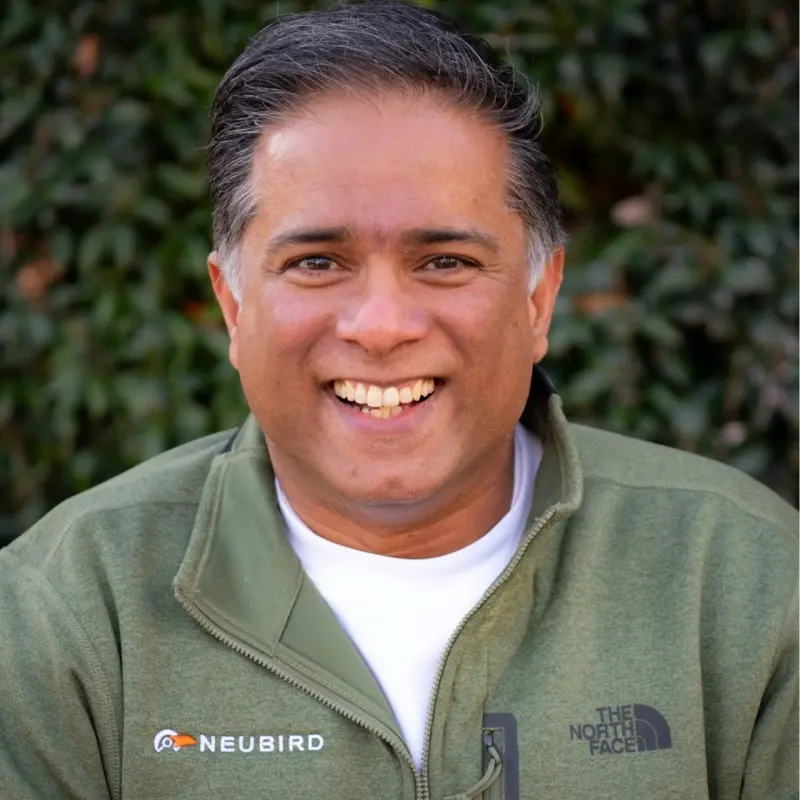
>> Welcome back to theCUBE Studio here. It's New York Stock Exchange. I'm Gemma Allen with NYSE Wired: Mixture of Experts and joining me now for a conversation on how the world of agentic AI meets SRE and DevOps is my next guest, CEO and president of NeuBird AI, Venkat Ramakrishnan. Welcome, Venkat.
Venkat Ramakrishnan
>> Great to be here, Gemma.
Gemma Allen
>> So you're new enough to this company joined in January of this year, but you've had quite the career in tech. Talk to us a little bit about this move for you, why you joined NeuBird AI at this moment and what you're working towards with the team.
Venkat Ramakrishnan
>> Yeah. One of the reasons I joined NeuBird AI is NeuBird is solving one of the toughest problems in enterprise infrastructure. If you really look at the number of systems, the number of compute nodes or the number of VM nodes and the scale of the infrastructure that is being deployed, even in a regular ordinary enterprise is mind blowing. The kind of number of applications, the number of users these applications serve are also continuing to grow and the amount of data they serve is continuing to grow exponentially. So what that means is that a lot of enterprises are betting big on their infrastructure. I mean, we are at the stock exchange and we all know how all of the digital platforms that run as stock exchange to deliver the low latency trades and starting from there to almost any commercial app that's ever built is running on modern high speed infrastructure. And the advent of coding agents where you can actually ship a lot more code into production and a lot faster, this is also causing a lot of churn, a lot of quick changes in the infrastructure that many companies are really finding hard to keep up with. And in all honesty, production has outgrown human understanding. And I looked at the problem, I looked at what the customers I was serving in my previous job was going through in managing large scale infrastructure. I saw what NeuBird has built and the kind of problems it was already solving for customers. I thought it's a great place to come and help scale the business and be part of that modernization and transformation journey for customers as they struggle to keep up with how to manage infrastructure and give a AI platform that can assist them 24/7/365 to really drive down their outages and drive down their downtime significantly.
Gemma Allen
>> So, talk me through the product. I'm an enterprise buyer. I have Splunk or Datadog in place already with OpenTelemetry. What does NeuBird AI do? Is it in addition to that stock? Does it replace parts of the stock? Talk me through how this works.
Venkat Ramakrishnan
>> Yeah. So that's a great question. NeuBird runs on top of the existing telemetry stacks. You could run a Datadog, Dynatrace, even from Prometheus, Grafana, Elasticsearch for logging. So any metrics event logging and tracing stack, NeuBird can run on top of that. It also works very well with hotel based products, which is an open source connector for like driving telemetry into your systems. More importantly, NeuBird can actually go talk to the source. It can interrogate the source of these logs and telemetry as well. So we integrate about a hundred different sources so we can while run on top of the existing observability providers. We can also directly talk to the systems, the servers, the storage, the networking, the we center endpoints, the cloud endpoints, the database and application endpoints. If you give us access, we could even look at the source code of applications and deliver end to end absorbability, corrective actions, recovery and operational automation from application down all the way down to the infrastructure layers.
Gemma Allen
>> And at the moment of anyone incident or anyone intelligible insight, will this technology take action autonomously or will it always involve some level of DevOps human who will have a level of ownership? Where are the parameters?
Venkat Ramakrishnan
>> Yeah. Look, I mean, our goal, what we have built is a fully autonomous AI agent. It can run into the background. It can actually be wired into your paging and alerting system and it can autonomously triage and resolve an issue. In fact, it can even prevent issues from happening. At the same time, most customers have built guardrails. If you want to make a change in the infrastructure or change in the application, we can work with the core depository of the customers and then generate a change and place a PR in their core depository, in their GitHub or in the source code depository and then a human in the loop can come in and approve. But we also see customers actually using testing, testing agents and change-based testing to test that PR autonomously and automatically merge it and then put it into testing and roll it out into production. So it all depends on how the customer has built their workflow and we work with customers to make sure any change that needs to be made in the infrastructure goes through the enterprise guardrails. We do not make a change ourselves. We work with the customer systems and processes to make that happen. But the system overall can detect, triage, resolve and effect changes and be a close loop agent. Most agents and people try to build these DIY agents with Claude and others, are what we call those open loop agents. They come up with an analysis, they send you a large file that you have to read through and just making sense out of it and taking corrective actions, that itself becomes fatigue for a lot of customers. So what we have built is a close loop agent. It can fully close the loop, but with enterprise guardrails.
Gemma Allen
>> Let's talk about how that loop is expanding massively and entering all sorts of new levels of risk, I'm sure. We know that production environments are very different today than they were two, three years ago. Everyone is building, people are vibe coding, we're seeing all sorts of activity within the technology space. Talk about who owns the incident when things go haywire, which I have no doubt that they do or will. Where does the buck stop in these scenarios where maybe this wasn't human driven?
Venkat Ramakrishnan
>> Yeah. In any organization you look at there's going to be a platform engineering team or infrastructure team or an SRE team that owns the stability of the infrastructure. What we are seeing more and more as agents like ours get deployed that we take almost 95 to 98% of detecting and triaging and resolving these issues out of the human's hands. In that case, yeah, if the agent does a mistake, then the agent owns up to it. In fact, we actually have a guarantee that we give our customers what I call as a five, five, five guarantee. It's like you can go from zero to like no signal to dial tone within five minutes and you can go to dial tone to value within five minutes. And anytime you have a seven issue, an alert coming in, we can actually find the root cause within five minutes as well. And all of that we do with 94% plus accuracy and more at couple of minutes speed and at the lowest cost. We are not very token hungry. We have, and I'll talk about it more, we have come up with a very unique IP, which we call it as an Agent Context Engine that surgically extracts context from petabytes of logs and events and telemetry and gets to the root cost and then works with the model. So instead of like giving so much to the model and having a runaway token cost.
Gemma Allen
>> I don't think I've ever heard an executive say we're not very token hungry. That's certainly a first, because it seems like it's just a token craze. So in that scenario, break that down for me further. You are basically building something that is almost like similar to some of the technology that we're seeing built in an edge environment? How does that differ to what we're seeing, especially in a live production environment? How is that made possible?
Venkat Ramakrishnan
>> Yeah. So the way we are talking, we control the token economy and we are very token efficient is we are able to, what we have built is actually a context engine. And this is why NeuBird is very unique. We can dynamically enrich the context across all of the sources we talked to. We spoke about Datadog, Dynatrace and other absorbability platforms like Prometheus and Grafana and even logging sources and tracing sources and even directly going to the source of the logs and telemetry. And all of this we have a context layer that dynamically enriches it in real time and we have built, our Agent Context Engine runs on top and it can understand and we have pre-trained it on over millions of workloads and we have built a lot of Sun Sandbox tooling to understand different kinds of enterprise environments and how it works in the workflows and it can get to what exactly happening in the system through all that context engine first and then use the models only for reasoning and then for deliberations and all of that and eventually be able to provide a summary and a confidence score. So what we use as a model and what we consume in token is a lot more efficient and surgical than what other competitive systems do. And this is significant because we have seen customers pay millions of dollars in token costs and I joke with our customers, you went from cloud cost to Claude costs, right?
Gemma Allen
>> True. Very true.
Venkat Ramakrishnan
>> And they stress out about it, right? Because everybody has given access to Claude, everybody has given access to open AI's models, but are they really getting the ROI? Do they even know what their engineers are building with it and how it is helping their business? Before they could even find out, they get a huge bill for a million dollars. Now they're to justify what those engineers were doing with all of that tokens, right? We decided to invert that. We actually are generating outcomes first and charging only for the outcomes and showing them how we can get all of the AI work, the entire agentic workflow done with less tokens.
Gemma Allen
>> Talk to me a second about the world of LLMs and frontier models and observability, DevOps, SRE, instant management per se, because I guess there might be somewhat of an assumption true or not that at some point these harness led models will become everything, they will become the entire brain and muscle of any tech stack. What do you think about that? How realistic and what do you think about the naiveties and those assumptions?
Venkat Ramakrishnan
>> Yeah, that's very good. I mean, a model is only as good as the data it's trained on, but it cannot just be a brain by itself. And in order for it to be a real brain, it needs context. It's like having someone ... How do you feel when you meet someone who lacks the depth but can speak eloquently about any subject at a very high level? That's what foundational models will get to. Is absolutely they'll be eloquent, they can be verbose and they'll try to impress you and sometimes they'll simply hallucinate and lie, it's because they lack the context as what they're talking about. And in order for anybody to build a serious agent, they need the model and they need the context. When we don't marry that, then all you get is super fluid agents that most of the time hallucinate and deliver inaccurate results. And this is why we believe models absolutely are important and they're going to get commoditized, but context is a king and data and in that context and how we can enrich that context dynamically in real time and surgically get to what is actually happening in the environment and working with the model is a secret sauce. And companies that do that actually will add a lot of value to customers and drive a lot of outcomes and they believe we are the market leaders in that.
Gemma Allen
>> I love that analogy. The guy who talks a big game but might not have the context. It's very good. So talk about the world of DevOps and the human relevance, the future of a DevOps engineer 5, 10 years from now. How do you think about how this path will evolve? And you're right, in any enterprise, there needs to be policies in place and a company like yours needs to meet an enterprise where they're at, there has to be regulation and guardrails. But there is also a belief that maybe these models will just become kind of self-fulfilling per se, right? How do you think about that from the perspective of the DevOps journey?
Venkat Ramakrishnan
>> I also want to correct again, models by themselves are not going to achieve anything, in any context, agents probably. So definitely. So look at it, in the history of human civilization, there has always been ... We have a tendency and urge to drive fine tools to drive our productivity up. I mean, this goes all the way back to the invention of wheel. And our motivation and even in our quest to go to Mars is all about how do we continue to innovate, but it hasn't made people any less busier or it hasn't eliminated ... We don't see a lot of jobless people because our productivity gains have been significant. In fact, it has created more jobs. It has created high value jobs. It has actually created more economic independence. I mean, I'll take a simple example. When the ride hailing apps came about, everybody was like, "Oh, the disaster is going to strike. A whole bunch of people are going to be unemployed and the whole taxi industry is going to die." Guess what happened? It enabled pretty much everybody to actually be an entrepreneur by themselves. They can take their own car and they can actually select rides and they can go and they can make money on their own. It actually put a lot of money in a lot of people's pockets. It actually expanded access to a lot more jobs for them. Same thing, when we actually have these agents come in, what we are going to do, what we will see and I'm already seeing it, is SREs, platform engineers suddenly have a superpower. If you really look at the day in the life of a platform engineer, it's like Groundhog Day. The same day repeats and is just worse than the previous day. They have the similar escalations, somebody is pushing a bad code, some of the infrastructure element fails and despite all of their best planning and redundancy, DR and all of that, there's always something that's out of control and network port fails or there's a power outage in a data center. So they're running between fire to fire. If you see the amount of hours a R&D team, a software development team, an application development team spends in firefighting, it's mind blowing. We are losing millions of hours of productivity in just firefighting repeat issues. Imagine the same building catches fire every other week and you have your firefighters going and fight. That's what is happening. The same application can crash. The same infrastructure can go completely, have an outage or a downtime and these people are fighting the same fires and they're waking up in the middle of the night. They're missing their kids' soccer games. They cannot go out on a date night without having the pagers ring. It is a slow motion disaster in most of the cases.
Gemma Allen
>> I heard from a DevOps engineer yesterday at the AWS Summit in New York, a member of their ecosystem which told me he missed the Knicks game on Saturday night.
Venkat Ramakrishnan
>> Exactly. Imagine that.
Gemma Allen
>> That's sacrilegious.
Venkat Ramakrishnan
>> Exactly.
Gemma Allen
>> So Venkat, I'm going to go back to the first question I asked you and I'm going to maybe tee it up a little bit differently. NeuBird AI, interesting company in a very interesting space, competitive space, but it seems as though it's space that's only just getting started. When the marketer, when folks see a shop like you with your chops join a company like this, they think, okay, something's changing here, there's going to be some sort of commercial scalability, something's ahead, the product works, they're bringing in the big guns. What is ahead? What's really ahead for you and the team from here?
Venkat Ramakrishnan
>> Okay. I mean, I can tell you what the short term vision and the longterm vision we just . I'm definitely, we're accelerating our expansion of the go to market. We're opening up more territories. We are hiring a lot more people in sales and marketing. We have seen some rockstar GTM folks come and join our team bringing their Rolodex of customers. Those customer conversations are amazing. They have told us we're exactly solving the right problem. This is exactly what they've been looking for and the existing AI solutions do not rise up. And you can also see in most of these customers, they're not a lot of pressure. I mean, every C-suite is going and asking, how are you going to help with my OPEX? How are you leveraging AI to drive more productivity, to get more cost savings? So we are kind of at the right time, the right product, the right team at the right moment in the industry. So those conversations are continuing to expand. So I'm expanding across all the years. I'm opening up about six territories here and then we are looking at a global expansion as well. And look, as I told you, my long-term goal is to list here in NYSE, right?
Gemma Allen
>> Love that.
Venkat Ramakrishnan
>> And something that we are battling towards really, really fast.
Gemma Allen
>> Well, if you do, Venkat, I hope you invite me to the party.
Venkat Ramakrishnan
>> Absolutely.
Gemma Allen
>> Thank you so much for joining us on theCUBE.
Venkat Ramakrishnan
>> Thank you, Gemma. Thanks for having me.
Gemma Allen
>> I'm Gemma Allen here at theCUBE Studio at the New York Stock Exchange. This NYSE Wired: Mixture of Experts. Thanks for watching.
>> Palo Alto Studio Connections, Silicon Valley and Wall Street. I'm John Furrier, co-host of theCUBE here, and Dave Vellante, my co-host.
Gemma Allen
>> Welcome back to theCUBE Studio here. It's New York Stock Exchange. I'm Gemma Allen with NYSE Wired: Mixture of Experts and joining me now for a conversation on how the world of agentic AI meets SRE and DevOps is my next guest, CEO and president of NeuBird AI, Venkat Ramakrishnan. Welcome, Venkat.
Venkat Ramakrishnan
>> Great to be here, Gemma.
Gemma Allen
>> So you're new enough to this company joined in January of this year, but you've had quite the career in tech. Talk to us a little bit about this move for you, why you joined NeuBird AI at this moment and what you're working towards with the team.
Venkat Ramakrishnan
>> Yeah. One of the reasons I joined NeuBird AI is NeuBird is solving one of the toughest problems in enterprise infrastructure. If you really look at the number of systems, the number of compute nodes or the number of VM nodes and the scale of the infrastructure that is being deployed, even in a regular ordinary enterprise is mind blowing. The kind of number of applications, the number of users these applications serve are also continuing to grow and the amount of data they serve is continuing to grow exponentially. So what that means is that a lot of enterprises are betting big on their infrastructure. I mean, we are at the stock exchange and we all know how all of the digital platforms that run as stock exchange to deliver the low latency trades and starting from there to almost any commercial app that's ever built is running on modern high speed infrastructure. And the advent of coding agents where you can actually ship a lot more code into production and a lot faster, this is also causing a lot of churn, a lot of quick changes in the infrastructure that many companies are really finding hard to keep up with. And in all honesty, production has outgrown human understanding. And I looked at the problem, I looked at what the customers I was serving in my previous job was going through in managing large scale infrastructure. I saw what NeuBird has built and the kind of problems it was already solving for customers. I thought it's a great place to come and help scale the business and be part of that modernization and transformation journey for customers as they struggle to keep up with how to manage infrastructure and give a AI platform that can assist them 24/7/365 to really drive down their outages and drive down their downtime significantly.
Gemma Allen
>> So, talk me through the product. I'm an enterprise buyer. I have Splunk or Datadog in place already with OpenTelemetry. What does NeuBird AI do? Is it in addition to that stock? Does it replace parts of the stock? Talk me through how this works.
Venkat Ramakrishnan
>> Yeah. So that's a great question. NeuBird runs on top of the existing telemetry stacks. You could run a Datadog, Dynatrace, even from Prometheus, Grafana, Elasticsearch for logging. So any metrics event logging and tracing stack, NeuBird can run on top of that. It also works very well with hotel based products, which is an open source connector for like driving telemetry into your systems. More importantly, NeuBird can actually go talk to the source. It can interrogate the source of these logs and telemetry as well. So we integrate about a hundred different sources so we can while run on top of the existing observability providers. We can also directly talk to the systems, the servers, the storage, the networking, the we center endpoints, the cloud endpoints, the database and application endpoints. If you give us access, we could even look at the source code of applications and deliver end to end absorbability, corrective actions, recovery and operational automation from application down all the way down to the infrastructure layers.
Gemma Allen
>> And at the moment of anyone incident or anyone intelligible insight, will this technology take action autonomously or will it always involve some level of DevOps human who will have a level of ownership? Where are the parameters?
Venkat Ramakrishnan
>> Yeah. Look, I mean, our goal, what we have built is a fully autonomous AI agent. It can run into the background. It can actually be wired into your paging and alerting system and it can autonomously triage and resolve an issue. In fact, it can even prevent issues from happening. At the same time, most customers have built guardrails. If you want to make a change in the infrastructure or change in the application, we can work with the core depository of the customers and then generate a change and place a PR in their core depository, in their GitHub or in the source code depository and then a human in the loop can come in and approve. But we also see customers actually using testing, testing agents and change-based testing to test that PR autonomously and automatically merge it and then put it into testing and roll it out into production. So it all depends on how the customer has built their workflow and we work with customers to make sure any change that needs to be made in the infrastructure goes through the enterprise guardrails. We do not make a change ourselves. We work with the customer systems and processes to make that happen. But the system overall can detect, triage, resolve and effect changes and be a close loop agent. Most agents and people try to build these DIY agents with Claude and others, are what we call those open loop agents. They come up with an analysis, they send you a large file that you have to read through and just making sense out of it and taking corrective actions, that itself becomes fatigue for a lot of customers. So what we have built is a close loop agent. It can fully close the loop, but with enterprise guardrails.
Gemma Allen
>> Let's talk about how that loop is expanding massively and entering all sorts of new levels of risk, I'm sure. We know that production environments are very different today than they were two, three years ago. Everyone is building, people are vibe coding, we're seeing all sorts of activity within the technology space. Talk about who owns the incident when things go haywire, which I have no doubt that they do or will. Where does the buck stop in these scenarios where maybe this wasn't human driven?
Venkat Ramakrishnan
>> Yeah. In any organization you look at there's going to be a platform engineering team or infrastructure team or an SRE team that owns the stability of the infrastructure. What we are seeing more and more as agents like ours get deployed that we take almost 95 to 98% of detecting and triaging and resolving these issues out of the human's hands. In that case, yeah, if the agent does a mistake, then the agent owns up to it. In fact, we actually have a guarantee that we give our customers what I call as a five, five, five guarantee. It's like you can go from zero to like no signal to dial tone within five minutes and you can go to dial tone to value within five minutes. And anytime you have a seven issue, an alert coming in, we can actually find the root cause within five minutes as well. And all of that we do with 94% plus accuracy and more at couple of minutes speed and at the lowest cost. We are not very token hungry. We have, and I'll talk about it more, we have come up with a very unique IP, which we call it as an Agent Context Engine that surgically extracts context from petabytes of logs and events and telemetry and gets to the root cost and then works with the model. So instead of like giving so much to the model and having a runaway token cost.
Gemma Allen
>> I don't think I've ever heard an executive say we're not very token hungry. That's certainly a first, because it seems like it's just a token craze. So in that scenario, break that down for me further. You are basically building something that is almost like similar to some of the technology that we're seeing built in an edge environment? How does that differ to what we're seeing, especially in a live production environment? How is that made possible?
Venkat Ramakrishnan
>> Yeah. So the way we are talking, we control the token economy and we are very token efficient is we are able to, what we have built is actually a context engine. And this is why NeuBird is very unique. We can dynamically enrich the context across all of the sources we talked to. We spoke about Datadog, Dynatrace and other absorbability platforms like Prometheus and Grafana and even logging sources and tracing sources and even directly going to the source of the logs and telemetry. And all of this we have a context layer that dynamically enriches it in real time and we have built, our Agent Context Engine runs on top and it can understand and we have pre-trained it on over millions of workloads and we have built a lot of Sun Sandbox tooling to understand different kinds of enterprise environments and how it works in the workflows and it can get to what exactly happening in the system through all that context engine first and then use the models only for reasoning and then for deliberations and all of that and eventually be able to provide a summary and a confidence score. So what we use as a model and what we consume in token is a lot more efficient and surgical than what other competitive systems do. And this is significant because we have seen customers pay millions of dollars in token costs and I joke with our customers, you went from cloud cost to Claude costs, right?
Gemma Allen
>> True. Very true.
Venkat Ramakrishnan
>> And they stress out about it, right? Because everybody has given access to Claude, everybody has given access to open AI's models, but are they really getting the ROI? Do they even know what their engineers are building with it and how it is helping their business? Before they could even find out, they get a huge bill for a million dollars. Now they're to justify what those engineers were doing with all of that tokens, right? We decided to invert that. We actually are generating outcomes first and charging only for the outcomes and showing them how we can get all of the AI work, the entire agentic workflow done with less tokens.
Gemma Allen
>> Talk to me a second about the world of LLMs and frontier models and observability, DevOps, SRE, instant management per se, because I guess there might be somewhat of an assumption true or not that at some point these harness led models will become everything, they will become the entire brain and muscle of any tech stack. What do you think about that? How realistic and what do you think about the naiveties and those assumptions?
Venkat Ramakrishnan
>> Yeah, that's very good. I mean, a model is only as good as the data it's trained on, but it cannot just be a brain by itself. And in order for it to be a real brain, it needs context. It's like having someone ... How do you feel when you meet someone who lacks the depth but can speak eloquently about any subject at a very high level? That's what foundational models will get to. Is absolutely they'll be eloquent, they can be verbose and they'll try to impress you and sometimes they'll simply hallucinate and lie, it's because they lack the context as what they're talking about. And in order for anybody to build a serious agent, they need the model and they need the context. When we don't marry that, then all you get is super fluid agents that most of the time hallucinate and deliver inaccurate results. And this is why we believe models absolutely are important and they're going to get commoditized, but context is a king and data and in that context and how we can enrich that context dynamically in real time and surgically get to what is actually happening in the environment and working with the model is a secret sauce. And companies that do that actually will add a lot of value to customers and drive a lot of outcomes and they believe we are the market leaders in that.
Gemma Allen
>> I love that analogy. The guy who talks a big game but might not have the context. It's very good. So talk about the world of DevOps and the human relevance, the future of a DevOps engineer 5, 10 years from now. How do you think about how this path will evolve? And you're right, in any enterprise, there needs to be policies in place and a company like yours needs to meet an enterprise where they're at, there has to be regulation and guardrails. But there is also a belief that maybe these models will just become kind of self-fulfilling per se, right? How do you think about that from the perspective of the DevOps journey?
Venkat Ramakrishnan
>> I also want to correct again, models by themselves are not going to achieve anything, in any context, agents probably. So definitely. So look at it, in the history of human civilization, there has always been ... We have a tendency and urge to drive fine tools to drive our productivity up. I mean, this goes all the way back to the invention of wheel. And our motivation and even in our quest to go to Mars is all about how do we continue to innovate, but it hasn't made people any less busier or it hasn't eliminated ... We don't see a lot of jobless people because our productivity gains have been significant. In fact, it has created more jobs. It has created high value jobs. It has actually created more economic independence. I mean, I'll take a simple example. When the ride hailing apps came about, everybody was like, "Oh, the disaster is going to strike. A whole bunch of people are going to be unemployed and the whole taxi industry is going to die." Guess what happened? It enabled pretty much everybody to actually be an entrepreneur by themselves. They can take their own car and they can actually select rides and they can go and they can make money on their own. It actually put a lot of money in a lot of people's pockets. It actually expanded access to a lot more jobs for them. Same thing, when we actually have these agents come in, what we are going to do, what we will see and I'm already seeing it, is SREs, platform engineers suddenly have a superpower. If you really look at the day in the life of a platform engineer, it's like Groundhog Day. The same day repeats and is just worse than the previous day. They have the similar escalations, somebody is pushing a bad code, some of the infrastructure element fails and despite all of their best planning and redundancy, DR and all of that, there's always something that's out of control and network port fails or there's a power outage in a data center. So they're running between fire to fire. If you see the amount of hours a R&D team, a software development team, an application development team spends in firefighting, it's mind blowing. We are losing millions of hours of productivity in just firefighting repeat issues. Imagine the same building catches fire every other week and you have your firefighters going and fight. That's what is happening. The same application can crash. The same infrastructure can go completely, have an outage or a downtime and these people are fighting the same fires and they're waking up in the middle of the night. They're missing their kids' soccer games. They cannot go out on a date night without having the pagers ring. It is a slow motion disaster in most of the cases.
Gemma Allen
>> I heard from a DevOps engineer yesterday at the AWS Summit in New York, a member of their ecosystem which told me he missed the Knicks game on Saturday night.
Venkat Ramakrishnan
>> Exactly. Imagine that.
Gemma Allen
>> That's sacrilegious.
Venkat Ramakrishnan
>> Exactly.
Gemma Allen
>> So Venkat, I'm going to go back to the first question I asked you and I'm going to maybe tee it up a little bit differently. NeuBird AI, interesting company in a very interesting space, competitive space, but it seems as though it's space that's only just getting started. When the marketer, when folks see a shop like you with your chops join a company like this, they think, okay, something's changing here, there's going to be some sort of commercial scalability, something's ahead, the product works, they're bringing in the big guns. What is ahead? What's really ahead for you and the team from here?
Venkat Ramakrishnan
>> Okay. I mean, I can tell you what the short term vision and the longterm vision we just . I'm definitely, we're accelerating our expansion of the go to market. We're opening up more territories. We are hiring a lot more people in sales and marketing. We have seen some rockstar GTM folks come and join our team bringing their Rolodex of customers. Those customer conversations are amazing. They have told us we're exactly solving the right problem. This is exactly what they've been looking for and the existing AI solutions do not rise up. And you can also see in most of these customers, they're not a lot of pressure. I mean, every C-suite is going and asking, how are you going to help with my OPEX? How are you leveraging AI to drive more productivity, to get more cost savings? So we are kind of at the right time, the right product, the right team at the right moment in the industry. So those conversations are continuing to expand. So I'm expanding across all the years. I'm opening up about six territories here and then we are looking at a global expansion as well. And look, as I told you, my long-term goal is to list here in NYSE, right?
Gemma Allen
>> Love that.
Venkat Ramakrishnan
>> And something that we are battling towards really, really fast.
Gemma Allen
>> Well, if you do, Venkat, I hope you invite me to the party.
Venkat Ramakrishnan
>> Absolutely.
Gemma Allen
>> Thank you so much for joining us on theCUBE.
Venkat Ramakrishnan
>> Thank you, Gemma. Thanks for having me.
Gemma Allen
>> I'm Gemma Allen here at theCUBE Studio at the New York Stock Exchange. This NYSE Wired: Mixture of Experts. Thanks for watching.