Marcela Granados of Databricks, global insurance leader, joins John Furrier of theCUBE Research to discuss how artificial intelligence, AI, reshapes the insurance value chain. Granados draws on an actuarial background and industry leadership to examine agent-driven AI across call centers, claims, underwriting and distribution. They review Databricks' evolving platform capabilities, governance needs and how Lakehouse and Lakebase architectures support scalable governed data and model workflows.
Granados explains that insurance is primed for agentic AI because of extensive unstructured data; insurers must address identity, security and privacy before scaling agents. They highlight Lakebase for governed transactional workloads and AI/BI Genie, which combines AI and business intelligence, BI, for natural-language interrogation, root-cause analysis and transparent query provenance. theCUBE analysts also emphasize outcome maps and persona-driven adoption as practical steps to turn pilots into measurable business outcomes.
Forgot Password
Almost there!
We just sent you a verification email. Please verify your account to gain access to
theCUBE + NYSE Wired: Mixture of Experts Series. If you don’t think you received an email check your
spam folder.
Sign in to theCUBE + NYSE Wired: Mixture of Experts Series.
In order to sign in, enter the email address you used to registered for the event. Once completed, you will receive an email with a verification link. Open this link to automatically sign into the site.
Register For theCUBE + NYSE Wired: Mixture of Experts Series
Please fill out the information below. You will recieve an email with a verification link confirming your registration. Click the link to automatically sign into the site.
You’re almost there!
We just sent you a verification email. Please click the verification button in the email. Once your email address is verified, you will have full access to all event content for theCUBE + NYSE Wired: Mixture of Experts Series.
I want my badge and interests to be visible to all attendees.
Checking this box will display your presense on the attendees list, view your profile and allow other attendees to contact you via 1-1 chat. Read the Privacy Policy. At any time, you can choose to disable this preference.
Select your Interests!
add
Upload your photo
Uploading..
OR
Connect via Twitter
Connect via Linkedin
EDIT PASSWORD
Share
Forgot Password
Almost there!
We just sent you a verification email. Please verify your account to gain access to
theCUBE + NYSE Wired: Mixture of Experts Series. If you don’t think you received an email check your
spam folder.
Sign in to theCUBE + NYSE Wired: Mixture of Experts Series.
In order to sign in, enter the email address you used to registered for the event. Once completed, you will receive an email with a verification link. Open this link to automatically sign into the site.
Sign in to gain access to theCUBE + NYSE Wired: Mixture of Experts Series
Please sign in with LinkedIn to continue to theCUBE + NYSE Wired: Mixture of Experts Series. Signing in with LinkedIn ensures a professional environment.
Are you sure you want to remove access rights for this user?
Details
Manage Access
email address
Community Invitation
Marcela Granados, Databricks
In this theCUBE + NYSE Wired: Mixture of Experts segment, theCUBE’s Dave Vellante sits down with Jim McNiel, Chief Growth Officer at TAE Technologies, to demystify fusion vs. fission and explore how proton–boron fusion could reshape energy economics for enterprise and Wall Street alike. McNiel explains why TAE targets abundant, low-cost boron fuel and how its approach avoids long-lived radioactive waste, requires only light shielding and eliminates meltdown risk. He breaks down siting and regulation – fusion treated more like medical isotopes than fission – and outlines first-gen levelized energy costs in the 7–9¢ range with a path to sub-5¢ as the technology matures. The conversation ties these fundamentals to market dynamics: dispatchable, carbon-free baseload power for data centers, safer urban siting and a financing narrative that aligns with investor expectations and hyperscaler demand.
Listeners also get a clear milestone roadmap: Copernicus (commissioned to operate in 2028) targeting net energy out; Da Vinci as a 50-MW commercial prototype; and TAE Fusion 1 designed for 350 MW—scalable units that could colocate with gigawatt-scale AI facilities. McNiel details how AI already governs plasma stability via TAE’s “Optometrist Algorithm” developed with Google and notes strategic investors (e.g., Chevron, Sumitomo) plus near-term revenue from TAE Power Solutions and TAE Life Sciences. The discussion frames emerging trends in enterprise strategy – from energy as a core input to AI-driven productivity gains – and why the go-to-market has shifted from utility-first to hyperscaler-led demand for dispatchable, clean power.
In this interview from theCUBE + NYSE Wired Mixture of Experts series, Marcela Granados, global head of insurance at Databricks, joins theCUBE's John Furrier to discuss why insurance ranks among the top industries poised for agentic AI transformation. Granados traces the evolution of AI use cases across the insurance value chain — from early call center experiments analyzing customer intent to claims automation, underwriting and now distribution and marketing pilots. With 2,000 financial services clients and over 500 insurance companies on the platform, she e...Read more
exploreKeep Exploring
What are you currently working on, particularly regarding Databricks, AI/agents, and the practical challenges (compliance, identity, security, and privacy) of applying them in verticals like insurance?add
How many customers does Databricks have overall, how many are in financial services (including insurance), and how many customers have annual recurring revenue greater than $1M and greater than $10M?add
What are the top key things people should know about Lakebase and its relationship to the Lakehouse/Lakeflow products (including governance and open-data-format strategy)?add
What is AI/BI Genie, and how does it let users interact with and analyze their data (including natural-language queries, metadata-driven context, root-cause analysis, and viewing the underlying SQL)?add
How has Databricks’ user base changed — are non-technical business users (for example actuaries, CFOs, CMOs, underwriting officers) adopting Genie to access and work with data without needing to write code?add
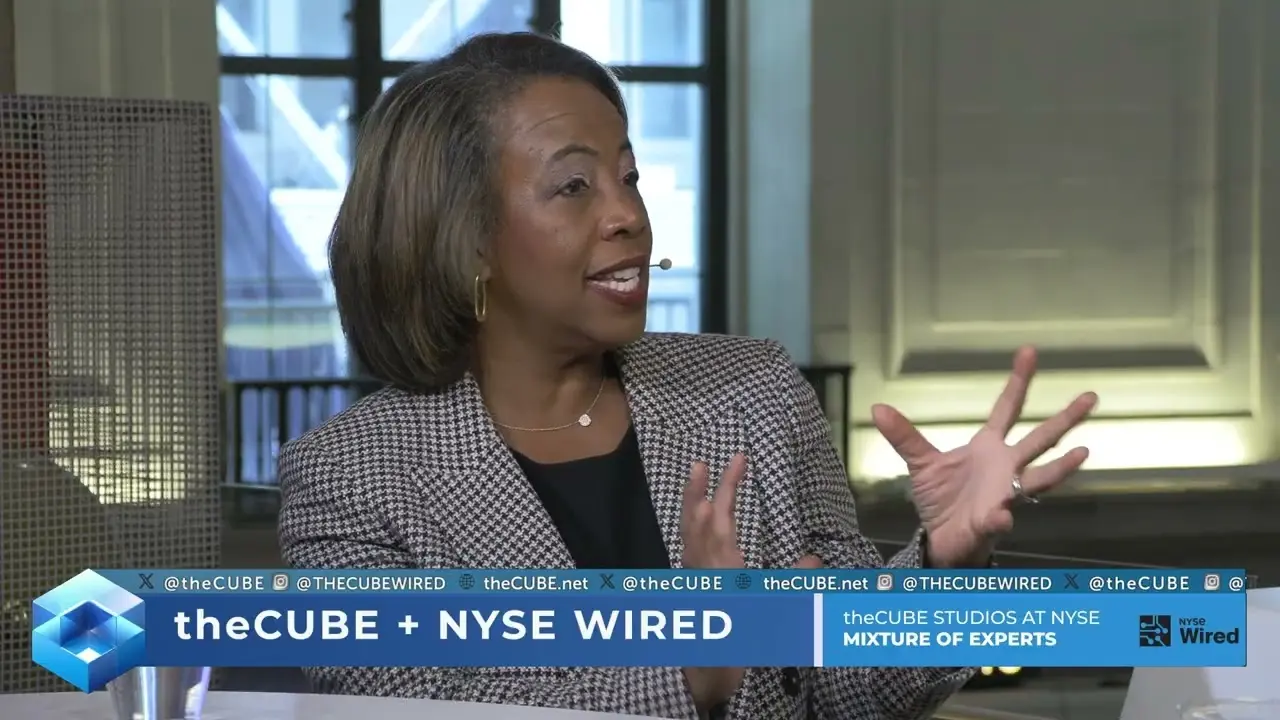
>> Welcome back to TheCube's studio here in the New York Stock Exchange. I'm John Furrier, host of TheCube here. Part of the NYSC Wired program of Cube Original and the NYSC Wired community, an open community of people, experts. Communities open for collaboration, of course, connecting Silicon Valley where our Palo Alto studio is to Wall Street. Technology is the market. Data is driving the value of AI. If you have the right architecture, do the right governance and the right compliance and the agents will all play out. Great conversation here. As part of our mixture of expert series, of course. We got Marcela Granados, who's been on the queue before. Great to see you. And it's been a couple years. You're now global head of insurance of Databricks. Good to see you. Thanks for coming back on.
Marcela Granados
>> Yeah. Great to be here, John. It's always a pleasure.
John Furrier
>> So you know I'm a fan of Databricks.
Marcela Granados
>> Yes.
John Furrier
>> I've been following that company from the beginning, David Valente and the whole team. But it just seems so bigger now. It's gotten the valuations. I mean, I think series X, financing, it's soon to go public, so many rounds.
Marcela Granados
>> Hopefully.
John Furrier
>> But the value creating really from the data lake initial vision has gone ... It's a developer dream scenario. AI is developer focused. Agents are solving real world business problem. Ollie's been here in this studio. You're starting to see the real world impact and in the vertical specifically, and you're covering insurance. So tell us about what you're working on right now because you're starting to see a lot more people doing the work, grinding out the compliance, setting up the identity and security and privacy. And once they get that, the agents just unleash.
Marcela Granados
>> Yeah, no. So spot on. In insurance, when you look at a lot of the consulting companies estimating which is the industry that would be right for success for Agentic AI in general, insurance comes on top because of all of the unstructured data that insurance companies may have. So think about video, images, text, and audio. So coming off of our financial services forum that we had just a couple of hours ago, we talk about the evolution of the use cases on AI and the functions are the same. So think about call centers, customer service. That's where the majority of the insurance company is started experimenting, looking at when somebody calls to report a claim or to ask questions about the coverage. How can you turn that voice transcript and measure the intent? But how can you also reroute it to an actual person to answer questions?
John Furrier
>> Yeah.
Marcela Granados
>> After call center, we started seeing AI use cases around claims and underwriting. Simple things like, what type of risk do I want to write? Do they have the right coverage? Is there preexisting conditions? With the goal of having a good balance between automating as many risks as possible, risk are simpler, but also having underwriting judgment and actual judgment when the risk is more complex. And now, as we sit here, we're seeing a lot of pilots on distribution and marketing. So it's really spanning the whole insurance value chain from back office, middle office, front office.
John Furrier
>> You mentioned the FINS forum, the financial forum. Here in New York, that just happened here?
Marcela Granados
>> Yes.
John Furrier
>> And that was financial services?
Marcela Granados
>> Yes.
John Furrier
>> So I need to ask you, because every vertical, finance, insurance, legal, they're all having the same pattern. AI is disrupting in a very accelerated way, value.
Marcela Granados
>> Yes.
John Furrier
>> Startups are coming out of the woodwork, very specialized, bigger players are becoming transforming if they've done the right things. What is the AI opportunity for these verticals? What's the general pattern?
Marcela Granados
>> So financial services, we have about 2000 clients in financial services. 505 are insurance companies. What we've seen is that we're broadening the base, meaning just even looking at Databricks overall, 20,000 customers. Out of those 20,000 customers, about 800 have revenue, ARR greater than a million dollars. And about 70 of those 800 have annual recurring revenue of greater than $10 million. So they're doing more with Databricks and you may be wondering, well, what does that matter? Well, because that means that all of these nascent concepts and paradigms that we created, such as the Lakehouse, now the Lakebase, are really being embraced by the industries. And these companies, these customers, as you know, we're paygo, right? We don't charge buy license or any of that. The more value, the more usage the higher of Databricks, the bigger the account is, and the more success they're probably seen around not only infrastructure or productivity, but also business outcomes.
John Furrier
>> It's hard to keep track of all the news that Databricks is coming out with. And MWC, we had a great contract around the telecom, another vertical, another domain. The developer traction, the enterprise traction, I tried to pin Ali Ghodsi down about, "Oh yeah, the agent, all the AGI." He says, "John, John, there's so much hype." He goes, "But let's just solve real world problems."
Marcela Granados
>> That's right.
John Furrier
>> And he goes, "It sounds boring, but the reaction in the enterprise specifically is to get a lot of the blocking and tackling done, get the basics done and get adoption." What is the latest key things that people should know about with Databricks right now in terms of news? What are the key momentum points? Because there's a lot. It's like you got the Lakehouse, you have now different versions of it. Now you have different tooling. The platform that's on serverless, so the performance is there. So there's a lot more going on. What's the latest? You have to summarize the top key things that people should know about.
Marcela Granados
>> Yes. So two things. Normally, every time we have our company kickoff, Ali tells us there's five things, five company partners. Now he made it even simpler for us and it's only two. One of them is Lakebase. So you being so familiar with Databricks, you know that we started solving three main problems. So one of them was about not having lock-in on your data. You shouldn't give your data to anybody, not even Databricks. We don't ingest data. So we started with just the open formats, and it's not only just Delta, it's Iceberg, it's Hoodie. Now we have Postgres within the open format. The second challenge that we saw is companies wanted to have the right governance around all of the assets. So we've been evolving Unity Catalog that would always be changing and improving on that. But now you have the different Lakehouse products. So think about Lakeflow Connect for ingestion of the data. We have Lakeflow Designer, which allows you to have the ability to drag and drop data. But with Lakebase, what makes it very unique is that we are looking at your transactional operational data being governed, separating that computer versus storage with the same architectural partner that we will have for the Lakehouse. So now you have the Lakehouse for your analytical workloads, and now you have Lakebase for your transactional operational, all governed by the same platform. And what that allows you to do is ... So going back to the one, two, company priorities, the first one is Lakebase. That's what's new. And the second thing or feature that we've been getting a lot of adoption from clients is AI/BI Genie. When we talk about AI/BI Genie, it's more than just the toy chatbot that everybody has. Is how can you interact with your data in natural language so that it's not just pulling data from the internet, but it is understanding the context of your data by looking at your metadata, looking at query patterns. And it's not just doing a simple retrieval augmented generation, pulling the right data to give you an answer, but it tells you why. It gets into root cause analysis. So Ali, as an example, he showed during kickoff that if you have a pattern on usage on dollar DBUs, which is how we look at revenues, and you see an outlier, you can start interrogating Genie on why that is. And it shows you, it gives you the transparency on the drivers of that anomaly, but it also runs analysis. It runs time series analysis, and with a click of a button, you can also see the SQL code. And so it knows what table and which field column to pull based on your metadata.
John Furrier
>> And this is also a transition. We're hearing about static dashboards, a lot of data's out there. The whole analytics world is transformed to generative AI. So how are people using Genie, for instance? Can you share some examples of where it's working and how should they think about it?
Marcela Granados
>> Good question. So when I joined Databricks about four years ago, it was a very heavily tech company, meaning that the main users were your data scientists, your data engineers, your enterprise architects. And to be honest with you, we heard from customers that they wanted to get, let's say, the quasi technical people to integrate the data, to get into the platform and benefit from all of that goodness. So I'm an actuary by background and actuaries are sitting somewhere between a data scientist and a business person. So now we're seeing a lot of adoption from actuaries, especially in insurance, on using Genie as the interface to talk to their data, to go beyond the dashboards as you said it. But now I can tell you that even looking at CFOs, chief financial officers, chief marketing officer, chief underwriting officers interacting with Genie, where we basically say we're meeting users where they are, we're not asking them to log into a separate Databricks workspace and wrong code like we normally do with Notebooks, but interoperability is key. So we're seeing a lot of-
John Furrier
>> We got both sides. You get the nerd factor.
Marcela Granados
>> Yes.
John Furrier
>> People want to go under the hood, go to town on that one, but the business users get to engage on the business model transformation. Is that what you're getting at?
Marcela Granados
>> Exactly. So let me give you an example. So for insurance, you can start asking questions about what is my profitability for my book of business? We call it combined ratio. You can ask, why is my combined ratio deteriorating? And it will pull that data. It will tell you, is it the same across the states? Does it vary by product? Is it different across lines of business? And from a banking example, you can look at a lot of the scenario testing. So for example, what would be the effect that 200 basis points change would have on my commercial real estate exposure? So those types of questions are the ones that you can answer with Genie. And the cool thing about this is that it understands your ontology. It understands how you define revenue. How do you define profitability? Even the time component on ... When you're talking about by year, are you talking about calendar year, fiscal year? So that's the power of Genie-
John Furrier
>> And it's just accurate. It's not like just some report.
Marcela Granados
>> Yeah.
John Furrier
>> It's just runtime.
Marcela Granados
>> Exactly. So for the business users, they would interrogate, they would do the sales service analytics. For the data scientists and all of our fan base from a technical perspective, they can build agents, they can have the applications, they will connect to MCP servers. And there's a lot of functionality on the main four things that Databricks does around agents. One of them is knowledge management. The other one is information instruction. Some very mature companies want to build their custom large language models, and there are others that want to decompose the workflow, whatever that workload may be, and have domain specific agents. But what we were talking about today, that it is not about task automation, it's how do you orchestrate those outcomes and having that governance, having that lead.
John Furrier
>> Yeah. And then that's where Generative AI shines. Marcela, I have to ask you, obviously insurance is one of the many verticals that are winning with AI and changing fast, but take me through the engagement of a customer because one pattern that's happening is the classic freemium model. I won't say you guys do this, but I mean, in some cases like, here, try it and do a pilot, a fast one, and then they get addicted to it. They see the value and they go, "I'm all in."
In legal, we see a lot of that. They're all skeptics, so like, "Oh, I'll try it for free." I mean, you guys are a lot larger platform, but take us through the engagement. What's it like with customers as they start to get into, ingratiate into the platform, what do they discover? What's the adoption and what's the flywheel look like for value? How do they react? Take us through a slice of life.
Marcela Granados
>> Yeah. So I would say that our greenfield customers, at the financial services forum, I was meeting ... I was remembering my first prospect dinner I had, I knew very little and the platform had changed a lot, right? But I would say with a greenfield customer or prospect, they used to start by use cases. So what I mean by that is just the typical ETL, they were just using us for as a distributed computer and processing engine, but now we started realizing that the pattern on how those, you can really scale AI going from like ... Because use cases sometimes they're very-
John Furrier
>> Narrow.
Marcela Granados
>> ... . Yeah. It's very, very tactical. Some of our customers are just trying to get that competitive advantage.
John Furrier
>> And by the way, the personas are unique. It's not like a whole organizational thing.
Marcela Granados
>> Correct. It's very, very hard to scale. So what we started doing is coming up with the concept of outcome maps. So I have to give it to Bhavesh Patel. He's my boss's boss. He leads all go to-market for all verticals. And he said, "We're growing really fast and how can we connect the technical with the business?" So what we did is, specifically for financial services, we built a framework on identifying the three main strategic priorities that financial services would have. One of them is driving growth. Second one is protect the firm because we live in a very heavily regulated industry. And the third one was being more efficient. So John, now what we're doing is we're shifting the mindset of buy use case to buy persona. So let me give you an example. So on the efficiency side, we see office of the CFO as one of the main business objectives that fits into those strategic priorities. And below that, you have different use cases that are mapped to that. So think about treasury, think about FP&A, finance, planning and accounting, think about regulatory workloads. So what we started doing is we created a whole set of solutions. Some of them are developed by Databricks. Some of them we rely on our partners that provides that speed to market because you'll hear from Ali. Ali says the reason why having the conversation around product roadmap is important because we don't want customers to be spending money on things that we're building. So taking that analogy-
John Furrier
>> So he's transparent on the roadmap for that reason?
Marcela Granados
>> Correct. Correct. And then he said, "Don't spend money on things that we're already building." He actually just saw a customer of ours last week and he was just like, he has 20,000 customers, but he still takes the time because the feedback that we get from the customers on not only strategic priorities and use cases, but also what is the ecosystem for a particular vertical look like? What are the external data providers? What are the connectors Databricks should be building and should be adding to the marketplace? So all of that intelligence, we got it from the customers and we build not only our product roadmap that is very horizontal by product, but these outcome maps I alluded to earlier represents the vertical product roadmap, strategic priorities, business objectives and use cases that ultimately-
John Furrier
>> Yeah. I mean, that's also good politics for him because if you know the customer's going to save money, why spend money when you could save it? That's one good business.
Marcela Granados
>> Yeah, exactly. And historically we looked at ... Because as you know, change management and everybody has a ... Well, most companies have a data platform. So even get them started with Databricks. Right now, a lot of our customers are more mature than others, but let's say the ones that are prospects, they need to have a business case to their boss and just like, why would I rip out the architecture? Everybody's trying to rationalize it. So just even bringing new technology, regardless of how powerful it is, they need to quantify the value.
John Furrier
>> Well, I'm super psyched to have you on. Final 30 seconds we have left. Tell the people why Databricks, why they should work with you. What's in it for them? There's a pitch.
Marcela Granados
>> You put me on the spot. No, I mean, listen, we're all talking about jobs with a purpose, right? I have a seven-year-old daughter that I don't think she wants to be an actuary like I am, but what really keeps me going every single day is how Databricks, our founders are still teaching. So I'll close with how Ali just launched Databricks One and Databricks Free Edition. So you don't need a credit card to use Databricks. So that to me, the democratization of data and AI when in a world, everybody was talking about data and we were being very, very quiet about AI. Now it's the other way around. And being with people that are still have a lot of their DNA in academia and continue to teach, it's mind-blowing.
John Furrier
>> Yeah. And it's such a great service. In fact, they're cheering so loud for the trades behind us waiting for Databricks. Thank you so much for coming on. Mixture of experts. Databricks continue to doing the work. They're still private company, but the valuation is so high. And again, the success is continuing. Datalakes have emerged into the bloodstream of success for AI and having the right data with the right compute, certainly the edge is hyper converging. Everything's coming together in distributed community. It's computer science happening for the real world. We're doing our part to bring that to you. Thanks for watching.














































 John Furrier