This conversation examines how artificial intelligence, or AI, embedded at the cursor transforms inbox and workplace productivity. Luke Behnke, vice president of product of Superhuman, appears on theCUBE with NYSE Wired for Mixture of Experts to describe how integrated AI assistants reshape daily work. Behnke explains that AI following the cursor provides contextual suggestions across unified inbox workflows and collaborative documents and shifts organizations from isolated point solutions to platform-level experiences. They highlight the role of AI assistants in improving productivity and streamlining email and document collaboration.
Behnke emphasizes transparency and user control for enterprise deployments. They report deployments with 80–90% daily adoption and substantial use of large language models, or LLMs. They outline single-tenant and sovereign cloud options, bring-your-own-key encryption, and the importance of measuring AI return on investment to demonstrate business value.
Analysts from theCUBE Research emphasize aligning rollouts with clear measurable business outcomes and monitoring adoption and performance metrics. The discussion covers technical and organizational factors to consider for deploying AI assistants in enterprise environments, including data security, sovereignty and integration with existing workflows.
Forgot Password
Almost there!
We just sent you a verification email. Please verify your account to gain access to
theCUBE + NYSE Wired: Mixture of Experts Series. If you don’t think you received an email check your
spam folder.
Sign in to theCUBE + NYSE Wired: Mixture of Experts Series.
In order to sign in, enter the email address you used to registered for the event. Once completed, you will receive an email with a verification link. Open this link to automatically sign into the site.
Register For theCUBE + NYSE Wired: Mixture of Experts Series
Please fill out the information below. You will recieve an email with a verification link confirming your registration. Click the link to automatically sign into the site.
You’re almost there!
We just sent you a verification email. Please click the verification button in the email. Once your email address is verified, you will have full access to all event content for theCUBE + NYSE Wired: Mixture of Experts Series.
I want my badge and interests to be visible to all attendees.
Checking this box will display your presense on the attendees list, view your profile and allow other attendees to contact you via 1-1 chat. Read the Privacy Policy. At any time, you can choose to disable this preference.
Select your Interests!
add
Upload your photo
Uploading..
OR
Connect via Twitter
Connect via Linkedin
EDIT PASSWORD
Share
Forgot Password
Almost there!
We just sent you a verification email. Please verify your account to gain access to
theCUBE + NYSE Wired: Mixture of Experts Series. If you don’t think you received an email check your
spam folder.
Sign in to theCUBE + NYSE Wired: Mixture of Experts Series.
In order to sign in, enter the email address you used to registered for the event. Once completed, you will receive an email with a verification link. Open this link to automatically sign into the site.
Sign in to gain access to theCUBE + NYSE Wired: Mixture of Experts Series
Please sign in with LinkedIn to continue to theCUBE + NYSE Wired: Mixture of Experts Series. Signing in with LinkedIn ensures a professional environment.
Are you sure you want to remove access rights for this user?
Details
Manage Access
email address
Community Invitation
Luke Behnke, Superhuman
This conversation examines how artificial intelligence, or AI, embedded at the cursor transforms inbox and workplace productivity. Luke Behnke, vice president of product of Superhuman, appears on theCUBE with NYSE Wired for Mixture of Experts to describe how integrated AI assistants reshape daily work. Behnke explains that AI following the cursor provides contextual suggestions across unified inbox workflows and collaborative documents and shifts organizations from isolated point solutions to platform-level experiences. They highlight the role of AI assistants in improving productivity and streamlining email and document collaboration.
Behnke emphasizes transparency and user control for enterprise deployments. They report deployments with 80–90% daily adoption and substantial use of large language models, or LLMs. They outline single-tenant and sovereign cloud options, bring-your-own-key encryption, and the importance of measuring AI return on investment to demonstrate business value.
Analysts from theCUBE Research emphasize aligning rollouts with clear measurable business outcomes and monitoring adoption and performance metrics. The discussion covers technical and organizational factors to consider for deploying AI assistants in enterprise environments, including data security, sovereignty and integration with existing workflows.
In this interview from theCUBE + NYSE Wired: Mixture of Experts Series, Luke Behnke, VP of product at Superhuman, joins theCUBE + NYSE Wired's Gemma Allen to discuss the shift from AI as a point solution to AI embedded directly in a worker's cursor. Behnke traces Superhuman's rebrand from Grammarly, explaining how the company evolved from a writing assistant into a full productivity suite spanning mail, docs and calendar. He details how auto-labeling and auto-drafting help users move through email four times faster, and why he sees Superhuman occupying a midd...Read more
exploreKeep Exploring
Can you describe the company—its origins and journey, what it does, and where it currently stands in the present market environment?add
How does Grammarly use AI to help users manage their inbox and collaborate on documents, and what features speed up those workflows?add
How does Grammarly position its AI assistant compared with point solutions and chat-based AI assistants, and how does it integrate into users' workflows?add
How does Grammarly achieve such high daily adoption and frequent use of its AI features, and what factors should organizations consider when deploying AI tools (deployment model, security/compliance, and measurable ROI)?add
What are your priorities and expectations for the next 12 months?add
>> Welcome back to theCUBE Studio, coming to you from the New York Stock Exchange. I'm Gemma Allen with NYSE Wired's Mixture of Experts. And often on this show, we talk about a transition from a world where we trained humans around software to training software to work around us. For a conversation on exactly that, joining me now as VP of product at Superhuman is Luke Behnke. Welcome, Luke.
Luke Behnke
>> Thank you. Thanks for having me.
Gemma Allen
>> So Superhuman, first of all, I love the name. It promises a lot. Maybe just set out this story, Luke. Tell us a little bit about the company, the journey, and where you guys are at in this mad market moment we're in.
Luke Behnke
>> Yeah, so Superhuman is an AI -native productivity suite. And it's really designed to bring AI to you as a worker, as a student. And Superhuman came out of Grammarly. We recently acquired a company called Superhuman / Grammarly, and we rebranded the whole company from Grammarly to Superhuman. Just as you said, we love the name. We think it really is telling of what we want to do. We want to make individuals superpowered. We still think humans are so essential to getting work done and that AI should work for us. And so making humans Superhuman is our goal. And we've really evolved from an AI assistant that helps you write, that's Grammarly, into a much more full featured suite of productivity capabilities that we offer to individuals as well as to enterprises.
Gemma Allen
>> Wow. So like you said, we all are familiar with Grammarly. It helps make us better writers. I know it makes a lot of students' papers a lot easier to write for sure. But Superhuman also has very much focused on the inbox, right? The inbox as a gateway to all levels of productivity and connectivity across enterprise. Talk about how that is changing. so much of our work starts and ends in our inbox, right? It's definitely the most important place in which most workers live, but it's evolving too. And I think AI is changing a lot. How is the product evolving in line with that?
Luke Behnke
>> Yeah, definitely. So you are right. Some people spend more than half their day in their inbox. In fact, the majority of our Superhuman Mail customers spend three plus hours a day working through email. And with the power of Superhuman's AI assistants, and now with Grammarly, and we also have a collaborative docs capability where you can work with your teammates on drafting documents with tables and bringing in data from different sources and managing and tracking your projects. But the inbox is definitely still a critical part of that flow. It is where anybody can put a task on your task list, as they say, and suddenly it's on you to work through it. And so Superhuman via our auto -labeling, auto -drafting capability, which drafts responses in your voice, gives you a number of options that you can one -click and either edit or send. We help people get through their email four times faster than before. And with our docs capability and with Grammarly, our writing assistant, and a number of other agents that we have launched on our Superhuman Go product. We just give you a number of other tools where we really bring AI directly to your fingertips where you're already working and where you're spending the most time in your day with the goal of just getting through that, especially the busy work faster than ever before. And the inbox is really one of the places, the place maybe where that is most at the forefront of our minds these days as we spend so much time managing that task list that others are creating for us in our inbox.
Gemma Allen
>> So describe to me what life is like as a customer of Superhuman. An enterprise user, I have my inbox, it might be run on Outlook, I might use Notion for certain things, I might use Salesforce. We all know a world where we have so many different productivity and connectivity apps running, right? And you're going from window to window. I am certainly someone who has 300 tabs open at once. How does Superhuman change that picture?
Luke Behnke
>> Yeah, if you think about the adoption of AI in the enterprise today, it kind of comes in one of two forms. One is the various 300 tabs that you have open probably all have some AI capabilities integrated in. You have the little magic star button somewhere in one of the different corners of your screen, and it changes when you move from app to app, or maybe it only works if you're working within that company's suite of apps. And so we kind of think of that as point AI solutions, which can be great, but are often limited to just that window that you're in. And then we, of course, have the rise of these new AI assistants and these super apps that are mostly chat-based experiences where you're going back and forth, either creating one-off conversations or maybe scheduling tasks. And obviously, both of those are super powerful. But we see Superhuman kind of living in a space between those. It follows you around like Grammarly does. 40 million people use Grammarly every day as a writing assistant. And we've spent 16-plus years now building out an experience that just seamlessly integrates AI into your cursor. So while you're typing, while you're reading in a million different web applications, desktop applications, and mobile applications, it just works. And it's the same consistent AI experience, whether that's chatting about what's on your screen, whether that's drafting a draft in your own voice, or whether that's scheduling through your calendar, triaging your mail. It's the same experience in every single application where you're working. You don't have to copy and paste into a chatbot, and you don't have to worry about switching through those 300 tabs with 300 different AI assistants that each behave a little bit differently. And so we really think bringing AI to your cursor anywhere you're working is quite a different paradigm. And we're seeing some really high adoption stats for our initial customers who have started to use the Superhuman Go platform, our AI assistant. That is far higher than any of the point solutions that we use internally here. We see really high adoption because it's always there and it's always the same in every one of the apps that you're working in.
Gemma Allen
>> Well, the idea of full integration is certainly very attractive, right, especially in the old world of enterprise. But like I said, it can be quite siloed. Talk me through what it would mean from the perspective of enterprise security. So we know that the inbox is an interesting moat in and of itself. it's also often the first place where security risks and threats and vulnerabilities happen right it's where that communication is first made in a world whereby you have an AI agent like a Superhuman agent following you around and even maybe and you can correct me on this executing tasks for you as a user how do you guys think about the security element of that and what sorts of questions I'm sure you get asked many. What are you seeing and hearing in the space?
Luke Behnke
>> Yeah, at Grammarly for many years, we really had to earn that right to be on your desktop, in your Chrome or Edge browser, and partnering with you on what you're doing everywhere you're working. And we earned that right with CIOs and IT teams by delivering on two major promises. First is transparency. We're extremely transparent about what data we are or are not storing on your behalf, what we're doing with the content on your screen at any time. And so that is the first part of the promise is that we're always going to be transparent about where and when Grammarly, and now the Superhuman extension is running on your computer. And then Control being the other one. That really means end users can turn it off at any time. End users can also set up things like, I never want you to run on these certain apps or these sites. I always want you to ask me before doing something on my behalf. And of course, administrators and IT can set up all of this centrally as well for their teams so that they ensure that we are never reading sensitive content. We respect those labels, say, within the Microsoft Word, Microsoft Office suite. Also, you can, of course, set up advanced security and encryption capabilities. So it's really about that transparency to the user about what's happening and that control for the user and the admin. And we've had to earn that right over many years at Grammarly, and we've now been able to apply that to Superhuman and to build that trust to be able to be with you in almost anything that you're doing. Wherever your cursor is, we can be there. And we certainly take that seriously. And it's a huge part of our product roadmap and our product capability has been supporting customers with their most sensitive data. And we've earned the trust of a number of financial services companies, health care companies, state and local government, even some federal agencies. And so it is really a priority for us and one that we've earned over the last 16 years.
Gemma Allen
>> You make an interesting point there around central IT management and centralized security and restrictions and governance and compliance and internal policies and all of that good stuff that we hear so much about, right? Which can sound stiff, but it's more important than ever, actually, in this world that we're in right now. In terms of deployments, you bring on a new enterprise client, a huge multi -tenant client, let's say a large bank, how quickly is value and culture change realized within these kinds of large enterprise environments? We hear mixed messages. On one end, we hear AI is changing everything. On the other end, we sometimes hear, actually, nothing's really changing. They're just talking about it changing. What are you actually seeing? And if I'm a large bank and I bring on a product like this tomorrow, how quickly is all of that governance, that structure that's set up in place, that is deployed and value is realized? What's a realistic timeframe?
Luke Behnke
>> Yeah. Yeah. We are really hearing mixed messages. I love your point there. It is very true. And I think what the reality is, is that the future is here. It's just unevenly distributed. And no doubt AI will change a lot of the way we're working. But it has been slower than I think some people want to admit. But what we have seen, certainly what we have, is many years of proven results rolling out a solution like Grammarly is that we see adoption unlike anything I've ever seen in any software company that I've worked for. And I think it is that paradigm of showing up at your cursor. You just install it. It's set and forget in many ways. Of course, your administrator can configure customizations for you as an end user, as a knowledge worker in the organization, but it's just installed and it starts working. And so we see 80 % to 90 % daily adoption. We process 125 billion LLM calls per week across our platform of 40 million active users. That translates to thousands of AI calls to our proprietary AI service every day per user. So I don't really think there's another tool that probably gets that level of adoption. And we think that's what happens when AI is right there at your cursor as you are working. Obviously, it understands context and is trying to be as relevant as possible. But it's also always there, kind of always on. And so I would say with other solutions, what we're seeing and we're hearing from customers, maybe even what we're seeing from our own internal use, is that just as important as setting up the compliance and security, which is quite easy with Superhuman, straight out of the box, no training, no storage of your data and a lot of that control instantly at your fingertips. But what we see is also just as important is actually rolling out with clear business objectives that you're trying to hit and a measurable ROI and reporting story so that you can show yourself and your management team that this is really working. And when 80 to 90 % of your org is using it, and many of them are using it 1000 times or more a day, that's just numbers that other AI solutions where you kind of have to remember it's there, maybe you ask one query per day, maybe you have one scheduled task running, per day, it's a very different story that we've seen now for many years, through Grammarly that we've now extended to the whole Superhuman platform.
Gemma Allen
>> So just to talk about the tech for a second, because we have a lot of tech viewers, I presume this is cloud based fully in its entirety. What are you seeing from the perspective of specific solutions? We hear a lot about people running sovereign cloud now, especially banks and legacy institutions in different jurisdictions. Or a lot of folks are moving certain workloads back on prem, right on prem. It's having kind of a sexy moment again in the world of tech. What are you guys seeing from the perspective of specific verticals and locations as you're kind of going to market in different regions with this? What are you seeing requirements and requests in the world of cloud and cloud kind of access changing?
Luke Behnke
>> Yeah, we have the core of our solution today does run in the cloud. We have clients that you install on your desktop and in your web browser that do process some information locally. But most of the AI that is processing is in the cloud. Some of that is our own proprietary models. And some of those are third -party models that we integrate in from the large model providers. So first step is we give you a lot of control around what you want to use and what capabilities you want to use and you want your end users to use. We also have, we are just in the process, we've over the first half of the year, signed two very large enterprise customers who require a single tenant cloud. So still cloud -based, but they're in their completely firewalled own tenant. And so that is definitely something we're hearing from our largest customers. And I think a big next step for us is to support sovereign cloud, non -US data residency. That's another thing we hear as we are expanding internationally. But we really think that this single tenant fully in your control, we also have a number of our features that are protected by an external key, bring your own key with an external key management service. And so obviously, if you're going to integrate in, and again, this is all in the control of IT, but if you're going to integrate in the various tools so that you can bring more context to the AI, and AI is only as good as the context it has, we need to make sure we're meeting that super high bar. And largely, we have for even some of the largest Fortune 100 companies that are using Superhuman. But of course, this is a never-ending story. We have so much to be watching to see how this develops. But I think we're going to continue to support these single tenant, more sovereign data storage with advanced encryption models that I think are becoming pretty common as you think about how you provide context to the AI in a safe manner.
Gemma Allen
>> That's it, right? In a safe manner and a secure manner. And it certainly seems where much of this market is headed. Well, Luke, last question to you. It's an interesting time, big rebrand for this company. Grammarly has really proven itself, I think, in the market. A lot of us use it every day. What's ahead? What does the next 12 months look like? Because it's difficult to think beyond that right now.
Luke Behnke
>> Totally, even if you can predict the next 12 months, you'd probably be very rich. Which, yeah, for us, it's really about continuing to build out our new Superhuman AI assistant and combine our document databases and mail, email, and calendar productivity products into a really useful and, frankly, delightful AI suite for both individuals, small teams, and enterprises. And I think the other big thing for us is that we are past the brief little stint of token maxing and that brief era of just spend as many tokens and the bills will come later and we'll deal with it. Obviously, the model providers, as they prepare to go public, are going to be tightening up their own financials. And that, of course, will pass down to all of us. And so I think the big story going into the second half of this year is getting back to the ROI story. Are we really solving employee workflows that are high value? Is the juice worth the squeeze? Are the tokens worth the result? And it's on us as a vendor to prove to you that if you're going to use some of our advanced agents that show up while you're working in any tool to automate parts of the work or assist your employees, and you're going to be paying extra for that. It's on us to show you how that's being used, how that's adding value to your business, and why you should continue to trust us with that. And it's on us to prove that ROI story. And I think the pendulum is definitely swinging back to what is the ROI of all of this AI and all of these tokens that we are spending? And are we getting the value that we think we are? And at Superhuman, it's always been our focus to give you that transparency into what's happening with your rollout of our tools and how it's impacting your business. And so I'm really excited to see that continue to progress. And like I said, we're going to be really focused on helping our customers measure this very tricky thing to measure of, what is the ROI of all of this AI spend? And is it really moving the needle on my business? And I think we're going to make a lot of big progress on that in the second half of this year.
Gemma Allen
>> Well, Luke Behnke, I have to say, you certainly delivered that message with a lot of conviction. And I think if we were to summarize this market moment into one sentence, is the juice worth the squeeze, is definitely the summary of the day. So thank you so much for joining us on theCUBE and NYSE Wired.
Luke Behnke
>> Thank you so much for having me. This was fun.
Gemma Allen
>> I'm Gemma Allen here at theCUBE Studio at the New York Stock Exchange. This is Mixture of Experts, one of our programs with NYSE Wired. Thanks for watching. Thank you.















































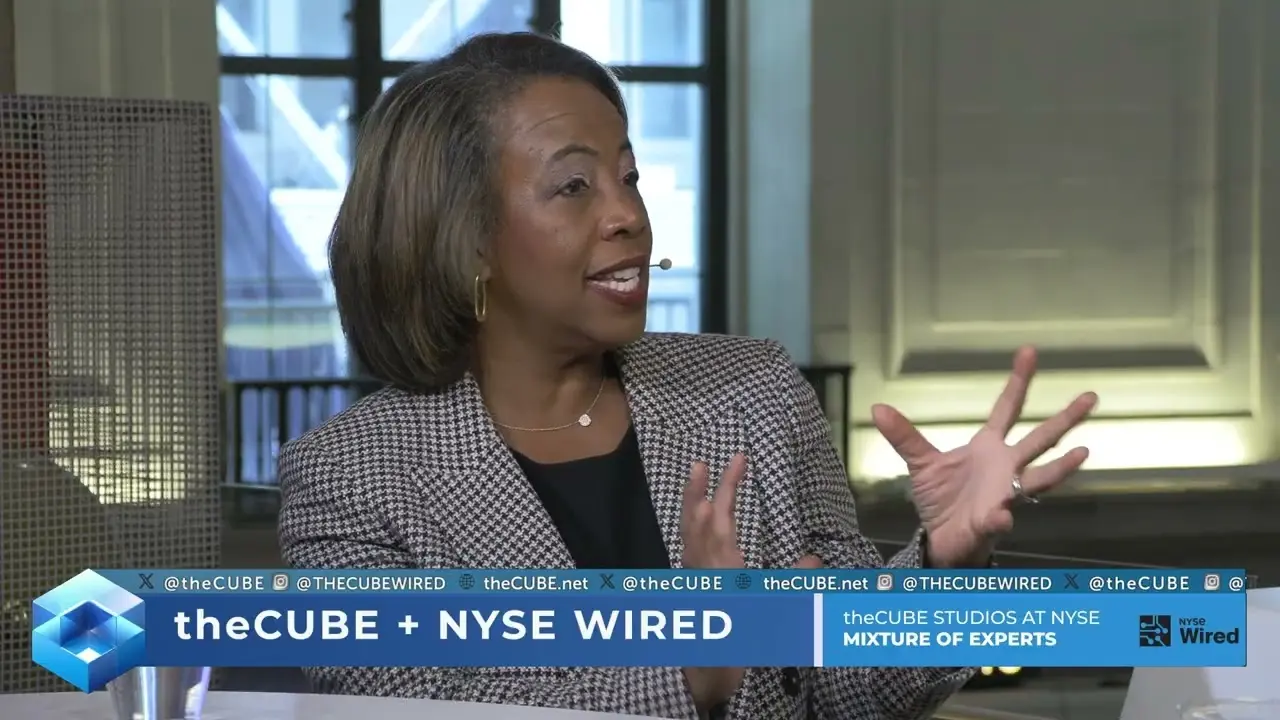






 Gemma Allen