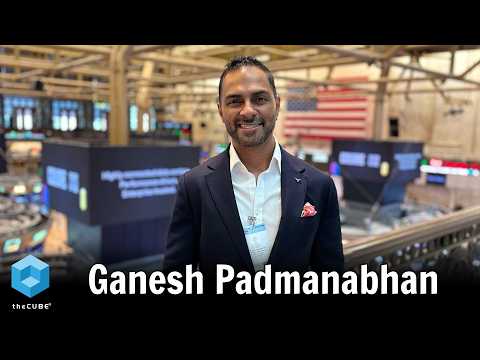
In this insightful edition of the Mixture of Experts series, Don Muir, Chief Executive Officer and co-founder of F2 AI, joins John Furrier, co-founder and co-CEO of SiliconANGLE Media, to explore innovations in artificial intelligence within financial markets. They convene at theCUBE's New York Stock Exchange studio to discuss the emerging landscape of AI-driven financial analysis and its potential to revolutionize financial markets.
Muir, an accomplished entrepreneur with a background in private equity, shares their journey from founding Arc to pioneering with F2 AI. This venture originated from Muir's vision to enhance financial data analysis using AI, initially incubated within Arc’s successful debt capital markets business. The conversation, led by Furrier of theCUBE, navigates through the innovative technology that F2 AI introduces to private credit funds and financial institutions.
Key insights from the discussion focus on the transformative role of AI in automating financial processes. Muir explains that F2 AI uses advanced AI techniques to eliminate manual tasks, thereby empowering professionals rather than replacing them. The discussion highlights the importance of adopting AI-native strategies in today's rapidly evolving market, with analysts emphasizing how AI-driven methodologies can provide a significant competitive edge.
Forgot Password
Almost there!
We just sent you a verification email. Please verify your account to gain access to
theCUBE + NYSE Wired: Mixture of Experts Series. If you don’t think you received an email check your
spam folder.
Sign in to theCUBE + NYSE Wired: Mixture of Experts Series.
In order to sign in, enter the email address you used to registered for the event. Once completed, you will receive an email with a verification link. Open this link to automatically sign into the site.
Register For theCUBE + NYSE Wired: Mixture of Experts Series
Please fill out the information below. You will recieve an email with a verification link confirming your registration. Click the link to automatically sign into the site.
You’re almost there!
We just sent you a verification email. Please click the verification button in the email. Once your email address is verified, you will have full access to all event content for theCUBE + NYSE Wired: Mixture of Experts Series.
I want my badge and interests to be visible to all attendees.
Checking this box will display your presense on the attendees list, view your profile and allow other attendees to contact you via 1-1 chat. Read the Privacy Policy. At any time, you can choose to disable this preference.
Select your Interests!
add
Upload your photo
Uploading..
OR
Connect via Twitter
Connect via Linkedin
EDIT PASSWORD
Share
Forgot Password
Almost there!
We just sent you a verification email. Please verify your account to gain access to
theCUBE + NYSE Wired: Mixture of Experts Series. If you don’t think you received an email check your
spam folder.
Sign in to theCUBE + NYSE Wired: Mixture of Experts Series.
In order to sign in, enter the email address you used to registered for the event. Once completed, you will receive an email with a verification link. Open this link to automatically sign into the site.
Sign in to gain access to theCUBE + NYSE Wired: Mixture of Experts Series
Please sign in with LinkedIn to continue to theCUBE + NYSE Wired: Mixture of Experts Series. Signing in with LinkedIn ensures a professional environment.
Are you sure you want to remove access rights for this user?
Details
Manage Access
email address
Community Invitation
Craig Schiff, BPM
Join us for an insightful episode featuring Raj Verma, CEO of SingleStore, as he shares his expertise in the rapidly-evolving landscape of data infrastructure and Artificial Intelligence. Hosted by theCUBE's John Furrier, this conversation takes place at the prestigious New York Stock Exchange, spotlighting SingleStore's strategic position and the innovative partnerships shaping the future of AI infrastructure. Verma's insights reveal the dynamic intersection of Wall Street and Silicon Valley.
In this episode, Verma discusses the transformative role of databases in AI development and the critical importance of modernizing data estates to capitalize on new AI capabilities. According to Verma, integrating data effectively can significantly enhance AI's operational efficiency, emphasizing the need for organizations to harness their own data. theCUBE analysts explore the future of enterprise technology, echoing Verma's predictions for AI-driven disruption across various industries. Don't miss out on the key takeaways from this engaging discussion. Learn more about SingleStore here: [SingleStore](https://singlestore.com). #AI #Cybersecurity #DataInfrastructure #SingleStore #NYSE
Stay connected with the latest in tech innovation by following the full series with theCUBE at NYSE Wired.
00:00 - Intro
00:06 - Launching into New Ventures: A Market and Partnership Overview
04:31 - AI Evolution: Infrastructure Trends and Applications Across Markets
08:57 - Modernizing Data Estates for the Future of AI and Agents
11:58 - Challenges with AI Hallucinations and Data Reliability
16:11 - Advancements in Data Technologies and Enterprise AI Integration
19:32 - Shifts in Enterprise Data Usage for AI
23:30 - The Future of System Software and Applications
31:24 - Disruption in Professional Services and SaaS Models
35:15 - Navigating the Future: AI, Innovation, and Strategic Roadmaps
Founder, President and CEO, Lead AnalystBPM Partners, Inc.
In this interview from the New York Stock Exchange, Craig Schiff, president and chief executive officer of BPM Partners, joins theCUBE’s John Furrier for the Mixture of Experts series to discuss the rapid evolution of business performance management. Schiff breaks down why the hype surrounding the shift toward agentic AI is legitimate, emphasizing that successful implementation starts with a robust data foundation. The conversation highlights how performance management vendors are now embedding AI directly into their platforms, removing the need for complex t...Read more
exploreKeep Exploring
What are the key considerations for preparing for AI integration in business operations?add
What are the advancements in AI that improved transaction matching, account reconciliation, and overall data quality?add
What is the relationship between financial strategy and technology innovation in the context of generative AI and organizational change?add
What recent changes have been observed in the priorities of CFOs regarding performance management solutions and the importance of AI?add
>> Welcome back everyone. I'm John Furrier, your host of theCUBE in our New York Stock Exchange CUBE studio here on the East Coast, of course. We have our Palo Alto studio connecting Wall Street and Silicon Valley, and of course, in Massachusetts, we got our Boston studios. theCUBE also covers the events. We're out covering all the action. And as part of the NYSE Wired collaboration, we've got a great mixture of experts here. We've got a great expert here, Craig Schiff, president and CEO of BPM Partners. He's the leading authority on business performance management. And this is the hottest area when you look at the evolution to the hyped up agent area, the hype's legit. However, the work that's being getting done now is the preparedness, the readiness, the data layer. There is so much very important work being done right now. A lot of people have narratives, everyone wants to be that control plane. Craig, thanks for coming into our Mixture of Experts series. Thanks for coming to our New York Stock Exchange studio.
Craig Schiff
>> Happy to be here. Thanks for having me.>> So you hear my little monologue preamble, okay, maybe a little bit long winded, but I'd say this, this is the most contested thing happening right now is that shim layer above the hardware and then where the developers are coming in. Some call it a semantic layer for meaning, some call it data engineering, orchestration, but it's where the action is. Because the data has to be available and intelligent. Now, complicating that, we've been pointing out that the flywheel of the models, Gemini, they're moving so fast. It's like an F1 race. Someone's in the lead, someone takes a pit stop. I mean, someone's ahead. Just keeping track of the models alone is so difficult. But people said, okay, I don't want to get distracted. What's my work load look like? What's my work flow? So I think there's a lot of business model re-engineering around how do I set myself up for AI? What's your reaction to that or perspective as you're in the trenches, you're talking to customers?
Craig Schiff
>> So right. Preparing for AI, really you need the data foundation. I mean, that comes first. You need to have the right data with reliable high quality data, but a vast volume of data. I mean, obviously, as you know, AI works better and is more accurate the more data it can evaluate for this process. And then on top of that, what we're seeing in the performance management space is the performance management vendors themselves who've been selling budgeting, planning, forecasting, consolidation, reporting solutions, have integrated AI into their product sets. So you don't have to go buy a third party solution, figure out how to integrate it, get a data scientist to help you build that out. These guys are building it into the product itself. So it's there for specific... They're building it at the platform level, but then it's implemented in specific use cases throughout the budgeting, planning, forecasting, reporting cycles. And that makes it accessible and easy to use. And that's to me, the easiest way to access AI instead of trying to figure out with your own developers and data scientists.>> Yeah, I mean you see people really kind of groping for what the approach is. Yeah, the search side's easy, RAG. That's nice. It's actually awesome. But really people trying to think about the architecture of their business. You wrote a report that showed the evolution and where it's happening. Can you take us through that report? What was the key findings?
Craig Schiff
>> So in the case of performance management, where it really started was natural language processing, which is a logical place to start. Help me find the data. I have all this data in the system, but I have to know what file it's in, what cell, how do I find the data? What was sales for Europe last month? Natural language processing made that easy. Not a lot of people actually took advantage of that, but that was one of the first things that was developed. Next, the performance management vendors took advantage of machine learning and anomaly detection. Machine learning helped tremendously in predictive forecasting. So the goal in forecasting is to be as accurate as possible. And machine learning, on deep learning, was able to look at a larger data set than we could do on our own. And then apply that to the forecasting process using some statistical models, Holt-Winters for seasonality, Monte Carlo simulations, and improve the probability and likelihood of these forecasts coming to pass. That was huge. Anomaly detection helped on the transaction matching side, account reconciliation, but also data quality itself, finding the outliers. That was the first couple of phases. Where it really began to take off is with generative AI, because then it became interactive, conversational, easier to use. It actually generated content. Don't just show me where the data is, run a report, or tell me what do I need to do to achieve our margins? I mean, it got fairly impressive what those capabilities were. And now we're at the dawn of the agentic AI era in performance management, and it's going to be even better. It's going to lead to, for the first time, I believe, productivity gains. Where all these others made things a little easier, improved accuracy. Now we're going to actually get to true productivity gains.>> I just, before you came on, had a startup in here, young guns, former investment bankers, private equity folks, they see opportunities in finance that have never been there before. I'm talking about financial entrepreneurship. Outside of the database, there really hasn't been a lot of financial entrepreneurship. Now you're starting to see workflows being automated. Finance is perfect workflows for business because that's where the money is. So it's a growth opportunity. So you talk about autonomous finance, right? This is a term. In the cloud game, Andy Jassy used to say undifferentiated heavy lifting. There's a lot of grind and toil in some of these systems that could be literally deleted. That's what AI could help. Do you believe that that's an opportunity? And if there was going to be a tweak to the systems, what would they be? What would be your analysis of that?
Craig Schiff
>> So the opportunity really is to automate some of those routine processes that you have to do every month. Years ago, we had robotic process automation. That was dumb. That was dumb automation basically. It had to be->> It was statically built.
Craig Schiff
>> It was like a batch job, did a bunch of steps. But agentic AI can go much further. It can make decisions. Not about your business, but about the process. What's steps to run and when? I mean, imagine that. I mean, you think about a finance department today, you say 50%, but more like 80% of their time is spent running through these processes, putting out spreadsheet templates to collect the data. Collecting that data, validating it, consolidating, reaching out to the people who have to change the data, people who didn't supply the data. When are they analyzing that? When are they doing any value add tasks? They don't want to be doing that, but it has to be done. Someone's got to do it. The promise here is agentic AI is poised to be able to do that. And agentic AI, it's the next evolutionary step. It's leveraging what's gone before. This isn't something brand new. I mean, agentic AI itself is, but the pieces .>> The generative process is new and the data quality now is new.
Craig Schiff
>> But leveraging the machine learning, which is now proven.>> Machine learning's been around for years. Fraud detection, everything's been around. But now the generative, this is the magic of... I like what you're talking about because we're seeing business logic be the IP.
Craig Schiff
>> And it pulls it all together. Everything that's gone before pulls together, which is why for people who've been on the sidelines, hesitant, skeptical, now's the time to jump in and to begin to work with agentic AI because you're going to get the value of all the other components of->> By the way, I would also say the time is good to jump in because it's not growth time yet. It's coming. The prep now is the perfect time. It's a quiet time to do it. If they wait and they wait to see growth, they're too late. That's my opinion. Do you agree with that?
Craig Schiff
>> I agree with that. But from an end user perspective, another benefit today is the vendors who've implemented agentic AI in their products are still figuring out how to monetize it. So a lot of them are not charging. So what better time than to essentially get a free trial of this and the system? It comes, for most vendors->> By the way, the vendors like that too. They want use case data.
Craig Schiff
>> Right. So they're looking to build the references. So it's a perfect time to jump in, experiment with it. And when it's monetized, when the vendor has a pricing for it later, you'll know what the value is because you've now used it in experience.>> Well, Craig, we're going to have to have you on our CFO program. Because we started last year, CFO AI series. And it's not a CFO thing, it's more of the CFOs were overseeing the business architecture, they're approving CapEx, OpEx. So a lot of the accounting finance things are the blueprint for an organization. So when you have change with generative AI and agentic, there's going to be financial upside. Top line growth potential, new products, and cost savings. Those are like a finance. That's finance language. So the financial strategy has to be aligned with the technology innovation. And when you can get your financial and technology innovation story strategy together, that means it's in lockstep. I see companies do innovation, say, "Hey, finance, just instrument it." What? This is a nuanced point, but explain, talk more about that because I think this is not well understood. And by the way, most CFOs want to learn about AI because they're like, "Why are we paying to these Neo-clouds all this money? Or why are we buying all these GPUs?" So there's a whole appetite for business people, CFOs, COOs, not just CISOs.
Craig Schiff
>> Absolutely right.>> Your thoughts.
Craig Schiff
>> So we tend to work with CFOs when they're selecting new performance management solutions. That's one of our main focuses in the market. And what I'm seeing this year, which I actually honestly didn't see in prior years, is CFOs saying AI is a top priority. When we look at a new performance management system, AI's got to be there. And when they evaluate the systems, they have the FP&A guys and the controllers look at the systems from pure functionality for their departments. The CFO and the senior team, they want to hear about the AI component. I mean, it's very exciting. That's a dramatic change. Because a year or two ago in the finance area, there wasn't that much interest. There was fear around security, transparency, and auditability.>> Hallucinations. Hallucinations. I mean, everyone liked the consumer experience, but it wasn't battle tested.
Craig Schiff
>> Actually, and then some of the media stories around the consumer experience showed when it went way off.>> I mean, I think it's beyond finance. It's really about the business model, the strategy, the growth, the data drives everything, and they got to do the work.
Craig Schiff
>> Well, when you think about it, these companies, and something we hear a lot from these CFOs, we want to grow, but I don't want to have to grow finance, the finance staff in lockstep with the growth of the company. I want to be able to use the resources I have, and as they always say, do more with less, which has always been the case. But now they want to grow without adding staff because, by the way, finance professionals are hard to come by. So even if I want to add staff, that's difficult. Agentic AI has the potential to enable you to do more with that existing staff. And don't forget, in today's economic environment, they're forecasting more frequently. So all the cycles have to be tightened up. Again, how are you going to do all this other than pushing your people harder? You need a tool. And this agentic AI or autonomous finance is poised to deliver that capability that's become more essential.>> Craig, I love the fact that you're such an authority on this. May look like a very niche area, and believe me, I was just doing some videos on, talking about niche areas that are super important, compliance and governance in stable coins on cryptography where it's booming right now, there are these impact areas that look small, but are critical system elements of the equation of, say, finance. I love the fact that you've got this autonomous finance angle because it could be semi-autonomous, doesn't have to be 100%. This is the added value. Again, the human in the loop is made better by AI.
Craig Schiff
>> Right. We have to be careful. When we say autonomous, there's fears. Humans need to own the decisions. So autonomous in terms of running the process from a trigger, it goes off and does what it needs to and orchestrates other agents, but it doesn't make the decisions for you. It queues it up. It provides the data, all that hard work.>> It does the heavy lifting.
Craig Schiff
>> Right. All you have to->> It makes the people faster.
Craig Schiff
>> I'll simplify it. All you have to do is look at the data, make the decision. That's your job. And quite honestly, the people in finance want to do that. You think about their career aspirations, it's not to do->> They're good at decision making, but the trust is an issue. That comes up a lot. Where are we on trust in your opinion? How far along are we? Are we in a good spot or are we got more work to do?
Craig Schiff
>> There's still work to do. But the way the vendors are implementing AI within their financial systems, understand it takes into account that it has to be secure, transparent, and trustworthy. And it needs to be auditable. So it's very important when you're dealing with financial data, you address all those elements. So some people have used the term glass box AI as opposed to black box. So you need to know what's going on. So when it produces a result->> I like the glass box. I mean, I was talking to JPMorganChase's CIO. She said, "We've been using machine learning for years." They nailed it with fraud detection. So the AI is not new to the large finance department. So glass box means what? Making sure the data quality is locked and loaded. Is that what it means? The resilience got to be hurdled over? What's the-
Craig Schiff
>> So what it means is you know what it did. How did it get to a number? So if it churns out here's the forecast for you, how'd you get there? What were the data sources? What methodologies did you use to analyze that? I need to understand how it happened. So I didn't do it myself. You did it. The system did it. What did you do? I need to understand it and be able to explain it to people, to myself, but also to the auditors, how we got to these numbers. So particularly in financial applications, incredibly important.>> Well, great work you guys are doing at your firm. Congratulations. I love autonomous finance. Love what you're doing. I think this is an area, business performance where the measurement is. AI is going to deliver value. It's going to create value and be extracted and the numbers are on the scoreboard will be finance. Did we save money? Did we make money? Or both?
Craig Schiff
>> Absolute both. We will do both. Other things we'll do, which are less measurable, we'll avoid errors. I mean, we're sitting here in New York Stock Exchange. If I report the wrong numbers, you know that has a major financial impact. You can't calculate that in ROI. But these systems, properly implemented, could potentially prevent an error coming to pass because they could look at a lot more data. They're doing a lot more testing and monitoring that you just can't do on your own. So the value is tremendous. But even if you just wanted to measure ROI, companies today take three to four months to create a budget on average, and there are people who take more. First of all, that sounds crazy in and of itself, spending a quarter or a third of the year, building next year's budget. But that is the reality. Imagine if you could shave two weeks of that. And that involves a lot of people around the company. Shave two weeks, maybe a month, if we're lucky. You can calculate the loaded costs of those people. You're not going to remove them. You're going to put them on more high-value strategic tasks, but you can calculate the value.>> But it's quantifiable.
Craig Schiff
>> Right. That's how you can measure it.>> Yeah. And I was just having a conversation with an entrepreneur yesterday that you could delete stuff off the balance sheet when it comes to coding with software with agents. So there's also other intangibles, well actually distangible, but like, hey, why are we paying for that software package? The agents can do it. I won't go there. Create a can of worms. Craig, thanks for coming on. I appreciate you.
Craig Schiff
>> My pleasure.>> Again, another example of our Mixture of Experts series. We bring in experts to share their knowledge with you. We're doing our part. Of course, we know a mixture of experts helps the AI with the reasoning. theCUBE is doing its part to help you reason with all this data. The data layer, what's in the system, how AI behaves, glass box, I want to see everything, trust, all part of the equation. Of course, this is theCUBE at the New York Stock Exchange. Thanks for watching.