Chris Matarese of NinjaOne joins host Gemma Allen on theCUBE at NYSE Wired to discuss product strategy and market position. Matarese outlines the company's focus on reducing IT fragmentation through a unified software as a service platform, SaaS, integrating artificial intelligence, AI, across tools and addressing device proliferation. theCUBE Research and the hosts probe how real-time scanning and AI-native capabilities shape modern IT operations, unified endpoint management and endpoint security.
Key takeaways include NinjaOne's $400 million Series C extension at a $12.3 billion valuation and a strategic emphasis on minimizing gaps that create attack vectors. Matarese notes that AI expands the device footprint and accelerates vulnerability discovery, so they prioritize continuous AI-native vulnerability scanning and intelligent patching to identify exploitable issues and sequence fixes safely. theCUBE analysts highlight this unified approach as improving remediation speed, context and operational efficiency for IT operations and cybersecurity teams.
Forgot Password
Almost there!
We just sent you a verification email. Please verify your account to gain access to
theCUBE + NYSE Wired: Mixture of Experts Series. If you don’t think you received an email check your
spam folder.
Sign in to theCUBE + NYSE Wired: Mixture of Experts Series.
In order to sign in, enter the email address you used to registered for the event. Once completed, you will receive an email with a verification link. Open this link to automatically sign into the site.
Register For theCUBE + NYSE Wired: Mixture of Experts Series
Please fill out the information below. You will recieve an email with a verification link confirming your registration. Click the link to automatically sign into the site.
You’re almost there!
We just sent you a verification email. Please click the verification button in the email. Once your email address is verified, you will have full access to all event content for theCUBE + NYSE Wired: Mixture of Experts Series.
I want my badge and interests to be visible to all attendees.
Checking this box will display your presense on the attendees list, view your profile and allow other attendees to contact you via 1-1 chat. Read the Privacy Policy. At any time, you can choose to disable this preference.
Select your Interests!
add
Upload your photo
Uploading..
OR
Connect via Twitter
Connect via Linkedin
EDIT PASSWORD
Share
Forgot Password
Almost there!
We just sent you a verification email. Please verify your account to gain access to
theCUBE + NYSE Wired: Mixture of Experts Series. If you don’t think you received an email check your
spam folder.
Sign in to theCUBE + NYSE Wired: Mixture of Experts Series.
In order to sign in, enter the email address you used to registered for the event. Once completed, you will receive an email with a verification link. Open this link to automatically sign into the site.
Sign in to gain access to theCUBE + NYSE Wired: Mixture of Experts Series
Please sign in with LinkedIn to continue to theCUBE + NYSE Wired: Mixture of Experts Series. Signing in with LinkedIn ensures a professional environment.
Are you sure you want to remove access rights for this user?
Details
Manage Access
email address
Community Invitation
Chris Matarese, NinjaOne
Chris Matarese of NinjaOne joins host Gemma Allen on theCUBE at NYSE Wired to discuss product strategy and market position. Matarese outlines the company's focus on reducing IT fragmentation through a unified software as a service platform, SaaS, integrating artificial intelligence, AI, across tools and addressing device proliferation. theCUBE Research and the hosts probe how real-time scanning and AI-native capabilities shape modern IT operations, unified endpoint management and endpoint security.
Key takeaways include NinjaOne's $400 million Series C extension at a $12.3 billion valuation and a strategic emphasis on minimizing gaps that create attack vectors. Matarese notes that AI expands the device footprint and accelerates vulnerability discovery, so they prioritize continuous AI-native vulnerability scanning and intelligent patching to identify exploitable issues and sequence fixes safely. theCUBE analysts highlight this unified approach as improving remediation speed, context and operational efficiency for IT operations and cybersecurity teams.
>> ... Palo Alto Studio Connection, Silicon Valley and Wall Street. I'm and my co-host.
Gemma Allen
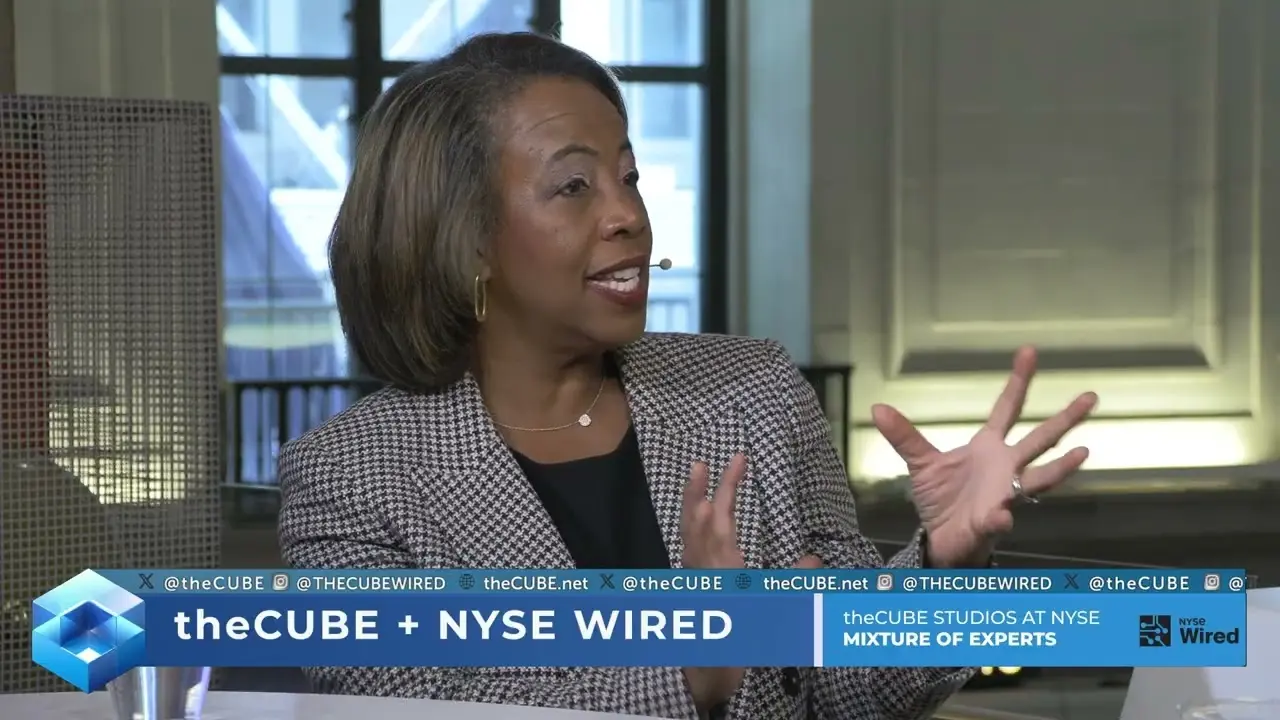
>> Welcome back to theCUBE studio here at the New York Stock Exchange. I'm Gemma Allen with NYSE Wired: Mixture of Experts, and joining me now from Los Angeles is Chris Matarese, President and Co-Founder of NinjaOne. Welcome, Chris.
Chris Matarese
>> Hi, thank you for having me. Really appreciate being on the show, I'm a big fan.
Gemma Allen
>> Well, we're delighted to have you, especially on the back of what is some very exciting news. We love big news here on theCUBE and NYSC Wired. Maybe let's start there, Chris. Talk to us about this recent funding round you've just gone through.
Chris Matarese
>> Yeah, NinjaOne just announced we closed a $400 million Series C extension at over a $12.3 billion valuation. Really excited to bring on some of the best partners we think in the world to help us grow the business and better serve our customers. NinjaOne is rapidly growing. We had our first profitable quarter in Q1, we've been cashflow positive for the last year. So, we didn't really need the money. Instead, this round was about picking the best possible partners we could to help the business. We had maybe 20 or 30 investors that were interested in the business. We could have raised over a billion or two billion if we wanted to, but instead we used this round to think about how we could best serve our customers, what partners could help us build the best business for our customers, give us advice on product, teach us things, and so we're really excited to bring on some great companies and continue to grow the business.
Gemma Allen
>> Well, it's certainly a very interesting time in the world of IT and control planes and unified platforms. Maybe just to start, this company is 12 years old. A lot has happened in 12 years and I would say specifically a lot has happened in the last three years, right? How has this modern moment and this race towards AI and Agentic AI changed your product strategy, your roadmap? What's happening for you and your team underneath the hood?
Chris Matarese
>> Yeah, I mean, well, first of all, we believe at NinjaOne the hardest problem in IT is complexity and fragmentation at scale. You've got companies that are using literally dozens of point solutions to manage, protect, support endpoints, and using all of those different point solutions creates risk, it costs money, it creates inefficiency and poor service for customers. NinjaOne solves that problem by unifying IT under one SaaS native, modern, unified platform. And that's become even more important today, because when you have point solutions, you inevitably have gaps in between those point solutions and those gaps are vectors for attack. And with AI, we've seen vulnerabilities being exposed more rapidly and we've seen bad actors being able to use AI to quickly attack those vulnerabilities, and having less vulnerabilities and less gaps with one unified solution becomes even more important in this AI world.
Gemma Allen
>> So, you mentioned new attack vectors. We hear a lot about shadow AI and we know that folks bring devices home. We're all guilty of sometimes using the odd LLM to help us with our homework a little bit. What sorts of threats and vulnerabilities are you seeing? Maybe give us some real concrete examples of what's really shifting and changing and what IT departments globally should be more aware of.
Chris Matarese
>> Yeah, I mean, this even started with device proliferation. Originally, everybody had their computer at the office, it was behind a firewall, it was protected. Over the last 10, 20 years, people have had laptops, cell phones, smartwatches, all of these devices that aren't behind firewalls and aren't protected, and NinjaOne protects and monitors all of those devices. And with shadow AI, you're seeing even more vulnerabilities. We've heard a lot about Mythos recently, and Mythos, again, has dramatically, dramatically accelerated the discovery of vulnerabilities and the development of exploits that can attack those vulnerabilities. So it's just a race to patch the vulnerabilities before they're exploited, but the answer isn't just faster patching. I think and that's where Ninja comes in, it's faster and smarter patching. So, Ninja has an AI native patch intelligence tool that will look at a system and determine which of these vulnerabilities are actually exploitable in your environment, which of them need to be patched, which patches work best together, because if you just patch 1,000 things without context, sometimes doing all of those patches shuts down a system more effectively than even an attack could. So by having Ninja's patch intelligence tool let you know what patches to use, when to use them, what order to do it in, maybe what patches not to do together, we're really protecting customers. Even before Mythos and AI, we had a patch sentiment tool, which looks to ... we have over 40,000 customers, we've got data on the patching of those customers. We use data from everywhere to analyze what ... an AI native product to analyze what patches we should use and how to do them. And our customers, even before Mythos and AI would thank us on a regular basis, "Oh, your patch sentiment tool saved us, because it told us not to do this patch. We didn't know in our environment it would've shut us down or it gave us advice to do this patch." So I think that's the key thing is with shadow AI, with devices not behind firewalls, with AI not behind firewalls, you're just going to have all of these open areas of attack, and we try to control, limit those open areas by having the one unified product. We limit the gaps and then we also can patch quickly and fix things immediately.
Gemma Allen
>> So-
Chris Matarese
>> So, we ... go ahead.
Gemma Allen
>> Sorry, just to interrupt there. So, one of the interesting things about Mythos and the narrative that's followed it has been that the response to actually, I guess, fixing these vulnerabilities, to running these patches, to securing these environments has been very slow, right? That's according to Anthropic. I think 80% is still right now in the wild and I guess subject to some sort of attack. But we know that historically, and I'm sure up until even this current moment, that has been because there is a level of challenge and constraint in IT departments. We all grew up in worlds where patching happened on a Friday or it happened overnight, right? That it was something that had to happen when systems were down or folks were offline. How far away are we from that past? And I guess and how close are you seeing your clients, your customers are to this world of real mature security and Mythos response in the world of IT? There is a bridge there to be crossed, right?
Chris Matarese
>> Yeah, no, it's a great question and it's a timely question. I heard a stat that the average patch to vulnerability is negative seven days, so we're seven days behind fixing a vulnerability. It's really a timely question, 'cause Ninja recently released this year an AI native vulnerability scanner tool that is scanning for vulnerabilities in real-time. Many of the competitors in the market, they scan on a weekly basis, 'cause they've got these big heavy products that take a lot of resources so you can't be scanning constantly. We created a native AI-based real-time scanner that discovers vulnerabilities immediately as opposed to waiting until you scan every week. Kind of reminds me of back in the day where you had tape backups where you used to tape backup every week and then continuous backup was developed. So, our scanner is running constantly and then because it's in one pane of glass, again, focusing on really this unified platform. We have one pane of glass, we have a patch tool that we can patch that vulnerability as soon as we find it, and our patch AI sentiment tool will tell you whether or not that patch is safe to do or what adjustments you need to make for your environment. So that really is something that we're seeing sell amazingly right now, because your question, as I said, it is really timely. Being able to scan, patch in real-time from one platform is just a huge advantage to our customers and something there's a lot of excitement about in the market, so we're really excited about it as well.
Gemma Allen
>> One thing we hear a lot on this show when we have folks in, especially in the cyber space specifically is this idea of the potential of mass convergence, right? I think cyber as an industry has talked about this for quite a while, but it's still being quite fragmented. When you think about your platform and the product roadmap ahead, do you see yourself becoming more of a full defense player? Or how do you kind of balance the weight of that from a product offering perspective?
Chris Matarese
>> No, I think we're really focused on managing the endpoint and having one unified management platform, but not going into the real EDR cybersecurity like a CrowdStrike goes into. Instead, we integrate with those tools, but we allow IT technicians to monitor everything, patch everything, and then also integrate into tools like a CrowdStrike to help with the security side of things.
Gemma Allen
>> So, you mentioned Mythos. There has also been, I guess again, in the industry probably, some level of skepticism around Mythos as a very successful marketing exercise by Anthropic, right? This idea that here's all these threats, pay us and we can fix them for you. And that also feeds into this whole debate right now that's happening around the SaaSpocalypse and whether there's going to be one harness level company or one core orchestrator that will run and manage everything for you. What are your thoughts on that debate, Chris, and how do you think about it from the perspective of your own company, your own moat, your own, I guess, offensive strategy for the next five years out?
Chris Matarese
>> Yeah, no, I think there's been a lot of talk about SaaSpocalypse being the death of software or the death of SaaS, but I think more that it's the death of fragmentation. Funding and customers are moving away from point solutions and they're moving towards mission-critical unified platforms like ours. So I don't think investors, I don't think the market, I don't think customers have abandoned SaaS companies, I think they're just becoming more selective about the companies they back, the companies they use. And I think we are moving towards unified platforms, but I don't think it's going to be one platform, one AI Anthropic taking over the world, I think there's definitely a place for companies like Ninja. I think we're actually seeing AI as a tailwind to our business for many reasons, and I think all platforms like ours, and there aren't many, will also have that tailwind. But for us, we see AI as really something that's going to add value to Ninja first, because AI is adding more devices and Ninja monitors devices. So with AI, we're seeing device proliferation. We've been seeing that for a while and even like a fast food restaurant you go to, there are kiosks that are devices, their ordering boards are devices, but also the fryers are now devices, the broilers are devices. You go to factories, to the extent you're getting robots, they're devices, security cameras are devices, printing machines, that is CVS is a device, and Ninja monitors those devices. So as AI grows, we're going to see more devices, more need for monitoring, which we're really excited about. The second thing is we're incorporating AI into every part of our product. I mentioned some of the tools that we're building that are going to make our customers more efficient, and if our customers are more efficient, they can service more of their employees and our business becomes more valuable. But third, we mentioned this, AI is just creating more vectors for attack, so I think having more vectors for attack is a bad thing, but it's a good thing for us, 'cause more things for us to monitor, protect, and manage.
Gemma Allen
>> So Chris, to finish out, I'm always interested in a founder's story and your story's quite interesting, because you're a lawyer turned serial tech entrepreneur who has founded multiple companies with a good pal you met at camp many years ago.
Chris Matarese
>> Yes.
Gemma Allen
>> Talk to me a little bit about, first of all, what makes you two continue to build businesses together? You must be great friends. Do you guys fight at all? And how you kind of think about the leadership style you guys both bring?
Chris Matarese
>> Yeah, no, we actually have been best friends since we were 10. We started our first business when we were 25, not the same level of Ninja, but it was a video game company and we sold it for $2 million and probably was more excited about that than this current round we did. But we've done a number of companies and I guess they've all been successful, so that's why we're still best friends. We don't fight too often, but having somebody you trust completely and the fact that we've been friends forever means I trust him more than ... don't tell my wife, but I trust him more than my wife, I trust more than anybody. Just kidding. But having somebody you trust completely with a different skillset. He is a product guru, he is our defacto head of product. If it was up to him, he'd be working on the product 85% of the time, but I think Ninja succeeds because we have the best product, and in all our companies we've kind of taken the view that there are three things to make a company successful. The first thing is build the best product, the second thing is treat your ... sorry, treat your customers better than you treat anybody else, better than you want to be treated. If you have the best product and you treat your customers well, you're going to win. And the third thing is treat your employees better than anybody else, and that's because happy employees treat customers better and they build better products. So, we've stuck to those three guiding principles in everything we've done throughout all our businesses, even in our investment rounds. In our investment rounds, we've had the ability to get higher prices or raise more money, but instead we've decided we'd rather take less money and pick the best partners and make sure that we stayed in control of the business. So my partner, Sal and I are still the biggest holders in the company. We control the board, we control the vote, we control everything about the business, and to us, that was important so we could stay on our mission, our primary mission of serving our customers better than anybody else does.
Gemma Allen
>> Well-
Chris Matarese
>> That's been exciting and it's been great to do it with a best friend. It makes it feel like play not work, which is fun.
Gemma Allen
>> Well, that's certainly a great story and I love your comment on treating your staff as you would like to be treated, even better than you'd like to be treated, because I think in this moment in 2026 that human capital is more important than ever. So Chris Matarese, thank you so much for joining us on theCUBE at NYSC Wired. I wish you all the best with this new
Chris Matarese
>> Thanks so much for having me.
Gemma Allen
>> Thanks.
Chris Matarese
>> Really appreciate it. Take care.
Gemma Allen
>> I'm Gemma Allen here at theCUBE studio at the NYSC. This is NYSE Wired: Mixture of Experts, thanks for watching.
>> ... Palo Alto Studio Connection, Silicon Valley and Wall Street. I'm and my co-host.
Gemma Allen
>> Welcome back to theCUBE studio here at the New York Stock Exchange. I'm Gemma Allen with NYSE Wired: Mixture of Experts, and joining me now from Los Angeles is Chris Matarese, President and Co-Founder of NinjaOne. Welcome, Chris.
Chris Matarese
>> Hi, thank you for having me. Really appreciate being on the show, I'm a big fan.
Gemma Allen
>> Well, we're delighted to have you, especially on the back of what is some very exciting news. We love big news here on theCUBE and NYSC Wired. Maybe let's start there, Chris. Talk to us about this recent funding round you've just gone through.
Chris Matarese
>> Yeah, NinjaOne just announced we closed a $400 million Series C extension at over a $12.3 billion valuation. Really excited to bring on some of the best partners we think in the world to help us grow the business and better serve our customers. NinjaOne is rapidly growing. We had our first profitable quarter in Q1, we've been cashflow positive for the last year. So, we didn't really need the money. Instead, this round was about picking the best possible partners we could to help the business. We had maybe 20 or 30 investors that were interested in the business. We could have raised over a billion or two billion if we wanted to, but instead we used this round to think about how we could best serve our customers, what partners could help us build the best business for our customers, give us advice on product, teach us things, and so we're really excited to bring on some great companies and continue to grow the business.
Gemma Allen
>> Well, it's certainly a very interesting time in the world of IT and control planes and unified platforms. Maybe just to start, this company is 12 years old. A lot has happened in 12 years and I would say specifically a lot has happened in the last three years, right? How has this modern moment and this race towards AI and Agentic AI changed your product strategy, your roadmap? What's happening for you and your team underneath the hood?
Chris Matarese
>> Yeah, I mean, well, first of all, we believe at NinjaOne the hardest problem in IT is complexity and fragmentation at scale. You've got companies that are using literally dozens of point solutions to manage, protect, support endpoints, and using all of those different point solutions creates risk, it costs money, it creates inefficiency and poor service for customers. NinjaOne solves that problem by unifying IT under one SaaS native, modern, unified platform. And that's become even more important today, because when you have point solutions, you inevitably have gaps in between those point solutions and those gaps are vectors for attack. And with AI, we've seen vulnerabilities being exposed more rapidly and we've seen bad actors being able to use AI to quickly attack those vulnerabilities, and having less vulnerabilities and less gaps with one unified solution becomes even more important in this AI world.
Gemma Allen
>> So, you mentioned new attack vectors. We hear a lot about shadow AI and we know that folks bring devices home. We're all guilty of sometimes using the odd LLM to help us with our homework a little bit. What sorts of threats and vulnerabilities are you seeing? Maybe give us some real concrete examples of what's really shifting and changing and what IT departments globally should be more aware of.
Chris Matarese
>> Yeah, I mean, this even started with device proliferation. Originally, everybody had their computer at the office, it was behind a firewall, it was protected. Over the last 10, 20 years, people have had laptops, cell phones, smartwatches, all of these devices that aren't behind firewalls and aren't protected, and NinjaOne protects and monitors all of those devices. And with shadow AI, you're seeing even more vulnerabilities. We've heard a lot about Mythos recently, and Mythos, again, has dramatically, dramatically accelerated the discovery of vulnerabilities and the development of exploits that can attack those vulnerabilities. So it's just a race to patch the vulnerabilities before they're exploited, but the answer isn't just faster patching. I think and that's where Ninja comes in, it's faster and smarter patching. So, Ninja has an AI native patch intelligence tool that will look at a system and determine which of these vulnerabilities are actually exploitable in your environment, which of them need to be patched, which patches work best together, because if you just patch 1,000 things without context, sometimes doing all of those patches shuts down a system more effectively than even an attack could. So by having Ninja's patch intelligence tool let you know what patches to use, when to use them, what order to do it in, maybe what patches not to do together, we're really protecting customers. Even before Mythos and AI, we had a patch sentiment tool, which looks to ... we have over 40,000 customers, we've got data on the patching of those customers. We use data from everywhere to analyze what ... an AI native product to analyze what patches we should use and how to do them. And our customers, even before Mythos and AI would thank us on a regular basis, "Oh, your patch sentiment tool saved us, because it told us not to do this patch. We didn't know in our environment it would've shut us down or it gave us advice to do this patch." So I think that's the key thing is with shadow AI, with devices not behind firewalls, with AI not behind firewalls, you're just going to have all of these open areas of attack, and we try to control, limit those open areas by having the one unified product. We limit the gaps and then we also can patch quickly and fix things immediately.
Gemma Allen
>> So-
Chris Matarese
>> So, we ... go ahead.
Gemma Allen
>> Sorry, just to interrupt there. So, one of the interesting things about Mythos and the narrative that's followed it has been that the response to actually, I guess, fixing these vulnerabilities, to running these patches, to securing these environments has been very slow, right? That's according to Anthropic. I think 80% is still right now in the wild and I guess subject to some sort of attack. But we know that historically, and I'm sure up until even this current moment, that has been because there is a level of challenge and constraint in IT departments. We all grew up in worlds where patching happened on a Friday or it happened overnight, right? That it was something that had to happen when systems were down or folks were offline. How far away are we from that past? And I guess and how close are you seeing your clients, your customers are to this world of real mature security and Mythos response in the world of IT? There is a bridge there to be crossed, right?
Chris Matarese
>> Yeah, no, it's a great question and it's a timely question. I heard a stat that the average patch to vulnerability is negative seven days, so we're seven days behind fixing a vulnerability. It's really a timely question, 'cause Ninja recently released this year an AI native vulnerability scanner tool that is scanning for vulnerabilities in real-time. Many of the competitors in the market, they scan on a weekly basis, 'cause they've got these big heavy products that take a lot of resources so you can't be scanning constantly. We created a native AI-based real-time scanner that discovers vulnerabilities immediately as opposed to waiting until you scan every week. Kind of reminds me of back in the day where you had tape backups where you used to tape backup every week and then continuous backup was developed. So, our scanner is running constantly and then because it's in one pane of glass, again, focusing on really this unified platform. We have one pane of glass, we have a patch tool that we can patch that vulnerability as soon as we find it, and our patch AI sentiment tool will tell you whether or not that patch is safe to do or what adjustments you need to make for your environment. So that really is something that we're seeing sell amazingly right now, because your question, as I said, it is really timely. Being able to scan, patch in real-time from one platform is just a huge advantage to our customers and something there's a lot of excitement about in the market, so we're really excited about it as well.
Gemma Allen
>> One thing we hear a lot on this show when we have folks in, especially in the cyber space specifically is this idea of the potential of mass convergence, right? I think cyber as an industry has talked about this for quite a while, but it's still being quite fragmented. When you think about your platform and the product roadmap ahead, do you see yourself becoming more of a full defense player? Or how do you kind of balance the weight of that from a product offering perspective?
Chris Matarese
>> No, I think we're really focused on managing the endpoint and having one unified management platform, but not going into the real EDR cybersecurity like a CrowdStrike goes into. Instead, we integrate with those tools, but we allow IT technicians to monitor everything, patch everything, and then also integrate into tools like a CrowdStrike to help with the security side of things.
Gemma Allen
>> So, you mentioned Mythos. There has also been, I guess again, in the industry probably, some level of skepticism around Mythos as a very successful marketing exercise by Anthropic, right? This idea that here's all these threats, pay us and we can fix them for you. And that also feeds into this whole debate right now that's happening around the SaaSpocalypse and whether there's going to be one harness level company or one core orchestrator that will run and manage everything for you. What are your thoughts on that debate, Chris, and how do you think about it from the perspective of your own company, your own moat, your own, I guess, offensive strategy for the next five years out?
Chris Matarese
>> Yeah, no, I think there's been a lot of talk about SaaSpocalypse being the death of software or the death of SaaS, but I think more that it's the death of fragmentation. Funding and customers are moving away from point solutions and they're moving towards mission-critical unified platforms like ours. So I don't think investors, I don't think the market, I don't think customers have abandoned SaaS companies, I think they're just becoming more selective about the companies they back, the companies they use. And I think we are moving towards unified platforms, but I don't think it's going to be one platform, one AI Anthropic taking over the world, I think there's definitely a place for companies like Ninja. I think we're actually seeing AI as a tailwind to our business for many reasons, and I think all platforms like ours, and there aren't many, will also have that tailwind. But for us, we see AI as really something that's going to add value to Ninja first, because AI is adding more devices and Ninja monitors devices. So with AI, we're seeing device proliferation. We've been seeing that for a while and even like a fast food restaurant you go to, there are kiosks that are devices, their ordering boards are devices, but also the fryers are now devices, the broilers are devices. You go to factories, to the extent you're getting robots, they're devices, security cameras are devices, printing machines, that is CVS is a device, and Ninja monitors those devices. So as AI grows, we're going to see more devices, more need for monitoring, which we're really excited about. The second thing is we're incorporating AI into every part of our product. I mentioned some of the tools that we're building that are going to make our customers more efficient, and if our customers are more efficient, they can service more of their employees and our business becomes more valuable. But third, we mentioned this, AI is just creating more vectors for attack, so I think having more vectors for attack is a bad thing, but it's a good thing for us, 'cause more things for us to monitor, protect, and manage.
Gemma Allen
>> So Chris, to finish out, I'm always interested in a founder's story and your story's quite interesting, because you're a lawyer turned serial tech entrepreneur who has founded multiple companies with a good pal you met at camp many years ago.
Chris Matarese
>> Yes.
Gemma Allen
>> Talk to me a little bit about, first of all, what makes you two continue to build businesses together? You must be great friends. Do you guys fight at all? And how you kind of think about the leadership style you guys both bring?
Chris Matarese
>> Yeah, no, we actually have been best friends since we were 10. We started our first business when we were 25, not the same level of Ninja, but it was a video game company and we sold it for $2 million and probably was more excited about that than this current round we did. But we've done a number of companies and I guess they've all been successful, so that's why we're still best friends. We don't fight too often, but having somebody you trust completely and the fact that we've been friends forever means I trust him more than ... don't tell my wife, but I trust him more than my wife, I trust more than anybody. Just kidding. But having somebody you trust completely with a different skillset. He is a product guru, he is our defacto head of product. If it was up to him, he'd be working on the product 85% of the time, but I think Ninja succeeds because we have the best product, and in all our companies we've kind of taken the view that there are three things to make a company successful. The first thing is build the best product, the second thing is treat your ... sorry, treat your customers better than you treat anybody else, better than you want to be treated. If you have the best product and you treat your customers well, you're going to win. And the third thing is treat your employees better than anybody else, and that's because happy employees treat customers better and they build better products. So, we've stuck to those three guiding principles in everything we've done throughout all our businesses, even in our investment rounds. In our investment rounds, we've had the ability to get higher prices or raise more money, but instead we've decided we'd rather take less money and pick the best partners and make sure that we stayed in control of the business. So my partner, Sal and I are still the biggest holders in the company. We control the board, we control the vote, we control everything about the business, and to us, that was important so we could stay on our mission, our primary mission of serving our customers better than anybody else does.
Gemma Allen
>> Well-
Chris Matarese
>> That's been exciting and it's been great to do it with a best friend. It makes it feel like play not work, which is fun.
Gemma Allen
>> Well, that's certainly a great story and I love your comment on treating your staff as you would like to be treated, even better than you'd like to be treated, because I think in this moment in 2026 that human capital is more important than ever. So Chris Matarese, thank you so much for joining us on theCUBE at NYSC Wired. I wish you all the best with this new
Chris Matarese
>> Thanks so much for having me.
Gemma Allen
>> Thanks.
Chris Matarese
>> Really appreciate it. Take care.
Gemma Allen
>> I'm Gemma Allen here at theCUBE studio at the NYSC. This is NYSE Wired: Mixture of Experts, thanks for watching.


























































 Gemma Allen