Title: Raphaelle D'Ornano | theCUBE + NYSE Wired: Mixture of Experts
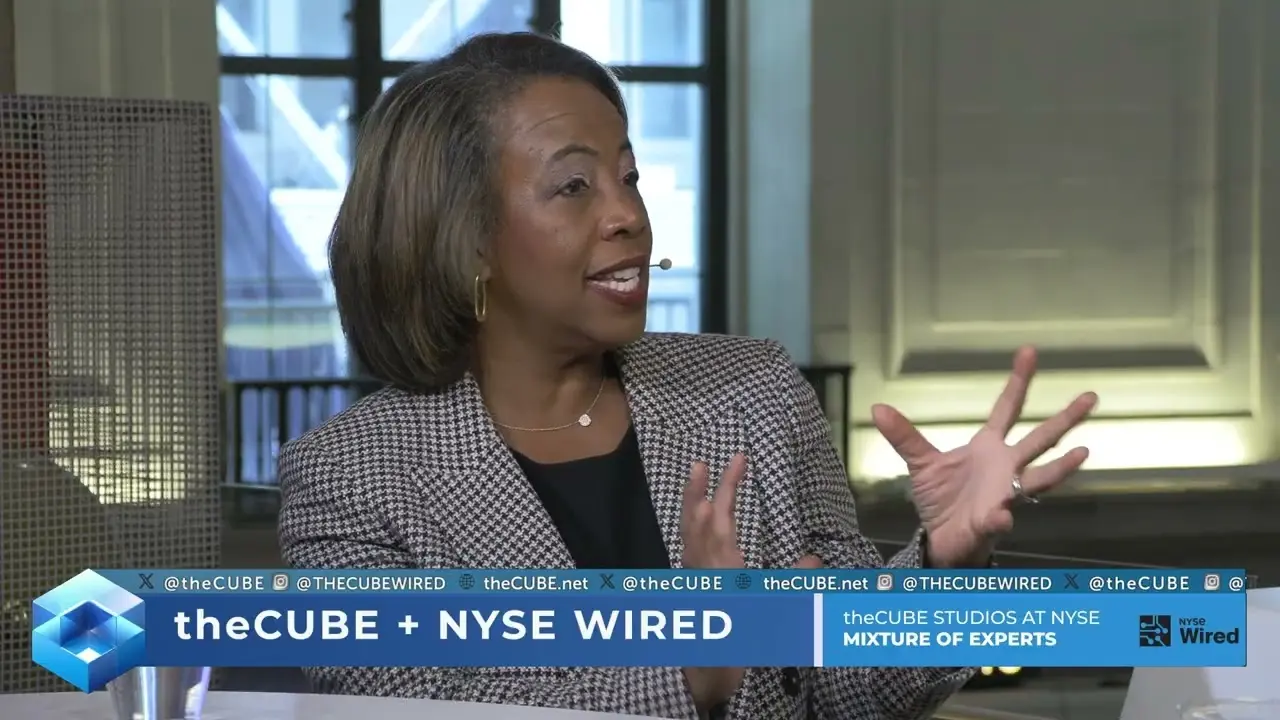
Join host Gemma Allen in this insightful episode of theCUBE's Mixture of Experts series, featuring guest Raphaelle D'Ornano, Chief Executive Officer and Chief Investment Officer of Decoding Discontinuity. Filmed at the New York Stock Exchange, this episode explores the dynamic intersection of Silicon Valley innovation and Wall Street finance.
The discussion introduces Raphaelle D'Ornano, whose extensive experience in the hedge fund sector is marked by significant research within the technology field. D'Ornano, known for work across software, artificial intelligence (AI), and core language learning models (LLMs), shares insights alongside theCUBE Research's analysts and video hosts, examining how companies navigate their transformative journeys in AI.
Key takeaways from this episode of the Mixture of Experts series include D'Ornano's methodology known as the Durable Growth Moat, which assesses architectural resilience in AI-driven business models. D'Ornano emphasizes that understanding agentic AI, compute challenges, and shifts in value creation are critical factors for companies aiming to succeed in a rapidly evolving technological landscape.
Forgot Password
Almost there!
We just sent you a verification email. Please verify your account to gain access to
theCUBE + NYSE Wired: Mixture of Experts Series. If you don’t think you received an email check your
spam folder.
Sign in to theCUBE + NYSE Wired: Mixture of Experts Series.
In order to sign in, enter the email address you used to registered for the event. Once completed, you will receive an email with a verification link. Open this link to automatically sign into the site.
Register For theCUBE + NYSE Wired: Mixture of Experts Series
Please fill out the information below. You will recieve an email with a verification link confirming your registration. Click the link to automatically sign into the site.
You’re almost there!
We just sent you a verification email. Please click the verification button in the email. Once your email address is verified, you will have full access to all event content for theCUBE + NYSE Wired: Mixture of Experts Series.
I want my badge and interests to be visible to all attendees.
Checking this box will display your presense on the attendees list, view your profile and allow other attendees to contact you via 1-1 chat. Read the Privacy Policy. At any time, you can choose to disable this preference.
Select your Interests!
add
Upload your photo
Uploading..
OR
Connect via Twitter
Connect via Linkedin
EDIT PASSWORD
Share
Forgot Password
Almost there!
We just sent you a verification email. Please verify your account to gain access to
theCUBE + NYSE Wired: Mixture of Experts Series. If you don’t think you received an email check your
spam folder.
Sign in to theCUBE + NYSE Wired: Mixture of Experts Series.
In order to sign in, enter the email address you used to registered for the event. Once completed, you will receive an email with a verification link. Open this link to automatically sign into the site.
Sign in to gain access to theCUBE + NYSE Wired: Mixture of Experts Series
Please sign in with LinkedIn to continue to theCUBE + NYSE Wired: Mixture of Experts Series. Signing in with LinkedIn ensures a professional environment.
Are you sure you want to remove access rights for this user?
Details
Manage Access
email address
Community Invitation
Raphaelle D'ornano, Decoding Discontinuity
In this theCUBE + NYSE Wired: Mixture of Experts segment from the New York Stock Exchange, theCUBE’s John Furrier sits down with Raj Verma, CEO of SingleStore, to unpack how the intersection of technology and finance is shaping enterprise strategy. Verma shares why SingleStore is “on course” for the public markets, reflects on brand-building through the company’s partnership with golf Hall of Famer Padraig Harrington and connects that ethos to how SingleStore helps organizations fix struggling data “swings.” The discussion zeroes in on what’s next as Wall Street watches the AI infrastructure buildout: after chips and systems, the software and data layers set the pace for value creation.
Verma outlines why enterprises must modernize “brown” data estates into “green” ones to safely bring corporate context, governance and compliance into LLM workflows via RAG – and why commoditized data-at-rest puts the advantage at the query layer that unifies data in motion with data at rest. He predicts agentic AI will gain reasoning capabilities in roughly 18 months, cites industry indicators like Google reporting ~25% of its software now built by AI and argues that high switching costs will give way to disruption as buyers reassess legacy vendors. The conversation closes with concrete momentum: ~33% YoY growth, ARR in the ~$135M range, gross dollar retention ~98%, cloud NDR ~130, ~50% of business now in the cloud, landing ~3 new customers per day, a path to cash-flow breakeven in the next two quarters and a teaser for AI-related announcements in the next two months. Listeners will find notable stats, real-world use cases and forward-looking views on how databases power reliable AI at enterprise scale.
play_circle_outlineInsightful Leadership: Raphaelle d'Ornano, CEO of Decoding Discontinuity, Shares Hedge Fund Perspectives and Her Multifaceted Background
replyShare Clip
play_circle_outlineDiscussion on the rapid growth of companies like Anthropic and OpenAI in AI sector.
replyShare Clip
play_circle_outlineObservations on the ongoing AI bubble and misconceptions about market dynamics.
replyShare Clip
play_circle_outlineDistinction between training compute and inference compute in AI model development.
replyShare Clip
play_circle_outlineNavigating SaaS Infrastructure: Challenges, Investment Opportunities, and Non-Negotiables Amidst AI Advancements
>> Welcome back to theCUBE. I'm Gemma Allen, here at our studio at the New York Stock Exchange. This is our Mixture of Experts series, connecting Silicon Valley to Wall Street. And joining me today is a woman who is no stranger to big bets and capital markets. Raphaelle d'Ornano, CEO and Chief Investment Officer at Decoding Discontinuity. Welcome to theCUBE.>> Thank you for having me. It's a pleasure.
Gemma Allen
>> So Raphaelle, you have had an interesting career. A fascinating time I think, to be in the hedge fund space, generally. Talk to me a little bit about what brought you to the space, what this last 10 years have been like for you, living between Europe and the US as well, which is of course very interesting. Bring us up to speed on your journey.>> Sure. Well, so I didn't start in tech. I have a background in finance strategy. I have a legal JD, also. So I'm, first, not from the tech space. I fell into tech with the advisory company that I founded 10 years ago, and I've been very fortunate to work on over 800 deals in the technology space. At first in the field of software, then in the field of AI, then in the field of core LLMs. And I've looked at all these businesses, and when AI came along three years ago, because it's been three years. I was like, "This time it's going to be different. This is not just going to be about companies that are technological companies. This is going to be about major disruption." And so I started really researching this AI discontinuity and said, "Well, this is not something that is linear disruption. This is something that is going to completely change the growth profile of a company, and we need to understand what that growth profile is going to look like, in a completely unknown and fast changing environment."
So I started really understanding, what does this AI tech stack look like? Where is the value occurring, et cetera. And I did more and more and more research. I was very privileged to work on the leading AI round, so got an in depth look at companies like CoreWeave, like Anthropic, like OpenAI. So I was like, "Well, this is going to create a massive trillion dollar value dislocation, like more than $10 trillion of value dislocation. And the architectural resilience, how are these companies like regular tech and non-tech companies, how are they positioned for this AI transition? And more so for the agentic AI transition, which is really the paradigm that we can talk about. Well, we need to understand which companies are on the right side of history, and which companies are on the wrong side of history. And so, there needs to be a methodology."
So I built a methodology that is called the Durable Growth Moat. What do Durable Growth Moats look like, in the age of AI and agentic AI, which is both financial adaptability and architectural resilience, so I really mixed the technological component, the financial component to see, "Well, what is the architectural resilience of a company, and how does that translate into more or less value?" So I started screening the whole S&P 500 and I was like, "Wow, there is actually companies that have huge pockets of value that is not seen today, and companies that are on the verge of huge value, like destruction. And so I want to invest behind those convictions."
And so, the methodology is something that I... I refine it every day. This is my passion. I refine, I refine. I started studying agentic AI at Berkeley recently, to get even more into depth. Now I do have this more computer science background, which I didn't have at first, but I'm just fascinated by what is going on.
Gemma Allen
>> Wow. And you mentioned some companies there like Anthropic, OpenAI, CoreWeave. They were companies no one really knew of in mainstream dialogue five years ago. The speed to market, the impact, the big bets, the amount of which they now dominate GDP, it's huge. And it all kind of relays back to this question around, if there's an AI bubble, what is meant by an AI bubble? Is it an AI bubble? Is it a compute challenge? What is really happening? Break that down for me. Break down that narrative.>> So I think that if we look at, we're three years on into ChatGPT, right? Happy birthday, ChatGPT. So again, AI didn't start existing when ChatGPT came to the public, but let's put that as the starting points. If you look at what has happened in the last three years, and in particular in the last six months, in terms of intelligence capabilities. Like PhD level reasoning, or not. In terms of coding capabilities, across all of the different benchmarks. If you look at the adoption of that technology, the numbers speak for themselves. We have models now, Gemini 3 being one of the latest, and we also have models from China like Kimi K2 Thinking, is pretty impressive. We have models now that reason like a PhD level student that did not exist six months ago. We have models that can actually, that are so good at coding that I think that's one of the categories that is in businesses that is going to be disrupted, number one, and which is already happening with very high growth companies that are killing it on this market. So, this is very real. Now, if you look at the adoption rates of Anthropic, OpenAI. I mean, Anthropic, I was at the Deal book Summit yesterday with Dario, and he was giving the figures. So this is public. The company went from one billion ARR, so annual recurring revenue, to 10 billion this year, projected 10 billion. He doesn't know, we don't know, but let's say. So it's 10 times. Some people are saying that it's going to be 70 billion ARR next year. He said that he didn't want to give a number, but I mean, the numbers we're talking about like a 10X increase in ARR. So 10X increase, that is completely unknown, and that's very real. So the fact that we're saying that there is a bubble, I think we need to really break down the components. Like you have this exponential progress, you have a bottleneck on compute, on training compute, on inference compute. You have to make the distinction, which I'm not seeing enough in the press, like all compute is not equal. Training is one shot, it's to train models that are better and better. Inference compute is like, "What is the compute that you use to actually have the model work and produce the day-to-day applications?" So all of these neoclouds and the hyperscalers do not address the same needs. So yes, there is a compute bottleneck, there is an exponential growth, and there is trillions of value that is yet to be captured by tech and non-tech companies that are at 1% of their agentic AI transformation. So I think that there's a lot of risks in terms, of course, the circular financing, the dependency that we have on, I mean, OpenAI more so than NVIDIA. I mean, OpenAI is at the center of so many of these deals in compute and in non-compute, so it has to be proven that OpenAI will actually be able to get the funding up until an IPO, or whatever liquidity event. I mean, that is a big question mark, and that could blow up in a very bad way. That's my opinion.
Gemma Allen
>> Well, let's talk about the circularity of that, because you mentioned NVIDIA, OpenAI, Oracle. Google is another player that's had a baller of a month, right?>> Right.
Gemma Allen
>> They're really getting great press, in terms of what they've developed. But there is, again, very, in some ways a small circle of huge hyperscalers, and new players to that game, like OpenAI. That are, in a way, obviously they're parsing the internet in many senses, but they're also kind of parsing opportunity, right? And how do you think about that? How do you think about the circularity aspect of it? Where do you see the real risk?>> I mean, again, I think the starting point is that you do not want to be left out of what is happening. The point is, OpenAI needs to get financed up until a certain degree, because up until now, and "up until now" is very important in my equation. This summer, OpenAI was leading all of the benchmarks, Anthropic was really killing it on the coding perspective, and their Sonnet and Opus models were already super good. And I mean, in the enterprise, they're the leaders. But OpenAI had kind of a technical supremacy that was, I would say, unchallenged. And I remember on Polymarket, and this was in August when GPT-5 was released, it was saying, "Maybe by September, the best model becomes Google." And few people believed that. This was this August, like a couple of months ago, right? So now you have a company that was set to be the company that everyone had to finance, because they were building the technology that would enable these massive billions of dollars, trillions of dollars of productivity gains, that needed to be financed. This company, the biggest part of its cost structure is what we call training compute. So the cost of training the new models, GPT-5, GPT-6, et cetera. And the training follows what we call the scaling laws, meaning, the more compute you put, the better your model is. And that has been the case. If you look at all of the GPT models, except for GPT-5 for certain reasons, you really have more compute equals better performance. Better performance is critical to reach the frontier, what we call state-of-the-art models. If you're not at the frontier, that 1% difference actually makes an impact. When people say, "Oh, all of these companies are in the same 5% range," that's not the right way to look at this. Because the 1% in coding, or in other reasoning capabilities, will make your agentic capabilities work and have people say, "Wow, this is great," or not work and have people say, "Oh, this is all failing. This is a scam." So you need to hit the frontier. So to hit the frontier, you need compute. To get compute, well, you need to pay for compute. NVIDIA up until now had all of the compute for the training parts. So of course, understandable, but-
Gemma Allen
>> What are your thoughts on the other non-negotiables? Obviously, compute is huge, energy, that's a massive, massive... The infrastructure layer is huge, right? But what are the other, like when you think about decoding the S&P 500, which is fascinating by the way. What are the other real non-negotiables you're looking for? What do you have to see?>> Right. So one sector that I'm very bullish on right now, it's really the software around what I call SaaS infrastructure. So companies like Elastic, though they were quite smashed last week, Datadog, Confluence, MongoDB, which is one of my favorites. All of these companies that are building the infrastructure layer, like the agentic railways for all of this to happen, I think that that sector as a whole is positioned very well. Because to get to agentic AI, if we really take a second on that, we need to move from generative AI as a technology to agentic AI as a paradigm. In the sense that agentic AI is a complicated architectural construction, by which agents are able to coordinate with other agents and produce tangible business outcomes. That's where we want to head, from an AI perspective, for all of this to translate into earnings. This is what we want. We're at the New York Stock Exchange. We want earnings, in the end, right? So for all of this to happen, we need a sophisticated architectural build out. That build out is, for example, memory systems. Today we need short term, long term, episodic, semantic memory. Well, we need companies that are building that. We need observability tools. We need to make sure that agents are going to say, sorry. LLMs. And so agents are going to say the same thing when they're called upon 1000 times, that there's not going to be 1000 different responses, because otherwise it doesn't work. If you're working for a financial or a healthcare institution, and you have 1000 different responses on a single LLM call, that doesn't work. So there's a lot to be built over the next months, and the next, I don't know if it's next months or next years but for sure the next months, to make this architectural construction a reality. Because it is not. Agentic AI today, we have AI agents. We don't yet have true agentic AI. And so, we want to get that working. When that works, we will have something that allows for much more expansion. So I think, that whole sector, I'm very bullish on.
Gemma Allen
>> Do you think we don't have true agentic AI yet, like your true supercomputers per se, because the capability isn't quite tuned? Or because the energy constraints aren't met? What do you think is, if you were to sum it up really quickly, what do you think is truly the bottleneck? And what do you think we need to do to get there? Because it feels like it's always five years away, right?>> So I think if, again, if you take agentic AI. What we need is models that are at the frontier, and models that are super good at coding. I've published on this, I think coding is the witch. If you're able to crack the coding use case, that's how you go into the whole enterprise system. So we needed models that are able to be extremely good at coding. If you look at Kimi K2 Thinking, the new Chinese model, it's called the agentic AI LLM. The marketing works well. Gemini 3 communicates a lot in that. So we are only starting to reach. This is like, we're talking about the last month, this is not the last six months. This is literally the last 30 days, right? We have models now that are really hitting the frontier on what matters for agentic AI to work. So in my perspective, of course, infrastructure like energy is a bottleneck. But I see that as a bottleneck to train the next LLMs. For me, those models are still coming out. We do have like a ChatGPT 5.1, we have OPUS 4.5. So of course it's a critical bottleneck, and I don't mean to say that it's not important. Energy is critical. But if you're asking right now, is energy preventing agentic AI advancements? I don't think-
Gemma Allen
>> But it's going mainstream, I guess. Yeah.>> ... Right. It's two parallel things that need to work together. And yes, can we afford to have three years of queue, to access the grid? Of course not. So this is why you're seeing companies... I mean, I commented on the Fermi IPO. I mean, Fermi got valued, like crazy numbers, because they were able to have that vertical integration and have access to the grid. A private grid. So that does matter. We're seeing some new clouds that have this value proposition.
Gemma Allen
>> Because you mentioned IPOs, and we're here at the NYSE, right? And we had a tag earlier on this week, "Make IPOs great again." And we're hoping to see research in the number of IPOs. But in that LLM category, the big, big disruptive players, the companies we didn't know about that now dominate the conversation. Anthropic, OpenAI. I know they have, like Anthropic is unique, and it's kind of like acqui forma. But perplexity, mystery, whatever. A lot of these companies, do you think that there's almost a safety in staying private for this very ambiguous period of time? How do you see the IPO strategy playing out?>> Well, I think that a part of the market that should not go public right now, it's SaaS. I'm seeing SaaS, it's like a bloodbath. A SaaS company today, like you're going to IPO and it's like, "Oh my God, are you still alive? Is the company still relevant in the age of agentic AI?" I'm seeing that, if you look at all of the value destruction that is happening right now, I mean, enterprise software has been hit really hard. Companies like Adobe, Salesforce, ServiceNow, that are some of the best companies. Adobe and Salesforce are over 30% down over the last 12 months. ServiceNow is down, I think more than 20%, and it's one of the most resilient names in software. So I think right now, the IPO markets are really trying to make sense of this discontinuity. They don't name it like that, but that's what is happening. So now comes those AI companies, that have completely different profiles of growth. Again, from one billion to 10 billion to 100 billion of ARR. That is not your typical growth curve of a SaaS company. They're coming to the market and at the same time people are saying, "Well, this is all commodity, LLMs are a commodity." So I mean, there needs to be an education for the market, because would you be doing an IPO when people think that what you're doing is a commodity? No. Well, what does Anthropic has? Anthropic has an orchestration layer. They launched the MCP, the Model Context Protocol, in November. So Anthropic, they're not just an LLM. They actually have a very strong orchestration layer that is where they build their Durable Growth Moat. So there is a market education that needs to happen to understand. These objects are different from those of the previous tech ways. They have their own anatomy, that's the term, and this is what a good anatomy looks like, and this is what a bad one looks like. And so, this is true not only for those LLM companies, but for all the rest.
Gemma Allen
>> And I guess that reeducation, because if you think about it, 10 years ago when we had this huge tech wave. When there was, some of those wonderful companies you mentioned, that have been major success stories. They would have, if you were to take that thinking, that timeframe, that mindset, and put it into today. A lot of these companies that have probably IPO'ed yesterday, certainly their reservation, or their kind of lack of understanding, is possibly something that needs to be overcome. Because it seems to me as though, until the market is educated, these kind of conversations around skepticism and hype, and the impacts it has kind of on the broader flywheel, is going to remain. How do you kind of adjust the narrative?>> Look, I think we need to get back to fundamentals, because finance is about fundamentals. We need to look at, "What is the revenue profile? Are you able to actually create new streams of revenue? Are you able to build more recurrence in your revenue? Are you able to have that revenue become higher margin?" Number one. Second, "What does your margin structure look like? Are you able to actually change the cost of your cost structure, because you're able to leverage AI and agentic AI across your P&L, starting with R&D and going to other functions?"
So for this to be beyond a bubble, beyond any speculative debate, and this is going to be the case for 2026 and beyond, which I'm very excited about. It's, "How does this now translate to real financial stuff?" Which is what we care about, in the end. It's like, "How does this technology that is great," and that again, I'm a big believer in, "how does that mean that Company A or Company B has a better P&L, has a better CapEx profile, and is able to deliver better returns to its shareholders or not?"
And I think we are going to start seeing that in 2026, of course in 2027, and this is when we're going to have a bifurcation between companies that are able to actually capture those gains, give it back to their customers. And by giving back one or 2% gains in some price sensitive sectors, you gain five or 6% market share. So this is when you're going to have the bifurcation, and the companies that are unable to seize that, that are not even starting to transform their P&L because they're still thinking that, "Oh, 95% of pilots fail." Well, a pilot will obviously fail if it's not done with a clear business outcome. This has made me sick, like this, "Oh, the MIT study, the pilots don't work." But to design a pilot-
Gemma Allen
>> They're very restricted sample sets too, right? So it's->> No, I mean, it's-
Gemma Allen
>> ... qualitative, and conscious of the challenge->> ... right.
Gemma Allen
>> ... of some of those studies, right? No, I mean, I'm a big believer in research, and it's important. But I do think that there are some shortcomings with some of this stuff.>> It's too easy... Again, I can tell you, studying this right now. Agentic AI is not yet a reality. No one will say the contrary. Is there a ton of research by very good students, being done on multi-agent systems, on reward systems, on emergent coordination behaviors in LLMs? All of this is happening as we speak. There are thousands of super talented students, thousands or hundreds of super talented students, that are working on this. So it's going to work at one point. It's normal that it does not yet exist. I'm not questioning that. But as a CEO, as the business leader, you need to navigate in this discontinuity, because otherwise the growth curve is not just going to go this way, it's going to go to zero. And that's going to happen next year, because if you're competitor, if you're in a cost-sensitive industry, which is most of the industries. And your competitor is able to get a 2% margin gain that you have not even started approaching because you don't believe in agentic AI? Well, that's a problem. So again, I have no stakes in agentic AI, which is a technological concept. I just think that the danger of not moving, and of not doing the homework on what is at stake, is for me very dangerous.
Gemma Allen
>> Raphaelle, quick, last few seconds. Wonderful to have you here in theCUBE. Tell us, outside of your big bets in your portfolio I would love to hear more about another day, what are the big bets ahead for you for the next year? What are you working towards? Give us your 30-second pitch.>> In terms of the companies that I'm looking for?
Gemma Allen
>> I guess, what's ahead in your roadmap? What are you focusing in on?>> Well, I'm focusing on really reinforcing this methodology, and I've run it through hundreds of companies, and it's really reality meets theory all at once. So what I have seen so far is that the returns we're having are like, stellar. So it's working, and it's working faster than we expected because again, this agentic optionality could have taken longer to unfold. And we're already seeing massive results. In the sense that the value dislocation, positive or negative, is already a reality. So I'm working on making that super powerful, and kind of a unique tool. I'm working on gaining convictions on what I think are going to be the next technological innovations. I mentioned to you, earlier on today, the move to the edge. I'm a big believer in how, with tiny models that are like five million, seven million parameters, how does this change the profile of so many industries, as you move to the edge? And kind of building a whole thesis around that. I'm very bullish on agentic commerce. I'm not naive on agentic commerce, so I want to see exactly what that implies. But if you take agentic commerce, well then, if you look at Walmart, Costco, Target, American Express, Visa, MasterCard. All of these companies, like PayPal. Which are the ones that are well positioned or not positioned? So I'm working right now on really doing research on some of the themes within the agentic AI discontinuity, according to also where research is going, where the protocols are being built, to see reinforcing the methodology in the right way. And continuing to navigate as technology unfolds.
Gemma Allen
>> Raphaelle, I love following you. Love your Substack. Looking forward to seeing a lot more content from you, I think, in the next couple of months ahead as well. Thank you so much for coming on theCUBE.>> Of course. No, thank you so much for your time. Thank you.
Gemma Allen
>> I'm Gemma Allen, here with theCUBE at our studio at the New York Stock Exchange. This is our Mixture of Experts series. Thanks so much for watching.
>> Welcome back to theCUBE. I'm Gemma Allen, here at our studio at the New York Stock Exchange. This is our Mixture of Experts series, connecting Silicon Valley to Wall Street. And joining me today is a woman who is no stranger to big bets and capital markets. Raphaelle d'Ornano, CEO and Chief Investment Officer at Decoding Discontinuity. Welcome to theCUBE.>> Thank you for having me. It's a pleasure.
Gemma Allen
>> So Raphaelle, you have had an interesting career. A fascinating time I think, to be in the hedge fund space, generally. Talk to me a little bit about what brought you to the space, what this last 10 years have been like for you, living between Europe and the US as well, which is of course very interesting. Bring us up to speed on your journey.>> Sure. Well, so I didn't start in tech. I have a background in finance strategy. I have a legal JD, also. So I'm, first, not from the tech space. I fell into tech with the advisory company that I founded 10 years ago, and I've been very fortunate to work on over 800 deals in the technology space. At first in the field of software, then in the field of AI, then in the field of core LLMs. And I've looked at all these businesses, and when AI came along three years ago, because it's been three years. I was like, "This time it's going to be different. This is not just going to be about companies that are technological companies. This is going to be about major disruption." And so I started really researching this AI discontinuity and said, "Well, this is not something that is linear disruption. This is something that is going to completely change the growth profile of a company, and we need to understand what that growth profile is going to look like, in a completely unknown and fast changing environment."
So I started really understanding, what does this AI tech stack look like? Where is the value occurring, et cetera. And I did more and more and more research. I was very privileged to work on the leading AI round, so got an in depth look at companies like CoreWeave, like Anthropic, like OpenAI. So I was like, "Well, this is going to create a massive trillion dollar value dislocation, like more than $10 trillion of value dislocation. And the architectural resilience, how are these companies like regular tech and non-tech companies, how are they positioned for this AI transition? And more so for the agentic AI transition, which is really the paradigm that we can talk about. Well, we need to understand which companies are on the right side of history, and which companies are on the wrong side of history. And so, there needs to be a methodology."
So I built a methodology that is called the Durable Growth Moat. What do Durable Growth Moats look like, in the age of AI and agentic AI, which is both financial adaptability and architectural resilience, so I really mixed the technological component, the financial component to see, "Well, what is the architectural resilience of a company, and how does that translate into more or less value?" So I started screening the whole S&P 500 and I was like, "Wow, there is actually companies that have huge pockets of value that is not seen today, and companies that are on the verge of huge value, like destruction. And so I want to invest behind those convictions."
And so, the methodology is something that I... I refine it every day. This is my passion. I refine, I refine. I started studying agentic AI at Berkeley recently, to get even more into depth. Now I do have this more computer science background, which I didn't have at first, but I'm just fascinated by what is going on.
Gemma Allen
>> Wow. And you mentioned some companies there like Anthropic, OpenAI, CoreWeave. They were companies no one really knew of in mainstream dialogue five years ago. The speed to market, the impact, the big bets, the amount of which they now dominate GDP, it's huge. And it all kind of relays back to this question around, if there's an AI bubble, what is meant by an AI bubble? Is it an AI bubble? Is it a compute challenge? What is really happening? Break that down for me. Break down that narrative.>> So I think that if we look at, we're three years on into ChatGPT, right? Happy birthday, ChatGPT. So again, AI didn't start existing when ChatGPT came to the public, but let's put that as the starting points. If you look at what has happened in the last three years, and in particular in the last six months, in terms of intelligence capabilities. Like PhD level reasoning, or not. In terms of coding capabilities, across all of the different benchmarks. If you look at the adoption of that technology, the numbers speak for themselves. We have models now, Gemini 3 being one of the latest, and we also have models from China like Kimi K2 Thinking, is pretty impressive. We have models now that reason like a PhD level student that did not exist six months ago. We have models that can actually, that are so good at coding that I think that's one of the categories that is in businesses that is going to be disrupted, number one, and which is already happening with very high growth companies that are killing it on this market. So, this is very real. Now, if you look at the adoption rates of Anthropic, OpenAI. I mean, Anthropic, I was at the Deal book Summit yesterday with Dario, and he was giving the figures. So this is public. The company went from one billion ARR, so annual recurring revenue, to 10 billion this year, projected 10 billion. He doesn't know, we don't know, but let's say. So it's 10 times. Some people are saying that it's going to be 70 billion ARR next year. He said that he didn't want to give a number, but I mean, the numbers we're talking about like a 10X increase in ARR. So 10X increase, that is completely unknown, and that's very real. So the fact that we're saying that there is a bubble, I think we need to really break down the components. Like you have this exponential progress, you have a bottleneck on compute, on training compute, on inference compute. You have to make the distinction, which I'm not seeing enough in the press, like all compute is not equal. Training is one shot, it's to train models that are better and better. Inference compute is like, "What is the compute that you use to actually have the model work and produce the day-to-day applications?" So all of these neoclouds and the hyperscalers do not address the same needs. So yes, there is a compute bottleneck, there is an exponential growth, and there is trillions of value that is yet to be captured by tech and non-tech companies that are at 1% of their agentic AI transformation. So I think that there's a lot of risks in terms, of course, the circular financing, the dependency that we have on, I mean, OpenAI more so than NVIDIA. I mean, OpenAI is at the center of so many of these deals in compute and in non-compute, so it has to be proven that OpenAI will actually be able to get the funding up until an IPO, or whatever liquidity event. I mean, that is a big question mark, and that could blow up in a very bad way. That's my opinion.
Gemma Allen
>> Well, let's talk about the circularity of that, because you mentioned NVIDIA, OpenAI, Oracle. Google is another player that's had a baller of a month, right?>> Right.
Gemma Allen
>> They're really getting great press, in terms of what they've developed. But there is, again, very, in some ways a small circle of huge hyperscalers, and new players to that game, like OpenAI. That are, in a way, obviously they're parsing the internet in many senses, but they're also kind of parsing opportunity, right? And how do you think about that? How do you think about the circularity aspect of it? Where do you see the real risk?>> I mean, again, I think the starting point is that you do not want to be left out of what is happening. The point is, OpenAI needs to get financed up until a certain degree, because up until now, and "up until now" is very important in my equation. This summer, OpenAI was leading all of the benchmarks, Anthropic was really killing it on the coding perspective, and their Sonnet and Opus models were already super good. And I mean, in the enterprise, they're the leaders. But OpenAI had kind of a technical supremacy that was, I would say, unchallenged. And I remember on Polymarket, and this was in August when GPT-5 was released, it was saying, "Maybe by September, the best model becomes Google." And few people believed that. This was this August, like a couple of months ago, right? So now you have a company that was set to be the company that everyone had to finance, because they were building the technology that would enable these massive billions of dollars, trillions of dollars of productivity gains, that needed to be financed. This company, the biggest part of its cost structure is what we call training compute. So the cost of training the new models, GPT-5, GPT-6, et cetera. And the training follows what we call the scaling laws, meaning, the more compute you put, the better your model is. And that has been the case. If you look at all of the GPT models, except for GPT-5 for certain reasons, you really have more compute equals better performance. Better performance is critical to reach the frontier, what we call state-of-the-art models. If you're not at the frontier, that 1% difference actually makes an impact. When people say, "Oh, all of these companies are in the same 5% range," that's not the right way to look at this. Because the 1% in coding, or in other reasoning capabilities, will make your agentic capabilities work and have people say, "Wow, this is great," or not work and have people say, "Oh, this is all failing. This is a scam." So you need to hit the frontier. So to hit the frontier, you need compute. To get compute, well, you need to pay for compute. NVIDIA up until now had all of the compute for the training parts. So of course, understandable, but-
Gemma Allen
>> What are your thoughts on the other non-negotiables? Obviously, compute is huge, energy, that's a massive, massive... The infrastructure layer is huge, right? But what are the other, like when you think about decoding the S&P 500, which is fascinating by the way. What are the other real non-negotiables you're looking for? What do you have to see?>> Right. So one sector that I'm very bullish on right now, it's really the software around what I call SaaS infrastructure. So companies like Elastic, though they were quite smashed last week, Datadog, Confluence, MongoDB, which is one of my favorites. All of these companies that are building the infrastructure layer, like the agentic railways for all of this to happen, I think that that sector as a whole is positioned very well. Because to get to agentic AI, if we really take a second on that, we need to move from generative AI as a technology to agentic AI as a paradigm. In the sense that agentic AI is a complicated architectural construction, by which agents are able to coordinate with other agents and produce tangible business outcomes. That's where we want to head, from an AI perspective, for all of this to translate into earnings. This is what we want. We're at the New York Stock Exchange. We want earnings, in the end, right? So for all of this to happen, we need a sophisticated architectural build out. That build out is, for example, memory systems. Today we need short term, long term, episodic, semantic memory. Well, we need companies that are building that. We need observability tools. We need to make sure that agents are going to say, sorry. LLMs. And so agents are going to say the same thing when they're called upon 1000 times, that there's not going to be 1000 different responses, because otherwise it doesn't work. If you're working for a financial or a healthcare institution, and you have 1000 different responses on a single LLM call, that doesn't work. So there's a lot to be built over the next months, and the next, I don't know if it's next months or next years but for sure the next months, to make this architectural construction a reality. Because it is not. Agentic AI today, we have AI agents. We don't yet have true agentic AI. And so, we want to get that working. When that works, we will have something that allows for much more expansion. So I think, that whole sector, I'm very bullish on.
Gemma Allen
>> Do you think we don't have true agentic AI yet, like your true supercomputers per se, because the capability isn't quite tuned? Or because the energy constraints aren't met? What do you think is, if you were to sum it up really quickly, what do you think is truly the bottleneck? And what do you think we need to do to get there? Because it feels like it's always five years away, right?>> So I think if, again, if you take agentic AI. What we need is models that are at the frontier, and models that are super good at coding. I've published on this, I think coding is the witch. If you're able to crack the coding use case, that's how you go into the whole enterprise system. So we needed models that are able to be extremely good at coding. If you look at Kimi K2 Thinking, the new Chinese model, it's called the agentic AI LLM. The marketing works well. Gemini 3 communicates a lot in that. So we are only starting to reach. This is like, we're talking about the last month, this is not the last six months. This is literally the last 30 days, right? We have models now that are really hitting the frontier on what matters for agentic AI to work. So in my perspective, of course, infrastructure like energy is a bottleneck. But I see that as a bottleneck to train the next LLMs. For me, those models are still coming out. We do have like a ChatGPT 5.1, we have OPUS 4.5. So of course it's a critical bottleneck, and I don't mean to say that it's not important. Energy is critical. But if you're asking right now, is energy preventing agentic AI advancements? I don't think-
Gemma Allen
>> But it's going mainstream, I guess. Yeah.>> ... Right. It's two parallel things that need to work together. And yes, can we afford to have three years of queue, to access the grid? Of course not. So this is why you're seeing companies... I mean, I commented on the Fermi IPO. I mean, Fermi got valued, like crazy numbers, because they were able to have that vertical integration and have access to the grid. A private grid. So that does matter. We're seeing some new clouds that have this value proposition.
Gemma Allen
>> Because you mentioned IPOs, and we're here at the NYSE, right? And we had a tag earlier on this week, "Make IPOs great again." And we're hoping to see research in the number of IPOs. But in that LLM category, the big, big disruptive players, the companies we didn't know about that now dominate the conversation. Anthropic, OpenAI. I know they have, like Anthropic is unique, and it's kind of like acqui forma. But perplexity, mystery, whatever. A lot of these companies, do you think that there's almost a safety in staying private for this very ambiguous period of time? How do you see the IPO strategy playing out?>> Well, I think that a part of the market that should not go public right now, it's SaaS. I'm seeing SaaS, it's like a bloodbath. A SaaS company today, like you're going to IPO and it's like, "Oh my God, are you still alive? Is the company still relevant in the age of agentic AI?" I'm seeing that, if you look at all of the value destruction that is happening right now, I mean, enterprise software has been hit really hard. Companies like Adobe, Salesforce, ServiceNow, that are some of the best companies. Adobe and Salesforce are over 30% down over the last 12 months. ServiceNow is down, I think more than 20%, and it's one of the most resilient names in software. So I think right now, the IPO markets are really trying to make sense of this discontinuity. They don't name it like that, but that's what is happening. So now comes those AI companies, that have completely different profiles of growth. Again, from one billion to 10 billion to 100 billion of ARR. That is not your typical growth curve of a SaaS company. They're coming to the market and at the same time people are saying, "Well, this is all commodity, LLMs are a commodity." So I mean, there needs to be an education for the market, because would you be doing an IPO when people think that what you're doing is a commodity? No. Well, what does Anthropic has? Anthropic has an orchestration layer. They launched the MCP, the Model Context Protocol, in November. So Anthropic, they're not just an LLM. They actually have a very strong orchestration layer that is where they build their Durable Growth Moat. So there is a market education that needs to happen to understand. These objects are different from those of the previous tech ways. They have their own anatomy, that's the term, and this is what a good anatomy looks like, and this is what a bad one looks like. And so, this is true not only for those LLM companies, but for all the rest.
Gemma Allen
>> And I guess that reeducation, because if you think about it, 10 years ago when we had this huge tech wave. When there was, some of those wonderful companies you mentioned, that have been major success stories. They would have, if you were to take that thinking, that timeframe, that mindset, and put it into today. A lot of these companies that have probably IPO'ed yesterday, certainly their reservation, or their kind of lack of understanding, is possibly something that needs to be overcome. Because it seems to me as though, until the market is educated, these kind of conversations around skepticism and hype, and the impacts it has kind of on the broader flywheel, is going to remain. How do you kind of adjust the narrative?>> Look, I think we need to get back to fundamentals, because finance is about fundamentals. We need to look at, "What is the revenue profile? Are you able to actually create new streams of revenue? Are you able to build more recurrence in your revenue? Are you able to have that revenue become higher margin?" Number one. Second, "What does your margin structure look like? Are you able to actually change the cost of your cost structure, because you're able to leverage AI and agentic AI across your P&L, starting with R&D and going to other functions?"
So for this to be beyond a bubble, beyond any speculative debate, and this is going to be the case for 2026 and beyond, which I'm very excited about. It's, "How does this now translate to real financial stuff?" Which is what we care about, in the end. It's like, "How does this technology that is great," and that again, I'm a big believer in, "how does that mean that Company A or Company B has a better P&L, has a better CapEx profile, and is able to deliver better returns to its shareholders or not?"
And I think we are going to start seeing that in 2026, of course in 2027, and this is when we're going to have a bifurcation between companies that are able to actually capture those gains, give it back to their customers. And by giving back one or 2% gains in some price sensitive sectors, you gain five or 6% market share. So this is when you're going to have the bifurcation, and the companies that are unable to seize that, that are not even starting to transform their P&L because they're still thinking that, "Oh, 95% of pilots fail." Well, a pilot will obviously fail if it's not done with a clear business outcome. This has made me sick, like this, "Oh, the MIT study, the pilots don't work." But to design a pilot-
Gemma Allen
>> They're very restricted sample sets too, right? So it's->> No, I mean, it's-
Gemma Allen
>> ... qualitative, and conscious of the challenge->> ... right.
Gemma Allen
>> ... of some of those studies, right? No, I mean, I'm a big believer in research, and it's important. But I do think that there are some shortcomings with some of this stuff.>> It's too easy... Again, I can tell you, studying this right now. Agentic AI is not yet a reality. No one will say the contrary. Is there a ton of research by very good students, being done on multi-agent systems, on reward systems, on emergent coordination behaviors in LLMs? All of this is happening as we speak. There are thousands of super talented students, thousands or hundreds of super talented students, that are working on this. So it's going to work at one point. It's normal that it does not yet exist. I'm not questioning that. But as a CEO, as the business leader, you need to navigate in this discontinuity, because otherwise the growth curve is not just going to go this way, it's going to go to zero. And that's going to happen next year, because if you're competitor, if you're in a cost-sensitive industry, which is most of the industries. And your competitor is able to get a 2% margin gain that you have not even started approaching because you don't believe in agentic AI? Well, that's a problem. So again, I have no stakes in agentic AI, which is a technological concept. I just think that the danger of not moving, and of not doing the homework on what is at stake, is for me very dangerous.
Gemma Allen
>> Raphaelle, quick, last few seconds. Wonderful to have you here in theCUBE. Tell us, outside of your big bets in your portfolio I would love to hear more about another day, what are the big bets ahead for you for the next year? What are you working towards? Give us your 30-second pitch.>> In terms of the companies that I'm looking for?
Gemma Allen
>> I guess, what's ahead in your roadmap? What are you focusing in on?>> Well, I'm focusing on really reinforcing this methodology, and I've run it through hundreds of companies, and it's really reality meets theory all at once. So what I have seen so far is that the returns we're having are like, stellar. So it's working, and it's working faster than we expected because again, this agentic optionality could have taken longer to unfold. And we're already seeing massive results. In the sense that the value dislocation, positive or negative, is already a reality. So I'm working on making that super powerful, and kind of a unique tool. I'm working on gaining convictions on what I think are going to be the next technological innovations. I mentioned to you, earlier on today, the move to the edge. I'm a big believer in how, with tiny models that are like five million, seven million parameters, how does this change the profile of so many industries, as you move to the edge? And kind of building a whole thesis around that. I'm very bullish on agentic commerce. I'm not naive on agentic commerce, so I want to see exactly what that implies. But if you take agentic commerce, well then, if you look at Walmart, Costco, Target, American Express, Visa, MasterCard. All of these companies, like PayPal. Which are the ones that are well positioned or not positioned? So I'm working right now on really doing research on some of the themes within the agentic AI discontinuity, according to also where research is going, where the protocols are being built, to see reinforcing the methodology in the right way. And continuing to navigate as technology unfolds.
Gemma Allen
>> Raphaelle, I love following you. Love your Substack. Looking forward to seeing a lot more content from you, I think, in the next couple of months ahead as well. Thank you so much for coming on theCUBE.>> Of course. No, thank you so much for your time. Thank you.
Gemma Allen
>> I'm Gemma Allen, here with theCUBE at our studio at the New York Stock Exchange. This is our Mixture of Experts series. Thanks so much for watching.
















































 Gemma Allen