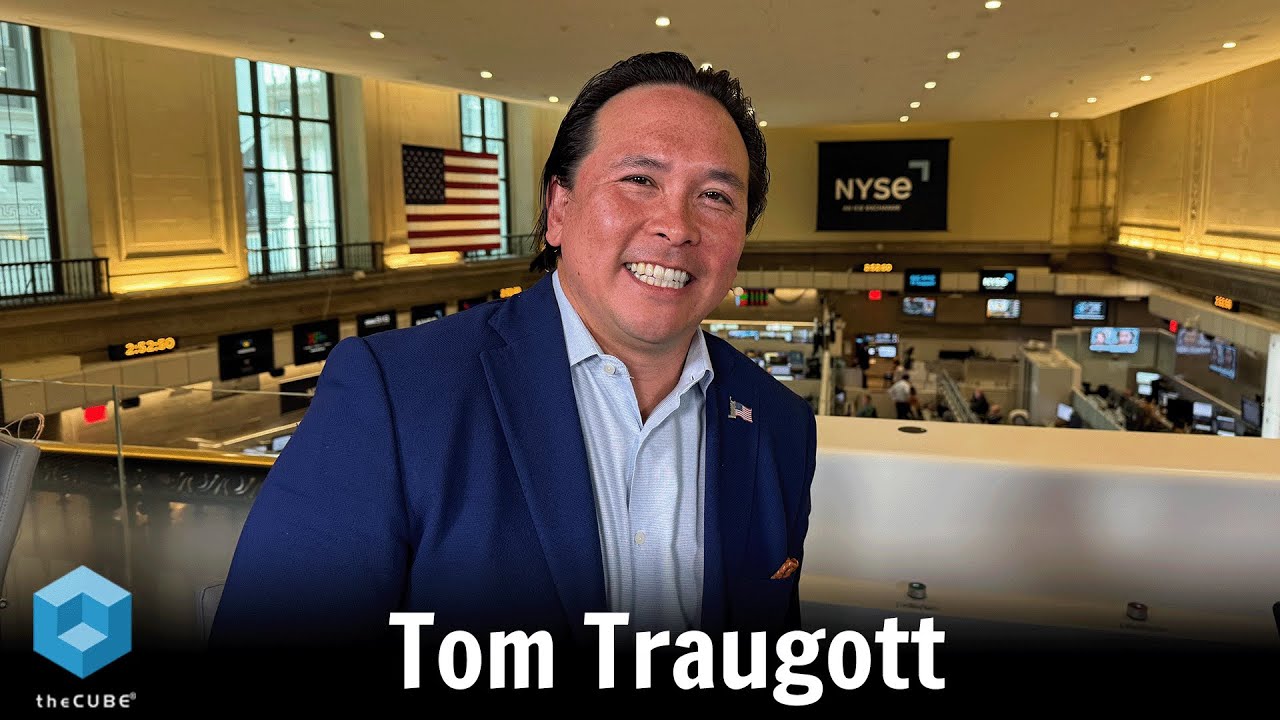
This interview appears on theCUBE and NYSE Wired Mixture of Experts at the New York Stock Exchange. Thomas Wyatt of Twilio, chief revenue officer, appears as a guest. Wyatt discusses Twilio's evolution and its role as an orchestration layer for artificial intelligence-enabled agents, explaining how the company integrates communications identity and customer memory to power personalized two-way interactions. The segment is hosted by John Furrier Gemma Allen and Dave Vellante and is produced with theCUBE Research.
Key takeaways include Twilio's neutral integration strategy and carrier footprint linking thousands of networks, plus built-in fraud prevention compliance and identity verification services that enable secure personalized agent experiences. Wyatt notes that usage-based pricing and a unified memory layer drive consolidation and adoption across self-service startups independent software vendors and large enterprises. Analysts on theCUBE observe accelerating demand as AI reshapes customer engagement and omnichannel communication infrastructure.
Forgot Password
Almost there!
We just sent you a verification email. Please verify your account to gain access to
theCUBE + NYSE Wired: Mixture of Experts Series. If you don’t think you received an email check your
spam folder.
Sign in to theCUBE + NYSE Wired: Mixture of Experts Series.
In order to sign in, enter the email address you used to registered for the event. Once completed, you will receive an email with a verification link. Open this link to automatically sign into the site.
Register For theCUBE + NYSE Wired: Mixture of Experts Series
Please fill out the information below. You will recieve an email with a verification link confirming your registration. Click the link to automatically sign into the site.
You’re almost there!
We just sent you a verification email. Please click the verification button in the email. Once your email address is verified, you will have full access to all event content for theCUBE + NYSE Wired: Mixture of Experts Series.
I want my badge and interests to be visible to all attendees.
Checking this box will display your presense on the attendees list, view your profile and allow other attendees to contact you via 1-1 chat. Read the Privacy Policy. At any time, you can choose to disable this preference.
Select your Interests!
add
Upload your photo
Uploading..
OR
Connect via Twitter
Connect via Linkedin
EDIT PASSWORD
Share
Forgot Password
Almost there!
We just sent you a verification email. Please verify your account to gain access to
theCUBE + NYSE Wired: Mixture of Experts Series. If you don’t think you received an email check your
spam folder.
Sign in to theCUBE + NYSE Wired: Mixture of Experts Series.
In order to sign in, enter the email address you used to registered for the event. Once completed, you will receive an email with a verification link. Open this link to automatically sign into the site.
Sign in to gain access to theCUBE + NYSE Wired: Mixture of Experts Series
Please sign in with LinkedIn to continue to theCUBE + NYSE Wired: Mixture of Experts Series. Signing in with LinkedIn ensures a professional environment.
Are you sure you want to remove access rights for this user?
Details
Manage Access
email address
Community Invitation
Thomas Wyatt, Twilio
This interview appears on theCUBE and NYSE Wired Mixture of Experts at the New York Stock Exchange. Thomas Wyatt of Twilio, chief revenue officer, appears as a guest. Wyatt discusses Twilio's evolution and its role as an orchestration layer for artificial intelligence-enabled agents, explaining how the company integrates communications identity and customer memory to power personalized two-way interactions. The segment is hosted by John Furrier Gemma Allen and Dave Vellante and is produced with theCUBE Research.
Key takeaways include Twilio's neutral integration strategy and carrier footprint linking thousands of networks, plus built-in fraud prevention compliance and identity verification services that enable secure personalized agent experiences. Wyatt notes that usage-based pricing and a unified memory layer drive consolidation and adoption across self-service startups independent software vendors and large enterprises. Analysts on theCUBE observe accelerating demand as AI reshapes customer engagement and omnichannel communication infrastructure.
>> Palo Alto studio connecting Silicon Valley and Wall Street. I'm John Furrier, host of theCUBE here with Dave Vellante, my co-host.
Gemma Allen
>> Welcome back to theCUBE Studio here at the New York Stock Exchange. I'm Gemma Allen with NYSE Wired's Mixture of Experts. And today at the NYSE, we have Twilio who are celebrating 10 years on the stock market. Joining me now to take me to the ups and downs and all the excitement ahead for that journey is Thomas Wyatt, Chief Revenue Officer at Twilio. Welcome, Thomas.
Thomas Wyatt
>> It's great to be here. Thanks, Gemma.
Gemma Allen
>> So 10 years on the NYSE.
Thomas Wyatt
>> 10 years, yeah.
Gemma Allen
>> I mean, what a 10 years it's been. I liked in the short brief I read about you guys, you said that you were the catalyst for the IPO flood of 2016, right? So hopefully you'll open more floodgates in the market, but talk to us a little bit about 10 years for Twilio, like what that journey has looked like, felt like, and how you're thinking about the moment you're in right now.
Thomas Wyatt
>> Yeah, it's been an amazing 10 years. I've been with the company about 3 of those 10. So a lot of success over the last decade has really come from the original founding team and the employees that were here back in 2016 when we did list as a public company. But the industry's changed a lot in the last 10 years as we've gone through the periods of hyper growth going through COVID and what that meant for technology companies and the adoption of services like Twilio. And then this reacceleration in the lieu of the AI era has been really fascinating to be a part of. And Twilio's been a kind of core AI infrastructure for a lot of what's happening in the agent building that's happening in the industry today.
Gemma Allen
>> And Twilio is one of those products that a lot of us use every day we don't necessarily see, right? It's definitely an infrastructure dev based ... It's the brain and the pipes really behind a lot of the conversations that happen with businesses and services that we use. Talk a little bit about the product evolution, how things have evolved. And I guess we're now one minute in and we haven't said AI yet. So that might be a new record for the week. Talk a little bit about what's happening for you guys from the kind of perspective of agentic.
Thomas Wyatt
>> Yeah. Well, we start with what a lot of people know Twilio for is that we made it really simple to be able to communicate from brands to consumers using a simple API that will allow you to send a text message, make a voice phone call, send an email and do it all in an automated way. And those were key primitives that required every application, mobile app, website, those are just embedded services that are part of that. And that's really what Twilio's underlying infrastructure has provided for the last 15, 16 years. But increasingly what's happening in the industry is that when it comes to building AI applications and agents, the thing is an agent needs to communicate with a human. And the best way to do that is through automated infrastructure that Twilio provides because we're able to bring all of those different channels together with customer memory and contact so you understand exactly who that user is, what the conversation is being had with that user across a variety of different channels, whether it be email, voice, SMS, WhatsApp, RCS, all these different technologies. And then you combine that with AI with large language models to be able to provide a real time kind of two-way conversation powered by personalization through AI. And that's why we've seen a real reacceleration of our business as customers don't view us as an SMS company or they view us as an orchestration layer to communicate to their end users.
Gemma Allen
>> When we think about that dialogue between agent to business to human, so much is shifting so quickly. There's a lot of risks that didn't exist 10 years ago, for sure, even two years ago when we think about how we govern or how any business has a entire guardrail around who is communicating with whom, when, how. Talk a little bit about that side of the business and what you're seeing from the kind of threat or opportunity of a landscape around new vectors, new ways in which agents are chatting to, as we know, but what does it mean for your customers?
Thomas Wyatt
>> Well, it's a really great question because so much when you communicate there's a ton of regulatory and compliance that you have to manage into the process as an enterprise communicate to users, they have to opt in. There has to be a certain way you handle data privacy and policies around that. All the campaigns need to be compliant and approved by the carriers, by the infrastructure that's provided. And so Twilio is much more than a software company. We've got a 4,800 carrier network suppliers that are part of our ecosystem and we handle all of the fraud operations and compliance needs required to be able to make sure that customers are not getting spam messages or voice automation is not blowing up their phones all the time. And so part of that is fundamentals that Twilio provides. Then the second part is with AI agents coming on board, it's more important that you understand who's a human and what's an agent and who's actually getting access to phone numbers to be able to make outbound calls or to be able to send messages. And so Twilio has identity and verification products in addition to communication products that allows you to secure and know who a person is, who an agent is, and make sure agents only have the right level of authorization to be able to do certain tasks within your developer ecosystem.
Gemma Allen
>> And we hear a lot about observability in AI, right? It's the new kind of buzzword in the cyber space, having a close eye at all times, eyes in the back of your head, I guess, really in terms of what's happening across your stack. How do you guys think about that? Do you see yourself becoming more of a cyber ancillary or even kind of more of a cyber related company, or do you very much see yourselves as still an infrastructure layer that cyber companies will build on top of?
Thomas Wyatt
>> Yeah, I think it's more the latter. We view ourselves as an AI infrastructure provider that helps with communications, personalization, and the ability to identify and verify users say they are who they say they are. So even today, majority of two-factor authentication runs through Twilio, even that's embedded in some of the largest security companies that we all use day in and day out for other security needs. But more importantly for us is as developers and builders, and developers are no longer just coders anymore, right? Vibe coding and builders can really do an awful lot of building. And so when you need to be able to communicate across any channel and have a two-way conversation and you want it personalized because you want to pull in data from systems of record or recent transactions or mobile analytics or web analytics and you want to personalize that experience, one element of that is identity and understanding is this person who they said they were, number one. And separately, what do I know about this person as a brand? How can I aggregate a unified profile of what I know about Thomas Wyatt so that my response in real time through messaging or voice assistant that could be fully AI enabled injects that personal data into that real time conversation and now a user feels like, "This brand really understands me. I'm getting a great experience. I don't have to repeat myself. I don't have to explain what I'm looking for. The brand already knows it." And that's really where Twilio's value add comes in.
Gemma Allen
>> And if we think about the customer experience of that, it means more memory, right?
Thomas Wyatt
>> Yes.
Gemma Allen
>> Understand someone's persona, you need to have more context around that individual user, more security around who that user is.
Thomas Wyatt
>> Yes.
Gemma Allen
>> And then I guess, and I'm guessing more of an action based conversation leads to action, right?
Thomas Wyatt
>> Right.
Gemma Allen
>> That's the whole agentic world we're moving to. How are you guys thinking about that? Do you see a scenario whereby, and I know you have some interesting products here, you will become more of an autonomous action based product where there will be full agency developed within some of these features.
Thomas Wyatt
>> Yeah. So let me start with how the data piece comes together and then we could talk about how we take action from the data. So several years back, we did an acquisition of a company called Segment, which is a customer data platform. And the benefit of a customer data platform is it has integrations with hundreds of systems of records and all of the common tools that most large organizations use to collect data and process it. So with all of those integrations already set up, we can actually hook into the data warehouses, the CRMs, the ticket desk information that businesses have and then we can inject that data in real time during conversations to understand who the person is. And so now the virtual agent, let's say it's a voice agent, you call a brand and you're looking to maybe get a mortgage and you're a consumer and you're like ... We all know mortgage takes multiple steps of underwriting and there's a process that requires a lot of communication and it could be via chat, it could be a email follow up, it could be a voice conversation with a human-
Gemma Allen
>> The painful example.
Thomas Wyatt
>> It is tough, right? We have a lot of banking customers using Twilio under the hood to streamline the mortgage process. And that's an example of where you combine that personalization layer with the conversation infrastructure that we provide. And then when you take action, what we find is whether you're using the AI frontier models or the agent builders like a cursor or some of these examples of those tools, customers can now build their own virtual agents to wrapped around the harness that Twilio provides around personalization and communications and then they can orchestrate the next best actions through that process. So we help with pick the right channel, how to communicate at the right time based on consumers' likely preferences to engage and then users can build more apparatus on top of that through some of these vibe coding tools and make it really cool.
Gemma Allen
>> Let's talk about the relationship with those frontier models and those LMs. I also read that Twilio is the Switzerland in the world of agentic AI, right? It's a safe bet to make.
Thomas Wyatt
>> Yes.
Gemma Allen
>> Talk to me about what that really means. It means that you're developing relationships with all of these different labs, that your product is always going to have mass integration opportunity. It doesn't matter which LLM you're building on, but also what are you seeing? How sticky are these products at an enterprise level and what does it mean from the perspective of your dev teams and your own R&D teams?
Thomas Wyatt
>> Yeah, great question. I think it all starts with philosophically who we've always been. We've always been a company that has been neutral in the sense of whether it was the hyperscalers, making sure that Twilio works across all the different cloud infrastructure providers, whether it's the data warehouses and the systems of record, we've done it, and the frontier labs are really no different because our consumers or our customers, I should say, they want to build whatever the best of breed tool is for the use case that they're trying to complete. And so we build connectors, MCP connectors, skills, et cetera, for all the most common AI labs as well as the infrastructure hyperscalers that have the AI lab LLMs embedded into their processes and that gives customers a full autonomy and choice to plug and play and we provide them the tooling and the templates to make it really easy.
Gemma Allen
>> Talk me through some customer examples. I'd love to hear. You've got some long-term customers here and some huge names. Give me an example of like one of those journeys.
Thomas Wyatt
>> Sure. I mean, I'll give you an example of some of the longtime customers since it's been 10 years since the IPO, but Twilio often really got its mojo going during the gig economy. A lot of the apps that you guys use to hitch a ride or have food delivered or do banking transactions, Twilio's under the hood of all of those companies. But more recently what we're seeing is the AI natives. A lot of the AI startups that are building voice agents, that are building multi-channel communication infrastructure for verticals like real estate or small businesses or healthcare. I'll give you an example of a car dealership, an ISV that builds software for car dealerships. Many of them are relatively small businesses and they don't have the infrastructure to do everything technically. So they go to a third party like an ISV to be able to set up that software to do it. And we all know the experience of dropping a car off for service, right? It's a bit of a hassle. You got to make a phone call, set up an appointment, drop the car off. It can be like, "Oh, I got to wait in line to check in and all of that." Well, the modern car dealerships are saying, "Well, let's make this as frictionless as possible." I want to be able to go to a phone ... Should be a voice agent, make a call, schedule the appointment for me. I drop off the car. I don't even have to go in because I send an SMS when I arrive, the car's there. The dealer sends me a text when it's all done with a quote to estimate to approve via email and then I get an invoice at the end. I don't even have to talk to anybody. Those experiences, that whole conversation shifts from being a transactional wait in line kind of frustrating experience to a pretty simple one. Another example is tons of small businesses today that aren't open to do customer support 24 by 7, having voice agents to be able to handle any incoming call during non-working hours and getting a response to frequently asked questions is the use case we're seeing really popular right now. So these are all examples where the modern AI natives are building apps that are powered on Twilio.
Gemma Allen
>> And as we see this craze for AI and agentic infrastructure and agentic opportunity across the stack, are you seeing more longer tail opportunities from like five years ago that are suddenly under pressure to compete from the perspective of market dynamics? Are there customers of Twilios that you really didn't imagine you would have? Or I know you were at the company three years, but 10 years ago, we're suddenly like, wow, everyone needs these services because everyone's in such a rush to compete.
Thomas Wyatt
>> Yeah, absolutely. Well, that's true. What we are seeing is that all different types of customers. So you may or may not know this, but our lion share of customers that get started with Twilio come through our self-service channel, which is a really fast growing channel. We have hundreds of thousands of customers that come in through self-service and then they get started with Twilio and then they eventually grow into larger enterprise accounts. Many of them have become listed on the NYSE over time, right? And so it depends a little bit on the customer profile, whether it's self-service, whether it's a traditional enterprise as you would think about it, or these larger ISVs, which are the software companies that are established that have embedded Twilio as a core underlying feature set inside of their application. And what we find is that there's a lot of younger companies being born that are just signing up with Twilio every day because they realize they have to communicate with that app they're building. Then there's the enterprises that are looking at the way they've done contact centers in the past or the way they've done outbound marketing in the past or the way they communicate with their customers and they're saying there has to be a more modern personalized way to do this. And we're very much leading those conversations. And then it's the third group, which is a lot of the larger software SaaS companies that we've all known and love, that their businesses are being transformed right now to become a little less workflow oriented inside of a SaaS app and more almost like a voice becomes a no user experience, that communications shifts from point and click through a web app to more of a two-way conversation on a mobile device using AI as the front end of that. And that's really where Twilio is helping those ISVs reinvent their workflows.
Gemma Allen
>> Let's talk about the numbers. You are the sales guy at the end of the day, right?
Thomas Wyatt
>> Sure.
Gemma Allen
>> You're leading the revenue for the company. And I mean, you guys have an impressive quarter for sure. Revenue's up, I think 20%. I think I read that just ... Yeah. So I mean, these numbers are showing that there is a real market appetite for this.
Thomas Wyatt
>> Yes.
Gemma Allen
>> Your product as well is usage based, correct?
Thomas Wyatt
>> Yes, yes.
Gemma Allen
>> It's not seat based. It predates the world of usage based, is that true?
Thomas Wyatt
>> Yes, we've always been usage based from-
Gemma Allen
>> Which is really interesting because now that's where the world is moving, right?
Thomas Wyatt
>> Exactly.
Gemma Allen
>> You guys are one step ahead. Talk a little bit about the conversations that you're having with buyers, with IT decision makers in the world of 2026 and how things are changing, shifting. It feels as though, again, just watching on, there's a lot of anxiety around what it would mean to sign up to anything for three to five years in this economy. Tell me what's playing out on your side of that table.
Thomas Wyatt
>> Well, firstly, I'll talk a little bit about the platform itself and then maybe about the consumption model. What we're finding is that where Twilio may have had a good relationship with a customer in the past, it might have been just anchored around one communication channel or one product. And increasingly what we're seeing because of the new software that we've implemented that we've been able to bring together all of the different channels in a way that has a software orchestration layer and a memory layer that makes it much more compelling to actually use Twilio for multiple types of use cases and channels because you get this personalization and seamlessness about it all because everything's integrated. And so what we found is a lot of our customers have, who may have multi-sourced some of these communication tools in the past, they're coming and consolidating with Twilio because we have the right platform services, observability as part of that conversational insight, sentiment, all of those types of reporting that you'd want to know as a brand about your relationship with the consumer, all that is seamlessly now part of the Twilio platform. So with all of that, then the next question is because we are usage based, we don't require customers to have to commit to a certain amount of spend and a certain amount of seats over a certain period of time. Customers have the full path of, "Hey, listen, we have the service, try it, we'll prove it to you. You can use our self-service motion, can use a credit card and if you like it, you can expand with us." And so that motion is just really authentic and it's really product driven and that helps us acquire a majority of our enterprise accounts. And then of course we do have a direct sales team that will nurture accounts once they get to a certain level and that relationship becomes much more high touch and white glove service as the sophistication of the customers increases.
Gemma Allen
>> And when we hear about the opportunity, but also the risk to SaaS companies for mass convergence, for example, right? We hear about this harness layer of frontier models, whether or not, and maybe this is a naive assumption, but some CFOs, for example, we hear say, "Can Anthropic do it all in five years?" How do you guys respond to that?
Thomas Wyatt
>> Sure. I think the thing that you have to understand about Twilio is that it's different in the sense that we're not a software only company, that the core of what Twilio software connects to is the physical infrastructure of carrier networks across the globe. But you're talking about 4,800 networks that have specific connections that we've established. That's everything from business development relationships to compliance and onboarding. There's a lot of regulatory issues with all that. And so what we've done is we've extracted all that complexity so that an enterprise doesn't have to do that with each one of those carriers. And on top of that, most carriers only allow a handful of direct connections total. You can't just sign up for a carrier connection. It's a really difficult process to be qualified to get one. And so from the infrastructure that we provide across that, fundamentally the same way a hyperscaler has the data centers and compute layers, our software is connected to that telecommunication infrastructure that everyone needs. And so the value that we're trying to create is how do we just put a software layer on top of that network that handles all the complexity, the fraud operations, all of the risk so that the LLM models, the software layer on top of it, the ISVs that are building on top of the LLMs, they don't have to worry about any of this. We provide that set of couple lines of code, you embed it into your agent and boom, you're up and running. And so we feel pretty good about our moat from that perspective. And of course our business model is aligned with where the world's going.
Gemma Allen
>> Well, it seems the market agrees with you, Thomas.
Thomas Wyatt
>> Thank you.
Gemma Allen
>> So last question, what's ahead? I mean, we're 10 years in public listed company, 10 years from now, what do you hope this company has achieved?
Thomas Wyatt
>> Yeah, that's a fun question to answer. I think where we are is 10 years ago, I don't know that we would've been thinking about the Twilio being an infrastructure provider for agentic tool sets 10 years ago. It's hard to imagine 10 years from now what will be the most .
Gemma Allen
>> I'm trying to remember if I knew what agentic meant 10 years ago.
Thomas Wyatt
>> I know. I don't think anyone did. We'll probably talk in quantum as the next . But that being said, I think over the next three to five years, you'll see us branch out more broadly into additional adjacent markets where we think the builder community could benefit from more sets of horizontal services similar to what we do around communications and personalizations and identities. So stay tuned for that. .
Gemma Allen
>> Well, the world is certainly your oyster.
Thomas Wyatt
>> Thank you so much.
Gemma Allen
>> Thomas Wyatt, thank you so much for joining us on theCUBE.
Thomas Wyatt
>> My pleasure. Lots of fun.
Gemma Allen
>> And congratulations to you and the team at Twilio.
Thomas Wyatt
>> Thank you. Very kind of you. Thank you.
Gemma Allen
>> I'm Gemma Allen here at theCUBE Studio at the New York Stock Exchange. This is NYSE Wired's Mixture of Experts. Thanks for watching.
>> Palo Alto studio connecting Silicon Valley and Wall Street. I'm John Furrier, host of theCUBE here with Dave Vellante, my co-host.
Gemma Allen
>> Welcome back to theCUBE Studio here at the New York Stock Exchange. I'm Gemma Allen with NYSE Wired's Mixture of Experts. And today at the NYSE, we have Twilio who are celebrating 10 years on the stock market. Joining me now to take me to the ups and downs and all the excitement ahead for that journey is Thomas Wyatt, Chief Revenue Officer at Twilio. Welcome, Thomas.
Thomas Wyatt
>> It's great to be here. Thanks, Gemma.
Gemma Allen
>> So 10 years on the NYSE.
Thomas Wyatt
>> 10 years, yeah.
Gemma Allen
>> I mean, what a 10 years it's been. I liked in the short brief I read about you guys, you said that you were the catalyst for the IPO flood of 2016, right? So hopefully you'll open more floodgates in the market, but talk to us a little bit about 10 years for Twilio, like what that journey has looked like, felt like, and how you're thinking about the moment you're in right now.
Thomas Wyatt
>> Yeah, it's been an amazing 10 years. I've been with the company about 3 of those 10. So a lot of success over the last decade has really come from the original founding team and the employees that were here back in 2016 when we did list as a public company. But the industry's changed a lot in the last 10 years as we've gone through the periods of hyper growth going through COVID and what that meant for technology companies and the adoption of services like Twilio. And then this reacceleration in the lieu of the AI era has been really fascinating to be a part of. And Twilio's been a kind of core AI infrastructure for a lot of what's happening in the agent building that's happening in the industry today.
Gemma Allen
>> And Twilio is one of those products that a lot of us use every day we don't necessarily see, right? It's definitely an infrastructure dev based ... It's the brain and the pipes really behind a lot of the conversations that happen with businesses and services that we use. Talk a little bit about the product evolution, how things have evolved. And I guess we're now one minute in and we haven't said AI yet. So that might be a new record for the week. Talk a little bit about what's happening for you guys from the kind of perspective of agentic.
Thomas Wyatt
>> Yeah. Well, we start with what a lot of people know Twilio for is that we made it really simple to be able to communicate from brands to consumers using a simple API that will allow you to send a text message, make a voice phone call, send an email and do it all in an automated way. And those were key primitives that required every application, mobile app, website, those are just embedded services that are part of that. And that's really what Twilio's underlying infrastructure has provided for the last 15, 16 years. But increasingly what's happening in the industry is that when it comes to building AI applications and agents, the thing is an agent needs to communicate with a human. And the best way to do that is through automated infrastructure that Twilio provides because we're able to bring all of those different channels together with customer memory and contact so you understand exactly who that user is, what the conversation is being had with that user across a variety of different channels, whether it be email, voice, SMS, WhatsApp, RCS, all these different technologies. And then you combine that with AI with large language models to be able to provide a real time kind of two-way conversation powered by personalization through AI. And that's why we've seen a real reacceleration of our business as customers don't view us as an SMS company or they view us as an orchestration layer to communicate to their end users.
Gemma Allen
>> When we think about that dialogue between agent to business to human, so much is shifting so quickly. There's a lot of risks that didn't exist 10 years ago, for sure, even two years ago when we think about how we govern or how any business has a entire guardrail around who is communicating with whom, when, how. Talk a little bit about that side of the business and what you're seeing from the kind of threat or opportunity of a landscape around new vectors, new ways in which agents are chatting to, as we know, but what does it mean for your customers?
Thomas Wyatt
>> Well, it's a really great question because so much when you communicate there's a ton of regulatory and compliance that you have to manage into the process as an enterprise communicate to users, they have to opt in. There has to be a certain way you handle data privacy and policies around that. All the campaigns need to be compliant and approved by the carriers, by the infrastructure that's provided. And so Twilio is much more than a software company. We've got a 4,800 carrier network suppliers that are part of our ecosystem and we handle all of the fraud operations and compliance needs required to be able to make sure that customers are not getting spam messages or voice automation is not blowing up their phones all the time. And so part of that is fundamentals that Twilio provides. Then the second part is with AI agents coming on board, it's more important that you understand who's a human and what's an agent and who's actually getting access to phone numbers to be able to make outbound calls or to be able to send messages. And so Twilio has identity and verification products in addition to communication products that allows you to secure and know who a person is, who an agent is, and make sure agents only have the right level of authorization to be able to do certain tasks within your developer ecosystem.
Gemma Allen
>> And we hear a lot about observability in AI, right? It's the new kind of buzzword in the cyber space, having a close eye at all times, eyes in the back of your head, I guess, really in terms of what's happening across your stack. How do you guys think about that? Do you see yourself becoming more of a cyber ancillary or even kind of more of a cyber related company, or do you very much see yourselves as still an infrastructure layer that cyber companies will build on top of?
Thomas Wyatt
>> Yeah, I think it's more the latter. We view ourselves as an AI infrastructure provider that helps with communications, personalization, and the ability to identify and verify users say they are who they say they are. So even today, majority of two-factor authentication runs through Twilio, even that's embedded in some of the largest security companies that we all use day in and day out for other security needs. But more importantly for us is as developers and builders, and developers are no longer just coders anymore, right? Vibe coding and builders can really do an awful lot of building. And so when you need to be able to communicate across any channel and have a two-way conversation and you want it personalized because you want to pull in data from systems of record or recent transactions or mobile analytics or web analytics and you want to personalize that experience, one element of that is identity and understanding is this person who they said they were, number one. And separately, what do I know about this person as a brand? How can I aggregate a unified profile of what I know about Thomas Wyatt so that my response in real time through messaging or voice assistant that could be fully AI enabled injects that personal data into that real time conversation and now a user feels like, "This brand really understands me. I'm getting a great experience. I don't have to repeat myself. I don't have to explain what I'm looking for. The brand already knows it." And that's really where Twilio's value add comes in.
Gemma Allen
>> And if we think about the customer experience of that, it means more memory, right?
Thomas Wyatt
>> Yes.
Gemma Allen
>> Understand someone's persona, you need to have more context around that individual user, more security around who that user is.
Thomas Wyatt
>> Yes.
Gemma Allen
>> And then I guess, and I'm guessing more of an action based conversation leads to action, right?
Thomas Wyatt
>> Right.
Gemma Allen
>> That's the whole agentic world we're moving to. How are you guys thinking about that? Do you see a scenario whereby, and I know you have some interesting products here, you will become more of an autonomous action based product where there will be full agency developed within some of these features.
Thomas Wyatt
>> Yeah. So let me start with how the data piece comes together and then we could talk about how we take action from the data. So several years back, we did an acquisition of a company called Segment, which is a customer data platform. And the benefit of a customer data platform is it has integrations with hundreds of systems of records and all of the common tools that most large organizations use to collect data and process it. So with all of those integrations already set up, we can actually hook into the data warehouses, the CRMs, the ticket desk information that businesses have and then we can inject that data in real time during conversations to understand who the person is. And so now the virtual agent, let's say it's a voice agent, you call a brand and you're looking to maybe get a mortgage and you're a consumer and you're like ... We all know mortgage takes multiple steps of underwriting and there's a process that requires a lot of communication and it could be via chat, it could be a email follow up, it could be a voice conversation with a human-
Gemma Allen
>> The painful example.
Thomas Wyatt
>> It is tough, right? We have a lot of banking customers using Twilio under the hood to streamline the mortgage process. And that's an example of where you combine that personalization layer with the conversation infrastructure that we provide. And then when you take action, what we find is whether you're using the AI frontier models or the agent builders like a cursor or some of these examples of those tools, customers can now build their own virtual agents to wrapped around the harness that Twilio provides around personalization and communications and then they can orchestrate the next best actions through that process. So we help with pick the right channel, how to communicate at the right time based on consumers' likely preferences to engage and then users can build more apparatus on top of that through some of these vibe coding tools and make it really cool.
Gemma Allen
>> Let's talk about the relationship with those frontier models and those LMs. I also read that Twilio is the Switzerland in the world of agentic AI, right? It's a safe bet to make.
Thomas Wyatt
>> Yes.
Gemma Allen
>> Talk to me about what that really means. It means that you're developing relationships with all of these different labs, that your product is always going to have mass integration opportunity. It doesn't matter which LLM you're building on, but also what are you seeing? How sticky are these products at an enterprise level and what does it mean from the perspective of your dev teams and your own R&D teams?
Thomas Wyatt
>> Yeah, great question. I think it all starts with philosophically who we've always been. We've always been a company that has been neutral in the sense of whether it was the hyperscalers, making sure that Twilio works across all the different cloud infrastructure providers, whether it's the data warehouses and the systems of record, we've done it, and the frontier labs are really no different because our consumers or our customers, I should say, they want to build whatever the best of breed tool is for the use case that they're trying to complete. And so we build connectors, MCP connectors, skills, et cetera, for all the most common AI labs as well as the infrastructure hyperscalers that have the AI lab LLMs embedded into their processes and that gives customers a full autonomy and choice to plug and play and we provide them the tooling and the templates to make it really easy.
Gemma Allen
>> Talk me through some customer examples. I'd love to hear. You've got some long-term customers here and some huge names. Give me an example of like one of those journeys.
Thomas Wyatt
>> Sure. I mean, I'll give you an example of some of the longtime customers since it's been 10 years since the IPO, but Twilio often really got its mojo going during the gig economy. A lot of the apps that you guys use to hitch a ride or have food delivered or do banking transactions, Twilio's under the hood of all of those companies. But more recently what we're seeing is the AI natives. A lot of the AI startups that are building voice agents, that are building multi-channel communication infrastructure for verticals like real estate or small businesses or healthcare. I'll give you an example of a car dealership, an ISV that builds software for car dealerships. Many of them are relatively small businesses and they don't have the infrastructure to do everything technically. So they go to a third party like an ISV to be able to set up that software to do it. And we all know the experience of dropping a car off for service, right? It's a bit of a hassle. You got to make a phone call, set up an appointment, drop the car off. It can be like, "Oh, I got to wait in line to check in and all of that." Well, the modern car dealerships are saying, "Well, let's make this as frictionless as possible." I want to be able to go to a phone ... Should be a voice agent, make a call, schedule the appointment for me. I drop off the car. I don't even have to go in because I send an SMS when I arrive, the car's there. The dealer sends me a text when it's all done with a quote to estimate to approve via email and then I get an invoice at the end. I don't even have to talk to anybody. Those experiences, that whole conversation shifts from being a transactional wait in line kind of frustrating experience to a pretty simple one. Another example is tons of small businesses today that aren't open to do customer support 24 by 7, having voice agents to be able to handle any incoming call during non-working hours and getting a response to frequently asked questions is the use case we're seeing really popular right now. So these are all examples where the modern AI natives are building apps that are powered on Twilio.
Gemma Allen
>> And as we see this craze for AI and agentic infrastructure and agentic opportunity across the stack, are you seeing more longer tail opportunities from like five years ago that are suddenly under pressure to compete from the perspective of market dynamics? Are there customers of Twilios that you really didn't imagine you would have? Or I know you were at the company three years, but 10 years ago, we're suddenly like, wow, everyone needs these services because everyone's in such a rush to compete.
Thomas Wyatt
>> Yeah, absolutely. Well, that's true. What we are seeing is that all different types of customers. So you may or may not know this, but our lion share of customers that get started with Twilio come through our self-service channel, which is a really fast growing channel. We have hundreds of thousands of customers that come in through self-service and then they get started with Twilio and then they eventually grow into larger enterprise accounts. Many of them have become listed on the NYSE over time, right? And so it depends a little bit on the customer profile, whether it's self-service, whether it's a traditional enterprise as you would think about it, or these larger ISVs, which are the software companies that are established that have embedded Twilio as a core underlying feature set inside of their application. And what we find is that there's a lot of younger companies being born that are just signing up with Twilio every day because they realize they have to communicate with that app they're building. Then there's the enterprises that are looking at the way they've done contact centers in the past or the way they've done outbound marketing in the past or the way they communicate with their customers and they're saying there has to be a more modern personalized way to do this. And we're very much leading those conversations. And then it's the third group, which is a lot of the larger software SaaS companies that we've all known and love, that their businesses are being transformed right now to become a little less workflow oriented inside of a SaaS app and more almost like a voice becomes a no user experience, that communications shifts from point and click through a web app to more of a two-way conversation on a mobile device using AI as the front end of that. And that's really where Twilio is helping those ISVs reinvent their workflows.
Gemma Allen
>> Let's talk about the numbers. You are the sales guy at the end of the day, right?
Thomas Wyatt
>> Sure.
Gemma Allen
>> You're leading the revenue for the company. And I mean, you guys have an impressive quarter for sure. Revenue's up, I think 20%. I think I read that just ... Yeah. So I mean, these numbers are showing that there is a real market appetite for this.
Thomas Wyatt
>> Yes.
Gemma Allen
>> Your product as well is usage based, correct?
Thomas Wyatt
>> Yes, yes.
Gemma Allen
>> It's not seat based. It predates the world of usage based, is that true?
Thomas Wyatt
>> Yes, we've always been usage based from-
Gemma Allen
>> Which is really interesting because now that's where the world is moving, right?
Thomas Wyatt
>> Exactly.
Gemma Allen
>> You guys are one step ahead. Talk a little bit about the conversations that you're having with buyers, with IT decision makers in the world of 2026 and how things are changing, shifting. It feels as though, again, just watching on, there's a lot of anxiety around what it would mean to sign up to anything for three to five years in this economy. Tell me what's playing out on your side of that table.
Thomas Wyatt
>> Well, firstly, I'll talk a little bit about the platform itself and then maybe about the consumption model. What we're finding is that where Twilio may have had a good relationship with a customer in the past, it might have been just anchored around one communication channel or one product. And increasingly what we're seeing because of the new software that we've implemented that we've been able to bring together all of the different channels in a way that has a software orchestration layer and a memory layer that makes it much more compelling to actually use Twilio for multiple types of use cases and channels because you get this personalization and seamlessness about it all because everything's integrated. And so what we found is a lot of our customers have, who may have multi-sourced some of these communication tools in the past, they're coming and consolidating with Twilio because we have the right platform services, observability as part of that conversational insight, sentiment, all of those types of reporting that you'd want to know as a brand about your relationship with the consumer, all that is seamlessly now part of the Twilio platform. So with all of that, then the next question is because we are usage based, we don't require customers to have to commit to a certain amount of spend and a certain amount of seats over a certain period of time. Customers have the full path of, "Hey, listen, we have the service, try it, we'll prove it to you. You can use our self-service motion, can use a credit card and if you like it, you can expand with us." And so that motion is just really authentic and it's really product driven and that helps us acquire a majority of our enterprise accounts. And then of course we do have a direct sales team that will nurture accounts once they get to a certain level and that relationship becomes much more high touch and white glove service as the sophistication of the customers increases.
Gemma Allen
>> And when we hear about the opportunity, but also the risk to SaaS companies for mass convergence, for example, right? We hear about this harness layer of frontier models, whether or not, and maybe this is a naive assumption, but some CFOs, for example, we hear say, "Can Anthropic do it all in five years?" How do you guys respond to that?
Thomas Wyatt
>> Sure. I think the thing that you have to understand about Twilio is that it's different in the sense that we're not a software only company, that the core of what Twilio software connects to is the physical infrastructure of carrier networks across the globe. But you're talking about 4,800 networks that have specific connections that we've established. That's everything from business development relationships to compliance and onboarding. There's a lot of regulatory issues with all that. And so what we've done is we've extracted all that complexity so that an enterprise doesn't have to do that with each one of those carriers. And on top of that, most carriers only allow a handful of direct connections total. You can't just sign up for a carrier connection. It's a really difficult process to be qualified to get one. And so from the infrastructure that we provide across that, fundamentally the same way a hyperscaler has the data centers and compute layers, our software is connected to that telecommunication infrastructure that everyone needs. And so the value that we're trying to create is how do we just put a software layer on top of that network that handles all the complexity, the fraud operations, all of the risk so that the LLM models, the software layer on top of it, the ISVs that are building on top of the LLMs, they don't have to worry about any of this. We provide that set of couple lines of code, you embed it into your agent and boom, you're up and running. And so we feel pretty good about our moat from that perspective. And of course our business model is aligned with where the world's going.
Gemma Allen
>> Well, it seems the market agrees with you, Thomas.
Thomas Wyatt
>> Thank you.
Gemma Allen
>> So last question, what's ahead? I mean, we're 10 years in public listed company, 10 years from now, what do you hope this company has achieved?
Thomas Wyatt
>> Yeah, that's a fun question to answer. I think where we are is 10 years ago, I don't know that we would've been thinking about the Twilio being an infrastructure provider for agentic tool sets 10 years ago. It's hard to imagine 10 years from now what will be the most .
Gemma Allen
>> I'm trying to remember if I knew what agentic meant 10 years ago.
Thomas Wyatt
>> I know. I don't think anyone did. We'll probably talk in quantum as the next . But that being said, I think over the next three to five years, you'll see us branch out more broadly into additional adjacent markets where we think the builder community could benefit from more sets of horizontal services similar to what we do around communications and personalizations and identities. So stay tuned for that. .
Gemma Allen
>> Well, the world is certainly your oyster.
Thomas Wyatt
>> Thank you so much.
Gemma Allen
>> Thomas Wyatt, thank you so much for joining us on theCUBE.
Thomas Wyatt
>> My pleasure. Lots of fun.
Gemma Allen
>> And congratulations to you and the team at Twilio.
Thomas Wyatt
>> Thank you. Very kind of you. Thank you.
Gemma Allen
>> I'm Gemma Allen here at theCUBE Studio at the New York Stock Exchange. This is NYSE Wired's Mixture of Experts. Thanks for watching.