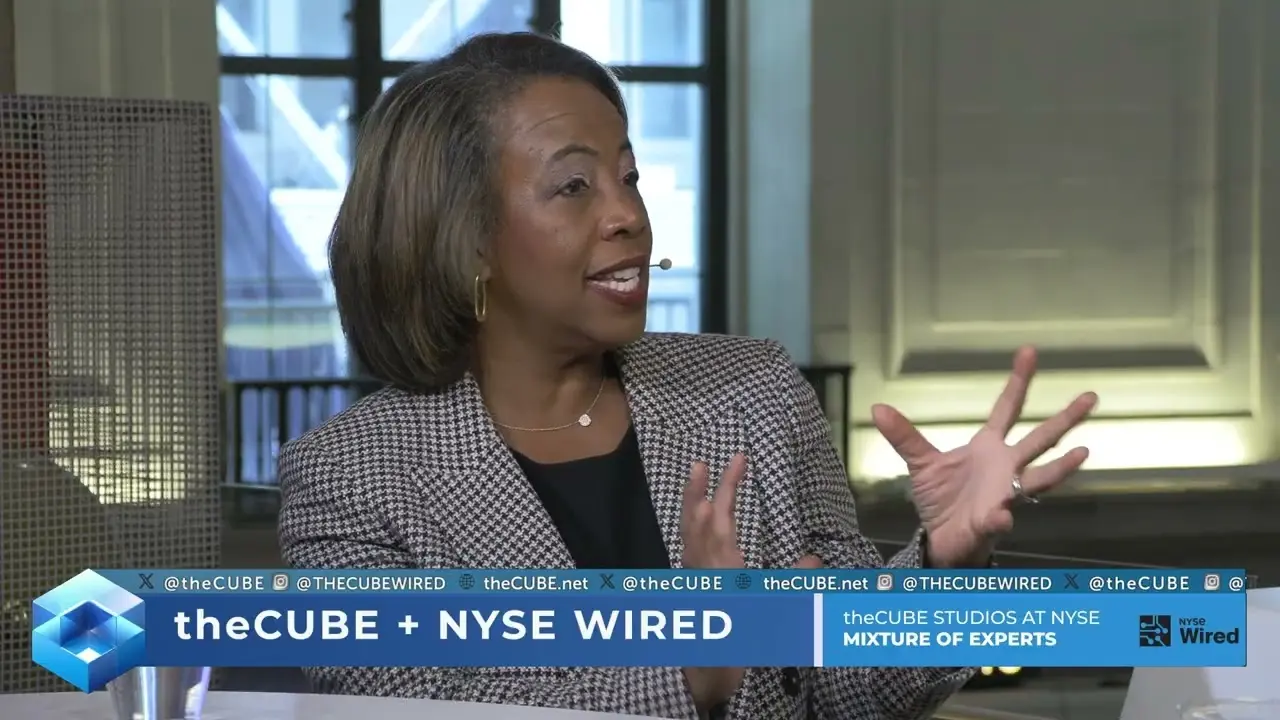
Richard Socher of Recursive Superintelligence and You.com appears with theCUBE Research hosts John Furrier and Dave Vellante at the NYSE Wired studio to discuss mixture of experts, agents and the Eureka Machine and the role of artificial intelligence in accelerating science and industry.
Socher outlines Recursive's approach to recursive self-improvement, agent-based workflows, open-source model optimization and the intersection of foundation models with knowledge graphs, biology and industrial applications such as protein design and corporate AI agents. They emphasize compute as a persistent constraint and the need to prioritize problems for high-impact compute investment. They highlight programmable biology and virtualized experimental platforms as mechanisms to accelerate discovery through what they term the Eureka Machine concept.
The conversation provides practical guidance for enterprise adoption of open-source models and agent-centric architectures to build specialized intelligence affordably while retaining control over proprietary data. Topics include implications for computational biology, protein design, foundation models, knowledge graphs and AI infrastructure for SaaS and industrial applications.
Forgot Password
Almost there!
We just sent you a verification email. Please verify your account to gain access to
theCUBE + NYSE Wired: Mixture of Experts Series. If you don’t think you received an email check your
spam folder.
Sign in to theCUBE + NYSE Wired: Mixture of Experts Series.
In order to sign in, enter the email address you used to registered for the event. Once completed, you will receive an email with a verification link. Open this link to automatically sign into the site.
Register For theCUBE + NYSE Wired: Mixture of Experts Series
Please fill out the information below. You will recieve an email with a verification link confirming your registration. Click the link to automatically sign into the site.
You’re almost there!
We just sent you a verification email. Please click the verification button in the email. Once your email address is verified, you will have full access to all event content for theCUBE + NYSE Wired: Mixture of Experts Series.
I want my badge and interests to be visible to all attendees.
Checking this box will display your presense on the attendees list, view your profile and allow other attendees to contact you via 1-1 chat. Read the Privacy Policy. At any time, you can choose to disable this preference.
Select your Interests!
add
Upload your photo
Uploading..
OR
Connect via Twitter
Connect via Linkedin
EDIT PASSWORD
Share
Forgot Password
Almost there!
We just sent you a verification email. Please verify your account to gain access to
theCUBE + NYSE Wired: Mixture of Experts Series. If you don’t think you received an email check your
spam folder.
Sign in to theCUBE + NYSE Wired: Mixture of Experts Series.
In order to sign in, enter the email address you used to registered for the event. Once completed, you will receive an email with a verification link. Open this link to automatically sign into the site.
Sign in to gain access to theCUBE + NYSE Wired: Mixture of Experts Series
Please sign in with LinkedIn to continue to theCUBE + NYSE Wired: Mixture of Experts Series. Signing in with LinkedIn ensures a professional environment.
Are you sure you want to remove access rights for this user?
Details
Manage Access
email address
Community Invitation
Richard Socher, Recursive & You.com
Richard Socher of Recursive Superintelligence and You.com appears with theCUBE Research hosts John Furrier and Dave Vellante at the NYSE Wired studio to discuss mixture of experts, agents and the Eureka Machine and the role of artificial intelligence in accelerating science and industry.
Socher outlines Recursive's approach to recursive self-improvement, agent-based workflows, open-source model optimization and the intersection of foundation models with knowledge graphs, biology and industrial applications such as protein design and corporate AI agents. They emphasize compute as a persistent constraint and the need to prioritize problems for high-impact compute investment. They highlight programmable biology and virtualized experimental platforms as mechanisms to accelerate discovery through what they term the Eureka Machine concept.
The conversation provides practical guidance for enterprise adoption of open-source models and agent-centric architectures to build specialized intelligence affordably while retaining control over proprietary data. Topics include implications for computational biology, protein design, foundation models, knowledge graphs and AI infrastructure for SaaS and industrial applications.
In this interview from theCUBE + NYSE Wired: Mixture of Experts, Richard Socher, founder of Recursive and You.com, joins theCUBE's John Furrier to discuss how AI is transforming the scientific process itself, from ideation to discovery. Socher traces the field's shift from manual, feature-engineered systems to scaled neural networks, pointing to the compute and data breakthroughs of the 2010s as the turning point that enabled today's agents. He explains why companies should think in terms of "agent count" rather than headcount, describing a future where human...Read more
exploreKeep Exploring
How did AI (including computer vision and natural language processing) evolve from manual, expert-driven and statistical methods to modern neural-network-based, large-scale systems, and what enabled that shift?add
How should we think about biological inspirations (e.g., brains, evolution) for AI design, and what role do swarm/collective intelligence and managing multiple agents play in the future of AI development and recursive self‑improvement?add
Which computer-science principles are likely to be turbocharged into the spotlight as AI commercialization accelerates and enables new discoveries?add
Which topic covered in your book excites you the most, and why?add
>> AIX Ventures, neural network professor, author of the book, The Eureka Machine. What haven't you done? Welcome to theCUBE. We could go an hour. We should have to get you back in Palo Alto.
Richard Socher
>> Thanks for having me. Yeah, excited to be here.
John Furrier
>> it's public, just came public how you were an early seed investor in Hugging Face, which is great success. They really did a lot of pioneering work in getting open source out there. So hats off to them. But also you were doing the neural network class at Stanford. You were the professor. They were in your class. Neural networks come to today. Everyone is raving about neural networks. It's been around for a long, long time, as is ontologies, as in knowledge graphs and knowledge layers. But with AI, the computer science of data, graphs, neural networks is really compatible with some of the software in the foundation models, the mathematics in the AI infrastructure. it's math. Feed the math with more math. GPUs. It's mathematics -based. It's a beautiful thing. How has that impacted the decades of people in computer science and now that's being commercialized? How would you describe this major shift?
Richard Socher
>> Boy, yeah, there's a lot to unpack there. I think the whole field has shifted, right? I think a lot of times in the history of science, fields shift from first trying out things and not knowing how things really work. Eventually, when you figure out enough of the foundational principles, it becomes more and more of an engineering science. And AI, computer vision, natural language processing certainly went through that transition from we're trying out a lot of things, there's a lot of manual processes, manual features. But the writing was on the wall, even when way back in the day, IBM said, every time I fire a linguist, my accuracy goes up. There's a famous saying. They use more statistics. Well, statistics have now been replaced by even more powerful models, namely neural networks. And so neural networks need a lot of raw data with the overall reward and the goals to predict. They need a lot of compute. But they also needed a lot of fine -tuning and improvements on the algorithms. The foundations were there. We laid some of them. Some of them were laid in the 50s, in the early days, Rosenblatt, Perceptrons, and so on. But then the really important work of scaling laws and trying to start scaling things up started in the 2010s. And now we're seeing the fruits of that. Not just chatbots, but agents and everything else.
John Furrier
>> I was doing a theCUBE interview. I think it was an AMD event in San Francisco last month, and we were riffing, Dave Vellante and I were talking about the future, and the UI's changed, obviously. It's prompt -based. But the machines are key. And I said something, I want to get your reaction to it, because we riffed on it. The winners will be the ones who can adapt and build infrastructure and software the way we think and work and play. Humans. So if you look at neural networks, a lot of that kind of concepts of, hey, software and the environment should be aligned with how I think and how I work or how I play. A lot of the biology references are coming in, right? You're starting to see, the brain of the company is your moat. How would you frame that in today's world? Because this is not an IT thing. It's not a mechanism. We have, it's like biology in a way. It's like these are living things when you get these networks. What is your reaction to that? How would you explain that to someone?
Richard Socher
>> I think we can be inspired by biology, but we can also not be hindered or held back by pushing that analogy too far. It's kind of similar to birds. We can be inspired by flight, but we don't want to fly planes like birds with flapping wings. And so similarly, there's some inspirations from neural networks in our brains. But we don't, for instance, model any of the chemistry that happens in the human brain. And certainly we learn very differently. And in some cases, we can do things much faster, more scalable. Obviously, models can now translate more languages than any single human can. They can have very spiky intelligence that spikes around certain skills, but maybe it's not as smooth and general as human intelligence still is. but overall it alludes to learning algorithms that could still do better. So one thing that we're very inspired by at Recursive, for instance, is the open-endedness of both biological and technological evolution. Finding interestingly different ideas, recombining them. And the intelligence of humanity is also not just an individual intelligence, but it's a swarm intelligence. There are multiple people, and we often stand on the shoulders of giants on past inventions. If you take one human, you drop them into a forest, they wouldn't be able to build a toaster. It's pretty complex to build all the infrastructure to make a toaster work. But together with past inventions in this history and evolution of culture and technology, we actually get to build amazing civilizations.
John Furrier
>> I like the swarm intelligence. There's also another term that's been bandied around maybe a couple decades ago, collective intelligence. We saw that in personalization and predictive analytics. What's the difference? Because swarm makes me, it seems more actionable. Like swarming on something is situational. But then you also have all this AI. How would you talk about that in terms of first principles? Because you're seeing a generation of engineers commercializing the technology that once was maybe not even a path to commercialization. All that manual labor. Swarm intelligence sounds like a very community-oriented thing. That's open source. Sounds like most go-to-market strategies for companies these days are to swarm. So there's a lot going on there. Almost as if first principles have shifted.
Richard Socher
>> Yeah, there's definitely a shift in how we think about working with AI. I think the biggest shift for most people will be that they're going to be managers of multiple agents. Like at Recursive, we don't think about headcount. We think about agent count. How much compute, how many agents do you get to delegate different work to? And then how much work can that community of scientists do to do research in AI? And that's how you get to recursive self-improvement loops where AI can code and is code and can do AI research.
John Furrier
>> I like the recursive name because it also has a play on words with recursion, which is a great technique in the AI field. Talk about some of the things that are kind of poised to break out as we get to faster commercialization, new discoveries. What are some of the computer science principles that you think are going to kind of be turbocharged into the spotlight?
Richard Socher
>> I think the biggest shift that we've seen every time we replace a manual process with a learned process is that then things will improve and capabilities will increase. And so right now we're thinking about the most fundamental process of doing science, and that is the ideation, implementation, and validation of ideas. And when we can automate that, we can build what I call The Eureka Machine in my book, too, which is the ultimate invention -generating system that will basically come up with all kinds of innovations for us afterwards.
John Furrier
>> I want to get into it. So one more question before we get into the book. I just wrote a post on this. Yes. In all big markets, the constraints are where the money goes to. where first the engineers go to, the entrepreneurs go to, and then the money follows. How would you describe the constraints in today's technology market? As the infrastructure is going to accelerate and power a lot of new capabilities, agentic ones, robotics is going to be another, how society operates potentially. What are the constraints that need to be pressure pointed at?
Richard Socher
>> one of the biggest constraints will continue to be compute for quite some time. We as humanity will almost have to decide which problems do we want to solve and hence give the most compute and resources to. And then of course with compute and the right models and simulations and verifiers comes more data but you can more and more generate data also in synthetic ways with more compute.
John Furrier
>> So let's get into the book. Eureka, I think there's going to be some energy things too there. And obviously security. I want to get into your book because why AI is key to unlocking new era of scientific discoveries. Peter Thiel wrote a book, Zero to One, that a lot of people have read. There's one point in the book where he talks about most people solve one of three problems. The easy problems, the very difficult but attainable problems, and then the impossible. And he says, he goes on to say, people's anxiety, they try to do something impossible and they can never get there. We are seeing breakthroughs with AI that were once impossible. So I have to ask you, that obviously reframes the conversation. And then what's impossible? So is it the laws of physics? But take me through your thoughts on that and then we'll get into the book. Problems that can be solved that weren't solvable now are solvable. What are some of those?
Richard Socher
>> There are so many, and I talk about everything from physics, chemistry, biology, medicine, neuroscience, economics, astrophysics, and so on in the book. I'll maybe choose one that is particularly exciting, and that is preclinical biology. I think biology will move from a natural science to an engineering science. It will become programmable. We don't just study what nature does, but how can we improve it? How can we modify it? How can we live longer, healthier lives? How can we cure many different diseases? In many ways, when you think about humanity and some of our biggest ailments like bacteria and viruses, bacteria were pretty incredibly resolved as a major cause of death for a lot of people with antibiotics. Viruses are much, much harder, but I think with AI, we can and will eventually cure many viruses the way we've basically gotten rid of the plague and all the other bacterial infections that plague humanity. And so I think, likewise, cancer is kind of a trope, but I think it's correctly identified as one of the many things that AI will help us solve. And then eventually it will get to longevity. Instead of sick care, we'll do actual health care.
John Furrier
>> one of the constraints in health and biology has been compute. You mentioned that earlier. Again, constrained resource. Now they have supercomputing. You don't have to wait for it or a time -sharing high -performance computing system. They're affordable.
Richard Socher
>> Biology is a good example where we also actually need more data. Like in natural language processing, we have the whole internet. And so we could solve to a large degree most of the really hard problems in natural language processing just by having enough data on the internet. We have not enough data for biology. They're incredibly complex systems. But if we can get what's called perturbation studies where you use for instance companies like Parallel Bio that create small organoids in petri dishes that you can analyze and skip animal trials with when you combine that with Tahoe Therapeutics that do these perturbation studies where you turn off one gene and you look at how does the cell react if you do enough of those? Eventually you will be able to build a virtual model of a cell and once you have a simulation now AI can create billions and billions of experiments and learn and find new cures.
John Furrier
>> The virtualization angle is actually interesting because, I was talking to someone here on theCUBE that was a spin -out from Google Moonshot. They're building a frontier model for biology. Right. materials. Very exciting. that is you can't crawl the Internet for that. That's right. There's also real -world data, too. There's also computer vision as well as just getting samples. How far along are we if you had to peg the progress bar on getting more data that's not crawlable or searchable? Not even game time yet? How would you peg the progress? Good? Just getting started? Figuring it out?
Richard Socher
>> We're just early days in biology. you can now download hundreds of millions of protein sequences, for instance. And one of our companies, ProFluent, that came from research in protein generation that I've done with Ali Madani, the first author back at Salesforce. was creating large language models on generating proteins that started in 2018. Just a few months ago, Eli Lilly signed a $2 billion -plus contract with them across multiple milestones to actually bring that into real clinical practice. And so these things in biology just take longer than pure software because you have to have human trials, and there is reasonable regulation for that.
John Furrier
>> I'll try to pivot from biology into a SaaSpocalypse question because you mentioned Salesforce. They had their earnings. I wrote a post on this and hey, they have moats. Yeah, maybe the user interface goes away. They did a deal with Anthropic, which they invested in. We as a species, we're survivors. So if you're a SaaS company, this is the number one question I get. Bad software always dies. That's what I said once. Okay, if you have bad software, it's going to die. But if you have a competitive person, competitive organization, you can move with the times. What's your take on the whole SaaSpocalypse? and what advice would you give folks knowing that they can adapt and what that adaptation looks like?
Richard Socher
>> Yeah, it's really interesting. In AI, people are sometimes pulled to the fringes on like, it will kill us all. It will cure all diseases next year. And the truth is always in between and it's complicated. And you have to stay competitive. I felt like the market kind of put all the pressure on just Salesforce to resolve all of the AI questions in software. And it made no sense to value it. It made no sense. Salesforce, I used to be the chief scientist there. We built, starting with Einstein, a ton of really exciting technology. We invented prompt engineering, which was cited multiple times in the early GPT papers. That organization is building Agentforce and so on.
John Furrier
>> And they got Slack as the ultimate nervous system.
Richard Socher
>> Slack is a great way to interact with agents. And so it made no sense. And it makes sense that now the stock's coming back up.
John Furrier
>> All right, so is there a eureka machine for corporations? because I've been saying on theCUBE, because there's no other way to describe it, every company should have their own brain. Almost like a living organism for their people that are working there. And they should contribute to that collective swarm intelligence when they need to. Collective system of record.
Richard Socher
>> I think more and more companies will want to use open source models and then work with companies like Recursive to make them as efficient as possible, have the fastest, most efficient inference, and then optimize those models for their own use cases. And know that because it's open source, no one will ever be able to take it away from them.
John Furrier
>> What's your advice to folks that want to work with Recursive, that want to have specialized intelligence? Because a lot of people are scratching their head that I talk to my friends too. They're saying, hey, I don't really want to be a frontier player. I'm not going to be big. I'm not going to have a zillion GPUs, but I'm going to have some compute. I might have some engineered systems that look like a supercomputer for me, but I want specialized intelligence. I have my own data. What do I do with it? How would they interface? What should they do? How do they take the next steps, in your opinion?
Richard Socher
>> Yeah, I think there are a few building blocks that just don't make sense for every company to build themselves. One is, take a model and get really high-quality tokens from that model. Then take a search engine of the web. You don't want to replicate all of that. That's what You.com provides for companies. It turns out when you give different LMs, different large language models and chatbots, access to search, they all become more similar because they have access to the same knowledge now through the search engine. And then you take your own proprietary data and infuse that into that system that has all the public data. But also you can update your own tokens, update your own model, and then have a much cheaper inference. And you also don't have to worry that anything leaks from your company internally.
John Furrier
>> Okay, I'll ask you, because this is something I publicly talked about, but we've been doing theCUBE for 17 years. Very open source concept, free access, good community. I was just reading a story that AI is going to start building media and videos. So what's... You're like the Boston Consulting Group here. What's the Eureka machine? What do we do? hell, if we're going to be replaced, what would be your advice? Because I need a Eureka machine.
Richard Socher
>> I think everyone will benefit.
John Furrier
>> Maybe control the data. what do we do?
Richard Socher
>> Anyone will benefit from a Eureka Machine to solve the hardest problems in their space and actually have a team of ... And I don't want to compromise too much, but it's kind of like a Eureka Machine is similar to having like 50 ,000 PhDs in AI work on your problem 24 -7 until they make enough inventions to solve a particular problem for you. How a company then uses that in their organization is up to them.
John Furrier
>> So what's your advice? Build a Eureka Machine first before the competition?
Richard Socher
>> It's hard to build it from scratch, just like it doesn't make sense to build a web index or pre-train your own large language model, but you can use it to then have your own LLM, have your own chatbot, your own AI, your own agents, and have them efficiently run. Yeah.
John Furrier
>> All right. So final question for your Eureka Machine. What do you hope people get out of this? What was the motivation? What's the takeaway for the book?
Richard Socher
>> I think there's a lot of negativity around AI. And I've seen it since 2003 when I joined the field and started studying it and then started doing research. And it's a little bit sad to see so much negativity in a field that will have so much positive impact. And I feel like we're not focused enough on all the positive impacts in physics for better fusion reactors, cheaper energy, sustainable energy and better materials, new batteries, new cures for a variety of diseases. And there's so many positive applications. So I hope people read this book and realize just like science has progressed humanity forward, AI will help in doing that too.
John Furrier
>> Well, it's a great mission. We totally support it. Thanks for coming on theCUBE. I'm John Furrier. There's so many positive benefits of AI. It's been politicized. They're protesting data centers in areas where there's any job creation. I don't know what's going on, but it's a lot of science, research, but also biology. The next cure is out there. So again, people are freaking out. Don't do it. We're doing our part to bring you the data here on theCUBE. Thanks for watching.


















































 John Furrier
 Richard Socher