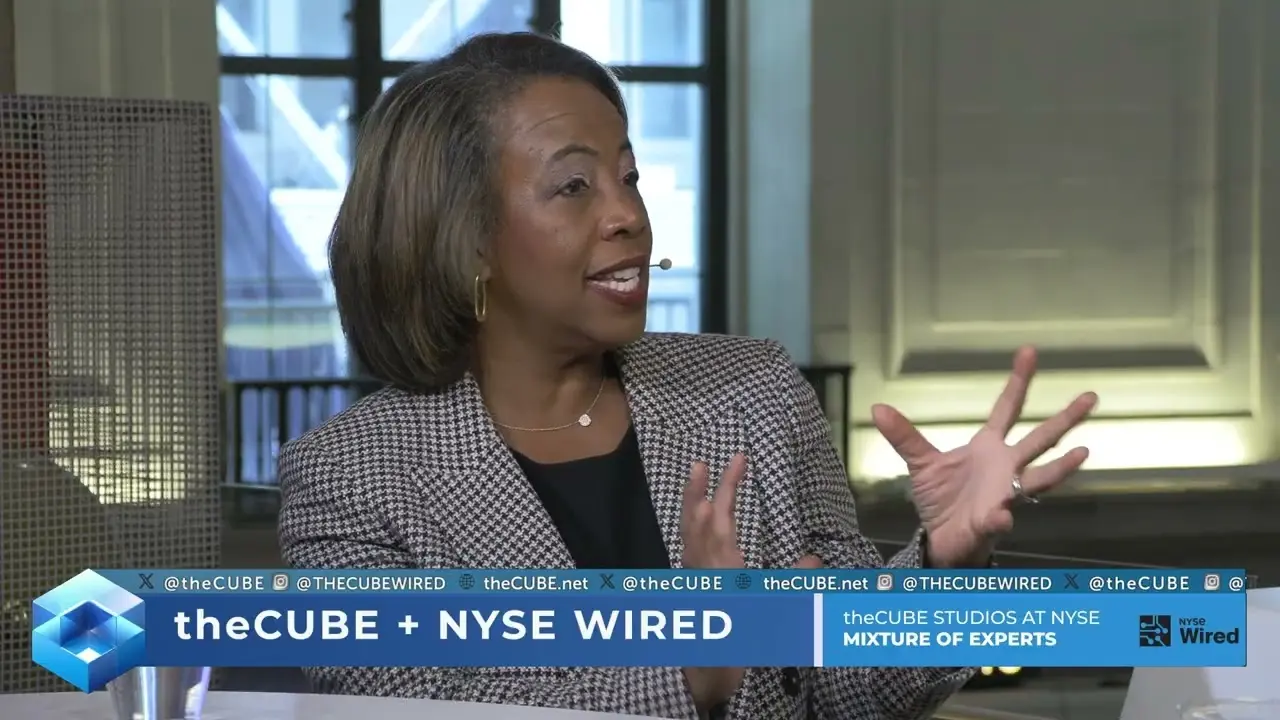
In this interview from the theCUBE + NYSE Wired: Mixture of Experts series, Teresa Carlson, president and founder of General Catalyst Institute, joins theCUBE’s John Furrier to discuss the critical intersection of public policy, capital markets and rapid technology transformation. Drawing on her experience pioneering cloud adoption in the public sector at AWS, Carlson details her new mission to foster robust public-private partnerships that help startups navigate complex regulatory environments. The conversation highlights the urgency of maintaining U.S. leadership in AI as a matter of national security and economic sovereignty, particularly in the face of competitive pressure from China’s rapid manufacturing and technological advancements.
Carlson and Furrier also explore the shifting geopolitical landscape of compute, identifying the Middle East, alongside the U.S. and China, as a potential third major node for AI infrastructure. The discussion delves into the massive capital expenditures currently defining the AI market, framing the investment as essential for "accelerated enablement" and long-term resilience rather than immediate ROI. Additionally, Carlson outlines the Institute's role in guiding governments through modernization in sectors like defense, healthcare and energy, while emphasizing the critical need for new educational curricula to bridge the widening skills gap between human intelligence and AI capabilities.
Forgot Password
Almost there!
We just sent you a verification email. Please verify your account to gain access to
theCUBE + NYSE Wired: Mixture of Experts Series. If you don’t think you received an email check your
spam folder.
Sign in to theCUBE + NYSE Wired: Mixture of Experts Series.
In order to sign in, enter the email address you used to registered for the event. Once completed, you will receive an email with a verification link. Open this link to automatically sign into the site.
Register For theCUBE + NYSE Wired: Mixture of Experts Series
Please fill out the information below. You will recieve an email with a verification link confirming your registration. Click the link to automatically sign into the site.
You’re almost there!
We just sent you a verification email. Please click the verification button in the email. Once your email address is verified, you will have full access to all event content for theCUBE + NYSE Wired: Mixture of Experts Series.
I want my badge and interests to be visible to all attendees.
Checking this box will display your presense on the attendees list, view your profile and allow other attendees to contact you via 1-1 chat. Read the Privacy Policy. At any time, you can choose to disable this preference.
Select your Interests!
add
Upload your photo
Uploading..
OR
Connect via Twitter
Connect via Linkedin
EDIT PASSWORD
Share
Forgot Password
Almost there!
We just sent you a verification email. Please verify your account to gain access to
theCUBE + NYSE Wired: Mixture of Experts Series. If you don’t think you received an email check your
spam folder.
Sign in to theCUBE + NYSE Wired: Mixture of Experts Series.
In order to sign in, enter the email address you used to registered for the event. Once completed, you will receive an email with a verification link. Open this link to automatically sign into the site.
Sign in to gain access to theCUBE + NYSE Wired: Mixture of Experts Series
Please sign in with LinkedIn to continue to theCUBE + NYSE Wired: Mixture of Experts Series. Signing in with LinkedIn ensures a professional environment.
Are you sure you want to remove access rights for this user?
Details
Manage Access
email address
Community Invitation
Teresa Carlson, General Catalyst Institute
In this theCUBE + NYSE Wired: Mixture of Experts segment from the New York Stock Exchange, theCUBE’s John Furrier sits down with Raj Verma, CEO of SingleStore, to unpack how the intersection of technology and finance is shaping enterprise strategy. Verma shares why SingleStore is “on course” for the public markets, reflects on brand-building through the company’s partnership with golf Hall of Famer Padraig Harrington and connects that ethos to how SingleStore helps organizations fix struggling data “swings.” The discussion zeroes in on what’s next as Wall Street watches the AI infrastructure buildout: after chips and systems, the software and data layers set the pace for value creation.
Verma outlines why enterprises must modernize “brown” data estates into “green” ones to safely bring corporate context, governance and compliance into LLM workflows via RAG – and why commoditized data-at-rest puts the advantage at the query layer that unifies data in motion with data at rest. He predicts agentic AI will gain reasoning capabilities in roughly 18 months, cites industry indicators like Google reporting ~25% of its software now built by AI and argues that high switching costs will give way to disruption as buyers reassess legacy vendors. The conversation closes with concrete momentum: ~33% YoY growth, ARR in the ~$135M range, gross dollar retention ~98%, cloud NDR ~130, ~50% of business now in the cloud, landing ~3 new customers per day, a path to cash-flow breakeven in the next two quarters and a teaser for AI-related announcements in the next two months. Listeners will find notable stats, real-world use cases and forward-looking views on how databases power reliable AI at enterprise scale.
In this interview from the theCUBE + NYSE Wired: Mixture of Experts series, Teresa Carlson, president and founder of General Catalyst Institute, joins theCUBE’s John Furrier to discuss the critical intersection of public policy, capital markets and rapid technology transformation. Drawing on her experience pioneering cloud adoption in the public sector at AWS, Carlson details her new mission to foster robust public-private partnerships that help startups navigate complex regulatory environments. The conversation highlights the urgency of maintaining U.S. lead...Read more
exploreKeep Exploring
What public policy think tank/advocacy effort did you and Hemant start at General Catalyst, and why is it important for your portfolio companies (especially in regulated industries and around AI)?add
Why is AI an urgent priority now, and what government policies and bipartisan actions are needed to ensure the United States remains competitive and protects sovereignty?add
How has the administration's approach to engaging with private-sector technology companies and startups changed to accelerate commercialization and domestic production of key technologies?add
Why are companies and investors pouring so much money into AI infrastructure and raising very large rounds (e.g., Anthropic’s $20B) now, even though user adoption remains limited?add
How are AI, robotics, and manufacturing startups reshaping U.S. manufacturing—particularly for defense—and how do they help address labor shortages and restore domestic industrial capacity (sovereignty)?add
What types of support does the General Catalyst Institute provide to startups in General Catalyst’s portfolio?add
Could the GCC / Middle East become a third major global node of computing power (alongside the US and China), and if so, why?add
>> Hello, I'm John Furrier with theCube. We are here at our New York Stock Exchange Cube Studios. Of course, we have our Palo Alto studio connecting Wall Street and Silicon Valley. Got a very special Cube alumni here, kind of on the AI leader series, as well as our mixture of experts. She's an expert in public policy, cloud computing, Teresa Carlson, president and founder of General Catalyst Institute. Teresa, great to see you-
Teresa Carlson
>> John, it's great to see you....
John Furrier
>> back in the chair on theCube with General Catalyst. Great to see you, and so much has happened in this industry you've been part of. You set the table for AWS, Amazon Web Services. You built out the cloud business there from scratch and became a huge business unit and really kind of changed the course of government and industry, private and public partnership. Now, you're with General Catalyst doing the same thing with the AI wave.
Teresa Carlson
>> Yes.
John Furrier
>> Explain your new role. You founded the institute with General Catalyst premier venture capital firm from founders to late stage and everything in between with all that muscle.
Teresa Carlson
>> Yeah.
John Furrier
>> What are you up to?
Teresa Carlson
>> Well, John, it's great to be back here with you on theCube. What a great environment here at the New York Stock Exchange. Yeah, so I'm now at General Catalyst. Hemant, our CEO, and I kind of came up with this idea to create a public policy think tank advocacy effort for General Catalyst, and we have 800-plus founders, companies around the world. One of the things, when you think about a flywheel of raising capital, getting these great portfolio companies that are mainly in highly regulated industries, and then you need public policy. You got to make sure that you are using public policy as a strategic advantage with these companies because we're in healthcare, financial services, defense, intelligence, industrial. So when you think about these areas in today's world with the public-private opportunity around AI, if you're not paying attention to policy and really proactively working with your portfolio companies and the policy makers, there's a lot of risk.
John Furrier
>> We met about 15 years ago when Amazon Web Service was just a little tinkering shop of building data centers in the cloud and putting your credit card down. You pioneered probably one of the most successful transformations in government because cloud computing was unknown in the government.
Teresa Carlson
>> Yes, that's right.
John Furrier
>> It was a foreign thing. Only startups did it. And now with AI, we're seeing a similar pattern. You've kind of changed the narrative. You won the CIA deal. I'll never forget that deal. You worked with the Department of Defense on the JEDI contract and a variety of other things, FedRAMP, the list goes on and on, the accomplishments.
Teresa Carlson
>> Yes, yes.
John Furrier
>> The tie into today, I want to get your thoughts on this, because we're seeing almost the same movie playing out, but at much greater speeds, where it's not just an IT-like purchase. There are significant government challenges around sovereignty, national defense, national wealth, we hear this all the time in the government, and the climate in DC is pro AI.
Teresa Carlson
>> Yes.
John Furrier
>> So take us through what's happening and how the tech capital markets is intersecting with DC, government, the formulation of what's happening with AI and their challenges and opportunities.
Teresa Carlson
>> John, it's such an interesting time. I used to tell my old team at Amazon, "Strap in, because you'll never see anything like this." I'm like, "What? It's a double strap in." It is crazy the growth of what we're seeing in AI because, to your point, it's now not an option. With cloud, it was a bit of an option. It took a while. We had to really show workloads, use cases, really roll our sleeves up with the customers. And now with AI, it's really a competitive advantage and a national security issue because we cannot let China get ahead. We've got to be the number 1 node globally. I call it AI should be like apple pie in America. It should be core to everything we think about and how we do business and how we educate our children. And in the government world, if that does not connect through policy and advocacy, there's an issue. But just one point that you made that is different, John, in terms of what's changed, one is what's changed is the rate and speed that we need to adopt because AI is moving so fast through these models, two is the fact that we've got to be competitive, but the third is the sovereignty piece, to your point. It's become such an issue on sovereignty that you need government to proactively put those policies. And today, we do not yet have broad scale support between the Republicans and Democrats on how we're going to do this, and that's one of our core issues because this should be nonpartisan. This has to happen, and it should outlast and outlive what all of us are doing to make sure AI is top of mind.
John Furrier
>> Teresa, I want to talk about culture. Between 2015 and 2020 or 2021 around pre-COVID, when that hit, people would scratch their heads when I would say public-private partnership. Because to me, as coming from Silicon Valley, I'm like, "It's a no-brainer. Why wouldn't you use private companies and partner?" But it's almost like a foreign concept.
Teresa Carlson
>> Totally.
John Furrier
>> Okay. Then COVID hits. We saw that acceleration of cloud pulled forward, all those benefits. Now, you've got AI forward. What is the evolution of public-private partnership? Because you're seeing SpaceX, you're seeing Anduril, a lot of in the defense side, healthcare again, not usually... They're in their little... They stay in their lanes. So you're seeing a lot more awareness and conversations and actual execution of public-private partnerships. What is your view on this? What's your vision? What's happening with this dynamic? Is it truly here? Is it evolving? What's the status of this dynamic?
Teresa Carlson
>> It is truly evolving. To your point, John, when you and I literally first started talking, people really didn't... It was a foreign concept. But the thing that's changed, this administration is much more pro commercial, and they understand the value of connecting the dots between private sector and public sector, and they also realize they can't do it alone. They need the push. They got to get the technology companies on board with them to move faster from infrastructure, critical minerals, energy, building, thinking about, "How do we drive production in this country a lot faster?" You cannot do that in a box alone as government, so they are reaching out a lot more and saying, "How do we do it?"
The other thing that's changed a lot, John, I see it with these startups and these amazing companies, they're not actually asking government to fund their R&D. They're saying, "We're shovel-ready. Take these technologies," and so this administration has been reaching out a lot more to the startup community to say, "We need those innovative companies out there." But again, they're looking to combine commercial public sector dollars with private sector dollars in a way that helps us move faster. What they've got to do is clear the path on the regulatory environment though to make sure that that works really well.
John Furrier
>> We have a saying on theCube, "Speed wins. Get the content out fast." That theme has crossed over. We're seeing the chip makers say, "Speed wins," obviously, performance of inference and the things we hear about in the nerd side, the tech side. Talk about the speed factor and why speed is important today with AI. You mentioned China, that's obvious one. We got to keep that pace. And then talk about the speed and what enables it. Is it the infrastructure build up, people are freaking out about the CapEx?
Teresa Carlson
>> Yeah.
John Furrier
>> Talk about that dynamic because manufacturing's transforming in the US, healthcare is transforming, oil and... Every vertical is going to infuse with some... AI will come to them. Talk about speed and how that is impacting change, behavior, whatnot.
Teresa Carlson
>> It's funny. I used to think Andy Jassy always talked about speed. He was like, "Speed matters." And now I'm at General Catalyst, I hear us talk about, "Speed, it matters because of the adoption." I was just on another show before coming here and talking about capital markets and the amount of spend. And if you look at what was happening just with the earnings a couple of weeks ago between Microsoft and Amazon, where even Amazon showed great earnings, AWS I think grew at 24%, but then they showed it over $200-plus billion spend on infrastructure just this year kind of freaked the market out. But the reason that has to occur... Again, Anthropic, you're seeing them do a big raise. It was 10 billion, now it's 20 that they were able to get because speed matters here. And we've got to keep ahead of these models, even though the adoption curve is not where we'd like it to be. If we're not ahead of China, John, it's a huge problem for America and the rest of the world.
John Furrier
>> What's the sentiment? What's the temperature around China? Are people aware of this? What's your feeling on where people think we are and the reality of where we are?
Teresa Carlson
>> I think people have mixed views on it. I'm very pro America and our allies, so I believe that we can move faster with the ingenuity. We fail fast, we experiment, we don't give up, and we don't have government tamping down on everything we do, like we have in China. I do, however... I was just at Davos, and I was sitting with some experts and people who work more closely in China who shared a few statistics. They're actually producing a really good EV every like 54 to 57 seconds, drone every like nine seconds, and we don't have that manufacturing capability. So we have to also be eyes wide open in this country about what we need to do on industrial and manufacturing for that resilience, and that's not a yet that we have. We had it, we kind of lost it, now we need it back. So how do we do that? We have to be focused again on what are the opportunities around AI for industrial robotics and things like that. We are, again, I'll just say mixed view, but I'm so bullish on America that we just have to be focused and we need the government to work with us on these policies and see that-
John Furrier
>> Manufacturing, you mentioned that, in the US, obviously a priority for the many reasons you talked about, for sovereignty. I had a founder in here talking to me about the defense tech. They're a startup. They're a platform company. So you start to see them take territory and win deals from the government and they're basically a three-year-old company. That wouldn't have happened a decade ago.
Teresa Carlson
>> Yes, that would not have happened. And John, you probably remember Jeff Wilke who was at Amazon. He started a company called Re:Build Manufacturing, and that's back to... He always said, "Hey, we got to rebuild America." He's from Pittsburgh originally. We're an investor in that company. I love it because they're taking a lot of traditional welding, wire harnessing, and bringing it back with a tech AI overlay. So think about that, that we can do to help build robotics, drones, all the things we need for a war fighter in mission.
John Furrier
>> Yeah. I heard a stat from someone who's in a similar robotic space and they said, "If I had a billion dollars, I couldn't hire enough welders." So you're seeing robotics fill the gaps of skills and this labor and then the humans become much more artisans, crafting, much more specialists where the robots fill in things like welding, these tasks. They're not necessarily replacing tasks or doing what wasn't possible before.
Teresa Carlson
>> So true.
John Furrier
>> Talk about where that fits in with General Catalyst. You guys are doing a lot of physical AI investments. I'll say agents are hot right now because that's more of a corporate thing. But agents are certainly relevant, that's a path to physical.
Teresa Carlson
>> That is a path to physical, and I'll give you kind of an interesting example that was just in the news this week, which was Accrual, which was a company that we've invested in. They're actually taking AI to the accounting world and helping CPA scale. We have a legal team helping legal scale. And to your point, you still need the humanities and the imagination of the human alongside these companies and the AI for what they're doing. We can't... AI blinks, remember, input and output. So they still blink. You still need that humanity, that imagination that Americans and humans bring to the table. So this is what's key. But I also will say in terms of the type of companies that we're seeing be creative, we are just still scratching the surface.
John Furrier
>> Talk about the role of the institute and the role founders play and how you're connecting them with either go-to-market, advisory, you're kind of shepherding them, you're kind of steering them. What are some of the things you guys work on for startups within the General Catalyst portfolio?
Teresa Carlson
>> I'll tell you something that has really changed. We did a survey of all of our startups. A couple of the top two areas that they brought up that they really needed support on was public policy and market acceleration, go-to-market. These are the things that they think about. Because you can have great technology, but if you don't know how to get it to market in the right way... So at the institute, we just happen to work on those two things to help our companies. One is we are an advocate for our over 800 companies globally. We don't just work in the US. We work around the world. We just had a set of founders in Brussels. We're going to be in London in a couple of weeks. We're going to be in India next week. And we curate these founders, we bring them together, and we literally work with them and say, "Look, you're amazing, but let us talk to you about how... When you go in and talk to a senator, congressman, you go to the White House, how do you have that conversation? Because they don't have a lot of time, we want to make sure you have a great impact and you're talking their language." So we teach them and work with them and support them. And then we also work in the opposite way with government to talk to government about what we feel is needed and missing, but in a collaborative way, John, not to just be, "We've met," but, "Let us share with you actually kind of what's working and what's not working."
John Furrier
>> And they don't have the staff or the time to actually understand. So the alternative in not having that is a missed meeting, misfiring on an objective-
Teresa Carlson
>> That's right....
John Furrier
>> hiring someone, training. So, in a way, you're shepherding that process of them coming on board.
Teresa Carlson
>> That's right. And also, I will say, working in governments is confusing. I didn't really think about it. They say you either do or teach. I was doing, and now I'm trying to teach, and it's like, "Okay, this is more complicated than it..." Because I tell everybody working in government, it's like Whac-A-Mole. But really teaching and working with our founders, how do you do contracting with government? How do you create partnerships? How do you make sure you have the right path to be certified for security and compliance? And it's honestly been a joy, John. We did that before to help our partners, but now it's just really been a joy to help support these companies on their journey.
John Furrier
>> So Teresa, the market's opening here. You were just on Fox with Maria this morning. Thanks for swinging by theCube. I really appreciate it. Love your perspective on the holistic view of how tech, capital markets, and governments are working together, and I think that's a huge mission. Very much love it because I think, one, it's a shortcut for the startups and the companies, the private companies, to also gets some contracts, which is money-
Teresa Carlson
>> Yes....
John Furrier
>> and we're seeing that flow. Could you share some of the conversations you're having in the institute and what you have on your agenda? Because it's not just a think tank come in and get some training. You guys are doing some real work. What's some of the things you're working on? Share the institute's mission and some of the examples and use cases of how it's playing out.
Teresa Carlson
>> Well, the mission is to really take our transformative companies that we're investing in, connect the dots with government to drive the right policies to enable societal change and good. That really is the gist of what we're trying to do because I've always believed, John, in paving the way to make the world a better place through this transformation. And tech really does matter, but you want to do it in the right way. So we work across a broad set of things from these industries and verticals that we invest in. We stay in our lane of things, in defense, industrial, healthcare, financial services, and things.
John Furrier
>> All the hot ones.
Teresa Carlson
>> Yeah. But they are the core resilient building blocks of an economy, right? And if you get all these things right, it does matter. They're hard, but if you get them right. And even if you think about the changes that you've seen in financial markets with stablecoins and tokenization, this is also just a really new area, even for governments, even though we have the GENIUS Act that really changed everything. But what we do as an institute, we go in... We launched a year ago, September, so we're fairly new. We launched in the US, UK, Europe, India, and we've been doing work now in the Middle East. We just wrote a paper with the Middle East Institute on... As an example, we believe that the GCC could be the third node of compute. We think about US being number 1, China... And then a third big node of compute that we've kind of been setting the stage for, it could be in the Middle East because they have land, they have power, they have economic opportunity to bring to the table, they have decent allied partnerships, and they have a lot of people, and the economy is growing. So you think about these third... We try to think big and strategic ideas in healthcare. GC bought a health system called Summa Health. It was Hemant, our CEO's vision that, in order to change healthcare, we need to change it from the inside out, that we need to buy a system and demonstrate how AI capabilities could drive outcomes, not just the cost.
John Furrier
>> So General Catalyst is more than an investor.
Teresa Carlson
>> For sure.
John Furrier
>> They're a change agent.
Teresa Carlson
>> For sure. They're a transformative capital markets provider. VC is a big part of what we do, but we're doing other things around, again, buying health systems. We're doing capital market deals, like the Janus take-private deal. We are doing creation deals where we're actually buying companies working with Accrual to do more applied AI to traditional industries. So if you think about it, it's transforming industries through the use of AI and trying to move that along a lot faster. Our job at the institute is to bring together the most interesting thought leaders between private and public sector to have these dialogues, thought leader reports in areas like defense and healthcare, and so it's really good. I think we bring a superpower that a lot don't have because we're not talking about it from one angle. We're bringing a perspective of all of our portfolio companies and our thinking to the table.
John Furrier
>> You mentioned China, Middle East, and US, so three nodes. It's interesting, the geopolitical landscape is changing. Sovereignty is a big discussion. International is one. You've lived through the AWS growth from creation through this massive growth. You've seen that change firsthand. Is there anything about the... What are people getting wrong? Maybe I should say it this way. What are people getting wrong around this AI infrastructure investment versus the gap between, "Wow, it's a lot of spend. Where's the money? Where's the proof?" So there's like a big disconnect between Wall Street and technology, for instance, around, "Oh, my God, stocks are up." Productivity is at the highest level in S&P 500 companies, yet it's a crisis because they're not hiring, but they're productive. But isn't that what a software is supposed to do? What's that enablement? Talk about this CapEx market and then the enablement behind it. How do you see that, looking at what you've seen with AWS?
Teresa Carlson
>> Well, I think what's happened... This is just kind of my view of the world on this. Because the enterprises and governments are not really sure yet about the amount of productivity gains that they're going to get and what skillsets they're going to need, it's almost like they're taking a bit of a pause and saying, "How do we readjust?" And what both enterprises, governments, and the markets have not figured out is, "How do we adjust the type of human staff we need with the type of AI staff that we're going to need, and what are the new skills?"
So I'd say one huge gap that we have not filled yet is really determining the skillsets that are required and creating the right curriculum. If we are ready to create cloud curriculum, we had to go through all that. Now, we are going to have to create new curriculum that teaches and trains how do you interact with AIs, how do you manage AIs, and how do we make sure that human intellectual understanding, high EQ, is paired with any of the AI stuff. That's a huge gap. This, I believe, the markets are reacting, John, because they're just not sure.
John Furrier
>> They haven't seen the proof in the pudding.
Teresa Carlson
>> Yeah, they haven't seen-...
John Furrier
>> because the infrastructure is enabling that and it's being built out in real time in front of our eyes.
Teresa Carlson
>> That's right. And I think if you ask anybody you have on here from Anthropic to OpenAI or Amazon or Google or Micro, they would say, "Why are you spending so much? Why are you spending a lot of capital on this?" I believe the answer would continue to be, "We can't get behind. Humanity depends on this."
John Furrier
>> The demand curve is too high.
Teresa Carlson
>> The demand curve is too high, and the models are reacting so quickly. Yes, the spend is high, but what the markets are trying to figure out, "When do we see the curve of productivity and returns on this? Because it feels very far off." Again, I'm not an economist expert, but we don't know. However, what I do know is that we need more work around companies that can help others go through the transformation. Just like we did cloud, we need more people helping these companies and governments get through their own journey on transformation.
John Furrier
>> I think you're right on that. In fact, Jensen Huang said last week in San Francisco, talking about this AI gap that's going to be filled as the infrastructure comes out, he said, quote, "It can't be spreadsheeted yet." Meaning, you can't model it out yet.
Teresa Carlson
>> That's right, yes.
John Furrier
>> You don't know what you don't know because it's emerging. That's one thing. And then also when I talked to some of the NVIDIA folks, I used to love to use the term disruptive enabler because anytime you have this kind of build out where you've got infrastructure, you're enabling and usually it's been disruptive. They said, "No, no, we don't use that word." We go accelerated disruption... I'm sorry, accelerated enablement, and it's interesting. I said, "What's the difference? Aren't this disruptive?" He goes, "Not really, because disruption means an incumbent loses." I paused and I said, "That's very interesting." I now use that term, accelerated enablement, because it's not that someone loses.
Teresa Carlson
>> No.
John Furrier
>> Everybody's winning with AI, so it's accelerating the enablement-
Teresa Carlson
>> That's right....
John Furrier
>> which people are confused, "Where's the unit economics? Where's the payout?" They just don't see that. It's not yet spreadsheeted, as Jensen would say.
Teresa Carlson
>> The only thing I would add to that is transformative because it's accelerated and it's transforming the way people do work, so it's in an accelerated path that people are trying to catch up to. The reason I think it's moving slower is the transformation curve, it's harder for humans to process how they have to do that without a lot of training and reeducation to it and just task orientation, right?
John Furrier
>> Yeah.
Teresa Carlson
>> If you think about how humans learn, they say you got to do at least three times to get it. John, if we could, for a minute, talk about international just for another second, because one of the things I think that we have done very differently as a capital provider and transformation company is we've looked at the world a little bit differently. Of course, we believe America is going to do really well. This is a great place to invest. The entrepreneurs are just mind blowingly-
John Furrier
>> Brilliant....
Teresa Carlson
>> creative and brilliant.
John Furrier
>> Yeah.
Teresa Carlson
>> And again, you push them down, and they jump right back up. They will fail and re-experience whatever it is and get back up. But we also believe that Europe and India are two big places that we're investing, and a lot of people are like, "Why would you invest there? Here..." Well, if you think about what's happening in the world, even though the geopolitical environment has changed and people are... They're trenching back in, right? They're becoming more sovereign. We believe that that's actually a good time to invest. Because if you think with Europe, they are really thinking through how do they build up their military capabilities, how did they rethink their sovereignty. If America's not going to be a strong a partner or somebody else is going to be a better partner, they're thinking through how do they do it. We believe that's a good time to invest in those founders because you're going to have more spend on innovation, you're going to have more spend on transformation, and they're really trying to move faster now, right? So it's an accelerant, back to your point. It's an accelerant to get to scale because they don't have a choice. Same with India. India is massively... What an opportunity. We're going to be there for the India AI Summit next week. I'll leave on Sunday. So we're actually also very big believers that the geopolitical change presents capital market opportunity to invest to other places.
John Furrier
>> Yeah, and that also hits your point about manufacturing-
Teresa Carlson
>> Yes....
John Furrier
>> in the US and in the areas that want to have competitive advantage. We were having our Cube Pod on Friday. Dave Valenta and I were talking, and I said, talking about Nvidia, "B300s are hard to get. Supply chain's a huge concern," and I said, "Is the chips the oil crisis of our generation?" Remember in the '70s when it's getting in line for gas? There was oil crisis. The AI is a competitive advantage for countries.
Teresa Carlson
>> For sure.
John Furrier
>> You mentioned the US, China, and say Middle East. But now if you're Europe, what do you got? If you're going to be relying on others, like oil... I think there's a lot of sentiment in Europe. We covered the RAISE Summit, and we'll be there again in July. It's a very European AI show. That's a huge issue, and the entrepreneurs are like... They were off the record complaining to me how slow the government is. I'm like, "I've seen that movie before." How do the governments bridge the entrepreneurial energy? You're investing in the area.
Teresa Carlson
>> Yes.
John Furrier
>> Europe is a classic case in point. The younger generation is like, "Why do we have it like this? Why can't you change the rules? Why can't we go faster? Why can't we have our own sovereign capital markets, our own venture capital investment community?"
Teresa Carlson
>> That's right. We were just in Brussels. We had 10 of our founders, and they represented a breadth of these investments from healthcare to defense to finance, and they were so brilliant. They're so pro European. It was so humbling. They feel so convicted that they want Europe to do a great job, right? They believe in European sovereignty, and they want to grow a great company, and they've decided to build their company in Europe. So we went into both the EU Parliament and Commission, we had great meetings, by the way, and they represented really well what government needs to do to change things. If you think about... I laugh a little bit, John, because what they experience is not that different to what we talk about here in the states versus federal, right?
John Furrier
>> Yeah.
Teresa Carlson
>> Because if an energy company here in the US is trying to go around states, they still have to go through all the permitting. It's still very slow. But in Europe, because it's so much more compact, their point is, we heard one of our founders say, "Look." And he was in the financial sector, he goes, "Give me a really hard certification. I will do the hardest thing you throw at me once. Don't give me 27 that I have to go through every country and do this because my business won't survive, but here's how I can help Europe grow." So I thought they just did such a great job, and I believe... Look, Europe is grappling with... They're talking about this 28th estate where it's basically one that they come together and they are... Look, it's hard. They've got 27 interviews and then-
John Furrier
>> Yeah. If you're an entrepreneur, you're like, "Hey, I want to be successful. I don't want to have to jump through hoops all the time. Do it once, get it done." But if you're also an investor, like say a venture capital investor, you don't want to lose money. "What's the money making look like?" So the risk increases, so there's a lot of... Again, this is evolving, because I've never seen this before, Europe being so pro capitalism before.
Teresa Carlson
>> That's right. We merged with the firm called La Famiglia about two years ago, and Jeannette started that firm in Germany, and she is one of the biggest fans and really talks. She's like the person that's been talking about AI champions in European renaissance on AI. And look, you've got to have these people talking about it. To your point, you have to have government doing something, take action on it, and that's what they got to do is take action fast.
John Furrier
>> Well, one of the things that Europe has is energy. You mentioned they're working on defense, they have healthcare. Manufacturing and energy seems to be two policy areas that are going to be hot in Europe, so that's going to be key. When you talk about your role with the institute, there's ecosystems forming. You mentioned international. We talked about Europe. If you could have your dream scenario, your magic wand, what would the ecosystem look like for you in a steady state? Say five years out, the institute, if you could say, "Okay, this is my preferred future. Here's what my ecosystem would look like," paint that picture for me.
Teresa Carlson
>> Well, what we would love to get to is where the institute is helping governments as we see the transformation of these different verticals, I'll say these industries like healthcare, defense, financial, the new stablecoin and tokenization market. Our goal would be to go in and help these governments actually set up their policies, help them... We've done it with a couple of countries already where they're trying to copy in a good way what US has done around the GENIUS Act and how do you think about the regulatory environment. The other example I'll just give you, I met with the nuclear regulatory agency lead a couple of weeks ago. Now, you have these countries around the world, John, who are now trying to set up the nuclear sites to increase energy capacity, right? But they don't have the regulation or regulatory environment set up. So I said to him, "Look, if we're getting them to use US tech, how can we help them move faster if they're ally and there's an issue?" We brainstormed about how the institute could help provide connection points to be the training part through partners like Meridian or Atlantic Council or others, and then let them do the hands-on training only at the Tennessee Valley Authority. We want to be the thought leaders globally that help connect the dots so our companies can scale faster. So we want to be the big problem solver that brings these countries more together, just like our report under -
John Furrier
>> Your community growth strategy then is governments. You already got the startups and the capital markets.
Teresa Carlson
>> That's right.
John Furrier
>> Check.
Teresa Carlson
>> Yes.
John Furrier
>> Government and the stakeholders around the governments around the world.
Teresa Carlson
>> So we want the startups. We want the best and brightest in these verticals-
John Furrier
>> Yeah, you get those....
Teresa Carlson
>> to work with us. We want governments to see us as a partner, okay, not an inhibitor. We want them to see us as a partner to help them drive the change they need. And then the third big thing is we are really interested in convening thought leaders that actually have a voice, because if we get like-kinded individuals that have these conversations... It can't just be us, so we have to scale our voice, we have to scale the knowledge, and we have to bring all these things together. Everyone says, "Okay, now, this is operating at global scale in the right way to really drive this change."
John Furrier
>> Yeah. Well, we're super excited that you came on theCube here. Our new brand, theCubes + NYSE Wired, is that open community of leaders. You're doing an amazing job. You've been a leader, you're continuing to lead. Love the mission of the Institute. Congratulations, and thanks for coming on sharing your perspective.
Teresa Carlson
>> Thank you, John. It's always great to be here with you.
John Furrier
>> All right. I'm John Furrier. We get the AI leaders here on theCube in the NYSE as part of our Cube's NYSE program, our new Cube original, of course. We've got our Palo Alto studio with theCube. It covers tech, of course. Now, tech and capital markets are coming together. The market is technology. That's our focus, and, of course, we're doing our part to bring that to you. Thanks for watching.


















































 John Furrier