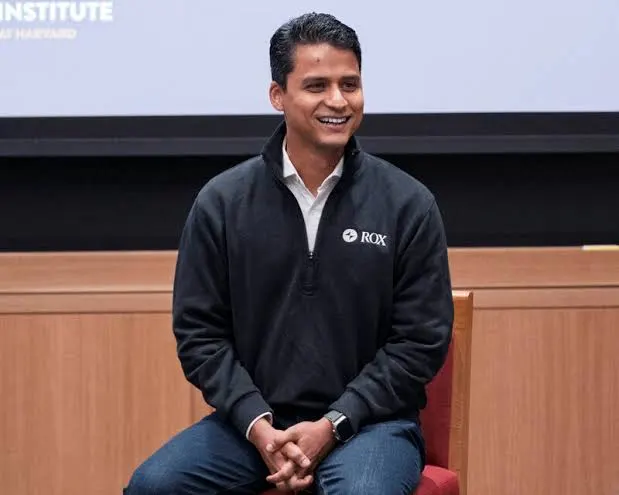
Ishan Mukherjee of Rox, co-founder and chief executive officer, discusses agentic artificial intelligence, referred to as AI, that drives revenue outcomes for large enterprises. Mukherjee draws on their team's knowledge graph experience and explains how Rox's revenue agents and context graphs unify customer relationship management, referred to as CRM, enterprise resource planning, referred to as ERP and public data to automate sales tasks. theCUBE Research frames the conversation with hosts Gemma Allen, John Furrier and Dave Vellante, exploring market fit and deployment.
Key takeaways include Rox's focus on rapid board reportable outcomes within a quarter and a sovereign AI stack that leverages open weight models, in-house search and post-trained models to reduce token costs. Mukherjee highlights the role of agents as productivity multipliers for quota carrying representatives, reimagining support roles and the importance of enterprise context graphs for secure scalable agent deployment across Global 2000 customers. The discussion also addresses large language models, referred to as LLM, model sovereignty and practical factors to consider for enterprise adoption of AI.
Forgot Password
Almost there!
We just sent you a verification email. Please verify your account to gain access to
theCUBE + NYSE Wired: Mixture of Experts Series. If you don’t think you received an email check your
spam folder.
Sign in to theCUBE + NYSE Wired: Mixture of Experts Series.
In order to sign in, enter the email address you used to registered for the event. Once completed, you will receive an email with a verification link. Open this link to automatically sign into the site.
Register For theCUBE + NYSE Wired: Mixture of Experts Series
Please fill out the information below. You will recieve an email with a verification link confirming your registration. Click the link to automatically sign into the site.
You’re almost there!
We just sent you a verification email. Please click the verification button in the email. Once your email address is verified, you will have full access to all event content for theCUBE + NYSE Wired: Mixture of Experts Series.
I want my badge and interests to be visible to all attendees.
Checking this box will display your presense on the attendees list, view your profile and allow other attendees to contact you via 1-1 chat. Read the Privacy Policy. At any time, you can choose to disable this preference.
Select your Interests!
add
Upload your photo
Uploading..
OR
Connect via Twitter
Connect via Linkedin
EDIT PASSWORD
Share
Forgot Password
Almost there!
We just sent you a verification email. Please verify your account to gain access to
theCUBE + NYSE Wired: Mixture of Experts Series. If you don’t think you received an email check your
spam folder.
Sign in to theCUBE + NYSE Wired: Mixture of Experts Series.
In order to sign in, enter the email address you used to registered for the event. Once completed, you will receive an email with a verification link. Open this link to automatically sign into the site.
Sign in to gain access to theCUBE + NYSE Wired: Mixture of Experts Series
Please sign in with LinkedIn to continue to theCUBE + NYSE Wired: Mixture of Experts Series. Signing in with LinkedIn ensures a professional environment.
Are you sure you want to remove access rights for this user?
Details
Manage Access
email address
Community Invitation
Ishan Mukherjee, Rox
Ishan Mukherjee of Rox, co-founder and chief executive officer, discusses agentic artificial intelligence, referred to as AI, that drives revenue outcomes for large enterprises. Mukherjee draws on their team's knowledge graph experience and explains how Rox's revenue agents and context graphs unify customer relationship management, referred to as CRM, enterprise resource planning, referred to as ERP and public data to automate sales tasks. theCUBE Research frames the conversation with hosts Gemma Allen, John Furrier and Dave Vellante, exploring market fit and deployment.
Key takeaways include Rox's focus on rapid board reportable outcomes within a quarter and a sovereign AI stack that leverages open weight models, in-house search and post-trained models to reduce token costs. Mukherjee highlights the role of agents as productivity multipliers for quota carrying representatives, reimagining support roles and the importance of enterprise context graphs for secure scalable agent deployment across Global 2000 customers. The discussion also addresses large language models, referred to as LLM, model sovereignty and practical factors to consider for enterprise adoption of AI.
>> Palo Alto Studio Connection, Silicon Valley and Wall Street.
Ishan Mukherjee
>> I'm John Furrier, co-host of theCUBE here with Dave Vellante, my co-host.
Gemma Allen
>> Welcome back to theCUBE Studio here at the New York Stock Exchange. I'm Gemma Allen, host of NYSE Wired's Business Transformation Edge. And joining me now for a conversation on the world of agentic AI in sales is Ishan Mukherjee, CEO and co-founder of Rox. Welcome, Ishan.
Ishan Mukherjee
>> Thanks for having me. Nice to meet you, Gemma. And you all do amazing work. So glad to be here.
Gemma Allen
>> Well, we're delighted to have you on the show. So let's get straight into it. This is a very interesting company, less than 2 years old, already over 100 people, certainly making a mark on the market, you might say. Maybe help me understand exactly what Rox does.
Ishan Mukherjee
>> Absolutely. So we build agents which drive revenue outcomes autonomously. We call them revenue agents. The market calls them sales agents or go-to-market agents. We do so for the world's largest businesses. So if you think of a Philips or an Intel or these kind of large corporations, they've been actively rolling out these agents to drive revenue outcomes, everything from finding new customers, executing contracts, and growing them. So ultimately for these CEOs and CFOs, we are driving top-line revenue outcomes at a dramatically lower cost of sale. By using agents. And these agents perform like coding agents and support agents. And now these revenue agents are proliferating through the Global 2000.
Gemma Allen
>> So correct me if I'm wrong, but you guys are not essentially replacing sales organizations in their entirety. This is really the underlayer, the backbone, the intel, the intelligence, the cross-pollinated information, I guess, that drives the agentic future of the sales stack. Which roles would you say you are maybe somewhat displacing or replacing? Are we talking SDR, BDR? Help us understand where that narrative gets somewhat mixed up.
Ishan Mukherjee
>> Yeah, great question. So the core insight came from us holding a number and running scaled businesses before. Our thesis was that the future-proof employees in commercial organizations are going to be these quota-carrying reps. So you call them account executives, salespeople, account managers. So our approach is how do we supercharge them and make them dramatically more productive? Could they support 2 times, 3 times, 4 times more customers? So those folks are future-proof. They're getting more and more productive. Now, what is changing is the people who support them, and the roles range from the BDRs to solutions architects to sales analysts to managers. What we're seeing is there's a compression in the ratio or the number of people who you need to support quota-carrying reps, and that's changing. So effectively, these agents are supercharging the future-proof employees and then essentially reimagining the support roles. And I think my best analogy is they're moving from being Uber drivers to way more orchestrators. So what we're seeing is customer-facing reps and employees getting dramatically more productive. They're using agents. And then people who are supporting them are orchestrating these agents to do everything from finding customers, executing deals to growing them.
Gemma Allen
>> So help me understand the technology side of this business, right? Because we know that many of these large enterprise organizations have had tech live in silos. Okay. Your CRM might not necessarily always connect to your ERP. It has always been quite a fragmented space, especially for companies like Philips that you mentioned. Are you saying that a product like Rox offers complete interoperability? And how easy is that to plug and play in any one enterprise?
Ishan Mukherjee
>> perfect question. The core insight for us was to make agents work in the commercial org. So think about sales, support, services, marketing. It is a game of context. These are like conversations that you and I are having. These are open-loop conversations that are not verifiable. It's not like code or ticket resolution. So we start off with unifying all enterprise context with public context in a revenue-focused knowledge graph that lives inside the customer's environment. So the foundational investment and the R&D that we've done is we take your CRM, we take your ERP, we take all of your internal systems, bring all that data and unify that into a knowledge graph, or what some may call a context graph, and then build that for the customers. And the agents effectively feed off of that data to go do work for the enterprise. So if you look at a business like Philips or Hitachi or WSP or these folks, they are unifying all the context in their own environment. And these context graphs are sitting on top of all their business systems. And that's what we do for the revenue stack.
Gemma Allen
>> So you make that sound so easy, right? That sounds like a relatively simple process. But we know when we go underneath the hood of that, it's not right. There is a reason that structured data hasn't been able to allow companies to talk system to system for decades, if we're frank. Talk about what's changing though. I understand the theory of context graphs and obviously they have huge efficiency and productivity outputs. But there's also the ingestion process, right? There's that process of housekeeping, ensuring that whatever you're feeding the data is structured in a particular way. What percentage of time is spent from a company like yours and some of your solution engineers is spent on that side of the house?
Ishan Mukherjee
>> Yeah, and that's a kind of core IP. We've built a product and platform that actually works out of the box. You can go to Rox.com and actually try it. The graph builds up, connects all the sources, and gets better over time. What makes that work is decades of experience. So a lot of the core team— I was part of the knowledge graph at Apple. We've been in the knowledge graph, context graph space for about 10 years, 10+ years. Building for consumer, building for enterprise. So there's a lot of expertise that goes in. Your question was, what was the big unlock? We actually use LLMs to unify messy data. We're using LLMs to find entities, resolve them, link them to create these clean representations. In our domain, we kind of think about them as Customer 360 graphs, right? So the way the technology works is we build connectors to all internal systems. We went out and collected all public data. So we do company contact web search. So that data feeds into a Knowledge Graph system, which is using LLMs to join them in one place. And the hardest part you talked about is how do you make it self-serve? How do you make it a product and not a services-led or a kind of deal-led motion? That's taken one and a half years of nonstop engineering. Like we're kind of, as you said, about 2 years in. We started building the platform actually early '24 before agents were a thing, before content staff were a thing. And it's just relentless execution. And the biggest unlock has been how can we leverage LLMs to actually do data wrangling? And now we're able to do that at scale.
Gemma Allen
>> Talk about the LLMs that you're leveraging. Is what you're building majority proprietary? Are you using any of the large frontier models that we all know of and talk about day to day? Help me understand what percentage of this IP is completely yours as opposed to built on another stack per se.
Ishan Mukherjee
>> Yeah, we have to be sovereign. Our customers expect us to be sovereign. We are mission critical. Customers can't process revenue if our stuff is not up. So the first 18 months when we were building the platform and we were in beta, we were using all Frontier models. We are drinking from the Frontier firehose. Because we had to really build that up. As we move to GA in October, what we've done is we've basically tried to dramatically reduce the dollar per token by about 7 to 8x. First, we obviously did offtake to open-weight models, so we do that. Second is we have built search in-house, so instead of using an external search provider, our agents use their own search stack. Now we are post-training our own models, so we are taking open weight models that are available post-training them for specific tasks. So for example, one of our core tasks is our agents reach out to customers through email, through social, through text. That is actually no longer a frontier model. So if you think about the enterprise, for us to be the market category creators and to be the dominant player coexisting with Salesforce and Microsoft, we have to accelerate the path to sovereignty. The way we do so is building an AI stack that's not just reliant on one token provider, but a plethora of providers. But ultimately, the business expects sovereignty, dollars per token to go down so that they can actually consume more of these agents.
Gemma Allen
>> So open weight models in a highly secure, parameter-driven environment, correct? Because I think when we hear open weights, we come up with all sorts of, reservations around how secure they are, what it really means. But what you're saying is that what you're building for, it's based on cost efficiency. And optimization on a mix. I want to move on to the companies you just mentioned, Salesforce and Microsoft and the competitive landscape. So last week we're off the back of Dreamforce. Salesforce had some interesting announcements. they announced Hunter and Piper, which sounds like it does a little bit of what you guys do, I guess. But again, in a Salesforce-heavy environment, right? Talk me through, if you're in a room with Marc Benioff, you're competing with him for someone's attention. Give me the Rox pitch versus the Agentforce pitch.
Ishan Mukherjee
>> Great question. First off, Marc Benioff is a legend. I've been a big early customer of Agentforce and all the Tableau and all these things. So he personally is a legend. I think last week's kind of Dreamforce was super impressive in terms of them presenting themselves to be AI native. And he's always been great at that. I think what we tend to see when a board reaches out to us is usually when they need outcomes within a quarter. So they already, 84% of the enterprise has Salesforce, right? So they have a dominant share. Most of them have a Microsoft, they have a ServiceNow. So they have existing platforms to go to build agents. There's a reason why those agents are not actually doing work. And the reason is they don't have a system and architecture that unifies all the context outside of those systems of record that can actually do the work completely. So the differentiation for us is we commit to delivering board reportable outcomes within the first quarter. The question is, when is the next board meeting? You are bringing us in mostly because you haven't seen the outcomes. If you want to see the outcomes, give us a shot to come in, deploy the system, go drive outcomes. And if it's there, like, I will personally go present to the board. And if not, we don't get to stay in the room. So I think the time to outcome is what we really focus on. We actually integrate with Salesforce, we integrate with Microsoft, we respect them. And I think the enterprise is a lot more heterogeneous than people might think. So do we compete for mindshare? Probably. But do we compete in practice? No. We're very agent-focused. We're focused on an outcome. How I do see things play out is again, we're here to accelerate the enterprise's move to having a sovereign AI stack where they control the context and they control the intelligence. And we're part of that movement. Like, we think the Fortune 500, the Global 2000 will have their own AI stack. They will build AI solutions and they will recruit agents like ours that will run in their environment just like their employees. And those will not be within old legacy systems of record.
Gemma Allen
>> So let's stay on the Fortune 500 and the Global 2000 for a second and help me understand your TAM. Okay. Because you're technically saying that you are in some respects living alongside Salesforce in some environments. You're also competing with, I guess, a lot of those frontier labs that claim to be the future orchestrator of just about everything. Okay. If you listen to some of the headlines, true or not true, it's certainly what the industry seems to believe is the case. So what is your unique TAM? clearly there is one here based on your funding, your numbers. There's a lot of hype behind your company. Boil it down for me, though.
Ishan Mukherjee
>> I think it's a great, great question. Obviously, we have— we are in the rainforest at night with a machete kind of figuring out our path. But one has to realize this is a massive market. Like, if you look at coding, if you look at customer support, and if you look at just sales and marketing, it's the CRM, it's all the SaaS tools, it's all the services, which is actually bigger than CRM and 40% of every business's OPEX, which is marketing. So our mindset is with agents and just AI in general, every business has to transform to thrive. The opportunity is like all software, all services and payroll as well. So our place is within that ecosystem. We do think that legacy systems of record will continue. They're obviously very important. They'll kind of find a way. There is increasingly the number one spend item is on agents and specifically agents do work at or above a kind of human caliber. And that's where we play in. It's very similar to what Cognition's doing in coding, what Sierra's doing in support, what we're doing in pre and post sales. Our focus is massive market. We timed it correctly. We built agents and Context Graph back in late '23, early '24. Our job is to land the right customers. I think to your point, the way I think about it is in this massive market, who are the companies that we do go serve and support? It's usually people who have dialed in CEOs who understand the path to having a sovereign AI stack and they pull us in and we get deployed as like the Palantir of go-to-market or the SEAL team of go-to-market. And that's usually what they say.
Gemma Allen
>> So it's an interesting company at an interesting intersection point. It feels like the world is up for grabs, as you say. What is ahead? you guys clearly raised a lot of money, I think $90 million or so, at a $900 million valuation. I know you've raised— it's just a stupid amount, but you're Series A. What does the next 12 months look like? What are the priorities from here?
Ishan Mukherjee
>> Yeah, I think we're very customer obsessed. We want to be mission critical to CEOs of Fortune 500 and Global 2000s as they transform. This is— I've run a public company, I've taken it private. A lot of the team comes from people being in the war rooms. That's what we focus on. In terms of business, we're outgrowing every other player in the market, actually any other agent company. The goal is, from here, to accelerate. So next year, our core focus is how do we really scale out our distribution across the US and then start our international and partner business. So 12 months from now, hopefully we have close to 100 Global 2000s kind of running revenue on Rox. And I think we maintain our market leadership. And then you'll see hopefully us not just in the US but also internationally and channel as well.
Gemma Allen
>> Well, Ishan, if a trip to New York gets added to your schedule, please come visit us here at our NYSE studio. Thank you so much for joining us at NYSE Wired.
Ishan Mukherjee
>> Yeah, Gemma, thanks for having me. Great questions. And yeah, excited to keep you posted. And we're growing a big presence in New York, so hopefully we get to meet up.
Gemma Allen
>> Great.
Ishan Mukherjee
>> All right.
Gemma Allen
>> I'm Gemma Allen here at the NYSE studio. This is theCUBE coming to you with Business Transformation Edge. Thanks for watching.
>> Palo Alto Studio Connection, Silicon Valley and Wall Street.
Ishan Mukherjee
>> I'm John Furrier, co-host of theCUBE here with Dave Vellante, my co-host.
Gemma Allen
>> Welcome back to theCUBE Studio here at the New York Stock Exchange. I'm Gemma Allen, host of NYSE Wired's Business Transformation Edge. And joining me now for a conversation on the world of agentic AI in sales is Ishan Mukherjee, CEO and co-founder of Rox. Welcome, Ishan.
Ishan Mukherjee
>> Thanks for having me. Nice to meet you, Gemma. And you all do amazing work. So glad to be here.
Gemma Allen
>> Well, we're delighted to have you on the show. So let's get straight into it. This is a very interesting company, less than 2 years old, already over 100 people, certainly making a mark on the market, you might say. Maybe help me understand exactly what Rox does.
Ishan Mukherjee
>> Absolutely. So we build agents which drive revenue outcomes autonomously. We call them revenue agents. The market calls them sales agents or go-to-market agents. We do so for the world's largest businesses. So if you think of a Philips or an Intel or these kind of large corporations, they've been actively rolling out these agents to drive revenue outcomes, everything from finding new customers, executing contracts, and growing them. So ultimately for these CEOs and CFOs, we are driving top-line revenue outcomes at a dramatically lower cost of sale. By using agents. And these agents perform like coding agents and support agents. And now these revenue agents are proliferating through the Global 2000.
Gemma Allen
>> So correct me if I'm wrong, but you guys are not essentially replacing sales organizations in their entirety. This is really the underlayer, the backbone, the intel, the intelligence, the cross-pollinated information, I guess, that drives the agentic future of the sales stack. Which roles would you say you are maybe somewhat displacing or replacing? Are we talking SDR, BDR? Help us understand where that narrative gets somewhat mixed up.
Ishan Mukherjee
>> Yeah, great question. So the core insight came from us holding a number and running scaled businesses before. Our thesis was that the future-proof employees in commercial organizations are going to be these quota-carrying reps. So you call them account executives, salespeople, account managers. So our approach is how do we supercharge them and make them dramatically more productive? Could they support 2 times, 3 times, 4 times more customers? So those folks are future-proof. They're getting more and more productive. Now, what is changing is the people who support them, and the roles range from the BDRs to solutions architects to sales analysts to managers. What we're seeing is there's a compression in the ratio or the number of people who you need to support quota-carrying reps, and that's changing. So effectively, these agents are supercharging the future-proof employees and then essentially reimagining the support roles. And I think my best analogy is they're moving from being Uber drivers to way more orchestrators. So what we're seeing is customer-facing reps and employees getting dramatically more productive. They're using agents. And then people who are supporting them are orchestrating these agents to do everything from finding customers, executing deals to growing them.
Gemma Allen
>> So help me understand the technology side of this business, right? Because we know that many of these large enterprise organizations have had tech live in silos. Okay. Your CRM might not necessarily always connect to your ERP. It has always been quite a fragmented space, especially for companies like Philips that you mentioned. Are you saying that a product like Rox offers complete interoperability? And how easy is that to plug and play in any one enterprise?
Ishan Mukherjee
>> perfect question. The core insight for us was to make agents work in the commercial org. So think about sales, support, services, marketing. It is a game of context. These are like conversations that you and I are having. These are open-loop conversations that are not verifiable. It's not like code or ticket resolution. So we start off with unifying all enterprise context with public context in a revenue-focused knowledge graph that lives inside the customer's environment. So the foundational investment and the R&D that we've done is we take your CRM, we take your ERP, we take all of your internal systems, bring all that data and unify that into a knowledge graph, or what some may call a context graph, and then build that for the customers. And the agents effectively feed off of that data to go do work for the enterprise. So if you look at a business like Philips or Hitachi or WSP or these folks, they are unifying all the context in their own environment. And these context graphs are sitting on top of all their business systems. And that's what we do for the revenue stack.
Gemma Allen
>> So you make that sound so easy, right? That sounds like a relatively simple process. But we know when we go underneath the hood of that, it's not right. There is a reason that structured data hasn't been able to allow companies to talk system to system for decades, if we're frank. Talk about what's changing though. I understand the theory of context graphs and obviously they have huge efficiency and productivity outputs. But there's also the ingestion process, right? There's that process of housekeeping, ensuring that whatever you're feeding the data is structured in a particular way. What percentage of time is spent from a company like yours and some of your solution engineers is spent on that side of the house?
Ishan Mukherjee
>> Yeah, and that's a kind of core IP. We've built a product and platform that actually works out of the box. You can go to Rox.com and actually try it. The graph builds up, connects all the sources, and gets better over time. What makes that work is decades of experience. So a lot of the core team— I was part of the knowledge graph at Apple. We've been in the knowledge graph, context graph space for about 10 years, 10+ years. Building for consumer, building for enterprise. So there's a lot of expertise that goes in. Your question was, what was the big unlock? We actually use LLMs to unify messy data. We're using LLMs to find entities, resolve them, link them to create these clean representations. In our domain, we kind of think about them as Customer 360 graphs, right? So the way the technology works is we build connectors to all internal systems. We went out and collected all public data. So we do company contact web search. So that data feeds into a Knowledge Graph system, which is using LLMs to join them in one place. And the hardest part you talked about is how do you make it self-serve? How do you make it a product and not a services-led or a kind of deal-led motion? That's taken one and a half years of nonstop engineering. Like we're kind of, as you said, about 2 years in. We started building the platform actually early '24 before agents were a thing, before content staff were a thing. And it's just relentless execution. And the biggest unlock has been how can we leverage LLMs to actually do data wrangling? And now we're able to do that at scale.
Gemma Allen
>> Talk about the LLMs that you're leveraging. Is what you're building majority proprietary? Are you using any of the large frontier models that we all know of and talk about day to day? Help me understand what percentage of this IP is completely yours as opposed to built on another stack per se.
Ishan Mukherjee
>> Yeah, we have to be sovereign. Our customers expect us to be sovereign. We are mission critical. Customers can't process revenue if our stuff is not up. So the first 18 months when we were building the platform and we were in beta, we were using all Frontier models. We are drinking from the Frontier firehose. Because we had to really build that up. As we move to GA in October, what we've done is we've basically tried to dramatically reduce the dollar per token by about 7 to 8x. First, we obviously did offtake to open-weight models, so we do that. Second is we have built search in-house, so instead of using an external search provider, our agents use their own search stack. Now we are post-training our own models, so we are taking open weight models that are available post-training them for specific tasks. So for example, one of our core tasks is our agents reach out to customers through email, through social, through text. That is actually no longer a frontier model. So if you think about the enterprise, for us to be the market category creators and to be the dominant player coexisting with Salesforce and Microsoft, we have to accelerate the path to sovereignty. The way we do so is building an AI stack that's not just reliant on one token provider, but a plethora of providers. But ultimately, the business expects sovereignty, dollars per token to go down so that they can actually consume more of these agents.
Gemma Allen
>> So open weight models in a highly secure, parameter-driven environment, correct? Because I think when we hear open weights, we come up with all sorts of, reservations around how secure they are, what it really means. But what you're saying is that what you're building for, it's based on cost efficiency. And optimization on a mix. I want to move on to the companies you just mentioned, Salesforce and Microsoft and the competitive landscape. So last week we're off the back of Dreamforce. Salesforce had some interesting announcements. they announced Hunter and Piper, which sounds like it does a little bit of what you guys do, I guess. But again, in a Salesforce-heavy environment, right? Talk me through, if you're in a room with Marc Benioff, you're competing with him for someone's attention. Give me the Rox pitch versus the Agentforce pitch.
Ishan Mukherjee
>> Great question. First off, Marc Benioff is a legend. I've been a big early customer of Agentforce and all the Tableau and all these things. So he personally is a legend. I think last week's kind of Dreamforce was super impressive in terms of them presenting themselves to be AI native. And he's always been great at that. I think what we tend to see when a board reaches out to us is usually when they need outcomes within a quarter. So they already, 84% of the enterprise has Salesforce, right? So they have a dominant share. Most of them have a Microsoft, they have a ServiceNow. So they have existing platforms to go to build agents. There's a reason why those agents are not actually doing work. And the reason is they don't have a system and architecture that unifies all the context outside of those systems of record that can actually do the work completely. So the differentiation for us is we commit to delivering board reportable outcomes within the first quarter. The question is, when is the next board meeting? You are bringing us in mostly because you haven't seen the outcomes. If you want to see the outcomes, give us a shot to come in, deploy the system, go drive outcomes. And if it's there, like, I will personally go present to the board. And if not, we don't get to stay in the room. So I think the time to outcome is what we really focus on. We actually integrate with Salesforce, we integrate with Microsoft, we respect them. And I think the enterprise is a lot more heterogeneous than people might think. So do we compete for mindshare? Probably. But do we compete in practice? No. We're very agent-focused. We're focused on an outcome. How I do see things play out is again, we're here to accelerate the enterprise's move to having a sovereign AI stack where they control the context and they control the intelligence. And we're part of that movement. Like, we think the Fortune 500, the Global 2000 will have their own AI stack. They will build AI solutions and they will recruit agents like ours that will run in their environment just like their employees. And those will not be within old legacy systems of record.
Gemma Allen
>> So let's stay on the Fortune 500 and the Global 2000 for a second and help me understand your TAM. Okay. Because you're technically saying that you are in some respects living alongside Salesforce in some environments. You're also competing with, I guess, a lot of those frontier labs that claim to be the future orchestrator of just about everything. Okay. If you listen to some of the headlines, true or not true, it's certainly what the industry seems to believe is the case. So what is your unique TAM? clearly there is one here based on your funding, your numbers. There's a lot of hype behind your company. Boil it down for me, though.
Ishan Mukherjee
>> I think it's a great, great question. Obviously, we have— we are in the rainforest at night with a machete kind of figuring out our path. But one has to realize this is a massive market. Like, if you look at coding, if you look at customer support, and if you look at just sales and marketing, it's the CRM, it's all the SaaS tools, it's all the services, which is actually bigger than CRM and 40% of every business's OPEX, which is marketing. So our mindset is with agents and just AI in general, every business has to transform to thrive. The opportunity is like all software, all services and payroll as well. So our place is within that ecosystem. We do think that legacy systems of record will continue. They're obviously very important. They'll kind of find a way. There is increasingly the number one spend item is on agents and specifically agents do work at or above a kind of human caliber. And that's where we play in. It's very similar to what Cognition's doing in coding, what Sierra's doing in support, what we're doing in pre and post sales. Our focus is massive market. We timed it correctly. We built agents and Context Graph back in late '23, early '24. Our job is to land the right customers. I think to your point, the way I think about it is in this massive market, who are the companies that we do go serve and support? It's usually people who have dialed in CEOs who understand the path to having a sovereign AI stack and they pull us in and we get deployed as like the Palantir of go-to-market or the SEAL team of go-to-market. And that's usually what they say.
Gemma Allen
>> So it's an interesting company at an interesting intersection point. It feels like the world is up for grabs, as you say. What is ahead? you guys clearly raised a lot of money, I think $90 million or so, at a $900 million valuation. I know you've raised— it's just a stupid amount, but you're Series A. What does the next 12 months look like? What are the priorities from here?
Ishan Mukherjee
>> Yeah, I think we're very customer obsessed. We want to be mission critical to CEOs of Fortune 500 and Global 2000s as they transform. This is— I've run a public company, I've taken it private. A lot of the team comes from people being in the war rooms. That's what we focus on. In terms of business, we're outgrowing every other player in the market, actually any other agent company. The goal is, from here, to accelerate. So next year, our core focus is how do we really scale out our distribution across the US and then start our international and partner business. So 12 months from now, hopefully we have close to 100 Global 2000s kind of running revenue on Rox. And I think we maintain our market leadership. And then you'll see hopefully us not just in the US but also internationally and channel as well.
Gemma Allen
>> Well, Ishan, if a trip to New York gets added to your schedule, please come visit us here at our NYSE studio. Thank you so much for joining us at NYSE Wired.
Ishan Mukherjee
>> Yeah, Gemma, thanks for having me. Great questions. And yeah, excited to keep you posted. And we're growing a big presence in New York, so hopefully we get to meet up.
Gemma Allen
>> Great.
Ishan Mukherjee
>> All right.
Gemma Allen
>> I'm Gemma Allen here at the NYSE studio. This is theCUBE coming to you with Business Transformation Edge. Thanks for watching.









































 Gemma Allen