In this theCUBE Research segment, Paul Gillin of theCUBE Research interviews Dr Pascal Elahi of Pawsey Supercomputing Research Centre, the quantum lead for Setonix‑Q. Elahi outlines Setonix‑Q's mission to integrate quantum technologies with the Cray supercomputer and Pawsey's high-performance computing environment, referred to as HPC, describes the deployment of a room-temperature diamond quantum system from Quantum Brilliance and explains hybrid quantum-classical workflows and national efforts to democratize access to quantum resources in Australia. They highlight applications in jet engine design, machine learning and large-scale simulation.
Elahi emphasizes that quantum systems complement rather than replace classical high-performance computing and that hybrid quantum-classical workflows are essential for tackling intractable optimization and certain machine learning challenges. They stress democratizing access through Setonix‑Q, validating noisy intermediate-scale devices and using Pawsey's supercomputing resources to simulate test and co-design quantum algorithms with domain researchers. The discussion also covers implications for artificial intelligence, AI and outlines factors to consider for co-design, validation and deployment across scientific domains.
Forgot Password
Almost there!
We just sent you a verification email. Please verify your account to gain access to
HPE World Quantum Day. If you don’t think you received an email check your
spam folder.
In order to sign in, enter the email address you used to registered for the event. Once completed, you will receive an email with a verification link. Open the link to automatically sign into the site.
Register for HPE World Quantum Day
Please fill out the information below. You will receive an email with a verification link confirming your registration. Click the link to automatically sign into the site.
You’re almost there!
We just sent you a verification email. Please click the verification button in the email. Once your email address is verified, you will have full access to all event content for HPE World Quantum Day.
I want my badge and interests to be visible to all attendees.
Checking this box will display your presense on the attendees list, view your profile and allow other attendees to contact you via 1-1 chat. Read the Privacy Policy. At any time, you can choose to disable this preference.
Select your Interests!
add
Upload your photo
Uploading..
OR
Connect via Twitter
Connect via Linkedin
EDIT PASSWORD
Share
Forgot Password
Almost there!
We just sent you a verification email. Please verify your account to gain access to
HPE World Quantum Day. If you don’t think you received an email check your
spam folder.
In order to sign in, enter the email address you used to registered for the event. Once completed, you will receive an email with a verification link. Open the link to automatically sign into the site.
Sign in to gain access to HPE World Quantum Day
Please sign in with LinkedIn to continue to HPE World Quantum Day. Signing in with LinkedIn ensures a professional environment.
Are you sure you want to remove access rights for this user?
Details
Manage Access
email address
Community Invitation
Dr. Pascal Elahi, Pawsey Supercomputing Centre
In this theCUBE Research segment, Paul Gillin of theCUBE Research interviews Dr Pascal Elahi of Pawsey Supercomputing Research Centre, the quantum lead for Setonix‑Q. Elahi outlines Setonix‑Q's mission to integrate quantum technologies with the Cray supercomputer and Pawsey's high-performance computing environment, referred to as HPC, describes the deployment of a room-temperature diamond quantum system from Quantum Brilliance and explains hybrid quantum-classical workflows and national efforts to democratize access to quantum resources in Australia. They highlight applications in jet engine design, machine learning and large-scale simulation.
Elahi emphasizes that quantum systems complement rather than replace classical high-performance computing and that hybrid quantum-classical workflows are essential for tackling intractable optimization and certain machine learning challenges. They stress democratizing access through Setonix‑Q, validating noisy intermediate-scale devices and using Pawsey's supercomputing resources to simulate test and co-design quantum algorithms with domain researchers. The discussion also covers implications for artificial intelligence, AI and outlines factors to consider for co-design, validation and deployment across scientific domains.
Quantum Lead, Setonix QPawsey Supercomputing Research Centre
Paul Gillin
Enterprise Editor & HostSiliconANGLE Media, Inc.
In this interview from HPE World Quantum Day 2026, Pascal Elahi, quantum supercomputing research lead at the Pawsey Supercomputing Centre, joins theCUBE's Paul Gillin to discuss how quantum computing is integrating with classical supercomputing to tackle problems beyond the reach of either technology alone. Elahi introduces Setonix-Q, the quantum extension of Pawsey's HPE Cray supercomputer Setonix, designed to give researchers across disciplines guided access to both classical HPC and emerging quantum hardware. He explains how qubits, superposition and entan...Read more
exploreKeep Exploring
What is Pawsey/Setonix, and what is the Setonix‑Q initiative?add
How does the group plan to use a hybrid quantum–classical approach to solve real-world problems, and can you give an example (such as jet engine design)?add
How is Pawsey (for example via Setonix-Q) working to democratize access to quantum computing and help non‑quantum experts use quantum acceleration in their research?add
Can quantum computers operate at room temperature, and which hardware technologies require cryogenic cooling versus those that do not?add
What role does the Cray supercomputer play in the services offered?add
What are the practical differences and trade-offs between superconducting qubits and atom/ion (trapped-ion) qubits in quantum computing?add
>> Hello, this is The Cube. I'm Paul Gillin, and today we are celebrating World Quantum Day. That's an annual celebration promoting public awareness and understanding of quantum science and technology around the world. Quantum mechanics is what really made transistors and semiconductors possible in the 20th century. And now, today is moving ahead to the next generation of quantum computers, which are capable of performing calculations that are impossible or that supercomputers are too slow to actually perform themselves. It's a whole new type of computing that's frankly difficult for most people to understand, but fortunately we have guests today who will help clarify it for us. This event is sponsored by Hewlett-Packard Enterprise, and we thank them for their sponsorship. I'd like to welcome Dr. Pascal Elahi, who is a high performance and quantum computing expert leading the quantum supercomputing research group at the Pawsey Supercomputer Research Center in Australia. Dr. Elahi received his PhD in computational astrophysics, held several postdoctoral research positions, and developed an extensive track record of developing astronomical software for high performance computing systems. His current focus is at the intersection of quantum computing and supercomputing, which he does at the Pawsey Center. He's looking to integrate these technologies to grow the quantum computing community in Australia. So Dr. Elahi, welcome. Thanks for joining us today.
Pascal Elahi
>> Thank you very much.
Paul Gillin
>> Let's start with that logo behind you, Setonix-Q. What is Setonix-Q?
Pascal Elahi
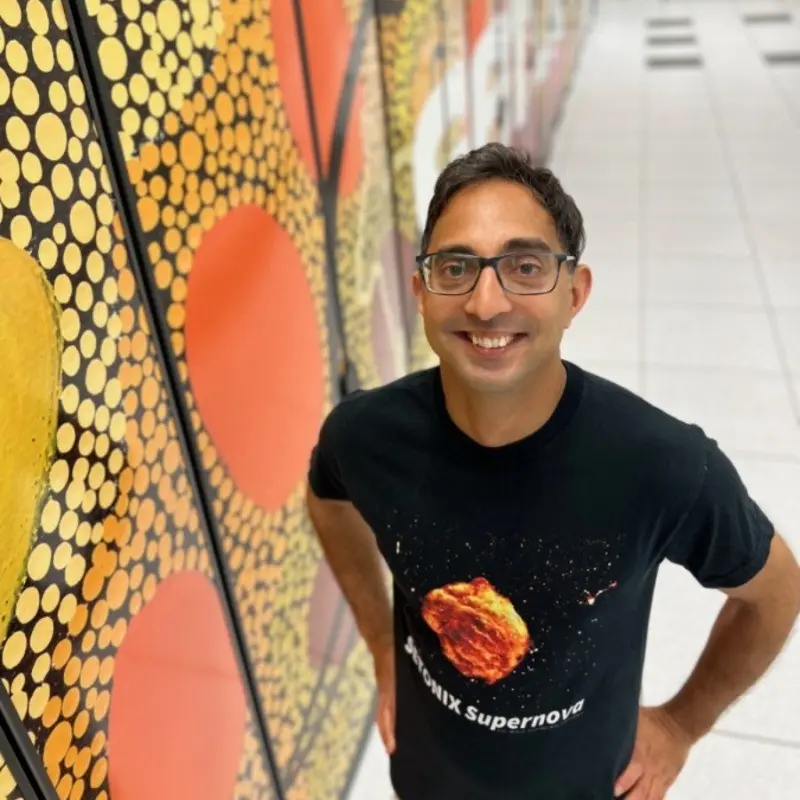
>> Right. So, Pawsey is a supercomputing center, and one of the major computing infrastructures we have, our supercomputer is Setonix, as is in my background, so this is the actual picture from our data center. Setonics is a high performance computing center actually provided by HPE Gray, providing the serious amount of compute to the scientific community in Australia. So we have GPUs and CPUs, and we really try to enable scientific research. So, our sort of is scientific computing to help accelerate science by providing computational infrastructure, but also expertise. Setonix-Q is expanding that to quantum technologies. So as we are a supercomputing center, we are usually always at the forefront of technology, and quantum computers happens to be a new computational paradigm. And the idea here is, like the high performance computing that we provide, we really are interested in democratizing access to quantum computers and really growing the quantum computing ecosystem as part of the scientific computing ecosystem.
This is just another novel computing element that can solve challenging problems. And so, Setonix-Q is the expansion of Setonix to quantum computing, where we provide not just quantum classical computers, but also access to quantum computers and guidance with expertise in quantum computing and classical computing so that the people who are in the science domain, who are field experts in bioinformatics, maybe jet engine design, get also expertise in how to run simulation software on computers like Setonix, and possibly figure out what parts of their problem will go and accelerate on quantum computers, which is a very different type of quantum computing, like computing, as you've mentioned.
Paul Gillin
>> Well, let's take a step back, and for the neophytes in the audience, can you try to explain as simply as possible what a quantum computer is and how it differs from conventional traditional supercomputers?
Pascal Elahi
>> I'll do my best. So, the classical computer tries to represent data and instructions as zeros and ones and does simple operations like representing two as a zero, one, or in this case, four maybe is zero, zero, one. So, these are simple binary numbers and it does operations on those binary numbers to change the state, do plus, minus. And those numbers can represent many different things. They can represent characters, they can represent more complex sets of ideas, but that is a simple linear operation. You basically get fast calculators, right? The actual calculations can represent a wide variety of things. That's why computers are such good modeling tools. You're not just using them to add two numbers together, but you add those two numbers to represent something more complex like characters, strings and so on. But there's a limit of how fast you can go. And the instructors are always kind of... Even though we do parallel computing, a single instruction will happen at a single time. So you do plus, minus. You might do it on four bits of data or you might do it on eight bits of data, but there's a certain paradigm where it would accelerate very well. They do very well at doing lots and lots of calculations. It's very good arithmetic, like Setonix does 42 times 10 to the 15 operations per second. So, that's a lot of calculations. That's roughly a few months worth of the human population calculating in a second. But there are certain problems which is quite attractable for a classical computer. If you have problems where there are many possible solutions, it can just take a very long time exploring all the possible solutions to a particular problem. Quantum computers operate in a different fashion. So, they use qubits. This is quantum bits of information, where you have not just something being zero or one, but having the ability to have a bit of information, the simplest bit of information, being a fraction of sometimes zero, sometimes one, depending on the measurement. So, it's actually a mixed state. It's a state in between zero and one, which means you can start representing many different solutions with very much smaller amounts of qubits than you would otherwise bits. If I have to represent all the numbers between zero and 16, I basically need 16 representations in a standard classical computer. But if I wanted to represent all 16 numbers with a quantum computer, I actually don't need that many bits. I actually only need four qubits and I can generate these mixed states so that I can represent all numbers between zero and 16. And then, that can be also all solutions between zero and 16 solutions, like solution one and 16. That opens up a really novel way of kind of representing data, but then you also have the fact that I can do stuff where I can entangle states. So, I can entangle qubits. This means I can get a qubit that depends on another qubit. This is a very quantum mechanical process. It's not a classical process. Superposition is also quite a quantum process rather than a classical process. And these operations, this ability to superimpose different sort of numbers or states or solutions and entangle solutions so you can get good solutions being enhanced and bad solutions being suppressed means suddenly I can do stuff where, if I needed a thousand years exploring 10 to the 200 possible solutions, it's a really big number. But if I have a quantum computer with 200 qubits, it will naturally explore that space. And then, it's just a matter of using an algorithm, a quantum algorithm, to enhance what you want to get so that at the end you get the probability of the best solution, let's say, for something like an optimization problem coming naturally out of the system.
And so, they really lend themselves to really novel types of computing where you find it challenging classically, but quantum mechanically, it ends up being super attractable. I wouldn't say super, but very attractable. The challenge right now is obviously there's a challenge in the hardware of doing quantum computing, but the mechanics is there and people are developing the algorithms.
Paul Gillin
>> So, are quantum computers ultimately a replacement for conventional traditional computers or a complement to them?
Pascal Elahi
>> It's very much a compliment. So, the power of a classical computer, this idea of rapid, simple operations, mathematical operations, that is not going to be the forte of a quantum computer. They both tackle different problems effectively. So, quantum computers are a great way to tackle a certain set of problems like optimization problems, but classical computers are great at doing a wide variety of other problems. I mean, simple things like just an app, a web app, running, you're not going to run that on a quantum computer. You're going to run that on a classical computer. Also, other sets of operations are quite good on classical computers. If I'm doing some heuristics, that is algorithms which try to guess, let's say, best solutions of some problem, that's quite good classically. You can then amplify it maybe with a quantum computer, but it's part of the computing landscape. It's just about really making sure that we have a new way of tackling other problems that we couldn't tackle before, but all the other variety of problems that are well suited to classical computing, they'll need classical computers anyway. So, it's just growing the ecosystem of what we can do computational.
Paul Gillin
>> How is Setonix advancing the state of quantum computing in Australia?
Pascal Elahi
>> So, part of the reason why our group is existing is that we're really interested in trying to tackle this hybrid approach. Really, we understand that real world problems, if you look at a real world problem, there's many sort of sub-tasks that are challenging computationally or challenging possibly to the point where they're almost intractable. And what we want to do is develop hybrid approaches where we use quantum where it's needed and use classical where it's needed. And so, Setonix is doing the classical approach, but it's also simulating quantum computers at smaller scales, and we are also developing lots of software to really integrate and, as best as we can, tightly couple quantum computation and classical computation so that people can solve a problem rather than... Just trying to focus on the solving the problem of quantum computing, use quantum computing to solve a problem. I would love to give an example, which is like if I think of some of the work we've been doing with collaborators, is like jet engine design. So jet engines, there's a huge way of playing with the blade shapes to maybe change the efficiency of jet engines and turbines. That's quite a complicated space to explore, you can use classical techniques, but it's also an interesting space where you can maybe use quantum algorithms to better tackle the optimization problem and also possibly improve the machine learning aspect as well. So, accelerate machine learning classically with quantum approaches or quantum machine learning, but you're going to do the simulations of a jet engine. These very large scale simulations usually will just run on classical computers. It's a very efficient way of doing the modeling of a fluid coming into a jet engine, getting ignited, right? You have combustion and then the expelling. And doing that simulation, you're going to run on a supercomputer like Setonix, but all the other bits to kind of improve how you design that in might entail quantum computing. So, it's a real hybrid approach. It always adds to the compute. It's not going to ever replace classical computers. I had someone ask me today actually at a conference I was at, "Is it going to be AI or quantum?" And I said, "No, no, it's going to be both." It's always going to be an addition to. It's never in replacements of. It's just a new tool in our toolkit to try tackling challenging problems.
Paul Gillin
>> Is one of the benefits of this tonic approach that you're making these resources available to researchers all over Australia, and perhaps beyond Australia, these resources that are difficult, too expensive, or maybe impossible for them to tap into otherwise?
Pascal Elahi
>> That's correct. One of the key focuses is this democratization of access. So, there are very few quantum computers. They are typically quite expensive. There's also just expertise bias of actually trying to use the actual real hardware. And so, what we're trying to do, what we launched recently, which is Setonix-Q, which is this national scheme for all Australian-based researchers to propose a science question that they think would benefit from quantum computing, so quantum computing acceleration. And so, we've developed a portal, we've developed a bunch of software to really enable this to happen, but we've also made a point of also providing our expertise so that people who are in domains that are not quantum computing can go and say, "Well, we want to tackle a portion of our real world problem with classical computing, but also tie it in with quantum computing." We want to eventually maybe try not just simulations of ideal quantum computers, but we want to try real current, though still noisy, quantum computers, and we would like some expertise to help that happen. And so, that's what Pawsey is really aiming to do. We really want to expand this access, not just quantum computing researchers, but people who actually want to just like, "Oh, I want to solve a problem, and I think maybe you guys could help us figure out what bit could be quantum accelerated and then help us actually implement that". And that is key to, I think, accelerating the quantum revolution, right? It's only going to happen if a large portion of the scientific community and industry start getting access and start getting assistance and start building up that expertise without having to really dive deep and having to be a true quantum algorithm specialist and like a person who really understands the hardware. There's enough extraction away and an ease of access. Then, we really will start accelerating the use of these new technologies and also come up with new novel ways of applying it.
Paul Gillin
>> I understand the quantum computer you're using is kind of unique. It's the first room temperature diamond-based quantum computer. What is significant about room temperature and diamond-based?
Pascal Elahi
>> Right. So, let's go with the room temperature first. So, a lot of quantum computing technologies rely on really cooling down the state of matters. So, the most common one that people are familiar with, it looks like these chandeliers, is superconducting quantum computers. So, Google, IBM, they have these superconducting essentially hardware as their quantum processing unit. That's the base of it, but it has to be cooled to very low temperatures. So, you need nitrogen cooling, you need helium 3. So they're not room temperature. They really require special cooling systems to operate and then produce these quantum states. Early on in sort of the start of the journey of policy and quantum computing was actually a partnership with Quantum Brilliance who had artificial diamond, like synthetic diamond, which had a specific defect in it. And the diamond is quite resilient. So, you don't have to cool diamond to very low temperatures to get it to then be able to be used as a computing element. And this defect... Same thing doesn't require any special cooling. So, Quantum Brilliance was actually... They were really interested in trying to deploy in a data center because that's quite a novel thing. A lot of quantum computers are still quite experimental. You can get some systems, but most express systems are designed and work in the lab, like a physics lab, and they were really interested in working in the data center. So, it was a world first kind of deployment of saying, what is the challenge faced by a quantum computing system deployed in a... What looks pretty quiet behind me, but it's for a quantum computer, it's a pretty hostile environment. There are pressure changes, there are dust, there are magnetic field changes. We went through this entire process to develop this and test this quantum computer and its deployment. And it was the first stage of doing an initial test to tie in at low latency a quantum computer with a supercomputer. And at this point, we're expanding our technology access to a wide variety of technologies. So, we're not necessarily focused on any given quantum computing technology, but we want to enable the growth of a wide variety of quantum computing technologies.
Paul Gillin
>> What role does the Cray supercomputer play in the service that you offer?
Pascal Elahi
>> So, many fold. One of the simple things is that, as I mentioned before, there are very few problems that you're going to just solely solve with a quantum computer. It's usually a multifaceted aspect. Real world problems are always multifaceted. So, some of them really need, well, standard, but they need high performance computing. If you're running really large simulations of jet engines, if you're trying to do simulations of fluid flows, erosion climate modeling, all of that needs standard classical computing, but there are certain aspects that will then really need quantum computing, but that's where the Cray comes in. We then provide the aspect that allows you to solve the problems that are not necessarily well suited to quantum computing, while also then hopefully tying in this quantum computer to do some error correction and error detection of quantum computers. We're doing quantum simulations where you simulate a quantum algorithm classically that is quite memory intensive, computationally intensive. That's why we want the actual quantum computing hardware. They'd sell it quite naturally, but you can simulate it to great expense on the computers by the computer behind me, Setonix. But also, one of the things that we're really looking at too is also exploring, is also helping quantum computing vendors understand the noise of their system. So currently, quantum computers are noisy. We're in the so-called NISC error. So, this is noisy intermediate scale quantum computing where quantum computers are still error-prone. So, Setonix doesn't produce many errors per hours. There's no bit flips. But in a quantum computing environment, qubits are still quite fragile. So, a physical qubit can change state without you asking it to change from a zero to a one, and that means that this noise is actually quite important. It's one of the major challenges that faces quantum computering companies, right, is dealing with the noise, addressing noise, detecting when their system has produced an error and possibly correcting it. And that's also what Setonix is also helping with, sort of simulating these errors, the noise, so we can actually test out error detection and error correction techniques and develop new ones because we can model a small digital twin of a simple quantum computer and progress the technology as well.
Paul Gillin
>> So, you mentioned that the Quantum Brilliance quantum computer uses quite a different architecture from other quantum computers. I know there are several approaches to quantum structure, to quantum infrastructure, out there. Do you see one of those approaches as eventually emerging as the standard for quantum computers or will there be many?
Pascal Elahi
>> I'm on the side of actually there will be many. So if you think of the computing landscape, the curb in one, we've got CPUs, but there's actually a variety of CPUs. There are GPUs, that's the big thing, right? NVIDIA, AMD, they produce GPUs. NVIDIA's obviously very famous for producing graphical processing units, GPUs that do gaming graphics, but also do lots of compute, and power the AI revolution to some extent. But there's also a bunch of variety of just novel classical computing, FPGAs and so on. So, you can imagine the same thing will apply to the technology modalities that people are exploring for quantum computing. I mean, there's a wide variety of them, and they all might have their pros and cons. I mean, currently, they definitely all have their pros and cons. And so, I just feel like that will continue. There'll be certain aspects of certain systems that lend themselves well to certain problems because it's easier to pose that problem with their given hardware. They're given sort of how they represent qubits, like what do they use for qubits, how those qubits can be connected to each other, but also the speed of an operation. So, I'm going to use two examples. Superconducting ones I mentioned, right? You cool the system down, you need liquid nitrogen, you need helium 3. These supercomputing chips, they're very fast in terms of operations. It doesn't take very long to do essentially a quantum operation like a plus or an entanglement. They're typically physically very fast, but it's very challenging because you have to cool them down, so you need lots of infrastructure, and it's also a challenge of maybe how you might scale up because it is a chip. So, it's a real challenge to kind of keep growing these and having more qubits in. It's one of the challenges that IBM and a bunch of vendors like IBM are trying to address, but they also have limited connectivity. To entangle qubits, you have to have qubits being able to essentially interact. And so, they have a very fixed topology. So, a qubit cannot interact with every other qubit in the chip. It interacts with nearby neighbors, so there's a limitation there, but you can really address the noise. There's other ones that try to use atoms or ions. So ionQ, Quantinium, QR, they use atoms or ions to be the basis of their operations and they have used lasers. And so, they move lasers or they use electric fields to move ions around. So, you're moving qubits around, which adds another technical challenge, but it means that you can have qubits actually really, truly entangle with every other qubit. There's essentially an all-to-all connectivity. This means that you can see immediately that there's a divergence of what advantages one technology might provide over another. And so, I can imagine they all start existing and having their specific use cases. Some places might be, well, we prefer photonic-based devices and the other ones might be, well, we prefer superconducting based devices for speed, and the other one might be, well, we really want all to all contactivities. So, ion traps and neutral atom quantum computers are the ones we're more interested in. I can see there being many, many types of quantum accelerators out there, even from a decade from now.
Paul Gillin
>> There's a lot of excitement, of course, around artificial intelligence right now, which is very compute intensive. Do you see quantum computers, or how do you see quantum computers playing in AI development?
Pascal Elahi
>> So, there's a couple of interesting ways where quantum might play a role. So, one thing just to note is that there are certain places where your classical techniques are very... They can learn stuff, you can train in AI, but it can be hard to train in AI if you have small, really complex data. I mean, the standard practice for most AI is throw more data at it, give it more data to learn. But if you have a small amount of data to learn, you sort of hit a bottleneck, but it's possible that certain quantum approaches might learn better in that low data domain, like medical data, small sample sizes, complex data. There's other ones where it's kind of really interesting. There's been recent studies looking at computer vision and classification where classical approaches can be fooled with a very specific type of approach. It's called adversarial attacks where you introduce noise in an image. It doesn't look like anything to us. It's a very small amount of noise. You change a pixel here and there, but then you can drastically change the classification that a standard classical algorithm will use, whereas the quantum approach is more resilient to this. So, it doesn't actually get fooled as easily, even though maybe its accuracy is a bit lower. But there's also certain approaches where we think we can augment the speed at which machine learning algorithms like AI would learn with quantum approaches. So, you enhance the learning rate using a quantum pre-step. So, there's now a quantum acceleration as part of the learning process, and then you might accelerate the speed at which you learn. So, there's those aspects. There's also an interesting aspect about energy use. So to train in AI, especially generative models, there's a lot of compute that's needed, so there's a lot of energy involved, and to have more compute. So if I want double the power of Setonix, I have to have two Setonixs, which means I double my energy footprint. But for a lot of quantum computing systems, you add a qubit. So a single qubit is effectively, to some extent, double the computing power of a quantum computer. So, I need to double my energy footprint here to get double the power there. I don't maybe need to even drastically change my energy footprint at all to double the power. So, there's going to be certain regions where you want to use a quantum computer, not necessarily because it's producing a better answer in terms of AI, but it's way more energy efficient. So you maybe accelerate to, as I said, use this approach of using quantum as part of the chain and training a classical surrogate and accelerate the classical approach, but also maybe reduce the energy cost of training a classical approach just because you don't necessarily have to have the same energy footprint growing the power of a quantum computer as you would have growing the classical infrastructure.
Paul Gillin
>> Fascinating. What's ahead? What does the next three years hold for Setonix-Q?
Pascal Elahi
>> So, we're still in the early stages of really getting users to experiment with quantum computers beyond the quantum computing experts. I really think that with the initial step, there'll be some teething pains, but there also would be really excitement and growing and testing at new ideas. So the first round, let's say, of researchers were pretty close to the quantum computing sector. They were quantum computing experts, so they had people that were in the team that were quantum computing experts, and their problems were quite focused about like, "Well, we want to use quantum computers." And a lot of it is maybe quantum computing simulation with maybe migrating to testing on real hardware. As hardware improves, there's more interest in going, "Well, the hardware now is getting better. It's less noisy." So if I have an algorithm, it may be less prone to noise just naturally. I didn't do anything to my algorithm, so there's a real novel thing to try. And I can just imagine the ecosystem is accelerating itself. So the ideas for the next couple of years... The idea is to expand the number of researchers that are getting access, but also expand access to possibly industry and beyond, right? So not just academia, but also industry with the idea that with co-design, with the quantum computing vendors, with our expertise in quantum computing and HPC, we can increase the number of people trying out quantum algorithms, developing quantum algorithms, and experimenting with real hardware, and then possibly applying algorithms in sort of novel ways that we didn't expect. That's kind of the key thing. I expect that they see the growth in the next couple of years of getting more researchers involved from a wider variety of scientific domains and backgrounds, and then possibly getting industry involved, which would then just naturally get you kind of critical mass in testing out new ideas and new algorithms and testing the limits of the current quantum hardware.
Paul Gillin
>> Living life on the edge, Dr. Pascal Elahi. It's an exciting time and you're in an exciting spot. Thanks so much for sharing some of your experience and your plans with us here on The Cube.
Pascal Elahi
>> Thank you very much for having me.
Paul Gillin
>> I'm Paul Gillin. This is The Cube. We're celebrating World Quantum Day. Stay with us.