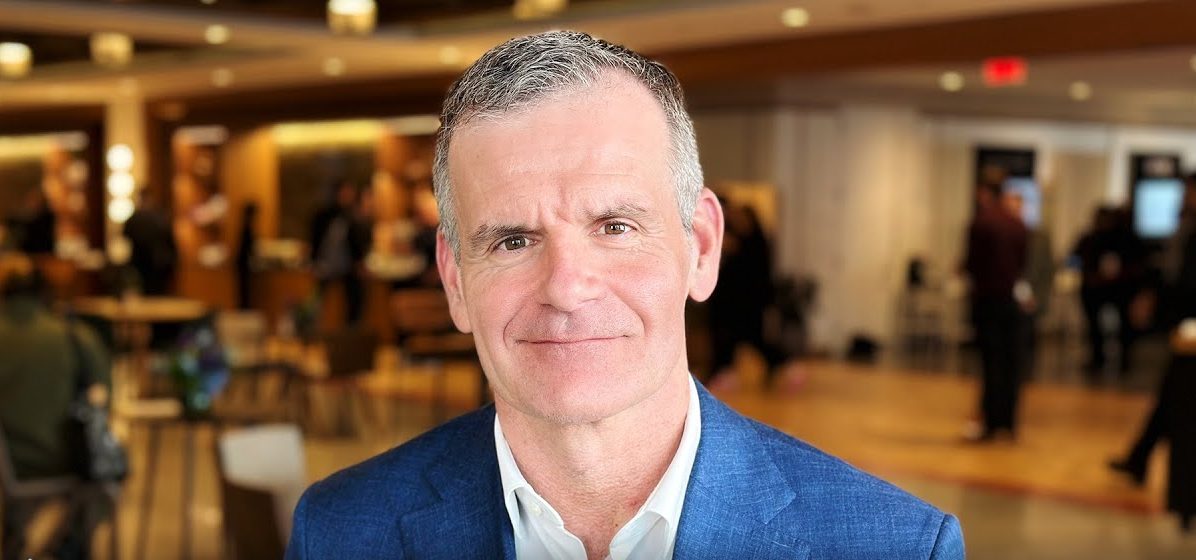
In this interview from Freshworks Refresh 2026 in New York City, Dennis Woodside, chief executive officer of Freshworks, joins theCUBE Research's Bob Laliberte to discuss how enterprises are moving from AI experimentation to measurable operational impact. Woodside frames the company's strategy around four core beliefs — depth and scale, ease, choice and trust — and explains why Freshworks targets what it calls the "agile enterprise": organizations that must compete with far larger rivals using leaner teams. He highlights customer wins like New Balance and Seagate, noting that Freshservice grew 27% last quarter, as proof that the platform approach is resonating at scale.
The conversation also explores the wave of product announcements Woodside unveiled at Refresh 2026, including an AI agent studio that enables no-code agentic workflow creation on top of Freshservice, an MCP gateway that lets customers invoke Freshworks capabilities directly from tools like Claude or ChatGPT and a new Experience Level Agreement (XLA) framework that replaces response-time SLAs with signal-based measures of actual employee productivity. Woodside addresses where enterprises most often stall on their AI journeys — fragmented data and multi-vendor tech stacks built through years of acquisition — and outlines the consolidation-first approach that helps customers establish a single system of record before AI is applied. From governing thousands of AI agents to redirecting skilled IT talent toward higher-value work, he provides a forward-looking roadmap for how organizations can move past legacy service architectures and operationalize AI at enterprise scale.
Forgot Password
Almost there!
We just sent you a verification email. Please verify your account to gain access to
Freshworks Refresh 2026. If you don’t think you received an email check your
spam folder.
In order to sign in, enter the email address you used to registered for the event. Once completed, you will receive an email with a verification link. Open the link to automatically sign into the site.
Register for Freshworks Refresh 2026
Please fill out the information below. You will receive an email with a verification link confirming your registration. Click the link to automatically sign into the site.
You’re almost there!
We just sent you a verification email. Please click the verification button in the email. Once your email address is verified, you will have full access to all event content for Freshworks Refresh 2026.
I want my badge and interests to be visible to all attendees.
Checking this box will display your presense on the attendees list, view your profile and allow other attendees to contact you via 1-1 chat. Read the Privacy Policy. At any time, you can choose to disable this preference.
Select your Interests!
add
Upload your photo
Uploading..
OR
Connect via Twitter
Connect via Linkedin
EDIT PASSWORD
Share
Forgot Password
Almost there!
We just sent you a verification email. Please verify your account to gain access to
Freshworks Refresh 2026. If you don’t think you received an email check your
spam folder.
In order to sign in, enter the email address you used to registered for the event. Once completed, you will receive an email with a verification link. Open the link to automatically sign into the site.
Sign in to gain access to Freshworks Refresh 2026
Please sign in with LinkedIn to continue to Freshworks Refresh 2026. Signing in with LinkedIn ensures a professional environment.
Are you sure you want to remove access rights for this user?
Details
Manage Access
email address
Community Invitation
Dennis Woodside, Freshworks
Dennis Woodside of Freshworks joins host Bob Laliberte of theCUBE Research to discuss Refresh 2026 announcements and the evolving role of artificial intelligence in service management and employee experience. Woodside draws on experience leading Freshworks to explain platform strategies: depth and scale, ease, choice and trust. They highlight new capabilities including AI agent studio, MCP gateway, experience level agreements XLA, and integrated IT asset and operations management ITOM.
Key takeaways include that enterprises must consolidate fragmented technology stacks into a single system of record before applying AI, and that AI adoption should proceed workflow by workflow to achieve measurable time to comfort. Woodside emphasizes measuring impact via experience level agreements XLA rather than traditional service level agreements SLA. They note Freshworks' position to help agile enterprises govern and scale thousands of AI agents securely, supporting digital transformation, automation and improved employee experience.
Watch the Refresh 2026 keynote for deeper discussion of platform strategy, AI governance, service management and IT operations.
play_circle_outlineWhy Enterprise Buyers Choose Freshworks: Operational Simplicity and Measurable AI Transforming Service Management and Employee Experience
replyShare Clip
play_circle_outlineFreshservice’s Four Pillars: Depth, Ease, Choice, and Trust Powering Enterprise IT and LLM Flexibility
replyShare Clip
play_circle_outlineAI Agent Studio: no-code platform to build custom agentic AI workflows and automations.
replyShare Clip
play_circle_outlineExperience-First IT: Leveraging XLA and Integrated ITAM/IOM to Boost Employee Productivity and Speed Incident Response
In this interview from Freshworks Refresh 2026 in New York City, Dennis Woodside, chief executive officer of Freshworks, joins theCUBE Research's Bob Laliberte to discuss how enterprises are moving from AI experimentation to measurable operational impact. Woodside frames the company's strategy around four core beliefs — depth and scale, ease, choice and trust — and explains why Freshworks targets what it calls the "agile enterprise": organizations that must compete with far larger rivals using leaner teams. He highlights customer wins like New Balance and Sea...Read more
exploreKeep Exploring
What is driving the acceleration in Freshworks' enterprise momentum and recent strong quarterly performance?add
How do the four key beliefs—depth and scale, ease, choice, and trust—shape the long-term strategy for the Freshservice solution?add
What announcements did you make about new AI capabilities on your platform, and how will they benefit customers?add
What product launches or developments are being introduced for IT service management, and how do they address SLAs versus XLAs, AI-driven responses, and IT asset/operations management?add
>> Enterprise software buyers are increasingly looking for platforms that combine operational simplicity with measurable AI outcomes. Now, Freshworks Solutions continue to gain traction as organizations transform service management and employee experience. Hello and welcome to Refresh 2026. We're at Hudson Yards in New York City and I'm Bob Laliberte, principal analyst for theCUBE Research and I am here with Dennis Woodside, the CEO of Freshworks. Welcome, Dennis.
Dennis Woodside
>> Hey, Bob, thanks for having me.
Bob Laliberte
>> Yeah, great to be here again. Great to see you. Let's get started. And I wanted to start maybe at a little bit of a higher level. I noticed you had a pretty good quarter, really strong, a lot of growing enterprise momentum. What's driving that acceleration?
Dennis Woodside
>> Yeah, so enterprises are looking for a couple things in transforming in an AI first world. They need to find partners that have the kind of breadth and depth in their core capability so that you can build AI on top of that. They need an organization that's going to be agile and fast, that's going to ship products that have a level of sophistication under them but actually present themselves to the user as easy to use, easy to get value from. They're looking for AI to be easy and fast and drive that kind of transformation internally. And they're looking to transform how they deliver service to their employees so that their employees can be more effective. And a lot of those trends are driving our business.
Bob Laliberte
>> Got it. And I'm just curious because I saw a lot of great customer announcements in the keynote this morning. Do you find, is there any one thing that's resonating more with customers than others?
Dennis Woodside
>> I think every customer that I talk to is looking to AI to help them transform their service operations. If you think about companies historically, you had to rely on humans to do a lot of work that was rote and a lot of work that was repetitive and not particularly interesting for the employee, which led to turnover problems. Now, a lot of that can be handled by AI, but a lot of companies are challenged in that their data is fragmented, their tech stack is fragmented. So the first thing they have to do is they have to consolidate, especially on the IT side, into a system of record that is robust, is broad, is enterprise grade. And that's what we offer.
Bob Laliberte
>> Yeah, it makes sense. The platform approach.
Dennis Woodside
>> The platform.
Bob Laliberte
>> Being able to unify it all.
Dennis Woodside
>> Yep.
Bob Laliberte
>> Absolutely. Another thing I wanted to touch upon in your keynote, you talked about your four key beliefs. I want to make sure I get this right. Depth and scale, ease, choice, and trust.
Dennis Woodside
>> That's right.
Bob Laliberte
>> And so I'm wondering if you could talk about how those beliefs really shape your long-term strategy with the solution.
Dennis Woodside
>> Yeah. So our primary customer for Freshservice is an IT team and they are looking for a platform to power every aspect of their operation. How they deliver service to their employees, how they track their assets, their hardware, their software and how they stay compliant, how they respond when there are incidents. That's operations management. They're looking for a platform that can extend beyond IT because there are lots of teams in a large organization that have to deliver service to their employees. Think about the HR team.
Bob Laliberte
>> Sure.
Dennis Woodside
>> So when we say depth, what we're talking about is the ability to cover all of those use cases. And that's what we've built. We've built a platform that can serve every need of IT. When we talk about scale, they're looking for a proven partner that has actually been there and done that at scale. We've been doing this for over 14 years. We have on any given day handled 25 million workflows as an example. So we have the kind of scale that they're looking for if they're a larger enterprise and they need to transform their operations. That's what I mean by depth and by scale in particular. When it comes to things like ease, they need that level of sophistication, enterprise grade security, all that, but they want the experience for their admins, and for their agents, and for their employees to be easy, to be fast. They don't want to get bogged down in a product experience that's antiquated. And that also is what we do. We built the product from the ground up to be easy to use, easy to deploy, and then very fast time to value. They want choice. They don't want to be locked into a platform. So some of our customers want to innovate on top of the system that we've built. One of the products that we launched is our MCP gateway that allows you to, if you want to live in Claude or you want to live in ChatGPT and access our system and action in our system, you can do that through the MCP gateway. That's an example of choice. And then the last thing is they need to trust you. They want to trust that you're going to be there for them, that your pricing policies, the way you price your products, the way you approach them at a renewal is ethical and fair and transparent. That's super important. They want to ensure that you can be trusted with your data, especially now that that data is so important for AI experiences. And that's really the fourth pillar. Again, we build our products that way.
Bob Laliberte
>> Excellent. That sounds great. Yeah. And it came clear in the keynotes, especially hearing the customer testimonials. I heard the word intuitive multiple times and I think that's a great way to define ease. I've always looked at it as what I call the principle of least astonishment. When you open something up, you just intuitively know how to use it. So it's great to hear the organizations validating one of your core pillars and so forth. I think some of the other areas that you mentioned are really going to be key. Trust was one of the big topics of Davos this year as well. So when you're building those out, you've got the four tenants. When you're going out talking to customers, just curious, is it the combination of all of them or is there any on that stands out more than the other?
Dennis Woodside
>> Well, I would start by saying the enterprises that are coming to us, we call them agile enterprises. An example is New Balance. New Balance has about 7,000 employees. They have to compete with Nike, which has 90,000 employees. So the way that they compete is they have to be faster, they have to be more nimble, they have to be more agile. And our products fit that customer cohort very well. Another example that we talked about on stage was Seagate. Seagate has about 30,000 employees, but they're competing with Samsung, which is a much larger organization. For them to compete and win and grow, they have to be faster, they have to be more nimble. And what was interesting about the case study that we showed, you heard from the IT leader, one of the things he cited was the ease of use. At the end of the day, the agents got up and running very fast. They were on a competitor platform for a decade. They moved off of it and got on us in three months, which in an enterprise software is pretty much unheard of. And the number one thing he highlights is people love it. We forgot what the old system was. And I love those kinds of testimonials because it really shows that the principles that I'm talking about, they truly guide what we build and it shows in the product, it shows in the experience.
Bob Laliberte
>> Yeah. And it's great to get that customer validation, right?
Dennis Woodside
>> Yes, absolutely.
Bob Laliberte
>> That it resonates with them. So you brought up one of the announcements around MCP, but there were a number of announcements. Pretty impressive, right? It's only been five or six months since the last Refresh you did, but yet a lot of innovation coming out. Can you summarize what you're delivering today, the new announcements and why they matter to the customer?
Dennis Woodside
>> So the announcements really are about delivering on this platform that has depth, that has scale, and is AI-enabled. One of them is our AI agent studio. So what that does is it allows our customers to build custom agentic AI applications on top of Freshservice or out of the box use workflows that we've prebuilt for things like resetting a password or getting an employment verification that most companies have. So they can build in actually a no code way, drag and drop type of experience for any agentic capability. And that's just not done in our competitor's product. So that's one. Every one of our customers is looking to create agentic workflows to make service much more effective. The second, as you mentioned, is the MCP gateway to give our customers choice if you want to use another AI to understand our product, to manage our product, to tell our products what to do, you can do that. And we see many, many companies that are heading in that direction. Third class of launches, we have a product that's called XLA, Experience Level Agreement. In the past, most IT departments were run off of SLAs. So how long does it take to respond? But when every response can be instantaneous because it's AI driven, what you really want to measure is did the response make the employee more productive? You can do that by asking the employee, but you can also do that by watching what they do next and understanding that that's an agentic way of creating what we call an XLA score. So that's another class of product that is really interesting for us and exciting. And then the last one is around our IT asset management and IT operations management. So every IT department needs to understand the hardware, the software, the inner relationships, things break, things go down. When that happens, they need to be able to respond fast. That's what those products do, which are now fully integrated into Freshservice. So our customers don't have to move from one application to the next to the next. They have a seamless experience. All the data's in one place. They can respond in a very fast way.
Bob Laliberte
>> Yeah. And that's so critical for AI to have all the right data there where it's needed and to be able to build off of it.
Dennis Woodside
>> That's right. And where it's all going, think about New Balance, managing literally tens of thousands of pieces of hardware and software all around the world. They don't want to have people having to monitor all that, respond to alerts. The AI can do it. The AI can also modify the systems at a lower level without a human even in the loop if New Balance chooses to do that. And that really makes the entire system work much more efficiently for New Balance.
Bob Laliberte
>> Yeah. Also, one of the things I also really liked was the ability to adopt the workflows at the pace that they needed.
Dennis Woodside
>> Exactly.
Bob Laliberte
>> So you've got a lot out of the back. So again, a lot of people are concerned that autonomous is a binary thing. It's either on or off. You're letting it be built on a workflow by workflow basis. So it gives them what I always refer to as the time to comfort with AI before they turn it to autonomous.
Dennis Woodside
>> Yeah. And our customers really range the gamut. I was actually speaking with another customer about half an hour ago that employs over 800,000 people and a lot of their interaction between the employee and the IT department is still on phone and they haven't really gotten down that automation journey, partly because they need to consolidate data, they need to consolidate systems. So for us, it's our job to help them get on that journey. We have other customers that are at the opposite end of the spectrum that are really leaning and heavily into AI and completely transforming how they deliver service. So our product flexes really to meet the customer where they are.
Bob Laliberte
>> Okay, nice. Now that you're expanding your portfolio, how is that strengthening your position against maybe some of your larger enterprise competitors?
Dennis Woodside
>> Yeah. Well, our positioning is very clear, especially for that nimble agile enterprise that might not have the resources of a Fortune 50 company, but has to compete with a Fortune 50 company. So in that space, we are the leader. We are the choice and you're seeing it with these names like Seagate. One of the things I talked about, we have a third of the major league baseball teams are with us today. A third of F1 teams are with us today. We have two of the top three music majors. These are massive companies, very important companies. We have two of the top four US steel manufacturers, Nucor Steel, Steel Dynamics. We have 1,000 universities. We have close to 1,000 law firms. So what I'm seeing is with all that momentum, the customers are starting to refer one another. They're starting to realize they have a real choice from some of the larger enterprise platforms that have been around a long time, the legacy players. And they're excited about where we're going. They're excited about the agentic vision. They're excited about the complete product vision that they're seeing and they're coming on board.
Bob Laliberte
>> No, I think that's great. And I think it's just a proof point of all the hard work that you've put into up till this point to get you here that's allowing you to start really... It seems like we're in this mode now where you're starting to really accelerate a lot of that momentum and adoption, especially in some of the larger enterprises as well.
Dennis Woodside
>> That's right. And you saw that in our results just going back to the last quarter anyway, our Freshservice business grew 27%, which is fantastic.
Bob Laliberte
>> Yeah, that's awesome. We talked about organizations moving past experimentation into operationalizing it, easy for me to say, their AI stuff, but some companies are still struggling. You mentioned you meet all across the world. Where are enterprises getting stuck today and how are you helping them get past that point?
Dennis Woodside
>> Well, for AI to work well, you need to have a single system of record. You need to have a single source of truth. You need to have defined your business processes very clearly. And for lots of companies, especially companies that have grown through acquisition, they're not at that point yet.
Bob Laliberte
>> Correct.
Dennis Woodside
>> Now, what we do see is companies using AI first and foremost to start moving in the direction of consolidation, consolidation of multiple vendors. We have lots of customers, new customers that are working on very fragmented tech stacks where different divisions are using different tools. So they need to get onto one platform. That's step one. The data needs to be clean and needs to be accurate. We can help them do that in the process of migrating them onto the platform. Then you can start applying AI. So it's a journey. We can help them on the journey for sure.
Bob Laliberte
>> Yeah, no, that makes sense. I think we hear that a lot, that data readiness first phase, getting your data locked up and then getting the governance and workflows going and things like that.
Dennis Woodside
>> That's right.
Bob Laliberte
>> Yeah. It makes a lot of sense for that. We've talked a lot about where you've been over the last six months and things you've done. How about if we change directions, look a little bit in the future? Where do you see the next major opportunity for Freshworks?
Dennis Woodside
>> I think if you look out two years, it's actually a really exciting time to be in our business. Think about how the experience for our customers is going to evolve. Again, our core customers in the IT team, they're the CIO or the director of technology. Everything AI is landing on them in a good way and in a challenging way too. So if you play it out two years from now, all of our customers are going to have thousands of AI agents. They're going to have human agents too. They're going to have AI agents from us. They're going to have them from the LLMs. They're going to build their own. All that has to work together. And the job of governing it, ensuring it's secure, the access controls, that's all going to fall on the IT team. So that's a real challenge for them. We can help them on that journey for sure. This notion of XLAs is really important because when an answer... You heard this from Julie Mohr at Forrester today. When you can answer something in a millisecond, the notion of a four XLA doesn't make sense, but the real question is, was the employee more productive at the end of the day?
Bob Laliberte
>> Correct.
Dennis Woodside
>> And there's various ways of measuring that. It's not the old survey based way. You can look at real signals in the data to understand did we actually resolve the problem? Is the employee able to get about doing their job faster? I think that's a really exciting kind of place to be as well. But through all that, you are going to need a platform that is the canonical source of truth that can form the basis of how you're delivering AI. And so that for us puts us in even better position. So I think it's a really exciting time to be here at Freshworks, but also to be one of our customers and to bring this world to life.
Bob Laliberte
>> Yeah, absolutely. I think a lot of that's going to bring a lot of value. I'm very excited to see the XLA piece. That's something, having a former telco background, it was always about how do we measure the experience, how do you measure the... It's typically subjective, right? So they had MOS Scores for voice, but that was just how the technology's doing, not what the end user's experiencing. So I'm looking forward to seeing that continue to evolve and become adopted globally as a standard saying, this is what we should focus on from here on out. And I think it's true, right? Because with AI taking on so many of the mundane tasks, freeing up time for these IT people to work on more strategic initiatives and obviously ensuring better experiences for everyone who's using it.
Dennis Woodside
>> Yeah. I've never met an IT team that doesn't have a list of projects that's much larger than their actual capacity. And the people who are answering questions today from employees, they are very skilled. They understand your systems, they understand your culture, they understand your business. So typically what I've seen our customers do when they have an agent where they're freeing up that time, they can find much more important work for them to do, much more creative work. And that's really the problem we're trying to solve.
Bob Laliberte
>> Yeah, absolutely. So congratulations on a great quarter. Congratulations on another packed event. A lot of energy here today, a lot of end users, which is fantastic to see. If you're thinking about today, what's the biggest takeaway you want customers to and even partners to leave Refresh with at this event?
Dennis Woodside
>> I think the number one thing is that we are offering our customers that agile enterprise a choice that they might not have had 18 months ago, 24 months ago. We've got a product that is broad, that is deep, that is operating at massive scale today. We've got customers that are large organizations that have made the choice to bet their business with us that are transforming their service operations with us. And we're ready for you, so come on in.
Bob Laliberte
>> Sounds like a great pitch to me. Dennis, as always, thank you. It's great to catch up with you and I want to thank everyone for joining us here at Refresh 2026. Stay tuned for more content to come.







 Bob Laliberte