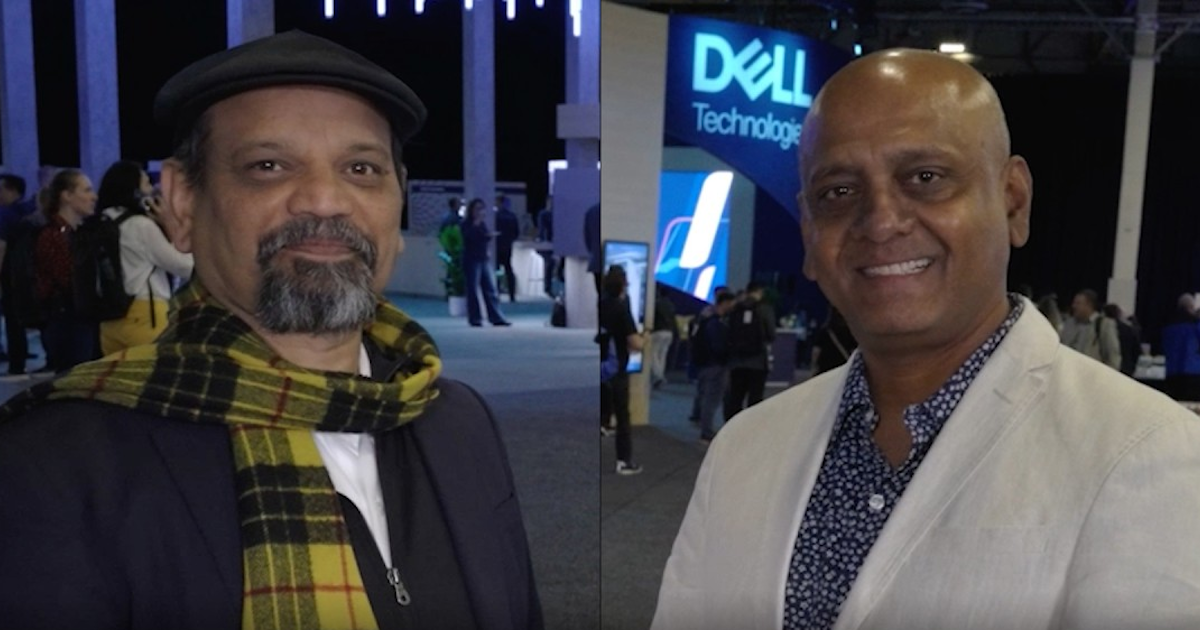
In this interview from Dell Technologies World 2026 in Las Vegas, Sri Ambati, founder and chief executive officer of H2O.ai, joins Satish Iyer, head chief technology officer of ecosystems and startups at Dell Technologies, to talk with theCUBE + NYSE Wired's Gemma Allen about how the Dell and H2O.ai partnership is accelerating the enterprise shift from AI experimentation to full-scale production. Iyer outlines Dell's deliberate strategy of integrating innovative AI startups into its AI factory, underscoring that enterprise challenges can only be solved through ecosystem collaboration. Ambati dives into the emerging tokenomics problem — where top developers are burning upward of $1,000 per day on tokens — and explains how H2O.ai is building orchestration layers that route workloads to the right model at the right size, shifting cost-intensive customers onto on-prem Dell AI factories running small language models, including the newly released TABH2O Tableau foundation model trained on more than six million synthetic datasets.
The conversation also explores the growing pull toward edge AI and sovereign deployments, with Iyer detailing how Dell is bringing AI to where customer data is generated — from industrial mining sites and healthcare facilities to laptops and mobile devices. Ambati highlights the geopolitical urgency behind on-prem adoption, noting that customers ranging from AT&T and Goldman Sachs to Commonwealth Bank of Australia are building AI-native assets to achieve predictable spend and data sovereignty. He also unpacks the vertical AI opportunity, where purpose-built agents for fraud prevention, predictive hedging and supply chain forecasting are proving far more powerful than generic platform models. From a hurricane prediction model that anticipated infrastructure damage from the Palisades fire to a Space Force deployment predicting launch readiness, Ambati outlines a vision for AI that serves humanity — and positions the Dell-H2O.ai partnership as the trusted infrastructure underpinning that ambition.
Forgot Password
Almost there!
We just sent you a verification email. Please verify your account to gain access to
Dell Technologies World 2026. If you don’t think you received an email check your
spam folder.
In order to sign in, enter the email address you used to registered for the event. Once completed, you will receive an email with a verification link. Open the link to automatically sign into the site.
Register for Dell Technologies World 2026
Please fill out the information below. You will receive an email with a verification link confirming your registration. Click the link to automatically sign into the site.
You’re almost there!
We just sent you a verification email. Please click the verification button in the email. Once your email address is verified, you will have full access to all event content for Dell Technologies World 2026.
I want my badge and interests to be visible to all attendees.
Checking this box will display your presense on the attendees list, view your profile and allow other attendees to contact you via 1-1 chat. Read the Privacy Policy. At any time, you can choose to disable this preference.
Select your Interests!
add
Upload your photo
Uploading..
OR
Connect via Twitter
Connect via Linkedin
EDIT PASSWORD
Share
Forgot Password
Almost there!
We just sent you a verification email. Please verify your account to gain access to
Dell Technologies World 2026. If you don’t think you received an email check your
spam folder.
In order to sign in, enter the email address you used to registered for the event. Once completed, you will receive an email with a verification link. Open the link to automatically sign into the site.
Sign in to gain access to Dell Technologies World 2026
Please sign in with LinkedIn to continue to Dell Technologies World 2026. Signing in with LinkedIn ensures a professional environment.
Are you sure you want to remove access rights for this user?
Details
Manage Access
email address
Community Invitation
Sri Ambati, H2O.ai & Satish Iyer, Dell
In this interview from Dell Technologies World 2026, Kevin Johnson, co-founder and chief operating officer of Bud Ecosystem, and Rob Rollinger, head of marketing at Bud Ecosystem, join theCUBE's John Furrier and Dave Vellante to discuss how enterprises are moving beyond fragmented AI tools toward unified, full-stack platforms built for production agentic workloads. Rollinger describes Bud Ecosystem's complete stack — spanning silicon through training, inference and governance to agent orchestration — deployable on Dell AI Foundry on-prem or in the cloud. Johnson explains that the highest-value AI outcomes come not from bolt-on tools but from re-architecting enterprise workflows entirely, with a platform capable of reducing AI infrastructure costs by up to 80%. Both guests frame the enterprise challenge as one of simplification: too many stove-piped tools, too little centralized control.
The conversation also explores how legacy systems — HCM, ERP and CRM — were built for querying, not real-time machine intelligence, and how the agentic era is forcing a fundamental rethink of enterprise architecture. Rollinger outlines how leading deployments assign distinct roles across agent layers — orchestrators, quality control agents and gatekeepers — to balance autonomy with accountability. Johnson points to the Bud Ecosystem Enterprise AI Management Platform as a unified control and data plane capable of governing thousands of agents across environments, from large-scale AI factories down to individual Dell Pro Max endpoints, without sacrificing security or compliance. From navigating the economics of distributed hybrid architectures to protecting data as the irreplaceable core of enterprise intelligence, the discussion offers a practical roadmap for organizations ready to move from experimentation to full-scale AI production.
In this interview from Dell Technologies World 2026 in Las Vegas, Sri Ambati, founder and chief executive officer of H2O.ai, joins Satish Iyer, head chief technology officer of ecosystems and startups at Dell Technologies, to talk with theCUBE + NYSE Wired's Gemma Allen about how the Dell and H2O.ai partnership is accelerating the enterprise shift from AI experimentation to full-scale production. Iyer outlines Dell's deliberate strategy of integrating innovative AI startups into its AI factory, underscoring that enterprise challenges can only be solved throug...Read more
exploreKeep Exploring
How does H2O.ai address tokenomics—reducing token consumption and cost while delivering value—and what approaches does it use to change that token cost/value equation?add
How are open-source models and on‑prem solutions (e.g., Dell AI Factory with H2O and the TABH2O model) being used to provide predictable token consumption/pricing, predictive and agentic AI capabilities, and sovereign (on‑prem) deployments for enterprise use cases?add
How does Dell plan to bring AI to customers where their data is, including on‑premises and edge deployments?add
What will the next year look like for this partnership and what are the priorities for bringing the technology to life for customers and partners?add
>> Welcome back to Dell Technologies World 2026 with theCUBE. We are here on the ground in Las Vegas, and we are talking all things Dell, the community, the ecosystem, the customers, and the stories that are driving this next wave of agentic AI. Joining me now are two folks who are going to bring this conversation to life. Satish Ayer, Head CTO of Ecosystems and Startups at Dell. And Sri Ambati, Co-Founder and CEO, or Founder and CEO I should say, of H2O.ai. Welcome, Sri.
Sri Ambati
>> Thank you.
Gemma Allen
>> I imagined a second founder there, but you're a one man show, right? Okay, so folks, this is a very important week for Dell, but really we know this is all about community relationships and also real life impacts on the field, right? Talk to me a little bit, maybe starting with you, Sri, about this relationship with Dell and what has really been shifting, changing, evolving in your space.
Sri Ambati
>> The space is really transforming right before our eyes, right? And distribution has become king almost. Innovation is moving so fast, content is becoming faster, cheaper, better to build, easier to build. The best path to reaching customers is through distribution. Dell is a trusted democratizing compute was for the democratize the whole PC and then post-PC and enterprise era. What we've done is democratization to all the AI, and so that together this is the best of both connections.
Gemma Allen
>> We know that Dell is a company that's had a lot of longstanding legacy relationships, right? You guys have been in this business a long time. You have built a phenomenal compound network over that time, but we also know startups, folks that are challenging incumbents are really important in this space.
Satish Iyer
>> Absolutely.
Gemma Allen
>> Talk to us a little bit about how you think about these relationships, how you foster them, grow them, and where you prioritize.
Satish Iyer
>> First of all, thanks for having us, Sri. I think the main, like Michael in his keynote splashed three screens of all the ecosystem partners we worked with. It's important to understand that we as Dell in AI journey will not be successful enterprises with our ecosystem partners. There is an added, the whole aspect of enterprise challenges can be solved only with ecosystems. We have been very particular in Dell the last two and a half years in terms of going and embracing a lot of these startups which are actually very innovative, doing some really cool things in really extremely complex bases in AI and bringing them on our factory. We think that's going to be the model by which we can be successful when we actually go solve our enterprise problems. So it's absolutely critical for us to have that.
Gemma Allen
>> Well, let's talk about some of that innovation as it relates to H2O.ai. We heard earlier this week some interesting numbers on tokenomics. We heard from Jon Siegal at Dell who spoke about a dev spending $3,400. And not at Dell, I should say, but a dev in the field in one day on tokens, right? We hear about token leadership boards, all of the crazy stuff that's happening that is costing a lot of money. Tokenomics is a big, big conversation point right now. Talk to us a little bit about H2O.ai and how you solve that value and really change that equation.
Sri Ambati
>> I think the killer piece that someone mentioned was that the more tokens you use, the better you're using agents and AI, coding agents specifically. And so at some point in January, I asked everybody to start using Claude Code and Codex and start building no human coding teams, if you will, and low human coding teams, and of course customer-facing teams which are more human. And what we found almost within a quarter is our best programmers are burning $1,000 a day of tokens, right? So it's almost 30,000. Jensen asked $20,000, $25,000 a month. We are seeing the top users are absolutely on fire, right? But there's a lot of other users of tokens which are not generating the ROI so we started building a model that orchestrates the right coding aspect to the right size of the model at the backend.
Sri Ambati
>> You use an Opus to do planning, but you want to use <inaudible> to generate certain pieces of the tool calling. So it's how do you do different pieces, orchestrate them across different ecosystem where it's Gemini or whether you're using OpenAI models and open source models. And so open source models absolutely which run on a Dell AI factory can give you that predictability for your token consumption, token pricing as well. Some of our customers are in billions of tokens, tens of billions of tokens a day. We moved almost half of them onto Dell and H2O with small language models. Tabular foundation model, they released a new model last week called the TABH2O, which is the tabular foundation model that brings predictive AI to the forefront into the generative planet where you can absolutely predict without...
Sri Ambati
>> We trained the transformer model on six plus million synthetic data sets and now we are able to absolutely predict without having to do a lot of this training and parameter tuning. And so that gives predictions generative and then combining all of it into agentic AI. Our predictive agents have been winning world with our benchmarks on FutureX and GAIA and what they're doing is bringing the best of external deep research, but also internal data and giving good predictions for world events and then allowing companies to predict their supply chains, predict their cyber exposure, predict their net growth rates for the future forecasting. And all of this can happen now on-prem, on sovereign AI. The war exposed a lot of geopolitical exposure for most of my customers where data centers need to be sovereign, and so we are seeing all that trend towards people wanting machines on-prem, wanting AI on-prem, wanting to own AI as an asset.
Sri Ambati
>> The third very interesting trend we are seeing is customers are bringing, building these AI assets with their data or with their customer experience, with their contact centers and features and starting to become net AI providers. As they're building AI brains inside their own companies, they're finding that they can help their clients better. So now we're beginning to see the next wave of AI native companies, which is not just Dell, not just H2O, not just NVIDIA and others, but our customers like AT&T or Commonwealth Bank of Australia and Goldman Sachs and others are beginning to build AI native assets that can then become make them AI superpowers as well.
Gemma Allen
>> Well, so much to unpack there. I think AI on the edge, smaller devices, but powerful devices are certainly having a moment, right? But when we're here at conferences like this, we hear from these large relationships at hyperscalers, all of the things that happen from this Dell ecosystem, which seems like it's happening at this big wave level, right? But we know that AI on the edge and again, like I said, it's also very, very powerful. Break it down though, give me some examples of some low hanging fruit, some folks in this community broadly for Dell that can avail of these AI factory solutions from companies like H2O.ai.
Satish Iyer
>> Yeah. I think to just summarize, one of the main things we talk about is we aspire and Dell to bring AI to where the customer data is, as simple as that, right? There is no AI without data, and most of enterprise data stays on-prem or for most part it will be generated wherever the decisions are supposed to be made. It's important on two aspects. One is, so that's to add to what Sri was saying, that it's important for us to support an enterprise environment where we can basically support an enterprise journey where we can make sure that enterprises are able to leverage AI to drive the right outcomes within that business without worrying about token cost and a lot of that stuff. I think that's one big aspect. The second one is as we look at where a lot of the AI trends are going, there is quite a bit in terms of actually having these decisions made, especially where the physical endpoints are, right?
Satish Iyer
>> There is a lot of discussion on physical AI where AI is going to go at the edge. That can be as simple as a very simple consumer angle in terms of you and I having something at the edge, whether it's a laptop or a phone, or it can be really complex industrial sites where there is mining operations, there is healthcare where a lot of these data is generated and the decisions are to be made locally. You need to have a footprint, and you need to have autonomous agents running locally, which we are to enable. They don't have a lot of things to go back to a data center to make that call, and that trend is coming and that's where we see a lot of these things going. There is a tremendous amount of use cases within, I would say industrial enterprise use cases where a lot of these AI inferencing, lot of the additions that have been made pretty close to where the data is generated and that's probably going to be the next big opportunity.
Gemma Allen
>> Sri, we know that there is a lot of concern right now around governance, control. We talk about sovereign AI, AI on the edge, some of those scenarios that you both just gave, right? We look at things like defense technology. We also know that the hyperscalers broadly didn't really play in this space so much up until late, what the future looks like there from a competitive perspective, I guess it's TBD, right? But when you're out in the field pitching for new opportunities for H2O.ai, what are the true drivers? Is it about owning that control plane, owning the data plane? Is it about total cost of ownership? Is it about not having vendor lock in long term? What's really do you think driving decision makers right now?
Sri Ambati
>> You hit on most of the top ticket items. Is the ROI from the tokens that they're burning, right? That's where the top concern for some of my customers is they're now prioritizing the top use case in predictive hedging, let's say, right for investment bank. If you're a retail bank, fraud prevention; or if you're our contact center customer experience. Cyber, major. Mythos exposed so many vulnerabilities. Most of my CIOs, CTOs are busy patching and rebuilding the stacks, using code. Then you have use cases that are, if you go into the business banks, one of the credit memos for the business bank merchants, the interest rates are interestingly hedging up and down. One of my customers predicted crude oil, brand pricing between all the volatility we've seen and made billions of dollars.
Sri Ambati
>> There's so much signal now in private market, public markets, in the betting markets like Polymarket and Kalshis of the world, how are you trying to bring all that signal from outside and bring your own data? Most companies have vast amount of data that they have collected over the years that they are not able to deploy into using public clouds. And that's one of the driver that they have. Predictable pricing, I mean a predictable spend. Companies are willing to take the AI journey, but they want to know how much it'll be next year. And last year, most people didn't care how much it costed. Now, with adoption across the company, they're beginning to see, is this the right use of our time, money, and also resources?
Sri Ambati
>> And some of our customers all in the top down CEOs want to build AI-first banks or AI-first telcos, first healthcare and patient centric healthcare, but I think they're beginning to seek forward deployment engineering more and more. We are known to have the world's largest constellation of Kaggle Grandmasters who are AI data scientists who have been practicing it for a decade, winning contests, winning world number one in several of these. They are being demanded more by the customers to come in because the last mile has been 99 miles, right? From many of them, that's the place where they want the tokenomics to work for them and they're willing to take the leap of faith, but they're expecting the ecosystem to come together before they would ask how we would do, but now they're asking how we would do together with several of the players, both the GSIs, the hardware, the cloud, but also AI providers, model makers.
Sri Ambati
>> The last part of this is where we go to vertical AI. So we build these agents that are really taking away bringing agency and if you can verticalize those agents and a fraud prevention model plus an agent is far more powerful than an agent that's really platform, right? So the platform is getting rapidly commodified and the gas guzzling models call them are very sharp. So then the next wave of AI is to distill and create smaller models that can be more widely deployed. That's the other place we are seeing a lot of traction. I think the biggest one I would say is AI has now picked up a perception of being negative.
Sri Ambati
>> That's where I think the right piece for the AI makers like ours are enthusiastic, which want to see AI is to go back to the roots. I started the company, my mom had breast cancer. I wanted to fight cancer with AI, and that's why H2O, the name make it ubiquitous like everywhere. And today, Dell World has become an AI world, right? Media conference, AI premier conference. Re:Invent is an AI conference. Every conference has become an AI conference. And so AI is everywhere, but I think giving it purpose so it's in the service of humanity, service of the world, service of the planet. We built a model for AT&T, one of our customers to predict hurricanes, like which telephone pole is likely to get hit by a hurricane. That predicted like some disasters with Palisades fire, that was a well-predicted model for our insurance customers.
Sri Ambati
>> We want to try and give that to the citizens so we can save lives. That same hurricane prediction model is now being used for predicting launch readiness by Space Force. There's some exciting IPOs coming ahead, but predicting launch at the right time and the conditions. I started my career in Indian space research. It's exciting to see all of this like the next, AI for life not just on this planet, H2O for life on this planet, but AI for the rest of the universe. That's the vision that started on most of the AI journeys. And I think we need to go back to that roots, give purpose. It's an interesting comment you mentioned, co-founder and founder, we need more founders, right? There's a lot of worry about jobs and layoffs and retrenchment. That's because we'll see more CEOs. We'll see just more founders. Billion founders are needed on this planet to take advantage of what AI has created, and that's how we're going to create abundance.
Gemma Allen
>> I think we also need more companies like Dell to continue to foster this ecosystem of growth. Back those who are taking on the incumbents, back the challengers, right? It's more important than ever before. Closing on that note for both of you, talk a little bit about what this next year looks like for this relationship. What are the priorities? We heard a lot about great tech that's happening in the field, great roll-outs, great advancements. How are you bringing that to life for this relationship and for the customers and partners that hopefully can benefit?
Satish Iyer
>> Well, simply put, our focus in Dell is to activate enterprise AI. And like Sri's talked about, there is a lot of tremendous good to be done in terms of enterprises actually driving more activation within it. And I think the next set is H2O has been doing a lot of vertical specific AI models, solving a lot of specific industry specific problems and I think them leveraging daily factories because we are all in big enterprises. I think for them to leverage our AI factory to build some of those vertical models and solve some of the vertical problems is a great way for us to activate enterprise.
Gemma Allen
>> I love it. And you, Sri?
Sri Ambati
>> I think we always, Michael built an amazing organization. You can see how customer-centric, how driven they are to bring customers and support them in this journey. We are obsessed with our customers. Our partnership was forged at the fee in the field. We made several silicon, we serve Singapore customers, the banks, the OB, or even the ministries there. That's how we found and Commonwealth Bank of Australia. AT&T, Wells Fargo, BNY, these are the places where Dell and JP Morgan, they've done so incredibly well and we are basically giving that life to that machines that have already been deployed and then we saw 5,000 Dell AI factories. So now, our goal is to go make sure the consumption of that and the return on investments on that, and then outsize returns for customers who are so passionate to transform and become AI native.
Sri Ambati
>> Processes in companies are companies are also joint organisms, right? So not all of it can be changed easily, but entrepreneurship is actually harder than entrepreneurship and you're seeing literally Satish, who's tried to transform large organizations, most of it's live. They're the unsung heroes, right? We think of ourselves as surrounding them with the best in AI, best in end-to-end, so that they don't falter. It's a thin line for most of my customers when they're trying to bring change in their organizations, your ancient bank or very large healthcare system, they don't need to change to be making tremendous amount of money. For them, this change is a non-linear step and it's risky.
Sri Ambati
>> That's why you want people you can trust who will be there when that midnight you have that call to make. Who do you call? H2O is Dell, and Dell has phenomenal services team as well. I mean, you've just interviewed some great leaders, right? It'd be great to bring this partnership to real success. The success of our partnership is not just building a great ecosystem around us, but also transform our customers' journeys into super, make them AI superpowers.
Gemma Allen
>> Well folks, I have seen you together in three cities so far in 2026, so I can certainly attest that this is a true partnership. Satish, Sri, thank you so much for joining us on theCUBE.
Satish Iyer
>> Thank you.
Sri Ambati
>> Thank you.
Gemma Allen
>> I'm Gemma Allen here live on the ground, it's Dell Technology World 2026. We are bringing the action to life, having conversations that really lives in the field. Stay tuned.











 Gemma Allen