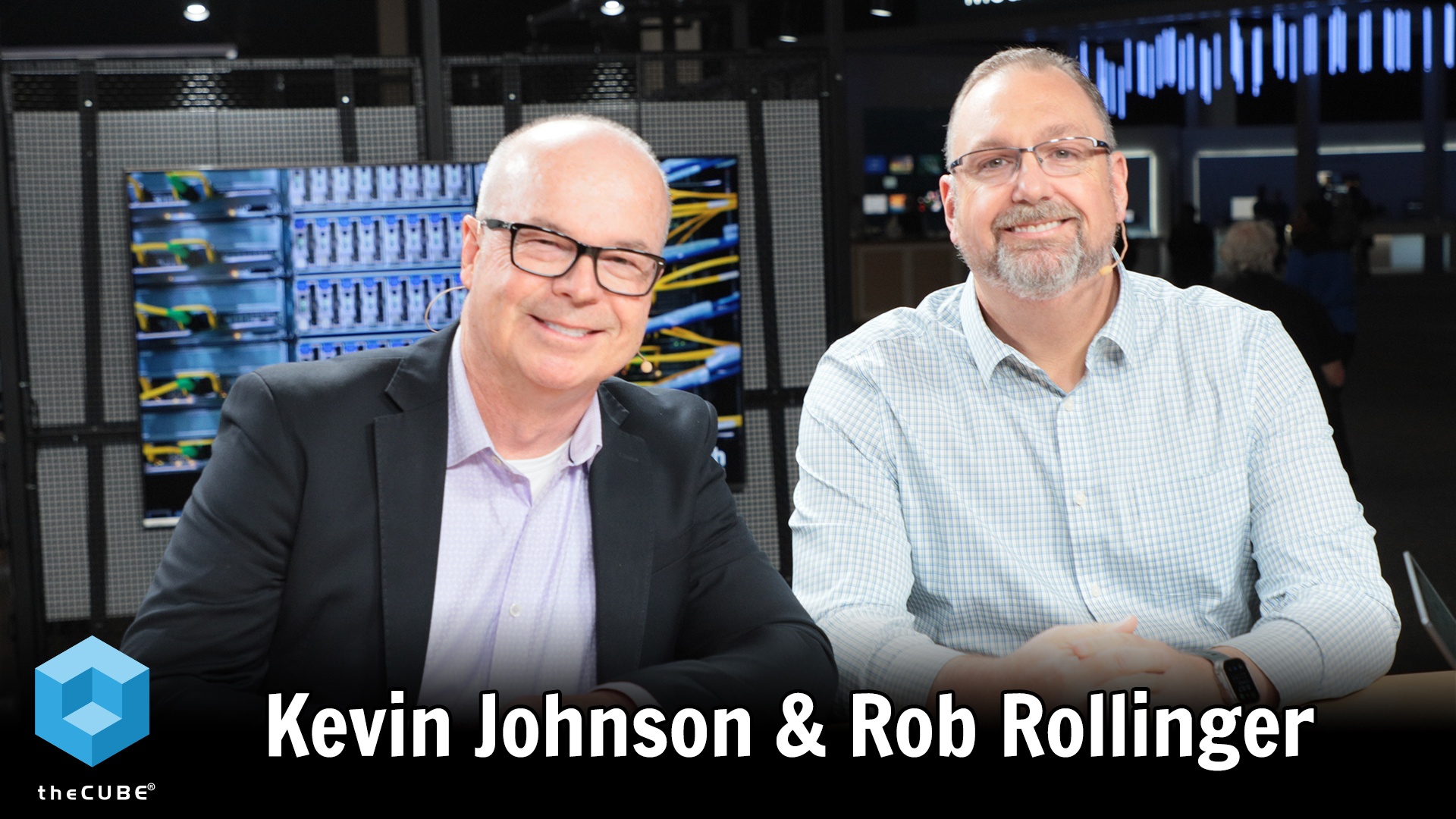
In this interview from Dell Technologies World 2026, Kevin Johnson, co-founder and chief operating officer of Bud Ecosystem, and Rob Rollinger, head of marketing at Bud Ecosystem, join theCUBE's John Furrier and Dave Vellante to discuss how enterprises are moving beyond fragmented AI tools toward unified, full-stack platforms built for production agentic workloads. Rollinger describes Bud Ecosystem's complete stack — spanning silicon through training, inference and governance to agent orchestration — deployable on Dell AI Foundry on-prem or in the cloud. Johnson explains that the highest-value AI outcomes come not from bolt-on tools but from re-architecting enterprise workflows entirely, with a platform capable of reducing AI infrastructure costs by up to 80%. Both guests frame the enterprise challenge as one of simplification: too many stove-piped tools, too little centralized control.
The conversation also explores how legacy systems — HCM, ERP and CRM — were built for querying, not real-time machine intelligence, and how the agentic era is forcing a fundamental rethink of enterprise architecture. Rollinger outlines how leading deployments assign distinct roles across agent layers — orchestrators, quality control agents and gatekeepers — to balance autonomy with accountability. Johnson points to the Bud Ecosystem Enterprise AI Management Platform as a unified control and data plane capable of governing thousands of agents across environments, from large-scale AI factories down to individual Dell Pro Max endpoints, without sacrificing security or compliance. From navigating the economics of distributed hybrid architectures to protecting data as the irreplaceable core of enterprise intelligence, the discussion offers a practical roadmap for organizations ready to move from experimentation to full-scale AI production.
Forgot Password
Almost there!
We just sent you a verification email. Please verify your account to gain access to
Dell Technologies World 2026. If you don’t think you received an email check your
spam folder.
In order to sign in, enter the email address you used to registered for the event. Once completed, you will receive an email with a verification link. Open the link to automatically sign into the site.
Register for Dell Technologies World 2026
Please fill out the information below. You will receive an email with a verification link confirming your registration. Click the link to automatically sign into the site.
You’re almost there!
We just sent you a verification email. Please click the verification button in the email. Once your email address is verified, you will have full access to all event content for Dell Technologies World 2026.
I want my badge and interests to be visible to all attendees.
Checking this box will display your presense on the attendees list, view your profile and allow other attendees to contact you via 1-1 chat. Read the Privacy Policy. At any time, you can choose to disable this preference.
Select your Interests!
add
Upload your photo
Uploading..
OR
Connect via Twitter
Connect via Linkedin
EDIT PASSWORD
Share
Forgot Password
Almost there!
We just sent you a verification email. Please verify your account to gain access to
Dell Technologies World 2026. If you don’t think you received an email check your
spam folder.
In order to sign in, enter the email address you used to registered for the event. Once completed, you will receive an email with a verification link. Open the link to automatically sign into the site.
Sign in to gain access to Dell Technologies World 2026
Please sign in with LinkedIn to continue to Dell Technologies World 2026. Signing in with LinkedIn ensures a professional environment.
Are you sure you want to remove access rights for this user?
Details
Manage Access
email address
Community Invitation
Mike Darby, AMD
In this interview from Dell Technologies World 2026, Kevin Johnson, co-founder and chief operating officer of Bud Ecosystem, and Rob Rollinger, head of marketing at Bud Ecosystem, join theCUBE's John Furrier and Dave Vellante to discuss how enterprises are moving beyond fragmented AI tools toward unified, full-stack platforms built for production agentic workloads. Rollinger describes Bud Ecosystem's complete stack — spanning silicon through training, inference and governance to agent orchestration — deployable on Dell AI Foundry on-prem or in the cloud. Johnson explains that the highest-value AI outcomes come not from bolt-on tools but from re-architecting enterprise workflows entirely, with a platform capable of reducing AI infrastructure costs by up to 80%. Both guests frame the enterprise challenge as one of simplification: too many stove-piped tools, too little centralized control.
The conversation also explores how legacy systems — HCM, ERP and CRM — were built for querying, not real-time machine intelligence, and how the agentic era is forcing a fundamental rethink of enterprise architecture. Rollinger outlines how leading deployments assign distinct roles across agent layers — orchestrators, quality control agents and gatekeepers — to balance autonomy with accountability. Johnson points to the Bud Ecosystem Enterprise AI Management Platform as a unified control and data plane capable of governing thousands of agents across environments, from large-scale AI factories down to individual Dell Pro Max endpoints, without sacrificing security or compliance. From navigating the economics of distributed hybrid architectures to protecting data as the irreplaceable core of enterprise intelligence, the discussion offers a practical roadmap for organizations ready to move from experimentation to full-scale AI production.
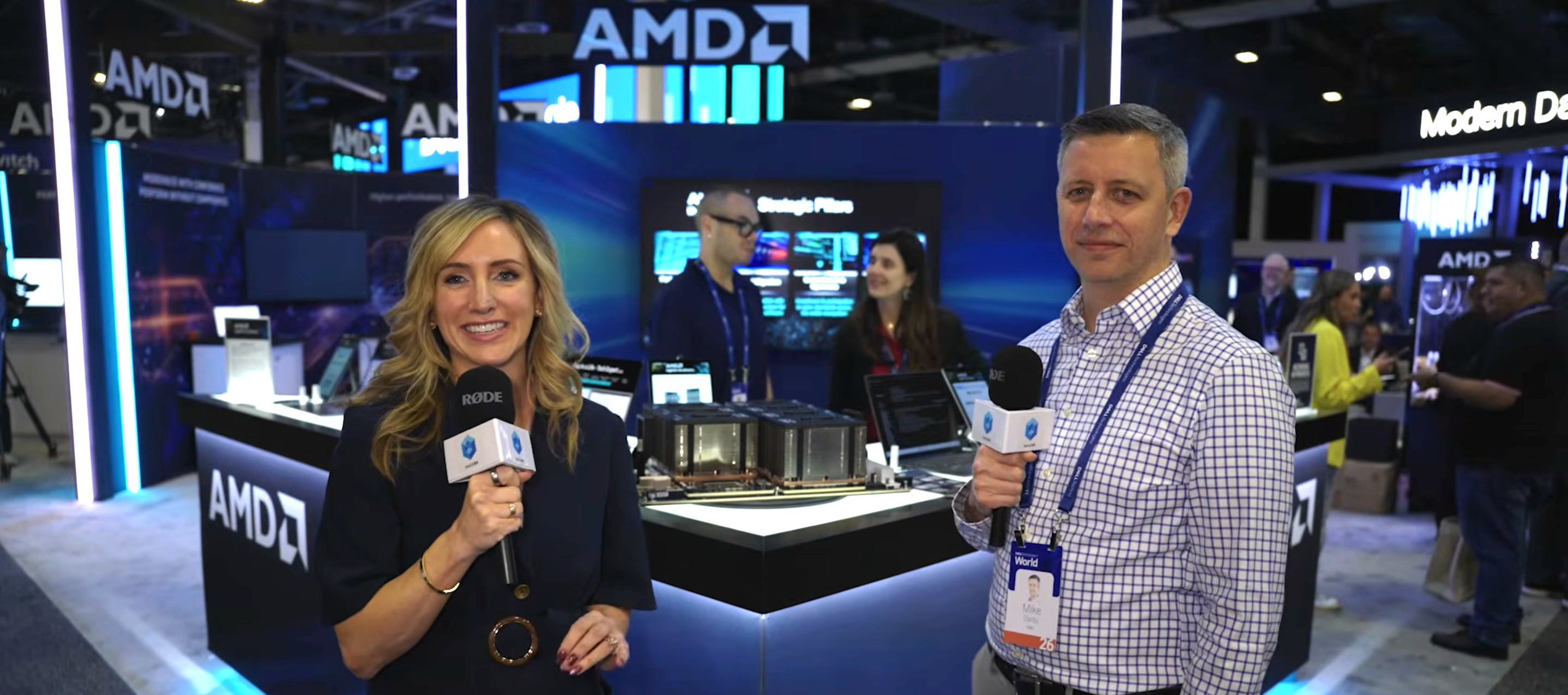
>> I'm Gemma Allen with theCUBE. We are live on the ground in Las Vegas. It's Dell Technology World 2026. All of the action is happening here, and I am at the AMD booth with Mike Darby. Mike, thanks for having me.>> Thanks for having me. Appreciate it.
Gemma Allen
>> There is some really interesting looking spec here. Looks like it has a lot of horsepower.>> Yes.
Gemma Allen
>> Talk me through what's happening here.>> On our booth here is the 350X Series GPUs, an eight-way board meshed together with 2.3 terabytes of HBM in one package going in one server. So, very large models for enterprise AI is what happens here. The key at Dell with the 350X Series is the 355X. That's a 1.4 kilowatt GPU times eight in a single package. Now, Dell offers this, even though it's 1.4 kilowatts per GPU, in an air-cooled 10U server so that enterprises can go to the top of the line in GPUs. And so with the air-cooled, as you see here with the heat sinks, would go into the XE9785. And when they sell it in a liquid-cooled with cold plates on it, it'll be in the XE9785L.
Gemma Allen
>> Wow. Talk me through the opportunity and potential this offers to customers. We know that there has been a massive race for GPUs. Speed, scale is everything right now. Who can this help potentially in a new TAM for AMD?>> Yeah. So the hardware has always been great, and what people are going to be excited about this year, especially in the enterprise space, is the out-of-box performance with ROCm 7, with AMD Inference Microservices to pull this, turn it on, launch the AIM, and you have out-of-box performance on the most popular AI models without having to have a PhD or computer science degree to figure it out. So the cool thing that I want to headline today is that those servers I mentioned are in Dell's Customer Solution Center right now live, ready to take remote POCs. You don't have to buy the huge server to try it and prove that it works. Dell has that ready to go live right now.
Gemma Allen
>> Let's talk about deployment for a second. How long does it take to put this in action, make this real, and realize value from this?>> Generally, if you're going through the POC first, you know what you're doing before you get it on site, and time to value is Dell's bread and butter and they're very good at deployment. And generally, especially if you're in the liquid-cooled space, these things are coming out already racked and cabled. I heard Jeff Clarke say earlier today they're six hours to deploy a rack from arriving and having it running. So Dell takes care of that part, and we've taken care of the out-of-box performance so that it's ready to go once they turn on the lights.
Gemma Allen
>> Wow. Well, there's a lot happening here broadly. This is quite the booth. Talk me through what else.>> Yeah, let's walk over here. We're going to take a look at our exciting new PCIe offer.
Gemma Allen
>> So Mike, we have here what looks like a tractor and a scooter. Break it down.>> So, very excited today because Dell recently announced earlier this month that they're going to have the new Instinct MI350P offered in PowerEdge systems. So we have our AMD Instinct here, our AMD EPYC here. These are Turin-based platform. This is the R7725, so 2U, two socket mainstream. Bread and butter for enterprise, accessible to a normal data center that has air cooling. And now we have an accessible GPU for that enterprise that will go into a mainstream server. So the 350P goes up to 600 watts, but in this server, it'll run in a mainstream data center at 450. We'll see the 600 watt server in a minute. So 450 watts in an R7725, 144 gigs of HBM memory. That's more than you'll find anywhere else.
Gemma Allen
>> Nice.>> And the new data formats, FP4, MP6 are in here as well. And then crucially, for the customers who need it, native FP64 is also in our cable card as well.
Gemma Allen
>> Wow. So let's stay on memory for a second because we know it's a big, big bottleneck right now. We talk about toks and we know that memory is really the key formula here. So that everything is happening here on the chip, that means that you have pretty much realized instant value in an inference era right here, right?>> Yes. And not only that. With the fact that it's a lot of memory, but it's also HBM3E, so an amazing amount of bandwidth.
Gemma Allen
>> Wow.>> So because the main use case being inference, it's all about that latency, time to first token, the user experience so that your attention span doesn't move somewhere else while you're waiting for your response.
Gemma Allen
>> And we talk about tokens, we talk about tokenomics, we talk about total cost of ownership. Talk to us about the AMD pitch for that side of this business. How do you guys solve for some of the modern day challenges we see in here all the time?>> Well, I think from a TCO perspective, our story from the beginning has always been performance for TCO, competitive and winning opportunities. That's our bread and butter. And now that we have the AMD Enterprise software reference stack out in the market with the AMD Microservice, so you can click it out-of-the-box and get to time to value without, again, having a computer science degree. It's just accessible now. Everyone wants an alternative. It's there. And now it's easy to try.
Gemma Allen
>> Mike, I love AMD because I love Lisa Su. I love to see a female leading a company of this scale in this era. You guys have had, I think, a great quarter. You're making a lot of ground. And it's obviously a very large incumbent in the industry, but you guys are certainly changing the narrative. Talk to me a little bit about the market opportunities right now. What's actually happening in the field, as there must be a lot of new activity that didn't exist three years ago.>> Yeah. It's interesting because a lot of the business that I've personally been involved in over the course of my career and the past several years has been a lot of cloud. As we heard on stage earlier today at Dell Tech World, 5,000 customers on the Dell AI Factory, but most of the revenue to date that I'm aware of has always been very large cloud deployments. And so the interesting thing as we look at the market growth that we have a roadmap for to investing in is on the enterprise side, the growth is->> Gemma.>> It's as big as we were talking about the cloud market being not too far in the past. So the opportunity is huge everywhere. There's no limit to it. There's room for plenty of players, and that's why the alternative is important
Gemma Allen
>> I mean, it's certainly there for the taking too. Folks can't buy and scale quick enough. What's ahead for you and the team at AMD? I mean, some really exciting product announcements here at Dell Tech World. How are you going to go and bring these market messages to the fields?>> I'm glad you asked. So the other cool thing that Dell talked about as we announced with the 350P, as well as Dell's announcements for their new modular AI Factory solutions is we're going to have the 350P in Dell's AI Factory, and the Dell AI platform with AMD is part of the family. And so all of the goodness that Dell brings to enterprise and bringing AI to life for enterprises, laying it on top of our hardware is going to be with us as well. So we're very excited about that. But what I want to show you, this is just the mainstream platform for the data center that ... Just for one or two GPUs per server. If we go around the corner, we'll see the big one.
Gemma Allen
>> Oh, wow. Okay. Let's do it.>> 745. We started with the R7725 2U two socket mainstream. Now we're at four U2 socket. Still mainstream. Okay, we're still not up to even the eight-way air-cooled that could still go into enterprise that we started with. This is the XE7745 that can hold up to eight double-wide GPUs. This is where we get our 600 watts at launch with Dell per card. So it can run it at full power and you get the best ... Not all workloads are made the same. Some people need their NUMAs arranged 1:1 CPU to GPU. This is four GPUs per CPU in this system paired again with the Turin processors. So this is for the enterprise that needs a little bit more horsepower, but it's still in that PCIe CEM swim lane.
Gemma Allen
>> So what are we talking here? Are we talking about enterprise devs? Give me a typical use case for this.>> I mean, every use case under the sun. At this point it's hard to define a vertical that's the sweet spot because all of the top models that exist on the planet are out in the open weights world. Everything's on vLLM or SGLang at this point. Most people aren't down in the weeds doing a kernel optimization, and all of the optimizations are already in the Microservices. So it's really across the board enterprise use cases are available to you now.
Gemma Allen
>> Wow. Talk to me about staying ahead of the curve, the speed, the race for scale at this moment. There is so much happening. Enterprise is shifting fundamentally. The buyer journey is shifting. The decision makers are shifting. How do you guys at AMD think about that? How do you prepare and stay at pace with the market?>> Pace. Pace is the keyword to what you're describing here. I mean, I came from Dell. I had 16 years at Dell before I came to AMD and both very ... I mean, AI hit everyone like a ton of bricks, and everything is so frenetic and fast-paced and you have to keep sprinting to keep up. It's amazing watching the development and the roadmap and the things that I can't possibly say right now on camera that I know are coming that are going to ... This is just the beginning.
Gemma Allen
>> Well, it's interesting you say that, because we had a conversation with some of the leadership at Dell this morning and we talked about how is one Dell Technology World enough? Things are happening so quickly now. These cycles are changing so fast. How do you even keep customers apprised of all that's moving and shifting? What are your thoughts on that?>> It's constant touch. I mean, honestly, Dell Tech World is the headline event, but we partner with Dell in global events, tens and tens of them all over the world throughout the year, and take this show on the road at different scales in different cities. So this will keep happening as well. So people, if you didn't get to travel to the US for this, we'll catch you in Paris, we'll catch you in Toronto, we'll catch you in Bangalore. There's plenty of opportunity for that.
Gemma Allen
>> A well-traveled, man. Okay, and then lastly, we've heard a lot today and this week about this move to on-prem, this move from more sovereignty, work control, what the future of inference looks like and who it sits with. What are you seeing in the market? How is AMD responding to some of the, I guess you could call it somewhat of a 180 from public cloud to private cloud to now this world of scale, speed, but also a control plane that's well-managed, right?>> Yeah.
Gemma Allen
>> What are your thoughts?>> I mean, if you came to Dell Tech World several years ago before the AI boom, you wouldn't have heard AI every three seconds. You would have heard cloud and multi-cloud every three seconds and various definitions of what cloud meant and everything. So Dell always had the hybrid cloud story, and so on-prem is in their DNA and it's always about the optionality to bounce between them dynamically and everything. So the key for me being with AMD and partnering with Dell in these platforms, is that they're designed for enterprises to be able to do this stuff on-prem. The Instinct GPUs are in the cloud. You can burst. It's in many clouds of your choice when you need to leave your on-prem for whatever your reasons are. But now finally with this, if you couldn't have consumed the eight-way, which not everyone can, just from power perspective or whatever, your workload might not need to take advantage of that much of an investment, now we've just opened up the aperture to the number of customers who can truly try us and have the option, open it up.
Gemma Allen
>> I think a key part of this message is when we think about hybrid cloud, is really meaning customers where they're at. And that is such an important part of this technology conversation right now. It's not necessarily a one-size-fits-all, right?>> Absolutely.
Gemma Allen
>> So from the perspective of AMD, where are the priorities? What are you guys thinking about and planning for, for the next six to 12 months? What can we expect, Mike, back here in 2027?>> Oh, man. I will reveal nothing and just say that things are going to continue to be very exciting going forward.
Gemma Allen
>> Great. Well, it's certainly a very exciting company. We are watching closely all the time for the New York Stock Exchange with theCUBE.>> Absolutely.
Gemma Allen
>> Thanks so much for joining us.>> Thanks very much. Appreciate it.
>> I'm Gemma Allen with theCUBE. We are live on the ground in Las Vegas. It's Dell Technology World 2026. All of the action is happening here, and I am at the AMD booth with Mike Darby. Mike, thanks for having me.>> Thanks for having me. Appreciate it.
Gemma Allen
>> There is some really interesting looking spec here. Looks like it has a lot of horsepower.>> Yes.
Gemma Allen
>> Talk me through what's happening here.>> On our booth here is the 350X Series GPUs, an eight-way board meshed together with 2.3 terabytes of HBM in one package going in one server. So, very large models for enterprise AI is what happens here. The key at Dell with the 350X Series is the 355X. That's a 1.4 kilowatt GPU times eight in a single package. Now, Dell offers this, even though it's 1.4 kilowatts per GPU, in an air-cooled 10U server so that enterprises can go to the top of the line in GPUs. And so with the air-cooled, as you see here with the heat sinks, would go into the XE9785. And when they sell it in a liquid-cooled with cold plates on it, it'll be in the XE9785L.
Gemma Allen
>> Wow. Talk me through the opportunity and potential this offers to customers. We know that there has been a massive race for GPUs. Speed, scale is everything right now. Who can this help potentially in a new TAM for AMD?>> Yeah. So the hardware has always been great, and what people are going to be excited about this year, especially in the enterprise space, is the out-of-box performance with ROCm 7, with AMD Inference Microservices to pull this, turn it on, launch the AIM, and you have out-of-box performance on the most popular AI models without having to have a PhD or computer science degree to figure it out. So the cool thing that I want to headline today is that those servers I mentioned are in Dell's Customer Solution Center right now live, ready to take remote POCs. You don't have to buy the huge server to try it and prove that it works. Dell has that ready to go live right now.
Gemma Allen
>> Let's talk about deployment for a second. How long does it take to put this in action, make this real, and realize value from this?>> Generally, if you're going through the POC first, you know what you're doing before you get it on site, and time to value is Dell's bread and butter and they're very good at deployment. And generally, especially if you're in the liquid-cooled space, these things are coming out already racked and cabled. I heard Jeff Clarke say earlier today they're six hours to deploy a rack from arriving and having it running. So Dell takes care of that part, and we've taken care of the out-of-box performance so that it's ready to go once they turn on the lights.
Gemma Allen
>> Wow. Well, there's a lot happening here broadly. This is quite the booth. Talk me through what else.>> Yeah, let's walk over here. We're going to take a look at our exciting new PCIe offer.
Gemma Allen
>> So Mike, we have here what looks like a tractor and a scooter. Break it down.>> So, very excited today because Dell recently announced earlier this month that they're going to have the new Instinct MI350P offered in PowerEdge systems. So we have our AMD Instinct here, our AMD EPYC here. These are Turin-based platform. This is the R7725, so 2U, two socket mainstream. Bread and butter for enterprise, accessible to a normal data center that has air cooling. And now we have an accessible GPU for that enterprise that will go into a mainstream server. So the 350P goes up to 600 watts, but in this server, it'll run in a mainstream data center at 450. We'll see the 600 watt server in a minute. So 450 watts in an R7725, 144 gigs of HBM memory. That's more than you'll find anywhere else.
Gemma Allen
>> Nice.>> And the new data formats, FP4, MP6 are in here as well. And then crucially, for the customers who need it, native FP64 is also in our cable card as well.
Gemma Allen
>> Wow. So let's stay on memory for a second because we know it's a big, big bottleneck right now. We talk about toks and we know that memory is really the key formula here. So that everything is happening here on the chip, that means that you have pretty much realized instant value in an inference era right here, right?>> Yes. And not only that. With the fact that it's a lot of memory, but it's also HBM3E, so an amazing amount of bandwidth.
Gemma Allen
>> Wow.>> So because the main use case being inference, it's all about that latency, time to first token, the user experience so that your attention span doesn't move somewhere else while you're waiting for your response.
Gemma Allen
>> And we talk about tokens, we talk about tokenomics, we talk about total cost of ownership. Talk to us about the AMD pitch for that side of this business. How do you guys solve for some of the modern day challenges we see in here all the time?>> Well, I think from a TCO perspective, our story from the beginning has always been performance for TCO, competitive and winning opportunities. That's our bread and butter. And now that we have the AMD Enterprise software reference stack out in the market with the AMD Microservice, so you can click it out-of-the-box and get to time to value without, again, having a computer science degree. It's just accessible now. Everyone wants an alternative. It's there. And now it's easy to try.
Gemma Allen
>> Mike, I love AMD because I love Lisa Su. I love to see a female leading a company of this scale in this era. You guys have had, I think, a great quarter. You're making a lot of ground. And it's obviously a very large incumbent in the industry, but you guys are certainly changing the narrative. Talk to me a little bit about the market opportunities right now. What's actually happening in the field, as there must be a lot of new activity that didn't exist three years ago.>> Yeah. It's interesting because a lot of the business that I've personally been involved in over the course of my career and the past several years has been a lot of cloud. As we heard on stage earlier today at Dell Tech World, 5,000 customers on the Dell AI Factory, but most of the revenue to date that I'm aware of has always been very large cloud deployments. And so the interesting thing as we look at the market growth that we have a roadmap for to investing in is on the enterprise side, the growth is->> Gemma.>> It's as big as we were talking about the cloud market being not too far in the past. So the opportunity is huge everywhere. There's no limit to it. There's room for plenty of players, and that's why the alternative is important
Gemma Allen
>> I mean, it's certainly there for the taking too. Folks can't buy and scale quick enough. What's ahead for you and the team at AMD? I mean, some really exciting product announcements here at Dell Tech World. How are you going to go and bring these market messages to the fields?>> I'm glad you asked. So the other cool thing that Dell talked about as we announced with the 350P, as well as Dell's announcements for their new modular AI Factory solutions is we're going to have the 350P in Dell's AI Factory, and the Dell AI platform with AMD is part of the family. And so all of the goodness that Dell brings to enterprise and bringing AI to life for enterprises, laying it on top of our hardware is going to be with us as well. So we're very excited about that. But what I want to show you, this is just the mainstream platform for the data center that ... Just for one or two GPUs per server. If we go around the corner, we'll see the big one.
Gemma Allen
>> Oh, wow. Okay. Let's do it.>> 745. We started with the R7725 2U two socket mainstream. Now we're at four U2 socket. Still mainstream. Okay, we're still not up to even the eight-way air-cooled that could still go into enterprise that we started with. This is the XE7745 that can hold up to eight double-wide GPUs. This is where we get our 600 watts at launch with Dell per card. So it can run it at full power and you get the best ... Not all workloads are made the same. Some people need their NUMAs arranged 1:1 CPU to GPU. This is four GPUs per CPU in this system paired again with the Turin processors. So this is for the enterprise that needs a little bit more horsepower, but it's still in that PCIe CEM swim lane.
Gemma Allen
>> So what are we talking here? Are we talking about enterprise devs? Give me a typical use case for this.>> I mean, every use case under the sun. At this point it's hard to define a vertical that's the sweet spot because all of the top models that exist on the planet are out in the open weights world. Everything's on vLLM or SGLang at this point. Most people aren't down in the weeds doing a kernel optimization, and all of the optimizations are already in the Microservices. So it's really across the board enterprise use cases are available to you now.
Gemma Allen
>> Wow. Talk to me about staying ahead of the curve, the speed, the race for scale at this moment. There is so much happening. Enterprise is shifting fundamentally. The buyer journey is shifting. The decision makers are shifting. How do you guys at AMD think about that? How do you prepare and stay at pace with the market?>> Pace. Pace is the keyword to what you're describing here. I mean, I came from Dell. I had 16 years at Dell before I came to AMD and both very ... I mean, AI hit everyone like a ton of bricks, and everything is so frenetic and fast-paced and you have to keep sprinting to keep up. It's amazing watching the development and the roadmap and the things that I can't possibly say right now on camera that I know are coming that are going to ... This is just the beginning.
Gemma Allen
>> Well, it's interesting you say that, because we had a conversation with some of the leadership at Dell this morning and we talked about how is one Dell Technology World enough? Things are happening so quickly now. These cycles are changing so fast. How do you even keep customers apprised of all that's moving and shifting? What are your thoughts on that?>> It's constant touch. I mean, honestly, Dell Tech World is the headline event, but we partner with Dell in global events, tens and tens of them all over the world throughout the year, and take this show on the road at different scales in different cities. So this will keep happening as well. So people, if you didn't get to travel to the US for this, we'll catch you in Paris, we'll catch you in Toronto, we'll catch you in Bangalore. There's plenty of opportunity for that.
Gemma Allen
>> A well-traveled, man. Okay, and then lastly, we've heard a lot today and this week about this move to on-prem, this move from more sovereignty, work control, what the future of inference looks like and who it sits with. What are you seeing in the market? How is AMD responding to some of the, I guess you could call it somewhat of a 180 from public cloud to private cloud to now this world of scale, speed, but also a control plane that's well-managed, right?>> Yeah.
Gemma Allen
>> What are your thoughts?>> I mean, if you came to Dell Tech World several years ago before the AI boom, you wouldn't have heard AI every three seconds. You would have heard cloud and multi-cloud every three seconds and various definitions of what cloud meant and everything. So Dell always had the hybrid cloud story, and so on-prem is in their DNA and it's always about the optionality to bounce between them dynamically and everything. So the key for me being with AMD and partnering with Dell in these platforms, is that they're designed for enterprises to be able to do this stuff on-prem. The Instinct GPUs are in the cloud. You can burst. It's in many clouds of your choice when you need to leave your on-prem for whatever your reasons are. But now finally with this, if you couldn't have consumed the eight-way, which not everyone can, just from power perspective or whatever, your workload might not need to take advantage of that much of an investment, now we've just opened up the aperture to the number of customers who can truly try us and have the option, open it up.
Gemma Allen
>> I think a key part of this message is when we think about hybrid cloud, is really meaning customers where they're at. And that is such an important part of this technology conversation right now. It's not necessarily a one-size-fits-all, right?>> Absolutely.
Gemma Allen
>> So from the perspective of AMD, where are the priorities? What are you guys thinking about and planning for, for the next six to 12 months? What can we expect, Mike, back here in 2027?>> Oh, man. I will reveal nothing and just say that things are going to continue to be very exciting going forward.
Gemma Allen
>> Great. Well, it's certainly a very exciting company. We are watching closely all the time for the New York Stock Exchange with theCUBE.>> Absolutely.
Gemma Allen
>> Thanks so much for joining us.>> Thanks very much. Appreciate it.