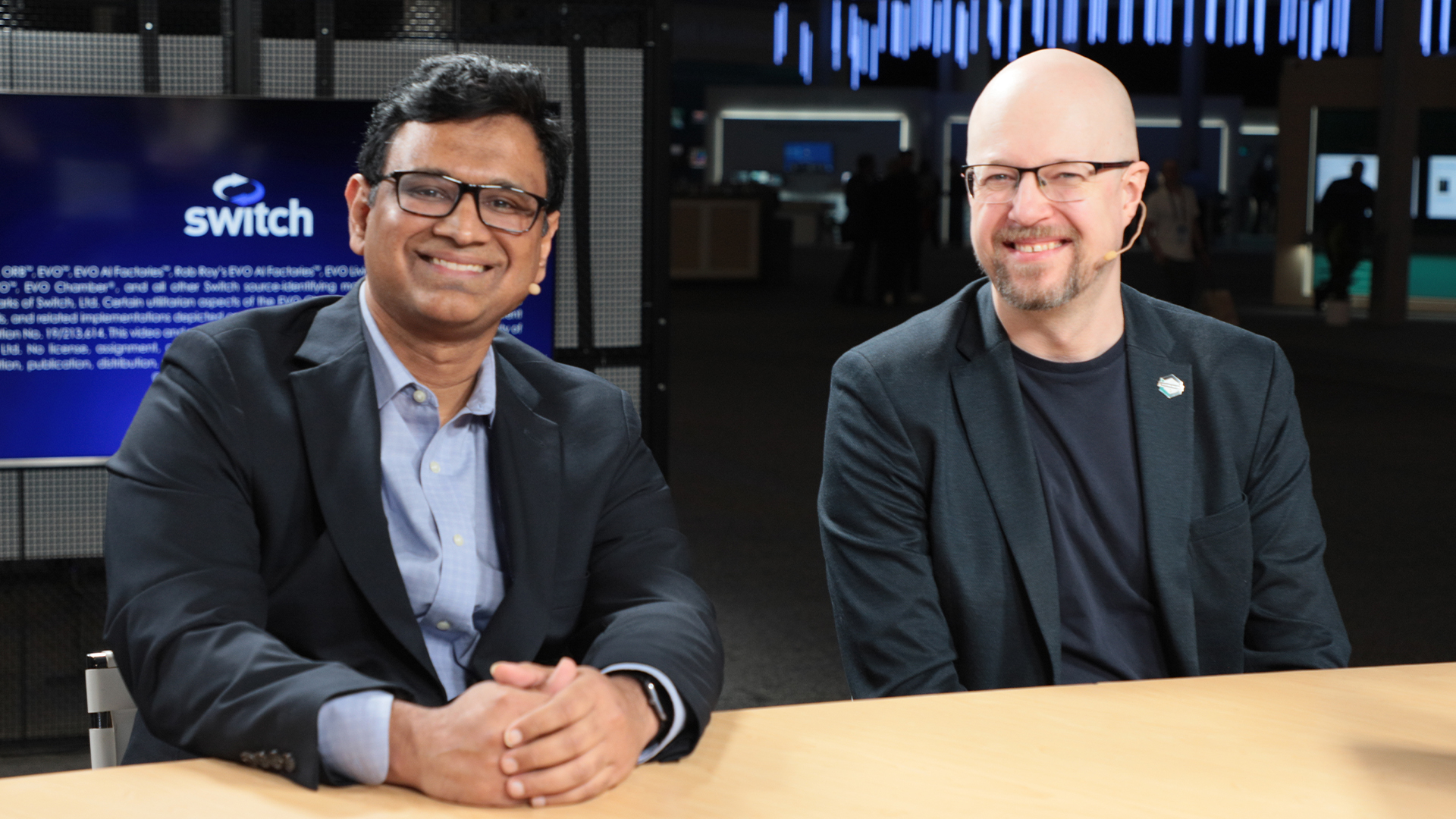
In this interview from Dell Technologies World, Kenny Lowe, solutions platform product manager at Dell Technologies, joins Raghu Venkataraman, principal product manager at Microsoft, to talk with theCUBE's Dave Vellante and theCUBE + NYSE Wired's Gemma Allen about how the Dell-Microsoft partnership is driving the shift from hyperconverged to disaggregated on-premises infrastructure to meet digital sovereignty requirements and enterprise AI demands. Venkataraman frames digital sovereignty as a compliance mandate — not an option — for government, healthcare and other regulated industries requiring full control over where data lives, who can access it and under what jurisdiction it operates. Lowe details how rising memory and storage costs are pushing enterprises away from hyperconverged infrastructure (HCI) and how Dell Private Cloud combines the manageability of HCI with the economics of disaggregated compute and storage, delivering roughly 64% cost savings for equivalent workloads.
The conversation also explores how Azure Local brings the full Azure portal experience on-premises — in connected or fully air-gapped deployments — allowing enterprises to run workloads in their own data centers while retaining familiar Azure management tooling. Venkataraman highlights the extension of Foundry Local to Azure Local, enabling fully local AI inference that keeps prompts and data entirely on-premises without relying on a cloud service. Lowe underscores agent memory as a fast-growing driver of storage demand, arguing that data gravity will increasingly anchor workloads on-premises where predictable, owned infrastructure — including PowerStore, backed by a new 6:1 data reduction guarantee — offers a fundamentally different cost model than paying per IO or per gigabyte. From streamlined lifecycle management through joint Dell-Microsoft lab validation to a unified roadmap spanning Foundry Local and M365 Local, the discussion makes clear that the next phase of enterprise AI will be built on a robust, sovereign on-premises foundation.
Forgot Password
Almost there!
We just sent you a verification email. Please verify your account to gain access to
Dell Technologies World 2026. If you don’t think you received an email check your
spam folder.
In order to sign in, enter the email address you used to registered for the event. Once completed, you will receive an email with a verification link. Open the link to automatically sign into the site.
Register for Dell Technologies World 2026
Please fill out the information below. You will receive an email with a verification link confirming your registration. Click the link to automatically sign into the site.
You’re almost there!
We just sent you a verification email. Please click the verification button in the email. Once your email address is verified, you will have full access to all event content for Dell Technologies World 2026.
I want my badge and interests to be visible to all attendees.
Checking this box will display your presense on the attendees list, view your profile and allow other attendees to contact you via 1-1 chat. Read the Privacy Policy. At any time, you can choose to disable this preference.
Select your Interests!
add
Upload your photo
Uploading..
OR
Connect via Twitter
Connect via Linkedin
EDIT PASSWORD
Share
Forgot Password
Almost there!
We just sent you a verification email. Please verify your account to gain access to
Dell Technologies World 2026. If you don’t think you received an email check your
spam folder.
In order to sign in, enter the email address you used to registered for the event. Once completed, you will receive an email with a verification link. Open the link to automatically sign into the site.
Sign in to gain access to Dell Technologies World 2026
Please sign in with LinkedIn to continue to Dell Technologies World 2026. Signing in with LinkedIn ensures a professional environment.
Are you sure you want to remove access rights for this user?
Details
Manage Access
email address
Community Invitation
Kenny Lowe, Dell Technologies & Raghu Venkataraman, Microsoft
In this interview from Dell Technologies World, Kenny Lowe, solutions platform product manager at Dell Technologies, joins Raghu Venkataraman, principal product manager at Microsoft, to talk with theCUBE's Dave Vellante and theCUBE + NYSE Wired's Gemma Allen about how the Dell-Microsoft partnership is driving the shift from hyperconverged to disaggregated on-premises infrastructure to meet digital sovereignty requirements and enterprise AI demands. Venkataraman frames digital sovereignty as a compliance mandate — not an option — for government, healthcare and other regulated industries requiring full control over where data lives, who can access it and under what jurisdiction it operates. Lowe details how rising memory and storage costs are pushing enterprises away from hyperconverged infrastructure (HCI) and how Dell Private Cloud combines the manageability of HCI with the economics of disaggregated compute and storage, delivering roughly 64% cost savings for equivalent workloads.
The conversation also explores how Azure Local brings the full Azure portal experience on-premises — in connected or fully air-gapped deployments — allowing enterprises to run workloads in their own data centers while retaining familiar Azure management tooling. Venkataraman highlights the extension of Foundry Local to Azure Local, enabling fully local AI inference that keeps prompts and data entirely on-premises without relying on a cloud service. Lowe underscores agent memory as a fast-growing driver of storage demand, arguing that data gravity will increasingly anchor workloads on-premises where predictable, owned infrastructure — including PowerStore, backed by a new 6:1 data reduction guarantee — offers a fundamentally different cost model than paying per IO or per gigabyte. From streamlined lifecycle management through joint Dell-Microsoft lab validation to a unified roadmap spanning Foundry Local and M365 Local, the discussion makes clear that the next phase of enterprise AI will be built on a robust, sovereign on-premises foundation.
In this interview from Dell Technologies World, Kenny Lowe, solutions platform product manager at Dell Technologies, joins Raghu Venkataraman, principal product manager at Microsoft, to talk with theCUBE's Dave Vellante and theCUBE + NYSE Wired's Gemma Allen about how the Dell-Microsoft partnership is driving the shift from hyperconverged to disaggregated on-premises infrastructure to meet digital sovereignty requirements and enterprise AI demands. Venkataraman frames digital sovereignty as a compliance mandate — not an option — for government, healthcare and...Read more
exploreKeep Exploring
What is driving the growing need for sovereign private cloud in 2026, and what are the implications for data sovereignty, AI-related infrastructure requirements, and vendor partnerships?add
What major trends or challenges are you seeing in the industry right now regarding infrastructure, cost management (memory/storage) and hypervisor choices?add
What infrastructure is required to run an Azure Local solution effectively, and how does Dell Private Cloud combine the benefits of hyperconverged infrastructure with a disaggregated compute/storage model?add
How will agent memory and the resulting growth in contextual data affect storage and compute requirements, and how does Azure Local address those challenges?add
How are lifecycle management and day‑two updates handled and validated for Azure Local running on Dell hardware, and how do customers apply those updates?add
Kenny Lowe, Dell Technologies & Raghu Venkataraman, Microsoft
search
Gemma Allen
>> Welcome back to theCUBE. We are here live at Las Vegas. It's Dell Technology World 2026 and we are talking all things Dell and their ecosystem. I'm here with my cohost, Dave Vellante, and joining us now are two solid partners within that ecosystem. We have Kenny Lowe, Solutions Platform Product Management at Dell Technologies and a Microsoft Azure MVP. Welcome, Kenny. And Raghu Venkataraman, Principal PM at Microsoft. Welcome folks.
Kenny Lowe
>> Hey guys, thanks for having us.
Gemma Allen
>> How are you feeling? It's a night one. Nobody's probably been to, has hit the casinos or hit the virus here in Vegas yet. We're all still fresh.
Kenny Lowe
>> Oh yeah.
Gemma Allen
>> So we are going to talk all things Dell Private Cloud and this very long relationship that is constantly evolving between Microsoft and Dell. So let's start with you if that's okay, Raghu. Talk to us a little bit about what you're seeing broadly in this space right now, this kind of increasing need for sovereign private cloud and what that really means at this moment in 2026.
Raghu Venkataraman
>> Yeah. One of the key feedback that we are getting from customers is on the topic of digital sovereignty. Customers want to have control over where the data lives, who has access to them and under what jurisdiction it needs to operate. And all these three things needs to be run either fully connected or intermittently connected or completely air-gapped. And with that, we also know that customers have an AI mandate. The AI mandate manifests itself into a set of infrastructure ask that is across your data, your models, your infrastructure, and your operations. And that actually means that we have to actually kind of work with partners like Dell towards developing joint solutions.
Gemma Allen
>> And Kenny, an AI mandate is one thing, right? That sounds relatively simple. We know that it's actually a very complex and like I said, evolving event, right? There's a lot to solve for here. One key part of this, and one key part of the bottleneck of this other story right now is memory. Talk to us a little bit about that. What are you seeing and where do you believe the solution lies?
Kenny Lowe
>> Sure. I mean, one of the major trends that we see in the industry just now is what we'll call memory and storage cost volatility there. And that's just going up and up and up. So the cost of solutions are going up and that's really leading to people having to be much smarter about how they architect their solutions as well. So what has worked in the past won't necessarily work moving forward. We need to be able to right size workloads in the right way on the right platform so you're not overpaying for the infrastructure that you're running on. That coupled with what I'll call hypervisor uncertainty. The looking into additional hypervisors or new ways of working, Azure Local being one of the most common hypervisors people are looking to move to. It's really causing people to look at what does my architecture look like in order to support my workloads, including Azure AI services and things like that, that we're bringing down on premises. So the core foundational model of the data center is shifting. I would say shifting away a bit from hyperconverged to a more disaggregated model is what we're seeing.
Dave Vellante
>> Well, it makes sense, right? Because hyperconverged is kind of a memory hog. And so the memory price is going through the roof. I mean, maybe if prices drop, hyperconverge will come back because it's simple. But right now that's a real pain point. I want to come back to digital sovereignty because I think a lot of people when they hear digital sovereignty, they think, and it's true, nations, governments, et cetera, but it's not just an international trend. Regulated industries here want digital sovereignty. And Raghu, I wonder if you could double click on that and explain what you're hearing from customers.
Raghu Venkataraman
>> Yeah. So whether it's a government agency, or healthcare network, or even other industries that you won't really actually kind of think of in terms of transportation and stuff like that. So you hear that, "Hey, you know what? For me, the data and the operation of the data is extremely critical to me." And these are mandates. These are not actually options for customers. These are mandates. So they need to be compliant. They need to actually kind of operate in a secure way and they need to actually kind of comply with the legal rules that has been imposed upon them, which they have to actually kind of preserve.
Dave Vellante
>> So how do you guys help specifically? I mean, obviously you have a private cloud solution, you've got Microsoft hybrid company, you've got Azure, you've got Local, you've got the tooling, but specifically how are you helping organizations? Maybe you can take us through an example, generic example, poke that a bit.
Kenny Lowe
>> Sure. Well, Azure Local is designed to bring just enough Azure on premises. So to bring the Azure cloud experience to the on premises world, either in a fully connected or fully disconnected manner there.
Dave Vellante
>> And that's a substantially identical experience or is it kind of same-same?
Kenny Lowe
>> So if you're in a connected state-
Dave Vellante
>> Sorry to interrupt, but is that ?
Kenny Lowe
>> Yeah. So if you're in a connected state, it's the same Azure portal. So you log into portal at Azure.com and you deploy your workloads, but they're running in your data center, not a Microsoft data center. So that's the fundamental difference there.
Dave Vellante
>> It's the cloud experience.
Kenny Lowe
>> Yeah.
Dave Vellante
>> Okay. Please carry on.
Kenny Lowe
>> If you're running in a disconnected state, we need to bring that management experience on premises as well. So you have the Azure portal experience running in an appliance VM inside the solution itself and it's the same experience. So the same Azure resource manager, the same way that you would deploy VMs and Kubernetes, the same AKS experience, and then a subset of the Azure services that you have as well. Things that make sense, data driven services, things like SQL-managed instances, some of the Azure AI services like Foundry Local, things like that. Things that you want to modernize around your data where it is on prem.
Gemma Allen
>> But the whole premise of this is that you are bringing AI to the data, right? It's this idea of having a very agile, fast approach. But there are bottlenecks too, right? It isn't, again, as simple as it sounds, I'm sure. What are you guys seeing in terms of the actual real life use cases? We all know data's been massively unstructured, right? And you hear mixed things. AI likes unstructured data. AI hates unstructured data. What's the truth here and what are the real fundamentals that need to be in places to work effortlessly?
Raghu Venkataraman
>> Yeah. I'll talk a little bit about the newest thing that we are launching with Foundry Local on Azure Local. So what we did was to have Foundry Local on personal devices, your laptops and your desktops and all these things. So it's a runtime that actually runs on your machine. You get local native inference completely on a machine. It's fully secure. Anytime you actually kind of have a prompt, it does not rely on a cloud service and it doesn't come back from a cloud service. Everything stays local. The exact same model we are extending right now with Foundry Local and Azure Local. So everything is actually going to be on prem, everything is going to be contained and we want to actually kind of bring AI where the data is rather than the other way around so that you can use the data and you can have all these models and pipelines and data to actually kind of operate with.
Gemma Allen
>> Oh, okay.
Kenny Lowe
>> I think from my perspective, one of the fundamentals that you need to have in place to do an Azure Local solution well is to have a rock solid infrastructure which is designed to run Azure Local specifically. So that's what we've developed with Dell Private Cloud. That's what we've done with Microsoft for many years to this point using our AX nodes and our hyperconverged solutions. But we're now bringing that intelligence to a disaggregated model where we can have separate compute and storage, but treated in an almost hyperconverged way. So the value proposition of HCI, I would say, was taking compute storage and sometimes networking and collapsing it down into a single manageable model there, which we didn't have with disaggregated. But Dell Private Cloud is bringing the automation to enable that so we get the benefits of a disaggregated infrastructure, scaling the computing storage independently, being able to right size things, not losing some of your infrastructure to the HCI overhead, all those things. But we get the benefits of being able to manage these as a unified whole.
Dave Vellante
>> Explain something to me because why is AI a catalyst for disaggregated on prem? Because we've had the modern data stack separated compute from storage, right? I mean, kind of Snowflake is the poster child for that and it seems like AI was the catalyst for on prem. Why? Why did it take so long? Why is it so important now?
Gemma Allen
>> We can say that about so many things, right? But yes.
Kenny Lowe
>> Good question. But why is disaggregated so important? It's because disaggregated storage can be attached to and work across multiple different platforms and ecosystems and serve that data or transfer that data between these different places. Whereas if we look at HCI, data is really locked within an ecosystem, locked within a single vendor's ecosystem there and it's more difficult to bring stuff to that across a unified storage stack there. So it becomes very important.
Dave Vellante
>> So really the answer to my question, I guess is if I understood it correctly, is that HCI was the predominant model and it didn't lend itself to that disaggregation. So the combination of higher memory prices, obviously AI as a catalyst, it's like the perfect storm for that.
Kenny Lowe
>> It is a perfect storm. Yeah.
Raghu Venkataraman
>> And I would also argue that disaggregated is the catalyst for AI rather than the other way around.
Dave Vellante
>> We'll argue over a year on that one.
Gemma Allen
>> Let's talk about the fun topic right now, cost, okay, specifically total cost of ownership, which we know is increasingly a challenge. Again, it's a complex time, right? We talk about tokenomics, we talk about all of the unpredictability in these models right now, what the next five years looks like. It's a terrible time to be a CFO really, right? Talk about how this helps with that, how this helps with, especially with the perspective of control, right? Which we all know CFOs love predictability, right? They like repeated cycles of predictability.
Raghu Venkataraman
>> Yeah, absolutely. So cost is a very important factor and we all know about the memory cost, the storage cost that has been increasing in the market and exploding tremendously and stuff like that. But what we are actually kind of noticing is the fact that the cost per token has been actually kind of decreasing over a period of time right now. And we're also noticing that there is so much optimizations that is actually coming in the market towards ensuring that AI not only actually kind of runs effectively but also runs cheaper and it has had a very positive trend in terms of cost over time. The other thing is that there is purpose built AI, right? There are very specific models, specific optimizations that can run, for example, Foundry Local, I talked about it, right? Foundry Local can be optimized around your CPU, GPU, and NPUs so that you can make sure that the right model uses the right kind of components towards kind of getting the right kind of solution. And that is very powerful in terms of what our customers want right now.
Kenny Lowe
>> Yeah. In terms of the cost optimizations that we see in the new disaggregated model that we're doing here, you'll probably be shocked to hear that when we do comparisons for the same workloads running on HCI versus disaggregated, we're seeing around about a 64% cost saving quite disaggregated just now. It is significant cost benefit.
Gemma Allen
>> And where's the bulk of that realized? If you were to break that down into line items, what are we talking?
Kenny Lowe
>> So number one is that you get all of your compute available to you, so you don't lose some of that to the HCI overhead there. So all the compute is usable there, so you don't necessarily need to buy as much in the first place. Then on the storage side, we have extremely efficient storage there. So we get much better data reduction and data deduplication compression on PowerStore, for example, as well. We just announced a six to one data reduction guarantee on PowerStore this week, which is financially backed. So if you don't receive that, then we will make it right for you as well. So being able to get that level of data reduction, plus use all your compute there, plus be able to share the storage across multiple ecosystems here. The efficiency and cost benefits are just phenomenal.
Dave Vellante
>> We like those guarantees with teeth. Raghu, I want to come back to the cost per token comment that you made because people are rightly concerned about token cost and they're using more and more. They get their token bill. It's like the cloud bill picked up. But if we're on a Moore's law, whatever, 2x every whatever, 18 months, we're at 10X every year now and so cost per token is dropping 90% per year and we're making the assumption that that's going to continue. I mean, if it doesn't, that could be a problem, but let's assume it will with all the great work that you guys, the hyperscalers, NVIDIA, AMD, Intel are doing some great, great work. So that curve's going to continue, which just means people are going to start consuming more and more and more, especially as the ROI is there. They're manufacturing intelligence, they're monetizing that intelligence, they're getting more efficiency. I mean, that truly is the promise of AI. So I guess my question is, do you think... I mean, I understand why with memory prices going up, we're sort of focused today, but if you look long term, the potential is enormous in terms of productivity impacts.

Kenny Lowe
>> It is.
Dave Vellante
>> You draw the curves on your log-log graph paper and 10 years from now, the world is going to look a lot different. What do you think about that?
Raghu Venkataraman
>> No, that is totally true. I can see from a Microsoft perspective, right? There is so many optimizations in my group itself. At this point in time, everybody has an agent right now and that agent is being shared across a lot of different groups and we are actually kind of finding ways to optimize the agent through open source and stuff. So the possibilities are endless, right? Even within an organization such as us in terms of how we are actually kind doing, that reflects itself into other things like CA/CD, pipelines, testing, validation, every single aspects of it. So with that, optimizations that are actually going to be tremendous, right? We think that there's going to be more purpose-built applications and more agents and more models which are completely optimized for a very specific workload. And that will be extremely powerful in terms of reducing cost and also more adoption as well.

Dave Vellante
>> Yeah. So storage is becoming sort of this context capability. We've talked a lot about disaggregated. You guys have a big lineup of storage. I think power store is sort of the standard, if you will, of your efficiency and your lineup. You're also starting to converse more in business terms, I'll say, as opposed to box terms, right? So the storage layer is changing and getting more and more functional and more and more important because agents are going to produce a lot of storage. So how does this from Dell standpoint and Microsoft with the partnership translate into better efficiency, lower cost? How do you keep on that 10X curve, if you will?
Kenny Lowe
>> Yeah. One of the things that's really going to generate a lot of data moving forward is agent memory. So agents needs to build memory and entertain context there that is only going to grow storage there as well. So we have the storage of the actual data that you want to bring intelligence to, but then there's additional context that's built around that as well, which just continues to grow and grow and grow the storage footprint there more and more. So storage we know has gravity. Data has gravity. So workloads will be built around where the data is and where it grows. That's where Azure Local comes in because we bring the workload to the data there and grow that within that. And we also get the full power of things like the GPUs that you have inside your Azure Local there. So you buy the hardware, you buy the GPUs, you get the full power of that at your disposal without any concerns except the electricity, of course, the power and cooling. But that is yours. You run it to its maximum capacity and you get the full benefit out of it. That's predictable. That's good for a CFO perspective there as well. Similarly with the storage, you own that storage so you get the full IO performance benefits of that there, not paying per IO or per gig or whatever, like you're doing some models there as well. So Azure Local can bring a lot of cost predictability and power at the same time to where the data is on prem.
Gemma Allen
>> Wow. Well, it's certainly a very convincing value proposition, I have to say, right? Total cost ownership goes down. It's agile, it meets the need, especially when you think of security and control. Well, let's just talk for a second about it. Sometimes maybe one missed element of this, which is the IT management side of it, right? The infrastructure management side, the day two operations, what that looks like for Dell Private Cloud. Talk us through that a little bit, like how... I'm sure it's positive, but explain.
Kenny Lowe
>> Yeah. From a day two perspective, especially around lifecycle management and doing updates, that's where people actually care, because that's when the workloads are running, that's when it actually matters what happens. When an update lands and you click apply, is it going to work? So we've put a huge amount of joint investment into creating a lab environment or a production environment where when Microsoft is testing new features for Azure Local, that's done on Dell hardware. So at the point where Microsoft releases an update, it's already been validated on our stuff and you know you can click apply and know it'll work with confidence. And then we as Dell integrate a whole bunch into Azure Update Manager as well. So whenever we have a new update, those just drop into Azure Update Manager as well for Azure Local. So the customer just has to go into this one place Azure Update Manager. They see the Microsoft updates, which we have validated jointly together already. They see the Dell updates, they can click go, and those will all be updated together as a unified proposition there.
Dave Vellante
>> Love it. Doing the dirty work before it hits the deal.
Kenny Lowe
>> Exactly.
Gemma Allen
>> The days of patching, right? And all of that stress. Well folks, certainly a fascinating time and a great partnership as always between Dell and Microsoft. I know you guys have been in this industry together a long time as companies and it seems as though this message and this market proposition is constantly evolving. Close us out. Talk to us a little bit about what's ahead for you both, especially I guess the next 6 to 12 months because that feels like a decade right now.
Raghu Venkataraman
>> Absolutely.
Kenny Lowe
>> Yeah. I mean, from our perspective as Dell working on the Dell Private Cloud, it's making sure we have the most robust foundation in the data center possible. So whether that is across HCI solutions or across disaggregated, what we want to make sure is that you have the best day one experience, which then leads into the best day two experience. Day two being a complete misnomer, by the way, because it's really day 2, 3, 4, 5, 1,000, 2,000, that's when things actually matter. That's where our focus is. Build that foundation so that our friends at Microsoft can land their services on that in the best way possible.
Raghu Venkataraman
>> Yeah. From my perspective, every single new thing that is coming in the market is affecting the silicon and the application layer and everything in between. So with that, we need to actually partner very closely with partners like Dell towards kind of developing solution, which actually has a very simplified experience for customers. So he talked about, hey, the unified experience of actually kind of doing updates, doing deployments, right? How do you actually kind of take care of other opinionated infrastructure applications and stuff like that, right? So we have done something like Foundry Local, M365 Local, right? All these things with joint partnerships, we know exactly the right kind of reference architecture, what we need to test, how we need to package it, how we need to deliver it to customers and that goes a long way in terms of the value prop that we jointly offer to customers.
Gemma Allen
>> Well, partnership is certainly paramount. Kenny, Raghu, thank you so much for joining us on theCUBE.
Dave Vellante
>> Thanks guys.
Raghu Venkataraman
>> Thanks. All right.
Gemma Allen
>> I'm Gemma Allen. We are here with theCUBE at Las Vegas. It's Dell Technology World 2026 and I'm joined by my cohost, Dave Vellante. We are talking all things Dell and its ecosystem. Stay tuned.