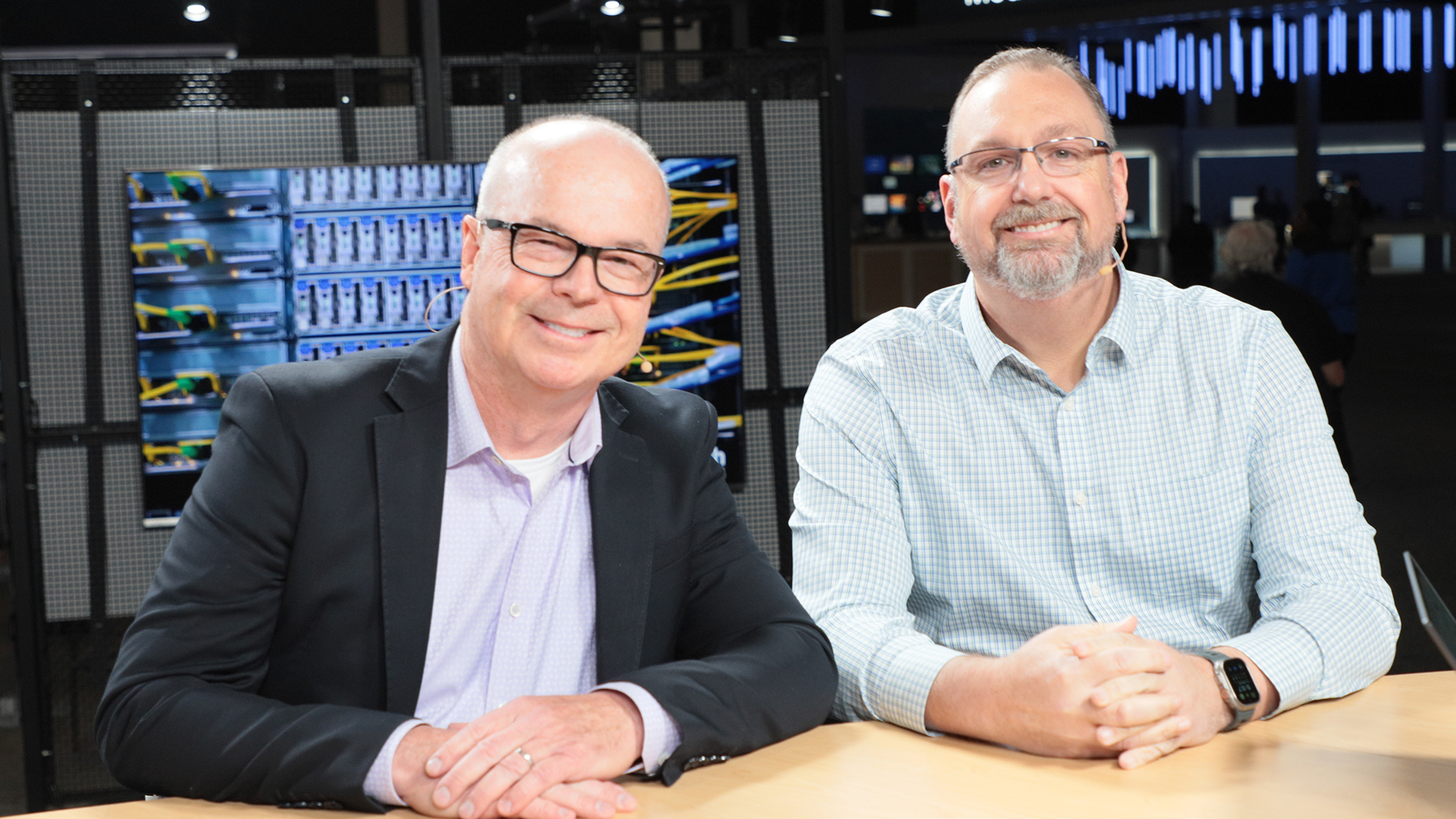
In this interview from Dell Technologies World 2026, Kevin Johnson, co-founder and chief operating officer of Bud Ecosystem, and Rob Rollinger, head of marketing at Bud Ecosystem, join theCUBE's John Furrier and Dave Vellante to discuss how enterprises are moving beyond fragmented AI tools toward unified, full-stack platforms built for production agentic workloads. Rollinger describes Bud Ecosystem's complete stack — spanning silicon through training, inference and governance to agent orchestration — deployable on Dell AI Foundry on-prem or in the cloud. Johnson explains that the highest-value AI outcomes come not from bolt-on tools but from re-architecting enterprise workflows entirely, with a platform capable of reducing AI infrastructure costs by up to 80%. Both guests frame the enterprise challenge as one of simplification: too many stove-piped tools, too little centralized control.
The conversation also explores how legacy systems — HCM, ERP and CRM — were built for querying, not real-time machine intelligence, and how the agentic era is forcing a fundamental rethink of enterprise architecture. Rollinger outlines how leading deployments assign distinct roles across agent layers — orchestrators, quality control agents and gatekeepers — to balance autonomy with accountability. Johnson points to the Bud Ecosystem Enterprise AI Management Platform as a unified control and data plane capable of governing thousands of agents across environments, from large-scale AI factories down to individual Dell Pro Max endpoints, without sacrificing security or compliance. From navigating the economics of distributed hybrid architectures to protecting data as the irreplaceable core of enterprise intelligence, the discussion offers a practical roadmap for organizations ready to move from experimentation to full-scale AI production.
Forgot Password
Almost there!
We just sent you a verification email. Please verify your account to gain access to
Dell Technologies World 2026. If you don’t think you received an email check your
spam folder.
In order to sign in, enter the email address you used to registered for the event. Once completed, you will receive an email with a verification link. Open the link to automatically sign into the site.
Register for Dell Technologies World 2026
Please fill out the information below. You will receive an email with a verification link confirming your registration. Click the link to automatically sign into the site.
You’re almost there!
We just sent you a verification email. Please click the verification button in the email. Once your email address is verified, you will have full access to all event content for Dell Technologies World 2026.
I want my badge and interests to be visible to all attendees.
Checking this box will display your presense on the attendees list, view your profile and allow other attendees to contact you via 1-1 chat. Read the Privacy Policy. At any time, you can choose to disable this preference.
Select your Interests!
add
Upload your photo
Uploading..
OR
Connect via Twitter
Connect via Linkedin
EDIT PASSWORD
Share
Forgot Password
Almost there!
We just sent you a verification email. Please verify your account to gain access to
Dell Technologies World 2026. If you don’t think you received an email check your
spam folder.
In order to sign in, enter the email address you used to registered for the event. Once completed, you will receive an email with a verification link. Open the link to automatically sign into the site.
Sign in to gain access to Dell Technologies World 2026
Please sign in with LinkedIn to continue to Dell Technologies World 2026. Signing in with LinkedIn ensures a professional environment.
Are you sure you want to remove access rights for this user?
Details
Manage Access
email address
Community Invitation
Kevin Johnson & Rob Rollinger, Bud Ecosystem Inc.
In this interview from Dell Technologies World 2026, Kevin Johnson, co-founder and chief operating officer of Bud Ecosystem, and Rob Rollinger, head of marketing at Bud Ecosystem, join theCUBE's John Furrier and Dave Vellante to discuss how enterprises are moving beyond fragmented AI tools toward unified, full-stack platforms built for production agentic workloads. Rollinger describes Bud Ecosystem's complete stack — spanning silicon through training, inference and governance to agent orchestration — deployable on Dell AI Foundry on-prem or in the cloud. Johnson explains that the highest-value AI outcomes come not from bolt-on tools but from re-architecting enterprise workflows entirely, with a platform capable of reducing AI infrastructure costs by up to 80%. Both guests frame the enterprise challenge as one of simplification: too many stove-piped tools, too little centralized control.
The conversation also explores how legacy systems — HCM, ERP and CRM — were built for querying, not real-time machine intelligence, and how the agentic era is forcing a fundamental rethink of enterprise architecture. Rollinger outlines how leading deployments assign distinct roles across agent layers — orchestrators, quality control agents and gatekeepers — to balance autonomy with accountability. Johnson points to the Bud Ecosystem Enterprise AI Management Platform as a unified control and data plane capable of governing thousands of agents across environments, from large-scale AI factories down to individual Dell Pro Max endpoints, without sacrificing security or compliance. From navigating the economics of distributed hybrid architectures to protecting data as the irreplaceable core of enterprise intelligence, the discussion offers a practical roadmap for organizations ready to move from experimentation to full-scale AI production.
play_circle_outlineOpportunity alert for investors: startup not yet funded, high potential.
replyShare Clip
play_circle_outlineBud Ecosystem Launches Full-Stack Agentic Enterprise AI on Dell Foundry, Claiming Up to 80% Cost Reductions
replyShare Clip
play_circle_outlineGovernance, security, control plane and data plane unified in one platform.
replyShare Clip
play_circle_outlineAgents at Scale: Simplifying Intelligence with Role-Based Patterns and Heterogeneous Infrastructure for Profitable Enterprise AI (15 words)
In this interview from Dell Technologies World 2026, Kevin Johnson, co-founder and chief operating officer of Bud Ecosystem, and Rob Rollinger, head of marketing at Bud Ecosystem, join theCUBE's John Furrier and Dave Vellante to discuss how enterprises are moving beyond fragmented AI tools toward unified, full-stack platforms built for production agentic workloads. Rollinger describes Bud Ecosystem's complete stack — spanning silicon through training, inference and governance to agent orchestration — deployable on Dell AI Foundry on-prem or in the cloud. John...Read more
exploreKeep Exploring
What is the vision for Bud and how did the company originate?add
What is Bud's vision and origin story?
When was Bud founded?add
What is an enterprise AI management platform (for example, the Bud Ecosystem Enterprise AI Management Platform), and why is it needed for controlling AI agents, security, and deployments across endpoints and clouds?add
What are the opportunities, risks, and practical requirements for deploying AI agents across an enterprise—particularly regarding data protection, governance, infrastructure, inference scaling, and agent orchestration?add
>> Hello, I'm John Furrier with theCUBE. We're kicking off Dell Tech World 2026. I'm here with Dave Vellante. Gemma Allen's here on the ground. Team coverage from SiliconANGLE and theCUBE as Dell rolls out their vision and the playbook, the blueprints for the agentic enterprise. We've got two great guests kicking it off. We got Kevin Johnson, COO and the co-founder of Bud Ecosystem Inc. Welcome to theCUBE.>> Thank you.
Dave Vellante
>> Good to have you. This is where it all started, John. Cloud meets big data in May of 2010 in the EMC World at Dell Tech World.
John Furrier
>> We've seen the movie. And an old friend of theCUBE when we first started, big supporter, former Intel, Rob Rollinger, head of marketing at Bud Ecosystem. Rob, great to see you.
John Furrier
>> Great to see you.
John Furrier
>> Thanks for coming on theCUBE. I think this might be your first CUBE appearance.
Rob Rollinger
>> My first appearance, I've been back there about 30, 40 times. Yeah.
John Furrier
>> You made it all happen back in the day.
John Furrier
>> We appreciate the Intel support of theCUBE over the years. A very tech focused company for tech forward. But now, the ecosystem's changed. It's a technology reset. The AI infrastructure is center stage and mainly because the demand curve is so high for what that's enabling. You guys have a unique startup. I like this startup. I like what you guys are doing. I know you're not yet funded. So if you're an investor, pay attention. This is where the agent action is going to get real. This is the year it's moving from hype. Nice chat outcome to some nice paper, some sort of RAG system. Now, it's coding is in the enterprise. That's opening up the era of full stack production workloads in the cloud and the AI factories at Dell with Nvidia and other providers are standing up the infrastructure, but you got to get stuff to run on it. That's what you guys do. Take us through the vision and the origination story for Bud.
Rob Rollinger
>> Yeah. Thanks, John. Yeah, we're really excited about where we're at. It's an agentic AI company that has a full stack and that full stack runs on the Dell AI foundry and systems if you're doing on premise and in cloud if you're doing cloud. So you have your choice. And the full stack is from platform up through agent development. It's a very comprehensive approach that we're taking and it's exciting to be in this part of the industry work and value for the customers.
Dave Vellante
>> And when was the company founded?
John Furrier
>> 2023.
Dave Vellante
>> Okay. And so you had the vision, you saw it coming.
John Furrier
>> Yes.
John Furrier
>> Rob, you were saying earlier off camera that customers are still trying to experimenting with this stuff, right? They're trying to figure it out. Some of it is experimentation, some of it is overkill, but share the vision that you have with how you see this playing out. What good AI looks like?
Rob Rollinger
>> Yeah. I mean, we're surrounded by a lot of companies that have a lot of tools that do this, that, and the other thing. You heard Michael Dell talking today about the economics of AI and how do we get to a hybrid, affordable model? Well, the hype doesn't match the tools. We got 50 different tools where noise and errors and all of that. And that's what really drew me into Bud Ecosystem was having a complete from silicon to training to inference to governance all the way up through agents in a single stack so it all self-learns. We're able to get costs down up to 80% governance in a single plane. So we really feel like we're going to provide that type of solution that customers, once they figure out what they need, how they can actually run it, run it at cost, run it for ROI.
John Furrier
>> You've seen the cloud game, Rob. We've lived through the cloud era together. Yes. Watching Amazon Web Services grow. They were a big customer of Intel. They're now large hyperscale. Now, you got the NeoClouds. I call this Cloud 2.0. We're kind of in this trend. But Cloud 3.0, which I wrote a post on LinkedIn is a distributed computing hybrid architecture. Core, on premise, and edge all working together. It's not private cloud per se, but it's just basically distributed computing. And with the cloud native infrastructure, solidifying Kubernetes, containers, the foundation is set. So I have to ask you, how do you feel about this wave? Because everyone's intoxicated around models, GPUs, token counts, frontier models. But now, there's a focus on operational reliability. We've kind of seen this movie before.
Rob Rollinger
>> The things that are getting us excited today are going to become commodities. The large language models, the silicon, it's going to be about how you operate it. And as Michael Dell was even talking about today, it's the intelligence needs to go where the data is and every business is different. Some, you're going to need to have that intelligence out on the edge. Some you need it, but you need to access the intelligence and the frontier model. So it's more like, think of AI as this massive operating system between, you've got your data here, you got in your data center at the edge, you've got open AI. I really think it's more like the fog that we used to talk about in the cloud days. It's everywhere.
John Furrier
>> So one of the things that we've been talking about theCUBE and theCUBE research is this whole new operating model, the AI operating model that's coming about. And today, if you think about the operating model, it's a lot of silos. Everybody has their own data. The vision that we put forth is that starts to dissolve. All the human adjudication, finally, maybe the industry can give us a single version of the truth. We've been promising that for a long time. How do we get there? How do we get from ... First of all, do you buy that sort of vision? And how do we get from where we are today to the future? How does that get built out?
Dave Vellante
>> Well, bring up a good point on cloud native. A lot of that enables the fundamentals of AI. So you need the technology to make it real in the enterprise, in the use, even actually the consumer. That fundamental capability, the connectivity, the devices, the ability to have served application on demand in real time and human time, all that's ability. Now, usage that's coming out with generative AI, it's actually the human interaction that makes it possible. And as more knowledge gets trained in, many say that we're at peak knowledge. Everything that's in the world has been trained up. So you have a lot at your disposal today as a professional or a consumer at home or in the office environment, the IT office environment. That ability to continue to reap benefit will continue because of the innovation that's coming out from Dell and many others.
John Furrier
>> Dave and I, three years ago at MWC, we sat down with this president at Broadcom and we were calling it large clusters, systems, large clustered systems. We didn't know what to call it. Jensen calls it AI factory two years ago. Michael Dell, first one right there with them on stage. They adopt the AI factory. And one of the premises that Dave and I had, and this really came out of Dave's work digging into the labs, the lab side of it, that AI factories was a great idea. Large scale systems put a name to it. I love the name, AI factory. I love the AI at the edge too. I don't want to go there for a second. But when we looked at it, there was nothing to run on. You can't load Linux on it. It's not like a server. It's like old days, you'd load Linux on the server. And so there was a real gap on the enterprise side around, what do you actually do with it? So you ship big gear, big iron comes to the loading dock. What do you do? And so you guys really fit this bill. I want to get your thoughts on this and Dave, I'd love you to chime in.
Rob Rollinger
>> Yeah. So one of the things that's exciting for us because we are head of genius, right? If a company already has existing CPUs, their existing infrastructure, we could go in and stand up on that. There's so much work that has to go into figuring out their workflows and what the agents are. The less we're focused on infrastructure and piecing that together, the better. So we go in on the infrastructure they have, you can expand out to GPUs if you need it as you grow. So it's a nice on ramp versus going to an enterprise and saying, "Everything you've got right now, throw it away, start over, over here." So I think that's going to be part of it.
John Furrier
>> And then the thing that we saw was there was no stack to run on anything.
John Furrier
>> Exactly.
John Furrier
>> And we've seen the moving, converged infrastructure, been there, done that 17 years ago. Virtualization, that just brings the cloud in. Now, you've got the stack for AI. So what is the number one thing that you guys see that the enterprises are rebuilding around? Because you have legacy technology, virtualization starting to be used for isolation. What does the rebuilding of the enterprise infrastructure look like?
Dave Vellante
>> That's a good question, John. It's in process. There's not a right answer right now, but what we have seen, we work with many enterprises through direct and partners, global SIs, our OEMs that we're working with, our cloud providers. What that looks like is, hey, we're going to do a skimming. We're going to get in third-party AI tools. Maybe HR gets better, your finance gets better, you can do some fraud detection. That's just skimming. Deep AI that's valuable in the enterprise is where you start looking at the workloads and the workflow and change them up such that the outcome is better. It's more efficient, more cost effective. That is where we have seen as you re-architect the infrastructure of enterprise, the most value, the most payback ROI that you see out of that work.
John Furrier
>> Well, what we've seen is that organizations, they start with, okay, what is that high value outcome that we're after?
John Furrier
>> Yes.
John Furrier
>> And then how do we get there? And the SaaSpocalypse, everybody talks about the SaaS market dissolving.
John Furrier
>> Yes.
John Furrier
>> What we've seen is you've got to have determinism and probabilistic come together. You can't just plug an LLM and build a RAG-based chatbot and get a lot of value out of it.>> Yes.
John Furrier
>> But in reality, deterministic software is kind of a myth today. I would love to get your take on this. Here's why. You've got your HCM over here, you've got your supply chain, you've got your finance. They're all sort of siloed systems and they all have their own single version of the truth. What we see happening is, again, I talked about this earlier, is those silos becoming dissolved and a new operating model popping up, running on the AI factory, but there's got to be a stack and a solution to be able to do that.
John Furrier
>> Yes.
John Furrier
>> And then instead of humans adjudicating what is that real version of the truth and spreadsheets and everything else, there's an AI layer and an intelligence layer that occurs. Now, it's got to be governed and I think you guys have some solutions there. I'd love you to talk about, but that's sort of the north star that we're putting out there, which is essentially a digital representation of your enterprise in real time, a digital twin, if you will.
John Furrier
>> Yeah. What we see is a need for an AI management platform and we call it actually the Bud Ecosystem Enterprise AI Management Platform. And what that is, is an enterprise AI operating system. It is truly the stack and that's the words we use. And that allows you to have full control, the control plane and the data plane in one element. So you can run on the AI factories. You can run on individual serving all the way down to the Dell Pro Max GB10. So you have an endpoint, and then you can cascade it back up into the main cloud or private cloud. Now, you point out security. Security is absolutely essential. You're going to have, as Michael Dale has said, thousands of agents popping around the enterprise. You want to know what they're doing. Where's the data leaks? What's the security? Are they performing? Are they doing what they say they're going to do? The investments you're making. There's a number of companies bringing in agents. You want a platform like the Bud Ecosystem AI Management Platform to bring that all together and have that control and flexibility at the same time all secure.
Rob Rollinger
>> The really exciting part when we were listening to Michael Dell today, when he talked about thousands of agents, every employee has an agent. I think half the crowd is excited, half is terrified, but that's really ... Think of agents as expertise. And when those agents can start working together, that's when this stuff goes to the moon. It's not just, "I've redone my workflow here." I've invented a new workflow that didn't exist before.
Dave Vellante
>> You just have to live through it. You really can't plan out what agent's going to go do and how they're going to interact, and-
John Furrier
>> You got to rebuild.
Dave Vellante
>> It has to be built. It has to be real-time.
John Furrier
>> That's why I see a lot of folks, technology companies focused on, "Well, we're going to govern the agent. We're going to make the agent secure. We're going to make the agent compliant." But you may not know about the rogue agents that are out there. So do you focus on the agent, or the data?
Dave Vellante
>> Well, it's both. The data is the jewel and the agent is the digital assistant, if you will. If it's in finance, it's still in collecting information from shop floor and manufacturing and brings it back to finance as it is, but the data is the jewel. It always will be the jewel. You want to protect the data.
John Furrier
>> Yeah. Everything's being rewritten. Rob, you mentioned heterogeneous earlier. Most people still think about AI infrastructure as GPUs. That's amateur hour thinking now.
John Furrier
>> Yes.
John Furrier
>> The real problem you're getting at is data gravity, orchestration, economics, inference scaling, governance, energy density, operational automation. That's the enterprise problem.
Dave Vellante
>> Yes. Yes.
John Furrier
>> Reaction. Yes.
Dave Vellante
>> Yes, yes, yes. But it's very complex. Nobody sits down and writes that notes out unless they've been burned or they have a good Claude chat going with, "Well, what are all the things I'm going to look at?" But you need somebody to take that complexity out and our tagline for the company, Bud Ecosystem is simplifying intelligence and that's putting intelligence first because that's the use of data and bringing something out of it. Sometimes I close an email on, "Hey, Bud Ecosystem is a fusion between data, intelligence and profit." And that's where it comes together.
Rob Rollinger
>> Our good friend, Pat Gelsinger, was just talking about this similar thing. I think it was at GTC and he said, "This is all great, but inference has got to get 10,000x more efficient." Right?
Rob Rollinger
>> Yeah, and that was our pedigree. Bud Ecosystem's pedigree.
John Furrier
>> Well, Michael Dell basically sat on stage that whichever enterprise winner simplifies, it wins. And he said that'll separate from the winners. There's going to be a, I call it the great sorting is coming. I wrote a post on that and he's not wrong, because the simplification is what enterprises want while maintaining the brittle nature of these systems of record, because let's face it, the HCM, CRM and ERPs, that's what the rules are.
John Furrier
>> Yes.
John Furrier
>> That's where governance is going to be grounded in, but those systems weren't built for the agent interactions. They weren't built for real-time, machine learning, relearning, inbound. It was basically for querying.
Rob Rollinger
>> Well, we're starting to see some really cool strategies on the agent deployments where it's not one agent doing all this crazy stuff, but roles like an orchestrator agent, a QC agent, different roles, different access to data. So you can set some of those boundaries through your gatekeeping agent and still unleash all of this. So we're starting to see whole new ways to think about solving that problem of let a thousand flowers bloom, but how do we not lose our business?
John Furrier
>> Or to quote Andy Grove, as John likes to do often, let chaos reign and then rein in the chaos.
John Furrier
>> I love that phrase. Andy Grove, legend. We're quoting the inner Andy Grove. Guys, thanks for coming on theCUBE. Really appreciate it. We're going to kick it off the show. I think you're a great use case for what we've been saying for a while that the stack needs to be enterprise ready so they can run workloads on it. Put a plugin for the company. I know you guys are coming out there. The value prop is pretty significant. Share the story. Put a pitch in for the company.
Rob Rollinger
>> I'll start. Really think of it as the next generation AI, enterprise AI platform. Today, you've got a lot of different fragmented tools. You're working on just getting basic AI, but as you mature, cost is going to matter. Governance is going to matter. Complying with new regulations. And that's what we're building is that more elegant solution, more efficient. It can help you focus on building your AI strategy, not building all these stove-pipes of infrastructure. That's what we're all about.>> Yeah.
John Furrier
>> Final word.>> Yeah. Our engineering is in the complexity of the stack of the enterprise AI operating system. So simplification can be at the user level, whether it's a professional or in the IT department.
John Furrier
>> AI builder, basically.>> Absolutely.
John Furrier
>> Or operator.
Rob Rollinger
>> Builder, operator, deployer, security agent, all of that.
John Furrier
>> Someone's got to help the world figure this stuff out.
John Furrier
>> Well, guys, thanks for coming on theCUBE. And Rob, thank you for coming on 16 years in.
John Furrier
>> First time.
John Furrier
>> Now, you have no handler to say, "No, you can't go on theCUBE.">> It's been a pleasure.
Dave Vellante
>> Thanks, Kevin. Thanks, Rob.
Rob Rollinger
>> Thank you.
John Furrier
>> Kick it off Dell Tech World 2026. Again, whoever simplifies it, Michael Dell on stage basically saying that this is going to be the year of execution, architecture, and excellence in operations. That's the C-suite line of business, developers and platform engineering all coming together. We'll be right back after this short break.












 John Furrier
 Dave Vellante