Jacob Yundt of CoreWeave and Sarat Krishnan of Dell Technologies join theCUBE Research hosts John Furrier and Dave Vellante at Fully Connected, CoreWeave's first annual conference to examine the evolution of rack-scale systems and operational best practices for artificial intelligence AI infrastructure. The discussion focuses on deployment patterns, co-engineering partnerships and operational readiness for large-scale AI data center deployments.
The conversation explores Vera Rubin and NVL72 deployments, lessons from GB200 and GB300, co-engineering between CoreWeave and Dell Technologies, telemetry and diagnostics, liquid cooling advances and tools such as Racky and DeepSeek-R1 that enable repeatable high-velocity AI infrastructure rollouts. Speakers emphasize unified observability and management across rack row and data-hall scale to support predictable operations and capacity planning.
Yundt emphasizes the shift from "the rack is the computer" to row, data-hall and data-center scale, requiring unified observability and management. They underscore the value of tight co-design and systems integration for scalable AI infrastructure and operational efficiency.
Krishnan highlights modular rack designs, shift-left diagnostics and integrated telemetry to reduce remediation costs and accelerate deployments. They describe these practices as category-defining for AI infrastructure and essential for operators, cloud providers and enterprises deploying AI at scale.
This session delivers practical guidance on design patterns, deployment automation, telemetry-driven operations and cooling strategies to inform planning and execution of modern AI infrastructure projects.
-R1
Forgot Password
Almost there!
We just sent you a verification email. Please verify your account to gain access to
CoreWeave Fully Connected 2026. If you don’t think you received an email check your
spam folder.
In order to sign in, enter the email address you used to registered for the event. Once completed, you will receive an email with a verification link. Open the link to automatically sign into the site.
Register for Coreweave Fully Connected 2026
Please fill out the information below. You will receive an email with a verification link confirming your registration. Click the link to automatically sign into the site.
You’re almost there!
We just sent you a verification email. Please click the verification button in the email. Once your email address is verified, you will have full access to all event content for Coreweave Fully Connected 2026.
I want my badge and interests to be visible to all attendees.
Checking this box will display your presense on the attendees list, view your profile and allow other attendees to contact you via 1-1 chat. Read the Privacy Policy. At any time, you can choose to disable this preference.
Select your Interests!
add
Upload your photo
Uploading..
OR
Connect via Twitter
Connect via Linkedin
EDIT PASSWORD
Share
Forgot Password
Almost there!
We just sent you a verification email. Please verify your account to gain access to
CoreWeave Fully Connected 2026. If you don’t think you received an email check your
spam folder.
In order to sign in, enter the email address you used to registered for the event. Once completed, you will receive an email with a verification link. Open the link to automatically sign into the site.
Sign in to gain access to CoreWeave Fully Connected 2026
Please sign in with LinkedIn to continue to CoreWeave Fully Connected 2026. Signing in with LinkedIn ensures a professional environment.
Are you sure you want to remove access rights for this user?
Details
Manage Access
email address
Community Invitation
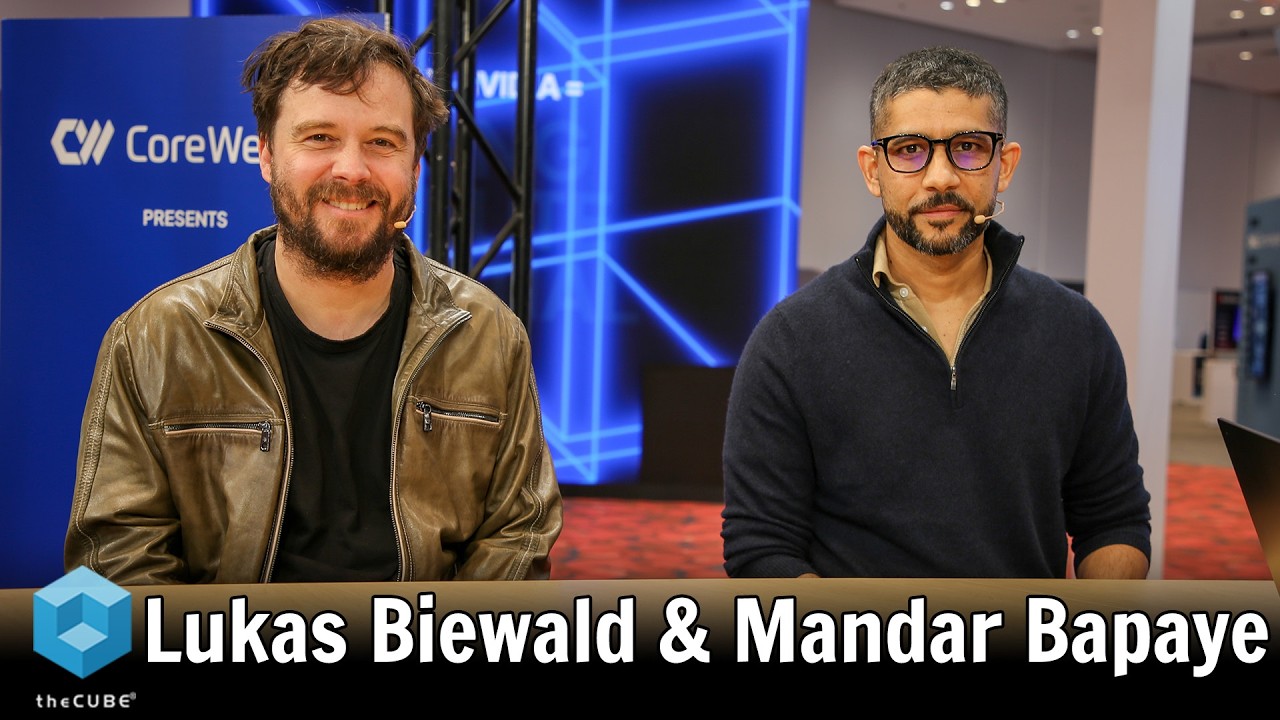
Sarat Krishnan, Dell Technologies & Jacob Yundt, CoreWeave
Jacob Yundt of CoreWeave and Sarat Krishnan of Dell Technologies join theCUBE Research hosts John Furrier and Dave Vellante at Fully Connected, CoreWeave's first annual conference to examine the evolution of rack-scale systems and operational best practices for artificial intelligence AI infrastructure. The discussion focuses on deployment patterns, co-engineering partnerships and operational readiness for large-scale AI data center deployments.
The conversation explores Vera Rubin and NVL72 deployments, lessons from GB200 and GB300, co-engineering between CoreWeave and Dell Technologies, telemetry and diagnostics, liquid cooling advances and tools such as Racky and DeepSeek-R1 that enable repeatable high-velocity AI infrastructure rollouts. Speakers emphasize unified observability and management across rack row and data-hall scale to support predictable operations and capacity planning.
Yundt emphasizes the shift from "the rack is the computer" to row, data-hall and data-center scale, requiring unified observability and management. They underscore the value of tight co-design and systems integration for scalable AI infrastructure and operational efficiency.
Krishnan highlights modular rack designs, shift-left diagnostics and integrated telemetry to reduce remediation costs and accelerate deployments. They describe these practices as category-defining for AI infrastructure and essential for operators, cloud providers and enterprises deploying AI at scale.
This session delivers practical guidance on design patterns, deployment automation, telemetry-driven operations and cooling strategies to inform planning and execution of modern AI infrastructure projects.
-R1
Sarat Krishnan, Dell Technologies & Jacob Yundt, CoreWeave
Sarat Krishnan
Director, PowerEdge AI Architecture and Systems Development EngineeringDell Technologies
Jacob Yundt
Senior Director of Compute ArchitectureCoreWeave
In this interview from Fully Connected 2026, Sarat Krishnan, director of PowerEdge AI architecture and systems development engineering at Dell Technologies, joins Jacob Yundt, vice president of engineering, compute architecture at CoreWeave, to talk with theCUBE's John Furrier and Dave Vellante about the evolution of AI infrastructure from rack-scale to data-center-scale design. Krishnan and Yundt trace the deep co-engineering partnership between Dell and CoreWeave, from the early GB200 deployments to a faster, smoother Vera Rubin rollout. Yundt explains how ...Read more
exploreKeep Exploring
What are your impressions of the Fully Connected conference — how is it translating into customer engagement, what's the overall vibe, and what topics are customers most interested in (especially regarding infrastructure)?add
How was the GB200 developed and scaled to enable rapid, repeatable deployment across diverse data centers, and what role did the partnership with CoreWeave play?add
What is the process for designing and deploying the Vera Rubin rack-scale system, and how have partnerships with CoreWeave and Dell helped accelerate and improve that process?add
What will a really successful, scalable rack-scale deployment with Vera Rubin look like?add
How is the unit of computation shifting from individual servers to racks, rows, or entire data centers (as with Vera Rubin and beyond), and what does that shift imply for systems integration and management across compute, networking, cooling, power, and control infrastructure?add
Sarat Krishnan, Dell Technologies & Jacob Yundt, CoreWeave
search
(INTRO)
John Furrier
>> Welcome back to theCUBE's live coverage here in San Francisco for Fully Connected, CoreWeave's first annual conference. Their leaders are here, their customers are here, their partners are here. All the industry luminaries are here, all the big builders, operators, and investors are checking it out. The growth of AI infrastructure at rack scale has been the biggest story in the industry. Of course, everyone wants more supply. I would say that's the biggest, but getting it deployed is the biggest. Sarat Krishnan here, Senior Director, PowerEdge AI Architecture and Systems Development Engineering at Dell Technologies. Great to see you. Thanks for coming on. Jacob Yundt here, VP of Engineering Compute Architecture at CoreWeave, CUBE alumni. You were in the CUBE studio when we did the first Vera Rubin workload. Great to see
Jacob Yundt
>> you.Thanks for having
John Furrier
>> me.Thanks for coming on. First, Jake, we'll start with you,
Jacob Yundt
>> your show.
John Furrier
>> Yeah.Fully Connected. I think I renamed it Fully Connected Intelligent Systems. Fully Connected. everything's kind of coming together. You've seen the role of intelligence being produced.
Jacob Yundt
>> Yeah.
John Furrier
>> So it's the AI factory example, but it's a system, not just a GPU and models. It's an entire intelligence-producing factory.
Jacob Yundt
>> Yes.
John Furrier
>> Your thesis is there. Give us a take on what you're seeing here at the show. How's that translating?
Jacob Yundt
>> Oh man. So first Fully Connected, it's truly wild. I've been at CoreWeave for, I don't know, 3 and a half years. And back then it was like 100 people. You could fit everyone into just one conference room. And to see this here today with all of our customers, all of our partners, just the energy, the announcements, this is just truly wild. This has been a
John Furrier
>> fantastic—Pace of play. We always say in theCUBE, but here the real pace of play is not just the tech, which you guys have been working on, the customers, the demand and the pace of the revenue opportunities, the tokens, So you got a technical innovation perfect storm of greatness and then you got the customer adoption. You guys are turning on systems big time.
Jacob Yundt
>> Yeah.
John Furrier
>> What have been the customer reactions here? What have been some of the— what's been the vibe? What have been some of the talking points?
Jacob Yundt
>> So I'm a little bit biased as the server guy, the hardware guy. The customer interactions here have been A, great, but people just love finding out more about the hardware. I think that that's something that if we're doing our job well, you're not necessarily like, you don't understand how the sausage is made. And a lot of the questions, a lot of the engagement, a lot of the sessions that we've had, there's been a lot of discussion about just like, tell us more, tell us more about the infrastructure. And I think that engagement's just, it's been fantastic.
Dave Vellante
>> So, Rod, I was in Ehab's lab, I think it was 2 years ago now, and it was, you guys were trying to get the first, I think it was GB200 racks out and get 'em off to, I think it was to Memphis or wherever it was. And he was sharing with us the complexities and the speed at which you had to respond. It was early days, right? 2 years is a lot of time in this era. So what's changed today? But talk about the challenges then and now.>> Yeah, the first GB200, real engineering marvel, right? 1296 NVLinks all coming up at the same time. Power, cooling, all one domain, just getting that functional, working with a partner like CoreWeave, first to market, that was engineering. Here we are, what, thousands of racks later. I think it's a process. It's really taken engineering, our operations team, our supply chain, our factories, all coming together to build this really repeatable, fine-tuned engineering process. And we have learned a lot along the way with a partner like CoreWeave. How do you shift left? How do you make your diagnostics increasingly more sophisticated? How do you configure your racks, build the amount of configurability in the racks that we can adapt to many different data center needs? For example, working with CoreWeave, they have a huge installed base. you have data centers that require cooling coming in from the top, cooling coming from the bottom. You have power whips of various sizes. We have learned now to build modular rack-scale infrastructure that can quickly adapt to all of these needs. And I think that's really how we have been first to market and we've been able to ship at this velocity and scale.
Dave Vellante
>> Just to follow up on just the trajectory of each subsequent generation, we're seeing it from NVIDIA. It's like you're here and then you're here and then you're here. The demand just keeps going up and up and up and the shape of the curve, I presume, that you're on an even steeper ramp with this generation than you were with previous?>> We are on a steeper, faster ramp. The learning curve is getting flatter because we have learned so much. We're able to scale. I'm sure Jacob can attest to the fact that Vera Rubin has been, you know, touch wood, much more smooth than GB200 was. And that translates to just faster deployment.
John Furrier
>> You guys build the muscle of a partnership too.
Dave Vellante
>> Well, the GB200 racks, they were new to people. they were heavy, GPUs were melting, it's true. That's a fact. And so, but that's the learning, right?
John Furrier
>> Jacob, I want to get into the partnership with Dell. Dave and I had dinner last night. We were talking about how people do business, how it's evolved. Just do a transaction. Give me the cash. What's our business transaction? You hit on something that's come up a lot is around extreme co-design. You mentioned the 100 people in a conference room. You guys grew together. Okay. Talk about that dynamic and the relationship, because when you have these emerging markets, you don't know what the other side may look like. And there's a lot of trust. In this case it's not technology transfer— that's a legal term, but technology interactions. Yeah. Talk us through the partnership because this is where the winners actually win. They make a bet and they work together and this paid off great for you. You learned from them, you learned from— talk about this new partnership, well, it's not new for you guys, but for the industry.
Jacob Yundt
>> Yeah, the partnership is A, tight, B, very strong, and C, yes, we wouldn't have been able to have all these firsts, first with GB200, first with GB300, first with NVL72 without that tight partnership. And that partnership is everything from just really tight co-engineering of solutions to being embedded at the factory, like being locked in the same data center for days at a time without sleep and just doing nothing but working on making this product better, figuring out how we can scale it, figuring out how we can deploy it. And I think it's mutually beneficial because we were able to leverage Dell's supply chain muscle, we're able to leverage their engineering experience, and they're able to leverage our deployment, our operations, and what we see operating this at scale.
Dave Vellante
>> Well, that deep engineering connection is important. I want to make a point because in the industry you hear things like, oh, well, Elon's got some xAI GPU capacity he's going to sell, or Zuck has it. Well, I guess not. He's going to announce Muse. But the point is, yeah, okay, you can just offer GPU capacity, but that's not what you guys are doing. you've got deep engineering. You're building a business that's geared toward AI infrastructure, not sort of a one-off to sort of bridge till the next, you know, generation. And I think that's key.>> I view the partnership with Jacob as a true joint development engineering model. I first met Jacob in Vegas. We were both trying to bring up the first GB200, talking about being locked in a data center, lots of cans of Red Bull, that forged our partnership. And you know what happened in Vegas did stay in Vegas. That really—
Dave Vellante
>> We won't go there.
John Furrier
>> Okay, just scratch that. But again, the point I want to get at, this is kind of a little bit off topic on what I want to get to next on the Vera Rubin, is that this is the formula for success because your revenues are up. So you're kind of together at the early part. You could go this way, but you went both up. The business benefit was clear on both sides. That is a new formula. People have, this is a new way to engage on co-designing. Okay. So I just wanna get that point out there 'cause I think this is gonna be a template. The real question I wanted to ask you guys, Jacob in particular, and just on Dell's side, walk us through the Vera Rubin from design and the NVL72 from design to production 'cause you had the first one. Take us through high-level version of how that went down because that's a huge milestone for you guys. You got shipping workloads. Yeah, first ones to get it.
Jacob Yundt
>> Yeah, I can start. so this starts, uh, months or sometimes years in advance. Uh, it looks like these things get, uh, announced and then launched and then they're in production pretty quickly, but what's not pictured is just, Sarat and his teams being locked in rooms with my teams and just whiteboarding out what we want this to look like. How are we gonna try to deploy this? What changes are we gonna do? How are we gonna do firmware settings? How are we gonna do mechanical changes? And so there's just a ton of work that goes into that. And then in terms of the deployment side, it's— yes, we've been able to leverage all the learnings from GB200, GB300 to make the deployments faster, smoother. But there's just so much work that goes into it before we even get the first rack, before we get our ES samples or QS samples. There's a lot of design work that goes into working with Dell ahead of time.
John Furrier
>> Sarat, what's your take on this? What would you add to that?>> I think this partnership with CoreWeave has really given us a lot of tools to accelerate and build faster. We have partnered with CoreWeave on things like telemetry, you know, rack scale management, things like integrated rack controllers, things like that. And that's really kind of helped us build out the story of what a really successful, scalable rack scale deployment is going to look like with Vera Rubin.
John Furrier
>> Yeah. And I think I wrote a post last week, went viral in certain circles, but it was the premise was the AI factory is the computer. Right. And I even suggested that the word data center might even go away because what you're building is essentially an industrial intelligence-producing factory. You're producing intelligence. That's a systems game. It's the entire system producing intelligence. And so the work you do on Vera Rubin is again going to continue on the next one. It's not rack and stack and you don't stand up AI factories. Now you build them and you turn them on.
Jacob Yundt
>> Yep.
John Furrier
>> So I like this idea of turning on AI, not standing up, because the rack scale shows us the way that's going to go down. So that's the data center view, a bunch of racks. So rack scale to me has crossed the threshold. It's game over on the concept. I don't think anyone's going to debate rack scale. So what's next? Data center scale makes sense, because now you have data centers. You got a great example with one of your customers doing remote training. Okay, Cognition. Great use case. So it's bigger. What's next on the rack scale innovation? What are we going to see?
Jacob Yundt
>> That's a good question. I think you sort of touched on it that just going back a little bit for GB200, GB300, we saw this transition from L10, individual server to L11. We deal with this rack. The rack is the computer now. For Vera Rubin and beyond, I think what we're seeing is that it's no longer the rack is the computer. It's this row is the computer or this data hall is the computer or this data center is the computer. And what that means is tight systems integration across the entire stack. So it's not just the Vera Rubin compute trays, it's the NVLink switches, it's the DPUs that are in them, it's the liquid cooling infrastructure that we're provisioning, it's all the data center power that we're provisioning, it's all of the network, like backend fabrics. And you need a system to manage all of those things. It's truly just like one living, breathing machine. And you really just need a system to handle that at that sort of data center scale. It's not just individual components
Dave Vellante
>> anymore.So I'm reading the ClusterMAX
Jacob Yundt
>> 3.0.Yeah.
Dave Vellante
>> 323 providers now, it's up to, there's only 2, you're joined now, you're not alone in the Platinum tier. We love the competition, but it says, while CoreWeave still sets the technical bar for others to follow. So that's impressive. And not many in the Gold tier and Bronze tier. So you kind of, you were standing alone there. Okay, so you got some competition there, but Triple Platinum. What is that? Yes, triple Platinum, right? Because yes, that's right. Because you were 1.0 and 2.0. So you really have set that standard. And I say it's good to see some competition, right? We like that. What does it take to achieve that and how do you sustain it?
Jacob Yundt
>> Good question. So A, just being relentless. And yes, we like competition, right? Competition keeps us sharp. We welcome that. But what does it take to maintain that is just being relentless, right? And having this sort of systems design approach. I think that others, if they haven't realized it, will soon realize that you truly can't even just manage this at this rack level, right? Like everything in your management stack, your observability stack, the telemetry that you're gathering, everything has to be related to this sort of overall— the row is the computer, the data center is the computer design. So I think that's what we're going to see next. I think that's what's going to continue to differentiate and continue to separate out those tiers.
Dave Vellante
>> Yeah, you mentioned shift left as an example. That's sort of pushing in that direction.>> I think if you think about a rack scale design, it's really about pushing your risk to the left. It becomes increasingly expensive to remediate and fix something as you go later on in the manufacturing process, becomes extremely expensive if you have to replace something in the data center. So what we have done really over the last 2 years is shift our most complex diagnostics, the ones that are going to capture true hardware failures further and further left. So if there's going to be a real hardware issue, you want to catch it at L10 and not really L11 and definitely not when it's in the data center. So I think working with CoreWeave, we've gotten some really good foundational data on how we kind of shift that risk left and improve our systems. So the reliability is awesome.
Dave Vellante
>> How do you guys think about this, steady state of AI. Clearly each generation you're applying the learnings, the demand curve is steepening. And so we've come to expect every year NVIDIA announces, you know, next generation 10x, 20x, 30x. When you project that forward on this sort of exponential curve, the capabilities are going to be astounding. But right now, there's— it's the opposite of what we're used to in tech. There's inflation, right? Technology is always deflationary. But now, largely because of HBM, prices are going up. At some point that levels off and we start to see what we saw in Moore's Law on steroids, just dramatic, drastic improvement in token costs. We're seeing token costs come down. How do you guys think about the sort of future economics of this business?>> What do you think?
Jacob Yundt
>> That's a good one. Okay, so this is maybe just Jacob's opinion, not official CoreWeave opinion.
Dave Vellante
>> Yeah, yeah, of course, this is all speculation. You don't really know what's going to happen.
Jacob Yundt
>> But it might be an unsatisfying answer, but I don't know. Here's an example. We thought we had what we understood to be a lifecycle plan or a refresh plan for older products, A100s, and we had understood, we thought the lifecycle would be appropriate for those devices and we were going to maybe figure out some disposal plans. And then we had customers that actively wanted those. And so that what we're finding is that our older GPUs still have a lot of value to customers such that that is kind of throwing off what our asset depreciation lifecycle plans are. And so now that's sort of calling into question what are the long-term plans for some of these things? So it's a little bit of an unsatisfying answer. It's a little bit of just like Jacob opinion, but I don't know right now.
John Furrier
>> We like your Jacob opinion.
Jacob Yundt
>> Yeah.
Dave Vellante
>> Well, I just wonder, is there a new sort of model in tech?>> Yeah.
Dave Vellante
>> Should we, cuz you used to want to lock in or get guaranteed forward pricing. Yeah. That's the last thing you'd want to do today. You wanna lock in today's price and make a commitment. Yeah.
John Furrier
>> Um, You can't carry anything. Look at what the semiconductor evolution, they've already moved on to this system where there's the chipmaking capability by the models themselves. OpenAI making their own
Dave Vellante
>> chip.And we're breaking other rules
John Furrier
>> too.You guys going to build your own chip?
Jacob Yundt
>> No, we have enough things we're working on right now that keep us busy.>> I think there's been a real revelation to me in how agentic models and inference models have moved to rack-scale design. But there was this kind of notion that those are going to be staying on like PCIe GPUs or 8-way GPUs. Have you really seen heavy adoption of rack scale for
John Furrier
>> those?Well, they have to. You have to because they need more.>> They need more.
John Furrier
>> Their models are getting better. Like I said, literally OpenAI is using their own model to make a
Jacob Yundt
>> chip.
John Furrier
>> Absolutely.Who would have thought about that? But again, Amazon has their own chip. They bought Annapurna. Google did their own chip. So I think chipmaking— I'm bullish on chipmaking for people who have domain expertise. I'm joking. CoreWeave has an
Dave Vellante
>> analogy.That's another example where you're seeing everybody's gonna— theCUBE is going to design its own chips
John Furrier
>> now.It's our joke. Yeah. theCUBE. the fabulous theCUBE.
Dave Vellante
>> You can, but we're seeing new—
John Furrier
>> if he gets his way, it'll be low power too.
Dave Vellante
>> But from an investor standpoint as well, look at Dell. Dell used to trade at probably $0.80 on the revenue dollar. I think it's at least 3x on the revenue dollar today. Look at Nvidia. When have we ever seen in the industry the leader— and Nvidia is clearly the leader— trade at a lower multiple than its competitors? Nvidia now, if you take into account its stock buybacks is trading at like 13 times earnings and it's like lower than the S&P. We've never seen this before. So that's why I asked that question.
John Furrier
>> The market's changed. If you look at the game with AI, the valuations might change. Product roadmaps are coming out. So again, the demand curve is so
Dave Vellante
>> big.
John Furrier
>> Yes.Well, right. I think that's better earned. I think always multiple earnings has always been kind of a voodoo, but there's always been consistent.
Dave Vellante
>> The leader gets the biggest multiple. Said another way, second gets, right? That's what I'm saying. There's kind of a new set of rules here. And then we used to debate whether or not there'd ever be another Amazon. Barclays got a forecast for CoreWeave, I think in fiscal '29 of like $53 billion. That's insane. And then it pales in comparison to Anthropic and OpenAI, which is— we've never seen before. So I feel like there's new rules.
John Furrier
>> What Dave's saying is, you guys are part of the growth. Thank you for what you do. That's exactly the work that you guys have done because we've been following it obviously from the beginning. It's a brand new system.
Jacob Yundt
>> Yeah.
John Furrier
>> And this is net new architecture around the requirements of the GPU. And they had the— NVIDIA was on yesterday, Ian Buck saying Vera was built because they had to build it. Yeah, because for the GPU, it wasn't to compete with Intel. Yeah, for sure. But the CPU wasn't going to work. So similar things are going on in the rack space now where it's like, well, we could use that, but it doesn't really fit to what we're doing. Does that— is that happening a lot? And what are the hot areas where you're like, Oh, storage could be better like this, because this is what you're discovering. You're basically building the next template.
Jacob Yundt
>> Yeah, we are. I can talk a little bit about one of my favorite things, Racky, our rack manager, or its full legal name of Racky McRack Manager. But that's a good example, right, where we saw that just based on our experience of operating liquid cooling at scale, there just wasn't necessarily a product that met our needs and we went out and built it, right? We're not going to go build chips because there's not a CPU that meets our need. But in this case, we're like, hey, there's— we have some very specific requirements for how we interact with liquid, how we interact with power. And so we built Racky. And I think that's one example of just, you know, because you're tuning system elements to the new requirements, not the old way.
John Furrier
>> Yes.And they're not individual components. You're tuning the entire
Jacob Yundt
>> system.It goes back to that system because it's managing its power, it's managing its cooling, it's managing sensors. It's
Dave Vellante
>> managing.Yeah.
John Furrier
>> That's not well understood in the market right now. People are thinking, oh, I got a GPU and I got some memory. I think what you're hitting on is that you're tuning the system and that's what rack >> scale—I think rack scale management, Racky is a great example. We work with CoreWeave to integrate Racky in our L11 factories. So by the time it ships, it's already tested and we have done a lot of joint innovation. One of the things we've been inspired by our partnership with CoreWeave is to build better leak detection mechanisms, that can be catastrophic. So things like a drip tray that can catch any leaks. So you're not like, you know, You know,
Dave Vellante
>> liquefied—how are we feeling about, if I may, how are we feeling about the state of liquid cooling? I mean, again, you go dial back a few years, the connection integrity was poor. Yeah, I have no doubt there's been a lot of innovation going on.>> I think it has. you look at Vera Rubin, it's now fully liquid cooled and you're now seeing a big shift. You have in-rack CDUs, now you have end-of-row CDUs. So I think there's a lot of forward momentum in liquid cooling and the technology is becoming more robust. And you're seeing a lot of innovation around it. At the same time, I think you're also seeing a lot of innovation around managing that liquid cooling, making sure you're catching any leaks early, whether it's a rack scale manager, an integrated rack controller, all of these things.
Dave Vellante
>> No green goo.
Jacob Yundt
>> No green goo.
John Furrier
>> Yeah, right. Guys, congratulations. It's kind of a historic moment. Obviously your first conference, but the first cloud conference in the new AI infrastructure category, which I put on my blog post. It's a new layer. I agree. Congratulations, CoreWeave, for putting on the first event in the category and for the rack-scale work you guys have done. And I know it's in demand. Obviously, the backlog's in the billions. I wish we had an hour. We'll come back. We'll keep tracking it. Thanks for coming on.
Dave Vellante
>> All the milestones.
John Furrier
>> Really appreciate it. I'm John Furrier with Dave Vellante. More live coverage after this short break. Bye.










 John Furrier
 Dave Vellante