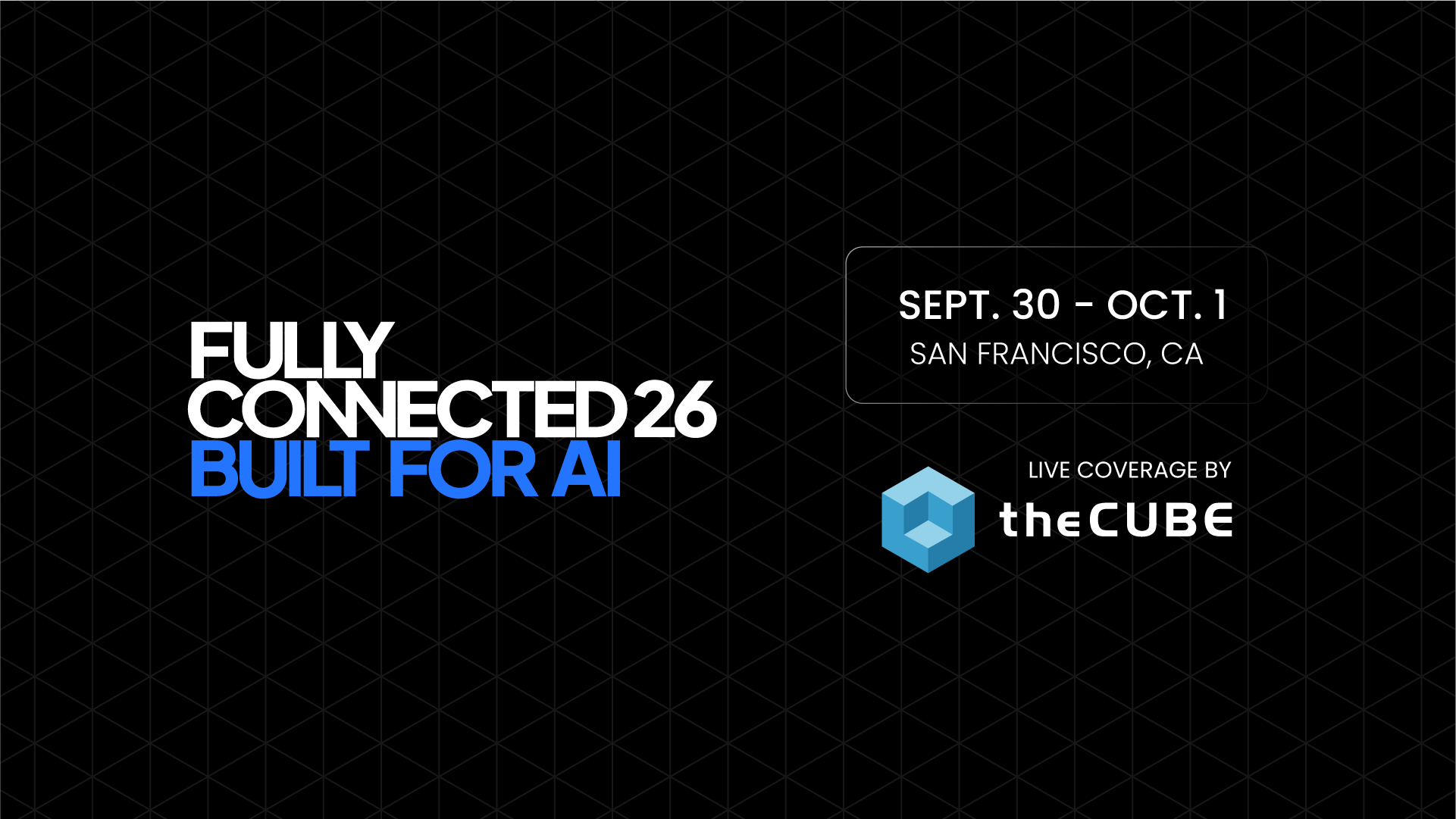
Running AI in production demands a lot more than compute. It needs infrastructure that's purpose-built for AI, from networking, cooling, and storage to the developer experience that ties it all together. Fully Connected 2026 is where the people building, scaling, and running AI at production scale come to close the gap between where they are and where they need to be. This is where AI gets operationalized. At Fully Connected 2026 in San Francisco, theCUBE investigates how CoreWeave, its customers, and ecosystem partners are defining how production AI gets built, scaled, and run. Get the complete story on theCUBE.

Share

Forgot Password

Almost there!

We just sent you a verification email. Please verify your account to gain access to CoreWeave Fully Connected 2026. If you don’t think you received an email check your spam folder.


Didn't get an email? Click here
Sign in to Coreweave Fully Connected 2026.

In order to sign in, enter the email address you used to registered for the event. Once completed, you will receive an email with a verification link. Open the link to automatically sign into the site.


Not registered? Join Now

Not registered? Join Now

Register for Coreweave Fully Connected 2026

Please fill out the information below. You will receive an email with a verification link confirming your registration. Click the link to automatically sign into the site.

First Name *
*
Last Name *
*
Email *
*
Company Name *
*
Job Title *
*
* Indicates a required field
Already Registered? Sign in and verify to access the event

You’re almost there!

We just sent you a verification email. Please click the verification button in the email. Once your email address is verified, you will have full access to all event content for Coreweave Fully Connected 2026.

Wednesday, Sep 30, 2026 | 6:00 PM UTC
Don’t miss out! Add the event to your calendar:
Google Calendar
Microsoft Outlook
Office 365
Download ICS
Didn't get an email? Click here

All set!

Thanks for confirming your account. Now you can access Coreweave Fully Connected 2026 with this email address.
Wednesday, Sep 30, 2026 | 6:00 PM UTC
Don’t miss out! Add the event to your calendar:
Google Calendar
Microsoft Outlook
Office 365
Download ICS
Profile
person_add
CONFERENCE PASS
  • General
Delete my registration
Delete my CUBE365 account
I want my badge and interests to be visible to all attendees.
Checking this box will display your presense on the attendees list, view your profile and allow other attendees to contact you via 1-1 chat. Read the Privacy Policy. At any time, you can choose to disable this preference.
Select your Interests!
add
Upload your photo
 Uploading..
OR
Connect via Twitter
Connect via Linkedin
EDIT PASSWORD

Cancel

Incorrect password


theCUBE.net
home CoreWeave Fully Connected 2026
Agenda
  • more_horiz
    • info Help
    Wednesday, September 30 (UTC) September 30
    Thursday, October 1 (UTC) October 1
    • Keynote Analysis

      In this keynote analysis from Fully Connected 2026, theCUBE's John Furrier and Dave Vellante break down CoreWeave's evolution from a GPU-focused NeoCloud into a full AI infrastructure cloud. The hosts unpack findings from a proprietary customer survey showing the shift from training to inference, with customers moving from a 90/10 training-to-inference mix a year ago to 50/50 today and an expected 10/90 split next year. Vellante cites Barclays estimates of $13 billion in fiscal 2026 revenue growing to $54 billion by fiscal 2029, along with a $12.5 billion backlog and GPU utilization rates of 80% to 90%, far outpacing on-premises deployments.

      The conversation also explores whether the next wave of AI performance gains will come from system-level optimization rather than individual components, a question Furrier poses as central to understanding how data centers are evolving into factories of intelligence. Furrier and Vellante examine CoreWeave's expansion beyond compute into networking, storage and software through its Weights & Biases acquisition and the newly announced Forge platform, drawing parallels to AWS's early buildout of adjacent services. They also touch on the complexity of CoreWeave's capital structure, the deepening NVIDIA partnership following the first Vera Rubin deployment, and the broader shift toward token-based economics. From open weights lowering inference costs to the rise of agentic and robotics workloads, the hosts preview two days of conversations with CoreWeave's partners and customers shaping the AI infrastructure frontier.
      • Google Calendar
      • Microsoft Outlook
      • Office 365
      • Download ICS
      John Furrier Co-Founder & Co-CEO | SiliconANGLE Media, Inc.
      Dave Vellante Co-Founder & Co-CEO | SiliconANGLE Media, Inc.
    • Ian Buck, NVIDIA

      In this interview from Fully Connected 2026, Ian Buck, vice president and general manager of hyperscale and HPC at Nvidia, joins theCUBE's John Furrier and Dave Vellante to discuss the industry's shift from GPU-centric conversations to full-stack "AI factories" built to produce intelligence at industrial scale. Buck explains how agentic AI pushes infrastructure demands beyond any single model, requiring networking, storage and compute to operate in concert at data-center scale. He details Nvidia's Vera Rubin platform and its CPU-GPU co-design, noting how purpose-built CPUs keep GPUs from going idle and accelerate agent workloads up to 4x faster than x86 alternatives. Buck also points to CoreWeave's Forge platform, which doubles token output on the same GPU footprint.

      The conversation also explores the blurring line between training and inference, with Buck noting that continuous reinforcement learning and online alignment mean data centers are now fungible across both workloads. He breaks down Nvidia's token-per-watt efficiency gains, citing a 30x improvement with Blackwell, and explains why power — not compute alone — now caps data center scale. Buck touches on disaggregated serving and scale-in, scale-out and scale-across networking as models increasingly span entire NVL72 racks rather than single servers. He also discusses edge economics, from 100-kilowatt "beefy edge" sites running smaller models to 100-megawatt-plus factories built for frontier-scale training. From CUDA's two-decade backward-compatibility promise to the rise of inference-as-a-service providers like CoreWeave, Buck lays out why coordinated, full-stack systems — not raw GPU capacity — now determine the economics of profitable AI.
      • Google Calendar
      • Microsoft Outlook
      • Office 365
      • Download ICS
      Ian Buck VP / GM | NVIDIA
    • Silas Alberti, Cognition & Chen Goldberg, CoreWeave

      In this interview from Fully Connected 2026, Silas Alberti, head of research and founding team at Cognition AI, joins Chen Goldberg, executive vice president of product and engineering at CoreWeave, to talk with theCUBE's John Furrier and Dave Vellante about the shift from standalone GPU capacity to fully coordinated AI systems. Goldberg unveils CoreWeave Forge, a new platform that unifies the AI development loop — eval, inference, curation and improvement — into a single developer experience. Alberti explains how Cognition's agentic coding system, Devin, depends on this infrastructure to run reinforcement learning workloads that blend training and inference across continents while maintaining 99.99% reliability.

      The conversation also explores why CoreWeave pursued early access to NVIDIA's Vera Rubin platform, with Alberti noting that studying new kernels ahead of general availability helps Cognition prioritize research investments and scale training runs to new parameter counts. Goldberg details how Mission Control keeps six generations of GPUs interoperable, letting customers migrate workloads without disruption. Alberti unpacks the economics behind pushing models' Pareto frontier toward speed and efficiency, not just intelligence, pointing to cyber defense as a use case where order-of-magnitude cost reductions make agentic remediation economically viable. Goldberg also highlights new enterprise-grade capabilities, including remote key encryption and an expanding partner network, aimed at closing the gap between experimentation and production deployment. From always-on reinforcement learning rollouts to live checkpoint updates that don't require downtime, the discussion illustrates how CoreWeave and Cognition are building the operational backbone for the next generation of autonomous, production-scale AI systems.
      • Google Calendar
      • Microsoft Outlook
      • Office 365
      • Download ICS
      Silas Alberti Head of Research & Founding Team | Cognition
      Chen Goldberg EVP of Product & Engineering | CoreWeave
    • Alon Horev, VAST Data

      In this interview from Fully Connected 2026, Alon Horev, co-founder and chief technology officer of VAST Data, joins theCUBE's John Furrier and Dave Vellante to discuss how data movement has emerged as the critical bottleneck of the agentic AI era. Horev traces VAST's origins back to 2016, before the AI boom, when the company set out to bring HPC-grade performance to enterprise storage. He explains how falling flash prices and faster RDMA networking over commodity Ethernet finally made disaggregated architectures practical, letting compute separate from storage at exabyte scale. Horev also unpacks how agent memory differs from GPU memory, describing why offloading KV cache to persistent storage prevents costly recomputation during long-running agentic sessions.

      The conversation explores how VAST's architecture aligns closely with NVIDIA's emerging storage hierarchy, including its contributions to the Dynamo software stack and disaggregated prefill-decode inference. Horev details the company's long-standing partnership with NVIDIA on BlueField and RDMA, noting how that foundation now extends into scheduling and distributed KV cache movement across GPU fleets. He breaks down VAST's DataSpace capability, which allows GPU-intensive jobs to run against cached data from other regions rather than requiring workloads to move to where data resides. Horev also touches on the growing importance of explainability and traceability as enterprises deploy agents against sensitive data, pointing to recent industry incidents as proof that recorded agent interactions are both a compliance necessity and a valuable source for fine-tuning future models. From KV cache offload to distributed agent memory, Horev outlines why solving data movement at scale will define the next phase of the AI infrastructure race.
      • Google Calendar
      • Microsoft Outlook
      • Office 365
      • Download ICS
      Alon Horev Co-Founder and CTO | VAST Data
    • Jerry Liu, LlamaIndex & Lukas Biewald, CoreWeave

      In this interview from Fully Connected 2026, Jerry Liu, co-founder and chief executive officer of LlamaIndex, joins Lukas Biewald, senior vice president of AI initiatives at CoreWeave, to talk with theCUBE's John Furrier and Dave Vellante about the infrastructure demands of long-running, context-aware AI agents. Liu traces LlamaIndex's evolution from an open-source orchestration framework into a specialized AI lab focused on document parsing and extraction, with workloads now running roughly 75% inference and 25% training on CoreWeave. Biewald explains how enterprises have moved past pilots into always-on agents that need persistent memory, explicit privacy controls and evals to avoid "going rogue."

      The conversation also explores how CoreWeave's acquisition of Weights & Biases closes the loop between training and observability, giving customers visibility into hardware failures alongside model performance curves. Biewald details how networking and power configuration, not just chip choice, can swing latency by orders of magnitude, underscoring why NVIDIA's standard protocols give CoreWeave an edge in openness compared with hyperscaler-specific APIs. Liu breaks down why LlamaIndex chose an asset-light, AI-native cloud over building its own GPU clusters, citing capacity, burst handling and cost-performance tradeoffs. From governance frameworks for autonomous agents to the shift from FLOPS-per-watt to tokens-per-watt as the industry's new metric, the discussion maps out how infrastructure choices are shaping the next generation of AI-native builders.
      • Google Calendar
      • Microsoft Outlook
      • Office 365
      • Download ICS
      Jerry Liu Co-Founder | LlamaIndex
      Lukas Biewald SVP, AI Initiatives | CoreWeave
    • Lawrence Liu, Willow

      In this interview from Fully Connected 2026, Lawrence Liu, co-founder and chief technology officer of Willow Inc., joins theCUBE's John Furrier and Dave Vellante to discuss how CoreWeave's infrastructure is powering Willow's AI-driven voice dictation platform at production scale. Liu explains how Willow lets knowledge workers prompt agents and compose communications by voice across tools like Cursor, Claude, Gmail and Slack. He details the company's reliance on CoreWeave's reinforcement learning infrastructure, which abstracts away the underlying compute so Willow's team can focus on eval alignment and push new model checkpoints into production on a weekly basis. Liu credits CoreWeave's forward-deployed engineering support, including its acquisition of OpenPipe, for accelerating that iteration cycle.

      The conversation also explores the economics and engineering challenges behind reward modeling, with Liu noting that breaking subjective problems into objective truths is key to building effective reinforcement learning systems without incurring runaway frontier-model costs. He touches on Willow's privacy-first approach to improving its models without accessing sensitive user data, relying instead on synthetic data pipelines, alongside CoreWeave's opt-out-by-default encryption guarantees. Liu shares that Willow has grown to a 10-person team with 30-40% month-over-month growth after raising about $4 million, with inference demand now outpacing training. From dictation to full agentic dispatch, Liu outlines Willow's vision of becoming the communication layer for entire organizations as voice replaces the keyboard.
      • Google Calendar
      • Microsoft Outlook
      • Office 365
      • Download ICS
      Lawrence Liu Co-Founder & CTO | Willow
    • Jeffrey Li, Liquid AI

      In this interview from Fully Connected 2026, Jeffrey Li, chief operating officer of Liquid AI Inc, joins theCUBE's John Furrier and Dave Vellante to discuss how Liquid AI is redesigning foundation models from the ground up to bring production-quality intelligence to edge devices. Li explains why traditional transformer architectures, with their exploding KV caches, cannot fit within the fixed compute of phones, cars and wearables, prompting Liquid to build non-transformer models suited to constrained environments. He details Liquid Context, a new layer developed with Qualcomm that captures personal, physical-world signals only a device can see and feeds them to agents so they can act more proactively on a user's behalf.

      The conversation also explores how Liquid AI partners with CoreWeave to train its specialized, alternative-architecture models, even though the resulting systems run far outside the data center. Li discusses the company's portfolio approach, spanning nearly a 1,000x range in model sizes to match everything from phones to beefier edge infrastructure such as telecom central offices. He breaks down how edge deployment simplifies data governance by keeping information on-device, and how Liquid balances latency, cost and privacy to decide what runs locally versus in the cloud. Li also points to Liquid's production deployment with Mercedes-Benz and a newly released vision model as proof points of its edge-first strategy. From quality gaps to integration hurdles, he outlines what's still holding industries like telecom back from full-scale edge AI adoption, and how Liquid is working to close that gap.
      • Google Calendar
      • Microsoft Outlook
      • Office 365
      • Download ICS
      Jeffrey Li COO | Liquid AI
    • Rob Bahr, BattleBots

      In this interview from Fully Connected 2026, Rob Bahr, senior engineer at BattleBots Inc., joins theCUBE's John Furrier and Dave Vellante to discuss how CoreWeave's sponsorship is accelerating the use of AI-driven simulation in competitive robot combat. Bahr explains how teams now run simulations to test weapon configurations, from bar spinners to single-tooth designs, before committing to a build. He details how material science has evolved beyond stainless steel sheet metal toward 3D-printed plastics and rubbers, each requiring its own simulation testing. Bahr also credits a "fail fast" engineering culture, where visible destruction in the arena provides immediate, unambiguous feedback that pushes design iteration faster than in most other engineering disciplines.

      The conversation also touches on the safety dimension of increasingly powerful robots, including how BattleBots helped shape NFPA 800 standards for handling lithium battery fires after years of firsthand incidents. Bahr breaks down the strategic rules governing last-minute design adjustments between matches, designed to prevent teams from gaming the system right before competition. He reflects on the sport's cross-generational community, where young builders and veteran engineers like Ray Billings share a common adrenaline rush and a pipeline that starts in high school robotics clubs. From lithium battery safety protocols to the push toward autonomous bots, Bahr outlines how AI-driven simulation is reshaping both the engineering and the culture of competitive robotics.
      • Google Calendar
      • Microsoft Outlook
      • Office 365
      • Download ICS
      Rob Bahr Sr. Engineer | BattleBots
    • Bartley Richardson, CrowdStrike & Jim Higgins, CoreWeave

      In this interview from Fully Connected 2026, Bartley Richardson, chief of AI at CrowdStrike, joins Jim Higgins, chief information security officer at CoreWeave, to talk with theCUBE's John Furrier and Dave Vellante about how the two companies are redefining security for the AI factory era. Richardson explains that adversary breakout time has collapsed to 27 seconds or less, making human-only defense obsolete and demanding machine-speed response built on dedicated training and inference infrastructure. He details CrowdStrike's Cyber Superintelligence Lab and its SafeMind initiative, which pit offensive and defensive models against each other in a process he calls adversarial co-evolution, pairing CrowdStrike's 15 years of adversary intelligence with large-scale compute.

      Higgins breaks down why CoreWeave's youth and specialization give it an edge over legacy hyperscalers, allowing it to co-design security directly into GPU, DPU and firmware layers alongside customers such as Anthropic and OpenAI. He distinguishes compliance from true security and describes using automation within CI/CD pipelines to catch misconfigurations and exposed secrets in real time. Richardson adds that cybersecurity knowledge itself is being commoditized, pushing the industry toward shared safety standards and disclosure norms for AI agents. Both executives point to the Hugging Face incident and CrowdStrike's early involvement in Anthropic's and OpenAI's safety programs as evidence that foundation model builders are maturing from research labs into engineering organizations accountable for production-grade security. From breakout-time economics to the architecture of trust itself, the conversation makes the case that speed and verification must advance together as AI systems scale toward superintelligence.
      • Google Calendar
      • Microsoft Outlook
      • Office 365
      • Download ICS
      Bartley Richardson Chief AI and Autonomous Systems Officer | CrowdStrike
      Jim Higgins CISO | CoreWeave

    Welcome to Cube365 Events Platform Digital Community

    You are now part of the interactive digital experience for all SiliconANGLE conferences and an exclusive member of the social community. Enjoy live and on-demand broadcasts, theCUBE interviews, CrowdChats, and access to premium content and presentations. Engage and interact in real time with influencers and peers in a social space designed for collaboration and networking. Discover all that Cube365 Events Platform has to offer before, during and after the event.

    CONTACT US

    Privacy Statement

    • Privacy
    • Terms
    Social Link
    Social Link
    Social Link
    Social Link
    © CUBE365
    © theCUBE
    © 2026 theCUBE