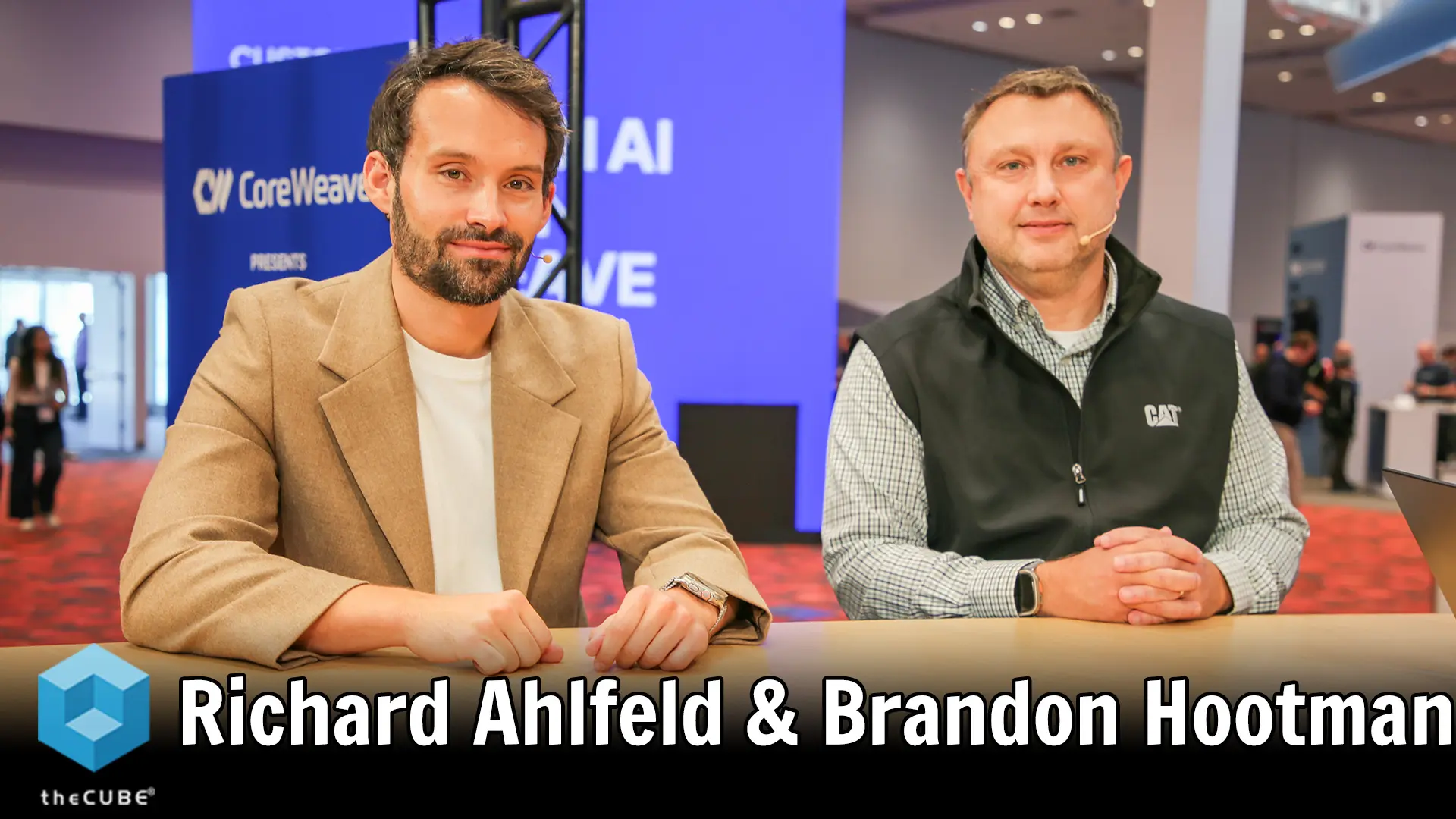
This discussion explores the application of artificial intelligence, AI, and high-velocity engineering to Formula 1. Richard Ahlfeld of CoreWeave, senior vice president of physical AI, and Eric Ernst of Aston Martin, commercial technology ambassador, join theCUBE Research hosts John Furrier and Dave Vellante at CoreWeave Fully Connected 2026. Ahlfeld explains CoreWeave's playbook for optimizing AI infrastructure and simulation workflows and they emphasize the need for data-driven decision-making under strict time and cost constraints. Ernst describes practical deployments such as AI transcription of multi-channel radio feeds and agent-based race strategy and they highlight how forward-deployed engineers bring external expertise to accelerate on-track problem solving and deliver actionable insights between practice and qualifying.
The conversation examines telemetry, forward-deployed engineers, simulation and the role of GPUs and digital twin technology in extracting performance from massive fast-moving data streams. Topics include high-performance computing, real-time simulation, model-based engineering and telemetric analysis for motorsport performance optimization.
Forgot Password
Almost there!
We just sent you a verification email. Please verify your account to gain access to
CoreWeave Fully Connected 2026. If you don’t think you received an email check your
spam folder.
In order to sign in, enter the email address you used to registered for the event. Once completed, you will receive an email with a verification link. Open the link to automatically sign into the site.
Register for Coreweave Fully Connected 2026
Please fill out the information below. You will receive an email with a verification link confirming your registration. Click the link to automatically sign into the site.
You’re almost there!
We just sent you a verification email. Please click the verification button in the email. Once your email address is verified, you will have full access to all event content for Coreweave Fully Connected 2026.
I want my badge and interests to be visible to all attendees.
Checking this box will display your presense on the attendees list, view your profile and allow other attendees to contact you via 1-1 chat. Read the Privacy Policy. At any time, you can choose to disable this preference.
Select your Interests!
add
Upload your photo
Uploading..
OR
Connect via Twitter
Connect via Linkedin
EDIT PASSWORD
Share
Forgot Password
Almost there!
We just sent you a verification email. Please verify your account to gain access to
CoreWeave Fully Connected 2026. If you don’t think you received an email check your
spam folder.
In order to sign in, enter the email address you used to registered for the event. Once completed, you will receive an email with a verification link. Open the link to automatically sign into the site.
Sign in to gain access to CoreWeave Fully Connected 2026
Please sign in with LinkedIn to continue to CoreWeave Fully Connected 2026. Signing in with LinkedIn ensures a professional environment.
Are you sure you want to remove access rights for this user?
Details
Manage Access
email address
Community Invitation
Eric Ernst, Aston Martin F1 & Richard Ahlfeld, CoreWeave
This discussion explores the application of artificial intelligence, AI, and high-velocity engineering to Formula 1. Richard Ahlfeld of CoreWeave, senior vice president of physical AI, and Eric Ernst of Aston Martin, commercial technology ambassador, join theCUBE Research hosts John Furrier and Dave Vellante at CoreWeave Fully Connected 2026. Ahlfeld explains CoreWeave's playbook for optimizing AI infrastructure and simulation workflows and they emphasize the need for data-driven decision-making under strict time and cost constraints. Ernst describes practical deployments such as AI transcription of multi-channel radio feeds and agent-based race strategy and they highlight how forward-deployed engineers bring external expertise to accelerate on-track problem solving and deliver actionable insights between practice and qualifying.
The conversation examines telemetry, forward-deployed engineers, simulation and the role of GPUs and digital twin technology in extracting performance from massive fast-moving data streams. Topics include high-performance computing, real-time simulation, model-based engineering and telemetric analysis for motorsport performance optimization.
play_circle_outlineAston Martin and CoreWeave: Million-Point Telemetry Driving Cost-Capped, Wind-Tunnel-Constrained F1 Decisions
replyShare Clip
play_circle_outlineForward Deployed Engineers (FDEs) bringing AI and infrastructure expertise to racing teams
replyShare Clip
play_circle_outlineEngineering velocity: rapid iterations to meet tight race weekend deadlines
replyShare Clip
play_circle_outlineAI-Powered Race Strategy with Historical Memory: Real-Time Multi-Channel Transcription, Summarization, and Noise-Filtered Decision Support
replyShare Clip
play_circle_outlineSimulation and digital twin importance; GPU acceleration versus current CPU-based CFD
Eric Ernst, Aston Martin F1 & Richard Ahlfeld, CoreWeave
Eric Ernst
Commercial Technology AmbassadorAston Martin F1
Richard Ahlfeld
SVP, Physical AICoreWeave
In this interview from Fully Connected 2026, Eric Ernst, commercial technology ambassador at Aston Martin F1, joins Richard Ahlfeld, senior vice president of physical AI at CoreWeave, to talk with theCUBE's John Furrier and Dave Vellante about how physical AI is reshaping Formula 1 race strategy and engineering velocity. Ernst details how the team's car generates a million data points per second, demanding a fully data-driven approach to setup decisions within tight cost-cap and wind-tunnel constraints. Ahlfeld explains how CoreWeave's forward deployed engine...Read more
exploreKeep Exploring
How do technology partners like CoreWeave help your Formula 1 team use data to improve car performance within constraints such as cost caps and limited wind‑tunnel time?add
Are CoreWeave’s forward-deployed engineers embedded with your team, and what is their role—do they focus on optimizing AI and how do they work with your F1 engineers?add
Can you tell a day‑in‑the‑life story illustrating how engineering velocity meets Formula 1—an example where AI/engineering sped up decision‑making (e.g., listening to many radio channels with speech‑to‑text, summarization, agents, and race‑strategy data) to meet tight deadlines and produce a notable outcome?add
How can AI be used to listen to, transcribe, and analyze Formula 1 team radio chatter to support engineers and inform race strategy?add
How are simulations in Formula 1 (digital twins, aerodynamic and finite-element analyses) performed today, are GPUs used, and what will change with new GPU-based capabilities?add
Eric Ernst, Aston Martin F1 & Richard Ahlfeld, CoreWeave
search
(INTRO)
John Furrier
>> Welcome back to theCUBE's live coverage here in San Francisco of CoreWeave's Fully Connected Conference, their first annual conference. I'm John Furrier with Dave Vellante. We got a great guest here. We got a little F1 action, Aston Martin's car, Eric Ernst, commercial technology ambassador. He knows all the tech in the cars. He's going to tell us what's going on, how to game the races. Of course, Richard Ahlfeld is SVP of physical AI of CoreWeave. So this is, first of all, a great use case of physical AI. The cars, the sport everyone loves, is fast growing, certainly in North America. Outside, it's been fast growing and established.>> It's a huge tech sport.
John Furrier
>> Every company is involved in cars that are in tech because the modernization of the sport has been significant. The fan bases are growing. The digital culture loves it.
Dave Vellante
>> And it's cool.
John Furrier
>> It's cool. Races are fun. Tell us, and the sponsorship with CoreWeave is a big part of that too. Sure. Welcome to theCUBE.>> Thank you. No, look, we have, a lot of different technology sponsors on our car, and we have a really full, complete stack if you look at all of them, all the way from Arm processor, CoreWeave is one of them, all the way up. So there is a tremendous amount of tech involved, and I got a great job of telling the stories about what all these great partners do for us. With CoreWeave, you have to look at it where motorsports happens in the world, it's like you have the Silicon Valley here, you have the Motorsport Valley in the UK and you have a circle of 20 kilometers and you can confirm this, right? Where almost everyone in Formula 1 works, right? And they move between teams and so the knowledge is really compressed there and they're all kind of fighting for that same kind of performance factor and that same kind of new tech. So the margins that we're fighting for are really, really small. So it's really essential that we go about looking at these problems from a data-driven perspective. You got cost cap on top. How much money can you spend on it, on a car? You've got the wind tunnel time regulation depending on where you ended the championship, how much wind tunnel time you can use. So you want to get from any test session, any race, as much data in as possible and then understand out of that data immediately, really fast, very clearly, what do you have to do next to get them to the next level of performance that you're looking for? And CoreWeave gives us a great platform to go through those tremendous amount of data points. So this car produces a million data points per second, right? Structured, unstructured data.
John Furrier
>> I mean, this is interesting because I love the tech angle. We've been covering some IoT stuff, this big data analytics story in F1 and all sports. But it really maps to the enterprise too, because the whole AI story now is outcomes. Now the ultimate outcome is winning. Like you said, there's fighting for that edge, tons of data points. A lot of the customers are going through this now in business themselves. All businesses are going through this. So what I guess the question is, what's the ideation phase, the first principles that you guys have to take There's discipline, obviously. It's very— I said the margins are very small. You're data hungry. Any piece of data to get an edge.>> Yeah.
John Furrier
>> Take us through what's going on on the tech car driver analysis back office. It's a data platform.>> Yeah.
John Furrier
>> Data teams. Take us through how that all works.>> Well, there's obviously the telemetry system that gives us a tremendous amount of data back, not just what we get from the races, but also when we then go in to bring the car back and pull off the entire telemetry stream of the cars. And then there's the development of the car where you have the wind tunnel and all kinds of other simulations to go through what's going to work, what's the next setup for this car. Even during a race, right, when we go through different free practices, the last free practice defines what the setup's going to be for qualifying. And every qualifying is different because every track is different, right? And that window there between Free Practice 3 and qualifying is where you look at the data and have to make that one decision to set up the car perfect to get that first jump in your race to have success, right? And that's a fully data-driven process. So that's highly complex. That kind of— it's just the end of the response.
John Furrier
>> Yeah, yeah, exactly.
Dave Vellante
>> The competitive picture in F1 is kind of a metaphor for, Richard, your industry, right? You guys are, you know, benchmarking each other, you know, trying to lead the benchmarks, et cetera. How do you guys think about how you're applying AI to help F1, you got the forward deployed engineers piece of that. We want to understand that and how it's different from the deploycos that are out there. Maybe you could fill us in.>> Yeah. So to begin with, you can imagine, CoreWeave over the last years has helped most of the world's leading AI companies set up infrastructure and run their models. And you can't really do that without learning a thing or two about what is really needed to run AI. And what use cases are actually amazing to run with AI. And so I think where we come in is obviously not as motorsports Formula 1 experts, but as a company who's seen everything that you can do with AI that is constantly on the bleeding edge of, wow, with ChatGPT 6 Astra, you can now do design iterations really quickly. It can look at a sketch and immediately design it, or you can see how quickly you could process something on a computer vision side. And since we're constantly in touch with the latest and greatest in what works in AI, we can feed that knowledge back into the team and then work with them to actually say, hey, cool, let's go and try and build this.
Dave Vellante
>> Okay. So, and on the FDE side, you've got CoreWeave forward deployed engineers in your shop. Is that right? and is their role, I think a classic FDE is gonna go in, they're gonna try to understand what the business problem is. It sounds like it's more optimizing AI really is what your FDEs are all about. Can you guys explain?>> It's a partnership. you'll have your take, but it's a partnership where we use CoreWeave's expertise with people that are not focused on the car to, like Richard said, bring the expertise in with the newest, freshest way to solve this problem. Because the other thing that we got to think about, we got every 2 weeks we got a race. Well, actually now we've got 3 races after each other. It's a tripleheader. So we did Baku, Singapore, and the next one is Austin. Austin, yes.
Dave Vellante
>> That's in 5 weeks?>> Yeah.
Dave Vellante
>> Right, it's like the Kentucky Derby, the Preakness, and the Belmont.>> We really need people that can be outside of the car development phase and come in with the fresh knowledge of what's happening in this industry that is moving extremely quickly, right? What is the most efficient way of solving this one problem? And that's where we really can use someone that can just bring in that expertise without being worried about the car too much, but say, here's a problem, go solve it, right? And with also the mindset of these cars are going to race next Sunday at that time. You can build as many processes as you want, call it agile, whatever you want. You cannot stop that process. You got to hit a deadline. The F1 engineers bring in that kind of we need to get there, and use us to kind of expand their knowledge with using someone like CoreWeave to then get to that goal a lot faster, taking them on the road as well. It's like, hey, give me your knowledge, we need to get there, we need to get there, right? And it's kind of the symbiosis of these two partners working together, which is really interesting that could drive success.
John Furrier
>> The engineering velocity has been a big discussion here at this conference. The pace of play is fast in this AI world you guys live in every day. Engineering velocity meets F1. Tell a story, if you can, tell a good story, if you can, of where, wow, that works. The outcome, maybe not expected or expected. Take us through an example, day in the life that could motivate someone watching to highlight this engineering velocity, that the speed of innovation to meet the deadline, the outcome.>> Yeah.
John Furrier
>> Because you, like you said, you have all the process, but oh, we didn't make the race because we didn't check the box on some process. No, that's not gonna happen.>> Yeah, no, yeah. Do you have a story about that? Do you wanna tell us? I'm gonna go for yours first. I have one too, but.
Dave Vellante
>> Yeah.>> Yeah.I was gonna talk about one in artificial intelligence that CoreWeave has worked on. Yeah. And so, when you first go to one of these race weekends and CoreWeave is there on race weekend watching live and trying to see what's actually going on there is, I didn't realize that beforehand, right, there's radio communication everywhere, right? The drivers have the channel, we probably all have sort of, the comments that you sometimes hear Alonso say to the radio.
John Furrier
>> And they do beep out the swears though too. I noticed that on TV.>> And so many radio channels. Radio channels from all of the different teams, right? It's not just the driver, there's the tech channels. Everyone is constantly talking, every single team, right? Assume just 2 radios per team, you've already got 40 channels. And so it's been a long-lasting tradition in Formula 1 that you have people sitting there trying to listen to all of the radio channels. It has existed for a long time. You usually have 20 people sitting there listening to what everyone is talking about. And then as somebody who's worked in AI for years, you're looking at this and you're thinking, couldn't I, we all know how AI models are great at just writing speech to text. Couldn't we just have an AI model listen to all of this? And then instead of having a couple of people write down and be like, hey, go do this. The AI model listens to 40 people at the same time, puts a summary, and immediately already knows from a prompt, if somebody is pitting, I need to do XYZ within the next 30 seconds. And so that's one example that, right, the engineers were doing their jobs, they need to get ready for the race. And you can very quickly go through this. And it's also a nice one because you need to include race strategy from the actual team. What are they looking for? You need to include a lot of real-world data from previous races on what this does. You need to include agents and this entire thing needs to run really, really quickly, right? If this thing, if you train an agent.
John Furrier
>> Do you have access to all the chatter?>> Yeah, so every team.
John Furrier
>> So you surveil other teams.>> Yeah, well, it's an open channel.
John Furrier
>> You predict chatter.>> Yeah.
John Furrier
>> It's okay.>> It's an open channel. And where CoreWeave really came in and made a difference is this driver is sitting in a car that has nothing to do with comfort. He's basically sitting, you know, on an engine that is screaming at 12,000 RPMs, screaming through a helmet to an engineer. And data in F1 only goes one way. It goes from the car to the pit. It doesn't come back. So anything that the engineer wants the driver to change, he needs to change on the steering wheel by himself, brake balance and all that kind of thing. So he really needs to first understand, well, what does the driver want from me? And then bring it back. So what we also do is, or what CoreWeave helped us do, is to make the model understand the lingo. Fernando has obviously a Latino accent. Make the model understand so that, you know, oversteering and overheating over a broadcast can sound almost the same. And you could never
John Furrier
>> hear Yeah, code words too, probably.
Dave Vellante
>> That as >> well.But just make it much clearer what the message is because you got split seconds to make decisions here. You can't go back and say, what did you say? What is this again? What? you never hear it on a broadcast when you listen to it because it's really kind of coming through clear. So it's also helping the models understand the transcription a lot easier, filtering out all the noise that's coming through the screaming engine behind you, and then helping the team really understand, like you said, for the other channels, what's happening, who's having problems, where's strategy going, is it raining somewhere that we don't see it yet? And kind of giving that cognitive scalability that these engineers need to have by not having to worry about the car anymore.
John Furrier
>> You're adding intelligence into the— real-time telemetry, in other cases, chatter.>> Yeah.
John Furrier
>> There's also car information.>> It's unstructured data that drives a very important part of what's happening, you know, on the racetrack.
John Furrier
>> Are there scenarios that you could envision from past races, maybe other teams, where AI could have solved that today?>> Yeah. Yeah, it could have. Yeah. Back then when they didn't have radios, they had flags and boards, right? Then you could not hear what was going on in the car? You had to kind of hope next time it comes by, you can read what's going on on that board.
Dave Vellante
>> You talk about imperfect information.
John Furrier
>> What other stories? Yeah, this is good. I like the stories.>> I think also another one on past races is one thing that we sort of didn't realize early on is that an AI agent can remember what happened last year in Austin or the day before or the year before. And so you can basically, once you train this AI system, it can essentially say this is currently happening on the track. At last year's race, this is what they did. And it's quite hard if you're actually sitting on a radio trying to sort of understand the words, to just remember what happened over the last 5 years and what everybody else did. And so you can really get the intelligence out there much faster.
John Furrier
>> Yeah. Yeah.
Dave Vellante
>> And there's a learning loop here. Again, we go back to the infinite loop. And I presume F1's not the only customer on deadlines going from proof of concept into scale. What do you take away from those learnings and how are you applying it to other customers, not other teams.>> No, no, we'd never have another team.
Dave Vellante
>> Yeah.>> So I think we kind of have the same playbook established now. We think we've done it more than 100 different projects. And the playbook usually means, and you talked about a partnership, is that the company, the CTO, it might be, you've seen Caterpillar like with me here yesterday, is they say this is what we're going to achieve. They set the deadlines. They say, this is what we're going to do by that time. And it will be great if AI can help us, if your cloud can help us, but that's what needs to happen. And then based on that engineering strategy, that roadmap, that sort of specific things, we try to work backwards to, like in a car, what are the most important things that you want to work on that actually move the needle? And how can we sit with the engineers to make these specific workflows run faster, run better, whether we're optimizing the infrastructure or we're trying to figure out how we run simulations faster. This entire loop, we sort of tried to optimize it, and it's a very generic playbook.>> Some things don't need AI and LLM, right? Some things can be a rule, right? So it's about making it really— and that's the same in a car, right? Not everything needs to be over-engineered. Sometimes a screw will do what a piece of carbon has to do, right? So it's about also looking at the process and understanding, well, this can be a rule, and this is something we need to give to an agent, right? Because it needs reasoning, right? And it's kind of like making those calls, even to the point where you take away all the tech, look at the process first, and then say, where do we bring the tech in?
John Furrier
>> This is why I love the physical AI tie-in, because the race, the team, the track, it's kind of a controlled environment. It's like a construction site for Caterpillar, or you're not just running like a Waymo. I don't know what's going to happen. So you have kind of some deterministic rules, but you have a lot of unstructured chaos to manage.>> 6 kilometers of track. Yeah. 24 drivers fighting for their lives at 300 kilometers an hour, almost at 200 miles an hour, and then all these cars producing sensor data and incidents and all kinds of things. So it is.
John Furrier
>> All right. So you talk to a lot of people in speeches. You talk to customers and sponsors, you talk to folks, inspire them on F1. It's really popular. What is your big learning on the general perception of the tech? Because you're an example of the systems thinking we've been talking about here on theCUBE all year. This is now a system that works together. The teamwork. It does map to a corporation or any kind of real-world example. What do you learn from the customers? What's their view of the technology? And what excites them?>> What excites the customer that I talk to?
Dave Vellante
>> Yeah.
John Furrier
>> Teamwork's the key or engineering velocity.>> No, what's always fun when we bring these stories from our sponsors into the real world is about trying to surprise the decision makers of what this tech can also do, right? Very few of the CIOs or CTOs that I talk to in my groups have a race car downstairs or have 1,000.
John Furrier
>> They want one. Yeah. Or fantasize about it.>> But it's not their main business, right? And 75% of our factory is run like a big corporation, right? We have HR, we have commercial, we have comms. So it's kind of like we're solving the same problems. Sometimes we struggle with the same things you struggle with, but we found these solutions because we use a different approach because we have a different mentality with the product we have, right? And I think what surprises a lot of the CIOs is all the other problems we can solve that maybe can resonate with them or what they're doing and depending on what industry they're sitting in. And saying, okay, well, if you can do that this fast with this model, maybe you can solve something in my factory that doesn't need that speed or can do it more at scale, right? I always say we have two end users, right? We have 1,100 people working for those two end users, which are our two drivers.
John Furrier
>> Yeah.>> Well, what can you do with that?
John Furrier
>> They're the application. Yeah. Well, they're the prompt engineers or the engineers driving the car. They're going to use everything you bring to the table.>> Everything comes together to what they do, what they operate.
John Furrier
>> So one of the big trends that we've been tracking in the past 4 years, in the past 3 years, it's been super hot with your partner NVIDIA. One of your core partners is the idea of a digital twin. Simulation is huge. It's huge. I can only imagine the levels of simulation you guys do, not only design materials, race strategies. Mm-hmm. This is where the real time, the new data coming in, How is that going? What's it like with that? Because I'm sure it would be a core competency to do simulations. And what's different about the new capabilities?>> So I think on the simulation front in general, I think we're looking at GPUs hopefully being allowed in Formula 1 in 2028. It's still early days. You can't really predict the regulations up front, but running simulations on GPUs, much faster.
John Furrier
>> So right now you can't do it.>> We cannot run classic aerodynamic simulation, finite element analysis on GPUs.
Dave Vellante
>> And that's at any point in the lifecycle, is that right? Or really?
John Furrier
>> I didn't know that. That's new information. See, how are they doing simulations now?>> On CPUs.
John Furrier
>> CPUs?>> You can just use 32 cores of a CPU cluster and they run—
Dave Vellante
>> Slide rules.
John Furrier
>> Well, HPC.>> Well, that was HPC. HPC used to buy you milliseconds, right? The more CPUs, the bigger your cluster was, the more you could do, right? It's kind of moved now where we're looking at what's the future going to bring us and also how is the Federation going to regulate it so it's fair,
John Furrier
>> right?>> Yeah.You know, because you still want it to be an enjoyable sport with a controlled budget, you
Dave Vellante
>> know?So, yeah, because the team with the biggest budget can get the most compute, >> right?Yeah. And obviously you could spin up in the cloud endlessly if you want, right? So you need to regulate it so
John Furrier
>> it's Yeah. You understand >> it.Yeah. Yeah. So you want to achieve that
John Furrier
>> then.The BattleBots were here last night. Another customer of CoreWeave, and, I was riffing with the BattleBots team about autonomous F1, and we were just kind of riffing on that, but I can imagine a day where there's gonna be a subchapter of F1.>> So, funny story on this one, right? We just announced that Wayve has become a CoreWeave customer, so autonomous cars driving on London street. They just launched that with Uber a few weeks ago. And one of the things I've learned in autonomous vehicles is that the latest tech, that learns from people driving, that is actually much smarter than the rule-based systems that I had learned before, doesn't work well on racetracks. Because how many times do you train your own car on a racetrack?
John Furrier
>> Yeah, >> it's hard.Who takes their Tesla down to the racetrack on Saturday to go and train the
Dave Vellante
>> AI?Yeah, I'm glad to hear
John Furrier
>> that.The reward is absolutely high, but the learning loop can be painful >> and So we might actually have cars, autonomous cars on normal streets everywhere before we have them on
Dave Vellante
>> racetracks.>> Good.It also takes the fun out of racing.
John Furrier
>> Yeah, it's the popularity of
Dave Vellante
>> sports.That's how you get alpha, right? you get it from the tech and you get it from the driver.
John Furrier
>> That's like saying robots are gonna play golf. No, it's not.>> That doesn't really work.>> But maybe. What's the point?
Dave Vellante
>> Another hole in one.>> Oh my God.
Dave Vellante
>> Yeah.>> Well, I don't know how you figured that out.
John Furrier
>> The Masters has all the data, but they don't share it because they don't want to give away a competitive advantage. They have every shot. I did a story on this at the Masters. Every lie, every shot, every wind condition.
Dave Vellante
>> And they do share it now.
John Furrier
>> No, they don't share the data. IBM runs the app.
Dave Vellante
>> Oh yeah. No, they don't share the raw data because you have to go through the app.
John Furrier
>> Talk about analytics.>> Okay.
John Furrier
>> But this is where fairness and safety are all a big part of the game. Talk about that piece. That's the cultural part of F1.>> Yeah, it's a legacy sport, right?
John Furrier
>> Yeah.>> And I've worked before in the America's Cup, which is a sailing competition, very famous one here in the US as well. Also has a massive legacy, which is also going on this tech ride. But the human factor is really a very important part of it. Like human in the loop with AI. Like, you want to keep— we wanted this tech to be an extension to us. Yeah. And we want it to help us do more cooler things faster, right? So we can play more golf. Yeah.
Dave Vellante
>> But there's definitely— you're right, Eric— there's a cultural and a social aspect to it as well. Like baseball with the autonomous ump. That's pretty good. Keeps the game moving. But we don't want autonomous
John Furrier
>> F1.Yeah, no. Eric, thank you so much for coming on and sharing. We'll see you in Austin for sure. theCUBE will be there. Good luck. As always, love what you do. I think the physical AI, putting intelligence in the real world starts with things we know, trucks, but it's going to ultimately be everywhere. And that's an exciting future. Thanks for coming >> on.Thank you very
John Furrier
>> much.I'm John Furrier, your host of theCUBE with Dave Vellante, my co-host. More coverage from CoreWeave's Fully Connected after this short break.










 John Furrier
 Dave Vellante