We just sent you a verification email. Please verify your account to gain access to
Celosphere 2024. If you don’t think you received an email check your
spam folder.
In order to sign in, enter the email address you used to registered for the event. Once completed, you will receive an email with a verification link. Open this link to automatically sign into the site.
Register For Celosphere 2024
Please fill out the information below. You will recieve an email with a verification link confirming your registration. Click the link to automatically sign into the site.
You’re almost there!
We just sent you a verification email. Please click the verification button in the email. Once your email address is verified, you will have full access to all event content for Celosphere 2024.
I want my badge and interests to be visible to all attendees.
Checking this box will display your presense on the attendees list, view your profile and allow other attendees to contact you via 1-1 chat. Read the Privacy Policy. At any time, you can choose to disable this preference.
Select your Interests!
add
Upload your photo
Uploading..
OR
Connect via Twitter
Connect via Linkedin
EDIT PASSWORD
Share
Forgot Password
Almost there!
We just sent you a verification email. Please verify your account to gain access to
Celosphere 2024. If you don’t think you received an email check your
spam folder.
In order to sign in, enter the email address you used to registered for the event. Once completed, you will receive an email with a verification link. Open this link to automatically sign into the site.
Sign in to gain access to Celosphere 2024
Please sign in with LinkedIn to continue to Celosphere 2024. Signing in with LinkedIn ensures a professional environment.
play_circle_outlineDriving Business Optimization Through Accelerated Value with Celonis's Data Harmonization and Holistic Process Intelligence Approach
replyShare Clip
play_circle_outlineEmpowerment of citizen developers with visual gallery for app building.
replyShare Clip
play_circle_outlineFocus on sustainability metrics and environmental impact within business processes.
replyShare Clip
play_circle_outlineTransition from infrastructure-focused to value-based pricing models.
replyShare Clip
play_circle_outlineExcitement for the results of the first-ever Hackathon at Celonis Celosphere.
Principal Analyst, Data & AISiliconANGLE & theCUBE
Rob Strechay
Dir./Principal Analyst & HosttheCUBE Research
HOST
Savannah Peterson
Principal Analyst & HostSiliconANGLE Media, Inc.
HOST
In Munich, Germany, George highlighted the value proposition of Celonis in transforming business processes. He noted the importance of harmonizing data across different applications to create a single source of truth. This approach, compared to traditional software, allows for faster implementation and customization. The process intelligence graph enables citizen developers to build applications based on real-world processes, empowering them to make decisions and take action. The focus on sustainability was also emphasized at the event, with discussions on in...Read more
exploreKeep Exploring
What are some of the highlights of what has been picked up over the last two days being here?add
What is the impact of the process intelligence graph on the ability to create applications that interact with SAP data?add
What are the differences in the language and conversation around sustainability at the Celonis event compared to other events and areas you cover?add
question: What is the shift in pricing model from consumption-based to value-based pricing in the context of real-world applications?add
What event are you excited to learn more about the finalists and see who wins tomorrow afternoon?add
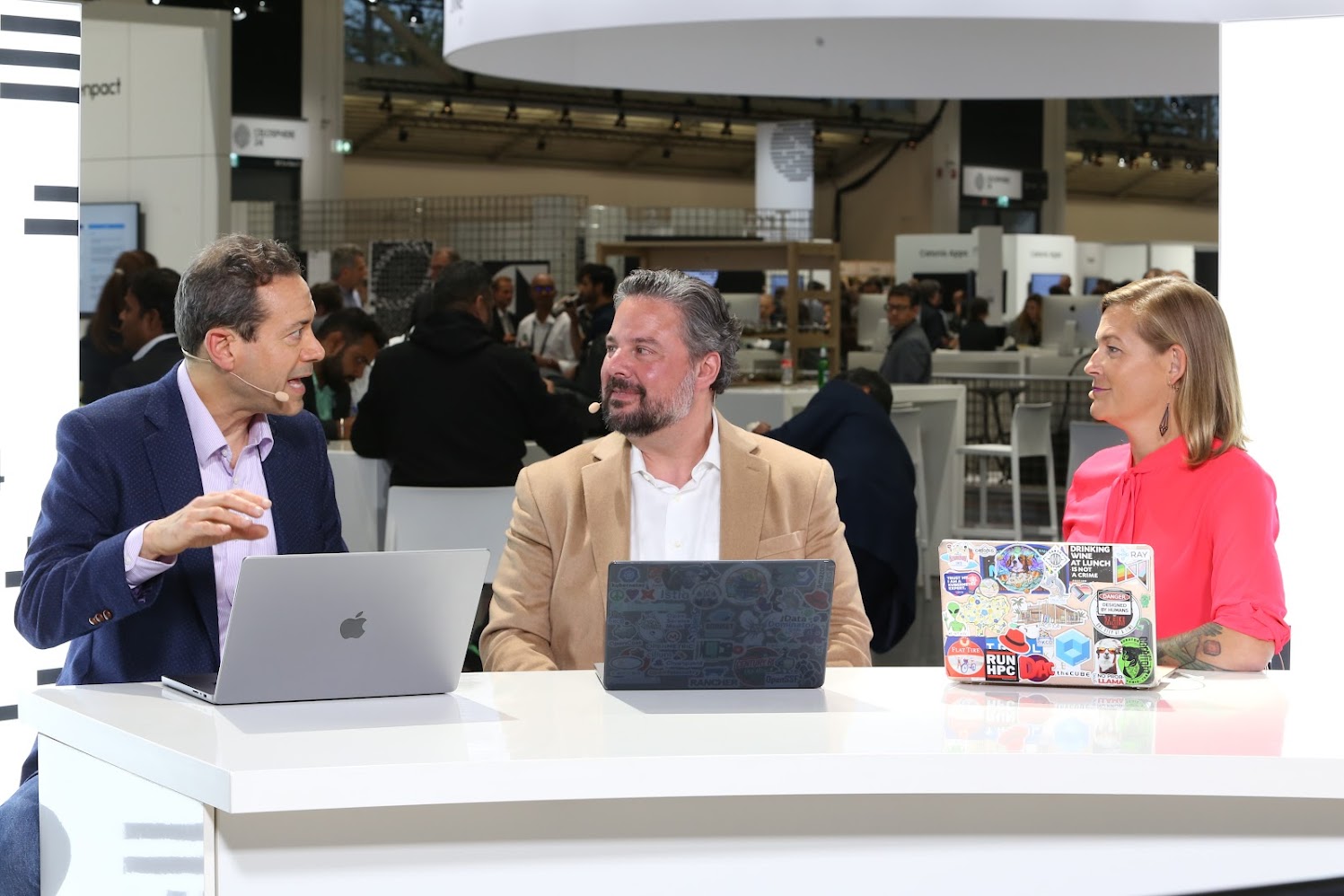
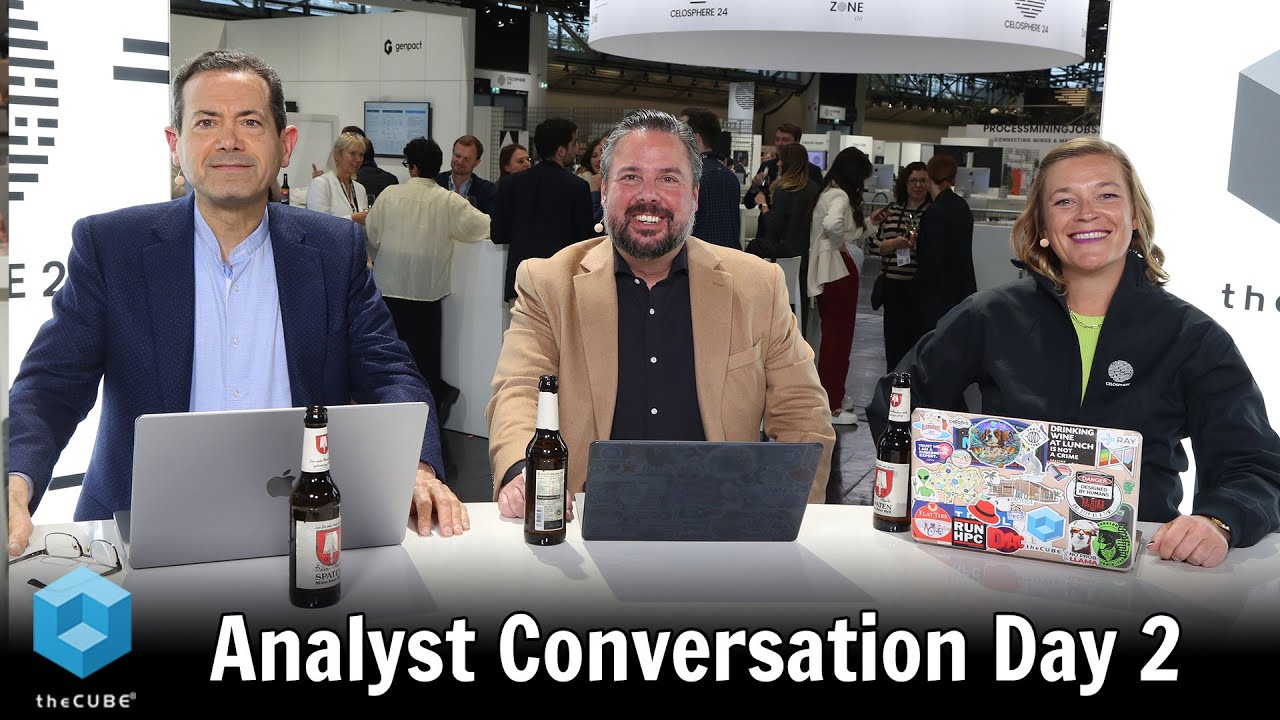
>> Good evening process optimizers, and welcome back to Celonis Celosphere. My name's Savannah Peterson, reporting in Munich, Germany alongside Rob Strechay and our favorite analyst to have on the show, as someone's who's been in this process mining and business optimization space for a long time, George, thanks for coming to join us this evening. >> My pleasure, always fun to join.
Savannah Peterson
>> Yeah. So, when you sat down, and I just want to capture on your excitement, the first thing you said was, "I've learned so much." So, give us an overview, some of the highlights of what you've picked up over the last two days being here.>> All right, so if I had to distill it down to one line, I'd say, like I was telling you guys earlier, this feels like when SKT was taking off in the US in the early 90s. There the dream was we are going to standardize wall to wall on one application so you can see everything that's going on in the enterprise. We all know that didn't happen, and actually really it was just a continuation of 50 years of building islands of automation in analytic data silos.
Now, the Celonis value proposition is that we can build a single source of truth across these islands of automation and data, and then create a map of the business as it's currently running, and then analyze how to transform that into a more ideal state. That is a very high value business proposition. And it's very different from 15 years of packaged software where you're forced to fit a business, a departmental function into a how the package runs. This is very different. And there's one other high level takeaway. So, everyone in the entire tech industry and beyond know that there's been this stampede into AI, and we've funded tens of billions of dollars between VCs and big tech, bordering, closing in on hundreds of billions worth of data center development. And I've got a sort of a man bites dog moment, which is that the real value isn't in the frontier models, or even the specialized models, it's in this harmonized source of truth that tells you how the business is running.
The agents are like the little machine tools, and then the source of truth is like your digital factoring. And this is much more valuable. And there's only a few companies doing this, and Celonis is emerging. And so, I think you're going to see a lot of focus on Celonis in the years going forward.
Rob Strechay
>> Yeah, I think one of the things, just picking up off of what you said, was again, because we've talked about this a lot, is that there are not just... There's silos of AI going on, and silos of the data underneath AI, and I think Celonis' message about being able to go across that, I don't care if it's in Databricks, in Snowflake, in SAP, in Salesforce CRM, or even in supply chain management, in your PMM software layer, they'll bring it all in to be able to harmonize that. I think one of the things is how much of it goes in and how much of it stays out, and what is needed, just some optimizations to be there, but the big thing, I think to what you were getting at, is they know the process of what the agent needs to do. And I think for me that was always missing when we're having these agent conversations.>> The agents that most companies are shipping are reinforcing those islands of automation, islands of analytics. They're not changing that. And so, basically there's the biblical Tower of Babel and Celonis is demolishing that and turning it into a parking lot. So, that it's just all harmonized. And so, where we had ERP, CRM, HCM, procurement, supply chain, they're putting a layer over that, the end-to-end process map. And you're doing something else too. For 60 years we've been dealing with data at the level of streams, like bits and bites. They're up-leveling it to things. We've talked about this on theCUBE before. But you can't see it until you go look into their tools, to up-level strings to things you really are changing the focus from rows and columns and tables in a SQL database to essentially a graph that deals with processes over time. And there are precious few application or tool vendors out there that have that whole platform and the application building environment on top of it. And so, I'm talking tech level stuff right now, but-
Savannah Peterson
>> I think you're doing a great job actually, though, of summarizing the ecosystem and the advantage of the ecosystem that they were talking about. Process intelligence graph is obviously very core to that. But to your point, and I just have to point out you are absolutely smashing the analogy game, from stampede to harmonizing things to the parking lot.
Rob Strechay
>> To parking lot.
Savannah Peterson
>> I know, you're really covering all the bases here. But the way that I've thought about it a lot, with a background of supply chain, is in the old days supply chain was like a game of telephone. One person picks up the phone, says something to the other guy, "Here, I'm passing this thing along, here you go." And if something's been done improperly or if there's a risk somewhere down the chain, it ends up actually having quite a waterfall effect moving down the line and that could impact productivity, margin, profit, a whole bunch of things, morale. There's a lot of different layers there. And what's really interesting about Celonis, and what I've been picking up here, to your point, is not only are they eliminating that game of telephone, they're harmonizing it like a choir. But now the choir, or everyone participating in that harmony, is all speaking the same language. And that is the big difference. No matter the legacy systems they have, we can all understand the same thing, and that can roll up to the decision makers who are calling the shots.>> You hit the core thing, which is all these agents and all the AI, they're based large language models, but every application speaks its own language and until you have a common language across then, you can't have agents working to communicate and give you visibility. So, in other words, within your own company, but upstream and downstream to your customers, up to your suppliers, where you can say, "I might have a bottleneck or a kink in my process here, how is that going to ripple downstream or ripple upstream?" And so, you're seeing essentially the mapping of processes over greater and greater scope. And since everything is connected by data, you basically now have this data-driven control plane, management gets embodied in software, and the scope and fidelity of your management product, because management now is not just know-how, it's increasingly embedded in a product, the scope and fidelity of your management system is a software product that is limited only by how far you've harmonized in a single language.
Savannah Peterson
>> Exactly. And that's when we start to see the real value. And speaking of value, I think one of the things that's also struck me about this week has been the time to value. Every single one of the wonderful customers that we've had the opportunity from, from NHS to BMW to... They were talking about Pfizer achieving over $300 million of value out of the last three years. And doing this quickly, they're getting agents off the ground in seven weeks, they're seeing impact in 60 days across the organization. That's an order of magnitude, if not two, faster that we've seen with other historic transformations in the digital space, which is why it's so much easier for folks to make the decision to start applying Celonis' toolkit to their ecosystem and expanding that. >> You hit on another key point, which is traditional software was like you put a packaged application in and then you forced it, like with a bulldozer, your business to match the existing processes and data structures in that application. Here you take all your existing applications and analytic data, and then you kind of you mine it to map into whatever structures you want to work on first. And so, it goes in much faster.
Rob Strechay
>> Yeah, we talked about this with the fact that when you're doing the ETL and you're looking at the models and the model ring and stuff of that nature, it's got to be critical to how that process works, and hey, revenue it needs to be the same here as it is over there as over there, between these different processes. What I'm saying is that they have a very metered way of going out, so that you're expanding the model as you go, versus, "Hey, I'm going to force you into a model, and tell you how it is." Now they have best practices and other things around different industries, but it wasn't like that. And to your point on the data stuff, it's, "Hey, we can take data how you can give it to us."
I think what was really interesting was, and I think BMW talked about it, was the fact that getting up and running, one of the keys to them was flexibility, because they had a data link prior to being with Celonis, so they could connect it up pretty easily. Do you see that as one of the keys as well, is that flexibility?>> It's funny, in fact I've got to get you guys a dollar for each time you say something, because you're keying up something I wanted to get to which was-
Savannah Peterson
>> I mean, you're welcome to do that .>> One of the big changes, going back to the theme of 50 years of tables and rows and columns, bits and bites, the process intelligence graph is basically a way of saying people, places, things and activities in the real world, but it had implications. Because let's say if you want to build an app that works with SAP data, you have to navigate 50,000 tables with three letter, German acronyms, whereas in the process intelligence graph then a citizen developer can take essentially from a visual gallery these elements and build what's not just a dashboard, but it can have action buttons that then operationalize the decisions that pushed back into SAP, or PeopleSoft, or Oracle or whatever. It's a profound change. Because we've been dealing with analytic artifacts, like just -only dashboards. Now people build these little applications that do stuff, like reprioritize orders or unblock orders that have been held up for credit. It's a complete change because now app development moves that into the business.
Savannah Peterson
>> I think that's a really good point. We were having that conversation with Patrick just a few minutes ago, at BMW 30 different plants across the world, everything from optimizing the folks who design the paint for the vehicles, to the manufacturing line, to how they're rolling things out to the customer and benefiting them with the end game. These are very different challenges, and yet Celonis' toolkit can come in and help tie them all together. It's a really interesting bundle. George, I'm curious, since you've had a different vantage point than Rob and I have had here sitting on the desk, what are some of the use cases and examples that you've seen or conversations you've had that really struck you the last few days?>> Well, the biggest thing is when you up-level from strings to things, you move application development, just as you're describing, out into the people, the domain experts. Today, you build applications or you team it up with people who are data engineers, data analysts, you have a whole lot of technical folks, and it's bottlenecked on a sort of central application development function, and a data engineering function. That's the bottleneck. But when especially that is leveled up so that it's real world stuff, then you're not bottlenecked, and you basically now have a application development toolkit. It's almost like when we took spreadsheets and allowed people to build financial models without going to some central IT group that only had a few people able to do it. Then financial modeling became something everyone could do. And the key is it's that process intelligence graph and the knowledge layer that you put on it now essentially empowers everyone else to build apps.
Savannah Peterson
>> Absolutely. One other thing you mentioned, real world applications, one of the most real world things that we see all across the scope floor is the emphasis on sustainability. >> Yeah.
Savannah Peterson
>> Sustainability within business, sustainability within AI, but most importantly sustainability for our planet, "The earth is our future." is one of their four values at Celonis. How does the language around that and the conversation around that this week compare to other events and areas that you personally cover?>> That's actually interesting. I think partly that it's in Europe, where they're more-
Savannah Peterson
>> That's a great observation.... >> they're more conscious about that. We, and I include myself, we Americans often drive big, gas-guzzling SUVs, and I'm told this has to be my last one, so I'm going to hang onto it for a while. And in Europe they don't use dryers, not because they're poor and don't have them, but because they save energy. But so, yes, so when you build these applications you have essentially a spree of metrics that measures how your business runs, and you can set these at dials as these are my constraints. It's like in a power plant, all the dials, and a critical one here is carbon footprint. So, we are more conscious of it here than back in the States.
Rob Strechay
>> And just adding on to that, and my thought on that was, and having an off-camera discussion about it, was the fact that there are also data points, then third party data flows that can be flowed into the process to then help. And we've had that discussion around how you can use some of the ranking of companies, and that can be put into your process about your sustainability rankings when you're actually building your supply chain, for instance. And you can do that in a way.>> Yes, so it's not just on-time performance, but it's carbon footprint, and then you can rank, you can make those decisions automated. All those are just descriptive attributes of resources that you're optimizing.
Savannah Peterson
>> Yeah, I think that's a really good point. Janina and Peter who we interviewed this afternoon both brought up different but complementary aspects of that puzzle. I do think you're right that it's about Europe. I think the AI and ESG is a hot conversation around the world right now, but yes, to your point, they're much more energy conscious here. I think they're a bit more fashion conscious, to our earlier point.
Rob Strechay
>> that's true.
Savannah Peterson
>> Which is a lot of fun. And even, I enjoy that Janina pointed out that the venue that we're in here actually has a real goal towards sustainability and they were willing to partner with Celonis to say, "This is our impact." And all them to calculate the true impact of an event like this. I can say personally I'm very grateful that I took the train from Amsterdam instead of taking a plane on this particular trip, because I realized the train ride I believe over there versus a plane ride, just from Paris to Munich, 10X the carbon impact if you're in an aircraft versus on a train. I wish the United States would also take a note out of their public transportation book and give us some more high speed rail in the United States.>> We are... Quick digressment, in the US going to feel our disregard for sustainability goals in property insurance that-
Savannah Peterson
>> I think we already are. >> Yeah.
Savannah Peterson
>> Lots of Californians can't get insured right now as we know, and same thing in hurricane country and everywhere else.>> One last thing I want to mention is as we go from this application model that was primarily pricing, even though we went from perpetual to subscription, it was often the center of gravity was based, and this consumption pricing on the data platforms. Now we're going to shift to something much closer to value-based pricing, where you're getting closer to the economic outcome of the customer. That's a profound change. And as we move from infrastructure focused to real world things focused, you're getting closer to the impact that you're going to have on the customer. Ultimately you're going to get embedded in their cost of goods sold, to some extent, and in their operating expenses.
Savannah Peterson
>> I think that's a really excellent point, like everything else you said. Last question for you gentlemen, we've learned a lot the last few days, we've heard some really interesting stories. We have one more very full day left tomorrow. What are you most excited about in the next 24 hours? George, I'll start with you.>> Most excited in the next 24... I want to see more about the development tools that they've building, because everything we've seen in the data platform space it's a very rich ecosystem, but it's still plumbing, it to plumbing its tables in rows and columns, and so the tooling here is less mature, but it is so much higher level and richer. I want to explore that.
Savannah Peterson
>> I think that's a great call. What about you, Rob?
Rob Strechay
>> I think I want to continue to poke at the how things come together actually from the cost, and how you're paying for it, and how we talked to some of the customers about how they saw ROI because they were able to reduce a lot outside of the infrastructure. So, that has to have a multiplier effect, which is I love unpacking that, to understand, okay, this is the multiplier effect, you're paying for this, you may have a little more double-data, but this is why you're doing it, because you're saving over here.
Savannah Peterson
>> I'm also curious about that. Frankly, just speaking quite literally I'm very curious to see who wins their first ever Hackathon tomorrow afternoon. Janina was telling us the teams had five hours yesterday, or, yeah, I believe it was yesterday, and they actually achieved MVP working solutions in just that short amount of time. So, I can't wait to learn about the finalists, I can't wait to see who wins, and I can't wait to continue to bring all of you, wherever you might be on this beautiful rock, our power-packed coverage at Celonis Celosphere in Munich, Germany. My name's Savannah Peterson, you're watching theCUBE, your leading source for enterprise tech news.