We just sent you a verification email. Please verify your account to gain access to
Celosphere 2024. If you don’t think you received an email check your
spam folder.
In order to sign in, enter the email address you used to registered for the event. Once completed, you will receive an email with a verification link. Open this link to automatically sign into the site.
Register For Celosphere 2024
Please fill out the information below. You will recieve an email with a verification link confirming your registration. Click the link to automatically sign into the site.
You’re almost there!
We just sent you a verification email. Please click the verification button in the email. Once your email address is verified, you will have full access to all event content for Celosphere 2024.
I want my badge and interests to be visible to all attendees.
Checking this box will display your presense on the attendees list, view your profile and allow other attendees to contact you via 1-1 chat. Read the Privacy Policy. At any time, you can choose to disable this preference.
Select your Interests!
add
Upload your photo
Uploading..
OR
Connect via Twitter
Connect via Linkedin
EDIT PASSWORD
Share
Forgot Password
Almost there!
We just sent you a verification email. Please verify your account to gain access to
Celosphere 2024. If you don’t think you received an email check your
spam folder.
In order to sign in, enter the email address you used to registered for the event. Once completed, you will receive an email with a verification link. Open this link to automatically sign into the site.
Sign in to gain access to Celosphere 2024
Please sign in with LinkedIn to continue to Celosphere 2024. Signing in with LinkedIn ensures a professional environment.
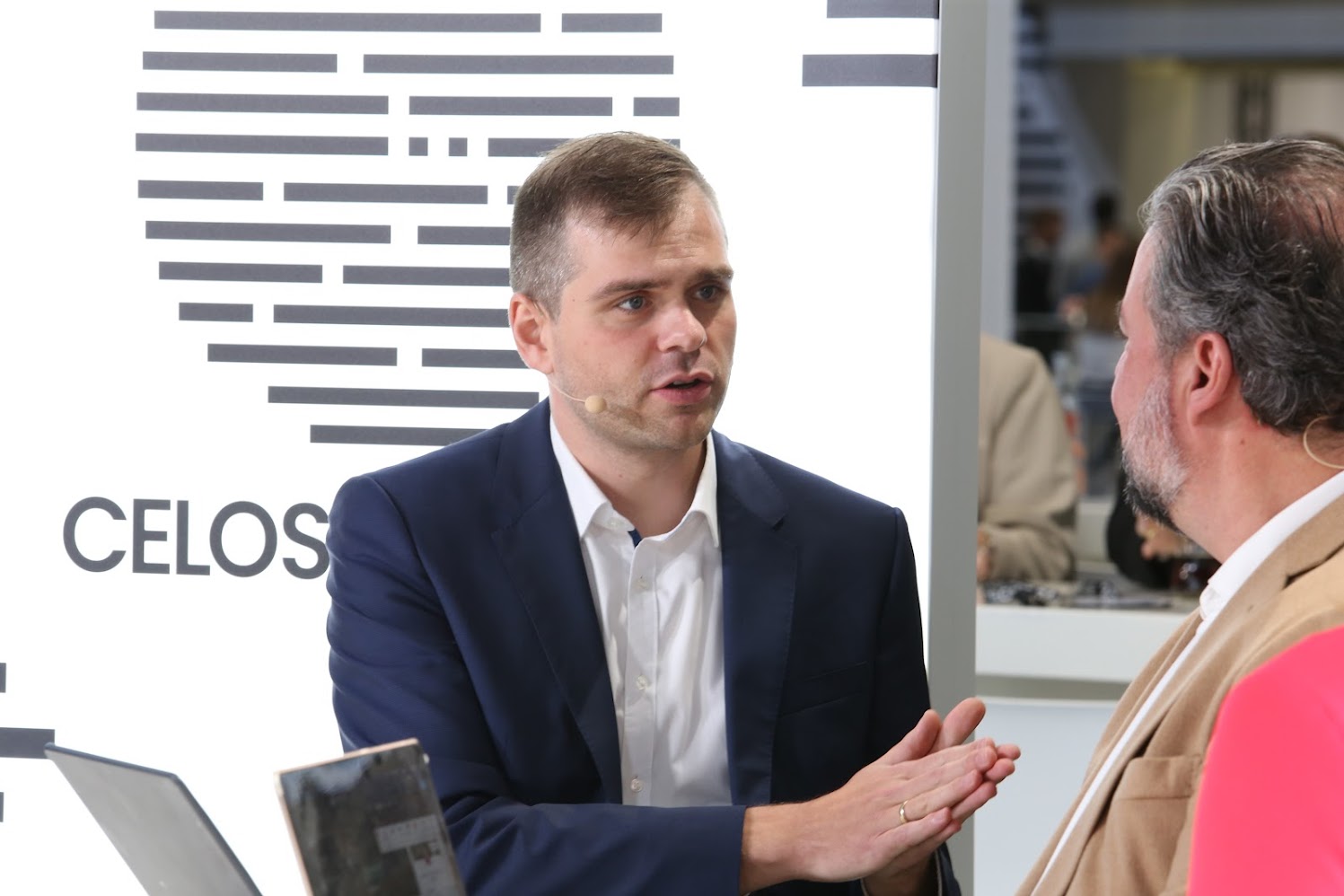
Supply chain expert, Peter, discusses the developments at Celonis for applying process intelligence holistically across the supply chain and using AI for decision making and improving efficiency. Collaboration and data exchange are key for optimizing supply chains, with trends showing more companies embracing better visibility and sustainability initiatives. Success stories include reducing costs and emissions by switching to more sustainable transportation methods. Peter hopes to see more trade-off decisions for sustainability and better application of AI fo...Read more
exploreKeep Exploring
What are the key factors that make process intelligence important in enabling better decision making and improving supply chain operations?add
What are some key considerations for companies looking to optimize their supply chain processes and collaborate with suppliers and customers?add
What are some examples of win-win situations in supply chain and sustainability for manufacturing companies?add
What are two areas of focus for the speaker in terms of sustainability and AI application for decision making?add
>> Good afternoon, supply chain superstars, and welcome back to Munich, Germany. We're here at Celonis Celosphere. I'm Savannah Peterson, joined with Rob Streche today. I'm feeling more efficient than I ever thought I could. How about you?>> I think our process and even in between segments are becoming more efficient as the day goes along.
Savannah Peterson
>> Yeah, I would agree with that. We're saving more and more time. Speaking of saving time and doing things efficiently, I'm very excited to welcome Peter, the GM of supply chain here at Celonis. Peter, thank you so much for taking time in what is undoubtedly a very busy week for you.
Peter Budweiser
>> Yeah, thanks a lot for having me. Yeah.
Savannah Peterson
>> So you've been at Celonis for a while now, almost seven years. You are in charge of one of the most important, if not the most important divisions of the team, supply chain. There are some really exciting announcements going on right now with supply chain and AI and how that fits into the ecosystem. Give us an overview.
Peter Budweiser
>> Yeah, so I think the most important part personally is that with the developments that we have over the last year and also the last month, we really tap into this position of where we can apply process intelligence holistically across the supply chain and essentially enable you to use that intelligence for our decision making, taking actions using AI and to essentially improve fundamentally the way you work in supply chain, right? And I think this is what excites me a lot. There's really a new way of working after that we facilitate and support. And a lot of the product announcements around AI, data, about how far we can go also in covering in the supply chain context, super exciting in terms of obviously looking forward to also see what we are going to work on the next couple of years as well.>> So I think one of the things ExxonMobil talked about, and I think that was in Bolivia or Peru. I can't remember where they were, but it was far-flung, as they called a frontier location. They were looking at how they optimized their supply chain so they wouldn't have down time, because obviously having been in oil and gas myself, down time of any of those facilities costs lots of money. Some people may think of supply chain as just getting a good from here to there. How do you see supply chain?
Peter Budweiser
>> So generally speaking, when we at Celonis talk about entering supply chain, a lot of people are talking about entering supply chains. We are starting from the perspective of that particular company, which means anything that you do in order to procure goods for your production or for your distribution, your traditional production manufacturing cost of the inbound logistics management, order management. All this is what we are generally speaking when we think of supply chain. Obviously there's more to that, right? If you think about a company, it's not only what they do, but there is typically a supply chain that happens before and after. That's something that we're slowly looking at. We had this announcement of the network, so we really are facilitating the data exchange. I would say the definition is more or less what happens in the four walls of the company, and we are kind of slowly pushing the boundaries to say we want to see more of what's happening outside that. Exactly.>> Yeah, we talked to Daviya about that earlier today and I just led to the fact that it's a network who's more than just another portal and in that data. It looks like it's helping organizations map their processes, and it's even more than what we used to call EDI and things like it. Are you seeing organizations really embracing that to optimize that supply chain?
Peter Budweiser
>> Yeah. I think very, very interesting part about supply, now we're getting a little bit more conceptual, is that in the end, it could almost be different organizations being an arbitrary structure of your whole supply chain. So you're creating data silos just as much as you're creating silos within the organization with the different functions. And then I think the appetite to optimize also processes across different companies is very large. But it's also a little bit dependent on what kind of industry you are in, right? So what is the typical collaboration with your suppliers, with your customers? In automotive for example, that integration is very, very tight, so it's more natural to say, "Okay, I actually want to also work with my suppliers, with my customers to optimize how we're doing." Because in the end, these benefits should be there for everybody, not only for one particular company. So I would say there's a lot of appetite, not only exchanging information, but also working on collaborations. Some industries naturally are a little bit more advanced than others.
Savannah Peterson
>> I'm curious because I come from a supply chain and manufacturing background. I've been looking forward to talking to you all day, which is awesome. There are so many junctures and opportunities for process improvement or process failure across the spectrum, also in terms of morale for the people involved in those processes both internally as well as the end customer, say procuring your good or whatever that might be or ordering a car. I'm wondering, because we get to see it all across a bunch of different verticals, are there any trends and common discoveries that you find when you start doing an MVP or a POC with a company, or is it very different depending on the company?
Peter Budweiser
>> I think it depends very much on the company because your supply chain is also in the end, on the one hand, just based on what kinds of products you eventually produce and ship, but it's also based on how you structure your organization. An inefficiency in an interface that you want to optimize in one company might be nonexistent almost because of a better organizational alignment. But what we typically see is that there's a journey also to get to the collaborating, because reality is there is these different functions. They also acknowledge they work in silos. They're not necessarily collaborating where they could. I think the common pattern that we see is that we start in one particular function that has a particular issue. Then as soon as that function, but also the adjacent ones see, okay, there's something that we could do about this. There's also a technology that can support us there. Then likely, appetite gets better. Then typically, customers start coming to know where the issues are. So that's a pattern that we're seeing, that as soon as they start giving everybody an understanding also how to apply this, I would say fairly new technology, as soon as you have these changes that make a lot of sense in their context, then they start to kind of evolve and then just your typically interfaces. You have procurement and inventory management that naturally have say competing priorities. You have generally speaking, inventory is competing with a lot of different priorities when you think about on time delivery and so on, so forth. So these are the very interesting ones. These are the ones that typically only your C level cares about. So the interesting part will be how do we break this down, enable the collaboration to make these kind of decisions also at a lower level.>> I would expect again we had the chip shortage a few years back. But supply chains have been more screwed up all during the pandemic.
Savannah Peterson
>> So everyone all of a sudden started to care about supply chain from every sense of the consumer side too.>> I think one of the interesting things is, have you seen organizations really looking for better visibility because of that and trying to look at, hey, how diverse am I in my supply chain? And is that one of the big use cases?
Peter Budweiser
>> 100%, and coming back to the previous one, there's also one of the situations where a lot of companies started to collaborate across functions. Because when you're out of a raw material, traditionally this was a procurement issue. But now, you needed to understand, what do I need this raw material for? What components do I produce from it? Who are the customers that are affected if I cannot deliver? So from that perspective, it was very interesting because collaboration was necessary to understand it. But that's also where a lot of appetite now came from, okay, we need to have a system or process in place of how we can deal with this more effectively going forward, right? Right now, we're in a phase where some companies are going a little bit back. It's not so bad anymore, but I think the general notion of I need to first get an understanding for what is happening, what are issues? What are issues that I also urgently need to respond to? That's definitely a theme, and it has been a theme for a lot of years already in supply chain, right? You know that yourself, but I think we're now really at a time where we can put this in practice and really provide people with solutions to do this a lot more effectively than they did in the past.
Savannah Peterson
>> You mentioned that collaboration, and I say this lovingly with venerable experience, is there's a lot of silos or historically has been a lot of silos. I take care of my portion of the puzzle. I move it along down, down through the supply chain or put it on the conveyor belt, literally sometimes. How have you found the reception is when teams are implementing Celonis at scale and we've been collaborating in this centralized, fast moving form factor?
Peter Budweiser
>> I think the big difference is better off building up on the visibility aspect. It brings down the discussion to database, essentially. Previously, people were not sure about what is the accepted rate and what is the status. Where is the process right now? Now it's a database discussion to say, "This is the situation. This is what the data says." And everybody might be aware, in order to improve, in order to resolve the situation, it might be tougher on some than on others. But everybody knows this is the situation now that we have the discussion not on what's the situation, but what do we do about about it? I think this is a big enabler. It also comes with a lot of change in how you collaborate and so on and so forth. But I think fundamentally really, this is one of the big advantages of putting this all together, bringing everyone to one single source of proof, one common ground both horizontally, but also vertically, right? Your top level executives, they're essentially looking at the same KPIs obviously aggregated from the ones that you have below. But everybody can make the systems in line with what the others are doing.>> Yeah.
Savannah Peterson
>> Oh, go for it, Rob.>> So I think just building off of what Savannah asked, I think one of the things that also has to be attractive to organizations that are looking at their supply chain is the fact that things like Celocore which was just announced and things like being able to take data from Databricks or Snowflake or your ERP systems, it doesn't matter. The ETL can happen. That has to be a key to getting people to talk together.
Peter Budweiser
>> Absolutely. There are so many systems involved in supply chains. I just came out of a customer conversation, very interesting supply chain where they have multiple systems, right? It's not only supply chain in the end, right? If you're producing new goods, you have your PLM systems. You have your engineering, your engineering change management processes, which then in turn has an effect on what you're procuring and so on and so forth. So that's a big advantage, and if you just look at supply chain and such, you have ERP, TMS, WMS, and I think what's a very interesting also trend that I think will become more and more important going forward is there's a lot of other systems that add data that does not reside in your system. We talked about end to end visibility, right? Right now, end to end visibility is more or less limited also by the data that you have available. But there's a few developments already that are happening. There's trade visibility which there's a big growth. I want to understand not only when did I put something on a ship, but where is the ship right now? Is it affected by the Suez Canal blockage? Yes or no? Second big topic, sustainability, right? Most companies don't know about CO2 footprint, emissions, so they need to bring in the data from partners that can provide that data to them. Then there's from my perspective a third big category which is risk. If you think about geopolitical risk of your suppliers, financial risk, risk associated to diseases, politics, whatever, that's three different areas that also in addition to all the systems that you're using yourself, I think provide very, very relevant context to expand that understanding of what's going to happen, and what do I need to respond to?
Savannah Peterson
>> So many different X factors, like you just talked about. I want to dive in a little bit to something that you just said that I've been very refreshed by at this show, quite frankly, is the emphasis on sustainability. The Earth is the future. There's so you can tell there's a whole push on the branding to raise awareness across industries and verticals about how to be more sustainable, which first of all, I just think is great as a human of the planet, let alone in supply chain. Can you give us some customer examples of wins you've seen in the sustainability category to get the audience's minds buzzing on the size of impact they could see as well?
Peter Budweiser
>> Yeah, so I think supply chain and sustainability, for many manufacturing companies, they go hand in hand, because in the end, what you manufacture is probably 90% or related to 90% company. So I think the cases where we see a lot of traction and a lot of success with existing customers to essentially relate to these areas where there's typically a win-win situation. What do I mean by that? If we think about shipping emissions, transportation, and logistics as an area which obviously has, I would say, substantial contribution to the CO2 footprint of a company, this is typically the area where you have a win-win situation. That's also where we see a lot of traction and success and cases that we can really also roll out across multiple customers. Because in this area, if you can change from air freight to sea freight or to rail without jeopardizing any on time delivery or anything, you both save on cost and you save on CO2, so win-win. And this is an area, if you can convince both on the cost and on the emission side, that's typically a win for everybody. Can we roll out very easily? Which is also important when we talk about sustainability. It's not sufficient if one company has a great use case, but a lot of companies in the end need to act in order to have a significant improvement there.
Savannah Peterson
>> And you have the ability to learn from all of the different companies that you work with to spread that good across other verticals.
Peter Budweiser
>> Exactly.
Savannah Peterson
>> The nice thing about sustainability is when we're competitive around sustainability, everybody wins, which is a lot. In theory, the customer usually wins in this situation.>> And the reporting aspect of it as well, it's not NSBC and others are looking into this, EU definitely, and that's three aspects of it that is a big piece as well.
Peter Budweiser
>> And that's second area, right? I know that you can debate whether you like all the regulations and so on and so forth, but the regulations right now, they create more of these win-win situations in certain area, right? If we look at material emissions, so emissions related to the materials that you're procuring, even that is a topic for many of our customers. Yes, it's an additional effort right now, but from a pure sustainability perspective, it creates this win-win situation. Because customers now need to consider where they buy it from and are considering to go for cheaper or more sustainable options to also adhere to the regulations. So that's another case that we have a lot of customers being interested, forced to be interested, kind of. So I think this is super interesting. Yeah.
Savannah Peterson
>> It is super interesting. All right, given that you've been around and seen the evolution of the supply chain team and a lot of things happen at Celonis, you're clearly a start on the team. So we'll definitely have you back on the show when we're here next year. What do you hope to be able to say when we sit down next time? It could be about the AI announcements today or anything else that you're seeing get adopted now. So what do you hope to be able to say then that you can't yet today?
Peter Budweiser
>> For me personally, two areas. We talked about sustainability. I would like to see more cases where you actually need to make a trade-off decisions where going for the more sustainable option is maybe not the best when it comes to cost. So to also see some cases where we have customers willing and making the trade-off and seeing an operating that's safe. We can support it, providing you with the context and providing you with the trade-off information, but that's one thing that I would be super interested in. The other thing that I think is extremely interesting right now, everybody talks about AI, knows about AI. What I would be very, very happy to talk about next year is how we can specifically apply it and really improve the way we make decisions. Because in the end, I think the ultimate goal of a lot of what gen AI is related to is to use the reasoning capabilities to also ... I don't want to say replace humans, but at least take some decisions that humans might not even have the capacity to take, right? There's a lot of that. There's also an aging population in many of the Western World, so there is also a need to become more efficient, overall speaking. So that's the second area, to get more hands on cases, to scale this better, and to really also not only make better decisions, but also automate the decision making and make it efficient.
Savannah Peterson
>> I love it, Peter. Well, I look forward to talking about better and more automated decision making, sustainability, and all the other magic that you're doing over there on the supply chain team next year. Thanks for taking the time to hang out with us.
Peter Budweiser
>> Thanks a lot. Thanks for having me.
Savannah Peterson
>> And thank you, Rob. I know we both were pretty pumped for this segment.>> Absolutely.
Savannah Peterson
>> And thank all of you for tuning in to what has been an inspiring and educational day here at Celonis Celosphere in Munich, Germany. My name's Savannah Peterson. You're watching TheCUBE, the leading source for enterprise tech news.