Exploring the Realities of Agentic AI at AWS re:Invent 2025
Jason Ballard of Toyota North America, Chris Jangareddy of Deloitte, and Rima Olinger of Amazon Quick Suite AWS explore the transformative potential of agentic artificial intelligence at AWS re:Invent 2025. The discussion, hosted by theCUBE Research, offers insights into integrating AI into various business processes, with a focus on agentic AI in organizational settings.
In the video, Ballard shares Toyota's strategic pursuit of AI integration to revolutionize its operations. They highlight the company’s emphasis on agentic AI's capacity to streamline supply chains and enhance customer experiences. Olinger provides insights into the evolution of AI, from traditional models to advanced agentic frameworks, and discusses how AWS facilitates this transformation. Jangareddy explores Deloitte’s methodologies to ensure seamless secure adoption of agentic AI solutions across industries.
Key takeaways from the conversation include the strategic alignment between AWS, Deloitte, and Toyota in employing agentic AI to achieve efficiency gains and business transformations. According to Ballard, Toyota aims to use AI to elevate both customer satisfaction and employee productivity. Meanwhile, Jangareddy emphasizes Deloitte's foundational partnership with AWS in crafting industry-specific AI solutions, which are continually tested and refined to deliver substantial return on investment.
Forgot Password
Almost there!
We just sent you a verification email. Please verify your account to gain access to
AWS re:Invent 2025. If you don’t think you received an email check your
spam folder.
In order to sign in, enter the email address you used to registered for the event. Once completed, you will receive an email with a verification link. Open the link to automatically sign into the site.
Register for AWS re:Invent 2025
Please fill out the information below. You will receive an email with a verification link confirming your registration. Click the link to automatically sign into the site.
You’re almost there!
We just sent you a verification email. Please click the verification button in the email. Once your email address is verified, you will have full access to all event content for AWS re:Invent 2025.
I want my badge and interests to be visible to all attendees.
Checking this box will display your presense on the attendees list, view your profile and allow other attendees to contact you via 1-1 chat. Read the Privacy Policy. At any time, you can choose to disable this preference.
Select your Interests!
add
Upload your photo
Uploading..
OR
Connect via Twitter
Connect via Linkedin
EDIT PASSWORD
Share
Forgot Password
Almost there!
We just sent you a verification email. Please verify your account to gain access to
AWS re:Invent 2025. If you don’t think you received an email check your
spam folder.
In order to sign in, enter the email address you used to registered for the event. Once completed, you will receive an email with a verification link. Open the link to automatically sign into the site.
Sign in to gain access to AWS re:Invent 2025
Please sign in with LinkedIn to continue to AWS re:Invent 2025. Signing in with LinkedIn ensures a professional environment.
Are you sure you want to remove access rights for this user?
Details
Manage Access
email address
Community Invitation
Jason Ballard, Chris Jangareddy & Rima Olinger
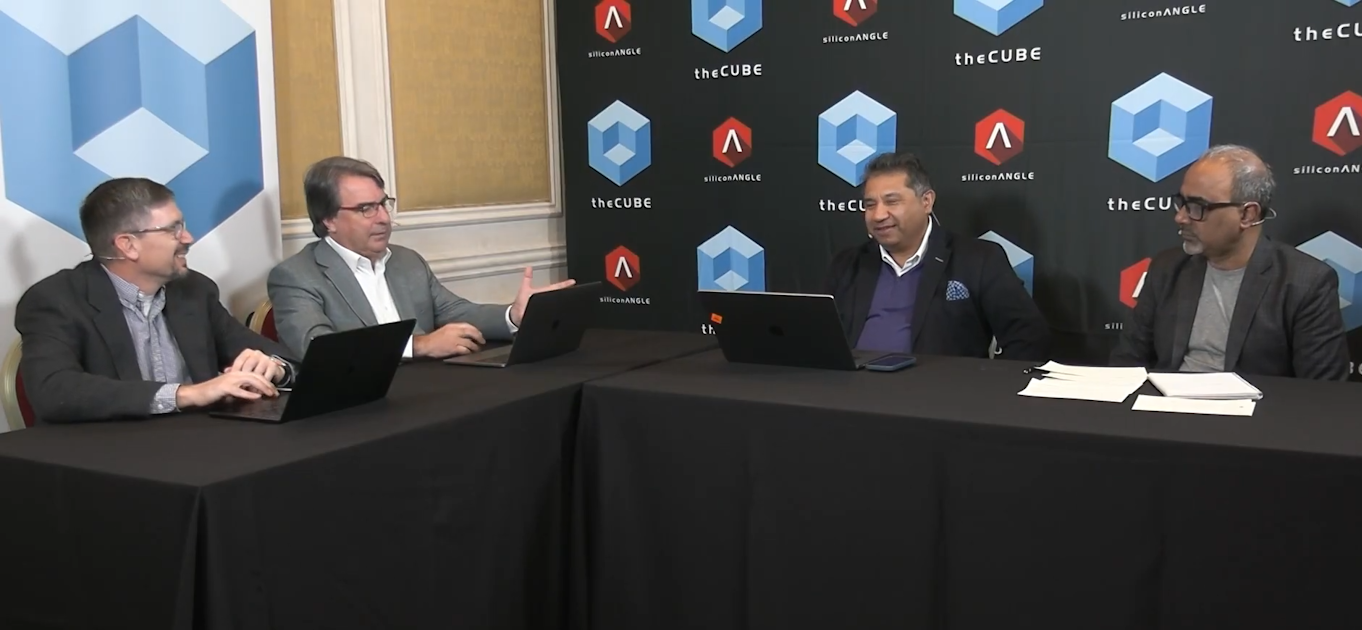
In this keynote analysis from AWS re:Invent 2025, theCUBE’s John Furrier joins analysts Paul Nashawaty, Zeus Kerravala and Sarbjeet Johal to unpack how Amazon is redefining cloud infrastructure through the lens of agentic AI. The panel breaks down Matt Garman’s declaration that "agents are the new cloud," exploring key announcements surrounding the Nova model family, AgentCore and Amazon Bedrock. The discussion highlights AWS’ strategic pivot from merely abstracting infrastructure complexity to abstracting work itself, effectively bridging the gap between professional coders and "citizen developers" while unifying the experience for builders at every level.
The conversation digs deeper into the practical realities of enterprise AI adoption, emphasizing the critical role of security, governance and compliance in moving from proof-of-concept to production. Kerravala, Johal and Nashawaty analyze AWS’ vertically integrated approach – spanning from custom silicon like Trainium and Inferentia to the application layer – and how this full-stack strategy allows customers to train models on proprietary data with improved price-performance. The group also debates the evolving competitive landscape, noting how AWS is equipping organizations to build autonomous, long-running agents that function as teammates rather than just tools.
Vice President of Digital InnovationsToyota North America
Rima Olinger
Director, Amazon Quick SuiteAWS
Chris Jangareddy
Managing Director/PartnerDeloitte
Rob Strechay
Dir./Principal Analyst & HosttheCUBE Research
HOST
In this interview during theCUBE's coverage of AWS re:Invent, Jason Ballard from Toyota Motor North America, Chris Jangareddy from Deloitte, and Rima Olinger from AWS join theCUBE’s Rob Strechay to unpack the practical realities of agentic AI. The discussion centers on the shift from generative AI's content creation to agentic AI's ability to plan, reason and execute autonomous tasks to solve complex business problems. The panel details how their strategic collaboration is revolutionizing Toyota’s supply chain operations, moving from traditional reactive mana...Read more
exploreKeep Exploring
What is agentic AI and how does it function within a system?add
What challenges are customers facing when adopting agentic AI, and how do Deloitte and AWS address these challenges?add
What advancements have been made in AI technologies and how are they integrated with AWS to support customer testing and scaling?add
What role do partners like Deloitte play in enhancing customer success and experience when collaborating with AWS?add
What were the outcomes observed from Toyota's supply chain transformation journey?add
>> Hello and welcome to AWS re:Invent 2025 live from Las Vegas. So excited to be here. I'm Rob Strechay. And one of the main topics that everybody is talking about this week and really going into is agentic AI and what does it mean? What's the ROI? How do you architect it? And most importantly, how do you avoid the challenges of what's going on? So a lot of people are looking at agentic AI and there's a lot of confusion around it. We kind of look at it as a system that can leverage other task-oriented agents or AIs. It could be AI, it could be analytics, it could be a number of different things. And these methods are used to then accomplish a bigger goal, not just one task. An example could be something like looking up a service record for a vehicle and comparing it to a knowledge base and a recall knowledge base, and then identifying routine maintenance that is required and then going into a scheduler where then it reaches out and texts out to the customer, it has an exchange with that customer and comes back to give that customer a much better customer experience. I think that one of the biggest things that we'll see is how agentic AI really becomes a helper in these organizations, not a replacement for people. And it's really about a better experience for customers. But rather than me continuing to babble on about this, let's bring in some experts who can really help me understand this. We have Rima Olinger, who's the director of Amazon Quick Suite, AWS. Thank you for coming on, Rima.>> Sure.
Rob Strechay
>> And we have Chris Jangareddy, who's the managing director/partner at Deloitte, AI, gen AI, and data engineering. And Jason Ballard, who's the vice president of digital innovations at Toyota Motor North America. Welcome on board, everybody.>> Thank you.
Rob Strechay
>> So I think again, we'll start with you, Rima. From your vantage point, what are the major differences that you see talking to customers about agentic AI and traditional AI? And between agentic AI and gen AI applications in terms of business transformations? Because everybody's looking to really almost rebuild how they do some of these processes this way.>> Sure, Rob. I think if you look at the evolution of AI, you see that it's gone through very distinct phases. With traditional AI, it is basically rules-based. It can execute on predefined parameters, but it cannot reason and it cannot plan beyond what it was programmed. Then you came with generative AI, and generative AI, it constituted a revolution in the way that we write, in the way that we derive analysis from existing data. But the game-changer really was with agentic AI because agentic AI can plan, can reason, can execute autonomous tasks on your behalf. Think of it this way for an example, whereas generative AI can help you draft an email, agentic AI can understand what is your business problem. It can go around different databases and gather information for you. It can schedule meetings and then it can reiterate based on that reasoning and the reiterations of these models. And I think this is a big, big change that we are going through. AWS is making this available for our partners like Deloitte and our customers like Toyota by providing the Bedrock model and the AI tools that makes this reasoning possible, it makes the autonomous actions of optimizing supply chains or automating the customer workflows. So very exciting time for all of us.
Rob Strechay
>> Yeah, I think it is. And I think Chris, at Deloitte you guys have seen this really accelerate, enterprise adoption of agentic AI across different industries. Can you walk us through the methodology that you're using when you partner with AWS and you partner with the customers to really help them get from agentic AI proofs of concept into production?
Chris Jangareddy
>> Absolutely. Across all industries, we are seeing similar challenges that customers are facing. They're looking for a structured and a safe way to adopt agentic AI and scale it securely. This is where the strategic partnership between Deloitte and AWS comes to bear. We have a three-part methodology. One, given our depth and breadth of industry expertise, we look at... we have a business value framework, so we help customers identify those use cases that give you the biggest bang for the buck and give them large business value. Two, we immediately shortlist all those use cases to something that would give a large ROI in less than 6 to 12 weeks, right? Number one. Secondly, given the advancements in agentic AI, gen AI and AI that AWS has to offer, we work pretty closely with AWS and built a multi-agent system accelerator, which tightly integrates with the Bedrock AI and the AWS agent core. Coupled with the AWS Audit Manager, which we helped work with AWS to build 100 controls. So combined the two, we provide that as an environment for customers to safely and securely test their POCs and scale it to production. The third and most important one is measure, right? How do you measure the outcomes? We have a value framework that we use to measure the outcomes, and only those use cases that pass the threshold is what gets moved to production. So those are the three areas that we focus on. Identify the use cases, the architecture infrastructure, and the safe environment, and three, measure and scale the use cases to production.
Rob Strechay
>> I love that because I think that helps people really understand what they're going to get to and like you say, get to production with something that's going to bring ROI. Jason, not to be left out here, you're where the rubber meets the road with Toyota there. So help us understand what your strategic vision is for agentic AI and what will really help transform Toyota's operations and really over the next few years, but also how that aligns with the transformation over the next five years that you're seeing from that kind of journey as well.
Jason Ballard
>> Yeah. First, I would say our transformation, we remain centered on the customer first, and then our team members and then the company. And so like, as Chris alluded, like we're trying to identify those business problems or business opportunities and then apply the right fit-for-purpose technology. So everything we're doing is not all about agentic, but as we're reimagining our operations horizontally across all of Toyota North America, certainly agentic AI is a key integral component on how we see those new reimagined processes come into life. And so when you think about the next few years in our supply chain, we think about opportunities for like self-healing operations. We're already seeing that in some of our data that we're trying to surface and expose augmented decisions for our team members, and then hopefully all parts of the Toyota operations. And then I believe a truly like better connected network supply chain responsiveness, where it's not the supply chain acting in independent parts, but acting as one cohesive end to end operation. And so our transformation, when we set forth a few years back, it's always been to have Toyota become the most admired and trusted supply chain in the world. And at the end it's about our customers. How do we create just some amazing experiences for them? And then at the same time, how do we elevate the work for our team members and have them doing much more higher valued work that the morale is high, they're loving what they're doing, and it just creates a win-win situation for everyone.
Rob Strechay
>> Yeah. Getting rid of that toil and helping them have a better experience as well. Rima, how does the collaboration with partners and AWS like Deloitte and AWS working together really help accelerate these customer successes and customer experiences?
Jason Ballard
>> Yeah. Rob, it's about bringing the best of both worlds, whereas AWS can bring forward the most secure, comprehensive AI platform, you have technology and transformation has to happen with a partner as critical as Deloitte, because transformation does not happen with technology alone. And this is where Deloitte comes in. They have very deep expertise that is tied to industries. They go to market with verticals. They know what are the pain points per customer, per industry, and they are the most qualified to say, "This is the best AI solution for this specific customer problem."
And what we love about this partnership is that it brings speed and scale that adds value to our customers. And the way they do that is they have hundreds of specialized certified AI resources that are dedicated working with the customer and with AWS to bring those solutions to fruition. And what we do is we make sure that there is a joint investment through the concept of the strategic collaboration agreement, SCA, where both companies are investing heavily to build solutions that will accelerate solutions for customers like Toyota. And what we're talking about here is transformation that happens in a matter of weeks instead of months or years. And that's a big change that we're seeing.
Rob Strechay
>> Yeah. I mean, Chris, building off what Rima was talking about there, let's dive in a little bit and understand what agentic AI solutions you're really helping develop for Toyota, how you're helping them with their supply chain operations, and what were the measurable business outcomes that you're seeing?
Chris Jangareddy
>> Absolutely. So when Toyota embarked on this large supply chain transformation journey, it's not a modernization, but it's a transformation journey. So they rewritten the entire supply chain operations from the ground up. We immediately identified there's a need for an ecosystem. I mean, this is a joint effort between Toyota and Deloitte and AWS, where we started building an ecosystem of AI and agentic AI. So there is a platform layer, there's intelligence layer where you build these AI models. There is an agentic foundation layer, and the agentic foundation would allow you to build, deploy, maintain, and monitor agents and multi-agent systems, and then there is an experience layer. So that's the ecosystem that we built, and it allows every business user or every line of service leader to build agents and build ML and AI models in a standard format, in a structured format. So everyone is not reinventing the wheel, but it's already there for... it's a standard that's been set, right? And the guardrails are put in place. So there's a significant improvements that we've seen riding upon this ecosystem where there's 18% improvement in the planner's time, there is a 20% improvement in the forecasting accuracy. And like Jason mentioned, it's a self-healing network. So the response to disruptions is not reactive anymore, it's proactive. So if there is a disruption in the supplier network, there are simulation engines in place which immediately act upon the disruption and give you an alternative recommendation to keep the plans running in full at 100% capacity.
Rob Strechay
>> Yeah. I mean, that sounds amazing. And Jason, what has the most impactful agentic AI solution that you've seen implemented really helped you and what did you see as some specific business outcomes?
Jason Ballard
>> Yeah, I would just say that first, we're continuing to build and refine these agents. So there's still a lot of maturity in this space as everybody's learning about agentic. But a couple examples I could share. So one, as Chris alluded to, we have our demand and supply planning function. That has notoriously been a very difficult job where they stitch together, I shouldn't even say, like 70 plus spreadsheets to perform their operation. And it's a monthly cycle. It's trying to figure out what volume of vehicles and what types of vehicles we should be producing at each of our plants across North America, taking input from our demand forecast, and then also looking at our supply and our constraints that we have there and our capacity. And so it's a very difficult job, but one that they would do each and every month with great success. But now with agentic, it's almost like having an AI companion sitting right beside you as you perform that operation. It's almost like two in a box from a software development standpoint. And so now they have an assistant that is providing them scenarios, providing them recommendations. They can interact and challenge the input to try to determine the right volume of information. And then as we go forward and each month we use these agents, they're learning and we're advancing that capability. So we're very excited about how that's going to evolve the role of our planners and uplifting the work that they're performing. The other is around our vehicle ETA or estimated time of arrival. So when a customer comes to a dealership and wants to purchase a vehicle, if we don't have that vehicle on the lot in inventory, then we're giving them an order date and we want to keep that promise to our customers. And so it's an area we've been very much focused on and that's a quick example I can share of like how we've evolved through the technology. That used to be done through lookups on green screens on the mainframe, right? And then we built a brand new product called Pipeline Management with a sexy UI, UX, very intuitive, easy for people People to look up information about their vehicles, but then you're still having team members clicking through the screen. So then we added a context window and some automation prompts to let them find out, okay, how many vehicles are maybe in a delayed state for this particular region and these sets of dealers? And now where we're taking it is, that was great, but now where we're taking it is, well, what if the agents could perform the task based on the types of delays they're seeing? And we say that, yes, that we trust the agent to handle these types of delays, but we still want a team member in the loop for these others. And so now the team member comes in and they've already got a report saying, "Hey, you had five delayed vehicles in this region. I've already addressed three of them. Now you just need to focus on the other two because they require your insights and your decision-making to help solve the problem." And so it's a huge sweep of what it's about for the team member. And then of course it's about our promise to the customer.
Rob Strechay
>> Yeah. I love it. I think you hit the nail on the head about having the two in the box and I always call it like the AI buddy, right? because I think agent sounds scary sometimes to people, but I think AI buddy helping you, but that brings up a really good point. And Rima, there's organizational transformation that has to happen with this as well. And in particular, there's like in terms of workforce upskilling and cloud migration strategies, what are you seeing and how are you talking to customers about this?
Rima Olinger
>> That is such an important angle, Rob, because when you look at it, is technology is half of the spectrum, but the other half is the people and the adoption of technology. And that is really key for any transformation to be successful. So we've realized this early on and what we did is we started what we describe as the AI-ready program. We said that we are going to have a goal and that goal is to train people, up to two million for free on AI. And we're going to accomplish that by the end of 2025. Well, what happened is we met our goal in 2024 and we ended up training 29 million people.
Rima Olinger
>> Wow.>> Then we targeted a different persona last July at our New York summit. We said we are going to train early career individuals as well as academia. And what we are offering is for two million customers, we want to educate them and offer them free 12 month access to our skill builders program because we believe that skilling individuals is really important in driving that transformation forward. And we are partnered with Deloitte on a number of initiatives and we continue to move that forward. That's going to be a key ingredient in success of any organization, is training and upskilling the workforce.
Rob Strechay
>> So Chris, what makes the AWS and Deloitte partnership so unique and how is it really positioned to help customers deliver on agentic AI transformations and what does the combination really help and create differentiated customer value?
Chris Jangareddy
>> Absolutely. So we have a multi-decade long relationship between AWS and Deloitte, and we have a strategic partnership that helps accelerate our clients on their agentic AI and gen AI journeys. So it's built upon three fundamental building blocks. One, Deloitte works with AWS in helping them build... I don't know if you know, we helped AWS build Bedrock. We deployed 1,000 developers who tested and productionized Bedrock, number one. Number two, we helped AWS build the audit manager where a team of compliance experts, security experts and AI experts came together across the two organizations, and we've built 100 controls across the eight compliance and security domains, which is fundamental to all of the agentic AI implementations that we do. The second pillar or building block is AWS helps Deloitte build these industry solutions. Given the technology breadth and depth that AWS has to offer we've built a significant amount of industry solutions across healthcare, life sciences, insurance, supply chain, and cross-industry solutions as well, which would help our customers accelerate on that industry adoption journey as well. And the third pillar is the co-investments that AWS and Deloitte does where we have some unique and Deloitte-exclusive investments from AWS and Deloitte invests where we help our customers accelerate their pilots into production. Those are the investments that we make jointly with our customers.
Rob Strechay
>> Yeah. I mean, I think that is really key, is coming together and helping for the customers and really moving that. Jason, I mean, the productivity games you were talking about are very impressive. Kind of help us understand really the journey that it's been with these efficiencies and the improvements that you're seeing. How has it helped you redeploy talent strategically that you were talking about? And really, how do you see that or does Toyota see that from a competitive advantage perspective going forward?
Jason Ballard
>> Yeah. If I double-click on the demand and supply planning example I gave a moment ago, that operation again with stitching together lots of spreadsheets required around 40 to 50 supply chain planners, and they had a very small scope of the North American operation just because of the difficulty of completing that task. As we're building this out, we foresee that we can do that same operation with around 10 planners in the future. So if you think about the role of the planner, it's going to change because now they go from having a slice of the responsibility of the North American planning operation to where they may be taking on maybe half of North American operations. So they're getting exposed to new parts of the business, different vehicle types across different plants.
Jason Ballard
So it's uplifting their exposure and their scope and their breadth of their responsibilities, which we think is a win for the team member. Also, the other planners, we're creating opportunities between like operations and the transformation. So some of these folks may be very interested in rotations and they could shift from being in the day-to-day to now helping us shape these future products as we shift from working in North America for our transformation to taking this global. And then for the others too, we're very keen to personal desires and how they want to grow inside of Toyota so we can fulfill more of their career aspirations with these opportunities. Believe me, there's plenty of problems to be addressed. So we really feel like it's really shaping the team members, giving them more opportunities, more exposure. And so again, we feel like it's a true win-win-win. It wins for our team members, it wins for our customers and then the company overall because the morale is up, they're taking on new types of work and so we're excited by that.
Rob Strechay
>> Yeah. I think that always is a great outcome of agentic AI and when technology goes really the right way. And I think again, taking an approach where you're involving them in that as well. So Rima, let's kind of bring it full circle here. What is something that you would give some piece of advice you'd give to enterprises that are just at the beginning of their journey? Because last year we weren't even talking about agentic AI. This year it's all agentic AI. And I have a feeling we're going to be talking about it for quite a while now. What piece of advice do you have for enterprises that are starting that journey?
Rima Olinger
>> From what we have seen, Rob, I would say is we always should start with solving to a business problem, not start with a technology, but start with the business need and look at what are the most operational bottlenecks. Look at what are the repetitive tasks where users have to access multiple systems to get those and start there. Number two, I would look into, don't reinvent the wheel. There are a lot of amazing things that exist there. I was listening to your conversation about the buddies and what Jason was alluding to of different agents doing different things. For example, I talk about Quick Suite, which I'm so passionate about, is it's a group of buddies basically that give you business intelligence, workflows, deep research and automation. If it is there, use it. Number three, I would say start small. Don't try and boil the ocean.
Rima Olinger
Focus on a small narrow use case. It could be automating customer invoices. It could be managing customer service incoming calls. So start small. And the last thing and the most important is really have a deep focus on security and compliance from day one. Don't wait until the end of the project to do that. And I know at AWS we provide you with a secure platform, but that being said, you need to ensure that you are building security based on your own company policies so that your implementations are successful. I think these are like starting building blocks and there's a lot to go into that, but we are in a very, very exciting agentic world where we're evolving every day on what we're doing.
Rob Strechay
>> That's putting it mildly. Yeah. I think it's really exciting. And I think Chris, as you work with a lot of customers, Toyota and other enterprise clients, where do you see this going and agentic AI going over the next two to three years? What do you hope to be able to say next year when we're sitting here at re:Invent 2026 and talking about the successes and things of that nature? And what can you say to give confidence in those people just starting their journey as well?
Chris Jangareddy
>> Absolutely. So I see some significant potential of application of agentic AI across supply chain, obviously. Toyota is a leader in this space right now. We've seen very few companies embark on the journey that Toyota did and gaining all the success they are right now. So supply chain is an area that we would see a lot of other companies fast-following Toyota. Number one. Number two, there's a significant potential in the healthcare payer and provider space. There's also significant opportunities in insurance industry where everything is manual. So underwriting and claims, I mean, there's a lot of opportunities that we are already undertaking in those industries. And the tech industry has already adopted in agentic AI. What I would give as an advice to somebody who's embarking on this journey is start with a, one, high value use case, don't go for a moonshot. Two, it's not a technology play, it's a workflow and operations play. So bring your business and technology teams together. The tech teams have to have business domain expertise. It cannot be a central team trying to do everything, and that's what Toyota has done as well. And number three is standardize on your architecture frameworks, do the heavy lifting ahead of time. And fourth, measure everything. Measure everything, only those use cases that clear the threshold of operational efficiencies, cost of quality, and labor productivity, and some revenues are the only use cases that would move into production.
Rob Strechay
>> Yeah. It makes total sense. It's about the process and how the people and it enables, and I totally agree. So Jason, last question to you. I mean, it seems like a fantastic partnership between Toyota, Deloitte, and AWS really helping you. Describe how this collaborative approach has really helped you move faster, as Chris kind of was alluding to there, and what you're really seeing as the business outcomes as you partnered, like the self-healing and the response of supply chain.
Jason Ballard
>> Sure. Yeah. There's a quote, I can't remember who to credit this, but it's like, if you want to go fast, go alone, if you want to go far, go together. We could have tried to do this alone. We would have moved slower, we would have learned slower and we would have scaled slower. So at Toyota, we bring kind of the deep operational knowledge and the discipline of Toyota Production System as part of our ways of working. Deloitte has been a fantastic partner. They bring a lot of that cross-functional orchestration, the muscle to help us adopt new ways of working and to move more with speed and science. And then of course, AWS has been another fantastic partner for us to bring the power of the platform and all the agentic infrastructure that's now enabling us to scale globally. So it's a partnership that's forward in motion. I would say shared outcomes, shared ownership, shared learning, shared risks. We're in it together and I think the partnership has truly allowed us to accelerate and build things that we wouldn't have been able to build by ourselves.
Rob Strechay
>> Yeah. I love it. I think that's a great place to end there. I think this has been fantastic. I really appreciate you all coming on board because I think a lot of what you're talking about is tangible and understandable examples, and especially when you're results-focused and working backwards. I think that really helps people understand how to achieve success. So thank you for coming on board.
Jason Ballard
>> Thanks.>> Thank you for having us.
Jason Ballard
>> Appreciate it.
Chris Jangareddy
>> Appreciate it.
Rob Strechay
>> And thank you for watching this episode of AWS re:Invent 2025 here live from Las Vegas. We'll see you soon.