AWS re:Invent 2025 sets the stage for what’s next in cloud evolution — where generative AI, data-driven workloads and hybrid architectures converge at scale. TheCUBE’s comprehensive coverage will break down how AWS and its partner ecosystem are advancing Trainium, Inferentia and Amazon Bedrock with tangible metrics, production use cases and real-world insights that reveal how today’s cloud is powering tomorrow’s AI infrastructure. Don’t miss theCUBE’s exclusive interviews, expert insights and in-depth analysis shaping the future of AI and cloud infrastructure.

Share

Forgot Password

Almost there!

We just sent you a verification email. Please verify your account to gain access to AWS re:Invent 2025. If you don’t think you received an email check your spam folder.


Didn't get an email? Click here
Sign in to AWS re:Invent 2025.

In order to sign in, enter the email address you used to registered for the event. Once completed, you will receive an email with a verification link. Open the link to automatically sign into the site.


Not registered? Join Now

Not registered? Join Now

Register for AWS re:Invent 2025

Please fill out the information below. You will receive an email with a verification link confirming your registration. Click the link to automatically sign into the site.

First Name *
*
Last Name *
*
Email *
*
Company Name *
*
Job Title *
*
* Indicates a required field
Already Registered? Sign in and verify to access the event

You’re almost there!

We just sent you a verification email. Please click the verification button in the email. Once your email address is verified, you will have full access to all event content for AWS re:Invent 2025.

Tuesday Dec 2, 2025 | 6:00 PM UTC
Don’t miss out! Add the event to your calendar:
Google Calendar
Microsoft Outlook
Office 365
Download ICS
Didn't get an email? Click here

All set!

Thanks for confirming your account. Now you can access AWS re:Invent 2025 with this email address.
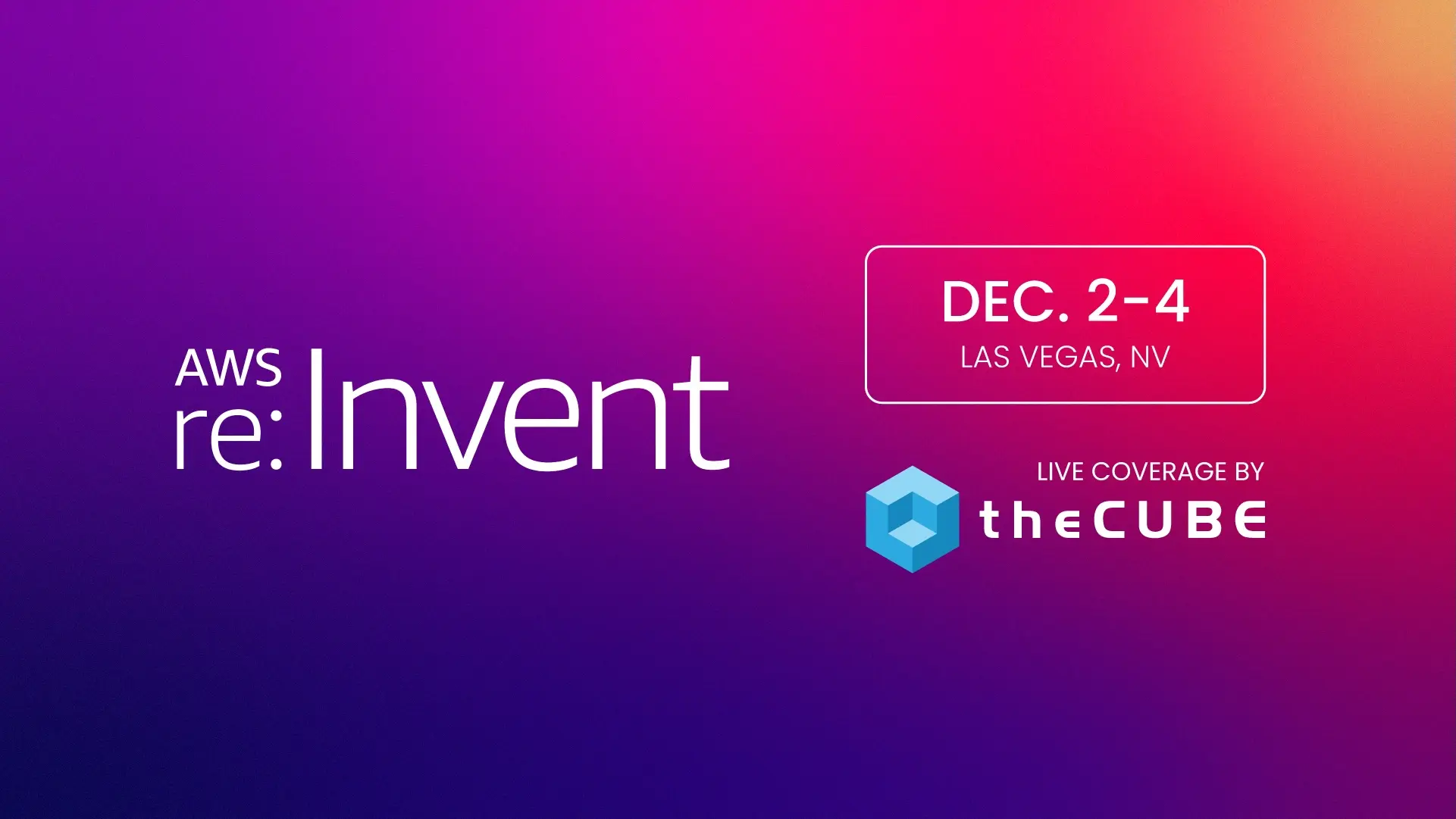
Tuesday Dec 2, 2025 | 6:00 PM UTC
Don’t miss out! Add the event to your calendar:
Google Calendar
Microsoft Outlook
Office 365
Download ICS
Profile
person_add
CONFERENCE PASS
  • General
Delete my registration
Delete my CUBE365 account
I want my badge and interests to be visible to all attendees.
Checking this box will display your presense on the attendees list, view your profile and allow other attendees to contact you via 1-1 chat. Read the Privacy Policy. At any time, you can choose to disable this preference.
Select your Interests!
add
Upload your photo
 Uploading..
OR
Connect via Twitter
Connect via Linkedin
EDIT PASSWORD

Cancel

Incorrect password


theCUBE.net
home AWS re:Invent 2025 Agenda
  • more_horiz
    • info Help
    Tuesday, December 2 (UTC) December 2
    Wednesday, December 3 (UTC) December 3
    Thursday, December 4 (UTC) December 4
    Friday, December 5 (UTC) December 5
    • ON DEMAND

      Sriram Devanathan, AWS Transform

      In this interview during theCUBE's coverage of AWS re:Invent, Sriram Devanathan, director of transformation and modernization at AWS, joins theCUBE’s John Furrier to discuss how agentic AI is fundamentally reshaping the cloud migration landscape. Devanathan explains that the traditional, multi-year approach of "lift and shift" followed by modernization is obsolete; instead, enterprises are now leveraging intelligent agents to assess, decompose and refactor legacy systems simultaneously. He highlights how AWS Transform uses these advanced AI capabilities to handle complex dependency analyses and validation, allowing customers to modernize mission-critical workloads – from Mainframes to Windows and VMware environments – in a fraction of the time previously required.

      The conversation underscores the quantifiable impact of this AI-driven acceleration, with Devanathan revealing that AWS has analyzed nearly one billion lines of COBOL and migrated 40 million lines of .NET code from Windows to Linux. He notes that these automated workflows are not only 80% automated and four times faster than manual methods but also deliver significant efficiencies, such as moving network configurations 80 times faster and reducing licensing costs by 40%. Furrier and Devanathan conclude by exploring how multi-agent collaboration is unlocking new revenue potential, enabling businesses to turn "modern legacy" maintenance into a driver for rapid innovation.
      • Google Calendar
      • Microsoft Outlook
      • Office 365
      • Download ICS
      Sriram Devanathan
      Director of Software Development AWS Transform
    • ON DEMAND

      Milin Desai, Sentry.io

      In this interview during theCUBE's coverage of AWS re:Invent, Milin Desai, chief executive officer of Sentry.io, joins theCUBE’s Christophe Bertrand to discuss how the company has evolved from simple error monitoring to a comprehensive code monitoring and reasoning platform. Desai highlights Sentry’s massive growth to over 150,000 customers and explains how their focus remains squarely on the developer. He details how Sentry is leveraging AI to transform the debugging process, moving beyond detection to "fixing it faster" with a 95% accuracy rate in identifying root causes through their new Seer reasoning platform.

      The conversation digs into the rise of agentic AI and how Sentry is now capable of preventing bugs within pull requests before code is even shipped. Desai explains how Sentry provides observability for AI agents by tracing interactions and prompts as part of the broader software stack, ensuring compliance and visibility without compromising data privacy. They also touch on the changing role of the developer in an AI-native world, where mundane tasks are delegated to agents, allowing engineers to focus on architecture and high-level design.
      • Google Calendar
      • Microsoft Outlook
      • Office 365
      • Download ICS
      Milin Desai
      CEO Sentry
      Christophe Bertrand
      Principal Analyst SiliconANGLE & theCUBE
    • ON DEMAND

      Matt Garman, AWS

      In this interview during theCUBE's coverage of AWS re:Invent, Matt Garman, chief executive officer of AWS, sits down with theCUBE’s John Furrier to outline the company's aggressive strategy for scaling AI infrastructure to meet the demands of the "AI factory" era. Garman describes a shift where the "campus is the new computer," highlighting Project Rainier – a collaboration with Anthropic involving 500,000 Trainium 2 chips in a single location. The conversation dives into the debut of Trainium 3, described as the world’s best inference platform with a 4x compute increase over its predecessor, and teases Trainium 4, which promises another 8x leap in performance. Garman notes that over 50% of tokens served through Amazon Bedrock are already running on Trainium, underscoring the rapid adoption of AWS custom silicon.

      Garman also details how AWS is moving beyond generic models to enable true enterprise differentiation through Nova Forge and "frontier agents." He explains that Nova Forge allows companies to inject proprietary data earlier in the training process to create secure, custom frontier models within their own VPCs. The discussion further explores the rise of autonomous agents capable of executing long-running tasks and remembering developer preferences to "force multiply" engineering teams. Garman argues that despite interest in the edge, the power and compute constraints of modern AI are driving workloads back toward the cloud, a trend supported by AWS landing 3.8 gigawatts of new data center power in the last 12 months alone.
      • Google Calendar
      • Microsoft Outlook
      • Office 365
      • Download ICS
      Matt Garman
      CEO AWS
    • ON DEMAND

      Marc Brooker, AWS

      In this interview during theCUBE's coverage of AWS re:Invent, Marc Brooker, vice president and distinguished engineer of agentic AI at AWS, joins theCUBE’s John Furrier to explore the infrastructure strategies powering the next generation of autonomous software. Brooker breaks down the transition from building agents locally with tools like Kiro to deploying them at enterprise scale, highlighting the challenge of connecting these dynamic systems to vast corporate data estates. He details the architecture of AgentCore, AWS's comprehensive environment for running agents, which provides the necessary compute, memory and gateway services to transform high-level business goals into executed actions while managing state and user context.

      The discussion also addresses the critical engineering shifts required for an agentic future, where the focus moves from code syntax to "essential complexity" and systems thinking. Brooker emphasizes how AWS leverages virtualization to enforce rigorous security boundaries, ensuring agents operate safely within defined budgets and credential limits. Looking toward 2026, Brooker predicts the rise of "Agent Ops" as a vital discipline for governing agent fleets and tracking ROI, alongside the evolution of open standards like the Model Context Protocol (MCP) to support massive scalability across thousands of tools and data sources.
      • Google Calendar
      • Microsoft Outlook
      • Office 365
      • Download ICS
      Marc Brooker
      VP and Distinguished Engineer of Agentic AI AWS
    • ON DEMAND

      Keynote Analysis

      In this keynote analysis from AWS re:Invent 2025, theCUBE’s John Furrier joins analysts Paul Nashawaty, Zeus Kerravala and Sarbjeet Johal to unpack how Amazon is redefining cloud infrastructure through the lens of agentic AI. The panel breaks down Matt Garman’s declaration that "agents are the new cloud," exploring key announcements surrounding the Nova model family, AgentCore and Amazon Bedrock. The discussion highlights AWS’ strategic pivot from merely abstracting infrastructure complexity to abstracting work itself, effectively bridging the gap between professional coders and "citizen developers" while unifying the experience for builders at every level.

      The conversation digs deeper into the practical realities of enterprise AI adoption, emphasizing the critical role of security, governance and compliance in moving from proof-of-concept to production. Kerravala, Johal and Nashawaty analyze AWS’ vertically integrated approach – spanning from custom silicon like Trainium and Inferentia to the application layer – and how this full-stack strategy allows customers to train models on proprietary data with improved price-performance. The group also debates the evolving competitive landscape, noting how AWS is equipping organizations to build autonomous, long-running agents that function as teammates rather than just tools.
      • Google Calendar
      • Microsoft Outlook
      • Office 365
      • Download ICS
      John Furrier
      Co-Founder & Co-CEO SiliconANGLE Media, Inc.
      Zeus Kerravala
      Founder & Principal Analyst ZK Research
      Paul Nashawaty
      Practice Lead and Principal Analyst theCUBE Research
    • ON DEMAND

      Ken Exner, Elastic

      Ken Exner, chief product officer at Elastic, joins Jackie McGuire, principal analyst at theCUBE Research, for an in-depth conversation during AWS re:Invent 2025. The discussion centers around developments in artificial intelligence (AI), particularly Elastic's innovations and the vital role of context engineering in advancing AI applications.

      With a significant industry tenure, including 16 years at AWS and a current position as chief product officer at Elastic, Exner details their journey and contributions at Elastic. The focus is on how Elastic utilizes AI to enhance its product portfolio. TheCUBE Research's Jackie McGuire and the hosts explore Exner's insights on the evolving landscape of AI and security.

      Key takeaways include the emergence of context engineering as a critical factor in building effective AI systems, a prediction reinforced by Exner. The examination covers how Elastic leverages its expertise in relevance and open standards to shape the future of agent-based technologies. The conversation also addresses strategic integrations of Elastic's offerings to enhance AI, security and observability solutions, according to Exner and analysts.
      • Google Calendar
      • Microsoft Outlook
      • Office 365
      • Download ICS
      Ken Exner
      Chief Product Officer Elastic
    • ON DEMAND

      Julia White, AWS

      In this interview during theCUBE's coverage of AWS re:Invent, Julia White, chief marketing officer of AWS, joins theCUBE’s John Furrier to break down the major announcements reshaping the enterprise AI landscape. White details the launch of "AI Factories," an opinionated infrastructure approach designed to bring large-scale compute capabilities directly to customers' existing data centers, specifically for highly regulated and sovereign needs. She explains how the new Nova Forge empowers organizations to create custom frontier models by securely blending their proprietary data with Amazon’s training data, effectively solving the trade-offs between fine-tuning and model performance. The conversation also highlights significant advances in custom silicon, with new generations of Trainium delivering up to 80% better price-performance to optimize AI infrastructure from top to bottom.

      The discussion then shifts to the emergence of "Frontier Agents," a new class of autonomous, massively scalable and long-running AI agents capable of executing ambiguous tasks over weeks without constant redirection. White outlines AWS' strategy to democratize agentic AI through AgentCore, which provides the essential enterprise building blocks – such as security, governance and identity management – needed to move agents from experimental fringes to production environments. She emphasizes how these innovations, alongside specific agents for software development, DevOps and security, are unlocking faster time-to-value and fundamentally changing how businesses approach the software development lifecycle.
      • Google Calendar
      • Microsoft Outlook
      • Office 365
      • Download ICS
      Julia White
      VP, WW AWS Marketing AWS
    • ON DEMAND

      Jason Ballard, Chris Jangareddy & Rima Olinger

      In this interview during theCUBE's coverage of AWS re:Invent, Jason Ballard from Toyota Motor North America, Chris Jangareddy from Deloitte, and Rima Olinger from AWS join theCUBE’s Rob Strechay to unpack the practical realities of agentic AI. The discussion centers on the shift from generative AI's content creation to agentic AI's ability to plan, reason and execute autonomous tasks to solve complex business problems. The panel details how their strategic collaboration is revolutionizing Toyota’s supply chain operations, moving from traditional reactive management to a "self-healing" network capable of proactively handling disruptions through simulation and automated recommendations.

      The conversation dives deep into tangible business outcomes, with Jangareddy revealing that Toyota has achieved an 18% improvement in planner productivity and a 20% boost in forecasting accuracy. Ballard explains how agentic AI acts as a "two-in-a-box" partner, transforming roles that once required stitching together over 70 spreadsheets into strategic positions with broader scope. Olinger highlights the critical necessity of workforce upskilling to support this transformation, noting that AWS surpassed its initial targets by training 29 million people on AI skills in 2024. Together, they outline a roadmap for enterprise adoption: prioritizing high-value use cases, ensuring security via tools like AWS Audit Manager and rigorously measuring ROI before scaling to production.
      • Google Calendar
      • Microsoft Outlook
      • Office 365
      • Download ICS
      Jason Ballard
      Vice President of Digital Innovations Toyota North America
      Rima Olinger
      Director, Amazon Quick Suite AWS
      Chris Jangareddy
      Managing Director/Partner Deloitte
      Rob Strechay
      Dir./Principal Analyst & Host theCUBE Research
    • ON DEMAND

      Han Xiao, Elastic

      In this interview during theCUBE's coverage of AWS re:Invent, Han Xiao, vice president of AI at Elastic and former chief executive officer of Jina AI, joins theCUBE’s Rob Strechay to unpack how Jina AI’s technology is reshaping the Elastic ecosystem. Xiao explains how Jina’s search foundation models – specifically embeddings, rerankers and small language models – serve as the "brain" behind Elastic’s orchestration framework. This integration aims to solidify Elastic as the essential computational layer for search, enabling developers to build highly accurate, multimodal and multilingual systems that are critical for powering the next generation of agentic AI.

      The conversation delves into the nuances of "context engineering," which Xiao describes as the art of optimizing the information fed to Large Language Models (LLMs). He details how small language models are increasingly utilized to compress context and rerank passages within massive token windows, ensuring LLMs receive the most relevant data without unnecessary noise. Xiao also highlights that Jina AI will become the default model provider for the Elastic Inference Service (ELSER), streamlining the developer experience by providing immediate access to state-of-the-art tools for building robust search and retrieval workflows.
      • Google Calendar
      • Microsoft Outlook
      • Office 365
      • Download ICS
      Han Xiao
      VP of AI Elastic
    • ON DEMAND

      Eswar Bala, AWS

      In this interview during theCUBE's coverage of AWS re:Invent, Eswar Bala, director of container engineering at AWS, joins theCUBE’s John Furrier to discuss the strategic shift toward "container native" computing. Bala explains that engineering teams currently spend nearly 70% of their time on infrastructure management rather than business applications, a dynamic AWS aims to reverse through new application-centric capabilities. The discussion breaks down major announcements designed to minimize operational overhead, including Amazon ECS Express Mode for one-click production deployments and the new Amazon EKS Capabilities suite, which features managed Argo CD and AWS Controllers for Kubernetes (ACK) to streamline GitOps and resource orchestration.

      The conversation also explores the massive surge in AI and agentic workloads running on containers, with Bala revealing that the number of GPU instances managed by Kubernetes on AWS has doubled compared to last year. He details how AWS is optimizing infrastructure for this AI boom through EKS Auto Mode, which automates GPU provisioning and right-sizing to maximize utilization and performance. Bala also highlights the introduction of 100,000-node ultra clusters for foundation model builders and the integration of Amazon Q into ECS and EKS, enabling developers to troubleshoot complex operational events in minutes rather than days.
      • Google Calendar
      • Microsoft Outlook
      • Office 365
      • Download ICS
      Eswar Bala
      Director of Containers AWS
    • ON DEMAND

      Deepak Singh, AWS

      In this interview during theCUBE's coverage of AWS re:Invent, Deepak Singh, vice president of engineering at AWS, joins theCUBE’s John Furrier to discuss the rapid rise of agentic workflows and the philosophy behind "spec-driven development." Singh shares insights into the explosive adoption of Kiro, revealing that over 250,000 developers engaged with the tool within its first three months. The conversation unpacks how Kiro bridges the gap between the creativity of "vibe coding" and the rigor of engineering best practices, allowing developers to convert conversational concepts into structured specifications, designs and executable tasks that are version-controlled in Git.

      Singh elaborates on the concept of "illuminate and clarify," a principle used by Amazon's principal engineers to break down complex problems – now accelerated through Kiro’s property-based testing and custom agents. The discussion explores how this approach democratizes software creation, enabling everyone from senior engineers to students to build robust, maintainable applications quickly. Singh also teases upcoming re:Invent themes, highlighting the industry's shift toward "context engineering," where developers focus on defining the precise boundaries and behaviors for agents to operate autonomously and securely.
      • Google Calendar
      • Microsoft Outlook
      • Office 365
      • Download ICS
      Deepak Singh
      VP, Next Gen Developer Experience AWS
    • ON DEMAND

      Clare Liguori, AWS

      In this interview during theCUBE's coverage of AWS re:Invent, Clare Liguori, senior principal engineer at AWS, joins theCUBE’s John Furrier to detail the rapid adoption and evolution of Strands, an open-source framework for building AI agents that originated internally at Amazon. Liguori reveals that Strands has surpassed 3 million downloads since its mid-year release, a testament to the industry's shift toward a "model-driven" development approach. She explains how this philosophy minimizes boilerplate code by allowing frontier models to handle reasoning and tool selection, rather than relying on brittle, hard-coded workflows. The discussion highlights major announcements for the framework, specifically the introduction of a TypeScript SDK and support for edge runtimes, which broaden accessibility to the massive JavaScript developer community and enable agents to run anywhere from browsers to factory floors.

      The conversation delves into the practicalities of deploying agents at the edge, where Liguori describes the necessity of hybrid architectures that combine fast, local models for immediate tasks – like robotic motor control – with powerful cloud-based frontier models for long-range planning. She also introduces the concept of "Strands steering," a mechanism designed to keep agents aligned with specific operating procedures (SOPs) through reminders, acting as a guardrail against model drift during complex, non-deterministic interactions. Liguori emphasizes that these advancements allow developers to treat AI agents not just as experimental code, but as reliable, production-ready assets that can integrate seamlessly with AWS services like Lambda, Bedrock and SageMaker while remaining flexible enough to run on a laptop.
      • Google Calendar
      • Microsoft Outlook
      • Office 365
      • Download ICS
      Clare Liguori
      Senior Principal Software Engineer AWS
    • ON DEMAND

      Christine Yen, Honeycomb.io

      In this interview during theCUBE's coverage of AWS re:Invent, Christine Yen, chief executive officer of Honeycomb.io, sits down with theCUBE’s Dave Vellante to discuss why observability is emerging as the critical "trust fabric" for AI-driven software development. Yen explains that as AI coding assistants accelerate development velocity and increase the volume of code in production, the potential for instability and "unknown unknowns" rises significantly. She argues that traditional monitoring, which often minimizes data collection to control costs, cannot keep up with the distributed dependencies responsible for nearly 70% of outages. Instead, high-fidelity telemetry is required to create the necessary feedback loops that allow engineering teams to validate agentic behavior and maintain system reliability.

      The conversation also highlights Honeycomb’s latest strategic announcements designed to meet these challenges, including the launch of Honeycomb Private Cloud for organizations with strict governance needs. Yen details the company’s full embrace of OpenTelemetry standards for metrics and the general availability of Honeycomb Canvas, a natural language interface that simplifies complex querying. Yen and Vellante further explore the misconception that AI will reduce the need for oversight, with Yen positioning observability as the "seatbelt" for AI – allowing teams to move fast while retaining the ability to detect and resolve issues in real time.
      • Google Calendar
      • Microsoft Outlook
      • Office 365
      • Download ICS
      Christine Yen
      Co-Founder Honeycomb.io
    • ON DEMAND

      Tom Eggemeir, Zendesk

      In this broadcast from AWS re:Invent 2025, Tom Eggemeier, chief executive officer of Zendesk, joins theCUBE’s John Furrier and Paul Nashawaty to discuss the company’s deepened strategic alliance with AWS. Eggemeier details a "three-legged stool" partnership that includes running infrastructure on AWS, integrating Amazon Connect for voice, and leveraging Amazon Bedrock and Nova models to power multimodal experiences. The conversation highlights the industry shift from abstracting infrastructure to abstracting work through AI agents, emphasizing how Zendesk utilizes its massive dataset of 18 billion interactions to train models for superior customer service outcomes.

      The discussion also explores the practical realities of AI adoption, moving beyond hype to tangible business impact. Eggemeier reveals that Zendesk processes 5 billion automated resolutions annually and is seeing customers achieve up to 80% automation, effectively freeing human agents for higher-value tasks known as the "service dividend." He outlines the importance of an open, flexible architecture for secure integrations and discusses the critical role of change management in workforce transformation. As Zendesk pushes toward $200 million in AI-specific revenue, Eggemeier stresses the necessity for SaaS companies to reinvent themselves as AI-first organizations to survive the coming disruption.
      • Google Calendar
      • Microsoft Outlook
      • Office 365
      • Download ICS
      Tom Eggemeier
      CEO Zendesk
    • ON DEMAND

      Christina Kosmowski, LogicMonitor

      In this engaging session from AWS re:Invent 2025, Christina Kosmowski of LogicMonitor discusses the company's strategic advancements with hosts John Furrier of SiliconANGLE Media and Paul Nashawaty of theCUBE Research. Among the highlights is LogicMonitor’s acquisition of Catchpoint, a move that enhances their capabilities across the digital landscape, extending observability from infrastructure to user experience.

      Kosmowski explores LogicMonitor's pioneering approaches to AI-driven observability and details their development of Edwin AI, which provides self-healing solutions for IT operations. This discussion also considers the significance of the timing of their new acquisition in relation to AWS's innovative announcements at re:Invent, emphasizing the seamless integration into AWS's ecosystem to deliver unmatched infrastructure visibility and prediction capabilities.

      Gain insights from Kosmowski on the transformative impact of LogicMonitor's strategies in achieving a unified observability view for companies in the digital era. The CUBE's John Furrier and Paul Nashawaty examine how these innovations streamline business operations across various sectors, enhancing resilience and reducing complexity for IT professionals. This discussion presents a forward-thinking perspective on the critical role of automation and the strategic integration of technology with business outcomes.
      • Google Calendar
      • Microsoft Outlook
      • Office 365
      • Download ICS
      Christina Kosmowski
      CEO LogicMonitor
    • ON DEMAND

      Andy Warfield, AWS

      In this interview from AWS re:Invent 2025, Andy Warfield, vice president and distinguished engineer at AWS, joins theCUBE’s John Furrier to discuss the pivotal shift toward agentic infrastructure and the evolving role of storage in the AI era. Warfield explains how Amazon S3 is transforming from a simple object store into a critical component for AI factories, specifically highlighting the launch of S3 Vectors and improvements to S3 Tables. He details how these advancements bridge the gap between generative AI capabilities and enterprise data, offering a unified metadata layer that simplifies retrieval augmented generation (RAG) and supports multimodal applications across text, video and code.

      The conversation dives deep into the technical and economic benefits of these new features, with Warfield revealing a 90% cost reduction for storing vector indexes in S3 compared to managed SSD instances. He explores the practical applications of these tools – from life sciences to radiology – and emphasizes the simplicity of the architecture, which eliminates complex provisioning. Warfield and Furrier also examine the broader trend of decomposing data lakes into open, componentized architectures, noting how this modular approach accelerates agentic workflows by allowing AI to navigate APIs and documentation more effectively to build custom solutions.
      • Google Calendar
      • Microsoft Outlook
      • Office 365
      • Download ICS
      Andy Warfield
      VP & Distinguished Engineer AWS
    • ON DEMAND

      Julie Neumann, Honeycomb.io

      In this interview from AWS re:Invent, Julie Neumann, chief marketing officer at Honeycomb.io, joins theCUBE’s John Furrier to discuss the rapid convergence of cloud-native architectures with the emerging AI-native world. Neumann compares the current pace of innovation to the industry's previous shift to the cloud but at "10x speed," emphasizing that while AI provides velocity, deep observability is essential for establishing trust. The conversation explores how organizations are moving beyond experimental "vibe coding" to deploying frontier agents in production, where understanding end-to-end workflows and data states becomes the new currency for operational success.

      The discussion also delves into the evolution of the software development lifecycle, with Neumann arguing that generative AI is ultimately a software engineering challenge that requires rigorous DevOps discipline. They examine how engineering roles are shifting from pure coding to outcome orchestration and how traditional cloud-native practices are adapting to support autonomous agents. Neumann highlights how Honeycomb is aiding enterprises like Netflix and Vanguard in creating fast feedback loops, ensuring that as companies embrace AI factories and hybrid infrastructures, they maintain the visibility needed to thrive in an increasingly complex, non-deterministic environment.
      • Google Calendar
      • Microsoft Outlook
      • Office 365
      • Download ICS
      Julie Neumann
      CMO Honeycomb.io
    • ON DEMAND

      Milin Desai, Sentry

      In this interview from AWS re:Invent, Milin Desai, chief executive officer of Sentry, joins theCUBE’s John Furrier to discuss the rapid evolution of AI agents and their role as the new infrastructure layer. Desai explains how Sentry has transitioned from a hot startup to an "escape velocity" enterprise, serving over 150,000 software teams, including major players like Anthropic and Disney+. The discussion centers on Sentry’s core value proposition: providing the deep context necessary to fix broken code faster. Desai reveals that by feeding production context into LLMs, Sentry is achieving 95% root cause accuracy, effectively turning remediation tasks that used to take hours into minutes through partnerships with tools like Cursor and Claude Code.

      The conversation also explores the changing dynamics of software engineering, moving from the myth of the "10x developer" to the reality of the "10x software team." Desai highlights how shared context and AI agents allow backend engineers to seamlessly handle frontend tasks, streamlining the entire development lifecycle. They delve into the implications of sovereign clouds and the rise of custom models, with Desai noting that increased cloud diversity and auto-generated code create a greater need for robust error monitoring. From internal "dogfooding" strategies to detecting bugs in pull requests before they ship, the segment offers a comprehensive look at how Sentry is navigating a world where code generation is becoming instantaneous and ubiquitous.
      • Google Calendar
      • Microsoft Outlook
      • Office 365
      • Download ICS
      Milin Desai
      CEO Sentry
    • ON DEMAND

      Rohit Prasad, AWS

      In this interview from AWS re:Invent 2025, Rohit Prasad, senior vice president and head scientist of artificial general intelligence at Amazon, joins theCUBE’s John Furrier to discuss the evolution of generative AI from abstract infrastructure to intelligent agents. The conversation centers on the unveiling of Nova Forge, a groundbreaking capability that addresses the limitations of generic frontier models by allowing enterprises to deeply customize models with their own proprietary data. Prasad explains how Nova Forge solves the "production reality" challenge where off-the-shelf benchmarks fail to meet specific business needs, offering a solution that sits between lightweight fine-tuning and the prohibitive cost of building models from scratch.

      Prasad dives into the technical mechanics of "forging" models via Amazon SageMaker AI, detailing how developers can access pre-training, mid-training and post-training checkpoints to blend domain expertise without losing general intelligence. He highlights a compelling use case with Reddit, where incorporating domain data into the pre-training process allowed the model to develop "social intuition" and replace multiple bespoke models. The discussion also explores the future of the "internet of agents" with Nova Act, the advancements in multimodal capabilities with Nova 2 Omni, and Prasad’s practical definition of AGI as a tool to democratize creation for developers ranging from the dorm room to the boardroom.
      • Google Calendar
      • Microsoft Outlook
      • Office 365
      • Download ICS
      Rohit Prasad
      SVP and Head Scientist, AGI AWS
    • ON DEMAND

      Rajiv Chopra, AWS

      In this interview from AWS re:Invent, Rajiv Chopra, vice president of AWS Healthcare, AI, Life Sciences and Just Walk Out at Amazon Web Services, joins theCUBE’s John Furrier to discuss the rapid expansion and technical evolution of Amazon’s frictionless shopping technology. Chopra details how Just Walk Out is shifting from pilot programs to large-scale deployments across diverse verticals, including airports, hospitals and universities like UC San Diego. The conversation examines the concept of the "AI factory" moving to the edge, highlighting how deep learning, computer vision and RFID are converging to create hyper-converged interfaces that handle high-throughput environments ranging from sports stadiums to Amazon fulfillment center break rooms.

      The discussion also explores the operational advancements driving this momentum, with Chopra revealing a 50% reduction in customer installation costs and deployment timelines now shrinking to under five days. They dive into the tangible business ROI, citing a 40% increase in same-store sales at Hudson airport locations by optimizing store flow. Chopra and Furrier conclude by looking at the future of retail, discussing how agentic AI and privacy-focused identity obfuscation will pave the way for hyper-personalized, seamless experiences in the physical world.
      • Google Calendar
      • Microsoft Outlook
      • Office 365
      • Download ICS
      Rajiv Chopra
      VP, AWS Healthcare AI, Life Sciences and Just Walk Out AWS

    Welcome to Cube365 Events Platform Digital Community

    You are now part of the interactive digital experience for all SiliconANGLE conferences and an exclusive member of the social community. Enjoy live and on-demand broadcasts, theCUBE interviews, CrowdChats, and access to premium content and presentations. Engage and interact in real time with influencers and peers in a social space designed for collaboration and networking. Discover all that Cube365 Events Platform has to offer before, during and after the event.

    CONTACT US

    Privacy Statement

    • Privacy
    • Terms
    Social Link
    Social Link
    Social Link
    Social Link
    © CUBE365
    © theCUBE
    © 2026 theCUBE