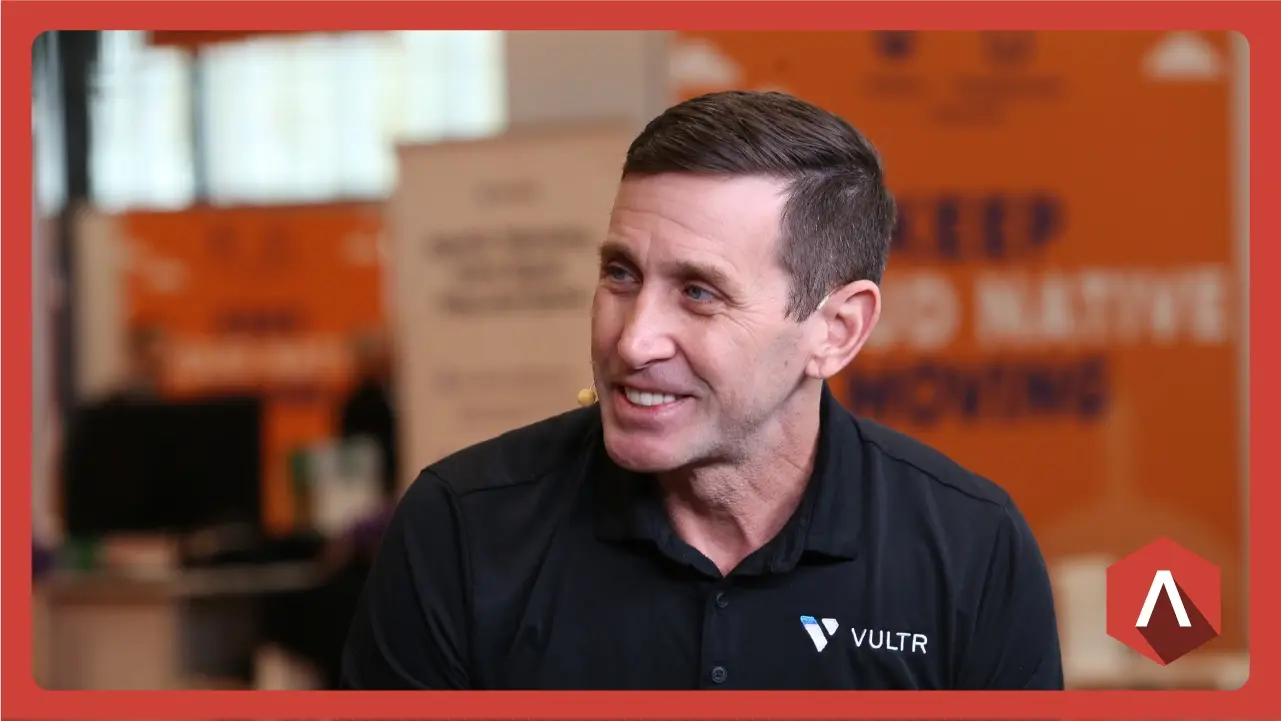
In this interview from KubeCon + CloudNativeCon EU 2026 in Amsterdam, Kevin Cochrane, chief marketing officer of Vultr, joins theCUBE Research's Rob Strechay and Paul Nashawaty to discuss how cloud-native practitioners are operationalizing the open AI inference stack for production-ready developer experiences. Cochrane explains how Vultr bridges the infrastructure visions unveiled at NVIDIA GTC with the practitioners retooling at KubeCon, offering one-click deployment of fully integrated GPU and CPU clusters across 33 data center regions. He highlights the critical role of platform engineering in governing open composable stacks so generalist developers can spin up compliant AI infrastructure in as little as 90 seconds.
The conversation also explores data sovereignty, which Cochrane reframes beyond national governments to encompass every global enterprise deploying AI-native applications across isolated regions. He details how Vultr ensures agents, RAG pipelines and data sources remain locally compliant in each geography — from Germany to Singapore — without data leaking across borders. Early traction from the NemoClaw launch at GTC underscores the demand: the platform surpassed two billion tokens generated per hour within its first week. With research indicating that 70% to 90% of code is now AI-generated and the EU Cyber Resilience Act deadline approaching in December 2027, Cochrane stresses why governed platform engineering is essential to preventing the costly cloud sprawl of the past from repeating in the AI era. From open composable stacks to globally compliant inference deployments, he provides a roadmap for scaling AI workloads without sacrificing simplicity, security or sovereignty.
Forgot Password
Almost there!
We just sent you a verification email. Please verify your account to gain access to
Scaling Enterprise Agentic AI with Vultr. If you don’t think you received an email check your
spam folder.
Sign in to Scaling Enterprise Agentic AI with Vultr.
In order to sign in, enter the email address you used to registered for the event. Once completed, you will receive an email with a verification link. Open the link to automatically sign into the site.
Register for Scaling Enterprise Agentic AI with Vultr
Please fill out the information below. You will receive an email with a verification link confirming your registration. Click the link to automatically sign into the site.
You’re almost there!
We just sent you a verification email. Please click the verification button in the email. Once your email address is verified, you will have full access to all event content for Scaling Enterprise Agentic AI with Vultr.
I want my badge and interests to be visible to all attendees.
Checking this box will display your presense on the attendees list, view your profile and allow other attendees to contact you via 1-1 chat. Read the Privacy Policy. At any time, you can choose to disable this preference.
Select your Interests!
add
Upload your photo
Uploading..
OR
Connect via Twitter
Connect via Linkedin
EDIT PASSWORD
Share
Forgot Password
Almost there!
We just sent you a verification email. Please verify your account to gain access to
Scaling Enterprise Agentic AI with Vultr. If you don’t think you received an email check your
spam folder.
Sign in to Scaling Enterprise Agentic AI with Vultr.
In order to sign in, enter the email address you used to registered for the event. Once completed, you will receive an email with a verification link. Open the link to automatically sign into the site.
Sign in to gain access to Scaling Enterprise Agentic AI with Vultr
Please sign in with LinkedIn to continue to Scaling Enterprise Agentic AI with Vultr. Signing in with LinkedIn ensures a professional environment.
Are you sure you want to remove access rights for this user?
Details
Manage Access
email address
Community Invitation
Kevin Cochrane, Vultr | Kubecon + CloudNativeCon EU 2026
Rob Strechay and Paul Nashawaty host a conversation with Kevin Cochrane, Chief
Marketing Officer, Vultr as part of theCUBE’s coverage of Kubecon +
CloudNativeCon EU 2026 from Amsterdam, Netherlands
Kevin Cochrane, Vultr | Kubecon + CloudNativeCon EU 2026
Kevin Cochrane
CMOVultr
In this interview from KubeCon + CloudNativeCon EU 2026 in Amsterdam, Kevin Cochrane, chief marketing officer of Vultr, joins theCUBE Research's Rob Strechay and Paul Nashawaty to discuss how cloud-native practitioners are operationalizing the open AI inference stack for production-ready developer experiences. Cochrane explains how Vultr bridges the infrastructure visions unveiled at NVIDIA GTC with the practitioners retooling at KubeCon, offering one-click deployment of fully integrated GPU and CPU clusters across 33 data center regions. He highlights the cr...Read more
exploreKeep Exploring
Who are the people introduced in this opening segment of KubeCon + CloudNativeCon EU 2026 in Amsterdam?add
How will the open NVIDIA AI stack announced at GTC (NVIDIA Dynamo, NeMoTron, NemoClaw) be adopted and deployed by enterprises and cloud‑native developers at KubeCon and on public cloud platforms like Rubin?add
How does Vultr’s developer-focused approach — including serverless APIs, bridging legacy and modern environments, and tools like NVIDIA NemoClaw — accelerate AI projects and improve developer productivity (e.g., by enabling pre-built composable stacks, on-demand infrastructure, and simplified “deploy” workflows)?add
How does Vultr make AI infrastructure easy for generalist developers to deploy and scale while handling compliance, governance, and upcoming regulations such as the EU CRA?add
Kevin Cochrane, Vultr | Kubecon + CloudNativeCon EU 2026
search
Rob Strechay
>> Hello and welcome back to KubeCon + CloudNativeCon EU 2026, live from Amsterdam. Today I am helping to break things down and I have Paul Nashawaty, who's a practice lead here, to also help me break things down at the intersection of AI and cloud native. Welcome on board, Paul.
Paul Nashawaty
>> Hey, great to be here, Rob.
Rob Strechay
>> Yeah, glad to have you on for this first one here that we're doing together. We have Kevin Cochrane, who's the CMO, chief marketing officer, for Vultr. Welcome onboard.
Kevin Cochrane
>> Great to see you guys again.
Rob Strechay
>> Yeah, I mean, it was literally like-
Kevin Cochrane
>> Last week?
Rob Strechay
>> ... feels like less than a week ago.
Kevin Cochrane
>> Correct.
Rob Strechay
>> Everybody was jetting over from GTC and getting here. Help us understand because there was a lot of NVIDIA today on the keynote, and obviously, a lot of NVIDIA at NVIDIA GTC last week. A lot of talk about Open. Help us understand where Vultr is fitting in with that, because you've got your own stack that you bring together and it has a lot of these pieces in there.
Kevin Cochrane
>> Yeah. So, this is the amazing follow-up to GTC. At GTC, a big, bold vision was laid out for enabling enterprises to adopt inference at scale. And in order to do that, there was an entire open stack, NVIDIA Dynamo, NVIDIA Nemotron optimized to be deployed on the upcoming Rubin platform. And we go straight here to KubeCon where every single cloud-native developer is now retooling and re-skilling to take the existing applications that they've built and to build new AI services, new agentic services, and embed them in their existing applications to transform them, to transform operations, to transform the customer experience. And so, this is where the practitioners are. This is where the practitioners are. They're going to take the open stack, debut it at NVIDIA GTC, and then put it into practice. And that's why we're so excited to be here, because as a public cloud platform, 14-year operating history, 33 data center regions, platform engineers are our best friend. CISOs are our best friend. We're all about enabling enterprises to build and scale cloud-native workloads. And now, we're happy to work with them to get them access to NVIDIA Dynamo, to get them access to NVIDIA Nemotron, and NemoClaw, and help build the future.
Paul Nashawaty
>> So, Kevin, you're right. This is taking that leap from last week, the infrastructure acceleration and what you're doing on that space is really powerful. Practitioners, you mentioned. This is the developer playground here, right? That's right. This is app dev focused. This is where all the action happens at the practitioner space. So, let's talk a little bit about developer productivity. Vultr's known for that. You're catered to the developers. You're working with the serverless APIs to work into the connectivity from the old and new, bridging the gap from the heritage environments to new environments. What does that mean for acceleration of these AI projects?
Kevin Cochrane
>> Yeah. So, it's really important to note that if you look at the future of AI infrastructure, it's all about the developer experience. It's all about unlocking developer productivity. And as you mentioned, the reason why Vultr was able to grow and scale so rapidly as an alternative public cloud platform was because of our developer experience just being so simple, so high performant, so cost-effective. And so, what we're really excited about is we're really excited about NVIDIA NemoClaw because if you look at what helps unlock developer productivity is... Imagine a future where your platform engineering team can work with all of the members of the IOCS team, the server engineers, the network engineers, the cloud engineers, the SRE team, et cetera, right? And then, pre-build all of the composable stacks, pre-build the skills that can be exposed to every front-end developer that's building an application, so that when they're using Cloud Code, they can simply say, "Deploy." And then, all of the AI infrastructure can automatically be spun up on-demand, all of the networking, all of the storage, and they don't have to know anything about it. But then, what they're spinning up, it's governed, it's secure, it's compliant, it's using the resources in the most cost-effective way. They're not just spinning up random stuff, right? That's what's happening here. Platform engineerings are figured out like in a future agentic world where developers are using new things like OpenClaw and NemoClaw, how do we help build the platform and the skills so that the infrastructure is just magic?
Rob Strechay
>> When you look at this, and like you said, all the practitioners are here. I was sitting with some yesterday in the day-zero events, like you said, there was platform engineering day yesterday. And it was just crazy at the amount of people were in there. There was in hundreds and hundreds of people in Argo. When you start to look at all of these different people in these different projects and they're coming to you and saying, "Hey, I need it to operate in this way." Is that your advantage about where you're going and how you've just simplified it?
Kevin Cochrane
>> Correct. 100% Oh, 100%. So, we believe in open composable stacks and a vibrant marketplace where people can, in an open community through open collaboration, can contribute different types of open composable stacks. It's like what Jensen was talking about at GTC. Vertical stacks that are tied to delivering specific outcomes for a given use case, but it's horizontally open. That's along the Vultr model. Let's give you the recipe for a specific use case. Let's give you example stacks that you can deploy, but it's completely open. So, you can plug and play whatever third-party resources, whatever Vultr resources you need in order to accomplish the goal. And that's a lot of what we're doing here in conjunction with the CNCF and the whole community here at KubeCon, which is like, how do we get to a future where open source, open collaboration can build a vibrant marketplace of composable stacks that developers can simply have access to, through a simple claw? Let's make it simple. The developer experience matters.
Rob Strechay
>> Absolutely.
Kevin Cochrane
>> All of these developers need to build the future. How do we enable them to do that?
Paul Nashawaty
>> No, absolutely and developer frictionless deployments is really where the keys are. So, let's talk about open source software models. One of the things you touched upon was skill-gap issues. You talked about compliance, governance and regulations. Those are the core functions for Vultr. One of the things I'm seeing from my research, the 2025 research, we see that 67% of organizations are hiring generalists over specialists. They want to remove that friction from the developer and let the complexity be addressed by the vendor. So, they're coming to you go, "Fix the complexity. Push the big green button," but we have a generalist to do the deployment. Now, compound that on top of, and it's appropriate talking about here since we're in Europe, talking about the new EU CRA that's coming out for governance, compliance and regulations. All applications need to be in compliance by end of 2027, December 2027. How is Vultr dealing with this?
Kevin Cochrane
>> Yeah, so think about it. So, up until now, AI infrastructure has been too costly and too complex and you need it to be a specialist in order to deploy it and scale it and everyone did it differently. So, we have long been in the business of simplifying cloud operations and making things super easy. And so, in our case, that means making things like spinning up a GPU cluster for either training or inference as easy as one click. Making it something that can be driven by an agent because when you're spinning up inference clusters, you're not just spinning up in one location, you're actually having to spin it up in multiple geographic regions that are isolated regions so you can actually marshal data and infer data in the locality in which it's actually originating, right? And moreover, we're not only spinning up your GPU cluster, but we're spinning up the supporting CPU cluster for your containerized application code and then doing all of the networking and the storage and setting up an entire system. If you look at GTC, what Jensen's talking about with like the Rubin family, he's talking about a systems architecture. And at Vultr, we don't just spin up a GPU. We spin up a system. It's a fully-integrated platform, not just to the hardware, the networking and storage, but also, all of the supporting software infrastructure, like Dynamo with all these , so that as a developer, in as a little 90 seconds, you're able to do productive work. You're able to get productive work done. Because as a generalist, your job is to just build and deploy applications to support the business, to understand requirements, to drive towards outcomes. You can't just have to hire like dozens and dozens of specialists that just know how to do the optical networking, dozens of specialists that just know how to attach VAST storage, it's the generalist game now. We're in the enterprise. We need to have the maturity and all of the costs and complexity, that needs to be completely abstracted for you and that's what we do at Vultr.
Rob Strechay
>> Yeah. I mean, I just look at it from the perspective that the people here don't want to understand the hardware underneath. Last week was all about the hardware. This week is about how do I actually utilize that hardware efficiently, performantly and securely? One of the big things is also sovereignty is a huge thing.
Kevin Cochrane
>> Can't forget that.
Rob Strechay
>> And data sovereignty is huge. And I know you work with DDN, you work with NetApp, you work with VAST as part of your stack. When you look and approach a client and you have a client and they are getting services from you, do you help them abstract all that complexity, so they know it's here, it's in this country, it's got this type of security and durability for it, and you're all set from that sovereignty perspective?
Kevin Cochrane
>> Yeah, so it's wonderful that you bring up sovereignty because I think that it's a very important topic and it's a topic that needs to get demystified a little bit because I think a lot of the sovereignty discussion is around national governments, and that's very important. This is why three and a half years ago we announced our sovereign cloud on-demand offering so national governments can stand up their own bespoke AI infrastructure, fully isolated in order to support national research, national universities, et cetera. But the principles of data of sovereignty actually apply to every single global enterprise. If you're operating as a global enterprise and you're in India, you're operating in Singapore, you're operating in Germany and France, remember when you're building and deploying an AI-native application, you have to be spinning up all of your CPU clusters and GPU clusters separately in Germany, in France, in the UK, in India, and Singapore. And when you're spinning up those clusters, you're also spinning up all of your RAG pipelines and you're attaching to data sources in each of those regions and you're deploying your agents to run in those regions. And each of those regions has to run autonomously. The agent in Germany can access German national data and it can only support the use of that data in Germany. And so, what we make easy for enterprises is setting up a globally-compliant AI infrastructure, so that when you're building and deploying an application, suddenly you're not just deploying it in North America and then you're taking all your data out of Germany and pumping it into a vector database in New Jersey, right? You can't do that in today's day and age, right? So, yeah, a lot of the principles of sovereignty is what we look to build into every single enterprise deployment. It's the biggest topic here, because no one's figured it out and that's why we're like, "Here we go. Let's go. Let's make it happen."
Paul Nashawaty
>> And Kevin, to build on Rob's point here, the sovereignty is a big factor, right? But when you also look at scalability, we see this exponential growth with AI-built applications. What we were seeing in our research that 50% of code was being developed by AI, and that was in August of 2025. We reran a survey into November-December timeframe, and that moved up to 70% to 90%. So, code is just coming out, it's coming out fast. And then, so if you look at it from a delivery perspective, sure, you can push code out the door fast, but when you're looking at these sovereign areas, that has to have the impact there. So, how are you addressing that ebb and flow of GPU utilization, moving applications from GPU to CPU as the learning occurs? How are you dealing with that?
Kevin Cochrane
>> Yeah, so there's two parts of that. So, first and foremost, now more developers than ever are able to produce quality application code, but this is where you need the governance, right? This is where platform engineering comes in. So, when the engineer's are actually generating this code, you want them to be using skills that are pre-built by your IOCS team, governed by your platform engineering team, so they're not just randomly spinning up infrastructure. Remember the early days of cloud? Every single developer just got an account on Amazon. I did it. And then, the next thing you know, I had like 20 in large instances, half of them I wasn't using and I had all these S3 buckets. And then, I got my bill and I'm like, "What was I doing?"
Paul Nashawaty
>> It wasn't your budget.
Kevin Cochrane
>> "This is a mess," right?
Rob Strechay
>> That still happens, by the way.
Kevin Cochrane
>> It still happens. And yet, we have FinOps and we have all these observability tools and yet we still have a hot mess. So, we got to make sure that we don't get that hot mess in AI infrastructure because it's even more costly, but it will happen if you're randomly spinning up code and then deploying it, we're going to be in a pretty precarious space. So, this is where you want to make sure that the platform engineers build that developer productivity platform, have the skillset so when you're generating code, the deployment is actually handled on the backend. But the other aspect of that is even our own internal... So, at GTC, we launched NemoClaw, right? So, we were super excited. We launched NemoClaw and within, I think within four hours on Monday afternoon, we had our first 750 accounts for people coming up to our booth at GTC and we were super happy because before people went to dinner, we already had like 25 million tokens generated out of those accounts. So, we were like, "Oh, that's pretty cool." But now, it's growing really fast, right? So, now what are we like seven days later and I think we're like well north of two billion tokens an hour and it's still like doubling, the doubling rate. And so, like we have the same problem, which is now people are generating a lot of code using NemoClaw on our platform using our serverless API. It's like, "Whoa, we got to scale even faster here." So, yeah, developers are going to be doing new and interesting things and so we need to unlock their ability to continue to accelerate, but do so in a way that scales, that makes sure that we maximize security and compliance.
Rob Strechay
>> So, final thought here, we have your Vultr backstory on it because, again... And I love that the people can win the big Vultr over in your-
Kevin Cochrane
>> Yes, Mega Morty, we call them. So, this is Morty. Morty is either Mortimer or Mortisha, depending your choice. So, we just call it Morty for short. Morty is a Himalayan vulture. Morty is an angry bird, specifically angry at the high cost and complexity of scaling AI infrastructure because Morty believes in a seamless, easy developer experience. And Morty's a very popular item in the Vultr universe. So, Morty's actually our number one support ticket because people actually are constantly requesting more Mortys as replacements because their daughter, their son, their dog lost it. And so, we have to open an online store one day, just let people buy them.
Rob Strechay
>> There you go. I think that... There you go. Another product set and product line.
Kevin Cochrane
>> Exactly. Exactly.
Rob Strechay
>> The merch store.
Kevin Cochrane
>> Exactly. Exactly. Exactly.
Rob Strechay
>> The Morty merch store.
Kevin Cochrane
>> Exactly.
Rob Strechay
>> Well, hey, Kevin, thanks for coming onboard. It's really great. Two weeks in a row here, keep the street going.
Kevin Cochrane
>> Awesome.
Rob Strechay
>> And thanks, Paul. Thanks for being on and thank you for watching this episode of theCUBE live from KubeCon + CloudNativeCon EU 2026, live in Amsterdam. See you soon. We'll be back with more.









 Rob Strechay
 Paul Nashawaty