This conversation examines the transition from artificial intelligence experimentation to production. Paul Nashawaty of theCUBE Research, practice lead and principal analyst, interviews Kevin Cochrane of Vultr, chief marketing officer, at HumanX 2026 on AI infrastructure and production-ready inference.
Cochrane outlines Vultr's global AI infrastructure strategy, Graphics Processing Unit and Central Processing Unit performance-per-dollar considerations, composable AI stacks, and the role of Kubernetes and partner ecosystems in enabling enterprise-scale training and inference. They highlight regional data sovereignty requirements and the need to adopt platform engineering to industrialize AI-native applications.
Nashawaty emphasizes research showing 64% of organizations increase AI investment and the growing demand for portability governance and composability to move workloads from pilots to production.
This discussion provides practical guidance for technology leaders responsible for AI infrastructure, platform engineering and cloud computing, including model serving performance, cost optimization and data sovereignty strategies.
Forgot Password
Almost there!
We just sent you a verification email. Please verify your account to gain access to
Scaling Enterprise Agentic AI with Vultr. If you don’t think you received an email check your
spam folder.
Sign in to Scaling Enterprise Agentic AI with Vultr.
In order to sign in, enter the email address you used to registered for the event. Once completed, you will receive an email with a verification link. Open the link to automatically sign into the site.
Register for Scaling Enterprise Agentic AI with Vultr
Please fill out the information below. You will receive an email with a verification link confirming your registration. Click the link to automatically sign into the site.
You’re almost there!
We just sent you a verification email. Please click the verification button in the email. Once your email address is verified, you will have full access to all event content for Scaling Enterprise Agentic AI with Vultr.
I want my badge and interests to be visible to all attendees.
Checking this box will display your presense on the attendees list, view your profile and allow other attendees to contact you via 1-1 chat. Read the Privacy Policy. At any time, you can choose to disable this preference.
Select your Interests!
add
Upload your photo
Uploading..
OR
Connect via Twitter
Connect via Linkedin
EDIT PASSWORD
Share
Forgot Password
Almost there!
We just sent you a verification email. Please verify your account to gain access to
Scaling Enterprise Agentic AI with Vultr. If you don’t think you received an email check your
spam folder.
Sign in to Scaling Enterprise Agentic AI with Vultr.
In order to sign in, enter the email address you used to registered for the event. Once completed, you will receive an email with a verification link. Open the link to automatically sign into the site.
Sign in to gain access to Scaling Enterprise Agentic AI with Vultr
Please sign in with LinkedIn to continue to Scaling Enterprise Agentic AI with Vultr. Signing in with LinkedIn ensures a professional environment.
Are you sure you want to remove access rights for this user?
Details
Manage Access
email address
Community Invitation
Kevin Cochrane, Vultr | HumanX 2026
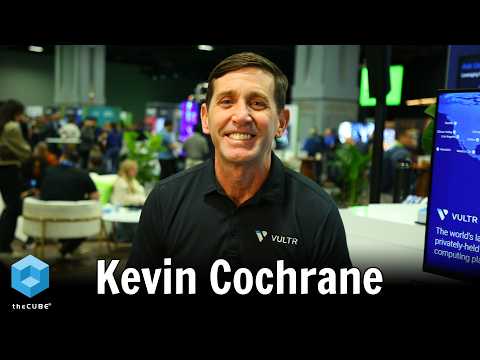
This conversation examines the transition from artificial intelligence experimentation to production. Paul Nashawaty of theCUBE Research, practice lead and principal analyst, interviews Kevin Cochrane of Vultr, chief marketing officer, at HumanX 2026 on AI infrastructure and production-ready inference.
Cochrane outlines Vultr's global AI infrastructure strategy, Graphics Processing Unit and Central Processing Unit performance-per-dollar considerations, composable AI stacks, and the role of Kubernetes and partner ecosystems in enabling enterprise-scale training and inference. They highlight regional data sovereignty requirements and the need to adopt platform engineering to industrialize AI-native applications.
Nashawaty emphasizes research showing 64% of organizations increase AI investment and the growing demand for portability governance and composability to move workloads from pilots to production.
This discussion provides practical guidance for technology leaders responsible for AI infrastructure, platform engineering and cloud computing, including model serving performance, cost optimization and data sovereignty strategies.
>> At HumanX 2026, the event drew 6,500 AI leaders, builders, and investors with a significant focus on cloud and AI infrastructure adoption for production-scale workloads, highlighting how infrastructure has become a primary bottleneck for scaling AI. My name is Paul Nashawaty. I'm a practice lead and principal analyst at theCUBE Research on the AppDev practice, and I'm joined by Kevin from Vultr. Kevin, how are you doing today?
Kevin Cochrane
>> I'm doing awesome. So great to see you again, Paul. I think the last line was in Amsterdam.
Paul Nashawaty
>> It certainly was. It's always great to have a conversation with you and talk to you, and you always bring some great insights. But let's start by having you introduce yourself and introduce Vultr.
Kevin Cochrane
>> Great. So, again, Paul, great to see you. I'm Kevin Cochrane. I'm the chief marketing officer here at Vultr. Vultr is a global leader in AI infrastructure. We started out as a public cloud platform as an alternative to the big three hyperscalers. Got a 14-year operating history, operating in over 33 cloud data center regions. And we're one of the original pioneers of taking GPUs to market in order to support ambitious enterprise AI workloads. And so, where we are today is we're a joint partner of both AMD and NVIDIA, specializing in helping enterprises optimize global training and global inference for all of their AI-native applications.
Paul Nashawaty
>> So Kevin, it's really been an exciting time. And we're here talking about HumanX, what we saw at HumanX. The momentum behind AI isn't just hype, right? We're seeing that showing up in real infrastructure decisions, just like you were talking about how Vultr supports this and drives this. What we're seeing in our industry research, we're seeing that it reveals 64% of organizations are increasing investment in AI. And machine learning is part of their broader cloud strategy, signaling a clear shift between experimentation to execution. So, we were talking about this in Amsterdam. We saw it at HumanX, but what was being discussed at HumanX really reflects this evolution where the conversations are no longer about the possible, it's about scaling, right? It's about turning AI ambitions into production-ready cloud infrastructure that really can support the next generation of application services. So, Kevin, I want to give you the mic. There's a lot to talk about here, a lot to unpack. When we look at AI infrastructure, the reality check, at HumanX, there was a clear shift from model innovation to infrastructure execution. Where do you see the biggest bottlenecks today with scaling AI workloads and how does Vultr dealing look?
Kevin Cochrane
>> Yeah, so let's take a step back because I think you're totally right, we're at a really interesting inflection point in the marketplace. We've gone from working hard to mature our understanding of what's possible with new generations of GPU, to really maturing the actual supporting software layer that we can put on top of that core infrastructure to start unlocking real possibilities for different enterprise use cases. And what was fascinating is at GTC, where this journey started this year, we saw an incredible keynote once again from Jensen, really marking this new era of AI adoption where he declared that this was now the time for enterprise inference. And NVIDIA rolled out a sequence of incredibly exciting announcements in terms of Dynamo 1.0, their Nemotron family of models, where they're going to be taking optimizations of the hardware layer for enterprise inference with Vera Rubin, and then also announcing the exciting debut of NVIDIA NemoClaw, which transforms developer and employee productivity with new ability to start automating common mundane tasks like never before. And it was fascinating because the emphasis, again, was on moving from the art of the possible to really concrete outcomes that you can start driving today using NVIDIA Dynamo, Nemotron models and unlocking new power and productivity for your workforce with NemoClaw. And then, we went straight into Amsterdam and KubeCon, which is where all the developers were that are responsible for actually translating business requirements and actually operationalizing them into new AI-native applications that actually can deliver real business results. And so, that was a really fun continuation of the conversation to see all of the worldwide community of 18,000 developers really start thinking about, well, how can they leverage all of this exciting new technologies? How can they start delivering inference at scale? And then, the wonderful thing was going to HumanX. And then, at HumanX, that's really where the conversation with business leaders around the outcomes that they were seeking to achieve, how they were going to accomplish that, and how they were going to remove the single biggest bottleneck, which is not just getting the core infrastructure in models from like an NVIDIA, not just enabling their developers to do new and exciting things, but how do you deliver the infrastructure that can scale these new systems, these new agentic systems? And so the topic of conversation with HumanX was a very fun topic for Vultr because that's what we do is we help unlock for global enterprises the ability to scale on demand, not just GPU clusters for training, which was the early market for people that were building and training frontier models, but how do you unlock full stack AI infrastructure that's inclusive of all of your inference clusters, the inference clusters, the GPUs you need to spin up in Japan, that you need to spin up in Brazil, that you need to spin up in Germany, and how do you couple that with all of the supporting CPU infrastructure and general cloud technology and cloud services to really deliver an AI-native application at global scale? So, HumanX was a wonderful capstone at a three-part series to where the market's going to be headed for the remainder of Q2 and for the second half of 2026, which is actually now delivering enterprise inference, a full stack of AI-native applications powered by a full stack of integrated AI infrastructure. And we here at Vultr could not be more excited to have this conversation with customers around the globe.
Paul Nashawaty
>> Yeah, Kevin, I think there was so much there to unpack. There's so much there to talk about. Super exciting times. And you're right, I mean when you talked about that journey of taking the different elements from, well, you saw it at GTC, taking it to KubeCon, now taking it to HumanX, and you can see all the different pieces. What I really love about Vultr's position here is the alternative hyperscaler. And given that my practice focuses predominantly on developers in the development app dev space, it's really focused around that persona. And what you were talking about is, I really want to ask two points, right? You talked about advantages, right? This is the ultimate hyperscaler strategy, but what specific advantages does models deliver for AI workloads in terms of cost performance and flexibility? But also, you touched on this from pilot to production, many enterprises remain stuck in experimentation. I was saying that 2025 was the year of experimentation and innovation. I think '26 is the year of implementation. What are your thoughts?
Kevin Cochrane
>> Yeah. Oh, I completely agree with you. So, a couple of points there. So, let's first of all talk about a core advantage of working with someone like a Vultr and it really gets down to performance per dollar. It's about operationalizing at global scale new AI-native applications that deliver superior performance with the lowest possible operational cost and the least amount of business risk because of built in compliance, security, governance, and more. When people are moving from experimentation, you're layering on an additional set of requirements to put something into production. The CISO gets involved, the CFO gets involved, the head of IOCS needs to make sure that operationally this thing scales and this thing scales without breaking the budget. Different people get involved, that we have core requirements for actually running the business in a profitable manner. And so, this is where we specialize here at Vultr, which is not just delivering the full-stack AI infrastructure your developers need, but making certain that it has a security, the governance, the compliance that's mandated by the CISO, making sure that it has the lowest possible operational cost, which is key to successfully managing the budget if you're a head of IOCS or if you're a CFO. And making certain that, again, we make sure that we deliver the best possible performance beyond anything you'll get from another cloud provider because these things matter. You're going to be investing in AI infrastructure and you need to achieve business results, and that means that you need to get bang for your buck, and that's what we deliver now here at Vultr. And I will say this conversation that we're having is not done. So, the conversation continues post-HumanX. I know you're attending SUSECON in Prague next week, right? The conversation continues at SUSECON because enterprise leaders also demand rock-solid, hardened Kubernetes infrastructure for scaling and running all of their containerized applications and models. SUSE is a beautiful partner of Vultrs, and we couldn't be more proud to partner with SUSE to ensure enterprise resilience and governance for all of their cloud-native applications. And it will continue straight through to PlatformCon and London and New York, where the platform engineers that are really responsible for ensuring operational excellence and operational productivity for development teams around the globe will be front and center speaking with them as well.
Paul Nashawaty
>> Yeah, Kevin, there's definitely a rolling thunder here for sure. And it's very appropriate. I mean, I want to touch on a couple of things you mentioned here. Well, one, you mentioned governance, compliance, regulations, and control, right? That is definitely top of mind, especially when you're talking about hyperscalers. Data sovereignty, we're going to be, as you mentioned, going to be in Europe. We're going to be talking a lot about data sovereignty. We talked about it in Amsterdam, we're going to continue to talk about that story. But also from a developer perspective, you have things like the EU CRA that's going into effect. All applications have to comply with reporting by September of this year and by end of December 2027, all applications have to comply. And people say, "Well, this is only a European impact," but it's really not. I mean, if you're using applications globally, that's an impact.
Kevin Cochrane
>> Oh, 100%.
Paul Nashawaty
>> Yeah, absolutely. For sure. The other thing you mentioned, I think, Kevin, that's really, really an... I don't want to gloss over this point because it's really important. Efficiency is a competitive metric, right? You were talking about GPUs, CPUs, and the utilization. A lot of companies don't understand that they can get going on their AI initiatives with CPUs. They think they have to have a GPU and it has to be fully provisioned. And the reality of it is that's far from truth. So, with GPUs demanding surgery costs that's under scrutiny, how should organizations really rethink the performance per dollar? And maybe we should double click a little bit on this to share with the audience around how does the role of infrastructure optimize planning in this long-term AI ROI?
Kevin Cochrane
>> Yeah. So, let's go back to both half of that. So, first of all, let's talk about the compliance angle. Every cloud-native application needs to be re-engineered, and that was what was so exciting to be at KubeCon for. And all those cloud-native applications need to become AI-native applications, which means they need to put AI services at the core. So, imagine a microservices-based architecture for all of your composable applications. Well, a new set of AI services now need to be exposed to your composable application to AI enable it. And when you're actually doing that, you're essentially rearchitecting your application. And when you're re-architecting your application, you need to do so with governance and compliance in mind. So, that means when you're re-architecting, think about what are the data sources you're marshaling to pull into your application real time to set the context for the agent to respond to a request? How are you mandating and enforcing data residency and data sovereignty? You need to think critically about that when you're re-architecting your application. When you're deploying those agents, again, think about sovereignty. Do you have all of the services running in region where your data is located or are there external dependencies on services external to that region that need to access the data, process the data, or need to run a model in order to deliver a customer response? We need to make certain that all of your applications are truly containerized applications, and that means containerized and running in a given region where all of the compute resources are located, where all of the GPU resources are located, where all of the storage is located. So, you can certify and a test that that application is fully contained and operating in that region, and there's nothing happening external to that region. And that's really what we also specialize here in Vultr is how do you think of that global governance and compliance? So, you're compliant with new and emerging regulations in the EU and elsewhere. If you're a global enterprise, you must think through this and there isn't a better time to think through this than when you're AI enabling your applications. And the next part of it is when you think through rebuilding those applications, think about the efficiency, make sure you're getting the best performance per dollar. And the best performance dollar means that you're deploying the right resources in the right region, the right CPU resources, the right GPU resources, and that leads to the best outcome. So, don't just assume that you have everything you need. Think really critically, how do you achieve the business outcome and how do you make sure that you get the most optimal performance at the lowest-possible cost?
Paul Nashawaty
>> Yeah, Kevin, absolutely. And I will say that a lot of the conversations I have, especially where my practice is about AppDev and app monetization, it's about bridging the gap between old and new. It's about bringing new applications forward. But like you said, there's a point where you refactor and sometimes the juice isn't like the sweet. Sometimes you just basically don't want to refactor because it just isn't worth it, but you have to encapsulate and then use it as a system of record, maybe build new systems of engagement. But look, you touched on the composable AI stack in the ecosystem. This is incredibly important because this is how you have enterprises moving towards a full-stack AI platform and Vultr is thinking about composability and partnerships to deliver integrated production-ready solutions across the AI lifecycle. That is something that I was very impressed with because you're not just offering a bag of bits to people. You're offering a solution that allows them to be productive right out the chute.
Kevin Cochrane
>> Exactly. We're offering access to an entire ecosystem. I think in the original move with the debut of Kubernetes towards building microservices and a cloud-native application architecture, I think unfortunately we didn't have the principles of composability in mind. Just going to a microservices architecture, being API first is necessary, but it's not sufficient because if you have interdependencies between services, if services are not interoperable with services from another third party, well, then you break the principles of composability. And if you're not composable, that means you're not portable, and that's where you actually got vendor lock-in, and that's where you got escalating cost. And so, when we're going into this new AI-native engineering world and we're building all of these new services, AI services, agentic services, let's remind ourselves, let's not just build microservices, nice API endpoint for them. Let's make sure there's no interdependencies, particularly between regions, because you cannot have any interdependencies across regions. You should not have that. You will run into compliance problems, if not now, in the future. And let's make certain that all the services you're building are interoperable. And so, what we're providing is we're providing access to an open ecosystem where we're making certain that all of our services are interchangeable, interoperable with an entire third-party community. So, you can have these open and composable stacks and you can plug and play different storage providers, you can plug and play different Kubernetes engines, so that you can build the right stack for the right initiative to get the right outcome.
Paul Nashawaty
>> Yeah. I couldn't have said it better myself. One of the things that you touched on there was portability. And we see in our 2025 research that 20% of respondents indicate that it is critical for their organizations to have application portability. So, you're onto it, I think it's great. Hey, so Kevin, we're coming to the end of our session here. Final words, what do you want to leave the audience with? There's a lot that we unpacked here, a lot to talk about. Where do they get started?
Kevin Cochrane
>> So, the most important thing is we need to start scaling with global governance and compliance, AI infrastructure, and we need to take a platform engineering approach to think about how to industrialize rolling out new AI-native applications. And the best place to start is come talk to us here at Vultr.
Paul Nashawaty
>> Kevin, always a pleasure talking to you. Your insights are invaluable. I think regardless of where people are in their journey, they can get started with Vultr. I think it's great. But Kevin, as the signal cuts through the noise here, one thing is clear, AI future won't be won at the infrastructure layer. Organizations, they really need to operationalize AI security and they also look at efficiency, as well as scale to drive to the next generation and next era of enterprise innovation. So, here at theCUBE, the leading source of enterprise technical news, we see this as a movement with a turning point where cloud data and AI converge into a single strategic priority, separating those experimentations from AI to those who truly believe in the future. Thank you for watching.
>> At HumanX 2026, the event drew 6,500 AI leaders, builders, and investors with a significant focus on cloud and AI infrastructure adoption for production-scale workloads, highlighting how infrastructure has become a primary bottleneck for scaling AI. My name is Paul Nashawaty. I'm a practice lead and principal analyst at theCUBE Research on the AppDev practice, and I'm joined by Kevin from Vultr. Kevin, how are you doing today?
Kevin Cochrane
>> I'm doing awesome. So great to see you again, Paul. I think the last line was in Amsterdam.
Paul Nashawaty
>> It certainly was. It's always great to have a conversation with you and talk to you, and you always bring some great insights. But let's start by having you introduce yourself and introduce Vultr.
Kevin Cochrane
>> Great. So, again, Paul, great to see you. I'm Kevin Cochrane. I'm the chief marketing officer here at Vultr. Vultr is a global leader in AI infrastructure. We started out as a public cloud platform as an alternative to the big three hyperscalers. Got a 14-year operating history, operating in over 33 cloud data center regions. And we're one of the original pioneers of taking GPUs to market in order to support ambitious enterprise AI workloads. And so, where we are today is we're a joint partner of both AMD and NVIDIA, specializing in helping enterprises optimize global training and global inference for all of their AI-native applications.
Paul Nashawaty
>> So Kevin, it's really been an exciting time. And we're here talking about HumanX, what we saw at HumanX. The momentum behind AI isn't just hype, right? We're seeing that showing up in real infrastructure decisions, just like you were talking about how Vultr supports this and drives this. What we're seeing in our industry research, we're seeing that it reveals 64% of organizations are increasing investment in AI. And machine learning is part of their broader cloud strategy, signaling a clear shift between experimentation to execution. So, we were talking about this in Amsterdam. We saw it at HumanX, but what was being discussed at HumanX really reflects this evolution where the conversations are no longer about the possible, it's about scaling, right? It's about turning AI ambitions into production-ready cloud infrastructure that really can support the next generation of application services. So, Kevin, I want to give you the mic. There's a lot to talk about here, a lot to unpack. When we look at AI infrastructure, the reality check, at HumanX, there was a clear shift from model innovation to infrastructure execution. Where do you see the biggest bottlenecks today with scaling AI workloads and how does Vultr dealing look?
Kevin Cochrane
>> Yeah, so let's take a step back because I think you're totally right, we're at a really interesting inflection point in the marketplace. We've gone from working hard to mature our understanding of what's possible with new generations of GPU, to really maturing the actual supporting software layer that we can put on top of that core infrastructure to start unlocking real possibilities for different enterprise use cases. And what was fascinating is at GTC, where this journey started this year, we saw an incredible keynote once again from Jensen, really marking this new era of AI adoption where he declared that this was now the time for enterprise inference. And NVIDIA rolled out a sequence of incredibly exciting announcements in terms of Dynamo 1.0, their Nemotron family of models, where they're going to be taking optimizations of the hardware layer for enterprise inference with Vera Rubin, and then also announcing the exciting debut of NVIDIA NemoClaw, which transforms developer and employee productivity with new ability to start automating common mundane tasks like never before. And it was fascinating because the emphasis, again, was on moving from the art of the possible to really concrete outcomes that you can start driving today using NVIDIA Dynamo, Nemotron models and unlocking new power and productivity for your workforce with NemoClaw. And then, we went straight into Amsterdam and KubeCon, which is where all the developers were that are responsible for actually translating business requirements and actually operationalizing them into new AI-native applications that actually can deliver real business results. And so, that was a really fun continuation of the conversation to see all of the worldwide community of 18,000 developers really start thinking about, well, how can they leverage all of this exciting new technologies? How can they start delivering inference at scale? And then, the wonderful thing was going to HumanX. And then, at HumanX, that's really where the conversation with business leaders around the outcomes that they were seeking to achieve, how they were going to accomplish that, and how they were going to remove the single biggest bottleneck, which is not just getting the core infrastructure in models from like an NVIDIA, not just enabling their developers to do new and exciting things, but how do you deliver the infrastructure that can scale these new systems, these new agentic systems? And so the topic of conversation with HumanX was a very fun topic for Vultr because that's what we do is we help unlock for global enterprises the ability to scale on demand, not just GPU clusters for training, which was the early market for people that were building and training frontier models, but how do you unlock full stack AI infrastructure that's inclusive of all of your inference clusters, the inference clusters, the GPUs you need to spin up in Japan, that you need to spin up in Brazil, that you need to spin up in Germany, and how do you couple that with all of the supporting CPU infrastructure and general cloud technology and cloud services to really deliver an AI-native application at global scale? So, HumanX was a wonderful capstone at a three-part series to where the market's going to be headed for the remainder of Q2 and for the second half of 2026, which is actually now delivering enterprise inference, a full stack of AI-native applications powered by a full stack of integrated AI infrastructure. And we here at Vultr could not be more excited to have this conversation with customers around the globe.
Paul Nashawaty
>> Yeah, Kevin, I think there was so much there to unpack. There's so much there to talk about. Super exciting times. And you're right, I mean when you talked about that journey of taking the different elements from, well, you saw it at GTC, taking it to KubeCon, now taking it to HumanX, and you can see all the different pieces. What I really love about Vultr's position here is the alternative hyperscaler. And given that my practice focuses predominantly on developers in the development app dev space, it's really focused around that persona. And what you were talking about is, I really want to ask two points, right? You talked about advantages, right? This is the ultimate hyperscaler strategy, but what specific advantages does models deliver for AI workloads in terms of cost performance and flexibility? But also, you touched on this from pilot to production, many enterprises remain stuck in experimentation. I was saying that 2025 was the year of experimentation and innovation. I think '26 is the year of implementation. What are your thoughts?
Kevin Cochrane
>> Yeah. Oh, I completely agree with you. So, a couple of points there. So, let's first of all talk about a core advantage of working with someone like a Vultr and it really gets down to performance per dollar. It's about operationalizing at global scale new AI-native applications that deliver superior performance with the lowest possible operational cost and the least amount of business risk because of built in compliance, security, governance, and more. When people are moving from experimentation, you're layering on an additional set of requirements to put something into production. The CISO gets involved, the CFO gets involved, the head of IOCS needs to make sure that operationally this thing scales and this thing scales without breaking the budget. Different people get involved, that we have core requirements for actually running the business in a profitable manner. And so, this is where we specialize here at Vultr, which is not just delivering the full-stack AI infrastructure your developers need, but making certain that it has a security, the governance, the compliance that's mandated by the CISO, making sure that it has the lowest possible operational cost, which is key to successfully managing the budget if you're a head of IOCS or if you're a CFO. And making certain that, again, we make sure that we deliver the best possible performance beyond anything you'll get from another cloud provider because these things matter. You're going to be investing in AI infrastructure and you need to achieve business results, and that means that you need to get bang for your buck, and that's what we deliver now here at Vultr. And I will say this conversation that we're having is not done. So, the conversation continues post-HumanX. I know you're attending SUSECON in Prague next week, right? The conversation continues at SUSECON because enterprise leaders also demand rock-solid, hardened Kubernetes infrastructure for scaling and running all of their containerized applications and models. SUSE is a beautiful partner of Vultrs, and we couldn't be more proud to partner with SUSE to ensure enterprise resilience and governance for all of their cloud-native applications. And it will continue straight through to PlatformCon and London and New York, where the platform engineers that are really responsible for ensuring operational excellence and operational productivity for development teams around the globe will be front and center speaking with them as well.
Paul Nashawaty
>> Yeah, Kevin, there's definitely a rolling thunder here for sure. And it's very appropriate. I mean, I want to touch on a couple of things you mentioned here. Well, one, you mentioned governance, compliance, regulations, and control, right? That is definitely top of mind, especially when you're talking about hyperscalers. Data sovereignty, we're going to be, as you mentioned, going to be in Europe. We're going to be talking a lot about data sovereignty. We talked about it in Amsterdam, we're going to continue to talk about that story. But also from a developer perspective, you have things like the EU CRA that's going into effect. All applications have to comply with reporting by September of this year and by end of December 2027, all applications have to comply. And people say, "Well, this is only a European impact," but it's really not. I mean, if you're using applications globally, that's an impact.
Kevin Cochrane
>> Oh, 100%.
Paul Nashawaty
>> Yeah, absolutely. For sure. The other thing you mentioned, I think, Kevin, that's really, really an... I don't want to gloss over this point because it's really important. Efficiency is a competitive metric, right? You were talking about GPUs, CPUs, and the utilization. A lot of companies don't understand that they can get going on their AI initiatives with CPUs. They think they have to have a GPU and it has to be fully provisioned. And the reality of it is that's far from truth. So, with GPUs demanding surgery costs that's under scrutiny, how should organizations really rethink the performance per dollar? And maybe we should double click a little bit on this to share with the audience around how does the role of infrastructure optimize planning in this long-term AI ROI?
Kevin Cochrane
>> Yeah. So, let's go back to both half of that. So, first of all, let's talk about the compliance angle. Every cloud-native application needs to be re-engineered, and that was what was so exciting to be at KubeCon for. And all those cloud-native applications need to become AI-native applications, which means they need to put AI services at the core. So, imagine a microservices-based architecture for all of your composable applications. Well, a new set of AI services now need to be exposed to your composable application to AI enable it. And when you're actually doing that, you're essentially rearchitecting your application. And when you're re-architecting your application, you need to do so with governance and compliance in mind. So, that means when you're re-architecting, think about what are the data sources you're marshaling to pull into your application real time to set the context for the agent to respond to a request? How are you mandating and enforcing data residency and data sovereignty? You need to think critically about that when you're re-architecting your application. When you're deploying those agents, again, think about sovereignty. Do you have all of the services running in region where your data is located or are there external dependencies on services external to that region that need to access the data, process the data, or need to run a model in order to deliver a customer response? We need to make certain that all of your applications are truly containerized applications, and that means containerized and running in a given region where all of the compute resources are located, where all of the GPU resources are located, where all of the storage is located. So, you can certify and a test that that application is fully contained and operating in that region, and there's nothing happening external to that region. And that's really what we also specialize here in Vultr is how do you think of that global governance and compliance? So, you're compliant with new and emerging regulations in the EU and elsewhere. If you're a global enterprise, you must think through this and there isn't a better time to think through this than when you're AI enabling your applications. And the next part of it is when you think through rebuilding those applications, think about the efficiency, make sure you're getting the best performance per dollar. And the best performance dollar means that you're deploying the right resources in the right region, the right CPU resources, the right GPU resources, and that leads to the best outcome. So, don't just assume that you have everything you need. Think really critically, how do you achieve the business outcome and how do you make sure that you get the most optimal performance at the lowest-possible cost?
Paul Nashawaty
>> Yeah, Kevin, absolutely. And I will say that a lot of the conversations I have, especially where my practice is about AppDev and app monetization, it's about bridging the gap between old and new. It's about bringing new applications forward. But like you said, there's a point where you refactor and sometimes the juice isn't like the sweet. Sometimes you just basically don't want to refactor because it just isn't worth it, but you have to encapsulate and then use it as a system of record, maybe build new systems of engagement. But look, you touched on the composable AI stack in the ecosystem. This is incredibly important because this is how you have enterprises moving towards a full-stack AI platform and Vultr is thinking about composability and partnerships to deliver integrated production-ready solutions across the AI lifecycle. That is something that I was very impressed with because you're not just offering a bag of bits to people. You're offering a solution that allows them to be productive right out the chute.
Kevin Cochrane
>> Exactly. We're offering access to an entire ecosystem. I think in the original move with the debut of Kubernetes towards building microservices and a cloud-native application architecture, I think unfortunately we didn't have the principles of composability in mind. Just going to a microservices architecture, being API first is necessary, but it's not sufficient because if you have interdependencies between services, if services are not interoperable with services from another third party, well, then you break the principles of composability. And if you're not composable, that means you're not portable, and that's where you actually got vendor lock-in, and that's where you got escalating cost. And so, when we're going into this new AI-native engineering world and we're building all of these new services, AI services, agentic services, let's remind ourselves, let's not just build microservices, nice API endpoint for them. Let's make sure there's no interdependencies, particularly between regions, because you cannot have any interdependencies across regions. You should not have that. You will run into compliance problems, if not now, in the future. And let's make certain that all the services you're building are interoperable. And so, what we're providing is we're providing access to an open ecosystem where we're making certain that all of our services are interchangeable, interoperable with an entire third-party community. So, you can have these open and composable stacks and you can plug and play different storage providers, you can plug and play different Kubernetes engines, so that you can build the right stack for the right initiative to get the right outcome.
Paul Nashawaty
>> Yeah. I couldn't have said it better myself. One of the things that you touched on there was portability. And we see in our 2025 research that 20% of respondents indicate that it is critical for their organizations to have application portability. So, you're onto it, I think it's great. Hey, so Kevin, we're coming to the end of our session here. Final words, what do you want to leave the audience with? There's a lot that we unpacked here, a lot to talk about. Where do they get started?
Kevin Cochrane
>> So, the most important thing is we need to start scaling with global governance and compliance, AI infrastructure, and we need to take a platform engineering approach to think about how to industrialize rolling out new AI-native applications. And the best place to start is come talk to us here at Vultr.
Paul Nashawaty
>> Kevin, always a pleasure talking to you. Your insights are invaluable. I think regardless of where people are in their journey, they can get started with Vultr. I think it's great. But Kevin, as the signal cuts through the noise here, one thing is clear, AI future won't be won at the infrastructure layer. Organizations, they really need to operationalize AI security and they also look at efficiency, as well as scale to drive to the next generation and next era of enterprise innovation. So, here at theCUBE, the leading source of enterprise technical news, we see this as a movement with a turning point where cloud data and AI converge into a single strategic priority, separating those experimentations from AI to those who truly believe in the future. Thank you for watching.






 Paul Nashawaty