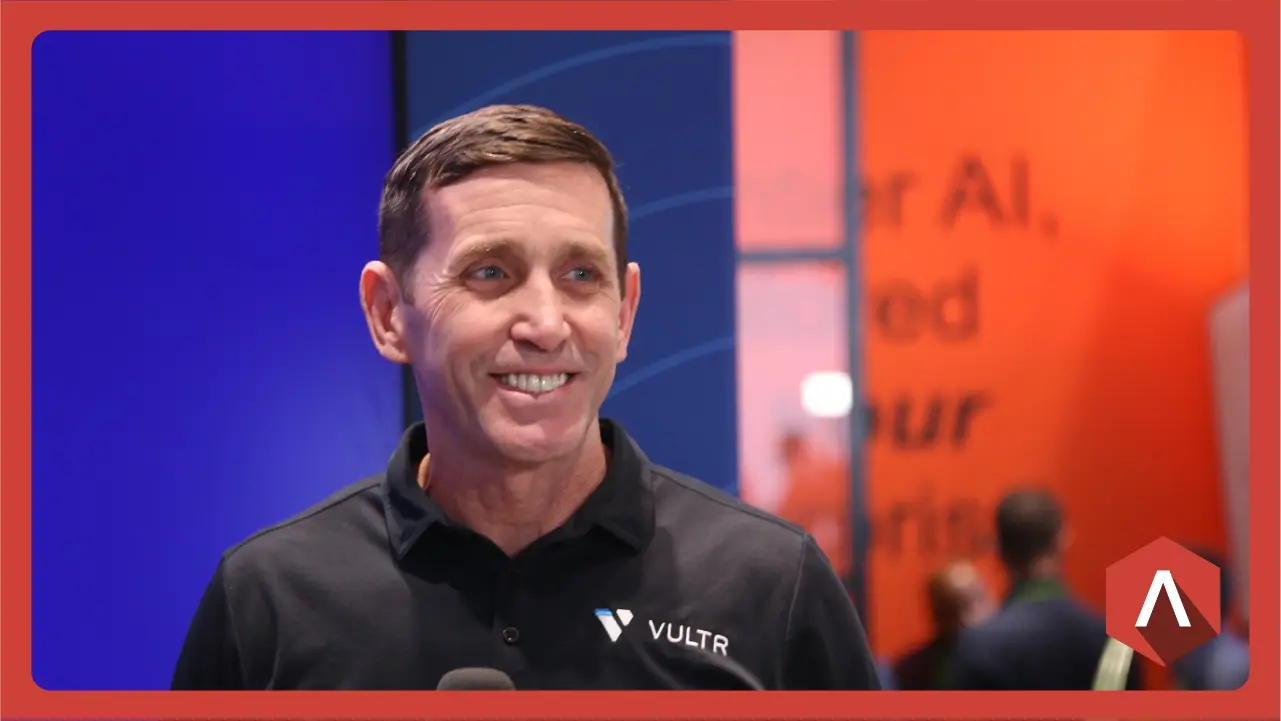
In this interview from the Nvidia GTC AI Conference and Expo in San Jose, Kevin Cochrane, chief marketing officer of Vultr, joins theCUBE + NYSE Wired's Gemma Allen to discuss how the "alternative hyperscaler" is positioning itself at the center of the global AI infrastructure buildout. Cochrane explains why raw GPU access is no longer enough — developers need a vertically integrated yet horizontally open stack with recipes, ecosystem flexibility and transparent pricing. Operating across 33 data center regions on six continents, Vultr is betting its developer-first DNA gives it a distinct edge as enterprises and national governments scale agentic systems worldwide.
The conversation also explores the rapidly expanding case for sovereign cloud, with Cochrane arguing that every national government must treat AI infrastructure as a public utility alongside water, power and energy. He highlights Vultr's unique architecture, which allows each region to run autonomously with a bespoke, single-tenant control plane for isolated government deployments. Cochrane also unpacks Jensen Huang's projection of $1 trillion in Blackwell and Vera Rubin purchase orders by end of 2027, framing the figure as an underestimate given that every supply chain, manufacturing line and digital application will ultimately be rebuilt for AI. From global inference infrastructure for enterprise-scale agentic systems to a seven-day free trial of NVIDIA NemoClaw on Vultr, Cochrane provides a practical roadmap for how developers and governments alike can tap into the next wave of AI-driven innovation.
Forgot Password
Almost there!
We just sent you a verification email. Please verify your account to gain access to
Scaling Enterprise Agentic AI with Vultr. If you don’t think you received an email check your
spam folder.
Sign in to Scaling Enterprise Agentic AI with Vultr.
In order to sign in, enter the email address you used to registered for the event. Once completed, you will receive an email with a verification link. Open the link to automatically sign into the site.
Register for Scaling Enterprise Agentic AI with Vultr
Please fill out the information below. You will receive an email with a verification link confirming your registration. Click the link to automatically sign into the site.
You’re almost there!
We just sent you a verification email. Please click the verification button in the email. Once your email address is verified, you will have full access to all event content for Scaling Enterprise Agentic AI with Vultr.
I want my badge and interests to be visible to all attendees.
Checking this box will display your presense on the attendees list, view your profile and allow other attendees to contact you via 1-1 chat. Read the Privacy Policy. At any time, you can choose to disable this preference.
Select your Interests!
add
Upload your photo
Uploading..
OR
Connect via Twitter
Connect via Linkedin
EDIT PASSWORD
Share
Forgot Password
Almost there!
We just sent you a verification email. Please verify your account to gain access to
Scaling Enterprise Agentic AI with Vultr. If you don’t think you received an email check your
spam folder.
Sign in to Scaling Enterprise Agentic AI with Vultr.
In order to sign in, enter the email address you used to registered for the event. Once completed, you will receive an email with a verification link. Open the link to automatically sign into the site.
Sign in to gain access to Scaling Enterprise Agentic AI with Vultr
Please sign in with LinkedIn to continue to Scaling Enterprise Agentic AI with Vultr. Signing in with LinkedIn ensures a professional environment.
Are you sure you want to remove access rights for this user?
Details
Manage Access
email address
Community Invitation
Kevin Cochrane, Vultr | NVIDIA GTC 2026
Kevin Cochrane of Vultr, chief marketing officer, joins Gemma Allen of theCUBE
at NVIDIA GTC 2026 to discuss artificial intelligence infrastructure, developer
experience and inference at scale, and sovereign cloud strategies. Cochrane
draws on more than a decade of global cloud operations to discuss GPU access and
pricing, developer-focused tooling and recipes, NemoClaw adoption and how
Vultr's 33-plus region footprint supports enterprise and sovereign deployments.
They emphasize a vertically integrated and horizontally open stack that pairs
recipes with ecosystem choice and the importance of global inference
infrastructure with enterprise-grade security and compliance. They assert that
developer adoption drives significant AI infrastructure investment and that
hybrid multi-cloud and sovereign cloud strategies remain critical. They
highlight Vultr's developer-first pricing and NemoClaw trial availability.
theCUBE Research produces the conversation and Gemma Allen hosts.
In this interview from the Nvidia GTC AI Conference and Expo in San Jose, Kevin Cochrane, chief marketing officer of Vultr, joins theCUBE + NYSE Wired's Gemma Allen to discuss how the "alternative hyperscaler" is positioning itself at the center of the global AI infrastructure buildout. Cochrane explains why raw GPU access is no longer enough — developers need a vertically integrated yet horizontally open stack with recipes, ecosystem flexibility and transparent pricing. Operating across 33 data center regions on six continents, Vultr is betting its developer...Read more
exploreKeep Exploring
What is Vultr, what services does it provide, and why is this moment exciting for the company?add
What cloud strategy should enterprises and national governments adopt with respect to hyperscalers and multi-cloud/hybrid architectures?add
How does Vultr enable sovereign cloud on demand for national governments and private institutions, and why is sovereign cloud important for global AI infrastructure?add
>> Welcome back to theCUBE here on the ground in San Jose, GTC. NVIDIA 2026. Energy is absolutely possible. I'm here at the Vultr Booth and joining me is CMO of Vultr, Kevin Cochrane. Welcome to theCUBE.
Kevin Cochrane
>> I'm so glad to be here.
Gemma Allen
>> So Kevin, Vultr has been around quite a while, right? 11 years pre the neocloud terminology per se. Quite the journey.
Kevin Cochrane
>> Yes.
Gemma Allen
>> Talk to me about this moment we're in right now. Big announcements from Jensen this morning.
Kevin Cochrane
>> Well, this is a very exciting moment for us here at Vultr. So as you noted, Vultr, over 14 year operating history. We're a global cloud platform. We are what we call the alternative hyperscaler. That means we have all of the core public cloud services that are required by both developers, enterprises, and national governments. And we're a specialist obviously in AI infrastructure. We operate over 33 global data center regions across all six continents. And of course, with the 14 year operating history, we have all of the compliance and all of the safety and the security that enterprises need when they're building and deploying enterprise AI at global scale. And what's most exciting for us about this moment is we add our roots in appealing to developers all around the world to democratize access to world-class cloud infrastructure with the lowest possible cost and the highest possible performance. And for us today, what we see is that the new battleground for AI is unlocking developers everywhere around the planet, giving them access to the highest performance infrastructure from NVIDIA with the most incredible performance so they can build and create the future.
Gemma Allen
>> And how is the way in which you continue to appeal to developers changing? We know that there has been opaque pricing models by hyperscalers.
Kevin Cochrane
>> Yeah.
Gemma Allen
>> You guys offer a very, I guess, opportunistic model in the per hour rate for developers. We also know that access to GPUs is a huge challenge, especially for edge players, right?
Kevin Cochrane
>> Right.
Gemma Allen
>> So what is really important? We talk a lot about speed, scale. What is it that you think gives you unique advantage at this moment?
Kevin Cochrane
>> Well, I think there's a couple things. And to your point, up until now, the game has really been about access and availability of GPUs. And we here at Vultr have always focused on the developer experience. What do developers need? They don't just need access. They don't just need availability. They don't just need the best performance. They actually need what Jensen talked about. What Jensen talked about today is they need a vertically integrated, horizontally open stack. The vertical integration means they need recipes. They need examples of all of the different things that they can build and deploy on Vultr infrastructure on NVIDIA GPUs. And they need an open ecosystem. They need a horizontally open ecosystem so they can pick and choose all of the third party services that they need to build in their stack. And so here at Vultr, what we specialize in is not just the access. It's not just the performance. It's not just the availability. It's just not the open transparent pricing. It's giving them all of the vertical recipes for different use cases and having the biggest, broadest ecosystem so they have freedom, choice, and flexibility.
Gemma Allen
>> One thing Jensen talked a lot about this morning is inference, right?
Kevin Cochrane
>> Yes.
Gemma Allen
>> You have talked about inference at scale, scaling outward. What exactly does that look like six months from now?
Kevin Cochrane
>> Well, six months from now, what it looks like is people are going to be building and deploying AI systems truly to run global business. Here today, we learned all about NemoClaw and it's so exciting what people are starting to spin up to start automating a lot of personal tasks and a lot of personal coding tours, and so on and so forth. This is now going to get adopted by the enterprise, and enterprise systems run planet wide. If you're a global 1000 organization, you have employees, you have customers everywhere in the world. So your agents are going to be running everywhere where your customers are. And this is what we do here at Vultr. We provide global inference infrastructure, running in over 33 global data center regions with all of the security and all of the compliance that's required when you're deploying at enterprise scale.
Gemma Allen
>> Jensen also talked some big numbers this morning. $1 trillion in purchase orders of Blackwell and Vera Rubin by the end of 2027.
Kevin Cochrane
>> Right.
Gemma Allen
>> I mean, some people can't even write a trillion dollars down, right? It's insane to think about the absolute enormity of this. Talk about how that plays into Vultr's hands.
Kevin Cochrane
>> Well, I don't think the number should be any surprising. We've seen massive build out of infrastructure in the past. Even during the early days of web, we saw hundreds of billions of dollars of infrastructure and spend by enterprises as they were rebuilding their data centers, moving racks into colo, and rebuilding all of their client server and mainframe applications and building new web applications. There was hundreds of billions of dollars a year spent on that. A trillion dollars in one year for AI infrastructure, it doesn't actually blow my mind. I think Jensen made the further point, which is he's underestimating the demand that's even out there, and he's completely right on that. Everything that we know and do today in the digital world and in the physical world, it's all going to get rebuilt. Everything. Every supply chain, every manufacturing line, every car, every mobile phone, everything is going to get rebuilt. A trillion dollars is underestimating it. And why this plays to us is because it's going to get built by someone, it's going to get built by a developer. And that is what we do. We have the best developer experience. And the developers are going to live and work everywhere around the planet. That's why we go all around the planet and run 250,000 hackathons. Developers live everywhere. And the systems are going to run everywhere. They're going to run in every single country. And this is why we have so many global data center regions, and this is why we're a specialist in sovereign cloud infrastructure as well.
Gemma Allen
>> Let's talk about where those developers operate at, specifically the hyperscalers.
Kevin Cochrane
>> Yeah.
Gemma Allen
>> Jensen also mentioned that Vera Rubin will have a preferred partnership with Azure. The hyperscalers are at an interesting point too. They're also at an inflection point from the perspective of competing with neocloud players, because up until this point, has certain types of business really been a priority for them, perhaps not, right?
Kevin Cochrane
>> Right.
Gemma Allen
>> Where do you see their trajectory going?
Kevin Cochrane
>> Well, I think Jensen had the point, he had the pie chart, which said 60% of the business is coming from the hyperscalers and 40% is coming from a mix of enterprises and developers and sovereign cloud, and so on and so forth. I think that pie chart's likely going to flip 60/40 in the other direction here in the next year or so. But look, the hyperscalers are wonderful partners for us, and they're wonderful partners for every single enterprise and for every single national government around the globe. Every single enterprise, every single national government needs to have a relationship with all of the big three hyperscalers and use them for different workloads where it's appropriate. And what we believe is we believe in the future of a hybrid multi-cloud architecture where you're running not just all three of the major hyperscalers, but you're also running alternative hyperscalers like Vultr, and you're actually deploying your workloads on the infrastructure that's best suited to drive that specific use case, that gives you the best performance at the lowest possible cost, that enables the best developer experience for rapid iterations and rapid product cycles. So we believe that Azure as a preferred partner, wonderful. That's awesome. Multi-cloud world, a hybrid cloud world, that's the future we're moving towards, and it's only going to increase as more enterprises and national governments continue to build and deploy agentic systems.
Gemma Allen
>> Let's talk about national government, specifically sovereign cloud.
Kevin Cochrane
>> Yeah.
Gemma Allen
>> So your customer base is changing, I guess, pretty rapidly. We're hearing a lot about sovereign cloud, a lot about devices on the edge. From a Vultr perspective, how are you guys supporting and enabling these businesses?
Kevin Cochrane
>> Right. So we are one of the early pioneers of sovereign cloud on demand. So we have a unique architecture at Vultr, which means each of our regions can run autonomously and we have the ability to deploy our control plane as a bespoke offering in an isolated single tenant environment for any sort of national government. Also for private institutions as well. So Jensen made the really key point that sovereign cloud is a priority because AI infrastructure needs to be adopted everywhere around the planet and we couldn't agree more. It gets back to our roots. It was all about democratizing access to world-class cloud compute for developers wherever they lived and worked. We believe every single national government needs to have a sovereign cloud strategy. Every single national government needs to be deploying AI to improve their citizen experience, to improve citizen services. The agentic systems that they're deploying to protect and enhance the quality of life of their citizenry, that needs to be safe. That needs to be secure. They need to own their own AI infrastructure.
Gemma Allen
>> For sure.
Kevin Cochrane
>> Every single government around the globe. So I believe that every single national government must have an AI policy. They need to invest in AI. It's a public service. It's a utility. If you're a national government, you invest in water and sewage and power, you need to invest in AI.
Gemma Allen
>> Fabric of society.
Kevin Cochrane
>> It's a fabric of society. Well said.
Gemma Allen
>> It's a company that was built by developers for developers.
Kevin Cochrane
>> Right.
Gemma Allen
>> How is this changing? How is your buyer persona changing in 2026?
Kevin Cochrane
>> I mean, everyone's a developer. We're all creators now.
Gemma Allen
>> Are they though? Are they?
Kevin Cochrane
>> This is why we are now offering seven day free trial access to NVIDIA NemoClaw here at Vultr. Seven day free trial access to NVIDIA NemoClaw. You heard it here. Build.NVIDIA.com. Click on the little Vultr icon. Best performant NemoClaw infrastructure on the planet, only takes two minutes to spin up and you're ready to go. Everyone's a developer. And you too are going to get a NemoClaw account before we're done.
Gemma Allen
>> I can see why you're in a marketing role, Kevin. You certainly deliver it with slick. So tell me what's ahead for you this week here at GTC and for the rest of 2026.
Kevin Cochrane
>> Well, amazing. As we talked about, it's all about open ecosystem. And so what I do here is I spend all of my time with our customers and partners and they come into our booth and they present what they're unlocking on Vultr and where they're headed. And it's just amazing. We just heard from Koyeb, the longstanding partner of ours, just recently acquired by Mistral. Incredible what they do with deploying sandboxes on Vultr worldwide so people can leverage NVIDIA NemoClaw in a safe, secure sandbox environment. And that is just one of so many people that are going to be here in the booth. So the actions here in the Vultr Booth, this is where I'll be and I'm going to be listening and learning and having a great time.
Gemma Allen
>> And I got to tell you, you win the award for best stuffy because my daughter sleeps with one of these.
Kevin Cochrane
>> Oh my God, yes.
Gemma Allen
>> I brought it home from Paris last year.
Kevin Cochrane
>> Oh my God. This little cutie is a real cutie.
Gemma Allen
>> It's a Vultr, right?
Kevin Cochrane
>> As much as I think people love Vultr and love our platform, I actually think that half of our customers buy us just because they want extra plushies. It's our number one support request.
Gemma Allen
>> Wow.
Kevin Cochrane
>> Because obviously we have no support tickets because our platform's awesome, and it just works and it's super resilient and highly performant. When we get a support request, it's usually from a small child that's lost or plushy and can't sleep at night.
Gemma Allen
>> Well, you certainly have a little child in Brooklyn who loves her one.
Kevin Cochrane
>> Awesome.
Gemma Allen
>> So thank you so much.
Kevin Cochrane
>> Thank you so much.
Gemma Allen
>> Kevin, thank you so much for chatting.
Kevin Cochrane
>> It's great seeing you again. Take care.
Gemma Allen
>> You too. I'm Gemma Allen here at the Vultr booth on the floor in San Jose, NVIDIA GTC 2026. All the action is here. Thanks so much for watching.









 Gemma Allen