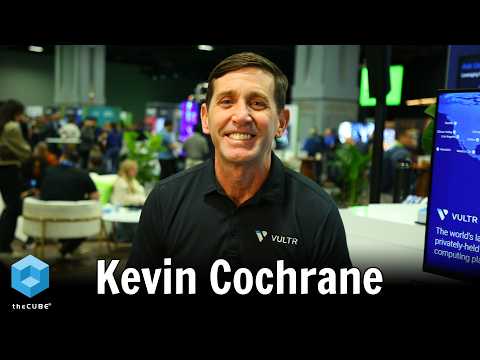
In this interview from AMD Advancing AI 2026 in San Francisco, Kevin Cochrane, chief marketing officer of Vultr Holdings LLC, joins theCUBE's Dave Vellante to discuss how the alternative cloud provider is deepening its partnership with AMD to challenge the hyperscalers on price and performance. Cochrane traces Vultr's history from EPYC-powered cloud compute to the new Instinct GPU line and Helios rack-scale architecture, crediting AMD's predictable roadmap for making long-term capacity planning possible. He details how Vultr delivers up to 33% better performance at an average of 82% lower cost than competitors, and explains why long-term enterprise contracts—not speculative capacity—are fueling the company's rapid, profitable expansion across 33 global regions.
The conversation explores the operational complexity of scaling data centers worldwide, from land and power constraints to the shift from centralized training clusters toward distributed, low-latency inference infrastructure. Cochrane makes the case that sovereign AI infrastructure is becoming as essential as telecom or utilities, extending beyond national governments to enterprises with regional compliance needs. He also unpacks Vultr's open, composable stack strategy, highlighting a new joint solution with AMD, VAST Data and SUSE that lets customers deploy full AI tech stacks—for use cases like protein folding—in seconds, with fully swappable components. From betting on open ecosystems over walled gardens to prioritizing customer choice at every layer, Cochrane outlines why openness is Vultr's most durable competitive advantage.
Forgot Password
Almost there!
We just sent you a verification email. Please verify your account to gain access to
Scaling Enterprise Agentic AI with Vultr. If you don’t think you received an email check your
spam folder.
Sign in to Scaling Enterprise Agentic AI with Vultr.
In order to sign in, enter the email address you used to registered for the event. Once completed, you will receive an email with a verification link. Open the link to automatically sign into the site.
Register for Scaling Enterprise Agentic AI with Vultr
Please fill out the information below. You will receive an email with a verification link confirming your registration. Click the link to automatically sign into the site.
You’re almost there!
We just sent you a verification email. Please click the verification button in the email. Once your email address is verified, you will have full access to all event content for Scaling Enterprise Agentic AI with Vultr.
I want my badge and interests to be visible to all attendees.
Checking this box will display your presense on the attendees list, view your profile and allow other attendees to contact you via 1-1 chat. Read the Privacy Policy. At any time, you can choose to disable this preference.
Select your Interests!
add
Upload your photo
Uploading..
OR
Connect via Twitter
Connect via Linkedin
EDIT PASSWORD
Share
Forgot Password
Almost there!
We just sent you a verification email. Please verify your account to gain access to
Scaling Enterprise Agentic AI with Vultr. If you don’t think you received an email check your
spam folder.
Sign in to Scaling Enterprise Agentic AI with Vultr.
In order to sign in, enter the email address you used to registered for the event. Once completed, you will receive an email with a verification link. Open the link to automatically sign into the site.
Sign in to gain access to Scaling Enterprise Agentic AI with Vultr
Please sign in with LinkedIn to continue to Scaling Enterprise Agentic AI with Vultr. Signing in with LinkedIn ensures a professional environment.
Are you sure you want to remove access rights for this user?
Details
Manage Access
email address
Community Invitation
Kevin Cochrane, Vultr | AMD Advancing AI 2026
In this interview from AMD Advancing AI 2026 in San Francisco, Kevin Cochrane, chief marketing officer of Vultr Holdings LLC, joins theCUBE's Dave Vellante to discuss how the alternative cloud provider is deepening its partnership with AMD to challenge the hyperscalers on price and performance. Cochrane traces Vultr's history from EPYC-powered cloud compute to the new Instinct GPU line and Helios rack-scale architecture, crediting AMD's predictable roadmap for making long-term capacity planning possible. He details how Vultr delivers up to 33% better performance at an average of 82% lower cost than competitors, and explains why long-term enterprise contracts—not speculative capacity—are fueling the company's rapid, profitable expansion across 33 global regions.
The conversation explores the operational complexity of scaling data centers worldwide, from land and power constraints to the shift from centralized training clusters toward distributed, low-latency inference infrastructure. Cochrane makes the case that sovereign AI infrastructure is becoming as essential as telecom or utilities, extending beyond national governments to enterprises with regional compliance needs. He also unpacks Vultr's open, composable stack strategy, highlighting a new joint solution with AMD, VAST Data and SUSE that lets customers deploy full AI tech stacks—for use cases like protein folding—in seconds, with fully swappable components. From betting on open ecosystems over walled gardens to prioritizing customer choice at every layer, Cochrane outlines why openness is Vultr's most durable competitive advantage.
In this interview from AMD Advancing AI 2026 in San Francisco, Kevin Cochrane, chief marketing officer of Vultr Holdings LLC, joins theCUBE's Dave Vellante to discuss how the alternative cloud provider is deepening its partnership with AMD to challenge the hyperscalers on price and performance. Cochrane traces Vultr's history from EPYC-powered cloud compute to the new Instinct GPU line and Helios rack-scale architecture, crediting AMD's predictable roadmap for making long-term capacity planning possible. He details how Vultr delivers up to 33% better performa...Read more
exploreKeep Exploring
Has AMD reliably delivered on its product roadmaps and commitments?add
How do partnerships with firms like AMD contribute to your cloud platform’s ability to deliver superior price‑to‑performance (for CPU, GPU, networking, and storage) across your global regions?add
Why is the company rapidly expanding its CPU and GPU fleets and investing in next‑generation VX1 cloud compute infrastructure?add
What is your company's strategy for providing AI infrastructure and supporting an open ecosystem of models, services, and partners?add
How does the end-to-end solution come together — who provides the storage/data and compute, what handles orchestration and security, and is it available as a click-to-deploy, composable offering in your marketplace?add
>> Hi everybody, welcome back to Moscone West, day two of AMD's Advancing AI. We're deep into day two. I'm Dave Vellante, and you're watching theCUBE's live coverage. Kevin Cochrane is here, theCUBE alum. He's the CMO of Vultr. Super excited to have you back.
Kevin Cochrane
>> So excited to be here with you. It's a good show. It's a great show.
Dave Vellante
>> We're traveling in July. We don't usually do that, but I'm so glad that we're here. AMD set up this great set for us and a lot of action, a lot of energy at this event. Lisa's keynote this morning, wow, she was pretty forceful and convincing.
Kevin Cochrane
>> Yeah, she knocked it out of the park. We were very excited not only to see all of the new Helios rack architecture and the MI455X, but also to see all of the innovation across the EPYC product line, across the Pensando product line, and of course, a teasing of the roadmap and what's to come next year.
Dave Vellante
>> Well, they've got to do that, right? For partners like you, you have to have a clear understanding of what's coming. I'll ask you, how has AMD's say-do ratio been? have they generally, from your perspective, done what they say they're going to do?
Kevin Cochrane
>> Well, I think, we've been long-standing partners for AMD. You know, here at Vultr, we're a full public cloud platform that initially built the business on its core cloud compute, all centered around AMD data center CPUs. And so our history with AMD goes back to their roadmap for EPYC, which was a very predictable, reliable roadmap, where there was each successive generation of EPYC that delivered generational improvements in performance and efficiency. Which of course, that translated to value for our customers because we deliver greater performance and efficiency to our customers, which is our core value proposition. So what you're seeing with the Instinct product line is that same year over year execution against a well-defined roadmap happening with Instinct, and now happening with the Helios rack-scale architecture. So as Lisa mentioned, they're committed every year to bringing out a new generation of Helios rack-scale architecture. So it's a very predictable roadmap and for us, that makes it very easy for us to say, okay, that's what's next, that's what's next, and start planning for the future.
Dave Vellante
>> Okay, so let me follow up on that, Kevin, because you guys position yourself as an alternative to the hyperscalers.
Dave Vellante
>> Correct.
Dave Vellante
>> You just mentioned that you started your journey with AMD with CPUs, of course, before they were ramping up their GPUs, but you got hyperscalers all building their own silicon now. So how do you differentiate, how do you maintain price performance advantages, cost per token advantages? I presume part of that answer is partnerships with firms like AMD, but take us through that.
Kevin Cochrane
>> Yeah, so as we mentioned, we're a full public cloud platform, so that's the combination of core cloud compute, networking storage, and of course, cloud GPU and all of the specialized networking and storage necessary to build and scale large-scale training and inference clusters. And of course, we do this worldwide, 33 operating regions all around the globe, all six continents. But the key there is deep partnership with AMD. So as an alternative hyperscaler, our key value proposition is price to performance. We deliver the greatest performance with the greatest cost efficiency in the business. So in traditional cloud compute for example, we'll deliver up to 33 % better performance at 82 % on average lower cost. Which is remarkable actually when you look at it. The economics cannot be beat. And the way we do that isn't custom silicon. What we do is we work closely with AMD on every subsequent generation of EPYC CPU processors and now the Instinct GPU processors to make certain that we always have the price, the performance per dollar advantage over anything else in the industry. So again, it's that deep partnership with AMD leveraging all of their incredible work, generational performance improvements in all of their lines of processors, and then again, translating that into the value we deliver to customers through our cloud.
Dave Vellante
>> We saw Google's earnings last night. They crossed the do not cross line, $200 billion in CapEx. Everybody's freaking out about that. I think I remember from one of our last conversations, you guys have taken a different philosophy in terms of, not trying to load up on tons of debt and just being more prescriptive about how you approach it. I wonder if you could describe that. What is the state of that business model today?
Kevin Cochrane
>> Yeah, so we're very rapidly expanding both our CPU and GPU fleets for this new era of agentic AI. I think one of the things that people maybe didn't understand about our business, even just a year ago, was we took to market our next generation cloud compute, top of the line cloud compute offering, which we call VX1, which was based on the latest generation EPYC processor. where people didn't understand, why are you investing so heavily to roll out, all of these new CPU fleets worldwide? And the answer was agentic AI. Because, as we like to say, it's not that the CPU is back, it's that the CPU never went away. It now just breathes new life because we have new types of workloads that we need to deploy. So we're rapidly scaling our business. And the good news is our business is getting rapidly scaled based on customer contracts. People are coming to us and saying, we have a five -year investment horizon, and we're putting in place capital plans for expanding our AI infrastructure capacity. And what's fueling the growth of our business is long -term committed customer contracts that help us fund all of the capital investment that we need to make to scale the business, scale it rapidly, and scale it profitably.
Dave Vellante
>> So is that a function of you have so much more demand than supply, and you're able to command those terms. It de -risks your business, and that's a model that you guys have perfected, and that's what you're pursuing.
Kevin Cochrane
>> Correct, and also, we're shifting now to enterprise buyers, and every enterprise has their own capital investment plan, they have five year planning horizons, and it really just becomes a question of understanding their strategy and their timelines for application modernization to put AI at the core, to understand their innovation requirements for building new AI native applications, and then sequencing the scale up of infrastructure worldwide to support it and lock it into a five year contract.
Dave Vellante
>> Well, the enterprise buyers, they want the latest and greatest. They want the lowest cost, highest performance infrastructure. But they're not, overnight anyway, refactoring their data centers for things like liquid cooling.
Kevin Cochrane
>> That's right. And so,
Dave Vellante
>> they call you.
Kevin Cochrane
>> They call us. Because we'll take care of the complexity of building and scaling out new systems in new data center architectures. and we make it simple and easy for them to take advantage on demand of the latest generation AMD EPYC CPUs and AMD Instinct GPUs.
Dave Vellante
>> You mentioned you have a number of global regions. I think you got 30?
Kevin Cochrane
>> 33, yes.
Dave Vellante
>> 33 now? Okay, so that's challenging.
Kevin Cochrane
>> Not data centers, people confuse it, multiple data centers per region, so those are regions.
Dave Vellante
>> Yeah, yeah, regions, right, okay. So more infrastructure than you might think. How are you finding that journey? Different challenges, different regulations in different regions, different affinity for having folks like you there. Even within this country you're seeing different attitudes.
Kevin Cochrane
>> I think there's three parts to that, which is number one is there is always the traditional challenge of finding available land, power, and shell to start building and scaling new data center infrastructure. And so this is the game of mapping our own capacity planning and investment capital to match customer contracts and customer demands around the world. So there is a game there to basically make sure we're mapping what's possible in terms of what's available in terms of build out of data center capacity to the timelines customers need for application innovation, application modernization. But the second part of it is that we're entering a new era where in the training era, it was just all about people needed to get access to GPUs. They didn't care who gave them the GPUs. They just needed one centralized cluster. They didn't care where the cluster was located. And that's why you got 178 neoclouds or whatever the number is. that's why I was just driving up through Narvik in Norway, two hours from the nearest airport that only supported small, lightweight aircraft, two hours from Tromsø, and I hadn't seen a single car or a single village or a single person for hours, and then all of a sudden I see this massive data center.
Dave Vellante
>> Ambient air, baby.
Kevin Cochrane
>> And I was like, great, there's a waterfall that you can use for clean and renewable power, but where's the connectivity to the rest of the planet?I didn't even have cell phone coverage.
Dave Vellante
>> Latency issue there.
Kevin Cochrane
>> Yeah, little latency, but if you're doing a large scale training run, it doesn't really matter, who cares, right? So the new era is different, which is you need to have decentralized distributed computing, you need to have it everywhere around the world, wherever your customers and your employees live and work. So it's a very, very different thing. So for us, it's not just about making capital investment decisions to build a massive new data center in one region, we actually have a global perspective, which is we need to distribute it, We need to build it out across all 33 global data center regions. The third part of it is, of course, all the compliance stuff. So this is our specialty, compliance. This is what we do better than anyone in our space, I would argue, is keep abreast of, in every single region, all the local market regulations and laws. And we firmly believe that every single national government needs a strategy around critical AI infrastructure. It's like if you go to any other country in the world, they have a telco, telecommunications provider. they have a utility provider, right? They have a water treatment plant. So every single country on the globe needs critical cloud infrastructure. And we here at Vultr are on a mission to make sure every single country on the globe gets a full stack AMD CPU GPU solutionbuilt out.
Dave Vellante
>> Yeah, and sovereign is not just data residency. It's a tech stack, there's legal, there's financial, obviously, but every country, you're right. Right, and even large corporations.
Kevin Cochrane
>> Yeah, and even large, correct, we say sovereign AI, but it actually applies to traditional enterprises as well. If you're processing healthcare data for UK citizens, you need to make sure that that data is getting processed in the UK, and you're inferencing that data in the UK, right? So enterprises need to worry about the regulations tied to sovereign cloud as well.
Dave Vellante
>> And as it relates to that tech stack, they want it to be an open tech stack that they can control and own, you can define that a lot of different ways. They want to reduce their switching costs.
Dave Vellante
>> That's right.
Dave Vellante
>> And there's a spectrum, right? if you go fully air -gapped, you're going to pay the price of not being able to do patching, it's not like a research lab, like Livermore, but nonetheless, that's a trend. Do you think it's durable? In other words, how much of it is just the recent backlash from the current administration, the fear of hyperscalers, frontier models taking over the world, or do you feel like this is, to your earlier point, a durable trend, like telcos, like water treatment plants, this is something that you think is going to last?
Kevin Cochrane
>> Oh, it's definitely a durable trend, and I actually think it's a good trend as well, right? So, like I said, it's like cellular service, right? you want cellular service everywhere around the globe. So you want to be able to provide new services to your citizens, you want to enable the economy. And if you took away cellular service, what type of economy would you have today? What type of services would you deliver to citizens? So I think it's like a global imperative to basically make sure we democratize access to AI infrastructure. It's a good thing, it needs to happen. I think we should go all in on it. And I think open standards, open source, and the democratization of AI development is a critical enabler to make that happen.
Dave Vellante
>> You mentioned hundreds of neo -clouds now. I often wonder what happens when demand and supply come into balance, so what's next? So that brings me to other services that you do. You got bare metal, you got compute storage networking. How do you prioritize that? What's your strategy to build a durable company?
Kevin Cochrane
>> Well, at the end of the day, it's all about the open ecosystem. So, we are an infrastructure specialist. We are the enterprise AI infrastructure specialist. We're going to deliver the best performance per dollar. We're going to deliver the best performance per watt? We're going to deliver the most agents per watt, right? But for the upstream services, like your models, your model orchestration, that's why we have an open ecosystem. So we basically provide a marketplace and within as little as 30 seconds, you can spin up integrated GPU, CPU clusters, and an entire tech stack on those clusters and just run and go. For example, we just announced our support for OpenFold3. It's single click and you get the entire AMD AI Workbench, the entire protein folding model, running on a GPU cluster, powered by AMD, and it just works like 30 seconds, it's amazing. So we have hundreds of people in our ecosystem, hundreds of people in our marketplace, literally everyone at the show floor, they're a partner. So we don't want to compete with our partners, we don't want to compete with the ecosystem, we want to enable the ecosystem, that is our play.
Dave Vellante
>> Well, so you play on the open card, and AMD is too. You've seen some interesting license shifts. I think about Elasticsearch, HashiCorp, Redis and MongoDB. As somebody who relies on that open ecosystem, how do you think about protecting your managed services and your IP?
Kevin Cochrane
>> Well, again, if you really do believe in open source, open standards, open community development and open ecosystem, you actually worry a little less about that because at the end of the day, Elastic, you can deploy it right now today, right now, I can do it right now in your system in 30 seconds and you can deploy Elastic and run it. And we want them to make money off our marketplace, right? The more money they make, the more infrastructure they consume. So our value proposition, it sounds like we're being altruistic and in some sense we are, but it's a huge win-win. The more we can popularize their services, the more infrastructure they consume. You look at this Cloud Native Computing Foundation, the CNCF, and they have all these amazing open source projects, so our goal is we want to help popularize and basically be a marketing vehicle for all those open source projects, because the more people that adopt those open source projects, they're going to run it on our infrastructure.
Dave Vellante
>> Well, you've seen what AWS has done with its ecosystem and how it monetizes that, and everybody wants to be a part of that, they want to be part of the marketplace, the whole ISV community. Right. So, but you're, it's not the exact playbook for you because you're AI native, really focused on new emerging workloads. I wonder if you could double click on that and explain that philosophy a little bit further.
Kevin Cochrane
>> Well, so we really believe that in this new era of agentic AI, we can now finally put AI to work to deliver real business outcomes. So what we're working on very closely with our ecosystem partners is to build what we call these open composable stacks, which are reference architectures that are prepackaged, instantly deployable, that are actually built to solve an actual use case, a real world use case for different verticals. So like I mentioned, OpenFold. So within healthcare life sciences, if the use case is you need to be able to bring your data to do advanced protein folding, we have a pre -built use case, pre -documented, hot deployable, a fully integrated stack. That's why here at the event, we announced we're working with VAST Data and with SUSE, as well as with AMD, to basically bring to market new solutions in robotics, financial services, and healthcare. It's open, composable stacks. All of us are committed to open, composable architectures and then making certain that those use cases are discoverable in our marketplace, easily deployable. if you want to solve for protein folding, why should you take weeks to figure out infrastructure and tech stack, why don't you just click deploy and start working?
Dave Vellante
>> Yeah, give me a package. So that's Vultr, VAST, and SUSE?
Kevin Cochrane
>> Vultr, VAST, SUSE, and AMD.
Dave Vellante
>> And AMD, okay, so I know what AMD brings. I know what you guys are bringing. Where are the lines? What's VAST bringing, what's SUSE bringing?
Kevin Cochrane
>> So VAST is bringing all the data. Okay, so at the end of the day, we have these fleets of CPUs and GPUs and we need to get them saturated, right? And the great news is with the performance of the Instinct MI455X, the orchestration of the data pipelines powered by AMD EPYC, to the extent that we can then saturate those GPUs with massive amounts of data from VAST is perfect. VAST is all AMD, so all of their storage nodes run on AMD EPYC. And what SUSE brings, it's the orchestration layer for all of the models.
Dave Vellante
>> Nice, yeah.
Kevin Cochrane
>> With all of the security, all of the compliance, all built on open source and open standard.
Dave Vellante
>> And that's a solution that is in your marketplace? It's already, you click deploy and go. Nice, okay, and I presume that's an example for future types of solutions that you can develop.
Kevin Cochrane
>> It's an open composable stack, so if you don't want the SUSE layer and you want to swap in something else like Nutanix, you can do that. If you don't want the VAST layer and you want to swap in something else like a NetApp, you can do that.
Dave Vellante
>> Love it, so very pluggable. Very pluggable. Optimizing on customer choice. What's next for Vultr? I say we don't typically travel in July, but this has been a great show. What's the fall look like for you guys?
Kevin Cochrane
>> So lots of exciting announcements to come. Like I said, we're growing very, very fast. and so you might see some news from us in the future around future capacity planning and financing. So you'll have to stay tuned for more next month.
Dave Vellante
>> we're following you closely, so we will continue to do so. All right, we'll be looking for that, Kevin. Thanks so much for coming back on theCUBE.
Kevin Cochrane
>> Thank you so much, always a pleasure to speak with you.
Dave Vellante
>> Ditto.All right, keep it right there, we're going to wrap this up right after this short break. My name is Dave Vellante, you're watching theCUBE's live coverage of AMD Advancing AI from Moscone Center West, keep it right there.





 Dave Vellante