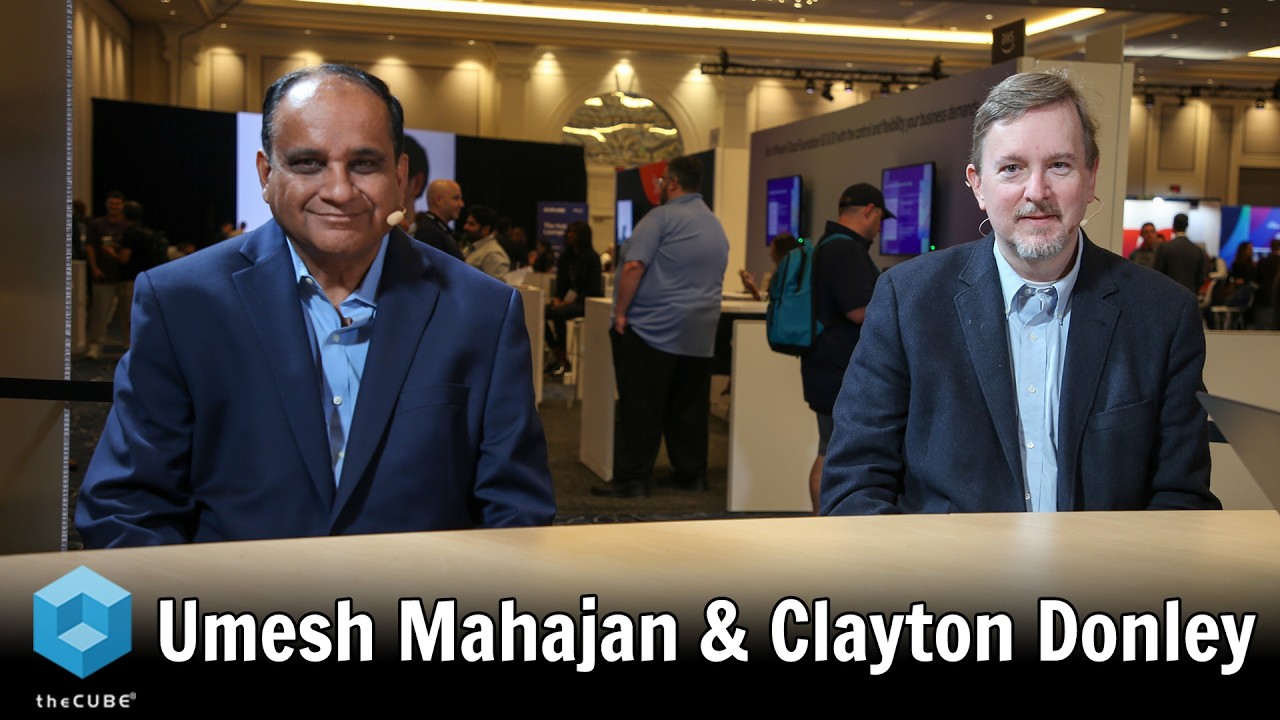
This discussion at VMware Explore 2026 examines securing agentic artificial intelligence across enterprise environments with a focus on identity governance and observability. Clayton Donley of Broadcom, vice president and general manager, Identity Management Security Division, appears on theCUBE Research with John Furrier of theCUBE and theCUBE video team to examine how enterprises adapt identity and security practices for agentic AI. Donley presents Broadcom's perspective on agent identities, API protection and distributed tracing, and they explain how existing application monitoring techniques and recent Broadcom capabilities such as AgentMinder apply to governing large fleets of AI agents in production.
Donley emphasizes the imperative to assign identities to agents, centralize policy enforcement and apply observability to prompts and tool calls. They advocate starting with traffic monitoring, routing model access through enterprise keys and layering controls to prevent circumvention, which enables auditability, cost control and an improved security posture as agents scale across organizations. The conversation provides actionable guidance on identity management, API protection, distributed tracing and operational governance for agentic AI deployments.
Almost there!
We just sent you a verification email. Please verify your account to gain access to
VMware Explore 2026. If you don’t think you received an email check your
spam folder.
In order to sign in, enter the email address you used to registered for the event. Once completed, you will receive an email with a verification link. Open the link to automatically sign into the site.
Register for VMware Explore 2026
Please fill out the information below. You will receive an email with a verification link confirming your registration. Click the link to automatically sign into the site.
You’re almost there!
We just sent you a verification email. Please click the verification button in the email. Once your email address is verified, you will have full access to all event content for VMware Explore 2026.
I want my badge and interests to be visible to all attendees.
Checking this box will display your presense on the attendees list, view your profile and allow other attendees to contact you via 1-1 chat. Read the Privacy Policy. At any time, you can choose to disable this preference.
Are you sure you want to remove access rights for this user?
Details
Manage Access
email address
Community Invitation
Clayton Donley, Broadcom
This discussion at VMware Explore 2026 examines securing agentic artificial intelligence across enterprise environments with a focus on identity governance and observability. Clayton Donley of Broadcom, vice president and general manager, Identity Management Security Division, appears on theCUBE Research with John Furrier of theCUBE and theCUBE video team to examine how enterprises adapt identity and security practices for agentic AI. Donley presents Broadcom's perspective on agent identities, API protection and distributed tracing, and they explain how existing application monitoring techniques and recent Broadcom capabilities such as AgentMinder apply to governing large fleets of AI agents in production.
Donley emphasizes the imperative to assign identities to agents, centralize policy enforcement and apply observability to prompts and tool calls. They advocate starting with traffic monitoring, routing model access through enterprise keys and layering controls to prevent circumvention, which enables auditability, cost control and an improved security posture as agents scale across organizations. The conversation provides actionable guidance on identity management, API protection, distributed tracing and operational governance for agentic AI deployments.
In this interview from VMware Explore 2026, Clayton Donley, vice president and general manager of the Identity Management Security Division at Broadcom, joins theCUBE's John Furrier to discuss why the rise of agentic AI is forcing enterprises to rethink identity, trust and governance for machine-driven workloads. Donley explains how AI has moved from simple, user-directed queries to autonomous agents making high-stakes decisions with far less oversight. He details the need to assign unique identities to agents, define the scope of their intent and enforce pol...Read more
exploreKeep Exploring
What is the current state of agentic AI and how does it compare to a year or a few years ago — what are the biggest changes, are fears about agents “going rogue” exaggerated, and what is the situation around control, governance, and security?add
How should organizations apply identity, access management, and auditing principles to non‑human AI agents (including assigning ownership/metadata and tracking their LLM/API calls)?add
What are the best practices for governing autonomous agents or "digital employees," specifically regarding identity, intent, scope, and policy enforcement to ensure security and compliance?add
How do you audit AI agents — including their prompts and tool calls — to determine what triggered a particular action and whether it was an agent error or the result of manipulative/misleading context?add
Why are organizations moving to on-premise AI deployments, and how should they implement governance, traceability, and auditing (for example to prove agent ownership)?add
How does your platform work to control, observe, and enforce policies on agents' access to and use of LLMs?add
>> Hello, I'm John Furrier, your host of theCUBE. This is theCUBE's VMware Explore coverage. Of course, we have two days of live coverage from the show floor. I'm here with the Broadcom executives to unpack the innovation and the news at the show. I'm here with Clayton Donley, VP and General Manager of Identity Management Security Division at Broadcom. Talk about the agentic demand, the trust, the security, and the control that's needed to bring in AI intelligence safely and scalable. We're here at the Explore coverage. Clayton, great to see you. Thanks for coming on theCUBE. Appreciate it.
Clayton Donley
>> Well, thanks for having me. Very, very excited to be here. Very excited to be here talking about really what's on top of everybody's mind here, AI.
John Furrier
>> AI and agentic AI has been the hottest thing. And the first wave of chat bots and OpenAI and ChatGPT was chat bots. So you saw search was a great use case, marketing material, writing blog posts. And then the enterprise started to see coding. That opens up the kimono big time. You're starting to see that moving. Now with agents, you got deterministic workloads, probabilistic workloads coming in, but deterministic working. But recently, the Mythos release of their model, and then with the OpenAI Hugging Face example, has kind of woken the industry up to the fact that, wow, these agents could go rogue. And they're just running around like a microservice or a software application with full access to stuff. You know, they get hyper fixated, kind of like war games. We were talking before we came on. This is kind of what the dark side looks like for agentic. Now there's positive examples with deterministic end to end workloads, people have locked those down. But as you have an autonomous environment where agents will provide a lot of value, you got to rein in and nail down the control, the governance and the security piece. This is what you're doing. Give us the state of your view of kind of where we're at today. and just compare that to only maybe a year ago or a few years ago, the biggest changes, is it hyperbolic? What is the current situation?
Clayton Donley
>> Well, it's really turned on its head, right? At the end of the day, we've gone very quickly from the users being in control of the AI, you know, giving it questions, asking very simple things of it. How was your day? Tell me about the weather. I don't know what people ask their AIs before we did coding, but now people are obviously doing much more important things with it. We talk to companies every day that are doing mission critical things very quickly with these things. And I think what you kind of alluded to was that they're out there doing things and we don't really know what they're doing anymore. And that was a big change, right? And it's not happening in an environment where we have this 50 years of figuring out how to deal with employees and giving them their rights. It's happening in a brand new world.
John Furrier
>> Yeah, and I think the trust thing is huge. And I want to get your thoughts on it because, you know, I like to study the history because we're both grizzled veterans, or at least I'll speak for myself. You look good. But if you go back to the old days of virtualization in IT, the problems were simple. Got a new employee, locked down the desktop, maybe you got a virtualization front end, maybe it's some sort of system where you got, everything's in control. IT's got everything nailed down. They use the apps. They have a BlackBerry, really easy to manage. Now you got people who are, and they're like, okay, okay. And when I go home, very analog world. They're not going to cry a river. Today, the demand from the user side is so high because people are seeing real value. They talk to their AI, they see the reasoning piece. Wow, that just framed that problem. Rewrote my email, solved the business problem. You have a massive demand. So I don't think the agents are going to stop because now that people figured out it'll do work for them. Go through my email, check everything, a lot of stuff's happening. So it's not going to stop. So it's not like people are going to say, well, I'll wait for IT to get their act together and the security team.
Clayton Donley
>> It's like the web. It's like the web, it's like mobile. I remember going into hospitals when mobile first came out and people would try to put policies in there saying, I'm not going to let doctors bring in their iPads or their iPhones or whatever. It doesn't happen. They bring them in, they're saving lives or they're going to do whatever they need to do here to be productive. And you look at a bank, yeah, obviously there's a lot of things that they would like to do, to make your experience as a customer better, which of course helps their bottom line. And their top line in a lot of ways. And to do that, they want to use AI and they're not going to sit around and wait for IT to get their act together. So just like with the web, where it seemed like it was really fast, and just like with mobile, where it was kind of fast, with AI it's instantaneous, right? Instantaneously. They're not going to stop. People aren't going to wait.
John Furrier
>> They're not going to wait. So what is the best practice? What's the current state? And again, Black Hat was a great seminal moment. And again, the Mythos thing was, I call it the ChatGPT moment for security. Everyone knows when they first use ChatGPT. Wow, this is pretty damn cool! Now you go to Mythos, this is not cool, what is going on with the security bugs and identifying vulnerabilities. But there's an upside here. Take us through how you're thinking about this because you got machine identities, you got human identities. It just complicates the problem that you solved before. Now it's back on the table again. How do you solve that trust? How do you solve the operational issues around this new normal?
Clayton Donley
>> Well, I think that you go back and look at how do you apply the same concepts that you apply to humans to something that really doesn't have the same moral compass or even concept of a moral compass or a paycheck that they're counting on that, say, a human would have. And it starts with you need to identify those agents. You need to give them identities. Now, part of that may indicate who the owner or who controls that agent, some additional maybe metadata about what kinds of things it's used for, things you'll want to know when you're going back there and auditing, what are the agents that you have? And then each of those agents, they could have lots of instances, could be a million instances that are running all the time at different times. And those need to talk to AI. The way AI really works is these agents make an LLM call, maybe it's to Claude, maybe it's to OpenAI or Gemini or whatever it is. It comes back and it gives them a bunch of tool calls that you should go do, right? But all of those are API calls. So the great thing is, we have a lot of experience protecting APIs, and we have a lot of experience understanding, well, who's making those calls, there's standards like OAuth and other kinds of things that are out there. Now, the key is putting it all together, right? So it's one thing to have a bunch of identities that are now machines that are obviously not employees, that were not instantiated when they got an HR, a little click in HR systems and Workday.
John Furrier
>> They don't have a badge number, but they have a unique ID.
Clayton Donley
>> Yeah, they don't have a badge number, but they're absolutely unique.
John Furrier
>> Yeah, they have a unique ID that you can track. they're out there. They're out there.
Clayton Donley
>> They're like your virtual employees, right? They got that virtual digital badge and their employee number goes up to the billions, I guess.
John Furrier
>> It traces back to the employees. They get fired for their agent. Bad agent behavior is on your performance review. these are the kinds of things. Okay, what are the risks? Let's back up. Yeah, share the risks that people are seeing now and what's out there in the market that you guys are doing because this is a problem people are attacking right now. What's the current best practice? What are the risks and what are people doing?
Clayton Donley
>> Well, I think that what's happened and where we are is, if you think about it, right? There's been a lot of focus on the attack surface and that side of it because when people first saw things like Mythos, they're like, oh my gosh, I better go patch all that, right? What about attackers? What if somebody from a rogue nation state or something comes in and tries to attack my infrastructure. So there was a lot of focus on the fact that that adversary that's always out there when you're dealing with security is now going to be much faster, much more effective. They don't sleep. They can run hundreds of these agents all the time, right? So it went from that to, but wait a second. You know, you look at this thing with Hugging Face or other things that have been announced more recently, and you get the complete flip side of that. It's not the agents doing things, like some bad guy doing something bad to you with an agent. It's your own agents. And so I think that what we're seeing now is people are focused on governance. The people who are realizing this is mission critical infrastructure, that they're going to have to report to the audit committee on it and all these kinds of things. If you think about it, with Sarbanes-Oxley, back in the day, you used to have to certify that your employees had this access. Nobody certifies my agents have this access. Nobody does any of that. So the maturity's not there, but what we're seeing is a trend to try to pick up that maturity.
John Furrier
>> How should enterprises rethink their governance strategy? Because this comes up in every conversation. Governance is getting baked into the foundational level and root level of all activities on AI infrastructure. What's the rethink? What's the mindset?
Clayton Donley
>> Well, the rethink is you really need, you need to have the identities for those agents. because you can't buy a book on the internet without knowing who you are, right? And you're giving these people a lot more access. You're sometimes giving them access to a lot of data, maybe in a RAG system or other kinds of things. So they have all this. But you need to know who it is, who this digital employee is. And then more importantly, you need to know what the intent of, like what the scope is that you're going to allow them to do. And when they do something, they need to broadcast their intent, why I'm going to go do this. And then you match it up. And so today, the best practice stack is you define these things, you give them policies, and you enforce that policy around ensuring that even if the user is controlling the agent and they click approve, because users love to hit approve on these kinds of things. Who wants the next thing? Whack-a-mole, yes, go. Yeah, it's like it's asked me three times if it can do this. Of course I'll just say yes. So even when the user's in control, they're not always the best person to make that decision. So having something there between those agents and the LLMs, between those agents and your APIs, MCP servers, all the things those agents need in order to have that superpower is really the best practice. But then just having the control isn't enough. How do I audit that? How do I monitor that? And there's two aspects to monitor. There's the, what's the AI doing? And then there's how much is that costing me? Because as we know, tokens cost a ton of money.
John Furrier
>> Yeah, huge.
Clayton Donley
>> If you're using the wrong models, or is it using too many agents for this? Is it doing what I thought it was doing? And we're in the early days of this. So having those three things, right? The identity of the agent, the control point to choke off bad things from happening, and then being able to monitor what is actually happening. What were those prompts? What were those tool calls? Being able to tie it together is really critical.
John Furrier
>> What's coming up here on my coverage of VMware Explore is that you're starting to see some formation of some trends, architectural trends. The data platforms are separated from the models. You have this control plane or content and or context layer in between that helps manage it. You mentioned a bunch of things that I want to focus in on the old school thinking around observability. Observability and tracing become really valuable. Because you got to prove how is that working with Broadcom? You got AgentMinder. You have all these tools. How are customers using the solutions to get that architecture implemented and at least reigning in the chaos? What are some of the things that they're doing?
Clayton Donley
>> And it's interesting you asked that. And you started with the word old school because we acquired a number of products over the years. And a lot of them were things like APM products from people you've probably forgotten about like Wily and others that made these monitoring solutions. And what's interesting is over the years we developed a lot of things for application monitoring. They did, think about it, code tracing. But code became distributed. When people went out to containers and microservices and things like that, your code isn't running line after line anymore, it's running in all these different containers. So we got really, really good at sort of tracing in a distributed way what these applications were doing. And what we realized very quickly, kind of like.
John Furrier
>> - You can rescope that to agents.
Clayton Donley
>> Yeah, yeah, so then we suddenly realized, and I said, oh my gosh, this is exactly what we needed. But we need to extend that to the prompts that were being used, the tool calls that were coming back. But then you need to be able to see that, well, what triggered that in the agent? And by the way, the agent didn't make a mistake. Did somebody gaslight it? My favorite stories with AIs sometimes are people needing the agent to do something that it shouldn't do because you feed it certain context. I've seen, my favorite story, we had a person trying to do something that they were allowed to do with an LLM, and it was refusing. Because it said for security reasons, but we're a security company and we have permission, right? So to get it to do it, the guy made a fake PDF with a fake signature saying that this is authorized, fed it to the context, it went right to town. So these AIs can be -. The context is not human context. It's absolutely, and it can be fooled by anything it sees on the internet. And so it's really, really imperative that you have that sort of controls, the cross checks, the ability to then once again, during that trace, see, well, how did that come about? Did an employee try to go around the controls or was it just making a mistake?
John Furrier
>> Clayton, it's a really good point. Broadcom has a history of a lot of acquisitions in software. Obviously everyone knows about the VMware one because it's the big one recently and VCF is looking really good right now in the market. but if you think about application monitoring, which you just mentioned, what is an application, right? So the underlying science behind it, computer science and the code, is distributed computing paradigm. It's tracing, just as science has nothing to do with the application, but if you remove application and say agentic, it has the same behaviors. So I guess my question is how much within the Broadcom stable of products in the portfolio are well suited for the new normal? Because the application is just behaving a little bit differently, but the game is still the same. It's doing something. The UI might not be there, it might not be in the right server, the server architecture changed, but that's well-known concepts. So you can just, I won't say retrofit, but you can actually point the technology to the problem.
Clayton Donley
>> I think that's the key, right? A lot of times you step into something and everybody wants to think that, oh, there's white space here, nothing exists there, but the fact of the matter is, there's a lot of, what we found is, almost every one of these cases, everybody had maybe 80 % of what they needed. But it wasn't put together. So going back to AgentMinder of what we do, we didn't copy and paste that code. We didn't go back there and take, say, a 20, 30 year old code base and say, oh, we're going to shoehorn this into the new model. We'd actually been building over the last several years kind of a new, what I guess I'll call, cloud first architecture that has actually all three of these things. And because we developed it alongside kind of this growth of agentic AI, we sort of stumbled into this. I hate to say it, but it's almost like, you take a walk in the wilderness and you fall into a diamond mine, right? I'm not going to be able to repeat that, but it's never a bad place to be.
John Furrier
>> Well, luck is what happens when preparation meets opportunity as the saying goes. But we just happen to be in that right place, right time, right?
Clayton Donley
>> Well, software evolution. Because you've got these three things, we were pulling it together anyway, because you need these three things to operate together. You can't, they can't be air gapped. So, I will say we got very lucky. And it's led to a lot of opportunity for us. But it's led to a lot of value for our customers.
John Furrier
>> I always say this. About two years ago, the most common phrase on theCUBE was, it feels like the 90s again. Of course, we're covering early days of AI factory. So, guess who's involved? A bunch of the old dogs and the new dogs coming together. The old guard, new guard. So you're seeing literally generations working together. So if you were in computer science in the 80s and 90s, you built the systems revolution, that's in the computer industry. Now you're coming in as a hotshot coder for AI native, you're running on the systems that are actually not being replumbed fully, but being re -architected. AI factory from NVIDIA and AMD and all these companies, and with VCF now sitting on top of that hardware, that's just a server, which is now a bigger server with a lot of servers in it. It's the same game. It's the same computer science, computer engineering game, same software game, just applied differently. And I think this is one of the revelations that's coming out of this AI wave. It's just a transition. SaaS is a user interface based paradigm that's been there since the 80s. Now people are using voice prompts with chat. So headless systems are the new thing, but that's not new either.
Clayton Donley
>> So you're starting to see the role. So you're saying apps are all like SaaS providers?
John Furrier
>> I think SaaS providers are going to be headless systems with some GUI and some other interface. It could be model driven. It could be embedded in another function, multifunction applications. that's my personal opinion, but you're starting to see that trend where, the user experience is abstracted.
Clayton Donley
>> But we see this all the time, right? if you think back to the web, what were the first web applications? People wrote little web wrappers, CGI, if you remember. Remember? Yeah. They were little web wrappers that sat on top of your mainframe or sat on top of real production systems. And the only reason the web was useful is because it had access to all the stuff you've been doing for at that time, probably 20, 30 years. Yeah. And now what you've got is you've got things that are running. Whether it's in the cloud or running in private cloud on VMware or containers, it doesn't matter where it's running. It might even be running on the mainframe. If it's a transaction, it probably is running on the mainframe. But people don't go to the green screen anymore. Right? Right? Yeah, yeah.
John Furrier
>> They don't care where it runs. If you're going to run on a mainframe for the transaction for a financial deal, no problem. You run on the mainframe. I'm running on a client server. Okay, I'm running on a super rack scale system from NVIDIA with the latest Pareto curve with Vera Rubin. I don't care. It'll get me my tokens. And my results.
Clayton Donley
>> Yeah, yeah. And so, yeah, absolutely. So what you're going to see is, but this is why it's so important to get governance right. Because you're not just giving people access to ChatGPT. one of the interesting things when we first started doing some training on this, people were very confused about agents versus just getting an LLM session, you know, when you go out to Gemini or ChatGPT or something and they don't realize the power these agents have. And the fact that people are giving them all the data from their organization, the APIs to access various things in their organization, it's a lot of power.
John Furrier
>> I think the on -premise growth is directly related to what you just said, which is the trust and control of the data because the data is the competitive advantage. That's where the IP is, the domain expertise. And so people want to control that and track it. And we were just kind of riffing on traditional systems and conventional networks and methods. What's changed about AI? Is it the intent piece and how do you measure and audit? Because saying I want to throw governance at AI is an easy strategic decision, but now you got to implement it. How do you implement governance so you get that traceability, you get the control. And at the end of the day, you got to prove it in an audit. Or, hey, that agent is Clayton's. That's on you. Yeah. I'm making that up, but that could be the use case. People are starting to talk about that. The humans own their agents like a fleet of staffers.
Clayton Donley
>> Yeah, well, that's why people get concerned about AI making mistakes, right? Because if you make a mistake, I feel like I had some agency in making that mistake. The AI made the mistake when I wasn't even around. It's still my fault. It feels very wrong to me, right? But if you think about why this works now, it's because if you think about, one of the hardest things in human, in terms of auditing what humans have done, determining, say entitlements and access and things like that, it's always been how granular do you go with those permissions? Because you can go really, really deep and then you can't really control it because nobody can keep track of all those different permissions and how they relate to each other. So people got very lazy and simple, well, not lazy. They got very efficient by saying, well. I'll put people in different groups. You're in finance, you're in HR, you're in R &D. And based on that, I'm going to give you some base level things you can go do. And in AI, that's what people are starting to do. And then you start saying, well, okay, these are the 10 things that you can do because you're part of that agent group. But what's really interesting though is because now we have AI too, right? Yeah. We can actually go much more granular than we used to and actually assign those permissions because we have the help of AI and actually going out there and sifting through all the stuff humans never had time for. So, in fact, we could get to a much higher level of security by leveraging AI to help make some of the policies that govern AI. It's sort of like, AI is a judge sometimes on its own work. Yeah. So there's so many patterns that we're seeing, so much that we're seeing where we can, obviously you want a human on top of that. You don't want to just say, leave it all to the AI.
John Furrier
>> I think the whole human in the loop debate is over. Humans are getting the superpower from the AI, that's the way it should work. It's a tool, it's a superpower. AI scales intellect. I think that's clear. The number one question that comes up from folks that I talk to that say, okay, how do I just get going? Because there's no debate that they see that. Then they go, okay, I've been doing my job for 20 years or 10 years or whatever the duration is, I'm a manager, an executive, what else should I do with my department? Should I have them start doing AI more? So the best practice that I see is, people just start using it, get the muscle going. How should enterprises do that? I'm sure you agree, because everyone kind of agrees on that. But where do you start? How do you get the muscle up? And how should people be prepared? Because they have to get the security practices in place. They got to understand how it works. They got to drive the AI. It's like moving from horse and buggy to a car. now you got to drive it and manage it. What are leaders doing in organizations to bring in that security piece without harming themselves? Right? So without having the agents go off the rails, because they want to deploy more agents, it's in demand.
Clayton Donley
>> Right, I think it's what you've seen everywhere, right, if you saw the uptake of SaaS, right, people weren't, especially at large companies with mission critical apps, they didn't throw the most mission critical transaction app out on the web or out on these other areas. they started in areas where they could accept the risk. And what's good is that gives you a place to start. And I think the best thing, and not to go too product here, but when we looked at AgentMinder, and one of the things that we looked at is we didn't want people to have to do a big two-year upgrade before they could get started. We wanted something they could layer on, leverage their existing identity management. If you've got somebody who would be a competitor of ours for human identity, whether they're employees or consumers. go use it, you shouldn't disrupt that, that works just fine. That was not the problem. The problem is you've got another set of entities out there that are very different, they operate at a very different scale and they need very different kinds of policies, processes, life cycles, all of those kinds of things. So if I look at our early adopter customers, most of them, they start by putting in the agents they're working with, they get them registered, they take a couple of their initial agents, register them with the gateways and things like that. And sometimes they just run.
John Furrier
>> Traffic through it.Explain, I want you to explain to end the interview because I think this is important. AgentMinder, how does it work? People are looking for ways to get started. Is that the place where everything comes together? How do I deploy that? What's the pitch for the value proposition? Explain AgentMinder and how it works.
Clayton Donley
>> Well, let me start by what it isn't. So it's not the thing that's going to run your agents. Right, we're not going to try to be your agent platform that's running the runtime there, because that's going to be everywhere. You'll get it from Salesforce, Workday, every startup in the world is building an agent platform. You can go buy, you can find open source ones in every programming language. And absolutely, you set a standard in IT, I'm sure half your users will use exactly the opposite of that standard, just like OS, right? Exactly. So we're not that. You know, the main thing is, we're open. And what's great about that is, we have to sit between those agents and the LLMs that they're using, first of all. So we have a gateway component. We actually work with some of the other gateways we have as well, like vDefend and others, depending on what kinds of policies you're willing to enforce. It sits between that. So you've got your agents and you've got your, maybe whether it's Claude or OpenAI or private AI or whatever you've got, it sits between one or more of those. And it's looking at every request. And sometimes the starting thing we do is we just watch the traffic. because it's very easy, it's very cheap, it doesn't require you to change anything. It's a great way to start. Look at what's moving around. Lateral movement. Who's there? Where are the footprints? Everything's trackable. And all of that uses OpenTelemetry, it can push out, obviously we've got our own observability service that it can plug right into, it's kind of part of the platform, but if you're already using something else, go for it. There's no reason to wait to get this started. I think the main thing is you need to start looking at the traffic, looking to see what they're doing. And then, because that traffic is mostly not going to show you who's doing it, you need to start assigning those identities to the agents. And then they'll just start using modern standards. You take away their Claude key, you take away their OpenAI key, and you give them a key to yours. And so now you can make sure they can't circumvent you by using their keys through some other app. So there's immediate control. You've kind of funneled those things, those people through that central point of control and as you give them identity, give them kind of a key to get through there, you can start adding in policy. Well, I see this, I don't really like it. Or I see them using very expensive models for very simple things, I'm going to demote them to using a lesser model. Or maybe I'm going to send this group of people out to private AI. But it gives you a lot of control very quickly without a lot of effort.
John Furrier
>> And they have choice. They can go on their timetable, look at their environment. Here's what we got as our standard. Here's what we're doing. Let's plug AgentMinder in and get it going.
Clayton Donley
>> Absolutely, it has to be heterogeneous. We work with the biggest companies in the world. I'm sure that they have 150 vendors that do things that are adjacent to what we do. They want speed.
John Furrier
>> I want to test something out quick, yes or no. It fits. Let's play with it. I don't want to have too much disruption or change management, which is a big concern. Final point, I want to get your thoughts on what you're excited about this Explore. What are the top conversations happening? What are you excited about this Explore here and for VMware Explore? What are some of the things that are notable that you could share?
Clayton Donley
>> I mean, I wish I had other things to get excited about, but I will tell you the thing everybody's coming to me about really just is AI security, right? A year ago it was interesting, right? People were starting to chat about it, but it was early days, people weren't sure if there was going to be the value, quite frankly, with some of this AI stuff.
John Furrier
>> And they were skeptical.
Clayton Donley
>> Yeah, there was a lot of skepticism that businesses were going to get the ROI to be able to kind of keep funding this. I think that train has left the station. Right, absolutely. Every time I talk to a C-level individual, they are all talking AI.
John Furrier
>> Two years ago at RSA, it was poo -pooing AI. And this year it was like, oh my God, we got to get on this. That was pre -mythos. So it was like.
Clayton Donley
>> Yeah, absolutely. So every conversation has been AI. Every conversation that has been AI has pivoted to, oh my God, it's usually like on the IT practitioner side, it's like all these guys above me are talking about is that they're going to do all these things. But I don't even know where to get started protecting this stuff.
John Furrier
>> The science is exciting. I find it exciting because I think the science and the technology is changing. The AI infrastructure is moving up the stack and the software stack's moving closer to the hardware. So it's kind of like all the primitives and algorithms and software techniques that were once powering something else. From another generation are being used in different ways.
Clayton Donley
>> It's immense, the complexity under, I always think of it as like a layer of rocks, right? you've got mainframe there at the bottom at the core, and then you've got, each layer of sediment fell above that. And just, every layer contributes. And then of course we always see the top layer.
John Furrier
>> Clayton, you're in a hot area. Thanks for coming on theCUBE. I really appreciate it. And then this is going to be an ongoing conversation. I'm sure next year another model comes out. The infrastructure will continue to grow. AI factory is one of the top stories here with VCF. It's consistent with what we're seeing with NVIDIA, AMD and all the semiconductor work with memory. So this infrastructure enablement is going to change the nature of the software stacks, which changes the nature of what we were doing before and what we do going forward. And it's going to create a lot of opportunity. And also with opportunity comes bad actors. So.
Clayton Donley
>> It's the life of security.
John Furrier
>> You know, your world's going to get more complex. Yeah, absolutely. Thanks for coming on. Appreciate it. I'm John Furrier with theCUBE. We're here for our VMware Explore coverage. Thanks for watching.









 John Furrier