We just sent you a verification email. Please verify your account to gain access to
VMware Explore 2024. If you don’t think you received an email check your
spam folder.
In order to sign in, enter the email address you used to registered for the event. Once completed, you will receive an email with a verification link. Open this link to automatically sign into the site.
Register For VMware Explore 2024
Please fill out the information below. You will recieve an email with a verification link confirming your registration. Click the link to automatically sign into the site.
You’re almost there!
We just sent you a verification email. Please click the verification button in the email. Once your email address is verified, you will have full access to all event content for VMware Explore 2024.
I want my badge and interests to be visible to all attendees.
Checking this box will display your presense on the attendees list, view your profile and allow other attendees to contact you via 1-1 chat. Read the Privacy Policy. At any time, you can choose to disable this preference.
Select your Interests!
add
Upload your photo
Uploading..
OR
Connect via Twitter
Connect via Linkedin
EDIT PASSWORD
Share
Forgot Password
Almost there!
We just sent you a verification email. Please verify your account to gain access to
VMware Explore 2024. If you don’t think you received an email check your
spam folder.
In order to sign in, enter the email address you used to registered for the event. Once completed, you will receive an email with a verification link. Open this link to automatically sign into the site.
Sign in to gain access to VMware Explore 2024
Please sign in with LinkedIn to continue to VMware Explore 2024. Signing in with LinkedIn ensures a professional environment.
CMO, VP, IBM Hybrid Cloud Portfolio & Product MarketingIBM
Coverage of VMware Explore 2025 in Las Vegas. John Furrier, Dave Vellante, and Scott Baker of IBM Storage discuss the partnership between IBM and VMware, focusing on integrating storage products with various VMware tools. They address challenges of data privacy and security in the era of generative AI. Baker introduces a custom silicon FlashCore Module for data analysis with AI. The importance of AI in data and issues like AI model drift are discussed. IBM's focus on sustainability in storage products is explored. IBM aims to launch new innovations aligning w...Read more
exploreKeep Exploring
What are some key points of integration between storage products and VMware for managing infrastructure in a virtualization environment?add
What is IBM doing to reduce its carbon footprint across its infrastructure components?add
>> Welcome back, everyone. Here's theCUBE's coverage here in Las Vegas for VMware Explore 2025. I'm John Furrier, host of theCUBE with my co-host, Dave Vellante, and CUBE alumni, Scott Baker, CMO of IBM Storage is here in the house. Scott, great to see you. Thanks for coming on. Great stopping by. I knew you were here, grabbed you in the hallway to get you on this calendar. Thanks for coming on.
Scott Baker
>> Well, that's the best part about theCUBE is you guys always seem to be in the right spot. All the traffic goes right by here. And when you see a familiar face, you have to stop by and say hello. That's for sure.
Dave Vellante
>> Well, thanks for doing so.>> Thanks for coming on. Obviously, storage continues to thunder away in relevance. I mean, 15 years we've been doing theCUBE, storage is dead. Every year it's like dead. It just keeps growing because more data, I mean obviously more data is happening, but now generative AI has really forced everyone to up their game in the enterprise. Your customers, it's a heterogeneous environment. You guys have a partnership with VMware. What's the relationship that you guys have with VMware right now? How is the storage team at IBM working with VMware right now?
Scott Baker
>> Yeah, you got it. So most other vendors that are out there, we work very closely with the VMware engineering team to make sure that we've got the plug-ins that are necessary to allow you to manage the back-end storage products from within your vCenter environment. Support for VAAI, when that was a thing.
Dave Vellante
>> Remember that?
Scott Baker
>> vVols now, right? vVols now, support for vRealize when, again, that was a thing, and then certainly getting into support for the VMware Cloud Foundation piece. So a lot of the work that we continue to do with VMware happens around those points of integration where you're able to bring the infrastructure into the virtualization space. But you really touched on an interesting point, which is what are you doing around GenAI? And in that particular arena, what we begin to see is organizations that are out there that are trying to figure out how do I take the VMware investment that I've made so far, and then how do I leverage that in such a way so that generative AI becomes a complementary workload versus a rip and replace kind of a strategy to where I dump everything that's virtualized to switch to GenAI? And in fact, you can't do that. It is in as much as a symbiotic relationship as storage was to VMware.>> Unlocking the GenAI potential, you said. Okay, let's talk about data privacy and security challenges because that seems to be the top of the list when you're looking at the current on-premises activity. Because AI's got great advantages if you've got the right data and there's some property involved that some people saying, "Whoa, I might want keep this on-premise." And then this is a thrust of Hock Tan's narrative here is on-premise private cloud.
Scott Baker
>> That's right. I like the way that you said that too, "If you've got the right data." Now we're all old enough to realize that back in the day when we were talking about big data, it was the four Vs, if you remember those, the volume of the information that you have, the variety of that kind of data, the velocity at which it grows, and then the veracity. And I put a huge emphasis on the veracity component, how accurate is that data? And when you think about how you protect that information, whether you consider that to be intellectual property, you look at it from intrusion-level attacks or data loss prevention or even extrusion-related activity, being able to protect that information is what's going to drive the fifth V, if you will, the value of the AI model behind it?
Dave Vellante
>> Value. Yes, the value.
Scott Baker
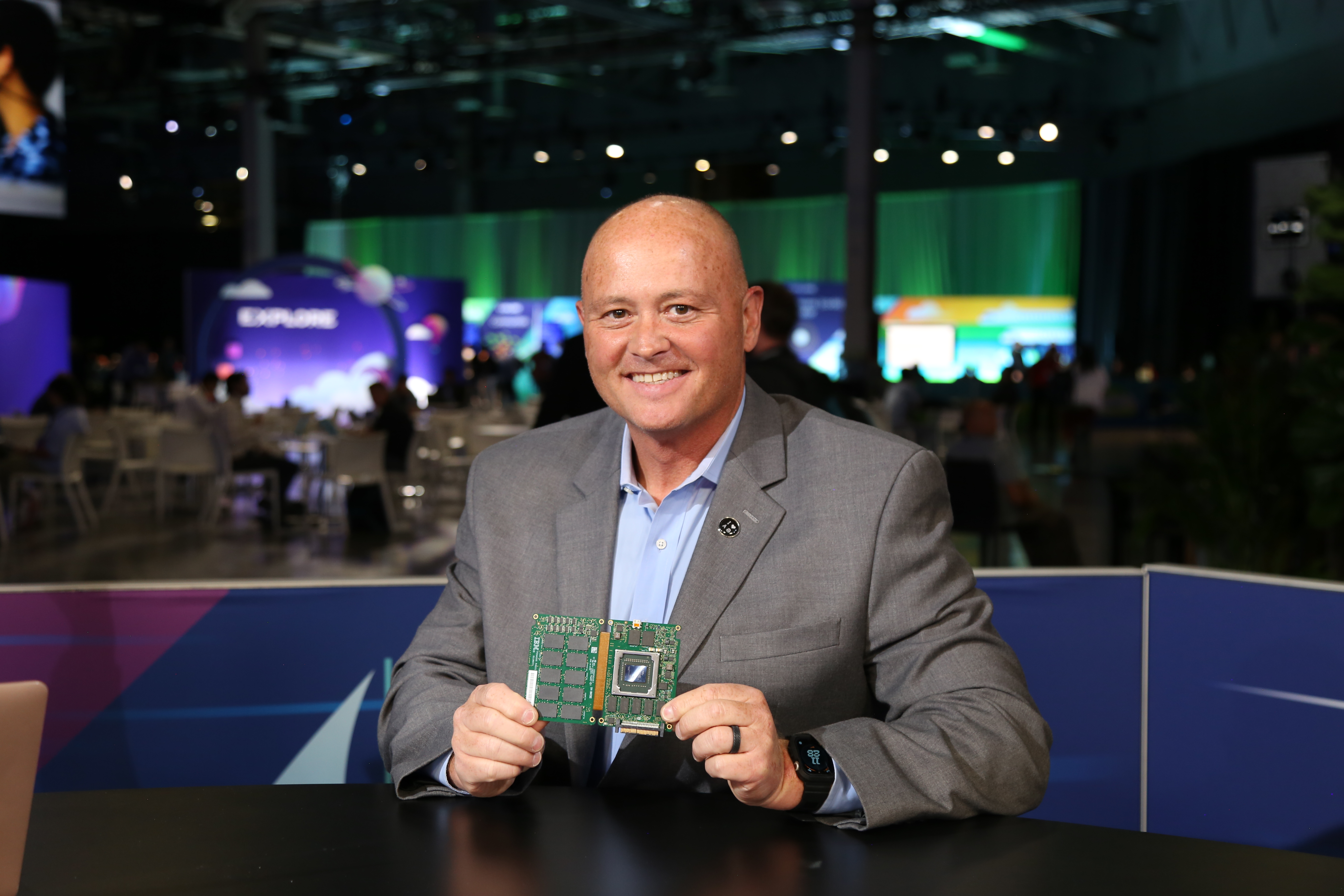
>> The value, right? I think AI begins to create a workload that has true intrinsic business value that can certainly be monetized. And what we're beginning to see, and certainly something we're doing at IBM, is how far down do we push the AI capabilities? Now, I am a CUBE alumni, and I don't like coming to these events without something to show and tell.>> You have a prop, okay.
Dave Vellante
>> All right.>> Look at that.
Dave Vellante
>> Love it.
Scott Baker
>> So what you're looking at here is->> Hold that up a little higher.
Dave Vellante
>> Get that-...
Scott Baker
>> the internals of the FlashCore Module. Now, it doesn't ship like this. In fact, it folded over like this.
Dave Vellante
>> It's a flip board.
Scott Baker
>> But what's interesting about this is right here is the CPU that makes this a computational storage component that's heavily laden with AI and machine learning that's constantly analyzing the data that's coming into this particular drive. And it's looking at heuristics and different kinds of entropy changes in that information to detect anomalous behavior, whether that is behavior that's trying to affect the data on disk or it's activity that pulls the data away from the disk itself.
Dave Vellante
>> Let me see. I love this because we talk in the industry all the time about bringing the AI to the data. You guys see this? Now, okay, so this folds. So this is a great example of that. What does that mean, bringing AI to the data? You see this, so this is custom silicon that you guys are building?
Scott Baker
>> That is custom silicon. That's right. So that CPU that's in the middle of that drive can be loaded with different kinds of microservices that affect the data itself, whether that's analyzing the information or identifying hot spots of information that need to be provided up very quickly to whatever the inferencing engine is that might be hosting that AI workload.
Dave Vellante
>> It's a really good example of bringing AI to the data and then bringing intelligence. And just follow-up, if I may, so you guys developed this.
Scott Baker
>> That's right.
Dave Vellante
>> You designed it, you don't manufacture it. I don't know, a foundry, a TSM or Samsung. What's the design, do you know? Can you take us, is it an ARM-based design or not sure? Is it an FPGA?
Scott Baker
>> So it's an ARM-based FPGA, yep.
Dave Vellante
>> Okay, awesome. That's great.>> How does that address some of the critical-
Scott Baker
>> Oh, sorry. Let put my AI back in my pocket.>> How does that solve some of the diverse and demanding issues around these workloads because is it more agility, does it deflects on needs and storage? Certainly as you begin to think about the needs of AI, it's not so much the scale of capacity that you need to be able to host that data and the interoperability with the virtual environment you're running in and the workloads that need to have access to it, it's also about making sure that whenever you're working with that data from a hardware perspective, we're also looking at the veracity of that information. So not so much checking that the data itself is accurate, but rather that the data that we have responsibility for has not changed in terms of the behaviors that drove it to the disk or the behaviors that are taking it away from the disk. And so that gets you around the privacy and the protection aspect that I had mentioned before. In that particular case, what we're really looking at here is are the recipients of the information the ones who are authorized to receive it? And if they're not, to provide the mechanisms by which that data does not leave that disk.
Dave Vellante
>> So that's a stop the intrusion, stop the bad actions, but sometimes people get through. You also, we've talked about this in the past, have the capability to recover if in fact something does go wrong.>> That's right.
Dave Vellante
>> That's another key part of the value proposition. How is that going? It's a hot topic, the whole ransomware piece. What are you seeing in terms of that trend?
Scott Baker
>> Right, so with respect to AI, all we're doing is, like I said, we're really increasing not only the volume of the information that we have access to, we're also adding a variety of different sets of information. And when you look at a large data set and you look at a variety of information, I believe that that brings with it a cadre of additional kinds of people that need to access it. Now, they may not need to access the entire large-language model, but they may need to access different pieces of it. So what we're finding is that as we look at the introduction of generative AI, there are drifts that can occur within the veracity of information. Pockets of drift, if you will, because maybe one subset of the large-language model is hotter than another set or an aggregate collection of that information. So a lot of times what we find is that when we look at how we provide that data out and how we protect it from something like a ransomware attack, we're not only looking at people that are coming in to try to lock that data down and hold it for ransom, we're also looking at people that try to come in and then have some kind of an effect on the data itself that could potentially change the outcome of the model.>> Yeah, I want to get to that cyber resilience angle on the ransomware a second, but can you explain drift for our audience real quick because that comes up a lot and we talk a lot about it on theCUBE? But from your perspective, what do you mean by drift?
Scott Baker
>> So if you've been in virtualization for a while, you know the term drift as in the virtual machine from its golden image changes its state over time. A new piece of software gets loaded, a new driver gets updated, and you begin to have this delta that gets created between the original golden image and the current image that's out there. When we talk about drift in the AI world, it's very similar. The model gets trained against a large-language model set. That training gets checked for accuracy, for bias, things of that nature. Unless you lock down that large-language model and you don't make any other changes to the model itself, then you're going to experience drift in the model. As new data sets come in, maybe new data sets that the model wasn't trained with, it can obscure the results that come from that. And so one of the things that we begin to watch for is how does the underlying data change, data coming in, data going out to the model itself so that we can make sure that we've got, again, veracity around that information for the context of the data that particular model was built against? And we use products like watsonx.governance to do that kind of work, or we'll use watsonx.ai for model training, things of that nature. But generally drift means from the golden state upon which everyone blessed this as being an unbiased model to the current state.>> Well, I brought it up because, one, we love the large language. They're only getting larger, so the drift potential's always going to be there. The specialty models are now in vogue. You're starting to see them come up where models interact. Of course, we had our power law out a year and a half ago calling this, but it's actually happening where it's okay to have small models because this is domain-specific to the data set. They can be big. They can be small, that they start working with other models, starting to see that. This brings up the question around storage around flexibility and scalability because sometimes you might need some performance, more reads, less writes, more writes, less reads, so you get this policy generative runtime situation.
Scott Baker
>> Right.>> So you need scale. Sometimes you need scale, but flexibility is key. This is a big part of what you guys do. Share your thoughts on how an organization can get the flexibility and the scale.
Scott Baker
>> Right, so two things that you touched on there. I firmly believe that we're getting into a mode of virtual models where large-language models will get so large that the model itself may find it difficult to process all of that data and then in as close to real time as possible generate a result. This idea of being able to spin up meta models or virtual models to do the work for it on various aspects of the large-language model is something that we naturally have to get to the larger and larger these data sets get. When it comes to the actual infrastructure itself, I think what you're also going to see is the speed at which the infrastructure needs to respond to the AI is going to drive more emphasis on software defined. Storage-as-code is something that I've heard people use before, infrastructure-as-code. All of these things are going to go hand in hand with those large data models where it's not about do I have the infrastructure available to provision, that's no longer the option. The option is here's the infrastructure that I need with all of the characteristics that make up what that infrastructure needs to look like, auto-deploy, autoload, auto-connect and provide.>> I got to ask you a personal question. We've been on theCUBE many times. You said you've just done a great whole segment with us on theCUBE Studio, Super Studio event. Looking back now, what are you most excited about? And GenAI has forced customers to up their game on their estate, how they're looking at their infrastructure. What are you excited about and what game have you upgraded at IBM and what are your customers upgrading? Because I mean, people are starting to realize the stuff, the price performance is coming out on the chip side every six months, as you're seeing, Cerebras just launched a new thing today on their inference engine service, amazing performance. The Llama model went out great. You're starting to see even tokens, just the costs are dropping, so just massive rise in the game.
Scott Baker
>> Right, right.>> So how have you been upping your game and talk about the customers too?
Scott Baker
>> I'm going to be selfish and tell everyone that what I look forward to is being able to say that we are the first, now I can't say this today, but we are the first storage vendor to have a quantum processor on our storage products. Now I can't say that today, but if I played the long game out, that's what I want to see because as you start to think about the impacts that quantum can have around AI, I really look forward to that. But look, here's what I'm excited about today. First and foremost, the fact that as we begin to look at infrastructure across the board, every vendor, not just IBM, but every vendor out there is looking across all workloads, whether it's virtual machines, containers, generative AI, legacy applications, you name it, they're looking at everything. And so I really appreciate the ecosystem camaraderie that's come up. And that's something that as I look back on our time on theCUBE, I can tell you from company to company, even though we compete, I think just about every vendor I've ever had a chance to be involved with is always focused on doing what's right for the customer. IBM is no different in that.
Dave Vellante
>> So that brings me to a topic that's maybe not in your swim lane, but as an IBM executive you might have visibility on it, and that's energy. So everybody talks about the energy needs going through the roof. You talk about quantum. God knows how much power that's going to consume. AI, obviously. What are you hearing inside of IBM? Because the question is, okay, that's important. It's going to be potentially a blocker. But companies like IBM are obviously close to that, they understand, they solve problems. What are you hearing inside of IBM in terms of the requirements and how the industry collectively is going to deal with the pending energy shortage?
Scott Baker
>> Wow, how much time do we have? So look-
Dave Vellante
>> Well, but you guys are going to be in the forefront of it, I think.
Scott Baker
>> We have a dedicated sustainability organization within IBM that's actually looking not only at IBM's carbon footprint and how we go to reduce that, but also as we look across the infrastructure components of IBM, whether that's the power line, the storage line, if we look at the IBM cloud line, what does our carbon footprint look like? Now, that same module that I pulled out of my pocket turns out doesn't require a whole lot of power. So one of the things that you'll see from an IBM perspective on the storage side is that we're moving toward a consistent use of that FlashCore module across all of our physical appliances as a means to reduce that footprint. When we look at that folded architecture that I showed you when it out of my pocket, that idea of being able to squeeze more capacity on a single disk means that in one rack unit of space, I can put almost two petabytes of effective capacity. And so what you're going to see us continue to focus on is how do we deliver more capacity in the smallest physical footprint that doesn't compromise the performance requirements of whatever the workload is that that particular kind of gear is capable of handling. Same thing as we look at scaling out the infrastructure. It's not so much about IBM producing that hardware. It's how do we connect with all of the other investments that an organization has made so that we can help them continue to utilize those assets without adding even more gear. But the thing that I want to call out that you brought up, which I think is really great, is number one, not all data is created equal. Therefore not all data is relevant, which means that AI is going to create, I believe, a force and function where data hygiene outweighs data quantity, and today we have a data quantity problem. So I can give you all the capacity, but I can't assure you that every bit of data that you store on there has any business value.>> I love the purpose-built hardware really enabling that essential infrastructure for your customers to do the GenAI thing and get faster acceleration, so props to you guys on that. And I know it as an IBM secret to have the combination there with the hardware-software. Hardware's back, Dave. We've said it for years. Scott, final question for you on theCUBE, what's up for you for the next rest of the year? We're going into the fall window now. We're going to get into the spring into 2025. I don't know when your fiscal year is, but I'm sure calendar year-
Scott Baker
>> Calendar year....>> is coming up. What's on your agenda? What's your goals?
Scott Baker
>> My goal is to make sure we end profitable, take market share as well as mind share. I mean, that's on everybody's goal.>> Of course.
Scott Baker
>> We've got a couple of new innovations that we've announced just this month even. We've got a couple of major ones that are coming up for the remainder of the year. So we want to make sure that any launches that we bring into market connect back to the AI for business story in as much as they help drive the value of infrastructure for organizations that are looking for storage. We're going to continue to focus on that, but as we begin to move into next year, we're starting to think differently about what storage means. It's not so much the physical appliance that you're going to place into a rack. We begin now to think about the volume that makes up whatever connects to the host, and how do we make that volume I would say more pliable, more bidirectionally mobile, if you will, so that it can move within the architecture for which it exists in. So we start looking at using AI now to help organizations determine where is the right location in my infrastructure to place this workload based on these known characteristics. And we'll take that same AI and apply it to, "Hey, Mr. Customer, you could get better performance, lower cost, reduce hotspot and noise by moving it from one location to another location without sacrificing the performance or the access to the data."
Dave Vellante
>> That's interesting because that used to happen inside the box, if you will, and now it's happening across the data estate as the data estate becomes distributed, as we talked about a lot. So a lot of storage services on top of what used to be spinning rust, right?
Scott Baker
>> Right.
Dave Vellante
>> And is now a new era, Scott. Thank you.>> Scott, thanks for coming on theCUBE. Great to see you. We'll be watching for those stories and enjoy the rest of the show.
Scott Baker
>> Sounds good. Thanks, gentlemen.>> Okay, Scott Baker here on theCUBE. I'm John Furrier, host of theCUBE with Dave Vellante. We'll be right back with more live VMware's floor coverage after this short break.