We just sent you a verification email. Please verify your account to gain access to
VMware Explore 2024. If you don’t think you received an email check your
spam folder.
In order to sign in, enter the email address you used to registered for the event. Once completed, you will receive an email with a verification link. Open this link to automatically sign into the site.
Register For VMware Explore 2024
Please fill out the information below. You will recieve an email with a verification link confirming your registration. Click the link to automatically sign into the site.
You’re almost there!
We just sent you a verification email. Please click the verification button in the email. Once your email address is verified, you will have full access to all event content for VMware Explore 2024.
I want my badge and interests to be visible to all attendees.
Checking this box will display your presense on the attendees list, view your profile and allow other attendees to contact you via 1-1 chat. Read the Privacy Policy. At any time, you can choose to disable this preference.
Select your Interests!
add
Upload your photo
Uploading..
OR
Connect via Twitter
Connect via Linkedin
EDIT PASSWORD
Share
Forgot Password
Almost there!
We just sent you a verification email. Please verify your account to gain access to
VMware Explore 2024. If you don’t think you received an email check your
spam folder.
In order to sign in, enter the email address you used to registered for the event. Once completed, you will receive an email with a verification link. Open this link to automatically sign into the site.
Sign in to gain access to VMware Explore 2024
Please sign in with LinkedIn to continue to VMware Explore 2024. Signing in with LinkedIn ensures a professional environment.
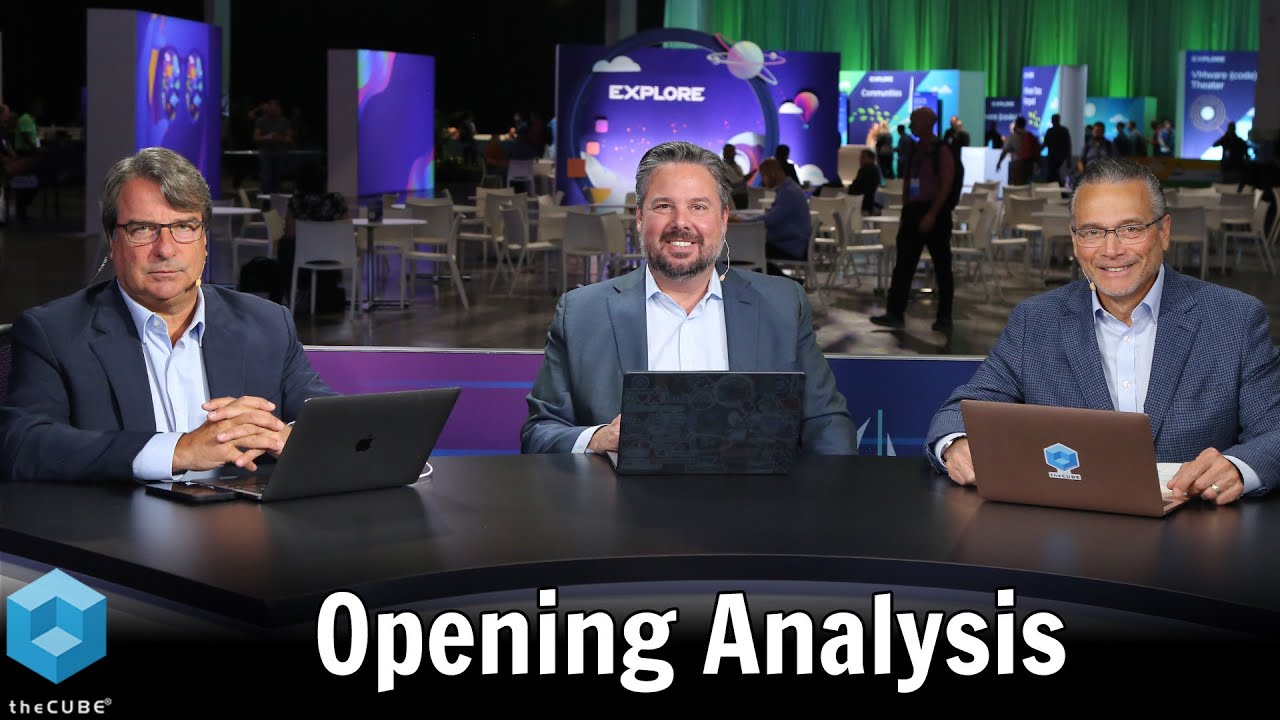
TheCUBE is providing live coverage from Las Vegas for VMware Explore 2024 with John Furrier and Dave Vellante. Brent Ellis, Senior Analyst at Forrester Research, discusses VMware's new direction under Broadcom. The focus is on building products for on-premises use with an emphasis on hybrid cloud. Customers are evaluating the TCO of VMware's offerings compared to public cloud options like AWS and Azure. Despite cost increases, customers see value in VMware's solutions due to their infrastructure needs and resilience cycles. The conversation also touches on Br...Read more
exploreKeep Exploring
What is the current state of VMware and its relationship with Broadcom and Hock Tan's leadership?add
What are some observations about the size and attendee demographic of the recent VMware Explorer event?add
What was the client's reaction to VMware by Broadcom articulating their vision for the first time?add
What are your thoughts on the impact of Broadcom's plans for the VMware product and the potential shift towards alternative solutions like Proxmox and Nutanix in the market?add
>> Welcome back everyone to theCUBE's live coverage here on the floor in Las Vegas for VMware Explore 2024. I'm John Furrier, host of theCUBE with Dave Vellante. Brent Ellis is here, Senior Analyst at Forrester Research. Brent, thanks for coming on theCUBE.
Brent Ellis
>> Thank you.>> Love the analyst angle; get the perspective. We can riff amongst ourselves, analyze, pontificate, that's us. You got the data. This is our 15th year covering VMware with theCUBE live on the floor. The change is radical, obviously with Broadcom and time. VMware is settling into its new regime, and Hock Tan has been clear as day from everything he says he does, and we mean business now. I think the cloud comment about, cloud's bad and evil and the three Cs, I think it's a little bit over the top. Personally, I think hybrid cloud is one, but I get their direction. Build a product for on-prem for the enterprise, leverage the assets that is the installed de facto standard in most operating IT shops.
Brent Ellis
>> Yeah.>> What's your take of the show so far?
Brent Ellis
>> I mean, it's quite a bit smaller than the last VMware Explorer that I was at. I'd say it's like a third, the size roughly. But I kind of think that was by design. I think that's what they wanted, and they wanted the people here that died in the world, VMware customers. I was talking to a customer earlier, and they said that they were looking forward to this show in particular because this is going to be the first time where VMware by Broadcom gets to articulate their vision, and they were kind of waiting for that before deciding how to move forward.
Dave Vellante
>> And what was their reaction? Do you have a sense?
Brent Ellis
>> This particular client has a lot of on-premise resources that don't make sense in a cloud environment. So, for them, this makes a whole lot of sense because they need the same sort of underlying infrastructure patterns. They're doing a lot of cloud native work; they're doing AI work, but it doesn't make sense for them to be using AWS or Azure or any of the hyperscalers that are out there because all of their stuff happens within a farm context.
Dave Vellante
>> So broadly, I think we saw some IDC data up there and the fine print, said Forrester. I don't know if you saw that.
Brent Ellis
>> Yeah.
Dave Vellante
>> They said IDC, but then you looked at the fine print and said IDC Forrester. So it was kind of a mashup; vendors do that sometimes to make their case, but the point is they will make the case that the cloud is more expensive than on-prem as a blanket statement. We know it depends. But for that client, that customer, it's the case that the TCO is probably going to favor. But what's your research radar tell you on balance? How are clients thinking about it? Where is the TCO actually advantageous for a VMware versus not?
Brent Ellis
>> Well, so I think if you were already using all the products that were in the bundle, maybe you're going to come out ahead, but I think it was few and far between that were doing that. Most people, they were standardizing around the hypervisor, but there might've been a certain threshold where, for instance, the cost of doing the hyper-converged storage from VMware, the vSAN product, might've been more expensive than moving back to a dedicated storage system. I've talked to a lot of customers like that in the past. And so when they have to then assume the cost of that component they're not using, they're coming out a little bit behind. So they have to make the decision, "Do we change our underlying infrastructure in order to take advantage of what we're going to be paying for anyway or not?" And so that's a hard decision for a lot of customers. The client that I was talking about earlier, they did say that their cost is going to go up, but for them, they're looking at it as a value play. They're not looking at it just on cost, but they're looking at: What does this enable for us?
Dave Vellante
>> Okay, so their TCO would go up.
Brent Ellis
>> Yeah.
Dave Vellante
>> But the overall value sounds like cloud. The overall value. But in a lot of cases, customers, I mean, it's not a simple, actually, it is a simple decision not to migrate because migrations are so painful. And if they...
Brent Ellis
>> Inertia matters, right?
Dave Vellante
>> And if they are going to migrate, where do they go? They go to Nutanix, they go to the cloud, they maybe go to OpenShift, they maybe go to Proxmox, which is you could take that route, SUSE, Ubuntu. There are options out there. But then when you look at them all, and you say, "Maybe the grass isn't greener," I don't know; what are your thoughts?
Brent Ellis
>> Well, I mean, you also have to look at what Broadcom is looking to do with the VMware product. And in the past, you had things like ESXi, which you could run for free. And I remember I used to be an IT consultant. I dealt with some very small shops, and I literally had some ESXi servers just to take advantage of the virtualization. And I was manually handling the moving and all of that stuff that you get with the full vSphere license. There's a whole lot of small businesses and even medium-sized businesses that are not using those full suite of capability. They were just really using ESX, ESXi, vSphere. And they're probably going to be looking for something different. Because, essentially, what we're looking at is this is focused on enterprise environments. The goal here is to provide an environment that is rock solid, fully featured for a premium price, honestly.
Dave Vellante
>> Yep.
Brent Ellis
>> And I think that's what we're seeing, a lot of the disruption, a lot of the frustration we're hearing in the market is that it takes away a product that a whole lot of businesses were dependent on. And so they start looking at Proxmox; they start looking at alternative solutions. Honestly, the people that are looking at Nutanix are... It's around the same cost when you look at it. So that's going to be like, were they just kind of upset by VMware?
Dave Vellante
>> Yeah, right.>> A protest vote.
Dave Vellante
>> The history of VMware, John, is amazing. You saw it in Silicon Valley. Diane Greene sells for whatever, 630, 635 million. Joe Tucci picks up the->> Yard sale.-
Dave Vellante
>> There, right? And then she has buyer's remorse or seller's remorse. It basically funds EMC for a decade.
Brent Ellis
>> Yep.
Dave Vellante
>> Funds Dell's, restructures their balance sheet. It's really been->> VMware's been a historic-
Dave Vellante
>> Remarkable.->> Icon in the industry. And I think Broadcom's going to do the same. And I think if you're looking at how they're separating the chip business, just another ecosystem partner, but I'm sure they have some back door, side doors, but it doesn't matter. They're going to build a business and lock in the infrastructure value. And I think that's the key conversation. Now we were having it before we came on camera, is that VMware is nested. I mean, I remember back in the enterprise days, we wanted to change one router, Cisco routers, two-month migration. Just to talk about it. Nevermind .
Brent Ellis
>> And there's a cost to that migration.>> Nevermind VMware; they're running all the apps, so you can't take out the bloodstream. I mean, it's really, really hard to switch. So I think the TCO, they probably have their internal TCO already done.
Brent Ellis
>> Yeah.>> You guys probably did the TCO. And you say, "Okay, five-year migration. Whoa, five years, we don't even know what's going to be different in six months with AI." So you can't do a migration. Migration if you're running full scale VMware, I just don't see it, I just can't see a customer... I think you got to bite the bullet, negotiate hard, pay the tax, and then bet the ranch that VMware will deliver product upgrades on the roadmap. And I would look at the roadmap. That would be, to me, the difference between CA, is the CA scar tissue is out there for all the Broadcom and Symantec. Mainly CA, where they just basically gutted it and tax everyone. VMware, if they have a roadmap, Dave, that's my proof point. If I'm a customer, "Okay, I'll pay the tax. What's in it for me?"
Brent Ellis
>> Yeah.>> I better have the payback with product value on the table. Show me. Not what the old VMware. Oh yeah, that's what Hock Tan meant by the shiny new toy.
Brent Ellis
>> Right, right, right.>> We're not going to just give you vSphere and then hope you'd buy into the hype.
Brent Ellis
>> Well, I mean, I think that also kind of says something about Broadcom's view on what R&D dollars are for. They only want to invest in what customers are going to pay for; they're not going to run a whole bunch of independent primary research on how i-provider should work. They're going to talk to their customers and say, "Hey, what are the features you actually want? We're going to put that on our product roadmap." And so it's going to be a leaner R&D budget.>> And pragmatic too. I got to give them credit on their Broadcom side, chip side; they're all meat and potatoes. Chips got to be... Because their Horizon's out, they got to make the right bet. And they do a ton of customer research, and they get in front of the tech. They're known for a good product.
Brent Ellis
>> And for them, when they scope down and look at the top of the pyramid with their customers, that means that they can have kind of a thicker relationship with them, and they can build the product for them easier. It's much easier to manage, say, one to 5,000 customers, than say 15,000 to a million.
Dave Vellante
>> So from an investment perspective, we were talking about this before, the value of VMware was always locked inside of EMC. And then the narrative used to be, "If you want to buy VMware cheaply, buy EMC stock," because there was a conglomerate tax. And then the same thing happened with Dell. And so, when VMware became finally, again, a public company, I think the management said, "Well, look, EMC, and then Dell had been siphoning off the cash for years." EMC neutered->> Siphoning off the cash.-
Dave Vellante
>> They had. I mean, Dell, it was a piggy bank for Dell. And so I think the management felt like, "Okay, hey, we can actually run our business and keep our own cash." And that's a really good business, and it was a good business. It's interesting to me that Hock Tan has basically come in and said, "This business has way more potential. We're going to jack this thing up to 60% operating margins just like our semiconductor business and really unlock the value." And that's exactly what's happening right now.
Brent Ellis
>> And as long as he keeps the TCO for running a workload under the cost of the public cloud and under the cost of comparable competitors, he's good. But the bar was low. I mean, like you were saying, essentially this was the discounted enterprise virtualization suite for Dell and EMC, and they used it to sell hardware; they used it to sell the other parts of their infrastructure. The price was artificially kept low, and essentially Hock Tan is allowing to figure out, "Will it sustain this higher price?" I think when you talk about the inertia, when you talk about how well embedded it is within the tech stack, the answer's probably going to be yes.>> And if you look at how their ecosystem is lowered down in terms of volume, pre-Broadcom was a thousand flowers blooming attached to that backbone of subsidized VMware to grow overall and rise the tide. Not only for those guys, but for the ecosystem. Now it's engineering the solutions; no more MDF; you engineer into our platform.
Dave Vellante
>> And before we get off the financial piece of it, I just want to say. So when Oracle bought Sun, they bought it for basically net of the cash on the balance sheet for about $7 billion. A lot of people said that was a stupid acquisition and, "Ah, the Sun's a mess." Remember, they had all the low-end Intel servers; they got rid of those. Oracle took a $7 billion acquisition and immediately, instantly turned it into about $35 billion in terms of market capitalization because it was trading at a premium because it was a software company. Broadcom's trading at about 20 times revenue, roughly back in the napkin math. I mean, even if Broadcom can get VMware ARR to five billion, which is their target, and I'm sure the revenue could be higher than that. That creates a $100 billion of value for a $63 billion acquisition, and if they get it to $10 billion, which VMware's revenue is over $10 billion now. So I don't know how much of that they're going to keep, but now you're talking about creating $200 billion of value for shareholders for 63 or 62 billion, whatever they paid. It's like a no-brainer from a shareholder perspective.>> Also, as we talked about in theCUBE intro segment, it's cyclical. So when chips are down, software's up. So it's counter cycle on the business model.
Dave Vellante
>> So you're saying it gives balance to the portfolio.>> Oh, it balanced it for Broadcom. I mean, everyone who stayed at VMware and the so-called merger, oh, the big bad Broadcom, they're rich now. I mean, let's face it. Look at the stock price from the deal. I mean, you got some happy VMware employees right now who stuck around.
Dave Vellante
>> Yeah, you're right. It was like probably maybe a $200 billion valuation, maybe 300. Now it's 700 plus since the acquisition, since the last two years, since they announced the acquisition.>> When if the semi has a trough, software's up because that's the cyclical nature of software and chips. So it's the genius move at all... So I love it. I mean, to me, I love it. I've always liked that deal.
Dave Vellante
>> What else are you doing, research-wise?
Brent Ellis
>> So I'm looking at this thing that I refer to as the continuous resilience cycle and really talking to people about... Abandoned the idea of recovery and disaster recovery, and think of resilience as starting at that day zero design phase where you're choosing where the platform is, what you're going to run, how you're going to run it? And then going into the build and deploy phase and figuring out how do you test workloads before they're put into production. So you avoid things like having security software that shuts down the entire->> Kernel access.-
Brent Ellis
>> Yeah, yeah. We'll not name names, right? But the idea that you can front-load a lot of those decisions to have more and more resilient workloads in general. And then pulling that through the day two operate phase, where this is where we think about it. Normally you have site reliability engineering, you have people that are kind of iterating for resilience and production, and then you have the implementation of things like after-action reviews, but then completing that cycle and taking recommendations not just for how you run the workload, but how you might design and deploy it.>> Awesome. Well, I mean, I think to me, the analyst side of the business right now that we're doing is going to come back down to TCO, you guys. I think VMware needs to get in front of their customers to show them... Dave, look, the value is shifting, engineered ecosystem together, not just hawking product and being a marketing event. I think this show turns into a real conference where it's like engineering conversations, kind of like the old early days of VMware when it was going...
Dave Vellante
>> could make that case, John. I mean, as we all know, the capital costs and the acquisition costs are a small component of the TCO. I mean, even Oracle, where license costs are actually a pretty large portion of the TCO, you could still make a case for consolidation and agility and some of that other business value that you were talking about, and I think make a pretty strong business case for those customers that are all in, Brent, as you were saying.
Brent Ellis
>> Yeah, and I think beyond the idea of TCO, you also have to talk about what sort of business options does the technology enable and get that conversation to start happening between your IT folks and your business folks, so that you don't have that divide in your business, where business is just asking tech to do stuff, and you can actually talk about how do I bring a platform in that's going to enable a future for my business rather than just locking me into technical debt.>> Well, Brent, great to have you on.
Brent Ellis
>> Yeah.>> Final word on this segment. What are you working on? What's cool? What's the coolest thing you're working on right now for research? What are you digging into?
Brent Ellis
>> Well, like I was saying, I'm working on this continuous resilience cycle. I'll be presenting that at our Forrester Summit in a couple of weeks. As far as current research plan, I'm doing some evaluative research around data resilience suites. You might think of them as enterprise backup, but they kind of do a little bit more than just backup these days. And then next year I'll be doing a storage arc.>> Awesome. Well, thanks for coming on, theCUBE. Appreciate it.
Dave Vellante
>> Good to have you.>> Good commentary. Great conversation about what's going on at VMware. Here now part of Broadcom as the ecosystem and the customers settle into the new normal. A lot of data being shared on theCUBE here. I'm John Furrier with Dave Vellante. Thanks for watching.