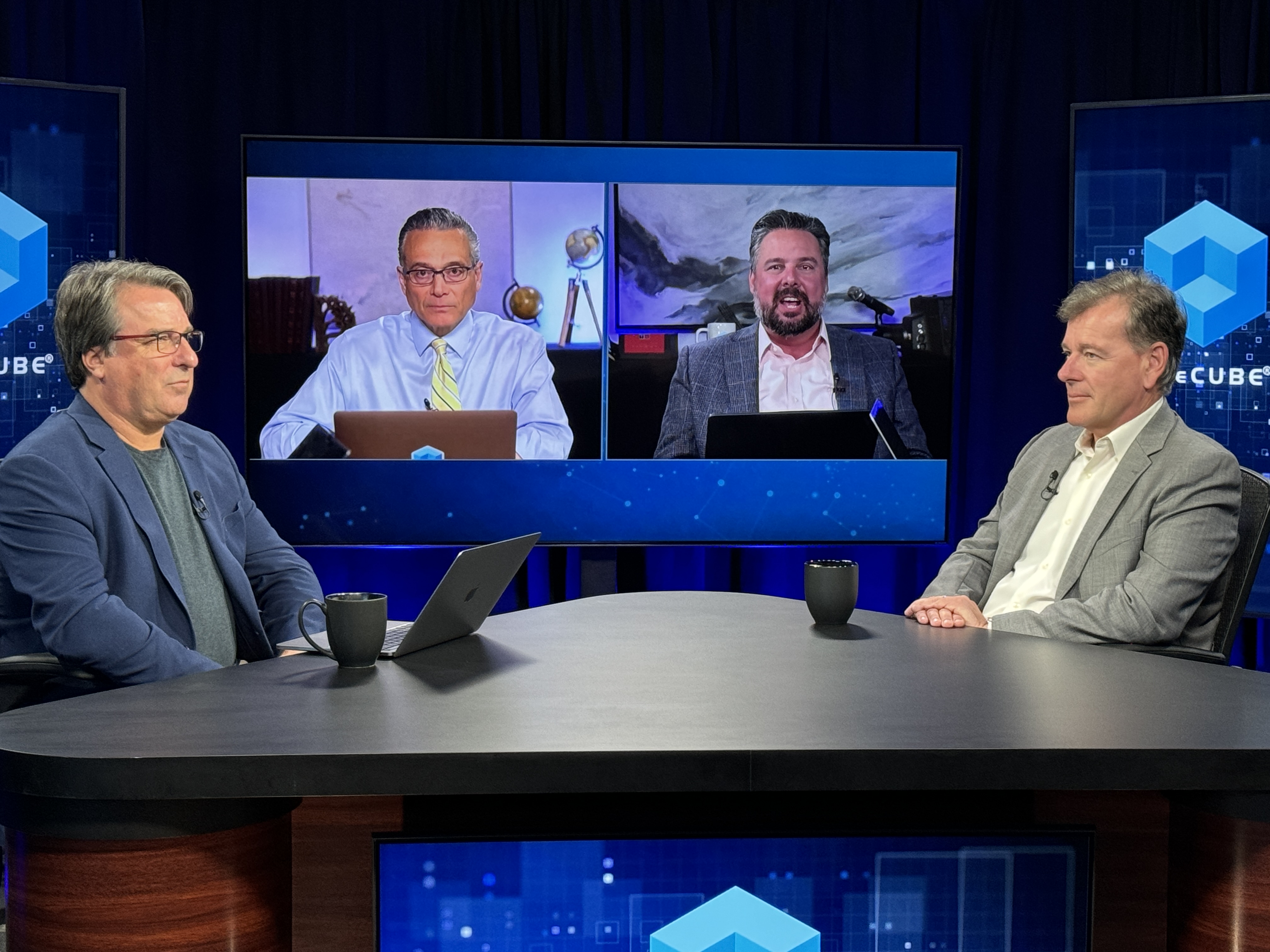
John Furrier, Christophe Bertrand, Dave Vellante, and Rob Strechay discuss VMware's Cloud Foundation Transform Program under Broadcom. They focus on partner reorganization, product integration, and the importance of AI in private cloud innovation. The team highlights budget allocation for gen AI projects, evaluation barriers, and infrastructure scalability for new AI applications. They emphasize the role of partners in leveraging proprietary data for competitive advantage in the AI landscape. With the launch of VCF 5.2, new capabilities to scale, automate, and run applications align with market trends towards SaaS. VCF 5.2 signifies a new era in AI infrastructure, enabled by unified licensing and governance considerations. The focus on applications as core business logic signifies a shift towards systems of agency driven by data and AI technologies. The upcoming VMware Explore event is expected to showcase partnerships and advancements in AI applications, highlighting innovation and growth in the industry.
Forgot Password
Almost there!
We just sent you a verification email. Please verify your account to gain access to
VMware Cloud Foundation Transformed: A New Era of Private Cloud Innovation and Value. If you don’t think you received an email check your
spam folder.
Sign in to VMware Cloud Foundation Transformed: A New Era of Private Cloud Innovation and Value.
In order to sign in, enter the email address you used to registered for the event. Once completed, you will receive an email with a verification link. Open this link to automatically sign into the site.
Register For VMware Cloud Foundation Transformed: A New Era of Private Cloud Innovation and Value
Please fill out the information below. You will recieve an email with a verification link confirming your registration. Click the link to automatically sign into the site.
You’re almost there!
We just sent you a verification email. Please click the verification button in the email. Once your email address is verified, you will have full access to all event content for VMware Cloud Foundation Transformed: A New Era of Private Cloud Innovation and Value.
Thanks for confirming your account. Now you can access VMware Cloud Foundation Transformed: A New Era of Private Cloud Innovation and Value with this email address.
I want my badge and interests to be visible to all attendees.
Checking this box will display your presense on the attendees list, view your profile and allow other attendees to contact you via 1-1 chat. Read the Privacy Policy. At any time, you can choose to disable this preference.
Select your Interests!
add
Upload your photo
Uploading..
OR
Connect via Twitter
Connect via Linkedin
EDIT PASSWORD
Share
Forgot Password
Almost there!
We just sent you a verification email. Please verify your account to gain access to
VMware Cloud Foundation Transformed: A New Era of Private Cloud Innovation and Value. If you don’t think you received an email check your
spam folder.
Sign in to VMware Cloud Foundation Transformed: A New Era of Private Cloud Innovation and Value.
In order to sign in, enter the email address you used to registered for the event. Once completed, you will receive an email with a verification link. Open this link to automatically sign into the site.
Sign in to gain access to VMware Cloud Foundation Transformed: A New Era of Private Cloud Innovation and Value
Please sign in with LinkedIn to continue to VMware Cloud Foundation Transformed: A New Era of Private Cloud Innovation and Value. Signing in with LinkedIn ensures a professional environment.
Are you sure you want to remove access rights for this user?
Details
Manage Access
email address
Community Invitation
AnalystANGLE | theCUBE Round Table
Join theCUBE Research analysts John Furrier, Dave Vellante, Rob Strechay and Christophe Bertrand for an in-depth discussion on VMware's Cloud Foundation’s transformation. They dive into the current state and future of VMware following the Broadcom acquisition. The conversation explores the integration of VMware Cloud Foundation with Broadcom's programs, changes in licensing and the impact on cloud service partners and end users. The analysts also discuss the strategic focus on private AI, Kubernetes integration and the evolving partner ecosystem.
>> Hello, welcome to the special CUBE presentation. I'm John Furrier, host of theCUBE here with a special AnalystANGLE with theCUBE Research for VMware's Cloud Foundation Transform Program. It's a new era in private cloud innovation and value. We're here with Christophe Bertrand in studio at Palo Alto with me. And coming in remotely from our Boston studio, Dave Vellante and Rob Strechay with theCUBE Research to really unpack the State of the Union with the VMware Cloud Foundation and what it means for Broadcom, now VMware, as they transform their company and bring new value to the market. Gents, great to see you, guys. Thanks for coming into theCUBE remotely. Good to see you.>> Hey, John.>> Hey there.
John Furrier
>> Christophe.
John Furrier
>> All right. So let's get into it, guys. Christophe, we were chatting before we came on. We've been talking about this power law for years. We're going to get into that in a second, but let's set the table. VMware's trotting out all their top execs. The moment in time happening right now is that VMware, now part of Broadcom, has kind of cleared the runway a little bit. A little bumpy on the runway to get everything together in the acquisition. Broadcom, a 10:1 stock split. Everyone's kind of high-fiving each other certainly on the VMware side, they joined the right team. The semiconductor business is booming. But VMware's transitioning. And the smoke is starting to clear a little bit now. And guys, I want to get into this now because there's a new table being set with VMware. What's your take right now as you see it today?
John Furrier
>> Well, I think it's very three-fold, right? The first one is I think on the partner side, they have clearly reorganized themselves, looked at adopting the Broadcom program, cleaned up a bunch of complex licensing questions for both end users and cloud service partners. So I think that's really very powerful. On the product side, I think the big challenge and the big opportunity is integration not only internally between the various components of VCF but also externally. And that's going to be absolutely key to the ecosystem. And then obviously gen AI and AI, right? Big topic and they certainly have a great card to play if they can deliver on this integration.
John Furrier
>> I want to get into the technology side of it. We had the CTO come on. We had the ecosystem partner go-to market come on, talk about the partnerships. We also had the president, Paul Turner, come on. And so you got kind of an infrastructure managed the workloads kind of vibe of VMware, but they had a lot of static with the partnerships. So they had a lot of, I would say, problems with canceling and rebooting their channel, their partner. They changed it from partner connection to Broadcom Advantage. We heard that from the executive. What's your take on this? Is it going to be clearer and cleaner? What's your evaluation of the whole partner network?
John Furrier
>> Well, obviously time will tell, but certainly they're making the right moves. There's no question about this. When you give a partner's visibility of other margins, you are doing something right. That's the first point. The other part is really there is an opportunity here for value add for different types of partners, whether they're resellers, whether they're cloud service providers. I think what I've heard is really Broadcom, VMware, is not trying to get into those added value services because they want to leave them to the partners. And I think that's very smart. So again, time will tell, but it looks like all of the components are in place. It's time to move forward. And let's see what they can do.
John Furrier
>> Guys, Dave and Rob, I want to get into the private AI in a second, but I want to first unpack is Broadcom sitting the table properly? The channel piece looks good, looks like they're putting some visibility and distribution is going to be providing support. We heard that from them. Clearly, they're really clean on how to make money. I like that. I think they're doing a good job cleaning. It's definitely not the old VMware, it's the new VMware under Broadcom. But Rob, we had Paul Turner on, he's the chief product officer. Kubernetes was a big part of this whole, "I'm going to run everything, automate everything." What do you think about the current situation on VMware's VCF approach for private cloud?
John Furrier
>> Well, I think they needed to make a lot of those changes to bring everything together. And I think as they made the licensing changes, Kubernetes used to be, I wouldn't say second class citizen, but it used to be a plugin on top of what is now VCF, bringing it in as a first class citizen being part of it, managing everything the same, same observability, same workflow. Being able to do the clusters at scale definitely gives them a better play. Also, I think some of the stuff that was announced around upgradability and being able to do that at scale is pretty impressive about what Paul was talking about and some of the keys to operating really these massive infrastructures in an efficient way. And I think that was clear coming from Paul.
John Furrier
>> Chris came on, talked about the State of the Union, addressed some of the licensing issues. Guys, I want to ask the question around the viability of the news. They talk about portability. Is private cloud going to be a thing? And for VCF, that's the big question. VCF, clearly a strategy they're taking around this new market, distributed computing, edge, on-premise cloud, cloud operations. But the big bet is that the enterprises will adopt VCF private cloud. So that's the big question. If it does, they have a winning product, good strategy, what's your take?
John Furrier
>> So I mean VMware Cloud Foundation was always the underpinning of on-prem cloud. And so now as we move to training outside of the cloud, can it be the underpinning of private AI, AI on-prem? And that's the strategy. And I think it's going to come down to understanding the customer adoption barriers, and we certainly have some data on that that we can share, removing those barriers and then laying out a roadmap and executing on that roadmap such that customers can train and ultimately run these models with inference both on-prem and at the edge. And that's the strategy. I think it's a clean strategy. It's simplified the licensing model, so that makes sense. Leaving enough meat in the bone for the partners and now it's game on.
John Furrier
>> Christophe, clearly they want to go after the top 2,000 customers or less, but that one VCF that might be viable, are you happy with some of the things that they've introduced, portability and other things? Does that hang together?
John Furrier
>> Yes, it does. I mean, look at the variability that's going to happen in those environments. You have to be able to be very flexible as an end user. One end user will not look like the next one, so you need to really be able to go with the flow. And you also need to be able to do this at scale, which I think we cannot say enough times at scale. It's really about this capability. And also, Rob, I think, brought up a very good point around Kubernetes. I think this is embrace it, run with it, make it an equal partner. And I think that's exactly what they need to do. Now at the same time as we think about adoption of gen AI and AI sort of use cases, it's going to be about quick wins. And I really liked the messaging around that. There are still some, I think lots of questions around the economics of early AI implementations, so we'll definitely have to keep an eye on that.
John Furrier
>> Rob, what's your take on the channel approach with VCF as it looks at trying to refresh VCF's go-to-market strategy to support the portfolio and the partner ambitions? I mean, they're putting support mechanisms closer to the resellers and VARs, the distribution's going to monetize that and hopefully be closer to the front lines. Will there be an enabled market for VCF? How do you see that?
John Furrier
>> Yeah, I liked where they were talking about how they're going to bring that transparency as kind of Christophe brought up that you understand where your gross margins are going to come from, you know how it's going to be applied, you can use that money in whichever way you want to from a marketing or sales enablement or what have you, as long as you have those capabilities to go and execute on it. I think like you said, being able to do and handle first level support at the distribution level, that's something that VMware had actually pioneered many years, probably almost a decade back. I think it was just not done in a consistent manner. And I think that's the name of the game with the Broadcom Advantage program is really they're bringing consistency to everybody. I think they're leveling the playing field for everybody. I actually found it very interesting that I think the CSPs are going to actually play a bigger role in this as they go forward and not a smaller role. Like everybody was really worried when they started going to go into AWS and Google and Azure, which they're still going to be there in a little bit, slightly different manner, but it's the same stack everywhere. And the CSPs and the new CSP program under the Broadcom Advantage, I think really will level the playing field for those CSPs and allow them to grow in different ways and differentiate on top of that platform.
John Furrier
>> Ahmar Mohammed, vice president and partners was very clear. He laid out the targets, OEMs, hyperscalers, CSPs and resellers, VARs, with distributors providing the support to the front lines. Very clear. I mean, this is not like the old fast and loose just sprawling organic VMware ecosystem that grew over the past decade and a half. This is kind of a very focused, and the mechanics are clear under the money making. So it looks like it's set up nicely. The real question is, is there enough meat in the bone to provide services around VSVCF for the partners? Because the real story here that we're bearing the lead on is private AI is the application. We're talking about AI, generative AI is the new application workload that VMware wants to manage under the cover. So the question to really squint through this is to say, "Does VCF really provide the system and the platform for those generative AI applications?" So guys, what's your take on this? Christophe, what's your opinion? We talked before you came on camera that this is the number one question.
John Furrier
>> Absolutely. Well, it's early stages, so I think the focus on quick wins is going to be key. I really like that approach. The reality is end users have to demonstrate that it works, that it is actually something that's not a crazy cost center. And when you think about the optimization that VCF wants to bring to the table using partial GPUs and allowing you to go from small to big, I think that's exactly the right approach. Now in time, I do believe that it will really allow a new set of ecosystem partners to go build on those new applications for lack of a better term, and bring really more AI into those larger enterprises. So it's going to be interesting to see, it's going to change the ecosystem.
John Furrier
>> Absolutely. Rob put out a great paper, research paper on private AI that VMware is showcasing in this. Dave Vellante, Chris Wolf came on theCUBE and talked about private AI on Supercloud and they've been presenting to that in the marketplace. And early days, I won't say they were laughed at, but people, "Oh, there's really no strategy there." Turns out they made the good call. And I want to walk through this because we were riffing in the end of 2022 about the power law and we were seeing it early because we were kind of playing with RAG at that time with our data. So it was clear to us that there was going to be a diversity of language models and ultimately different multimodal foundation models, which actually is playing out now. So we got the research right, but we published it in 2023. Let's pull that up. I want you to give your take because I think the real question about private AI is, it's legit, it's now a category. And actually everyone's talking about. In fact, Databricks's CEO was showcasing on their event small language models, which is essentially what we've been seeing with special models. Take us through the power law and let's discuss why this is pointing to private AI being a winning strategy.
John Furrier
>> Well, the whole idea of the power law, and John, you're the first one who really brought this to my attention, and we applied the notion of a power law to gen AI, and the idea is that there's an inverse relationship between the size of the model and the model specificity. So the size of the model here is on the vertical axis and the model specificity in the horizontal where the industry is going to be applying their own data, their own proprietary data to create competitive advantage. When we talk about, is there enough meat in the bone for the partners, this is where I think partners really have to think about shifting their business models because, look, VMware is not going to be the data expert, but there's tons of opportunity for partners to really help customers identify that proprietary data, how to leverage that data and make it specific for their industry, and then really make the AI sing beyond what is just co-generation and customer support. Some of those quick wins that Christophe was talking about, that's great. Hit some singles, generate some cash flow and some gain sharing, and then really drive unique competitive advantage along that horizontal axis. That's really what the power law suggests.
John Furrier
>> I want to bring Rob and Christophe in here because, one, that's the obvious thing about, "Hey, the data is proprietary. It's your intellectual property. You don't want to leave." We get that. Everyone's talking about that. But generative AI applications, Christophe and Rob, it's beyond just that. It's not just data processing in a silo, it's integrating data. So let's get into that piece right now and discuss why this power law is more important than just saying private AI is just good for your data on premise. There's actually the application of the generative AI workloads. What's your take on this, guys?
John Furrier
>> Yeah, I mean I'll jump in. When you start to look at how you bring this to bear and what use cases are being actually generated and solved for, people have been all over the map. And we will have some data on that as well. And when I did the report on examining the VMware private AI foundation with NVIDIA vision and you started to look at how they were approaching this, this is a lot of where organizations, be it CSPs, be it those VARs and SIs, will be able to generate revenue. It's one of the places. And also, VMware's not getting rid of a lot of the other use cases that they've built on VCF over the years in their CSP market and allowing people to iterate and innovate on top of that platform. From what I see is that, again, a lot of people want to bring the AI to the data versus the other way around still. And that really, again, drives home a private AI strategy or a private cloud strategy as well.
John Furrier
>> Christophe, let's get into the stack because at the end of the day, the bet here is that private AI will work, the data points to it being a category. The model, the power law shows that it's relevant. When you look at the stack, VCF isn't just vSphere. So VMware is well known for managing workloads virtualization. We went through that era. The next era of VMware's future is going to be around, how do you manage more GPUs? What's the workload management if the workload is generative AI? Not just private AI, it's all generative AI. The stack has to hang together, networking, storage, compute, all there. That's the big bet here in the stack.
John Furrier
>> Right. It is. But at the same time, think about the other dimension we haven't covered. One of the areas maybe we should talk about a little bit more in this context, which is compliance and governance. I mean, the private cloud approach and private AI is really also a way to secure your IP. You don't want to give your IP away to your competitors. You want to actually use this as a competitive advantage. And you may need, in many cases, to run this on your own premises for all sorts of reasons. In other cases, you may want to go run your AI model somewhere else in a cloud or through a CSP, whatever the case may be. So I think we're looking at is this hybrid distributed AI or gen AI model that I think could emerge from having the flexibility with the integrated stack. Again, I'll go back to what I said earlier, integration is going to be everything on this one.
John Furrier
>> Yeah, guys, this is the situation. They're cleaning up the contracts, the channel. VCF is targeted clearly at private cloud innovation. Private AI is a category, that's the entry point. Where it goes from here is going to be dependent upon what customers think. So Dave, you've got data on this. What's actually happening in the marketplace when it comes down to when the rubber meets the road, what are customers thinking? Where are we? What does the data show? What's the analysis?
John Furrier
>> Yeah, if we could bring up the data that we have on the customer survey from our partners ETR, it's in the field right now. And so this is a survey of more than 1,200 IT decision makers, 25% of them said they're not in production yet. Those that are in production or doing things like you said, code generation, customer support, content marketing, we're starting to see some IT support trickle in and collaboration. But this 313 here said that they've got barriers to putting gen AI into production. So they're still in the evaluation stage. You can see that's the huge percentage here, but what are the big barriers? Just like Christophe was saying, data privacy, security concerns, legal, compliance, regulatory concerns. And Rob, this is the first time we've seen lack of budget really pop in. It's up to now 20%. We know from the other surveys that 42% of the customers tell us that there's stealing from other budgets to fund gen AI. So it's important, again, back to Christophe's notion of hitting small wins, quick wins, hitting singles, but they've got to really start to show that return and they need something like private AI that they can trust so they can build the infrastructure around that so they know that their data is not leaking into the LLM vendor or to competitors. And that's really the foundation for going beyond the current chatty gen AI applications.
John Furrier
>> That's great analysis. I think that points to the activity. One, bifurcation of budgets. That's kind of happening and cleaning up. People are investing in gen AI projects that are going to drive the future. And the private AI shows the compliance, Christophe, that compliance, privacy, legal is holding things up. Guys, bifurcation of budgets, we're seeing budgets being approved for gen AI. Maybe some tests. We've seen that on the data. But look at the bottleneck there. We're evaluating. And the next thing is governance privacy, which we just talked about. What needs to happen with VCF and the market to break this logjam, if you will, We call it a logjam. Mainly it's more of a... I won't say blocker, but it's just evolution.
John Furrier
>> I was talking to a large bank the other day and they said... You know the old saying, "Move fast and break things?" They said, "We got to move fast, but we can't break things." So they need infrastructure that they don't have to worry about and take away that heavy lifting. And they can't break things, so they got to be able to trust it. And so that's why there's so many companies are still in the evaluation phase, but I think by the second half really into Q4, we're going to start to see really substantive use cases hitting the enterprise, starting to throw off enough cash so that we can gain share, enough ROI, big enough ROI so that we can invest in future AI projects.
John Furrier
>> Rob, you did your white paper and research report on this. The use cases show the low hanging fruit is not risky. Are there new projects coming in beyond the whole chatbots and age and stuff? And how do you see their ability to execute with this transition to evaluate and break that governance, crack the code on governance?
John Furrier
>> Yeah. And I think a lot of people were getting real. And again, it spiked in production use for marketing and sales collateral has really spiked again. So that actual summarization and being able to build content has really been the driving force. And I think to Dave's point, it's sometimes hard to see the ROI on that that isn't with people or things of that nature and moving people into different areas to work on different things or what have you. I think what has been happening is that people are learning how to work with the AI in these different places, especially in code development. I think code pilots was a low hanging fruit. I think some people took a little step back after the whole Samsung thing where some of their code had leaked out into a public LLM. I think people are retrenched and they get the value out of that to go faster, not break things and be able to bring something to production, but they also want to do it with those guardrails. And I think that to me is where a lot of people have kind of taken a step back and really started to look at, "Okay, how do I bring the right guardrails to my infrastructure and how do I roll that out?"
John Furrier
>> It's interesting you bring that up because the whole hallucination things drove a lot of the fear and paranoia around data leaking. And then that kind of validated the data modeling around the specialty long tail power law. Christophe, you've been covering data for years. You just think data protection turns into cyber resilience. Is there a similar wave happening now where the data products just be called gen Ais, just renaming the same category? And by the way, you can't just bolt things on the old days. So people have to zoom out and they're taking caution right now from the data, but they ultimately have to jump in. And you can't be half-assing gen AI. This is a categorical platform shift. You got to do it right. What's your take on this? And then we'll kick it out to the guys to riff on this because you got to solve the governance problem. You got to solve the data problem, you got to make data available, but it's not yesterday's data processing in the cloud deal.
John Furrier
>> Exactly. And by the same token, I think the data protection processes are changing. So are two things going on. There's AI being used by data protection vendors back to recovery, disaster recovery, et cetera, to automate better, to better protect the whole infrastructure. While the whole infrastructure is now evolving to also include AI-related data. And actually, I expect that it will be a very large amount of extra data being generated when already it's hard enough to know what you have, where it is, and protect it. So I do think that there will be some significant challenges with protecting those, let's call them workloads for lack of a better term, and data products. They're pure AI. In many cases, they're pure IP and they're very valuable. So I expect to see an evolution. I do believe it's a great opportunity, again, for the ecosystem to come in and look at this holistically. Compliance, security, which we haven't talked about much. And of course the protection of data assets, either the original data or the data that's produced and supports those gen AI and AI models in general terms.
John Furrier
>> It's interesting, Dave, how this Gen of AI basically collapses existing categories into one data protection. This that is one big data platform. Rob, same thing's happening on Kubernetes and cloud native. Big part of Paul Turner's conversation is that we're going to automate Kubernetes completely and take that away and make it boring and just part of the fabric with networking and all the software-defined stuff they've had over the years. So cloud native's collapsing. Microservices, we hear Jensen Huang on states saying NIMS and microservices, language NIMS. The whole cloud native piece is part of this two announcement. VCF has to run at scale on premise, cloud and the edge, which VMware already has by the way, with VCF. So how do you see the cloud native, I won't say collapsing, but consolidating to a platform?
John Furrier
>> Yeah, I think again, you and I have been talking about this for a while now around Kubernetes and the fact that Kubernetes really is software. It's 10 years old at this point in time. Again, it's not as old as VMware or doing virtual machines and partitioning and things of that nature. But when you start to look at Kubernetes and how they're building it in, now instead of it being another platform, it's part of the same platform. It's managed the same way. You get the scale that security and it's not complex. I think that complexity and reducing, and everybody wants the easy button with Kubernetes. And I think that this is a good time for them to really jump in on that and bring it together. So I think as Paul had said, this is pretty big stuff for VMware making Kubernetes and containers a first-class citizen in there because that to me is when we've been talking about it, how it should be CloudNativeCon instead of KubeCon. I think this is really jumping the shark here. I think when VMware says it's a first-class citizen and we're going in all in on containers, you got to believe that we're there.
John Furrier
>> If you look at the news and updates on the VCF on 5.2, this launch, all this is a lot of piece parts that actually helps scale, automate and run things faster. This is kind of the VMware's sweet spot, how their core comps is putting these platforms together. Dave, we talk about in theCUBE pod all the time around how the market's changing at the SaaS level and platforms are becoming ecosystems we talk about all the time. The impact here is going to be at the application layer, Dave, because SaaS converts into gen AI applications, which has data completely refactored, I should say, into a fabric neural network, whatever you want to call it. Vectors, tokens. Cloud native consolidates, scales up, automates, runs. So platform engineering becomes now data operations and data engineering. That's going to impact the apps that come out. And we've been watching the SaaS. What's your angle on this? Because if this tsunami, this Cambrian explosion of private AI kicks in, it'll fuel the generative AI global market.
John Furrier
>> Well, I think a couple of things. One is VCF 5.2, you mentioned it, I think it marks a new era in AI infrastructure because of the licensing, the unified licensing. And I think to your point, that enables applications to be built on top of it. I come back to governance, it's the number one barrier to taking things into production, privacy, trusted, legal compliance, governance, but it can be the number one enabler as well. And I think to your question about applications, that's where all the business logic lives. And you really want to unlock that. We're going to go beyond just a simple sort of request and retrieve model, and we're going to get into systems of agency where agents are actually acting on data that lives in applications, that business logic that's going to be harmonized. This is where the value add is for the ecosystem. And you're going to have agents operating on behalf of humans in a trusted manner, and that is the future of AI in the near to midterm.
John Furrier
>> What I love about the generative AI, it's a runtime environment. It assembles, it generates things. Our next Supercloud, we're going to talk about data platform. We tied Uber on. You actually call things the Uber, the enterprise, as a categorical way, how people should think. That involves search, people, places and things. A whole nother rethinking of data. Essentially, they've built their own private cloud innovation and publicly. They have all those tricks in their trade craft at Uber and the enterprises are trying to copy that. I think this is where this goes. So to wrap up, guys, I wanted to go around the horn and get your thoughts on VCF, this launch. And VMware is now part of Broadcom, starting to clear the runway a little bit, the smoke clears. We're seeing the new VMware emerge. What's your take on the new VMware and how does this transform with VCF? We'll start with Christophe. We'll go with you first.
John Furrier
>> Well, you're talking about takeoff, I think. Yeah, the plane has been updated, upgraded. It's got new engines, it's ready to go. I think they're already well down the runway, so let's make sure everything goes well. I think it's going to be a great run for them. It's going to be an interesting journey. And again, integration partners, everything looks good to me.>> Dave, what's your take?
John Furrier
>> Yeah, to me, it's all about the roadmap, right? Now we've got a more focused VMware, thanks to what Broadcom has done. And that's their playbook, is we're going to narrow the focus. We're going to invest. We're going to have an R&D roadmap, we're an engineering company. And that's the key. Stay close to your customers and keep them on that roadmap indefinitely. I mean, it's a durable business. And there's no reason to leave if the investment is there, and that's what customers should be looking for.>> Rob?
John Furrier
>> Yeah, I think that everything and the focus, like Dave was saying, was definitely a key word. I think that also ties back to the partners and their focus on going with partners, not going it alone and really doubling down on that. Especially with when you start to look at... And I'm expecting that we'll hear a lot about this at VMware Explore in a little over a month now, that we'll see a lot about the partners. Not just the CSPs and the hyperscalers, but also around a lot of the OEMs and the VARs and SIs, which will really bring some focus and take people that can build those apps, those mixture of experts, types of agents and AI apps that are more than just gen AI where people want to go, and that's going to help get to what Dave was talking about in driving revenue.
John Furrier
>> Guys, I want to thank you all for coming on. I want to say at SiliconANGLE and CUBE, we love the deep tech analysis. We love to unpack everything... theCUBE research team, you guys have been doing an amazing job of unpacking it and bringing it to life and actually unpacking all the data and actually putting it in context and helping people with their transformations. The content's been great. You guys have been doing some amazing research. And thank you so much for coming on this special program for VMware's Cloud Foundation Transform, because this is the next level. We are there. It's legit. Next level gen AI applications are coming. There are some blockers right now holding things back, this evolution, but you guys are nailing it parallel. Great. Love that data, Dave. And you guys are doing great. Keep up the good work. And thanks to theCUBE Collective out there as well. And our independent third-party friends who contribute to the community, we appreciate you as well. Thanks for coming on and appreciate your time.
>> Hello, welcome to the special CUBE presentation. I'm John Furrier, host of theCUBE here with a special AnalystANGLE with theCUBE Research for VMware's Cloud Foundation Transform Program. It's a new era in private cloud innovation and value. We're here with Christophe Bertrand in studio at Palo Alto with me. And coming in remotely from our Boston studio, Dave Vellante and Rob Strechay with theCUBE Research to really unpack the State of the Union with the VMware Cloud Foundation and what it means for Broadcom, now VMware, as they transform their company and bring new value to the market. Gents, great to see you, guys. Thanks for coming into theCUBE remotely. Good to see you.>> Hey, John.>> Hey there.
John Furrier
>> Christophe.
John Furrier
>> All right. So let's get into it, guys. Christophe, we were chatting before we came on. We've been talking about this power law for years. We're going to get into that in a second, but let's set the table. VMware's trotting out all their top execs. The moment in time happening right now is that VMware, now part of Broadcom, has kind of cleared the runway a little bit. A little bumpy on the runway to get everything together in the acquisition. Broadcom, a 10:1 stock split. Everyone's kind of high-fiving each other certainly on the VMware side, they joined the right team. The semiconductor business is booming. But VMware's transitioning. And the smoke is starting to clear a little bit now. And guys, I want to get into this now because there's a new table being set with VMware. What's your take right now as you see it today?
John Furrier
>> Well, I think it's very three-fold, right? The first one is I think on the partner side, they have clearly reorganized themselves, looked at adopting the Broadcom program, cleaned up a bunch of complex licensing questions for both end users and cloud service partners. So I think that's really very powerful. On the product side, I think the big challenge and the big opportunity is integration not only internally between the various components of VCF but also externally. And that's going to be absolutely key to the ecosystem. And then obviously gen AI and AI, right? Big topic and they certainly have a great card to play if they can deliver on this integration.
John Furrier
>> I want to get into the technology side of it. We had the CTO come on. We had the ecosystem partner go-to market come on, talk about the partnerships. We also had the president, Paul Turner, come on. And so you got kind of an infrastructure managed the workloads kind of vibe of VMware, but they had a lot of static with the partnerships. So they had a lot of, I would say, problems with canceling and rebooting their channel, their partner. They changed it from partner connection to Broadcom Advantage. We heard that from the executive. What's your take on this? Is it going to be clearer and cleaner? What's your evaluation of the whole partner network?
John Furrier
>> Well, obviously time will tell, but certainly they're making the right moves. There's no question about this. When you give a partner's visibility of other margins, you are doing something right. That's the first point. The other part is really there is an opportunity here for value add for different types of partners, whether they're resellers, whether they're cloud service providers. I think what I've heard is really Broadcom, VMware, is not trying to get into those added value services because they want to leave them to the partners. And I think that's very smart. So again, time will tell, but it looks like all of the components are in place. It's time to move forward. And let's see what they can do.
John Furrier
>> Guys, Dave and Rob, I want to get into the private AI in a second, but I want to first unpack is Broadcom sitting the table properly? The channel piece looks good, looks like they're putting some visibility and distribution is going to be providing support. We heard that from them. Clearly, they're really clean on how to make money. I like that. I think they're doing a good job cleaning. It's definitely not the old VMware, it's the new VMware under Broadcom. But Rob, we had Paul Turner on, he's the chief product officer. Kubernetes was a big part of this whole, "I'm going to run everything, automate everything." What do you think about the current situation on VMware's VCF approach for private cloud?
John Furrier
>> Well, I think they needed to make a lot of those changes to bring everything together. And I think as they made the licensing changes, Kubernetes used to be, I wouldn't say second class citizen, but it used to be a plugin on top of what is now VCF, bringing it in as a first class citizen being part of it, managing everything the same, same observability, same workflow. Being able to do the clusters at scale definitely gives them a better play. Also, I think some of the stuff that was announced around upgradability and being able to do that at scale is pretty impressive about what Paul was talking about and some of the keys to operating really these massive infrastructures in an efficient way. And I think that was clear coming from Paul.
John Furrier
>> Chris came on, talked about the State of the Union, addressed some of the licensing issues. Guys, I want to ask the question around the viability of the news. They talk about portability. Is private cloud going to be a thing? And for VCF, that's the big question. VCF, clearly a strategy they're taking around this new market, distributed computing, edge, on-premise cloud, cloud operations. But the big bet is that the enterprises will adopt VCF private cloud. So that's the big question. If it does, they have a winning product, good strategy, what's your take?
John Furrier
>> So I mean VMware Cloud Foundation was always the underpinning of on-prem cloud. And so now as we move to training outside of the cloud, can it be the underpinning of private AI, AI on-prem? And that's the strategy. And I think it's going to come down to understanding the customer adoption barriers, and we certainly have some data on that that we can share, removing those barriers and then laying out a roadmap and executing on that roadmap such that customers can train and ultimately run these models with inference both on-prem and at the edge. And that's the strategy. I think it's a clean strategy. It's simplified the licensing model, so that makes sense. Leaving enough meat in the bone for the partners and now it's game on.
John Furrier
>> Christophe, clearly they want to go after the top 2,000 customers or less, but that one VCF that might be viable, are you happy with some of the things that they've introduced, portability and other things? Does that hang together?
John Furrier
>> Yes, it does. I mean, look at the variability that's going to happen in those environments. You have to be able to be very flexible as an end user. One end user will not look like the next one, so you need to really be able to go with the flow. And you also need to be able to do this at scale, which I think we cannot say enough times at scale. It's really about this capability. And also, Rob, I think, brought up a very good point around Kubernetes. I think this is embrace it, run with it, make it an equal partner. And I think that's exactly what they need to do. Now at the same time as we think about adoption of gen AI and AI sort of use cases, it's going to be about quick wins. And I really liked the messaging around that. There are still some, I think lots of questions around the economics of early AI implementations, so we'll definitely have to keep an eye on that.
John Furrier
>> Rob, what's your take on the channel approach with VCF as it looks at trying to refresh VCF's go-to-market strategy to support the portfolio and the partner ambitions? I mean, they're putting support mechanisms closer to the resellers and VARs, the distribution's going to monetize that and hopefully be closer to the front lines. Will there be an enabled market for VCF? How do you see that?
John Furrier
>> Yeah, I liked where they were talking about how they're going to bring that transparency as kind of Christophe brought up that you understand where your gross margins are going to come from, you know how it's going to be applied, you can use that money in whichever way you want to from a marketing or sales enablement or what have you, as long as you have those capabilities to go and execute on it. I think like you said, being able to do and handle first level support at the distribution level, that's something that VMware had actually pioneered many years, probably almost a decade back. I think it was just not done in a consistent manner. And I think that's the name of the game with the Broadcom Advantage program is really they're bringing consistency to everybody. I think they're leveling the playing field for everybody. I actually found it very interesting that I think the CSPs are going to actually play a bigger role in this as they go forward and not a smaller role. Like everybody was really worried when they started going to go into AWS and Google and Azure, which they're still going to be there in a little bit, slightly different manner, but it's the same stack everywhere. And the CSPs and the new CSP program under the Broadcom Advantage, I think really will level the playing field for those CSPs and allow them to grow in different ways and differentiate on top of that platform.
John Furrier
>> Ahmar Mohammed, vice president and partners was very clear. He laid out the targets, OEMs, hyperscalers, CSPs and resellers, VARs, with distributors providing the support to the front lines. Very clear. I mean, this is not like the old fast and loose just sprawling organic VMware ecosystem that grew over the past decade and a half. This is kind of a very focused, and the mechanics are clear under the money making. So it looks like it's set up nicely. The real question is, is there enough meat in the bone to provide services around VSVCF for the partners? Because the real story here that we're bearing the lead on is private AI is the application. We're talking about AI, generative AI is the new application workload that VMware wants to manage under the cover. So the question to really squint through this is to say, "Does VCF really provide the system and the platform for those generative AI applications?" So guys, what's your take on this? Christophe, what's your opinion? We talked before you came on camera that this is the number one question.
John Furrier
>> Absolutely. Well, it's early stages, so I think the focus on quick wins is going to be key. I really like that approach. The reality is end users have to demonstrate that it works, that it is actually something that's not a crazy cost center. And when you think about the optimization that VCF wants to bring to the table using partial GPUs and allowing you to go from small to big, I think that's exactly the right approach. Now in time, I do believe that it will really allow a new set of ecosystem partners to go build on those new applications for lack of a better term, and bring really more AI into those larger enterprises. So it's going to be interesting to see, it's going to change the ecosystem.
John Furrier
>> Absolutely. Rob put out a great paper, research paper on private AI that VMware is showcasing in this. Dave Vellante, Chris Wolf came on theCUBE and talked about private AI on Supercloud and they've been presenting to that in the marketplace. And early days, I won't say they were laughed at, but people, "Oh, there's really no strategy there." Turns out they made the good call. And I want to walk through this because we were riffing in the end of 2022 about the power law and we were seeing it early because we were kind of playing with RAG at that time with our data. So it was clear to us that there was going to be a diversity of language models and ultimately different multimodal foundation models, which actually is playing out now. So we got the research right, but we published it in 2023. Let's pull that up. I want you to give your take because I think the real question about private AI is, it's legit, it's now a category. And actually everyone's talking about. In fact, Databricks's CEO was showcasing on their event small language models, which is essentially what we've been seeing with special models. Take us through the power law and let's discuss why this is pointing to private AI being a winning strategy.
John Furrier
>> Well, the whole idea of the power law, and John, you're the first one who really brought this to my attention, and we applied the notion of a power law to gen AI, and the idea is that there's an inverse relationship between the size of the model and the model specificity. So the size of the model here is on the vertical axis and the model specificity in the horizontal where the industry is going to be applying their own data, their own proprietary data to create competitive advantage. When we talk about, is there enough meat in the bone for the partners, this is where I think partners really have to think about shifting their business models because, look, VMware is not going to be the data expert, but there's tons of opportunity for partners to really help customers identify that proprietary data, how to leverage that data and make it specific for their industry, and then really make the AI sing beyond what is just co-generation and customer support. Some of those quick wins that Christophe was talking about, that's great. Hit some singles, generate some cash flow and some gain sharing, and then really drive unique competitive advantage along that horizontal axis. That's really what the power law suggests.
John Furrier
>> I want to bring Rob and Christophe in here because, one, that's the obvious thing about, "Hey, the data is proprietary. It's your intellectual property. You don't want to leave." We get that. Everyone's talking about that. But generative AI applications, Christophe and Rob, it's beyond just that. It's not just data processing in a silo, it's integrating data. So let's get into that piece right now and discuss why this power law is more important than just saying private AI is just good for your data on premise. There's actually the application of the generative AI workloads. What's your take on this, guys?
John Furrier
>> Yeah, I mean I'll jump in. When you start to look at how you bring this to bear and what use cases are being actually generated and solved for, people have been all over the map. And we will have some data on that as well. And when I did the report on examining the VMware private AI foundation with NVIDIA vision and you started to look at how they were approaching this, this is a lot of where organizations, be it CSPs, be it those VARs and SIs, will be able to generate revenue. It's one of the places. And also, VMware's not getting rid of a lot of the other use cases that they've built on VCF over the years in their CSP market and allowing people to iterate and innovate on top of that platform. From what I see is that, again, a lot of people want to bring the AI to the data versus the other way around still. And that really, again, drives home a private AI strategy or a private cloud strategy as well.
John Furrier
>> Christophe, let's get into the stack because at the end of the day, the bet here is that private AI will work, the data points to it being a category. The model, the power law shows that it's relevant. When you look at the stack, VCF isn't just vSphere. So VMware is well known for managing workloads virtualization. We went through that era. The next era of VMware's future is going to be around, how do you manage more GPUs? What's the workload management if the workload is generative AI? Not just private AI, it's all generative AI. The stack has to hang together, networking, storage, compute, all there. That's the big bet here in the stack.
John Furrier
>> Right. It is. But at the same time, think about the other dimension we haven't covered. One of the areas maybe we should talk about a little bit more in this context, which is compliance and governance. I mean, the private cloud approach and private AI is really also a way to secure your IP. You don't want to give your IP away to your competitors. You want to actually use this as a competitive advantage. And you may need, in many cases, to run this on your own premises for all sorts of reasons. In other cases, you may want to go run your AI model somewhere else in a cloud or through a CSP, whatever the case may be. So I think we're looking at is this hybrid distributed AI or gen AI model that I think could emerge from having the flexibility with the integrated stack. Again, I'll go back to what I said earlier, integration is going to be everything on this one.
John Furrier
>> Yeah, guys, this is the situation. They're cleaning up the contracts, the channel. VCF is targeted clearly at private cloud innovation. Private AI is a category, that's the entry point. Where it goes from here is going to be dependent upon what customers think. So Dave, you've got data on this. What's actually happening in the marketplace when it comes down to when the rubber meets the road, what are customers thinking? Where are we? What does the data show? What's the analysis?
John Furrier
>> Yeah, if we could bring up the data that we have on the customer survey from our partners ETR, it's in the field right now. And so this is a survey of more than 1,200 IT decision makers, 25% of them said they're not in production yet. Those that are in production or doing things like you said, code generation, customer support, content marketing, we're starting to see some IT support trickle in and collaboration. But this 313 here said that they've got barriers to putting gen AI into production. So they're still in the evaluation stage. You can see that's the huge percentage here, but what are the big barriers? Just like Christophe was saying, data privacy, security concerns, legal, compliance, regulatory concerns. And Rob, this is the first time we've seen lack of budget really pop in. It's up to now 20%. We know from the other surveys that 42% of the customers tell us that there's stealing from other budgets to fund gen AI. So it's important, again, back to Christophe's notion of hitting small wins, quick wins, hitting singles, but they've got to really start to show that return and they need something like private AI that they can trust so they can build the infrastructure around that so they know that their data is not leaking into the LLM vendor or to competitors. And that's really the foundation for going beyond the current chatty gen AI applications.
John Furrier
>> That's great analysis. I think that points to the activity. One, bifurcation of budgets. That's kind of happening and cleaning up. People are investing in gen AI projects that are going to drive the future. And the private AI shows the compliance, Christophe, that compliance, privacy, legal is holding things up. Guys, bifurcation of budgets, we're seeing budgets being approved for gen AI. Maybe some tests. We've seen that on the data. But look at the bottleneck there. We're evaluating. And the next thing is governance privacy, which we just talked about. What needs to happen with VCF and the market to break this logjam, if you will, We call it a logjam. Mainly it's more of a... I won't say blocker, but it's just evolution.
John Furrier
>> I was talking to a large bank the other day and they said... You know the old saying, "Move fast and break things?" They said, "We got to move fast, but we can't break things." So they need infrastructure that they don't have to worry about and take away that heavy lifting. And they can't break things, so they got to be able to trust it. And so that's why there's so many companies are still in the evaluation phase, but I think by the second half really into Q4, we're going to start to see really substantive use cases hitting the enterprise, starting to throw off enough cash so that we can gain share, enough ROI, big enough ROI so that we can invest in future AI projects.
John Furrier
>> Rob, you did your white paper and research report on this. The use cases show the low hanging fruit is not risky. Are there new projects coming in beyond the whole chatbots and age and stuff? And how do you see their ability to execute with this transition to evaluate and break that governance, crack the code on governance?
John Furrier
>> Yeah. And I think a lot of people were getting real. And again, it spiked in production use for marketing and sales collateral has really spiked again. So that actual summarization and being able to build content has really been the driving force. And I think to Dave's point, it's sometimes hard to see the ROI on that that isn't with people or things of that nature and moving people into different areas to work on different things or what have you. I think what has been happening is that people are learning how to work with the AI in these different places, especially in code development. I think code pilots was a low hanging fruit. I think some people took a little step back after the whole Samsung thing where some of their code had leaked out into a public LLM. I think people are retrenched and they get the value out of that to go faster, not break things and be able to bring something to production, but they also want to do it with those guardrails. And I think that to me is where a lot of people have kind of taken a step back and really started to look at, "Okay, how do I bring the right guardrails to my infrastructure and how do I roll that out?"
John Furrier
>> It's interesting you bring that up because the whole hallucination things drove a lot of the fear and paranoia around data leaking. And then that kind of validated the data modeling around the specialty long tail power law. Christophe, you've been covering data for years. You just think data protection turns into cyber resilience. Is there a similar wave happening now where the data products just be called gen Ais, just renaming the same category? And by the way, you can't just bolt things on the old days. So people have to zoom out and they're taking caution right now from the data, but they ultimately have to jump in. And you can't be half-assing gen AI. This is a categorical platform shift. You got to do it right. What's your take on this? And then we'll kick it out to the guys to riff on this because you got to solve the governance problem. You got to solve the data problem, you got to make data available, but it's not yesterday's data processing in the cloud deal.
John Furrier
>> Exactly. And by the same token, I think the data protection processes are changing. So are two things going on. There's AI being used by data protection vendors back to recovery, disaster recovery, et cetera, to automate better, to better protect the whole infrastructure. While the whole infrastructure is now evolving to also include AI-related data. And actually, I expect that it will be a very large amount of extra data being generated when already it's hard enough to know what you have, where it is, and protect it. So I do think that there will be some significant challenges with protecting those, let's call them workloads for lack of a better term, and data products. They're pure AI. In many cases, they're pure IP and they're very valuable. So I expect to see an evolution. I do believe it's a great opportunity, again, for the ecosystem to come in and look at this holistically. Compliance, security, which we haven't talked about much. And of course the protection of data assets, either the original data or the data that's produced and supports those gen AI and AI models in general terms.
John Furrier
>> It's interesting, Dave, how this Gen of AI basically collapses existing categories into one data protection. This that is one big data platform. Rob, same thing's happening on Kubernetes and cloud native. Big part of Paul Turner's conversation is that we're going to automate Kubernetes completely and take that away and make it boring and just part of the fabric with networking and all the software-defined stuff they've had over the years. So cloud native's collapsing. Microservices, we hear Jensen Huang on states saying NIMS and microservices, language NIMS. The whole cloud native piece is part of this two announcement. VCF has to run at scale on premise, cloud and the edge, which VMware already has by the way, with VCF. So how do you see the cloud native, I won't say collapsing, but consolidating to a platform?
John Furrier
>> Yeah, I think again, you and I have been talking about this for a while now around Kubernetes and the fact that Kubernetes really is software. It's 10 years old at this point in time. Again, it's not as old as VMware or doing virtual machines and partitioning and things of that nature. But when you start to look at Kubernetes and how they're building it in, now instead of it being another platform, it's part of the same platform. It's managed the same way. You get the scale that security and it's not complex. I think that complexity and reducing, and everybody wants the easy button with Kubernetes. And I think that this is a good time for them to really jump in on that and bring it together. So I think as Paul had said, this is pretty big stuff for VMware making Kubernetes and containers a first-class citizen in there because that to me is when we've been talking about it, how it should be CloudNativeCon instead of KubeCon. I think this is really jumping the shark here. I think when VMware says it's a first-class citizen and we're going in all in on containers, you got to believe that we're there.
John Furrier
>> If you look at the news and updates on the VCF on 5.2, this launch, all this is a lot of piece parts that actually helps scale, automate and run things faster. This is kind of the VMware's sweet spot, how their core comps is putting these platforms together. Dave, we talk about in theCUBE pod all the time around how the market's changing at the SaaS level and platforms are becoming ecosystems we talk about all the time. The impact here is going to be at the application layer, Dave, because SaaS converts into gen AI applications, which has data completely refactored, I should say, into a fabric neural network, whatever you want to call it. Vectors, tokens. Cloud native consolidates, scales up, automates, runs. So platform engineering becomes now data operations and data engineering. That's going to impact the apps that come out. And we've been watching the SaaS. What's your angle on this? Because if this tsunami, this Cambrian explosion of private AI kicks in, it'll fuel the generative AI global market.
John Furrier
>> Well, I think a couple of things. One is VCF 5.2, you mentioned it, I think it marks a new era in AI infrastructure because of the licensing, the unified licensing. And I think to your point, that enables applications to be built on top of it. I come back to governance, it's the number one barrier to taking things into production, privacy, trusted, legal compliance, governance, but it can be the number one enabler as well. And I think to your question about applications, that's where all the business logic lives. And you really want to unlock that. We're going to go beyond just a simple sort of request and retrieve model, and we're going to get into systems of agency where agents are actually acting on data that lives in applications, that business logic that's going to be harmonized. This is where the value add is for the ecosystem. And you're going to have agents operating on behalf of humans in a trusted manner, and that is the future of AI in the near to midterm.
John Furrier
>> What I love about the generative AI, it's a runtime environment. It assembles, it generates things. Our next Supercloud, we're going to talk about data platform. We tied Uber on. You actually call things the Uber, the enterprise, as a categorical way, how people should think. That involves search, people, places and things. A whole nother rethinking of data. Essentially, they've built their own private cloud innovation and publicly. They have all those tricks in their trade craft at Uber and the enterprises are trying to copy that. I think this is where this goes. So to wrap up, guys, I wanted to go around the horn and get your thoughts on VCF, this launch. And VMware is now part of Broadcom, starting to clear the runway a little bit, the smoke clears. We're seeing the new VMware emerge. What's your take on the new VMware and how does this transform with VCF? We'll start with Christophe. We'll go with you first.
John Furrier
>> Well, you're talking about takeoff, I think. Yeah, the plane has been updated, upgraded. It's got new engines, it's ready to go. I think they're already well down the runway, so let's make sure everything goes well. I think it's going to be a great run for them. It's going to be an interesting journey. And again, integration partners, everything looks good to me.>> Dave, what's your take?
John Furrier
>> Yeah, to me, it's all about the roadmap, right? Now we've got a more focused VMware, thanks to what Broadcom has done. And that's their playbook, is we're going to narrow the focus. We're going to invest. We're going to have an R&D roadmap, we're an engineering company. And that's the key. Stay close to your customers and keep them on that roadmap indefinitely. I mean, it's a durable business. And there's no reason to leave if the investment is there, and that's what customers should be looking for.>> Rob?
John Furrier
>> Yeah, I think that everything and the focus, like Dave was saying, was definitely a key word. I think that also ties back to the partners and their focus on going with partners, not going it alone and really doubling down on that. Especially with when you start to look at... And I'm expecting that we'll hear a lot about this at VMware Explore in a little over a month now, that we'll see a lot about the partners. Not just the CSPs and the hyperscalers, but also around a lot of the OEMs and the VARs and SIs, which will really bring some focus and take people that can build those apps, those mixture of experts, types of agents and AI apps that are more than just gen AI where people want to go, and that's going to help get to what Dave was talking about in driving revenue.
John Furrier
>> Guys, I want to thank you all for coming on. I want to say at SiliconANGLE and CUBE, we love the deep tech analysis. We love to unpack everything... theCUBE research team, you guys have been doing an amazing job of unpacking it and bringing it to life and actually unpacking all the data and actually putting it in context and helping people with their transformations. The content's been great. You guys have been doing some amazing research. And thank you so much for coming on this special program for VMware's Cloud Foundation Transform, because this is the next level. We are there. It's legit. Next level gen AI applications are coming. There are some blockers right now holding things back, this evolution, but you guys are nailing it parallel. Great. Love that data, Dave. And you guys are doing great. Keep up the good work. And thanks to theCUBE Collective out there as well. And our independent third-party friends who contribute to the community, we appreciate you as well. Thanks for coming on and appreciate your time.






 John Furrier