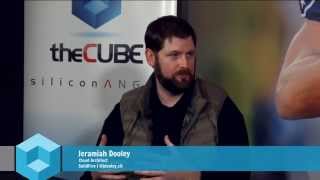
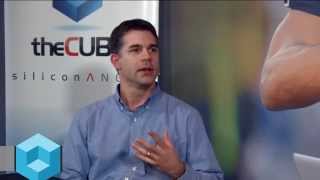
Joe Onisick,Cisco, at VTUG Winter Warmer 2015 with Stu Miniman
@theCUBE
#VTUG
Software-defined networking promises the freedom to provision transport capacity through a consistent programming interface instead of individually configuring the underlying components, but details of how that will translate into practice for the average organization have been relatively scarce.
Joe Onisick of Cisco Systems, Inc. appeared on theCUBE at the seventh annual Virtualization Technology User Group (VTUG) meet-up in Massachusetts last week to try to clear up some of the unresolved questions surrounding the trend, starting with the simplest and most important: the reason behind the need for change.
According to Onisick, the network has fallen behind advancements in other parts of the data center over the last decade or so. While the rise of virtualization has helped greatly streamline server management and mainstream storage platforms increasingly provide comparable level of simplicity in provisioning capacity, practitioners still have get down into the weeds when it comes to handling switches and routers.
That results in a noticeable difference between the amount of time and effort required to manage the network versus the rest of the enterprise stack. “You can spin up virtual machines in a few minutes or seconds while storage pooling enables very quick storage provisioning,” Onisick told theCUBE’s host Stu Miniman, “and then you get down to IP subnets and VLANs and all these other things that we talk about on the network side.”
The goal that the networking industry in general is striving for is a software-defined approach that makes that complexity “disappear,” as Onisick put it, and thereby removes the bottleneck to implementing changes and deploying new services.
Of course, the transition from the current paradigm of manual provisioning to the software-defined networks of the future won’t come easily, but Onisick, who is an engineer himself, doesn’t expect the prospect of automated provisioning and self-aware infrastructure to have nearly as big of an impact on the careers of network admins as some people fear.
“They’re going to have to learn some new skills,” he said. “They’re probably going to want to have some understanding of how APIs drive a product and some understanding of scripting, but this is stuff that they probably already have some exposure to.”
The same applies to the business leaders who ultimately dictate and stand to benefit the most from the new technologies emerging in the networking world. Still, Onisick noted, Cisco is seeing growing adoption for its story at the high levels of the organization.
“Your business has requirements for the applications you’re deploying,” he said. “We take that and translate it automatically into infrastructure provisioning, so you get rid of the layers that happen from human to human, you reduce the risk of error as it gets deployed and you’re able to tie it back up to provide visibility for the top brass,” he said. At the same time, CIOs gain the ability to better compete against the high standard set by cloud providers such as Amazon, which are taking over more and more processes traditionally handled on premise.
“It’s not just that we have to be able to accelerate what we put on the network from the application and network perspective for our own industries but also to keep our users,” Onisick explained. “The whole idea of “shadow IT” is that if I can’t give you something you need fast enough, you’ll find it alone, and then I have no risk and security control over that.” Software-defined networking offers a potential solution.
Forgot Password
Almost there!
We just sent you a verification email. Please verify your account to gain access to
VTUG Winter Warmer 2015. If you don’t think you received an email check your
spam folder.
In order to sign in, enter the email address you used to registered for the event. Once completed, you will receive an email with a verification link. Open this link to automatically sign into the site.
Register For VTUG Winter Warmer 2015
Please fill out the information below. You will recieve an email with a verification link confirming your registration. Click the link to automatically sign into the site.
You’re almost there!
We just sent you a verification email. Please click the verification button in the email. Once your email address is verified, you will have full access to all event content for VTUG Winter Warmer 2015.
I want my badge and interests to be visible to all attendees.
Checking this box will display your presense on the attendees list, view your profile and allow other attendees to contact you via 1-1 chat. Read the Privacy Policy. At any time, you can choose to disable this preference.
Select your Interests!
add
Upload your photo
Uploading..
OR
Connect via Twitter
Connect via Linkedin
EDIT PASSWORD
Share
Forgot Password
Almost there!
We just sent you a verification email. Please verify your account to gain access to
VTUG Winter Warmer 2015. If you don’t think you received an email check your
spam folder.
In order to sign in, enter the email address you used to registered for the event. Once completed, you will receive an email with a verification link. Open this link to automatically sign into the site.
Sign in to gain access to VTUG Winter Warmer 2015
Please sign in with LinkedIn to continue to VTUG Winter Warmer 2015. Signing in with LinkedIn ensures a professional environment.
Are you sure you want to remove access rights for this user?
Details
Manage Access
email address
Community Invitation
Joe Onisick - VTUG Winter Warmer 2015 - theCUBE
Joe Onisick,Cisco, at VTUG Winter Warmer 2015 with Stu Miniman
@theCUBE
#VTUG
Software-defined networking promises the freedom to provision transport capacity through a consistent programming interface instead of individually configuring the underlying components, but details of how that will translate into practice for the average organization have been relatively scarce.
Joe Onisick of Cisco Systems, Inc. appeared on theCUBE at the seventh annual Virtualization Technology User Group (VTUG) meet-up in Massachusetts last week to try to clear up some of the unresolved questions surrounding the trend, starting with the simplest and most important: the reason behind the need for change.
According to Onisick, the network has fallen behind advancements in other parts of the data center over the last decade or so. While the rise of virtualization has helped greatly streamline server management and mainstream storage platforms increasingly provide comparable level of simplicity in provisioning capacity, practitioners still have get down into the weeds when it comes to handling switches and routers.
That results in a noticeable difference between the amount of time and effort required to manage the network versus the rest of the enterprise stack. “You can spin up virtual machines in a few minutes or seconds while storage pooling enables very quick storage provisioning,” Onisick told theCUBE’s host Stu Miniman, “and then you get down to IP subnets and VLANs and all these other things that we talk about on the network side.”
The goal that the networking industry in general is striving for is a software-defined approach that makes that complexity “disappear,” as Onisick put it, and thereby removes the bottleneck to implementing changes and deploying new services.
Of course, the transition from the current paradigm of manual provisioning to the software-defined networks of the future won’t come easily, but Onisick, who is an engineer himself, doesn’t expect the prospect of automated provisioning and self-aware infrastructure to have nearly as big of an impact on the careers of network admins as some people fear.
“They’re going to have to learn some new skills,” he said. “They’re probably going to want to have some understanding of how APIs drive a product and some understanding of scripting, but this is stuff that they probably already have some exposure to.”
The same applies to the business leaders who ultimately dictate and stand to benefit the most from the new technologies emerging in the networking world. Still, Onisick noted, Cisco is seeing growing adoption for its story at the high levels of the organization.
“Your business has requirements for the applications you’re deploying,” he said. “We take that and translate it automatically into infrastructure provisioning, so you get rid of the layers that happen from human to human, you reduce the risk of error as it gets deployed and you’re able to tie it back up to provide visibility for the top brass,” he said. At the same time, CIOs gain the ability to better compete against the high standard set by cloud providers such as Amazon, which are taking over more and more processes traditionally handled on premise.
“It’s not just that we have to be able to accelerate what we put on the network from the application and network perspective for our own industries but also to keep our users,” Onisick explained. “The whole idea of “shadow IT” is that if I can’t give you something you need fast enough, you’ll find it alone, and then I have no risk and security control over that.” Software-defined networking offers a potential solution.