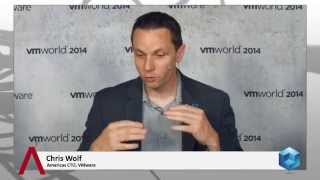
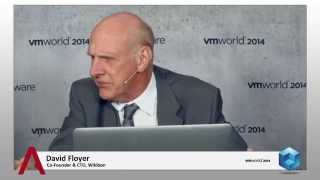
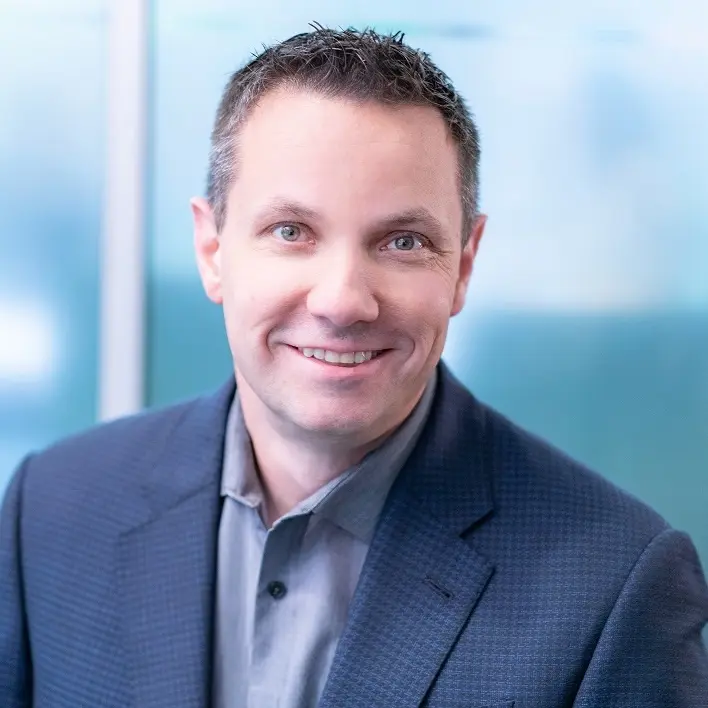
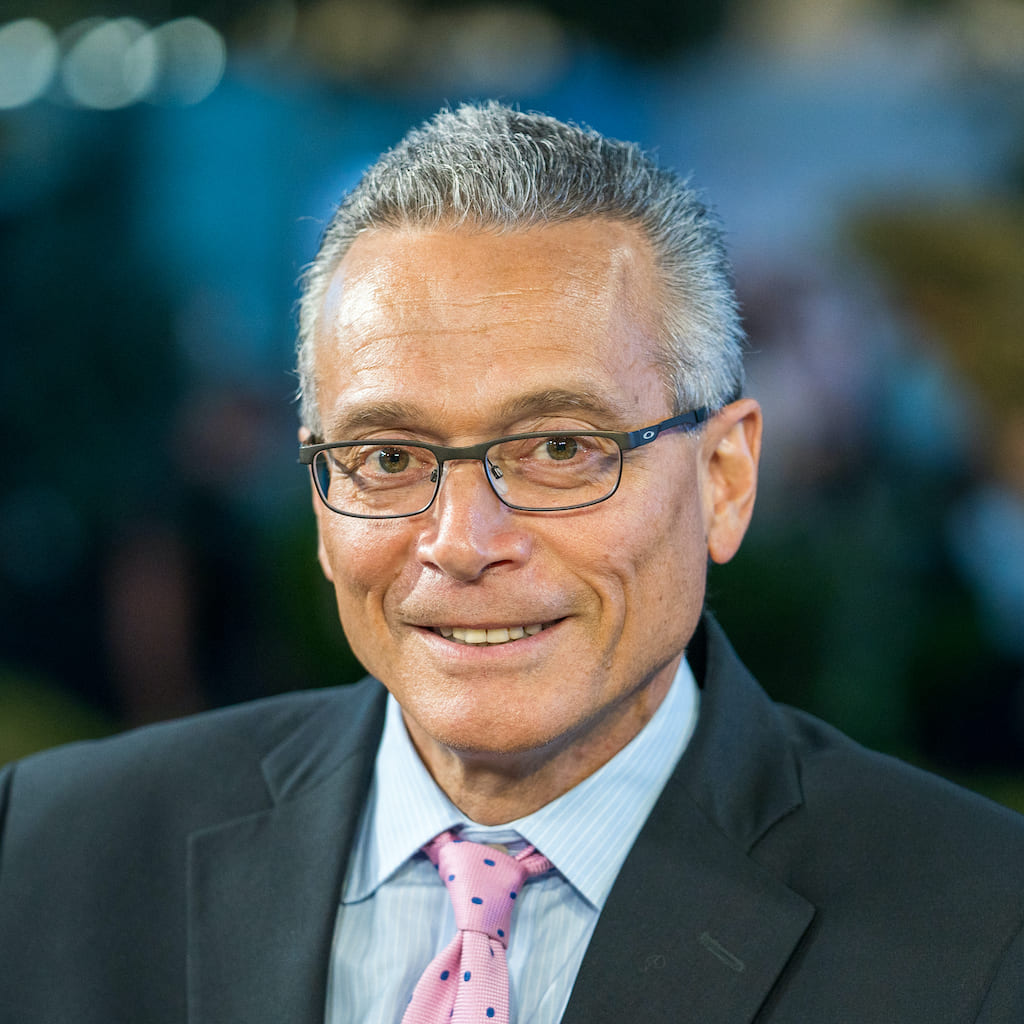
Chris Wolf, VMware, at VMworld 2014 with John Furrier and Dave Vellante
@theCUBE
#vmworld2014
VMware Inc.’s recent foray into the converged infrastructure market is not merely an attempt to gain more control of its ecosystem but part of a broader push to help CIOs retool their operations, according to Chris Wolf, the hypervisor maker’s CTO for the Americas.
Speaking on SiliconANGLE’s theCUBE at the recently concluded VMworld conference in San Francisco, the executive described the move as a continuation of his firm’s efforts to abstract away the messy details of enterprise infrastructure that keep IT organizations from focusing on business objectives.
“Storage provisioning, network provisioning, security provisioning and operational management are commodity tasks in the sense that they’re none-differentiating, you have to do them extremely fast and everyone has to do them,” Wolf told theCUBE hosts John Furrier and Dave Vellante. “I should not be trying to build a custom solution for what is a commodity IT service.”
One building block at a time
VMware’s newly introduced EVO:RAIL appliance offers customers an alternative to cobbling together their environments from scratch in the form of a standardized module that combines servers, storage and networking equipment in a single chassis. The system unifies the individual components under a common management layer Wolf said it’s meant to eliminate much of the manual work that historically had to go into configuring and maintaining data center infrastructure.That consolidated approach offers significant advantages at the organizational level, but for many individual practitioners it also poses a career threat. That can create cultural barriers to the adoption of hyper-converged solutions such as EVO:RAIL, and that’s bad for VMware’s business. But Wolf isn’t too concerned. He believes that reluctant elements in the IT organizations will eventually be forced to adapt because the benefits are so compelling.
“Think about electronics technicians 25 years ago,” he said. “We had folks who were really good at finding bad transistors on a circuit board. If I was still trying to do that level of specialization today, I’d be out of work.”A base to work fromHyper-convergence is the foundation of VMware’s vision for the software-defined data center, which extends beyond the classical definition of a facility where all hardware resources can be consumed as a service to include interoperability with other environments. To that end, the hypervisor maker recently teamed up with Docker Inc. to provide support for the latter’s namesake container engine in its flagship vSphere virtualization platform.
Much like EVO:RAIL, Docker relies on standardization to simplify operations. The software packages applications into consistent and lightweight containers that can be moved across different types of infrastructure with no concern for the underlying clockwork. But according to Wolf, that only works on paper in the enterprise.Docker may make it possible to migrate a workload from a VMware environment to a public cloud, but the management and security capabilities needed to support that workload don’t carry over, he explained. That makes interoperability impractical for mission-critical applications, a pitfall that Wolf said his company is helping to mitigate. “We make the operational stack consistent and multi-provider. Other providers don’t,” he said.
Not putting all the virtual eggs in one basket
Over the last year and a half, Docker has evolved from a side-project at an obscure startup to a major force in the industry, with a fast-growing user base and the endorsement of some of the biggest computing vendors. The project ultimately poses a direct threat to VMware, and Wolf made it clear that that reality hasn’t escaped his company’s attention.
The company’s long-term answer to Docker is Project Fargo, a homegrown technology that he described as similar to the open-source tool but with more management flexibility. The experimental software makes it possible to create copies of a virtual machine without taking it offline and to have those copies share an operating system image with their parent in the same way that multiple containers run on top of a singular kernel. Any changes made to common files within so-called child instances are automatically saved locally.
Forgot Password
Almost there!
We just sent you a verification email. Please verify your account to gain access to
VMworld 2014 | San Francisco. If you don’t think you received an email check your
spam folder.
In order to sign in, enter the email address you used to registered for the event. Once completed, you will receive an email with a verification link. Open this link to automatically sign into the site.
Register For VMworld 2014 | San Francisco
Please fill out the information below. You will recieve an email with a verification link confirming your registration. Click the link to automatically sign into the site.
You’re almost there!
We just sent you a verification email. Please click the verification button in the email. Once your email address is verified, you will have full access to all event content for VMworld 2014 | San Francisco.
I want my badge and interests to be visible to all attendees.
Checking this box will display your presense on the attendees list, view your profile and allow other attendees to contact you via 1-1 chat. Read the Privacy Policy. At any time, you can choose to disable this preference.
Select your Interests!
add
Upload your photo
Uploading..
OR
Connect via Twitter
Connect via Linkedin
EDIT PASSWORD
Share
Forgot Password
Almost there!
We just sent you a verification email. Please verify your account to gain access to
VMworld 2014 | San Francisco. If you don’t think you received an email check your
spam folder.
In order to sign in, enter the email address you used to registered for the event. Once completed, you will receive an email with a verification link. Open this link to automatically sign into the site.
Sign in to gain access to VMworld 2014 | San Francisco
Please sign in with LinkedIn to continue to VMworld 2014 | San Francisco. Signing in with LinkedIn ensures a professional environment.
Are you sure you want to remove access rights for this user?
Details
Manage Access
email address
Community Invitation
Chris Wolf | VMworld 2014
Chris Wolf, VMware, at VMworld 2014 with John Furrier and Dave Vellante
@theCUBE
#vmworld2014
VMware Inc.’s recent foray into the converged infrastructure market is not merely an attempt to gain more control of its ecosystem but part of a broader push to help CIOs retool their operations, according to Chris Wolf, the hypervisor maker’s CTO for the Americas.
Speaking on SiliconANGLE’s theCUBE at the recently concluded VMworld conference in San Francisco, the executive described the move as a continuation of his firm’s efforts to abstract away the messy details of enterprise infrastructure that keep IT organizations from focusing on business objectives.
“Storage provisioning, network provisioning, security provisioning and operational management are commodity tasks in the sense that they’re none-differentiating, you have to do them extremely fast and everyone has to do them,” Wolf told theCUBE hosts John Furrier and Dave Vellante. “I should not be trying to build a custom solution for what is a commodity IT service.”
One building block at a time
VMware’s newly introduced EVO:RAIL appliance offers customers an alternative to cobbling together their environments from scratch in the form of a standardized module that combines servers, storage and networking equipment in a single chassis. The system unifies the individual components under a common management layer Wolf said it’s meant to eliminate much of the manual work that historically had to go into configuring and maintaining data center infrastructure.That consolidated approach offers significant advantages at the organizational level, but for many individual practitioners it also poses a career threat. That can create cultural barriers to the adoption of hyper-converged solutions such as EVO:RAIL, and that’s bad for VMware’s business. But Wolf isn’t too concerned. He believes that reluctant elements in the IT organizations will eventually be forced to adapt because the benefits are so compelling.
“Think about electronics technicians 25 years ago,” he said. “We had folks who were really good at finding bad transistors on a circuit board. If I was still trying to do that level of specialization today, I’d be out of work.”A base to work fromHyper-convergence is the foundation of VMware’s vision for the software-defined data center, which extends beyond the classical definition of a facility where all hardware resources can be consumed as a service to include interoperability with other environments. To that end, the hypervisor maker recently teamed up with Docker Inc. to provide support for the latter’s namesake container engine in its flagship vSphere virtualization platform.
Much like EVO:RAIL, Docker relies on standardization to simplify operations. The software packages applications into consistent and lightweight containers that can be moved across different types of infrastructure with no concern for the underlying clockwork. But according to Wolf, that only works on paper in the enterprise.Docker may make it possible to migrate a workload from a VMware environment to a public cloud, but the management and security capabilities needed to support that workload don’t carry over, he explained. That makes interoperability impractical for mission-critical applications, a pitfall that Wolf said his company is helping to mitigate. “We make the operational stack consistent and multi-provider. Other providers don’t,” he said.
Not putting all the virtual eggs in one basket
Over the last year and a half, Docker has evolved from a side-project at an obscure startup to a major force in the industry, with a fast-growing user base and the endorsement of some of the biggest computing vendors. The project ultimately poses a direct threat to VMware, and Wolf made it clear that that reality hasn’t escaped his company’s attention.
The company’s long-term answer to Docker is Project Fargo, a homegrown technology that he described as similar to the open-source tool but with more management flexibility. The experimental software makes it possible to create copies of a virtual machine without taking it offline and to have those copies share an operating system image with their parent in the same way that multiple containers run on top of a singular kernel. Any changes made to common files within so-called child instances are automatically saved locally.