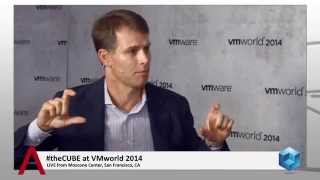
Mark Balch, Cisco, at VMworld 2014 with Stu Miniman.
@theCUBE
#vmworld2014
VMware Inc.’s newly confirmed foray into the burgeoning hyper-convergence space positions it to tap one of the fastest-growing segments of the data center market, but the move has not come without a price. The long-coming introduction of EVO:Rail at VMworld yesterday was met with the revelation that the virtualization top networking partner has allied with a major competitor to ship an integrated system that will rival the freshly introduced appliance.
Under the agreement, Cisco Systems Inc. will act as the server supplier for an upcoming model of SimpliVity Inc.’s OmniCube, a tightly-bundled infrastructure module that combines compute, storage and networking capabilities in a single chassis with a unified management console. The 2U platform is the same size as EVO:Rail and employs the same virtualization solution – VMware’s – but packs a homegrown suite of data services.
Hyper-convergence is defined as “a type of infrastructure system with a software-centric architecture that tightly integrates compute, storage, networking and virtualization resources and other technologies from scratch in a commodity hardware box supported by a single vendor,” according to Whatis.com.
“It’s something that [SimpliVity] decided to drive but we’re very happy because they’re leveraging UCS capabilities, and hyper-convergence is…bigger than any one vendor here at the show today,” said Mark Balch of Cisco’s Unified Computing Systems (UCS) business in an interview on SiliconANGLE’s theCUBE at VMworld (see video below). “We encourage that open ecosystem.”
The new variation is based on the 2-socket C240 machine in Cisco’s UCS C-Series of rack-mount servers. The series also powers the hugely popular Vblocks from VCE, a venture between the networking stalwart and VMware parent company EMC Corp. that sells traditional converged systems without all the management bells and whistles. VCE recently announced that it surpassed the $1 billion revenue mark in 2013, but the lucrative alliance between its top backers has grown tense since VMware’s acquisition of software-defined networking startup Nicira Inc. in 2012.
Yet the buy, which has positioned the virtualization giant as a direct competitor to Cisco, merely introduced an additional dimension to an already complex relationship defined as much by competition as cooperation. The year after VCE was established, Cisco inked a deal with EMC runner-up NetApp Inc. to ship a separate line of converged appliances called FlexPod that continues to compete against Vblock series to this very day.
The agreement between Cisco and SimpliVity adds yet another twist to the complex web of alliances and rivalries that forms the converged infrastructure market. First, it buys the switch maker a ticket into the increasingly lucrative hyper-convergence sub-segment at the expense of further complicating its relationship with the EMC federation, a worthy trade-off by all accounts, especially now that EVO:Rail is in the picture. And second, it eases SimpliVity’s reliance on previously sole server supplier Dell Inc., which partnered with arch-rival Nutanix Inc. back in June and now provides hardware for VMware’s appliance as well.
However, this particular alliance isn’t likely to knock the leaders back on their heels, said Stu Miniman, Principal Research Contributor at Wikibon. “This expands the adoption of converged infrastructure at the lower end,” he said. “It is important for SimpliVity but not strategic for Cisco and it doesn’t disrupt EMC or NetApp.”
“The fact that in just five years, UCS has gone from just starting out to being a platform that SimpliVity chose to base a lot of their strategy on is really very exciting and we’re happy to work with them,” Cisco’s Balch noted.
The emergence of co-opetition as the status quo in the marketplace is contributing to a great deal of confusion, but it’s also enabling more freedom of choice than ever. Vendors are jumping on the bandwagon en masse, with VMware recently adding integration with third-party OpenStack distributions and SimpliVity working on extending hypervisor support beyond the former’s vSphere to Microsoft Corp.’s Hyper-V and the open-source KVM. The company’s plan will give customers more virtualization options and conveniently remove another strategic dependence for management to worry about as it pushes deeper into the EMC federation’s turf.
Forgot Password
Almost there!
We just sent you a verification email. Please verify your account to gain access to
VMworld 2014 | San Francisco. If you don’t think you received an email check your
spam folder.
In order to sign in, enter the email address you used to registered for the event. Once completed, you will receive an email with a verification link. Open this link to automatically sign into the site.
Register For VMworld 2014 | San Francisco
Please fill out the information below. You will recieve an email with a verification link confirming your registration. Click the link to automatically sign into the site.
You’re almost there!
We just sent you a verification email. Please click the verification button in the email. Once your email address is verified, you will have full access to all event content for VMworld 2014 | San Francisco.
I want my badge and interests to be visible to all attendees.
Checking this box will display your presense on the attendees list, view your profile and allow other attendees to contact you via 1-1 chat. Read the Privacy Policy. At any time, you can choose to disable this preference.
Select your Interests!
add
Upload your photo
Uploading..
OR
Connect via Twitter
Connect via Linkedin
EDIT PASSWORD
Share
Forgot Password
Almost there!
We just sent you a verification email. Please verify your account to gain access to
VMworld 2014 | San Francisco. If you don’t think you received an email check your
spam folder.
In order to sign in, enter the email address you used to registered for the event. Once completed, you will receive an email with a verification link. Open this link to automatically sign into the site.
Sign in to gain access to VMworld 2014 | San Francisco
Please sign in with LinkedIn to continue to VMworld 2014 | San Francisco. Signing in with LinkedIn ensures a professional environment.
Are you sure you want to remove access rights for this user?
Details
Manage Access
email address
Community Invitation
Mark Balch | VMworld 2014
Mark Balch, Cisco, at VMworld 2014 with Stu Miniman.
@theCUBE
#vmworld2014
VMware Inc.’s newly confirmed foray into the burgeoning hyper-convergence space positions it to tap one of the fastest-growing segments of the data center market, but the move has not come without a price. The long-coming introduction of EVO:Rail at VMworld yesterday was met with the revelation that the virtualization top networking partner has allied with a major competitor to ship an integrated system that will rival the freshly introduced appliance.
Under the agreement, Cisco Systems Inc. will act as the server supplier for an upcoming model of SimpliVity Inc.’s OmniCube, a tightly-bundled infrastructure module that combines compute, storage and networking capabilities in a single chassis with a unified management console. The 2U platform is the same size as EVO:Rail and employs the same virtualization solution – VMware’s – but packs a homegrown suite of data services.
Hyper-convergence is defined as “a type of infrastructure system with a software-centric architecture that tightly integrates compute, storage, networking and virtualization resources and other technologies from scratch in a commodity hardware box supported by a single vendor,” according to Whatis.com.
“It’s something that [SimpliVity] decided to drive but we’re very happy because they’re leveraging UCS capabilities, and hyper-convergence is…bigger than any one vendor here at the show today,” said Mark Balch of Cisco’s Unified Computing Systems (UCS) business in an interview on SiliconANGLE’s theCUBE at VMworld (see video below). “We encourage that open ecosystem.”
The new variation is based on the 2-socket C240 machine in Cisco’s UCS C-Series of rack-mount servers. The series also powers the hugely popular Vblocks from VCE, a venture between the networking stalwart and VMware parent company EMC Corp. that sells traditional converged systems without all the management bells and whistles. VCE recently announced that it surpassed the $1 billion revenue mark in 2013, but the lucrative alliance between its top backers has grown tense since VMware’s acquisition of software-defined networking startup Nicira Inc. in 2012.
Yet the buy, which has positioned the virtualization giant as a direct competitor to Cisco, merely introduced an additional dimension to an already complex relationship defined as much by competition as cooperation. The year after VCE was established, Cisco inked a deal with EMC runner-up NetApp Inc. to ship a separate line of converged appliances called FlexPod that continues to compete against Vblock series to this very day.
The agreement between Cisco and SimpliVity adds yet another twist to the complex web of alliances and rivalries that forms the converged infrastructure market. First, it buys the switch maker a ticket into the increasingly lucrative hyper-convergence sub-segment at the expense of further complicating its relationship with the EMC federation, a worthy trade-off by all accounts, especially now that EVO:Rail is in the picture. And second, it eases SimpliVity’s reliance on previously sole server supplier Dell Inc., which partnered with arch-rival Nutanix Inc. back in June and now provides hardware for VMware’s appliance as well.
However, this particular alliance isn’t likely to knock the leaders back on their heels, said Stu Miniman, Principal Research Contributor at Wikibon. “This expands the adoption of converged infrastructure at the lower end,” he said. “It is important for SimpliVity but not strategic for Cisco and it doesn’t disrupt EMC or NetApp.”
“The fact that in just five years, UCS has gone from just starting out to being a platform that SimpliVity chose to base a lot of their strategy on is really very exciting and we’re happy to work with them,” Cisco’s Balch noted.
The emergence of co-opetition as the status quo in the marketplace is contributing to a great deal of confusion, but it’s also enabling more freedom of choice than ever. Vendors are jumping on the bandwagon en masse, with VMware recently adding integration with third-party OpenStack distributions and SimpliVity working on extending hypervisor support beyond the former’s vSphere to Microsoft Corp.’s Hyper-V and the open-source KVM. The company’s plan will give customers more virtualization options and conveniently remove another strategic dependence for management to worry about as it pushes deeper into the EMC federation’s turf.